New Delhi: Prime Minister Narendra Modi has flagged-off the Delhi-Faridabad Metro Line that would allow hassle free travel for around two lakh daily commuters between the national capital and the industrial hub in Haryana.
The extension of the Delhi Metro connects Badarpur to Escorts Mujesar in Faridabad.
The total cost of the project from Badarpur to Escorts Mujesar is nearly Rs. 2,500 crore. Out of this, Rs. 1,557 crore was borne by the Haryana Government, the Centre contributed Rs. 537 crore, while the Delhi Metro provided Rs. 400 crore.
All these are elevated and located on either side of the Delhi-Mathura Road (NH-2).
“The nine-station metro corridor which was 95 per cent indigenously built will provide people a safe, affordable, quick, comfortable, reliable, environment-friendly and sustainable transport facility,” a Haryana government spokesperson said.
Haryana Chief Minister ML Khattar, addressing a press conference on Saturday, had thanked the Prime Minister for “gifting” the Metro service which would take the city to “another level of progress” with better connectivity with other NCR towns.
He had also said that the Prime Minister would be announcing the go-ahead for connecting Gurgaon with Faridabad by Metro.
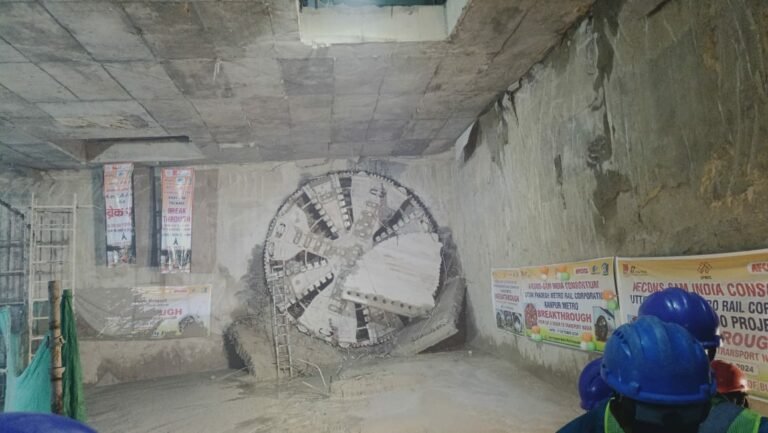
Kanpur (Metro Rail News): Kanpur Metro progressed with the second tunnel breakthrough of Tunnel Boring Machine (TBM) Azad at Transport Nagar Station under package KNPCC-06, which connects Nayaganj Station with the Transport Nagar Ramp. Afcons – Sam India Consortium celebrated the achievement.
TBM Azad (S-640 B)
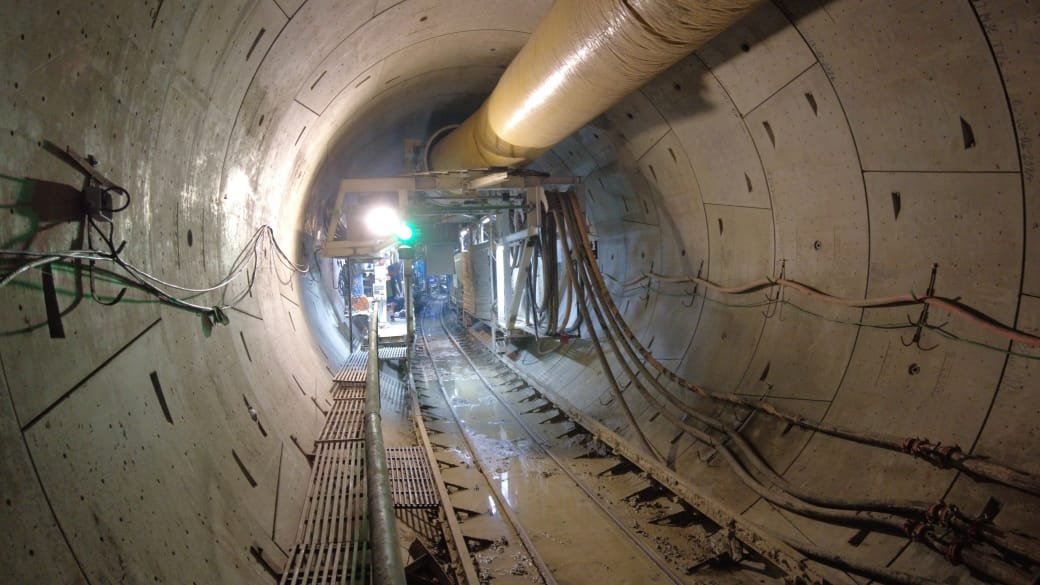
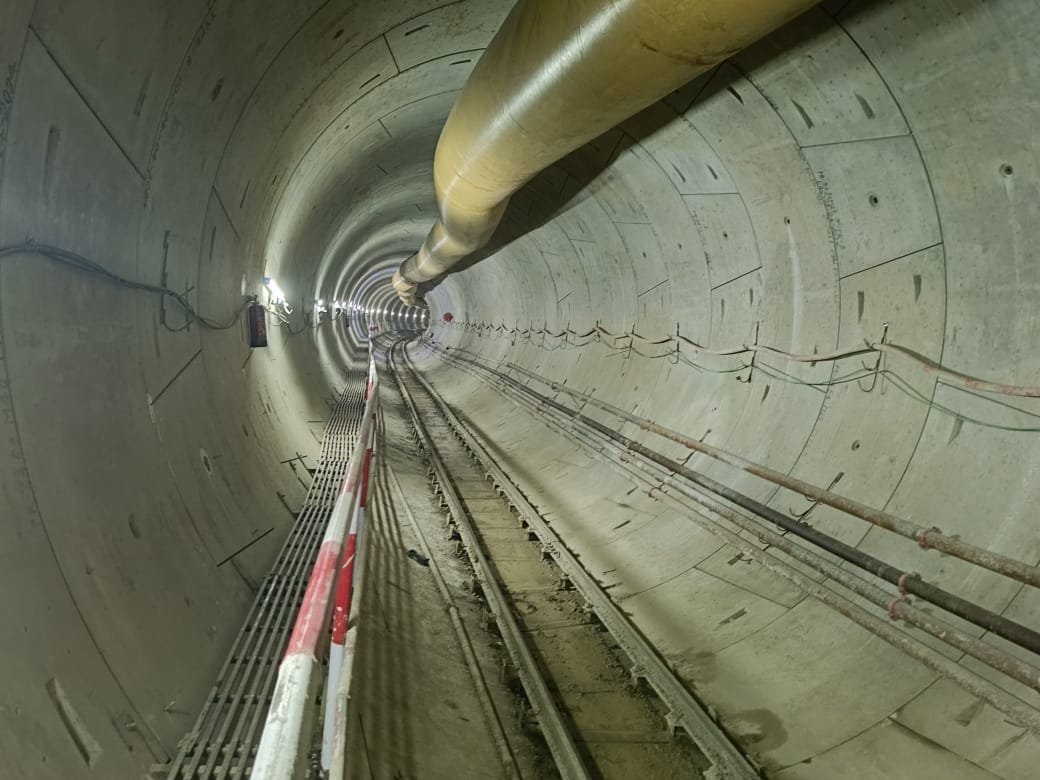
TBM Azad (S-640B) is a Herrenknecht Earth Pressure Balance machine, commissioned in October 2023 as the third tunnel boring machine (TBM) in the Kanpur Metro Phase 1 project. It will construct twin tunnels on package KNPCC-06, which connects Nayaganj Station with the Transport Nagar Ramp on 23.78 km of Line-1 between IIT Kanpur and Naubasta.
photo credit to UPMRC
This is TBM Azad’s second assignment on package KNPCC-06, which will connect Nayaganj to the Transport Nagar Ramp via 3 underground stations –
Kanpur Central
Jhakarkatti
Transport Nagar
The machine took about 92 days to complete its journey after it was put into service in the middle of July.
From Kanpur Central Station towards Nayaganj Station.
Second Assignment
TBM Azad built a 330m tunnel.
From the ramp area at Swadesh Cotton Mills to Transport Nagar Station.
In March 2022, the Uttar Pradesh Metro Rail Corporation (UPMRC) awarded a contract worth Rs. 1087.67 crore to Afcons – SAM JV for a 4.65 km stretch of KNPCC-06. The contract had a 36-month deadline.
Additionally, TBM Vidyarthi (S-639B), was re-commissioned in August on a parallel down-line, from the ramp to Transport Nagar. To construct the final set of twin tunnels leading to Kanpur Central Station, both machines (TBM Azad S-640 B and TBM Vidyarthi S-639B), will be hauled via the station box of Transport Nagar, and build tunnels to Jhakarkatti Staton.
With this change, Afcons-Sam India has now achieved 3 out of 8 breakthroughs. The first two took place in March and June of 2024 at Nayaganj Station.
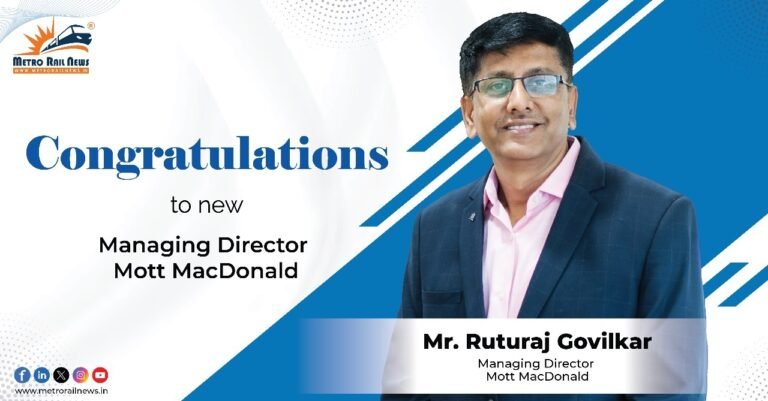
Ruturaj Govilkar has been appointed as the managing director of Mott MacDonald’s South Asia business.
Ruturaj will be the charge of enhancing the consultancy’s capacity to provide important clients with advisory projects and strategic infrastructure. He replaces Ashley Taylor, who will remain managing director of Mott MacDonald’s global design centre.
Mr Govilkar’s Work experience
Previously, he served as a manager director for India at Black & Veatch. With more than 32 years of experience in the engineering and construction sector, he brings an enormous amount of knowledge to the role.
Ruturaj Govilkar said: “South Asia including India, is witnessing huge investments, offering multiple growth opportunities. As multinational firms expand their operations in the region, we are seeing a growing demand for high-quality project management consultancy, advisory and engineering design expertise. Our team at Mott MacDonald combines technical know-how with a laser focus on social impact and I am looking forward to working closely with them as we build on the solid foundations that Ashley has set out.”
In Praise of Ruturaj Govilkar
Doug Wilson, Mott MacDonald’s regional managing director for international development, South Asia, Middle East and Africa at Mott MacDonald said: “I am delighted to appoint someone of Ruturaj’s calibre to this position. His outstanding track record in building business in South Asia, as well as his expertise and insight into operations, will be invaluable as we continue to expand our services for our diverse range of clients. I want to thank Ashley for her tireless commitment to transforming the South Asia business over the past year and look forward to seeing our global design centre go from strength to strength under her leadership.”
Mott MacDonald’s overview
With over 20,000 employees spread across 50 countries, Mott MacDonald is an employee-owned engineering, development, and management consultant. Infrastructure that is essential to people’s everyday lives, such as buildings, energy, transportation, and water, is planned, designed, built, and maintained by us. Delivering transformative outcomes for our customers and the communities they serve is our unwavering commitment. Our primary strength is overcoming obstacles with unsurpassed technical skills and digital innovation.
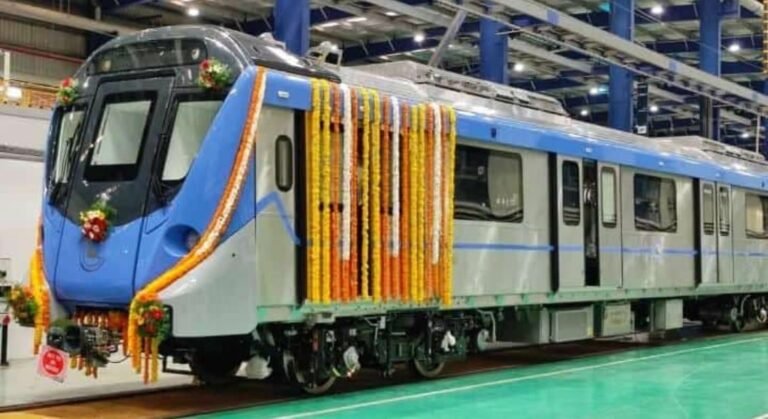
Metro Rail News: The first Metropolis metro train for the Chennai Metro Phase II has been delivered by Alstom (a global leader in smart and sustainable mobility), from its top-notch production facility in Sricity, Andhra Pradesh.
Chennai metro
These driverless Metropolis cars are part of the ‘Make in India’ and ‘Atmanirbhar Bharat’ initiatives. Intended to run at 80 kmph and reach a safe speed of 90 kmph.
When production was finished, the mock-up automobile was unveiled in front of dignitaries from the Tamil Nadu government, CMRL, and Alstom during an event held at Alstom’s Sri City site on September 22, 2024.
Olivier Loison, Managing Director of Alstom India shared his views on this momentous milestone,
“Chennai Metro has become a beacon of efficient and reliable transportation, transforming daily commutes for its residents. We are proud to support this vision by delivering world-class, made-in-India driverless metro trains that not only elevate the commuter experience but also drive sustainable mobility by reducing emissions and easing road congestion. As India’s trusted partner in advancing sustainable transportation, Alstom is committed to strengthening this partnership and reshaping Chennai’s mass transit landscape for a greener future”
Production on this innovation, which already began in February 2024, is scheduled to produce 36 trains, each with three cars. The 26 km corridor of Chennai Metro Phase 2, connects Poonamallee Bypass to Light House via 28 stations—18 elevated and 10 underground.
Salient Features of driverless trainset:
The project costs a high value of 124 million euros and also involves operation and maintenance training for Chennai Metro staff. These metro trains are built and engineered to operate automatically.
Unattended Train Operations (UTO)
Grade of automation level 4 (GOA 4)
Automatic Train Operation (ATO)
Automatic Train Protection (ATP)
Chennai commuters will have an effective, eco-friendly, and comfortable metro option with these trains because of the regenerative braking mechanism, which ensures significant energy savings. These Metropolis trains are being manufactured at the Sri City (Andhra Pradesh) manufacturing facility and were entirely developed in Bangalore, Karnataka, as part of the “Make in India” project.
Alstom’s Contribution to Chennai Metro
In 2010, Alstom supplied 208 metro cars for the Chennai Metro’s phase as it was the first contract by Chennai Metro Rail Limited (CMRL). In addition, 45 kilometres of track have been designed, tested, and put into service by Alstom along these corridors.
Alstom is further demonstrating its dedication to changing Chennai’s transportation environment and advancing the city’s transition to a more sustainable and interconnected future with the delivery of the first trainset of Chennai Metro Phase II.
Alstom’s Metropolis Metro
For almost 60 years, Alstom’s contemporary metro trains have been meeting the various needs of passengers all around the world. Metropolis metro trains are built to match new and old infrastructure and may be customized to meet various capacity requirements. Alstom Metros come in a variety of configurations ranging from 2 to 9 cars, small to large gauge profiles, various voltage systems, and customizable interior designs. They can be driven manually or autonomously. Metropolis metros have minimal environmental impact due to their high recycling rates, low noise levels, and optimized energy efficiency. In more than 70 cities across 40 nations, more than 35,000 metro cars have been ordered or are now in use.
Key Facts About Alstom
Alstom pledges to help create low-carbon futures through developing and advocating eco-friendly transportation options.
Alstom offers its varied clients the widest range of products and services in the industry, from high-speed trains, metros, monorails, and trams to complete systems, services, infrastructure, signalling, and digital mobility.
The company concentrates its design, innovation, and project management talents where mobility solutions are most needed thanks to its presence in 64 countries and talent pool of over 84,700 individuals from 184 nationalities.
Alstom, which is listed in France, generated €17.6 billion in sales during the fiscal year that ended March 31, 2024.
Alstom in India
Alstom is the sole global provider of sustainable mobility in India. Associated with the nation’s “Rail Revolution,” Alstom is a vital ally in bolstering India’s freight and passenger transportation revolutions.
The corporation serves numerous worldwide projects in addition to meeting the needs of domestic ones due to its six industrial locations and five significant engineering centres. Alstom has been at the forefront of implementing various ground-breaking innovations in India with world-class rolling stock, rail equipment & infrastructure, signalling, and services, supporting the government’s modernization plans.
Fully in line with the nation’s Make-in-India and Aatmanirbhar Bharat initiatives, Alstom is steadfastly dedicated to enhancing its local sourcing practices.
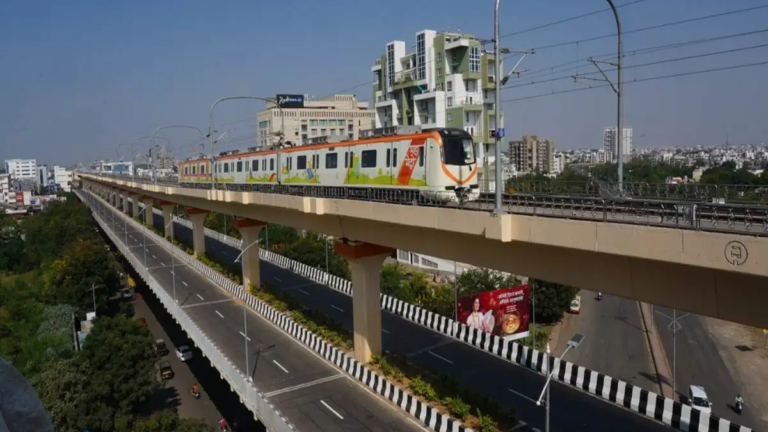
Pune (Metro Rail News): For the Phase 1 Extension (Phase 1A) project of Pune Metro, STUP Consultants – RITES JV awarded a contract worth Rs. 2.92 crore to provide Detailed Design Consultant (DDC) services.
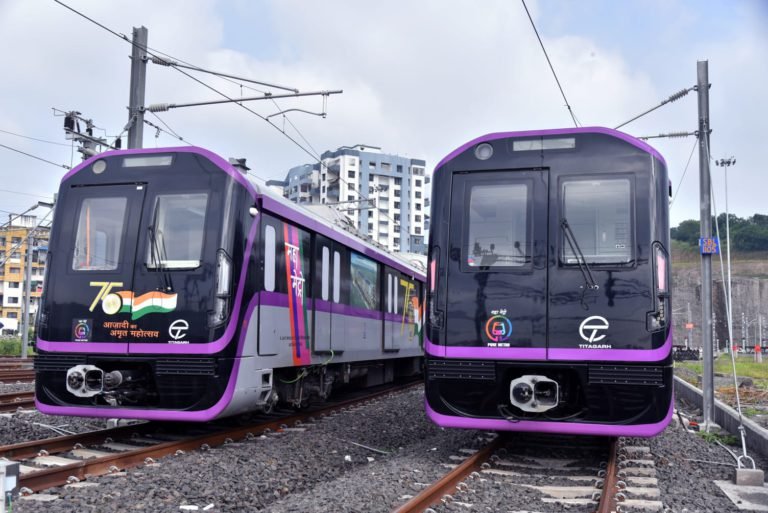
Pune metro
In March 2024, the Maharashtra state government approved the construction of the extensions, at an estimated cost of Rs. 3756.58 crore.
Package DDC-03 (Pune Metro phase 1A)
For Package DDC-03, STUP RITES JV is responsible for designing 13 additional elevated stations on Pune Metro’s Aqua Line (Line-2), which will be expanded in both directions.
Western extension Vanaz – Chandni Chowk : (1.12 km, 2 stations )
Kothrud Bus Depot
Chandni Chowk
Map of Pune metro
Work description
Maha-metro describes the work scope for Package DDC-03, Detailed Design Consultancy Services for 11 (eleven) elevated stations in Line 2B-Ramwadi to Wagholi and for 2 (two) elevated stations in Line 2A-Vanaz to Chandni Chowk, excluding Viaduct in station parts of Pune Metro Rail Project.
The responsibilities of STUP – RITES JV will encompass the creation and submission of substitute designs for all civil, architectural, building services, electrical, and mechanical projects.
In July 2023, MahaMetro invited bids for Package DDC-03, which has a 4-year contract period and an estimated cost of Rs. 2.36 crore. Out of 3 bidders, 2 bidders were found to be qualified and one was disqualified.
STUP – RITES JV ( L1)
SYSTRA MVA Consulting (India)
With this accomplishment, Maha-Metro has completed the composition of its three DDCs project for the Phase 1 Extension. The other two projects will be carried out upon the extension of the Purple Line.
Package
Scope
Firms
DDC-01
Detailed Design Consultant for 3 elevated stations at Chinchwad, Akurdi and Nigdi
LKT Engineering
DDC-02 R
Detailed Design Consultant for architectural and E&M Services and proof checking of Swargate to Katraj corridor
PINI Group
DDC-03 (current )
Includes designing 13 new elevated stations on Pune Metro’s Aqua Line which will be extended in both directions.
STUP – RITES JV
Hence, Pune Metro Extension Phase 1 A is under construction and has been witnessing major achievements and is expected to be completed by 2029.
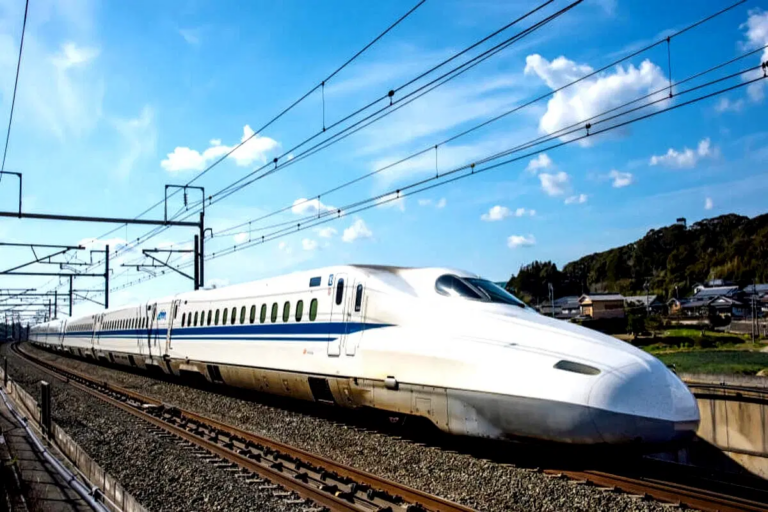
BEML Ltd. has secured a Rs. 866.87 crore contract from Integral Coach Factory (ICF) to supply two high-speed train sets for the 508 km Bullet train project from Mumbai to Ahmedabad.
ICF floated a tender for the 2 train-set contract on 5 September. Technical bids were opened on 19 September, revealing that BEML was the only firm to bid for the contract, making it the lowest bidder.
BEML will be collaborating with Medha Servo Drives for the development of propulsion systems in the 2 prototype trains.
Train specifications:
The prototype train set will comprise 8 coaches, and each coach will be manufactured at an estimated cost of 27.86 crore.
These 2 train sets will be designed for standard gauge tracks and manufactured at the Bengaluru rail coach complex, which is situated in CV Raman Nagar.
These train sets will be engineered to operate at a maximum speed of 280 km/h and an average speed of 250 km/h. They will be fully air-conditioned with reclining and rotatable seats.
As per the tender notice, the prototype train sets will be designed to operate with the European Train Control System (ETCS) Level 2 signalling system.
The tender notice clearly states that the trials for the prototype trains will be conducted on the Surat-Bilimora section of the Bullet train.
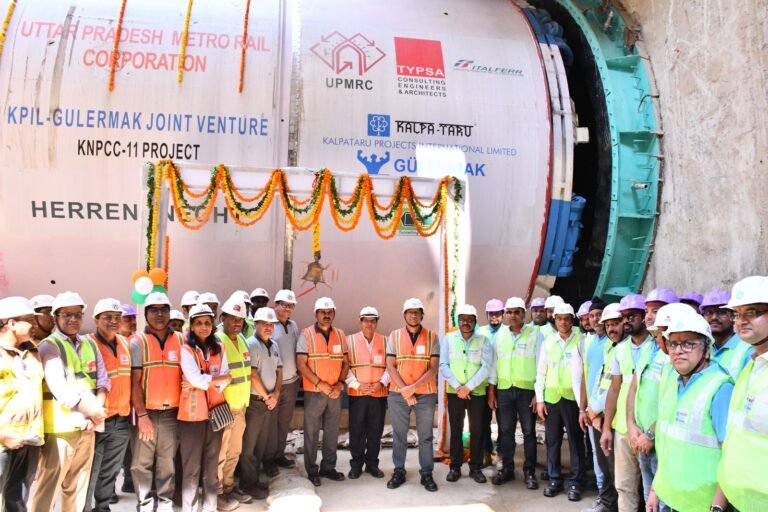
Kanpur (Metro Rail News): Kalpataru Projects International Ltd. (KPIL) – Gulermak deployed their first TBM S-1408A at Rawatpur station of Kanpur Metro’s Line 2 spanning 8.38 km from agriculture university to Barra 8 under package KNPCC-11 on 15 October.
TBM S-1408A
TBM S-1408A, nicknamed TBM Gomati, is the first of two TBM machines for the underground Package KNPCC-11, which connects the Agriculture Depot to the Double Pullia Ramp.
TBM Gomati is the fifth TBM to be deployed for constructing the 32.385 km Kanpur Metro Phase 1 project’s underground twin tunnels.
TBM Gomati will complete the following Assignments for Line 2 of Kanpur Metro:
First assignment
Rawatpur station – ramp at Agricultural University
622m Tunnel
Second assignment
Rawatpur station- Kakadeo station
772m Tunnel.
Third assignment
Kakadeo Station -Double Pullia Station
1005m Tunnel
Package KNPCC-11
KPIL – Gulermak JV secured Rs. 762.50 crore package KNPCC-11 from Uttar Pradesh Metro Rail Corporation (UPMRC) for Line 2’s underground section from Agriculture Depot to Double Pullia Ramp spanning 4.08 km in December 2023 with a 30 months deadline.
Package KNPCC-11’s scope of work includes the construction of twin tunnels from the Agriculture Depot to the Double Pullia Ramp and 3 underground stations.
Nagpur (Metro Rail News): Rail Vikas Nigam Ltd. (RVNL) has emerged as the lowest bidder to construct the civil package C6 of the 43.8 km long Nagpur Metro Phase 2 project.
Contract C-06 (Nagpur Metro phase 2)
This contract covers the construction of 10 elevated metro stations on the new 6.6 km (Reach 3A) and 5.5 km (Reach 4A) western and eastern extensions of the 19.4 km Aqua Line.
Reach 3A (Lokmanya Nagar to Hingna) consists of 7 elevated stations
Hingna Mount View
Rajiv Nagar
Wanadongri
APMC
Raipur
Hingna Bus Station
Hingna.
Reach 4A (Prajapati Square to Transport Nagar) consists of 3 stations
Pardi
Kapsi Khurd
Transport Nagar
Bidding process
In January 2024, Maha-Metro invited bids for constructing all 10 stations, with an estimated cost of Rs. 307.34 crore and a duration of 900 days.
2 bidders submitted the bids :
RVNL (Rs. 255 crore)
YFC Projects and BBG Infrastructure JV (disqualified)
RVNL’s bid of Rs. 255 crore was significantly less than Maha-Metro’s estimate of Rs. 307.34 crore. A contract should be issued in the upcoming weeks without a drawn-out financial bid evaluation process.
Nagpur-metro-Rail
So far, RVNL has secured 4 major achievements in Phase 2 including:
Package C-01 (the 6.92 km viaduct in Reach 2A)
Package C-05 (the eight stations and viaduct in Reach 1A & 2A)
Package C-08 (6 stations on Reach 2B)
Package C-06 ( 10 elevated stations on Reach 3A and Reach 4A)
Moreover, Nagpur Metro Phase 2 is currently under construction and is expected to be completed by 2026. Asian Development Bank (ADB) will finance Nagpur Metro Phase 2 with a USD 200 million (about Rs. 1678 crore) loan that was authorised in July 2024.
Furthermore, an additional loan of €210.72 million, or around Rs. 1943 crore, is presently under evaluation by the European Investment Bank (EIB).
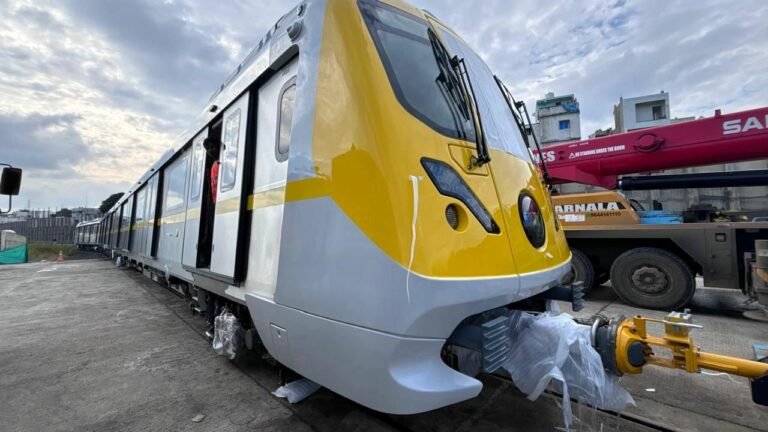
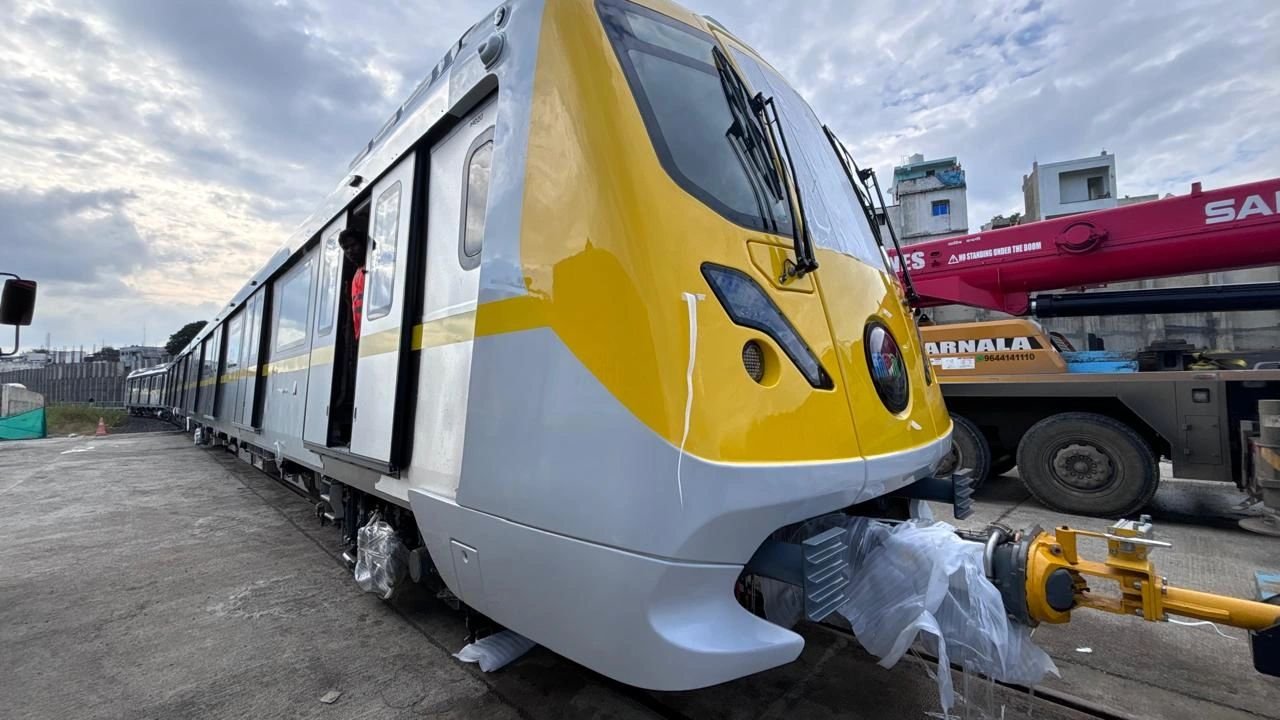
Indore ( Metro Rail News): The 9th Rolling Stock (a 3-car train set) was added to the fleet of 8 existing train sets of Indore Metro at the Gandhi Nagar Depot of the 33.53-long Yellow Line. Additionally, the authority has been conducting night trials over super over the super-priority corridor from Gandhi Nagar to Super Corridor 3 for its successful operations.
9th Rolling Stock to the Indore Metro
S Krishna Chaitanya, MD of Madhya Pradesh Metro Rail Corporation Limited ( MPMRCL) congratulated the entire team, as the city’s fast transit project moves closer to its objective, the ninth set of rolling stock for the Yellow Line of the Indore Metro has arrived and been successfully unloaded at the Gandhi Nagar Depot. Three train sets now total six at Indore Metro. Two more sets came in September after the safe arrival of a new three-car set in August.
MPMRCL has awarded Alstom India the rolling stock contract with a total cost of Rs.3,248 crore. The firm is responsible for supplying train sets to both Indore and Bhopal metro under one package- BH-IN-02. As per the package details, Alstom will provide 25 train sets (75 Coaches) to Indore metro and 27 Train sets (81 coaches) to Bhopal metro. Out of 25 train sets, Indore Metro has been finalised with 9 rolling stocks and 27 coaches so far.
The company’s facility in Baroda is producing these innovative coaches that are recognized worldwide. The company will maintain these coaches for 15 years in addition to providing the communication-based train control signalling system. Additionally, Stockholm, Singapore, and London are also served by the same company’s coaches.
Indore Metro Commencing Night Trials
Mr Shobhit Tandon, Director (System) Madhya Pradesh Metro Rail Corporation Limited, stated
“We are operating the train during night hours so that its functioning can be checked properly. The commercial run of the train over the priority corridor is expected soon”
To make sure there are no problems with the train once the commercial run begins, the Madhya Pradesh Metro Rail Corporation has begun a nightly trial run of the metro for 4 to 5 from Gandhi Nagar to Super Corridor 3 over the super-priority corridor.
Cause of trials
The metro’s signalling system is being examined to fix any glitches or bugs during this trial run.
The train will run both automatically and by the operator. The officials stated that although the train operates automatically, it would initially be controlled by a human operator to ensure safety and inconvenience.
At each station and even halfway through, different signals are installed to gauge the train’s speed and braking capability. The train is signalled to accelerate, decelerate, stop, and so on.
Indore Metro’s status
The Indore Metro is currently under development and not operated yet. The Madhya Pradesh Metro Rail Co Limited (MPMRCL) is building this Mass Rapid Transit System (MRTS) to serve the state’s largest and most populous city, Indore.
Indore Metro is still under construction up to Khajrana Square. The elevated corridor connecting Gandhi Nagar to Radisson Square is almost finished, and girder launching will take place over the corridor until Khajrana Square. Additionally, the number of stations has expanded, and escalators and elevators have been added at numerous corridor stations.
There isn’t much work left once the Gandhi Nagar station is finished. Likewise, the Metro Control Center has been established to ensure appropriate management and functioning of the train.
Vijay Nagar Metro Station ( huge metro station )
The Metro Corporation has requested property to build a sizable metro station at Vijay Nagar Square. This will require some land from the Vijay Nagar bus stand on the one side and land from the Vijay Nagar police station on the other. As a result, the police station will be moved and destroyed. The administration has been asked to provide the police department with around 6 acres of property in exchange.
Pune (Metro Rail News): The Pune Metro project advanced as the Maharashtra government cabinet approved the Detailed Project Report (DPR) of 31.64 Km Pune Metro Phase 2 on 14 October 2024. The approved DPR will now be sent for central government approval. Phase 2 is expected to cost around Rs. 9,897.19 crore.
On 4 October, Maha-Metro invited bids for the appointment of a general consultant for the Pune metro phase 2 Project.
Pune Metro Phase 2’s Approved Lines
Line 5
Khadakwasla station – Kharadi station
25.518 km
Elevated
Total no. of station: 22
Line 5 extension
Nal Stop station – Manik Bagh station
6.118 km
Elevated
Total no.of stations:6
Line 5 Stations:
Khadakwasla
Dalvewadi
Nanded City
Dhayari Phata
Manik Baug
Hingane Chowk
Rajaram Bridge
Deshpande Udyan
Dandekar Pul
Swargate North
Seven Loves Chowk
PCB
Race Course
Fatima Nagar
Ramtekdi
Hadapsar
Magarpatta South
Magarpatta Main
Magarpatta North
Hadapsar Railway Station
Sainath Nagar
Kharadi Chowk
Line 5 Extension Stations:
Paud Phata
Karve Putla
Dhunkar Colony
Karve Nagar
Warje
Daulat Nagar
The DPR will be evaluated by various ministries, including the Ministry of Housing and Urban Affairs (MoHUA) and the Ministry of Finance (MoF). After a thorough review, it will be recommended for final approval by the Central Government’s Cabinet. This step is essential for securing funding and advancing the project towards implementation.
Thane (Metro Rail News): This week marked the official beginning of geotechnical sub-soil study work by Renuka Consultants at Hiranandani Estate for the 29-kilometer Thane Metro project, which has 2 underground and 20 elevated stations circling the city.
This site is located next to Vijay Orovia Phase 1 towers in Hiranandani Estate off of Waghbil Road.
In August 2024, the Central Government’s cabinet authorised the Thane Metro project, which is expected to cost around Rs. 12,200 crore. The metro is expected to be operational by 2029.
A few days ago, India’s Prime Minister Narendra Modi laid the foundation stone for Thane Metro. The findings of Renuka’s study Thane Metro, would aid in accurately establishing the final alignment of Thane Metro’s ring line.
Furthermore, the outcomes will be incorporated into the civil construction tender documents to assist infrastructure firms in submitting more sophisticated financial bids and utilising the proper tools, techniques, and technologies while building.
Additionally, Maha-Metro updated its website, added Thane Metro’s new logo, and made a new X handle recently to update all its work systematically.
Overview of Thane metro
The 26-kilometre elevated Thane Metro route, which has 20 stations, and the 3-kilometre underground twin tunnel segment, which has two underground stations, would encircle the city. Passenger interchanges would be available along the line to the Thane Station of Central Railways, the 32.32 km Line-4 (Green Line) of Mumbai Metro, and the 24.9 km Line-5 (Orange Line).
Thane Metro’s progress
STUP Consultants in September was declared as the lowest bidder for the initial Detailed Design Consultant (DDC) contract for the line, which covered 6 stations:
Dr. Kashinath Ghanekar Natyagraha
Manpada
Dongripada
Vijay Nagari
Waghbil
Waterfront
As per the current rate of advancement of the Thane Metro project, the publication of the first civil tender notice for station construction in Q2 2025.
Before that, a tender notice for building an elevated viaduct connecting these stations by the end of 2024 should appear, as Maha-Metro tends to divide civil work into two distinct packages for viaduct and station works.