New Delhi: Prime Minister Narendra Modi has flagged-off the Delhi-Faridabad Metro Line that would allow hassle free travel for around two lakh daily commuters between the national capital and the industrial hub in Haryana.
The extension of the Delhi Metro connects Badarpur to Escorts Mujesar in Faridabad.
The total cost of the project from Badarpur to Escorts Mujesar is nearly Rs. 2,500 crore. Out of this, Rs. 1,557 crore was borne by the Haryana Government, the Centre contributed Rs. 537 crore, while the Delhi Metro provided Rs. 400 crore.
All these are elevated and located on either side of the Delhi-Mathura Road (NH-2).
“The nine-station metro corridor which was 95 per cent indigenously built will provide people a safe, affordable, quick, comfortable, reliable, environment-friendly and sustainable transport facility,” a Haryana government spokesperson said.
Haryana Chief Minister ML Khattar, addressing a press conference on Saturday, had thanked the Prime Minister for “gifting” the Metro service which would take the city to “another level of progress” with better connectivity with other NCR towns.
He had also said that the Prime Minister would be announcing the go-ahead for connecting Gurgaon with Faridabad by Metro.
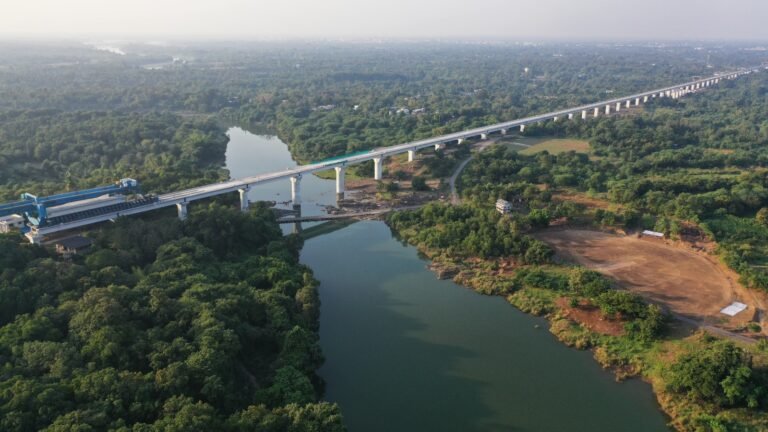
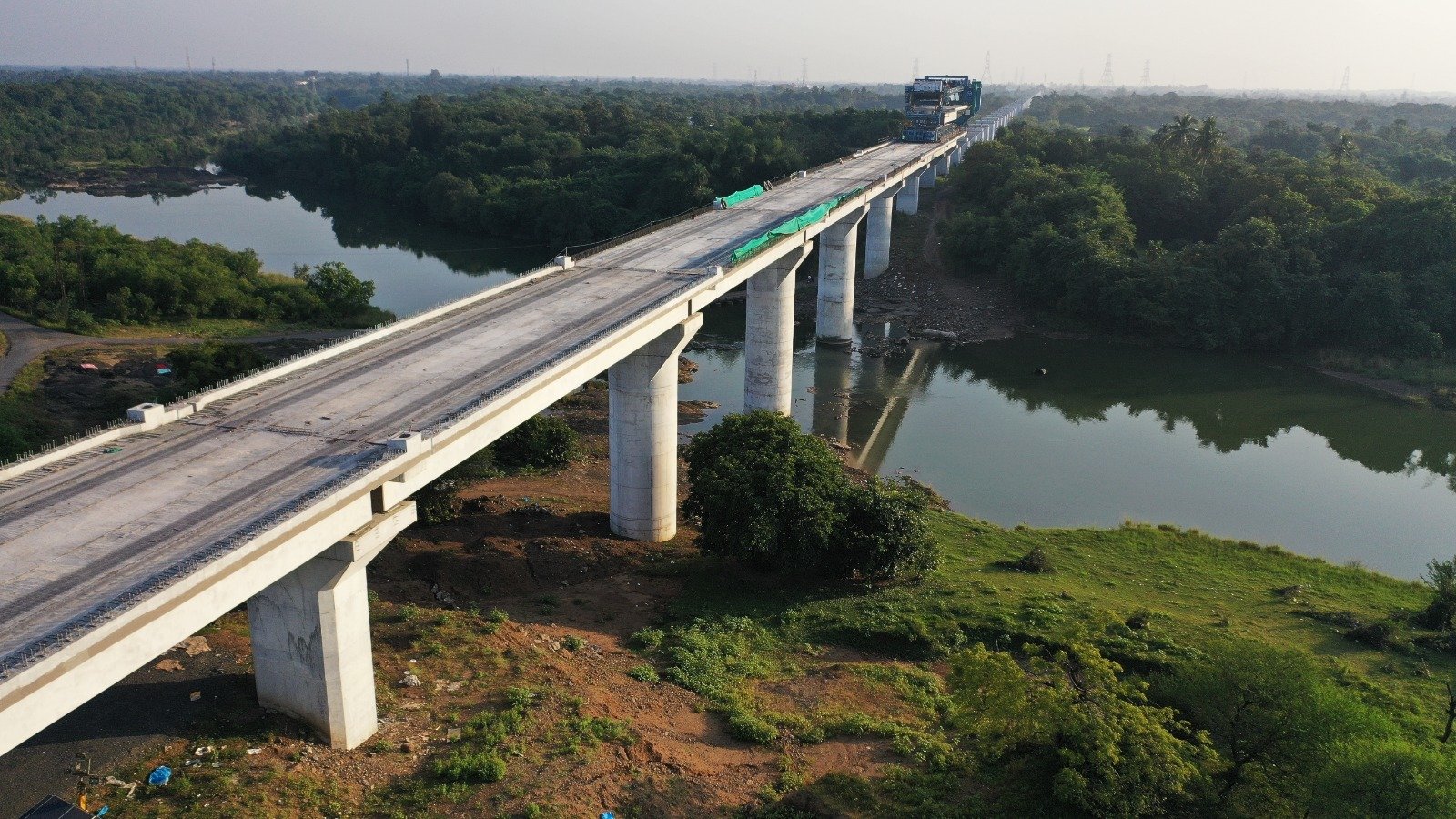
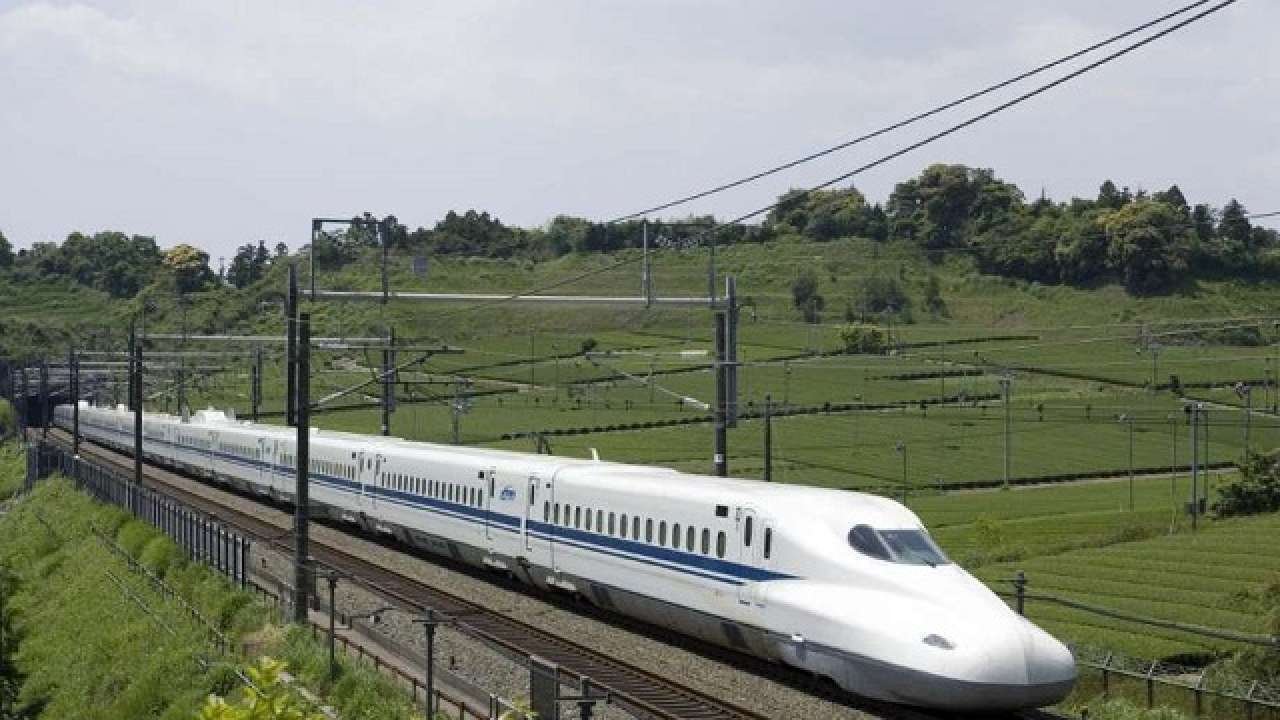
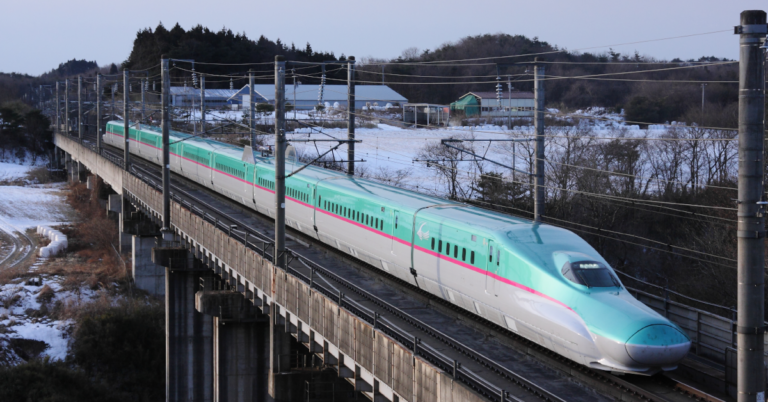
(Metro Rail News): Another milestone has been achieved for the Mumbai Ahmedabad Bullet Train project as the bridge on the Kharera River, Navsari District, Gujarat, was completed on 29 October, marking the completion of the 12th bridge out of 20 bridges in Gujarat state.
The completion of the bridge on the Kharera River marks the completion of the 9th and final bridge between Vapi and Surat stations for the Bullet Train Project.
Features Of Bridge On Kharera River
The bridge at Kharera River, Gujarat, spanning 120 metres, falls between the Vapi and Bilimora stations.
The bridge consists of one circular pier with a 4m diameter and 3 circular piers of 5m diameter, while the height of the piers varies between 14.5 m to 19 metres.
The bridge consists of 3 full-span girders of 40 m each.
Bridges Completed In Gujarat
As part of the ongoing Bullet Train project in Gujarat, 12 out of the required 20 bridges have been successfully completed to date. Of these completed bridges, 9 are situated along the stretch between Vapi and Surat stations.
Bridges Between Vapi and Surat Bullet Train Stations:
Delhi, the National Capital Territory of India, has been a union territory since November 1, 1956, and spans 1,484 square kilometres. With a population exceeding 11 million, it is a major urban centre surrounded by satellite cities like Ghaziabad, Faridabad, Gurgaon, Noida, Greater Noida, and YIEDA City, forming a metropolitan region with over 28 million inhabitants.
Known for its historical significance, diverse infrastructure, and vibrant economy, Delhi is a hub for finance, IT, public administration, and social services. The city’s extensive network of highways, railways, and metro systems ensures efficient connectivity for its large population.
The Beginning of Delhi Metro
1969 Study
The study of 1969 traffic and travel characteristics led to the idea of a mass rapid transit system for Delhi. Over the years, various government-commissioned committees evaluated technology, route alignment, and legal frameworks. In 1984, the Urban Art Commission proposed a multimodal transport system.
Between 1981 and 1998, Delhi’s population doubled, and vehicle numbers increased fivefold, leading to severe traffic congestion and pollution. Efforts to privatise buses in 1992 failed, worsening public transport conditions.
Overview of Delhi Metro
On May 3, 1995, the Delhi Metro Rail Corporation (DMRC) was established by the Government of India under Prime Minister H.D. Deve Gowda, with Elattuvalapil Sreedharan as its first managing director. The DMRC is a joint venture between the Government of India and the Government of Delhi, under the administrative control of the Ministry of Housing and Urban Affairs (MoHUA).
On December 31, 2011, Mangu Singh succeeded Sreedharan as managing director.
Delhi Metro Authorization
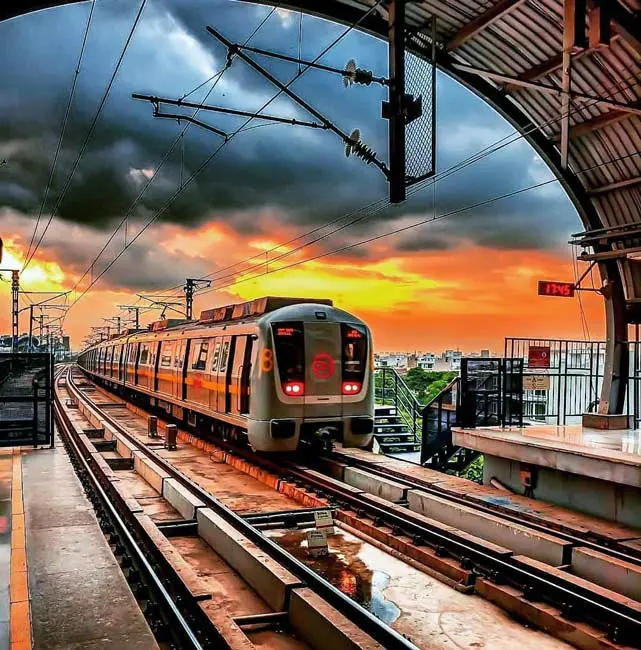
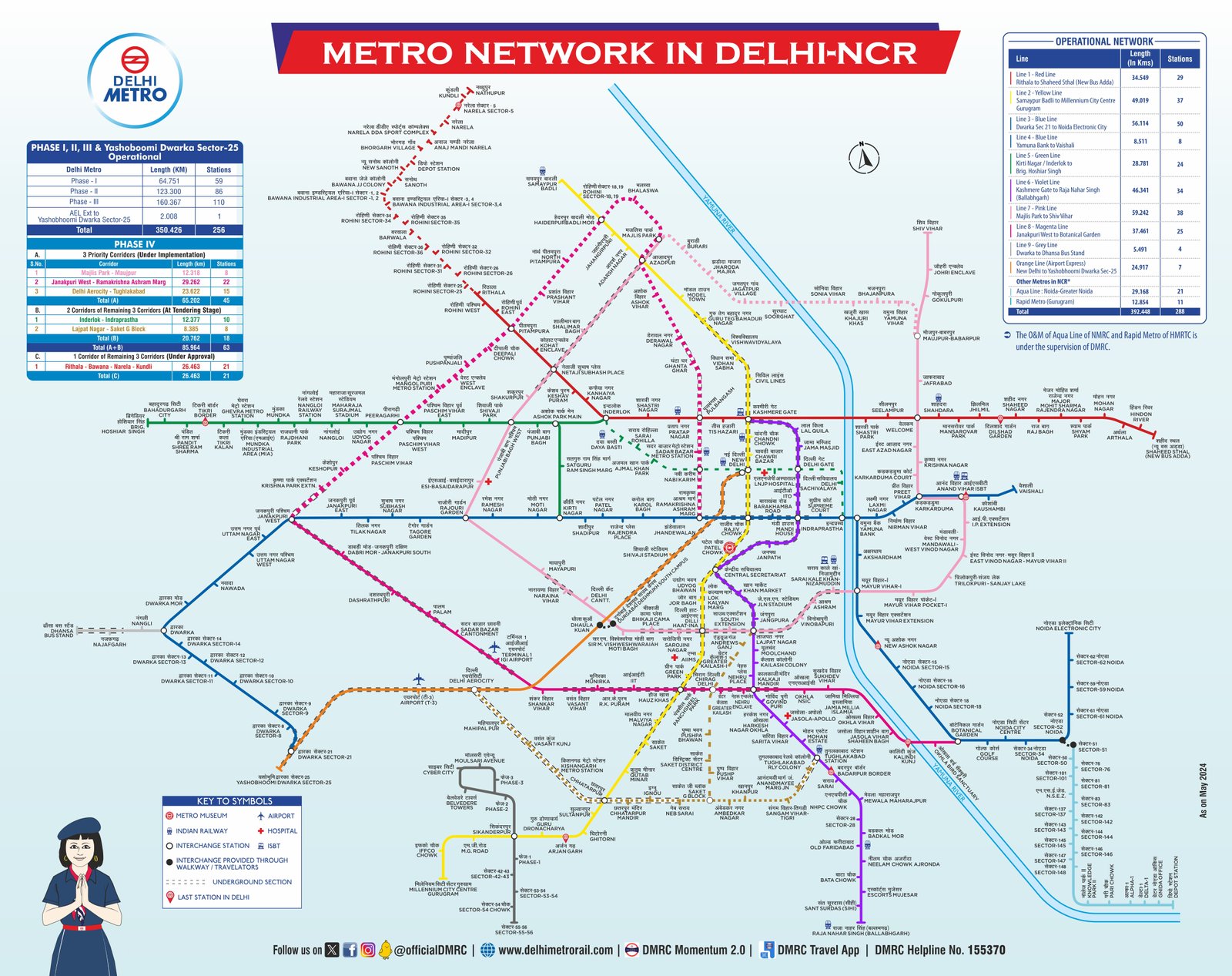
The Delhi Metro Rail Corporation (DMRC) is a joint venture between the Government of India and the Government of Delhi. It is under the administrative control of the Ministry of Housing and Urban Affairs (MoHUA). It operates 10 colour-coded lines, covering 256 stations over a network of 350.42 kilometres. As India’s largest and busiest metro system, it plays a crucial role in urban mobility and connectivity. Additionally, Delhi Metro is the second-oldest metro system in India, following the Kolkata Metro.
Key Specifications of Delhi Metro
Speed and Track
Maximum Speed: 80 km/h
Average Speed: 34 km/h
Track Gauge: Broad Gauge: 1676 mm (Lines 1-4) and Standard Gauge: 1435 mm (Lines 5-9)
Safety and Electrification
Electrification: The metro is powered by a 25 kV, 50 Hz AC OHE.
Signalling: The metro system will use Cab Signalling/Distance to Go (Lines 1-6), CBTC (Lines 7-9)
Daily Ridership
4.63 million+ passengers
Delhi Metro’s Rolling Stock
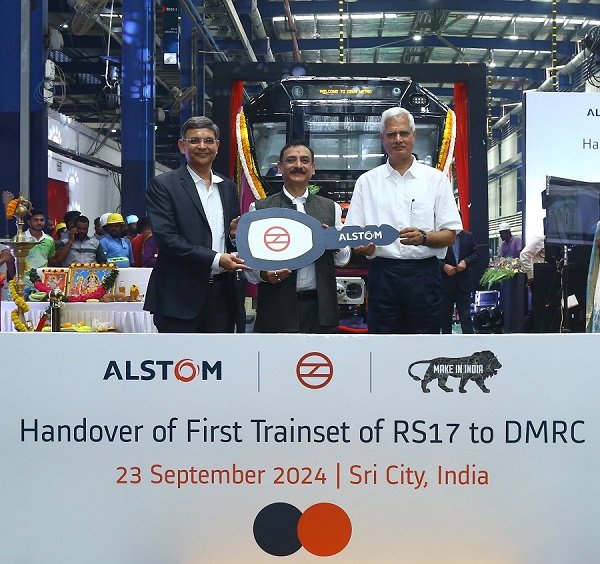
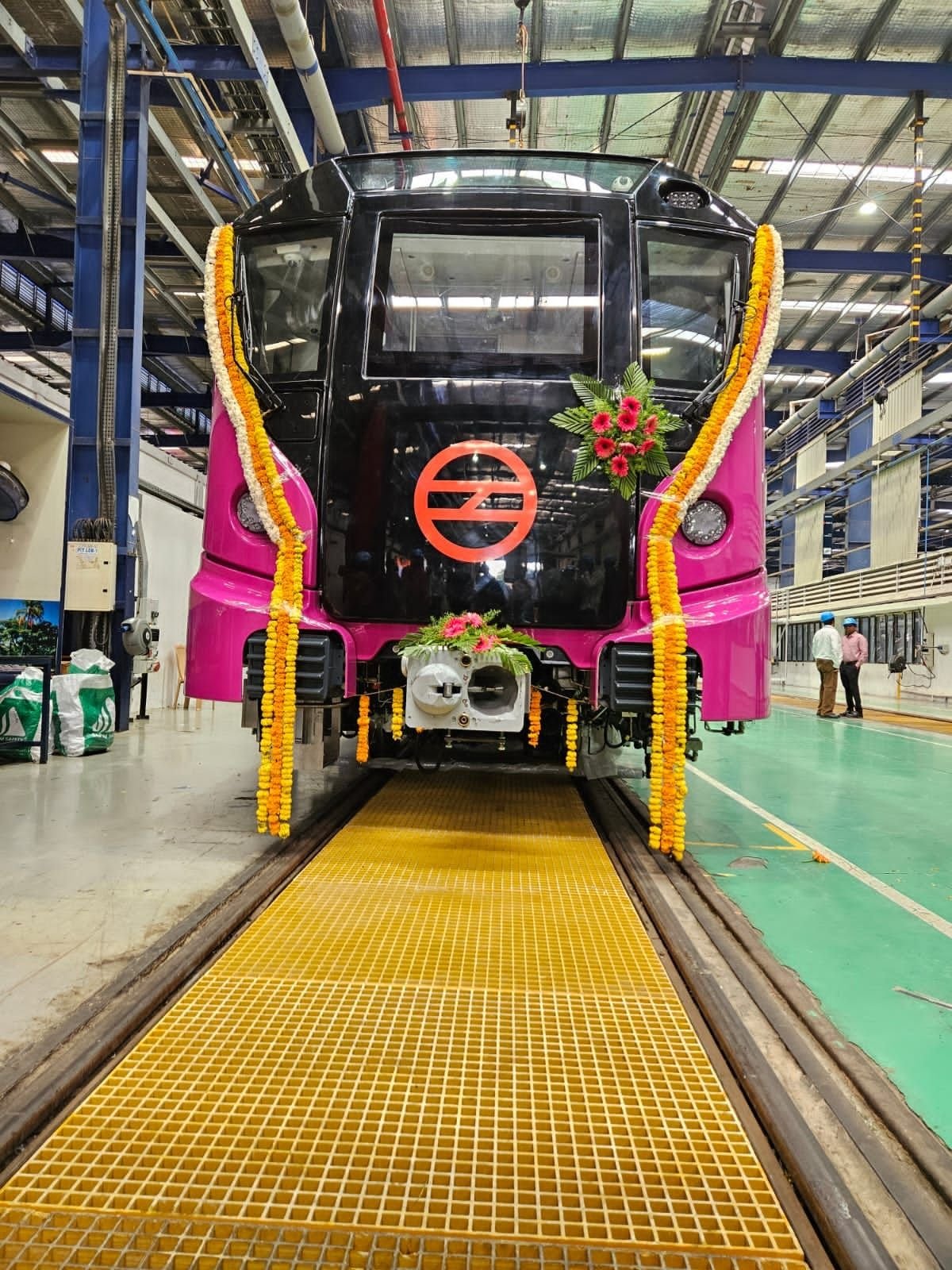
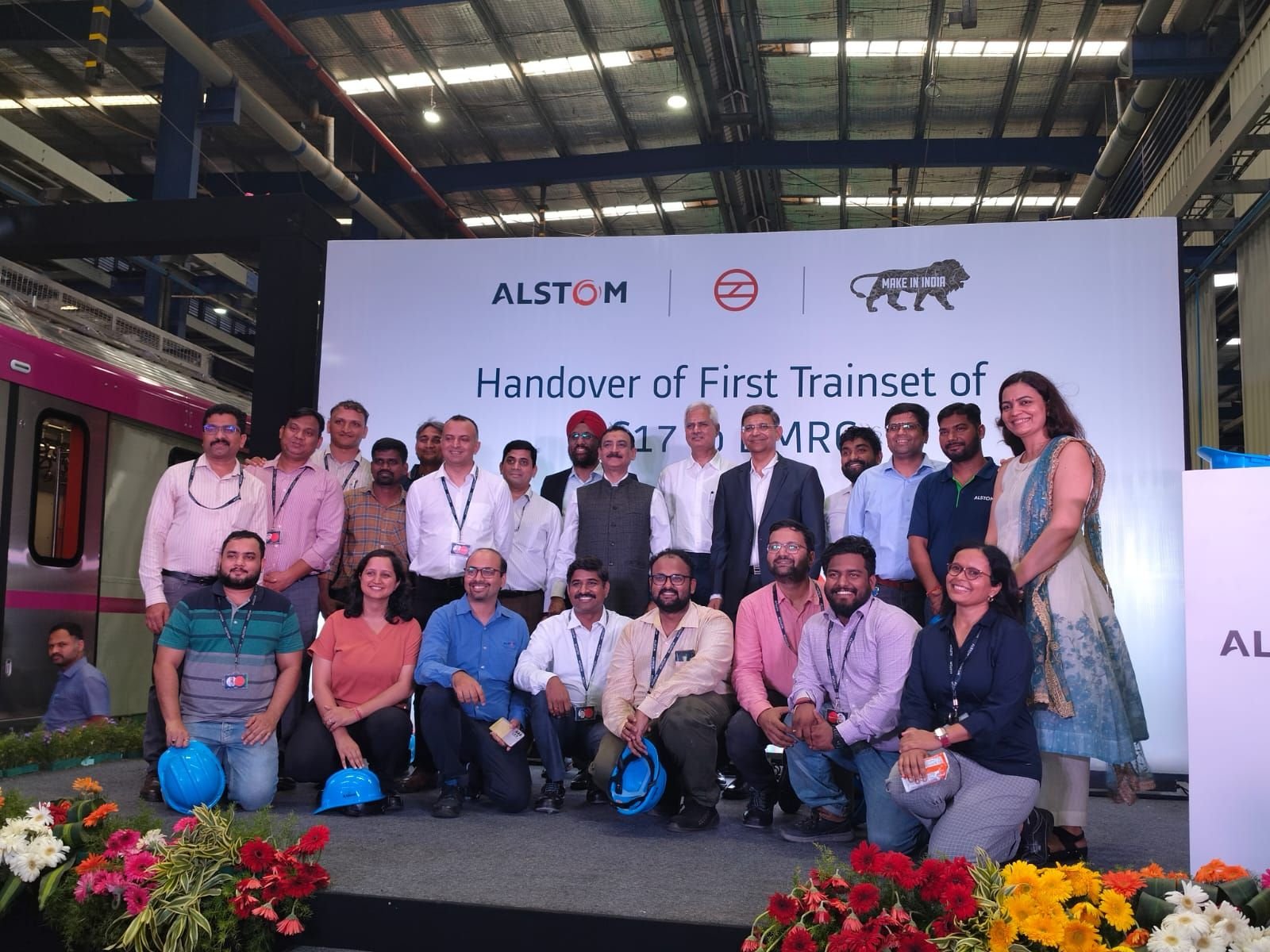
As of March 2019, the Delhi Metro Rail Corporation (DMRC) maintained a fleet of 2,214 metro coaches, consisting of 1,352 broad gauge and 862 standard gauge units. To support the expansion plans under Phase 4, DMRC awarded Alstom with the contract to supply 312 coaches.
Contract
Coaches
Manufacturer
RS1
240+40
Mitsubishi – MELCO – BEML
RS2
340+84
Bombardier Transportation
RS3
156+40
Hyundai Rotem
RS4
64
BEML
RS5
74+40
Bombardier Transportation
RS6
136
BEML
RS7
76
Bombardier Transportation
RS9
162
BEML – Hyundai Rotem
RS10
486+18
Hyundai Rotem – BEML
RS11
162
Bombardier Transportation
RS13
74+22
BEML
RS14
24
Cancelled (Airport Exp Line)
RS15
80
BEML
RS16
40
Bombardier Transportation
RS17
312
Alstom Transport India
Lines of Delhi Metro
Operational: 351.28 km | Under Construction: 65.1 km | Approved: 20.76 km | Proposed: 35.76 km
Phase 1:The construction of Phase 1 began in 1998 with the objective of establishing an approximately 65 km-long metro network in Delhi. The first operational segment extending 8.3 km from Shahdra to Tis Hazari was inaugurated on December 25, 2002. The entirety of Phase 1 was fully operational by 2006.
Vishwa Vidyalaya – Kashmere Gate (Yellow Line): 4 km
2005
July
Kashmere Gate – Central Secretariat (Yellow Line): 7 km
December
Dwarka – Barakhamba (Blue Line): 22.9 km
2006
April
Dwarka – Dwarka Sector 9 (Blue Line): 6.5 km
November
Barakhamba – Indraprastha (Blue Line): 4.0 km
Phase 2: Following the success of Phase 1, the construction of Phase 2 started in 2006. This phase consisted of 124.93 km of route length and 86 stations. The first section opened in June 2008, and the last section was completed in August 2011.
Vishwa Vidyalaya – Jahangirpuri (Yellow Line): 6.4 km
May
Indraprastha – Yamuna Bank (Blue Line): 2.1 km
November
Yamuna Bank – Noida City Centre (Blue Line): 13.1 km
2010
January
Yamuna Bank – Anand Vihar (Blue Line): 6.3 km
April
Inderlok – Mundka (Green Line): 15.1 km
June
Qutub Minar – Huda City Centre (Yellow Line): 14.5 km
September
Central Secretariat – Qutub Minar (Yellow Line): 12.5 km
October
Central Secretariat – Sarita Vihar (Violet Line): 15 kmDwarka Sector 9 – Dwarka Sector 21(Blue Line): 2.8 km
2011
January
Sarita Vihar – Badarpur (Violet Line): 5.1 km
February
New Delhi Railway Station – Dwarka Sec 21 (Airport Express Line): 22.5 km
July
Anand Vihar – Vaishali (Blue Line): 2.6 km
August
Kirti Nagar – Ashok Park Main (Green Line): 3.3 km
Phase 3:The construction of Phase 3 began in 2011. It involved a total length of 162.495 kilometres, including 109 stations. The phase consisted of three new lines and extensions of existing lines from Phases 1 and 2. The last section of Phase 3 was completed in September 2021. Phase 3 was one of the most challenging construction phases due to its extensive underground sections totalling 54 km. DMRC deployed more than 20 TBMs simultaneously to facilitate the construction of underground sections.
Estimated Cost: Rs. 41,079 crore
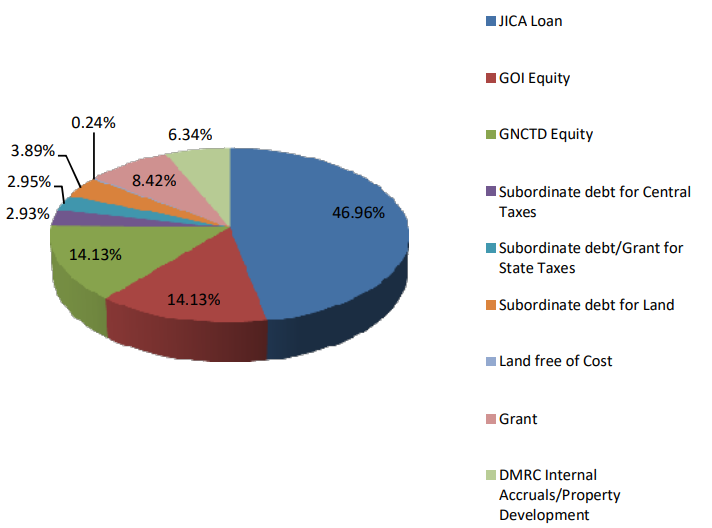
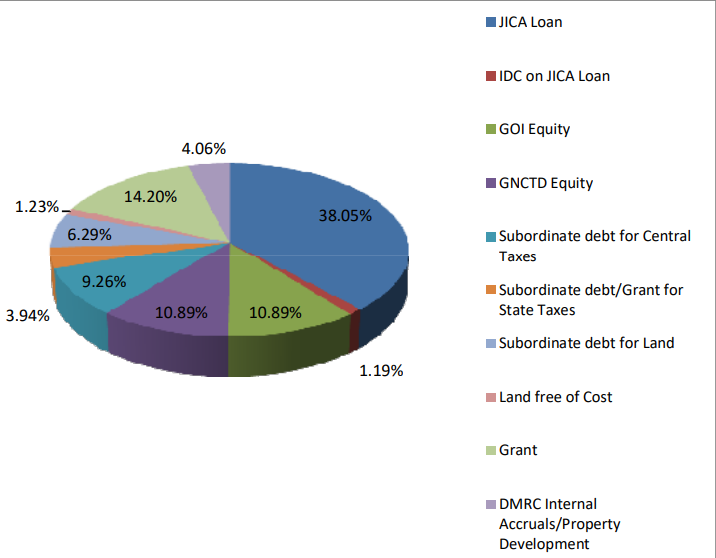
Funding Plan
Introduction of 3 New Lines
Line 7 (Pink Line): Majlis Park – Shiv Vihar
Distance: 57.49 km
Stations (18): Majlis Park, Azadpur, Shalimar Bagh, Netaji Subhash Place, Shakarpur, Punjabi Bagh West, ESI Basaidarpur, Rajouri Garden, Mayapuri, Naraina Vihar, Delhi Cantt, Durgabai Deshmukh South Campus, Sir Vishweshwaraiah Moti Bagh, Bhikaji Cama Place, Sarojini Nagar, Delhi Haat INA, South Extension, Lajpat Nagar, Vinobapuri, Ashram, Sarai kale Khan Hazrat Nizamuddin, Mayur Vihar 1, Mayur Vihar Pocket 1, Trilokpuri Sanjay Lake, East Vinod Nagar – Mayur Vihar II, Mandawali – West Vinod Nagar, IP Extension, Anand Vihar ISBT, Karkarduma, Karkarduma Court, Krishna Nagar, East Azad Nagar, Welcome, Jafrabad, Maujpur – Babarpur, Gokulpuri, Johri Enclave, Shiv Vihar
Line 8 (Magenta Line): Janakpuri West – Botanical Garden
Line 9 (Grey Line): Dwarka – Dhansa Bus Stand (Najafgarh)
Distance: 5.340 km
Stations (4): Dwarka, Nangli, Najafgarh, Dhansa Bus Stand
Extensions of Existing Lines
Line 1 (Red Line): Dilshad Garden – Shaheed Sthal (New Bus Adda)
Distance: 9.410 km
Stations (9): Dilshad Garden, Shaheed Nagar, Raj Bagh, Major Mohit Sharma Rajendra Nagar, Shyam Park, Mohan Nagar, Arthala, Hindon River, Shaheed Sthal (New Bus Adda)
Line 2 (Yellow Line): Jahangirpuri – Samaypur Badli
Dilshad Garden – Shaheed Sthal/New Bus Adda (Red Line): 9.41 kmNoida City Centre – Electronic City (Blue Line): 6.675 km
October
Dwarka – Najafgarh (Grey Line): 4.295 km
2021
August
Mayur Vihar Pocket 1 and Trilokpuri – Sanjay Lake (Pink Line): 1.38 km
September
Najafgarh – Dhansa Bus Stand (Grey Line): 1.218 km
Phase 4:Construction ofDelhi Metro’s Phase 4, initiated in 2019, is set to expand the network by an additional 103 kilometres. Once completed, the total length of the Delhi Metro will surpass 450 kilometres. Presently, construction efforts are concentrated on three priority corridors, covering a combined distance of 65.1 kilometres.
Expected to be operational by 2026.Estimated Project Cost: Rs. 24,948.65 croreAll the lines in Phase 4 will use fully driverless technology.
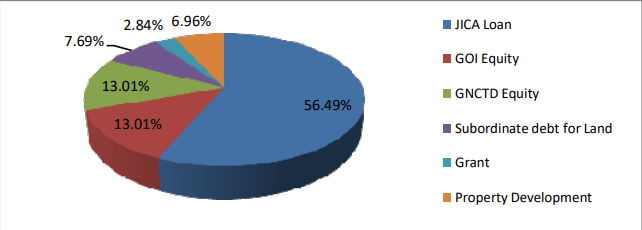
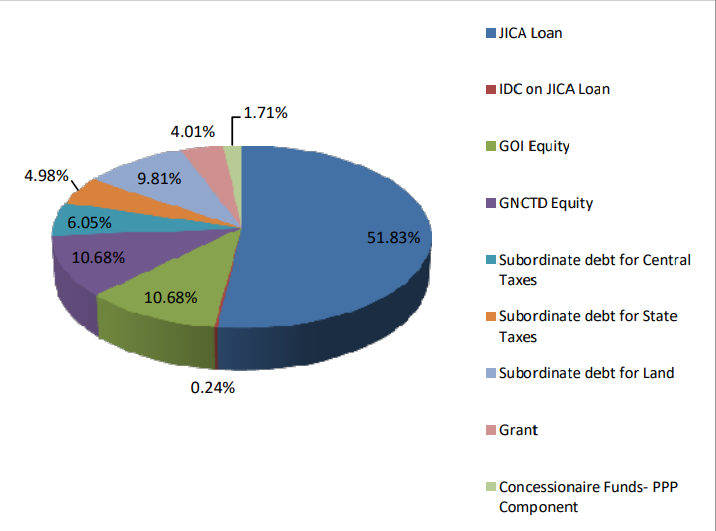
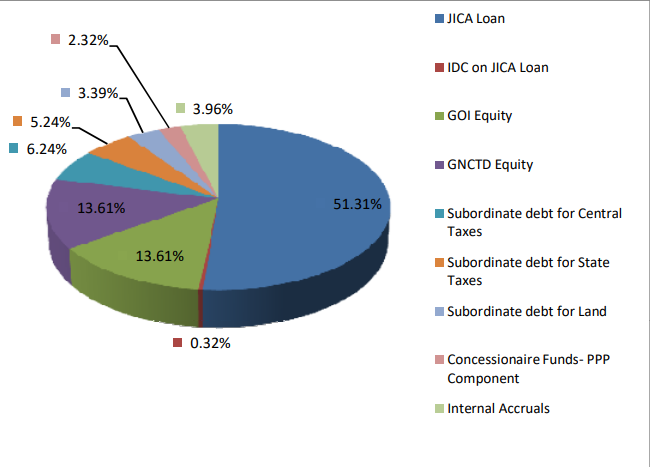
Funding Pattern for Delhi Metro’s Phase 4
Under -Construction Lines in Phase 4
Line 10 (Golden Line): Tughlakabad – Terminal 1 IGI Airport
Distance: 23.622 km
Type: Elevated (4.279 km) and Underground (19.343 km)
Line 5 (Green Line Extension): Inderlok – Indraprastha
Distance: 12.38 km
Stations (10): Inderlok, Dayabasti, Sarai Rohilla, Ajmal Khan Park, Nabi Karim, New Delhi Railway Station, LNJP Hospital, Delhi Gate, IG Stadium, Indraprastha
Proposed Lines in Phase 4
Line 1 (Red Line Extension): Rithala – Nathupur (Kundli)
Distance: 27.32 km
Station (21): Rohini Sector 25, Rohini Sector 26, Rohini Sector 31, Rohini Sector 32, Rohini Sector 36, Barwala, Rohini Sector 35, Rohini Sector 34, Bawana Industrial Area – 3 & 4, Bawana Industrial Area –1 & 2, Bawana JJ Colony, Sanoth, New Sanoth Colony, Depot Station, Bhorgarh Village, Anaj Mandi Narela, and Narela DDA Sports Complex, Narela, Narela Sector 5, Kundli and Nathupur
On September 4, 2024, transport minister Kailash Gahlot announced that the Rithala – Narela corridor will extend to Kundli – Nathpur in Haryana. The Delhi government has approved the extension and the proposal will now be sent to the central government to plan and announce the tenders for the project.
Line 3 (Blue Line Extension): Noida Electronic City – Sahibabad
Stations (21): Kirti Nagar, Saraswati Garden, Mayapuri Bus Depot, Mayapuri, Hari Nagar Block BE, Mayapuri Industrial Area, Mayapuri Industrial Area-II, Tihar Jail, Shivpuri, Dabri Village, Sitapuri Extension, Mahavir Enclave, Dwarka Sector 2, Dwarka Sector 7, Dwarka Sector 6, Dwarka Court, Dwarka Sector 20, Dwarka Sector 23, Dhul Siras Village, ECC Dwarka, Bamnoli Village
Recent Updates on Phase 5
According to former DMRC managing director E. Sreedharan, Delhi will require Phase 5 after completing Phase 4. This suggestion highlights the need to handle the rising demand for public transportation by the growing population. The corridor proposal is not yet done, but there are a few recommendations.
Yamuna Bank – Loni (12 km): Eliminated from Phase IV expansion
The Central Vista Redevelopment Project includes the Central Vista Loop Line.
The Indira Gandhi International Airport development includes the Delhi Air Train, also known as the Automated People’s Mover, providing links with Aerocity, T1, T2, and T3.
The DPR has been prepared for the Delhi Metro Yellow Line’s expansion from Samaypur Badli metro station to Khera Kalan in North Delhi, with a stop in Siraspur.
DMRC’s Initiatives to Streamline Passenger Comfort
Airport Check-In ServicesSince the first week of June, DMRC has introduced check-in facilities for international flights at New Delhi and Shivaji Stadium metro stations on the Airport Express Line. Passengers can check in their luggage at these two metro stations, and the authorities will transport it to the airport using advanced automated systems. Multiple TicketsThe passengers can purchase up to 6 Single Journey QR Tickets with the same origin and destination for a group of family or friends. Multiple QR Tickets will be issued, allowing multiple entries and exits for each ticket.
Challenges Faced by the Delhi Metro
Overcrowding
The high ridership in metros has led to overcrowding, leading to delays in the metro arrivals. Steps have been taken to address the issue, and eight coach trains have been introduced along the yellow and blue lines.
Rising Fares
The fares for the Delhi metro are higher than those for the bus services. They are the second-most unaffordable metro, charging less than US$0.5 per ride.
Benefits of Metro in Delhi
Addressing the Environmental Concerns
Following the New York City Subway, the Delhi metro is ranked second worldwide in holding an ISO 14001 certification for environmentally friendly construction. The metro has won awards for its environmentally friendly practices from the United Nations, RINA, and the International Organization for Standardization. Rainwater collection and rooftop solar power plants are features of the network that help safeguard the environment.
Interchange Stations
Delhi Metro plans to expand its number of triple interchange stations from three to four. At present, there is only one triple exchange station, Kashmiri Gate, and the Azadpur metro station is under construction. The New Delhi metro station and Lajpat Nagar will soon become triple exchange stations.
Conclusion
The Delhi Metro has transformed urban transportation, reducing traffic congestion and pollution while enhancing city connectivity. Its extensive network highlights a commitment to sustainable and efficient transit solutions. The ongoing expansions show the system’s adaptability to growing demands and its role in shaping a modern, eco-friendly metro system. Despite challenges like overcrowding and rising fares, the Delhi Metro offers significant environmental benefits, showcasing its crucial role in Delhi’s infrastructure and urban planning.
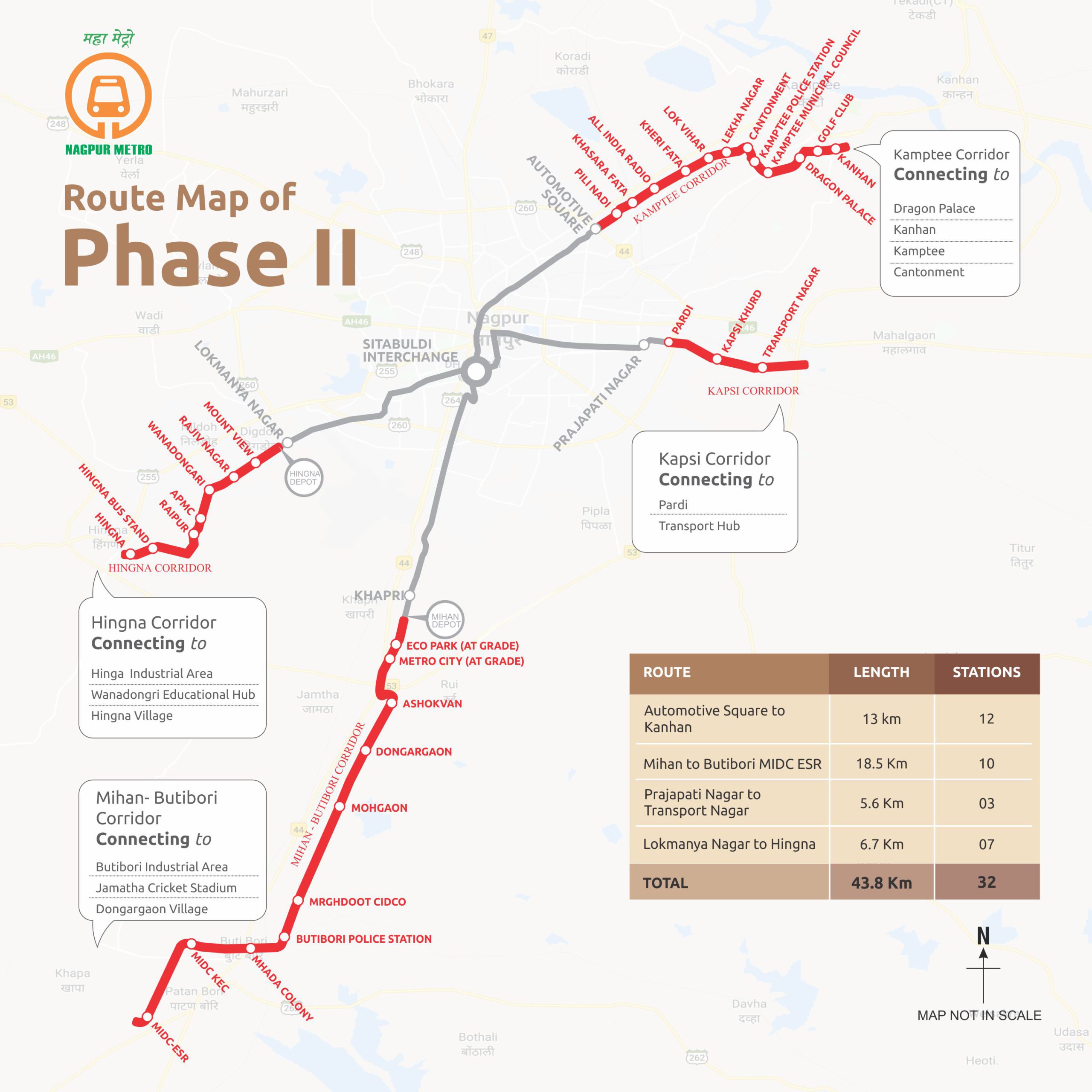
Nagpur (Metro Rail News): Nagpur Metro progressed as the two firms, Rahee Infratech Ltd. and Texmaco Rail and Engineering Ltd., submitted bids to supply and install tracks for Nagpur Phase 2 project spanning 43.8 km under package T-02 on 1 November.
Maha- Metro floated tenders for Package T-02 in March 2024 with a Rs. 185.00 crore estimate and a 2.5-year installation deadline.
Detailed Scope of Work:
The appointed contractor under this contract will be responsible for installing the ballasted tracks on 1.746 km at the grade section of Orange Line’s Reach 1A (Khapri – MIDC ESR). This at-grade section falls between Eco Park Station and Metro City Station.
In addition, the contractor will install ballastless tracks at the elevated viaduct of 1. Orange Line’s Reach 2A connecting Automotive Square – Lekha Nagar. 2. Aqua Line’s 5.33 km Reach 4A which connects Prajapati Square to Transport Nagar.
Brief Scope: Design, Supply, Installation, Testing and Commissioning of Ballasted-Ballastless track in At Grade section of Reach 1A and elevated viaduct of Reach 2A and Reach 4A of NMRP Phase-2
The bids submitted by the two firms have now been sent for technical evaluation. After the completion of the technical evaluation, the financial bids of the qualified bidders will be opened to reveal the lowest bidder for the contract.
As the population grows, so does production, consumption, and transportation demand. With a population exceeding 1.4 billion, the transport sector is vast and multifaceted. It heavily impacts economic activities across the nation. As of the fiscal year 2012-2013, urban transportation contributed approximately 5.2% to the national GDP, with road transportation representing a substantial share.
Regulatory Framework
The governance of urban transport is primarily executed by the Ministry of Urban Development, which operates under the provisions outlined in the National Urban Transport Policy (NUTP), 2006. This policy framework mandates that state governments oversee urban transport management while adhering to central policies. Many vital agencies collaborate to implement these policies, ensuring cohesive and efficient transport solutions across urban regions.
Key Components
Transport Modes: Urban transportation encompasses various modes, including:
Bus Rapid Transit System (BRTS): Designed for efficient bus transit, reducing travel time and enhancing passenger experience.
Metro Rail Projects: These projects facilitate high-capacity urban transit, providing a reliable alternative to road-based transport.
Urban transportation is particularly complex due to the different modes of transport, numerous starting points and destinations, and the diverse types of traffic. However, it enhances connectivity within the regions, allowing people to avoid road congestion and reach their destination on time.
Early History of Urban Transport in India
On April 16, 1853, India witnessed the launch of its first urban rail transit system with the introduction of commuter rail in Mumbai. The first passenger train in India ran from Bori Bunder (now Chhatrapati Shivaji Terminus) to Thane, covering a distance of 34 km in 1 hour and 15 minutes. This became India’s first suburban rail. This service laid the foundation for future rail networks in urban areas, providing a reliable means of transportation for commuters.
The Tram Era
During the early 20th century, the tram system emerged as a prominent mode of urban transport in several major cities, including Mumbai, Delhi, Kolkata, and Chennai. These tram networks were designed to provide efficient and reliable public transit, catering to the growing demands of urban populations. These systems are discontinued in Chennai, Delhi, and Kanpur, making Kolkata an exception where trams are still operated.
Different Forms and Trends in the Indian Urban Transport
Automobiles
In India’s urban areas, private cars make up 30% of the total transport system. Around 963 new private vehicles are registered daily in Delhi. Chennai is called the “Detroit of India” for its automobile industry. The most popular brands in the automobile industry based on the market share are Hyundai, Maruti, and Tata Motors.
Two-Wheelers
Motorised two-wheeler vehicles are famous for their fuel efficiency. They are preferred as using them on congested roads is easy. Motorcycle manufacturing in India started with the plant establishment of Royal Enfield in Chennai in 1948. In 1949, India began manufacturing scooters by establishing Automobile Products of India (API) in Mumbai.
Buses
Buses are an essential means of Indian public transport. Due to their social significance, they are operated mainly by the state authorities. They connect villages and towns and are preferred by many individuals as the share of the ride is negligible.
Autos
Auto is a three-wheeler vehicle with a small cabin for the driver in the front and a rear seat for the passengers. Depending on the area, it is generally painted yellow, green, or black. Most cities utilise the regular metered fares to determine the ride charge. There is now a popular means of transport: electric rickshaws. They are becoming popular in India due to their environmental-friendly nature.
Airplanes
The Ministry of Civil Aviation controls India’s aviation industry. Air India plays a crucial role in the aviation industry, connecting India with other parts of the world and connecting different domestic regions. Over the past five years, numerous airports have been privatised.
Railways
The Indian Railways offers country-wide rail services. As of March 2021, the Indian railways cover more than 7,325 stations over a total route length of more than 68,080 km and track length of about 132,310 km. Vande Bharat Express is the fastest train in India. IR also transports freight such as consumer goods, fuels, raw materials, and industrial products. Due to its cost and speed of delivery, IR’s freight services cannot compete with other modes of transport.
List of India’s Major Urban Transport
Focus on India’s Metro System
1919:
W.E. Crum established a committee in September 1919.
The committee recommended the development of a metro line in Kolkata, setting up the initial proposal for India’s first metro system.
1949-50:
The Government of West Bengal submitted a formal proposal for the Kolkata Metro.
A survey was conducted by French experts to assess the feasibility of the project.
1972:
After a delay of 23 years, the foundation stone for the Kolkata Metro was laid.
1984:
On 24 October 1984, the Kolkata Metro became operational, making it India’s first metro system.
Metro systems in India developed in parallel with urbanisation, as the increasing population density and infrastructural demands in major cities necessitated advanced transit solutions. As urban expansion progressed, additional metro projects were implemented to facilitate economic growth and enhance intercity connectivity, providing an efficient and sustainable mode of transportation for the evolving urban landscape.
Operational Metro Route
902.39 km
Under-Construction Route
649.56 km
Approved Route
261.03 km
Proposed Route
1065.83 km
First Metro System
Kolkata Metro
Newest Metro System
Navi Mumbai
Largest Metro System
Delhi Metro
Smallest Metro System
Kanpur Metro
Busiest Metro System
Delhi Metro
Operational Metro Lines
Metro
Operator
Started
Annual Ridership
Rolling Stock
Lines
Delhi Metro
DMRC
24 December 2002
2032.3 million
BEML, Bombardier, Alstom, Hyundai Rotem
Operational: 350.42 kmUnder-Construction: 65.20 kmProposed: 53.281 km
Namma Metro(Bengaluru)
BMRCL
20 October 2011
232.8 million
BEML, Hyundai Rotem, Titagarh Rail Systems, CRRC
Operational: 73.81 kmUnder-Construction: 108.65 kmProposed: 79 km
Hyderabad Metro
HMRL
29 November 2017
162.06 million
Hyundai Rotem
Operational: 69.2 kmUnder-Construction: NAProposed: 70 km
Kolkata Metro
KMRC
24 October 1984
192.5 million
BEML, ICF, CRRC
Operational: 67.45 kmUnder-Construction: 73.8 kmProposed: 205.52 km
Chennai Metro
CMRL
29 June 2015
110.1 million
Alstom
Operational: 54.1 kmUnder-Construction: 118.9 kmProposed: 112 km
Mumbai Metro
MMRC
8 June 2014
273.75 million
CRRC, Alstom, BEML
Operational: 46.5 kmUnder-Construction: 146.08 kmProposed: 287.75 km
Ahmedabad Metro
GMRC
4 March 2019
29.35 million
Hyundai Rotem
Operational: 38.63 kmUnder-Construction: 28.26 kmProposed: 7.41 km
Nagpur Metro
MahaMetro
8 March 2019
27.38 million
CRRC
Operational: 38.215 kmUnder-Construction: 43 kmProposed: 48.30 km
Pune Metro
MahaMetro
6 March 2022
14.66 million
Alstom, Titagarh Rail Systems
Operational: 29.1 kmUnder-Construction: 52.95 kmProposed: 129 km
Noida Metro
DMRC
25 January 2019
16.7 million
CRRC
Operational: 29.168 kmUnder-Construction: NAProposed: 84.95 km
Kochi Metro
KMRL
17 June 2017
31.17 million
Alstom
Operational: 28.125 kmUnder-Construction: 11.2 kmProposed: 59.16 km
Lucknow Metro
UPMRC
5 September 2017
26.82 million
Alstom
Operational: 22.878 kmUnder-Construction: NAProposed: 85.00 km
Rapid Metro Gurgaon
DMRC
14 November 2013
14.6 million
CRRC
Operational: 12.854 kmUnder-Construction: NAProposed: 198.99 km
Jaipur Metro
JMRC
3 June 2015
18.12 million
BEML
Operational: 11.979 kmUnder-Construction: 2.85 kmProposed: 26.36 km
Navi Mumbai Metro
CIDCO
17 November 2023
0.935 million
CRRC
Operational: 11.10 kmUnder-Construction: NAProposed: 86.2 km
Kanpur Metro
UPMRC
28 December 2021
3.6 million
Bombardier
Operational: 8.98 kmUnder-Construction: 15.05 kmProposed: 8.6 km
Agra Metro
UPMRC
6 March 2024
NA
Bombardier
Operational: 5.2 kmUnder-Construction: 6.70 kmProposed: 15.40 km
Under Construction Metro Lines
Metro
Under-Construction
Length Planned
Construction Began
Estimated Opening
Bhoj Metro(Bhopal)
27.87 km
80 km
2018
2024
Indore Metro
33.53 km
248 km
2018
2024
Meerut Metro
23.6 km
38.6 km
2019
2025
Patna Metro
16.86 km
30.91 km
2020
2025
Surat Metro
40.35 km
40.35 km
2021
2027
Bhubaneshwar Metro
26.024 km
26.024 km
2024
2028
Approved Metro Lines
Metro
Length Planned
Construction Began
Estimated Opening
Visakhapatnam Metro
76.90 km
2024
2028
Chandigarh Metro
154.5 km
TBD
TBD
Vadodara Metro
43.20 km
TBD
TBD
Rajkot Metro
37.8 km
TBD
TBD
Thane Metro
30 km
TBD
TBD
Planned Metro Lines
Metro
Length Planned
Vijayawada Metro
75 km
Coimbatore Metro
34.8 km
Thiruvananthapuram Metro
46.7 km
Guwahati Metro
61.42 km
Ranchi Metro
16 km
Aurangabad Metro
25 km
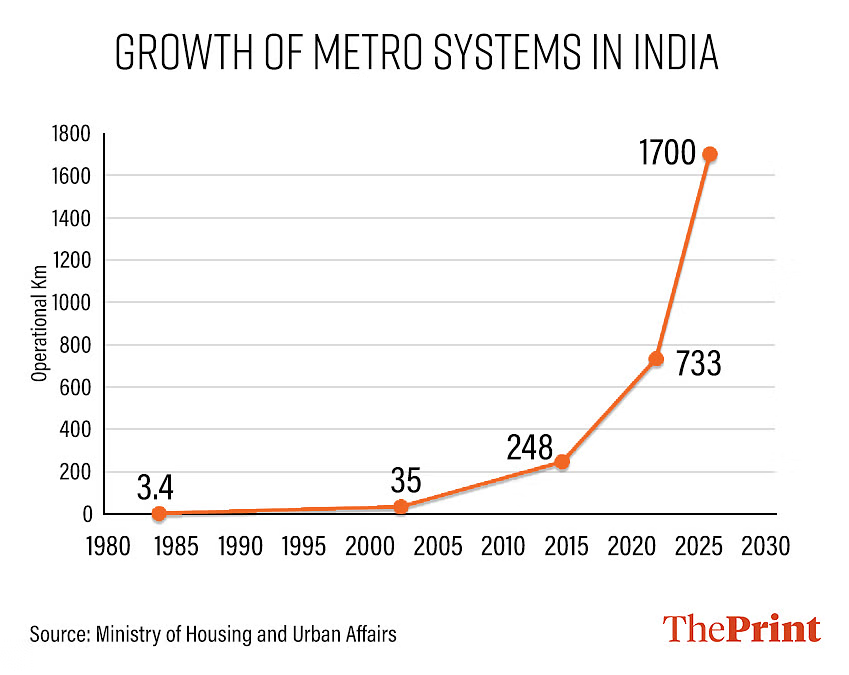
The metro system in India has significantly expanded in terms of length, development in different cities, and ridership.
Source: Ministry of Housing and Urban Affairs
Challenges Faced by the Indian Metro System
Low Ridership: A report by IIT Delhi reveals that most metro networks in India operate at less than 50% of their expected capacity. The Delhi Metro achieves around 47% of its projected ridership, while Mumbai and Kolkata hover around 30%, and Bengaluru registers a mere 6%. Despite these low utilization rates, daily ridership across all metro systems in India has surpassed 10 million, with projections to exceed 12.5 million in the near future. For example, the Delhi Metro has reported an average of approximately 67 lakh passenger journeys on weekdays, representing an 8% increase over the ridership projections for 2023.
Faulty Planning and Execution: Issues related to detailed project reports (DPRs), such as poor planning for first and last-mile connectivity and insufficient catchment areas, contribute to low ridership.
Lack of First and Last-Mile Connectivity: Inadequate feeder bus services present a major obstacle to accessing metro stations, with bus services available on only 44% of approved routes in cities like Delhi due to fleet shortages. This lack of reliable first and last-mile connectivity discourages potential commuters from using the metro, limiting the system’s overall effectiveness and ridership growth.
Fluctuating Raw Material Prices
It is difficult to predict the prices of the raw materials used in metro construction. The prices fluctuate based on market demand and supply, sometimes making it costly for the contractors to fulfil the project within the assigned budget.
Adapting to the Changing Socio-Economic Dynamics
Due to the rapid growth and development of cities, changes in technology, demography, socioeconomic conditions, and the environment all need to be taken into account. The system must adapt to changing trends through various strategies, including comfort, end-to-end connectivity options, and real-time and reliable information.
Financial Sustainability
The construction of the metro involves high costs, and the low ridership in various cities affects the revenue of the metro in those cities. This leads to losses. Due to such situations, multiple cities face difficulties in launching the metro. Let us consider the Mumbai metro, where the operations of local trains are more beneficial to the locals. The people prefer to travel via local trains as they are less expensive than metros and people can travel long distances for just 5-10 rupees.
Benefits of the Metro System in India
Speed and Efficiency
Metro rails are efficient and carry up to 50,000 passengers every hour. Their speed helps them cover long distances in a short period, allowing people to travel easily, safely, and quickly.
Environment Friendly
The metro rails are electrically powered, and their operation produces zero emissions, which helps to reduce air pollution. As more and more people prefer the metro to avoid road congestion, the number of private vehicles on roads has been reduced, helping to improve the air quality of cities.
Economic Development
The construction and operation of metro rails in cities have helped to improve their economies. The projects have attracted multiple business opportunities and new investments, helping many people get employment. The standard of living in the cities has improved.
Social Equity
Metro rails have helped to improve social equity and reduce social discrimination. As travel has become affordable and accessible, almost everyone can use the metro as a transportation facility regardless of income and social status.
Exploring the Metrolite Projects in India
Metrolite projects, also known as light rail transit, are an urban rail transit combination of rapid transit and tram systems. As it is cost-efficient, several urban cities have utilised the metrolite system in their cities. It caters to low-ridership demand and acts as a feeder service for existing metro systems.
Approved Metrolite Projects
Metro Projects
Lines
Stations
Length
Planned Opening
Jammu Metro
2
40
43.50 km
2026
Srinagar Metro
2
24
25 km
2026
Kozhikode Light Metro
1
14
13.30 km
TBD
Chennai Light Rail
1
TBD
15.50 km
TBD
Gorakhpur Metro
2
27
27.41 km
2024
Planned Metrolite Projects
Metro Projects
Lines
Stations
Length
Planned Opening
Raipur Metro
TBD
TBD
TBD
TBD
Delhi Metrolite
2
37
40.88 km
2026
Rajkot Metro
TBD
TBD
TBD
TBD
Jamnagar Metro
TBD
TBD
TBD
TBD
Bhavnagar Metro
TBD
TBD
TBD
TBD
Madurai Metro
3
41
91 km
2027
Bareilly Metro
1
10
20 km
TBD
Varanasi Metro
2
26
29.23 km
TBD
Prayagraj Metrolite
2
39
42 km
TBD
Jhansi Metro
2
17
18 km
TBD
Mathura Metrolite
TBD
TBD
TBD
TBD
Ayodhya Metrolite
TBD
TBD
TBD
TBD
Challenges Faced by Metrolite Projects
Cost and Revenue
The major challenge for metrolite projects is the high cost involved in the construction. The cost of construction is high, and there are high chances for the project to incur loses due to low ridership.
Displacement and Congestion
The light rail project can lead to the displacement of local residents. It can also make streets congested, causing people to suffer from road congestion.
Benefits of Metrolite Projects
Boost Local Economy
The Metrolite projects will provide enhanced transportation facilities to the residents and tourists and create business opportunities in the city. Besides creating employment in the construction and operations of the metrolite, the local economy will see a boost. The shops in the range of the metrolite corridor will be benefited. As the city develops, many educational institutions and commercial centres will open, leading to the city’s economic growth.
Reduced Road Congestion
The metrolite system can reduce the number of cars on the road by providing a reliable and efficient mode of transportation. It will help to reduce traffic congestion and air pollution.
A New Trend of RRTS Projects in India
Regional Rapid Rail Transit (RRTS) connects metropolitan areas with similarly sized cities and surrounding towns and cities. Its high speed enables it to cover long distances in a short period. The maximum speed of RRTS is 180 km/h, the operating speed is 160 km/h, and the average speed is 100 km/h.
The Delhi-Meerut RRTS, or RapidX, is partially operational, and the 100 m route is still under construction.
Expected Daily Ridership on the Priority Corridors of the RRTS
Delhi-Meerut
7,40,000
Delhi-Panipat
5,47,000
Delhi-Alwar
9,10,000
Challenges Associated with the Construction of RRTS
Land Acquisition
Due to the high population of Delhi and Meerut, it became difficult for the NCRTC to acquire land to construct RRTS. Compensation and negotiations delayed the construction and completion of the RRTS project.
Pollution Control
As pollution in Delhi NCR is rising rapidly, smog mitigation became a huge challenge during the construction of the Delhi-Merut RRTS. Several measures, such as sprinkling water and deploying anti-smog guns, were taken to ensure a reduction in dust.
Benefits of RRTS
Rise in Economic Activities
RRTS focuses on improving the pattern of movement and development across different regions. As RRTS offers high-speed travel, the total time to reach the destination is reduced, enhancing the region’s productivity and overall economic activities.
Employment Opportunities
RRTS would open up new opportunities for the people of the country. With its development and commencement, new businesses and shops would open up in the regions, creating job opportunities for the people. It would also improve the people’s travel conditions.
Trams: Future of Indian Urban Transport System?
The introduction of trams in Indian cities took place in the late 19th century; however, many cities phased out the plan. The only city that implemented a tram system is Kolkata, which is still operational. After the construction of the Kolkata Metro Green Line, only 19.53 km of tram lines were operational in Kolkata.
Operational Tram in India
System
Lines
Length
Opened
Kolkata Tram
3
19.53 km
1873
Defunct Trams in India
System
Length
Opened
Discontinued
Mumbai Tram
–
1873
1964
Nashik Tram
10 km
1889
1931
Chennai Tram
–
1892
1953
Patna Tram
–
–
1903
Kanpur Tram
6.04 km
1907
1933
Kochi Tram
–
1907
1963
Delhi Tram
–
1908
1963
Bhavnagar Tram
–
1926
1960s
Discussing Kolkata Tram
Route
Esplanade-Shyambazar
Seats
32
Fare
Rs. 20
Average Daily Collection
Rs. 7000-8000
Average Daily Collection from Non-AC Tram
Rs. 2500
Tram Timeline
1873 – 1901
Horse-drawn Trams
1900 – 1951
Electric Trams
1951 – 1990
Nationalisation of Tramways
2013
First AC Tram For Heritage Ride
2018
First AC Tram Fine-Dining Restaurant
2019
First AC Tram In Route Service
Recent Update on Kolkata Tram Service
On September 29, 2024, Kolkata discontinued its tram service on all the routes except one running from Maidan to Esplanade.Trams are discontinued to ensure low traffic congestion as they are slow, and people nowadays need a faster mode of transportation.
Exploring Some Of The Tram Systems in Asia
Trams started to be used as urban transport systems in Asia in the early 20th century. However, their use started to decline around the 1930s, and by the 1960s, most tram systems were closed. Extensive legacy tramways still exist in Japan, and more modern systems have recently been built in China.
Country
Details
Indonesia
In 1869, a horse tram was started in Batavia (now Jakarta), the capital of the former Dutch colony of the Netherlands East Indies. A steam tram ran from 1881, and an electrified tram in 1897.
China
In 1899, Beijing had the first tram system in China.
Hong Kong
In 1904, the tramway system was introduced in the then-British colony.
Japan
In 1895, the first tramway in Japan was built. It is known as the Kyoto Electric Railroad.
South Korea
The South Korean capital, Seoul, had trams up until 1968. The Wirye Line in Seoul is a future tram line scheduled to open in 2025.
Challenges Faced By Trams in India
Higher Implementation Cost
Buses don’t need street alterations to start operating, but installing rails for tram tracks and overhead power cables requires a higher initial cost. The high costs and risks of installing tram tracks make it difficult to think of opening trams in India, as trams can be easily substituted with buses.
Hazardous for 2-Wheelers
Bicycles on tram tracks, especially those with narrow tyres, risk getting their wheels stuck in the tracks. Tram tracks can become slippery when wet, mainly during the rainy season, making riding a bicycle or a motorcycle unsafe, especially in traffic.
Benefits Offered By Trams
Reduced Road Congestion and Pollution
Trams are more efficient to use as they can accommodate up to four cars. They reduce the use of private vehicles, allowing the city to look well-maintained and traffic-free.
Environmental Friendly
Trams are a sustainable option compared to cars and buses. They accommodate a large number of people and also reduce air and noise pollution in the city. Using stell wheels in the trams is environmentally sustainable as they can be recycled more easily than the rubber tiers.
Bullet Trains: Finding Their Way in the Indian Urban Transportation
During the 1980s, India proposed bullet trains that run up to 250 km/h. Since then, initiatives have been taken to do pre-feasibility studies, prepare project reports, and predesign documents by multi-national engineering companies and countries (e.g., Japan, Spain, France, etc.). They continuously worked towards finalising costs, selecting the right technology, and starting construction work.
In February 2016, National High-Speed Rail Corporation Limited (NHSRCL) was established to finance, construct, maintain and manage all high-speed rail corridors in India. NHSRCL was formed with equity participation by the Central Government through the Ministry of Railways and Gujarat and Maharashtra state governments.
Operational: 0 km | Under Construction: 324.67 km | Approved: 183.50 km | Proposed: 6668 km
Route
Length
Stations Planned
Status
Mumbai – Ahmedabad
508.17 km
12
Under Construction
Delhi – Varanasi
865 km
12
DPR Preparation
Delhi – Ahmedabad
886 km
12
DPR Preparation
Mumbai – Nagpur
741 km
12
DPR Preparation
Delhi – Amritsar
465 km
13
DPR Preparation
Mumbai – Hyderabad
711 km
11
DPR Preparation
Chennai – Mysore
435 km
9
DPR Preparation
Varanasi – Howrah (Kolkata)
760 km
10
DPR Preparation
Hyderabad – Bangalore
618 km
TBD
Proposed under the National Rail Plan
Nagpur – Varanasi
855 km
TBD
Proposed under the National Rail Plan
Patna – Guwahati
850 km
TBD
Proposed under the National Rail Plan
Amritsar – Pathankot – Jammu
190 km
TBD
Proposed under the National Rail Plan
Challenges Faced by Bullet Train
Technical Difficulties
High-speed rail technology demands specific technical knowledge and experience. For instance, there is a requirement for significant tunnelling and bridge building to utilise the challenging terrain for the Mumbai–Ahmedabad route. Training indian engineers and managers for the project becomes difficult.
Cost and Affordability
The construction of bullet trains requires a large sum of money. Due to their expensive tickets, a large proportion of the population may not be able to afford them.
Political Differences
The implementation, construction, and operations of the bullet trains see a delay due to political differences. Any two cities with different political parties see differencing thoughts in the bullet trains and thereby delays the approval of the project.
Benefits of Bullet Train project
Support to Make in India
Bullet trains utilize Japanese technology and components made in India, providing support to the Make in India campaign of India.
Time Efficiency
Travel times can be decreased by bullet trains because of their rapid speeds. A bullet train, for example, can cover the distance between Mumbai and Ahmedabad in less than three hours, whereas a standard train would take seven or eight hours to complete the same distance.
As of late July 2024, the Mumbai-Ahmedabad High-Speed Rail (MAHSR) project has achieved 100% land acquisition. This encompasses approximately 1,390 hectares across Gujarat, Maharashtra, and Dadra and Nagar Havel.
Construction Progress
Pier Foundations: Pier foundations have been completed for 341 kilometers of the rail alignment.Pier Construction: Pier construction is completed for 324 kilometers.Girder Casting and Launching: Girder casting has been completed for 231 kilometers, while girder launching has been achieved for 200 kilometers.Track Laying: The laying of rail tracks is actively underway, further advancing the project’s timeline for completion.
Tunneling and Bridges
The first 350-meter mountain tunnel near Zaroli Village in Valsad, Gujarat, has been successfully completed. Additionally, a total of 11 river bridges have been constructed, including the recently completed bridge over the Kaveri River in Navsari district on August 25, 2024. In total, 24 river bridges are planned, with 20 located in Gujarat and 4 in Maharashtra.
Station Development
Construction is progressing at eight high-speed rail stations—Vapi, Bilimora, Surat, Bharuch, Anand, Vadodara, Ahmedabad, and Sabarmati. Foundation work is completed, and various slabs are being cast across the stations.
Undersea Tunnel
Work has started on India’s first undersea rail tunnel, a 7 km segment that forms part of a 21 km tunnel between BKC (Bandra Kurla Complex) and Shilphata in Maharashtra.
Noise Mitigation Measures
To address noise pollution, over 1,75,000 noise barriers have been installed along approximately 87.5 kilometers of the viaduct. These barriers, which stand up to 3 meters in height, are particularly in densely populated regions to mitigate noise from the high-speed rail operations.
Standard Requirements to Enhance the Urban Transportation
Encourage Green Mobility
There is a need to encourage the use of bicycles, e-rickshaws, and electric vehicles. The use of micromobility systems like electric bikes and e-scooters for short trips can be a small step to enhance the sustaineblt transport system in India.
Public Financing
It is important to allocate the resources to the transport authorities for sustainable mobility. The budgets are ill-equipped to meet such huge capital expenditure. To smoothen transportation, correcting the imbalance between funds and investments made for the urban transportation system is necessary.
Involvement of Private Firms
The involvement of the private sector is crucial for financing and managing urban transport services in the city. Due to the scarcity of public funds and expertise, the PPP (Public Private Partnership ) route has been proposed in the recent past for funding and implementing urban transport projects.
Conclusion
India’s urban transportation system is evolving rapidly to meet challenges such as a growing population and diverse mobility needs. While significant progress has been made with initiatives like metro systems, metrolite projects, and the introduction of bullet trains, challenges such as financial sustainability, land acquisition, and public acceptance have remained a significant concern for the authorities. Promoting green mobility, encouraging public-private partnerships, and enhancing funding mechanisms are essential for a more efficient and environmentally friendly transport network. By addressing these issues, India can create a sustainable urban transport system that supports economic growth and improves the quality of life for its citizens.
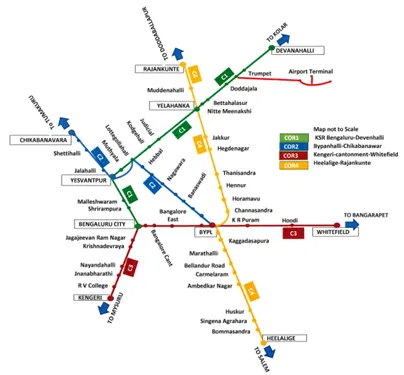
Bengaluru (Metro Rail News): Another development has been waiting for the Bengaluru Suburban Rail project as Four firms have submitted bids for construction contract C1A of Sampige Line (Line 1) spanning 41.47 km from KSR Bengaluru City to Devanahalli.
Karnataka’s Rail Infrastructure Development Company (K-RIDE) floated a tender in July 2024 for this contract with a Rs. 1422.60 crore estimate and a 2.5 construction year deadline. Furthermore, the technical bids were opened on 30 October to reveal the names of firms who had bid for the same.
Bidders
Apsara Pvt. Ltd.
Ceigall India Ltd.
NCC Ltd.
Shankaranarayana Constructions Pvt. Ltd.
Scope Of Work
The scope of work under this contract includes the construction of a section of Line 1, referred as Corridor 1A, from KSR Bengaluru to Yelahanka. The awarded contractor will build an elevated viaduct spanning 14.213 km with 5 elevated stations, a 3.417 km at-grade section with 2 stations, and a rail overbridge (ROB).
Additional Information:
The submitted four Bids have been sent for technical bid evaluation. After the completion of the technical bid evaluation, the financial bids for the qualified bidders will be opened to reveal the lowest bidder for the contract.
The Bengaluru suburban rail project has been progressing rapidly as this is the 5th civil contract which has entered the bid evaluation stage. Furthermore, the 2 contracts have been awarded to L&T, while 2 contracts are under the technical bid evaluation stage.
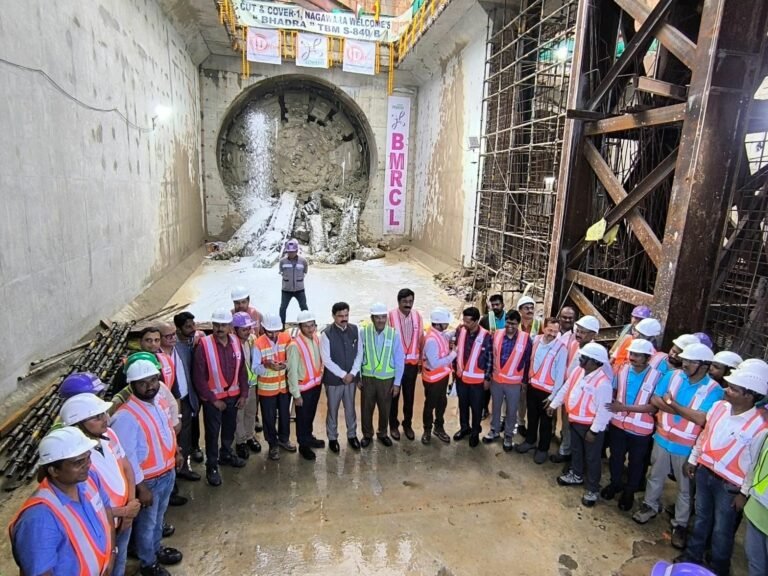
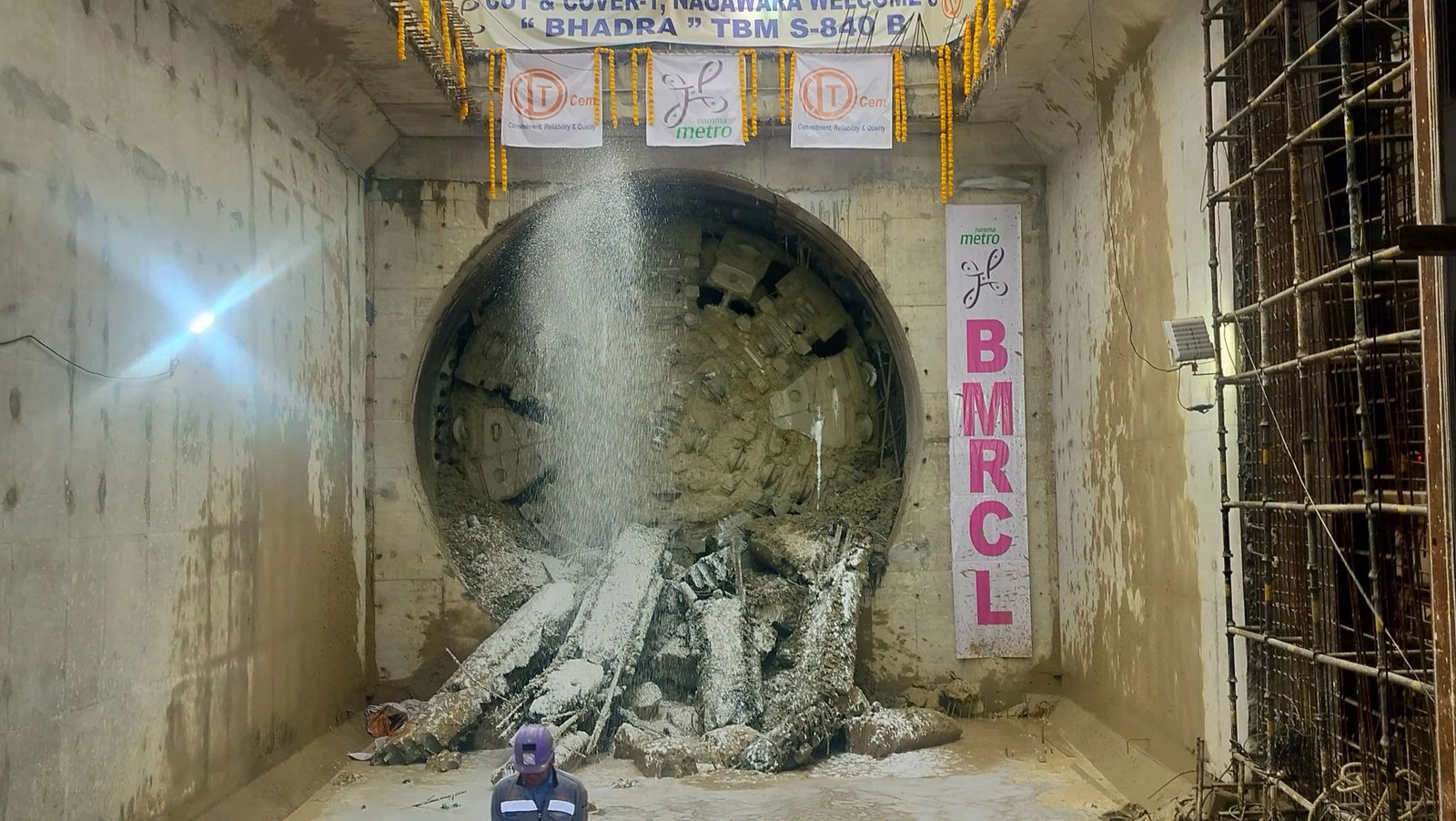
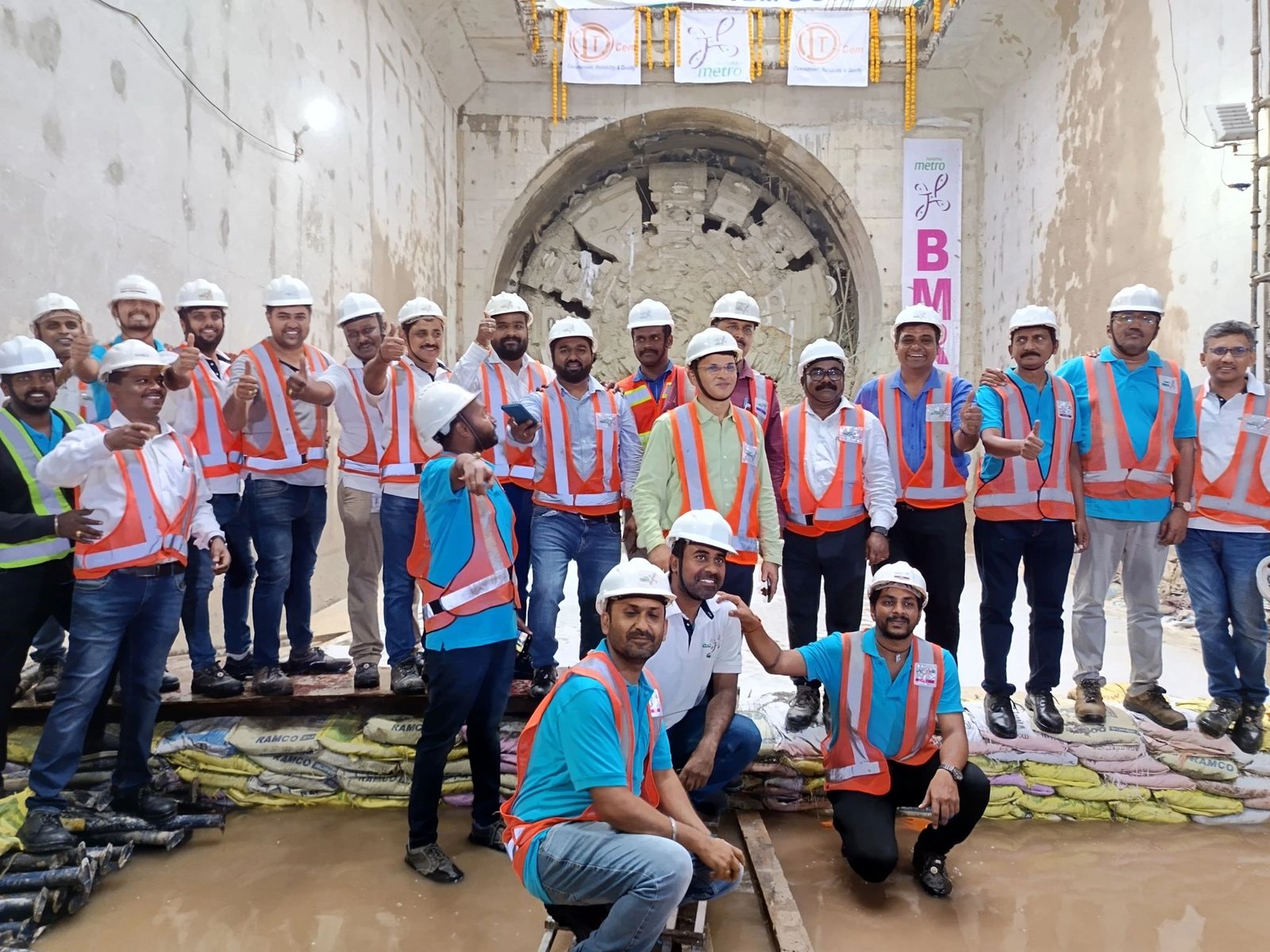
Bangalore (Metro Rail News): A major milestone has been achieved for the Bangalore Metro project as ITD Cementation India’s TBM Bandra has achieved its final breakthrough at Pink Lines’s Nagawara Station’s South Shaft on 30 October.
For its current assignment, TBM Bhadra constructed an approx 937m tunnel northward from Kadugondanahalli to Nagawara’s Cut & Cover Shaft.
Image Credit: Santhosh Gowda
This is TBM Bhadra’s 4th breakthrough and the 8th breakthrough for the Package RT-04 . Furthermore, this major milestone marks the completion of 20,992m tunnelling work for the Bangalore Metro Phase 2 project.
Current assignment
Kadugondanahalli – Nagawara C&C-1
937m
October 2024
First assignment
Venkateshpura – Tannery Road
822m
July 2022
Second assignment
Tannery Road- Shadi Mahal TBM Retrieval Shaft
222m
December 2022
Third assignment
Venkateshpura- Kadugondanahalli
1184m
February 2024
Package RT-04
Under this contract, ITS Cementation’s work involved the construction of 6.34 km twin tunnels, a roughly 360-metre ramp at Nagawara, and four underground stations:
Tannery Road
Venkateshpura
Kadugundanahalli (formerly Arabic College)
Nagawara
With this development, all 9 TBMs deployed for Bangalore Metro Phase 2 has completed their assignments for the Pink Line’s underground section spanning 13.92 km.
Bengaluru (Metro Rail News): The Bengaluru Suburban Rail project progressed as Four firms (one in a consortium) submitted Bids for the track laying contract for Mallige Line (Line 2) spanning 23.86 km from Baiyyappanahalli to Chikkabanavara.
Karnataka’s Rail Infrastructure Development Company (K-RIDE) in August 2024 floated tenders for this contract with a Rs. 102.24 crore estimate and 2 year deadline. Furthermore, the technical bids were opened on 29 October to reveal the 4 bidders.
Bidders
Apurvakriti Infrastructure Pvt. Ltd.
Rahee Infratech Ltd.
Sumcon – PPMPPL JV
Texmaco Rail and Engineering Ltd.
Bengaluru Suburban Rail (Representational image)
Scope of Work:
The scope of work under this contract includes the Design, Supply, Installation, Testing and Commissioning of Ballastless, Ballasted Track, Fastening System and Turnouts in Line 2 from Benniganahalli to Chikkabanavara spanning 23.86 km.
The contract also includes the ballasted and special tracks in Soladevanahalli Depotat Soladevanahalli Depot in north-western Bengaluru.
Additional Information:
The elevated viaduct of the Bengaluru Suburban Rail Project’s Line 2 is under construction by Larsen & Toubro (L&T). The L&T was awarded the Line-2 viaduct’s construction contract in September 2022.
The bids submitted by four firms have now been sent for technical bid evaluation. After the completion of technical bid evaluation the financial bids for the qualified bidders will be opened to reveal the lowest bidder for the contract.
Bhopal (Metro Rail News): Afcon Infrastructure was declared as the lowest bidder for the civil construction contract BH-05 for Bhopal Metro Phase 1’s Blue Line spanning 12.915 km from Bhadbhada Chauraha to Ratnagiri Tiraha via 14 elevated stations on 29 October.
MPMRCL invited bids for Package BH-05 of Blue Line in June 2023 with a Rs. 1121.63 crore estimate and a 3-year deadline. Furthermore, the technical bids were opened in October 2023, and bid evaluation was completed last week to reveal the 4 bidders who qualified through the technical round.
Financial Bid Values
Firm
Bid (Rs. Crore)
Afcons Infrastructure Ltd.
1006.74
Kalpataru – Gulermak JV
1028.49
Larsen & Toubro Ltd. (L&T)
1069.20
Tata Projects Ltd. (TPL)
1337.38
Scope of Work
The scope of work under package BH-05 includes the construction of the entire Blue Lines viaduct with the 13 stations between Bhadbhada Chauraha and Ratnagiri Tiraha, excluding the Bogda Pul (interchange) station which is a part of package BH -03 and a ramp to Subhash Nagar Depot.
Stations covered in Package BH-05 :
Bhadbhada Chauraha
Depot Chauraha
Jawahar Chowk,
Roshanpura Chauraha
Kushabhau Thakre Hall
Parade Ground
Prabhat Chauraha
Govindpura
Govindpura Industrial Area
JK Road
Indrapuri
Piplani
Ratnagiri Tiraha
Afcon’s bid of Rs. 1006.74 crores is lower than the MPMRCL estimate of Rs. 1121.63 crores. Hence, the contract will likely be awarded to Afcon in the coming weeks.
Press release ( Metro Rail News): This release from NHSRCL represents the core idea of the bullet train, expected to be completed by 2026. The bullet train stations are to be designed in a way to improve accessibility and boost economic activities around stations. Bullet train stations serve as a doorway to a contemporary lifestyle. Every stop along the Mumbai-Ahemdabad Bullet Train track will be designed to capture the essence of the city it passes through. This will foster a sense of ownership over India’s first high-speed system and establish an immediate relationship with the local population.
By integrating with other modes like rail, metro, buses, taxis, and automobiles, the stations on the alignment will be designed as a transportation centre for a smooth travel experience. This will allow for quicker and easier connectivity to and from the station. By reducing journey times, improving accessibility, and encouraging the use of public transit, such an interface will lessen traffic and pollution in the cities.
Authorities Involved
Under the Mumbai Ahmedabad High-Speed Rail project (SMART), the program aims to introduce world-class station area development techniques in partnership with the Ministry of Housing and Urban Affairs, the Ministry of Railways, the Governments of Gujarat and Maharashtra, and the Japan International Cooperation Agency (JICA), which brings decades of experience from similar successful projects in Japan.
One of JICA’s responsibilities is to provide technical advice and experience to guarantee that the TOD plans adhere to international best practices.
Four stations have been shortlisted by the City & State authorities:
Sabarmati and Surat in Gujarat
Virar and Thane in Maharashtra
TOD under Bullet train project
The surrounding regions of bullet train stations are intended to be developed in compliance with TOD (Transit Oriented Development) rules to improve passengers’ and stakeholders’ accessibility and convenience as well as to encourage economic activity around the stations.
Benefits of TOD:
1. Improved Accessibility and Reduced Congestion. The project will streamline access to the stations, offering passengers a smoother transit experience.
2. Mix use development around HSR stations at a walkable distance by developing Key Infrastructure such as corporate offices, hotels, educational institutions, and healthcare facilities around the station areas, creating a holistic urban ecosystem
3. Boost to Local Economy: The TOD initiative is expected to foster commercial activities around the stations, benefitting local businesses and contributing to the regional economy
4. Revenue Generation through Land Value Capture: The development Initiatives can be supported by Urban Planning tools such as the introduction of premium FSI/FAR Transfer of Development Rights (TDR) etc.
5. Sustainable Urban Growth: The project will promote the surrounding cities as liveable, sustainable urban centres, attracting investment and improving the quality of life for residents.
The TOD initiative is planned to be implemented in a phased manner, ensuring long-term sustainability and scalability. The project will cater to both immediate needs at the station level and broader regional development in the future.
Additional information:
Area
Description
Action/Planning
Area 1
Immediate surroundings of Bullet Train station, Pick & Drop off, Parking, development Passenger Plaza
Multi-model integration (MMI) schemes for all stations in close coordination with different state planning authorities to ensure smooth integration with the existing infrastructure of Stage 1 is already completed
Area 2
Up to 200-300 m around the station building including facilities for passengers.
The area around the station will be developed by various city authorities under the Gujarat and Maharashtra Governments This may require the incorporation of a station arca development plan in the Master Plan of the city, Development Plan and local plans. Amendment or substantive change in the policy framework such as change of bylaws, development controls, amendment of Floor Area Ration (FAR/PSI) etc. Widening of existing roads and correction in road geometry.
Area 3
Up to 500-800m around the Bullet Train station building including medium to long term development.
Influence areas beyond Area 2 are to be developed based on the city’s vision of creating its unique identity utilising the presence of HSR connectivity. This may include Urban Planning tools such as change in Land use, transfer of Development rights (TDR) etc. This area shall be developed by city authorities considering a period beyond 10 years.
Image for representation purpose only copyright: respective Authority
Current Status (as on 21 Oct 2024)
The entire land (1389.5 Ha) for the Project has been acquired.
All Civil tenders and depot tenders for the Project and Track tender for the Gujarat portion have been awarded.
Viaduct construction is in full swing.
Pier works: 8 km
Viaduct construction: 222 km
Bridges on rivers: 11
Erection of Steel bridges 5
Work is progressing on all 12 Bullet Train stations.
Installation of Noise Barriers is underway.
Progress of 42.07 km of Track bed construction has been achieved so far.
The work of a 21 km tunnel with a 7 km length passing through undersea has also started.
The undersea tunnel is about 36 m below the ground with a diameter of 12.1 m to accommodate both UP and DN tracks of Bullet Trains in one tunnel Such big big-diameter undersea tunnel is being constructed first time in India. 10 km of Tunnel out of a total of 21 km is planned to be constructed using a Tunnel Boring Machine (TBM) and the remaining 5 km by the New Austrian Tunneling method (NATM). Slurry-type TBMs with cutter head diameter of 11.6 m are being procured keeping in mind the ground conditions and reliability. Works on three shafts for lowering and retrieval of TBMS are nearing completion. Further, the 194 m long Additionally Driven Intermediate Tunnel (ADIT) is already completed and tunnel boring through NATM has taken up three faces simultaneously to pace up the work.
Bangalore ( Metro Rail News): After the Bangalore Metro Rail Corporation Ltd. (BMRCL) invited technical bids on 24th October 2024, 5 companies placed bids for the electrical and mechanical contract E&M-6 of Bangalore Metro’s 57 km Blue Line.
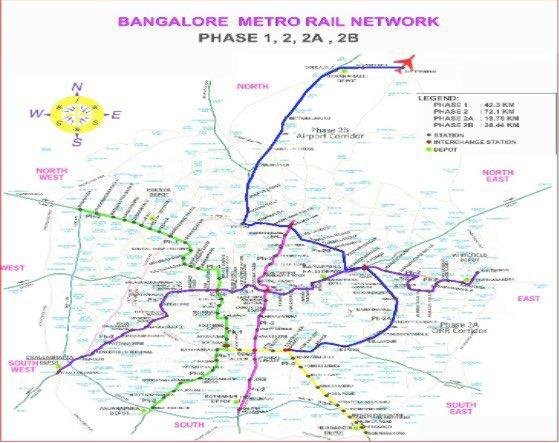
This new line (Blue Line), which is now under construction as part of Bangalore Metro’s Phase 2A (ORR Line) and Phase 2B (Airport Line) projects, would connect Silkboard to KR Puram (Phase 2A) and KR Puram to Bengaluru International Airport ( Phase 2B). It would feature 30 stations on NH-44 and the Outer Ring Road national highway.
PACKAGE E&M-6
This critical systems contract covers E&M work at 28 stations, two traction substations (TSS), and the approximately 718-meter cut and cover section next to the Yelahanka Air Force Station, including LT panels, LT cables, lighting, hydraulics, fire safety systems, UPS, DG sets, HVAC, and BMS.
A different contract will cover E&M’s work at the KIA Terminals Station and the Airport City Metro Station (also called KIA West Station).
In September 2024, BMRCL released a bid invitation for Package E&M-6, with a 1.5-year completion timeline and an estimated cost of 183 crore.
Bidders who have submitted bids for the contract are:
The technical bid examination of the bids has now begun and may take several months to finish. Following that, the lowest bidder and most likely contractor will be identified by opening the financial bids of the technically qualified bidders.
Further development procedure
As per the ongoing construction, Phase 2A will open no earlier than Q4 2026 and Phase 2B opening no earlier than Q3 2027, given the current course of events.
The first batch of BEML trains from rolling stock contract 5RS-DM will probably be used to service Phase 2’s 21.38 km Pink Line, which is at a more advanced stage of construction, hence the Blue Line will experience train-related delays, just like the Yellow Line. In Q4 2025, the first of 53 trains from BEML’s nearby Bengaluru complex at CV Raman Nagar is expected to begin service.