
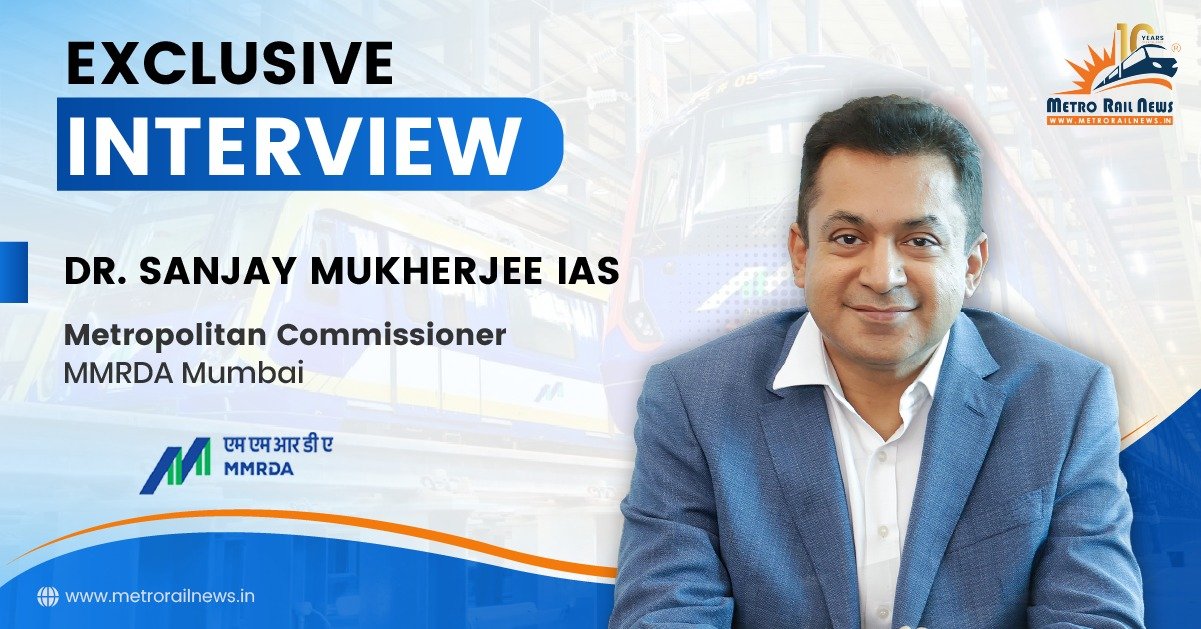
During an interaction with Metro Rail News, Mr. Sanjay Mukherjee, IAS, Metropolitan Commissioner of MMRDA, explained how the Mumbai Metro has progressed from a predominantly paper-based ticketing system to a fully digital model. He emphasised India’s first unified ticketing platform, the “Mumbai One App”, which brings metro, railways, buses, and monorail services together on a single interface. Mr. Mukherjee expressed that moving from paper tickets to digital options has improved system availability, eased station-level congestion, and lowered operational costs. He reiterated that digital ticketing is no longer just a convenience feature; it has become a core component that strengthens operations, improves revenue, and makes public transport more convenient. Here are the edited excerpts:

Q1. What has been the scale and pace of Mumbai Metro’s transition from paper-based ticketing to digital platforms?
Over the last 3 years, the Mumbai Metro has undergone a rapid shift from a system that relied almost entirely on paper-based QR tickets to one where digital transactions form the majority of ticketing activity. According to Maha Mumbai Metro Operation Corporation Limited (MMMOCL), Metro Lines 2A & 7 now record more than 67% of daily ticketing through digital modes, compared to a more than 90% dependence on paper QR tickets in 2022.
This transition has helped reduce congestion at station counters, as fewer passengers now need to queue for paper tickets. It has also lowered the operational effort involved in handling physical tickets. As per the officials, this digital shift has not only improved day-to-day station management but has also positioned the system to support integrated and multimodal travel across the Mumbai Metropolitan Region (MMR).
Q2. What operational challenges did the metro face when it began with paper-only ticketing in April 2022?
When Phase 1 of Metro Lines 2A and 7 (Aarey–Dahanukarwadi) began operations in April 2022, the system depended entirely on paper-based QR tickets. These were issued through station counters, customer care points, and Ticket Vending Machines (TVMs).
A very high volume of paper QR tickets had to be printed every day, which created steady pressure on both staff and equipment. Long queues were common at counters during peak hours, as every transaction involved issuing a physical ticket. The large consumption of paper rolls added to day-to-day operational costs, and the continuous printing of QR codes caused frequent wear and tear of the AFC equipment.
Additionally, the old system relied on heavy manpower that had to be deployed for cash handling, crowd control, and ticketing support, adding to operational load. According to officials, these early difficulties indicated that a shift to digital ticketing would be necessary to manage growing ridership and improve system efficiency.
Q3. How did the launch of the Mumbai 1 NCMC card support the vision of paperless ticketing?
The turning point came in January 2023, when the Hon’ble Prime Minister launched the Mumbai 1 National Common Mobility Card (NCMC) while inaugurating Mumbai Metro Line 2A & 7. Unlike closed-loop cards used in some other metros, Mumbai opted for an open-loop, bank-issued model, which allows wider usage and supports nationwide interoperability.
Key commuter products introduced:
Tourist Pass (Unlimited rides):
- 1-Day Pass-80
- 3-Day Pass-200
Store Value Pass:
- 5% discount on weekdays
- 10% discount on Sundays & national holidays
Trip Passes:
- 45 trips-15% discount
- 60 trips-20% discount
- 25% discount for senior citizens, persons with disabilities, and students (up to Class 12)
Simultaneously, the Automatic Fare Collection (AFC) system was upgraded to accept about 30 NCMC variants issued by different banks, ensuring the system could support multiple card types. This phase resulted in around 35% adoption of paperless ticketing, along with reduced queues and quicker gate validations.
Q4. What additional initiatives were taken to widen access and support high-frequency commuters?
To make metro travel more accessible and convenient for regular commuters, MMRDA introduced several initiatives. One of the key steps was the launch of NFC-enabled wearable devices such as smartwatches, wristbands, rings, and keychains. These wearables allowed commuters to pass through entry gates quickly without needing to handle a card, making travel faster and more convenient.
In addition, MMRDA made its ticketing system more widely available by opening its APIs through the ONDC (Open Network for Digital Commerce) platform. This allowed third-party apps to integrate metro ticketing directly, creating more options for commuters to buy tickets without relying solely on the metro’s own infrastructure. Eight apps, including Pelocal, One Ticket, Yatri Railways, Red Bus, Trip Ozo, EaseMyTrip, Tummoc, Highway Delite, and Nav,i were connected through this system. According to officials, this integration helped in reducing marketing costs, reaching more users, and building a multi-partner ticketing ecosystem for commuters.
Q5. How did the introduction of WhatsApp ticketing in October 2024 change commuter behaviour and digital adoption rates?
MMRDA conducted detailed studies on commuter behaviour and found that passengers preferred using platforms they were already familiar with for daily transactions. Based on these insights, WhatsApp ticketing was introduced in October 2024 to provide a simpler and more convenient way to purchase metro tickets. The adoption of this service was immediate: within a few months, WhatsApp accounted for 23% of total ticketing, paper ticket usage decreased proportionally, and queues at ticket counters were noticeably shorter. When combined with other digital ticketing modes, over 67% of all tickets were being purchased digitally. Officials described this development as Mumbai reaching a “digital tipping point,” showing that familiarity and ease of access were key factors in increasing digital adoption.
Q6. What operational improvements were observed after digital adoption increased?
MMRDA reported that the rise in digital ticketing led to noticeable improvements in revenue, AFC performance, and manpower utilisation across the metro system.
Ticketing Mode Shift
The rise in digital adoption brought a clear change in how commuters purchased tickets. Paper ticket usage dropped by around 33%, while NCMC cards grew to about 43% of the overall share. WhatsApp, which had no presence earlier, quickly reached nearly 22%, and mobile app-based options and other digital modes also increased from almost zero to a noticeable share.
Revenue Improvements
According to MMRDA, digital ticketing directly contributed to revenue performance. Peak-hour transactions became faster, helping convert more passengers quickly. The issues, including ticketing leakage and cash-handling discrepancies, led to a decline in cash transactions. The digital platforms, such as NCMC and ONDC-linked channels, also encouraged more recurring travellers, which improved revenue stability.
AFC System Benefits
The improvements were also visible in the Automatic Fare Collection system. Lower QR ticket printing reduced strain on AFC equipment, which led to fewer failures and less maintenance. NFC-based ticketing enhanced gate throughput and faster validation times, which optimised crowd movement during peak periods.
Manpower Optimisation
The shift to digital modes lowered the need for staffing at physical ticket counters, as fewer commuters depended on paper tickets. This transition also decreased the cash-handling tasks. As per the officials, these operational changes not only extended AFC equipment life but also reduced the cost incurred per ticket.
Q7. Why is the Mumbai One App being seen as a game-changer for Mumbai, and how does this app improve the overall travel experience for people across the region?
The Mumbai One Unified Mobility App was introduced in October 2025, and it is India’s first platform to unify ticketing and travel information across Metro, monorail, suburban rail and bus services. The app integrates 11 operators, including Metro Lines 1, 2A, 7, 3 and the Navi Mumbai Metro, the Western, Central, Harbour and Trans-Harbour railway networks, bus services such as BEST, NMMT, MBMT and TMT, and the Monorail. More services like auto-rickshaws, radio taxis and other feeder modes are planned to be added.
Through this app, commuters can plan routes based on cost, time or convenience. They can also purchase tickets for different modes in a single transaction, which supports easy movement across the metro, bus and train systems. The app also covers first- and last-mile requirements and provides a unified wallet and a common QR system for all available transport modes.
Officials have described this platform as the foundation of “One MMR Mobility,” where the focus is on giving commuters one continuous travel experience rather than separating services by operator.
Q8. What does the Mumbai Metro’s ticketing transformation indicate for future urban mobility systems?
The ticketing transformation on Mumbai Metro Lines 2A and 7 shows how urban mobility systems are moving toward greater efficiency, financial stability, and commuter-focused design. The shift from lakhs of paper QR tickets to NCMC cards, NFC wearables, WhatsApp ticketing and, most recently, the Mumbai One app illustrates how a corridor can evolve into a fully integrated digital mobility model. According to officials, this journey proves that digital ticketing is no longer just an add-on for convenience. Instead, it has become a fundamental element that strengthens operations, supports revenue growth, and makes public transport more reliable..
In what ways the platforms like the Mumbai One app changing commuter behaviour and improving the overall travel experience across the city?
Digital ticketing isn’t just a tech upgrade, it is a behavioural shift. When our systems work seamlessly together, the city moves with far greater ease. And when mobility becomes intuitive through familiar platforms like WhatsApp and a single unified app, travel suddenly becomes simpler and far less stressful. Mumbai One App brings all operators together on one platform is already changing the way Mumbai moves, simplifying decisions, speeding up journeys, and reducing the stress of daily travel. At its heart, One MMR Mobility is about respecting people’s time and giving them one smooth journey across the entire region, no matter which mode they choose.
Join the 6th edition of InnoMetro to explore how the progressions in AI are improving the railway systems, including ticketing, rolling stock, and signalling. Witness the innovation from 200+ exhibitors at India’s leading show for metro & railways which is going to held on 21-22 May 2026 at Bharat Mandapam, New Delhi
Register now: https://innometro.com/visitor-registration/