


Page 16 - Demo
P. 16
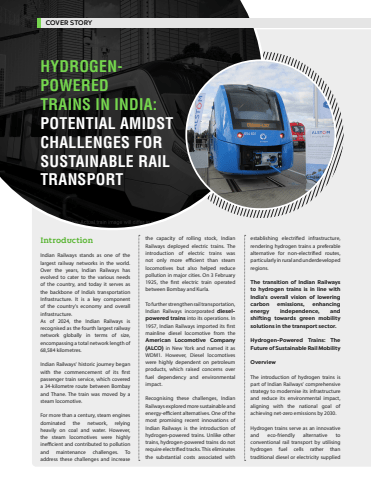
HYDROGENPOWERED TRAINS IN INDIA: POTENTIAL AMIDST CHALLENGES FOR SUSTAINABLE RAIL TRANSPORTIntroductionIndian Railways stands as one of the largest railway networks in the world. Over the years, Indian Railways has evolved to cater to the various needs of the country, and today it serves as the backbone of India%u2019s transportation Infrastructure. It is a key component of the country's economy and overall infrastructure.As of 2024, the Indian Railways is recognised as the fourth largest railway network globally in terms of size, encompassing a total network length of 68,584 kilometres.Indian Railways' historic journey began with the commencement of its first passenger train service, which covered a 34-kilometre route between Bombay and Thane. The train was moved by a steam locomotive.For more than a century, steam engines dominated the network, relying heavily on coal and water. However, the steam locomotives were highly inefficient and contributed to pollution and maintenance challenges. To address these challenges and increase the capacity of rolling stock, Indian Railways deployed electric trains. The introduction of electric trains was not only more efficient than steam locomotives but also helped reduce pollution in major cities. On 3 February 1925, the first electric train operated between Bombay and Kurla.To further strengthen rail transportation, Indian Railways incorporated dieselpowered trains into its operations. In 1957, Indian Railways imported its first mainline diesel locomotive from the American Locomotive Company (ALCO) in New York and named it as WDM1. However, Diesel locomotives were highly dependent on petroleum products, which raised concerns over fuel dependency and environmental impact. Recognising these challenges, Indian Railways explored more sustainable and energy-efficient alternatives. One of the most promising recent innovations of Indian Railways is the introduction of hydrogen-powered trains. Unlike other trains, hydrogen-powered trains do not require electrified tracks. This eliminates the substantial costs associated with establishing electrified infrastructure, rendering hydrogen trains a preferable alternative for non-electrified routes, particularly in rural and underdeveloped regions. The transition of Indian Railways to hydrogen trains is in line with India's overall vision of lowering carbon emissions, enhancing energy independence, and shifting towards green mobility solutions in the transport sector.Hydrogen-Powered Trains: The Future of Sustainable Rail Mobility OverviewThe introduction of hydrogen trains is part of Indian Railways' comprehensive strategy to modernise its infrastructure and reduce its environmental impact, aligning with the national goal of achieving net-zero emissions by 2030. Hydrogen trains serve as an innovative and eco-friendly alternative to conventional rail transport by utilising hydrogen fuel cells rather than traditional diesel or electricity supplied COVER STORY


