


Page 17 - Demo
P. 17
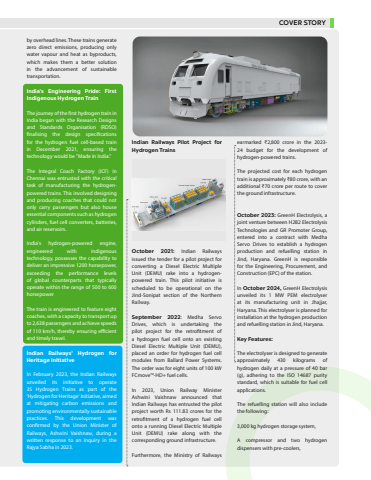
COVER STORYby overhead lines. These trains generate zero direct emissions, producing only water vapour and heat as byproducts, which makes them a better solution in the advancement of sustainable transportation. India's Engineering Pride: First Indigenous Hydrogen Train The journey of the first hydrogen train in India began with the Research Designs and Standards Organisation (RDSO) finalising the design specifications for the hydrogen fuel cell-based train in December 2021, ensuring the technology would be \The Integral Coach Factory (ICF) in Chennai was entrusted with the critical task of manufacturing the hydrogenpowered trains. This involved designing and producing coaches that could not only carry passengers but also house essential components such as hydrogen cylinders, fuel cell converters, batteries, and air reservoirs.India's hydrogen-powered engine, engineered with indigenous technology, possesses the capability to deliver an impressive 1200 horsepower, exceeding the performance levels of global counterparts that typically operate within the range of 500 to 600 horsepowerThe train is engineered to feature eight coaches, with a capacity to transport up to 2,638 passengers and achieve speeds of 110 km/h, thereby ensuring efficient and timely travel.Indian Railways%u2019 Hydrogen for Heritage InitiativeIn February 2023, the Indian Railways unveiled its initiative to operate 35 Hydrogen Trains as part of the 'Hydrogen for Heritage' initiative, aimed at mitigating carbon emissions and promoting environmentally sustainable practices. This development was confirmed by the Union Minister of Railways, Ashwini Vaishnaw, during a written response to an inquiry in the Rajya Sabha in 2023. Indian Railways Pilot Project for Hydrogen TrainsOctober 2021: Indian Railways issued the tender for a pilot project for converting a Diesel Electric Multiple Unit (DEMU) rake into a hydrogenpowered train. This pilot initiative is scheduled to be operational on the Jind-Sonipat section of the Northern Railway. September 2022: Medha Servo Drives, which is undertaking the pilot project for the retrofitment of a hydrogen fuel cell onto an existing Diesel Electric Multiple Unit (DEMU), placed an order for hydrogen fuel cell modules from Ballard Power Systems. The order was for eight units of 100 kW FCmove%u2122-HD+ fuel cells. In 2023, Union Railway Minister Ashwini Vaishnaw announced that Indian Railways has entrusted the pilot project worth Rs 111.83 crores for the retrofitment of a hydrogen fuel cell onto a running Diesel Electric Multiple Unit (DEMU) rake along with the corresponding ground infrastructure.Furthermore, the Ministry of Railways earmarked %u20b92,800 crore in the 2023-24 budget for the development of hydrogen-powered trains.The projected cost for each hydrogen train is approximately %u20b980 crore, with an additional %u20b970 crore per route to cover the ground infrastructure.October 2023: GreenH Electrolysis, a joint venture between H2B2 Electrolysis Technologies and GR Promoter Group, entered into a contract with Medha Servo Drives to establish a hydrogen production and refuelling station in Jind, Haryana. GreenH is responsible for the Engineering, Procurement, and Construction (EPC) of the station.In October 2024, GreenH Electrolysis unveiled its 1 MW PEM electrolyser at its manufacturing unit in Jhajjar, Haryana. This electrolyser is planned for installation at the hydrogen production and refuelling station in Jind, Haryana.Key Features:The electrolyser is designed to generate approximately 430 kilograms of hydrogen daily at a pressure of 40 bar (g), adhering to the ISO 14687 purity standard, which is suitable for fuel cell applications.The refuelling station will also include the following:3,000 kg hydrogen storage system, A compressor and two hydrogen dispensers with pre-coolers,


