
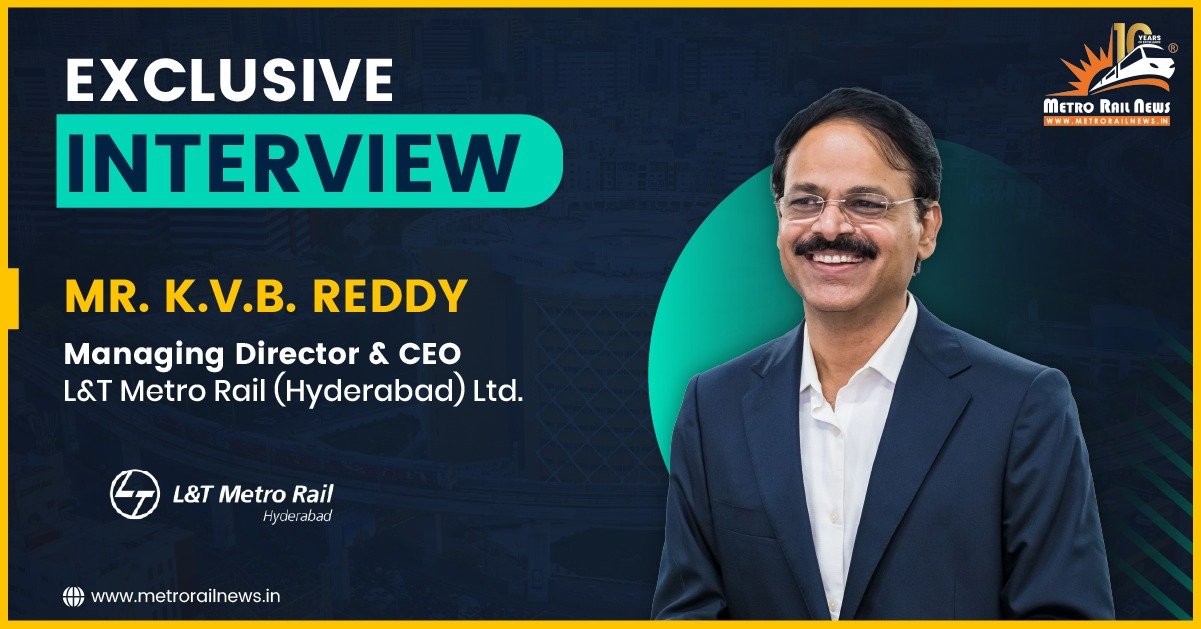
Metro Rail News conducted an exclusive interview with Mr. K.V.B. Reddy, MD & CEO of L&TMRHL. In the discussion, Mr. Reddy outlined the operational performance of Hyderabad Metro, highlighting its 99.99% punctuality and overall system reliability. He also detailed the measures undertaken to improve ridership, including last-mile connectivity initiatives, multimodal integration through feeder services, and partnerships in e-mobility solutions.

Mr. Reddy explained that L&TMRHL’s decision to exit the project was based on long-term financial sustainability considerations. He further discussed the need to strengthen the ecosystem for PPPs in large infrastructure projects. According to him, policymakers should continue to develop frameworks that combine private-sector operational expertise with public-sector stability, while private entities must account for long gestation periods and the service-oriented nature of urban transit systems. He said that with transparent processes and shared accountability, PPPs can remain a viable model for urban mobility in India. Here are the edited excerpts:
1. Could you walk us through your illustrious professional journey spanning over 4 decades?
My journey over the last four decades has spanned power, infrastructure, and large-scale public mobility systems. I began in 1983 with NTPC Delhi as an Engineering Executive Trainee and spent over 12 years building a strong foundation in planning and systems operations. After rising to Manager (Planning & Systems – NCR), I moved to Essar Group in 1995, where I spent 22 pivotal years leading diverse EPC and power-sector projects, eventually heading Essar Power Limited as CEO. In 2017, I took charge of L&T Metro Rail (Hyderabad) Limited, leading the ₹20,000-crore Hyderabad Metro Rail Project world’s largest PPP metro system. Under this journey, the Metro has grown into a backbone of Hyderabad’s mobility, having carried 780 million commuters until 31st October 2025. Professionally, the transition from power systems to urban mass transit gave me the opportunity to apply technical, commercial, and strategic experience to a project that directly serves citizens daily. It reinforced my belief that integrity, fairness, and disciplined execution remain the timeless pillars of impactful leadership.
2. What have been your key learnings from handling a project of this scale and complexity under constant public and political scrutiny?
Managing Hyderabad Metro has shown me that transparency, responsiveness, and operational excellence are non-negotiable when you serve millions. A metro system is evaluated every minute by its users, and that shapes a leadership environment where accountability becomes instinctive. The Metro’s steady ridership growth crossing 780 million cumulative journeys has reaffirmed that when you consistently deliver safety, on-time performance, and reliability, public trust becomes your strongest asset. With Hyderabad ranking No. 1 in India for On-Time Performance at 99.99% in FY24, ahead of every other member metro system, it became clear that delivering service excellence under scrutiny requires relentless discipline, constant feedback loops, and empathy for daily commuter realities.
3. Hyderabad Metro, the world’s largest metro project built on a PPP model, has reached a critical juncture with L&T’s decision to exit the project. Could you walk us through the primary commercial and operational factors that led to this decision?
Hyderabad Metro’s operational success has been unquestionably reflected in industry-leading KPIs such as Operating Revenue to Operating Cost ratio of 3.22, the highest among all Indian metros in FY24. The system is also highly cost-efficient, with a Service Operations Cost of just ₹4,861 per train hour, the best performance nationally.
However, PPP viability depends on long-term financial alignment, and evolution rate of ridership or rate of model shift across India including Hyderabad have evolved slower than originally forecasted. Even with good ridership the revenue curve of a ₹20,000-crore capital-intensive PPP project remains extended. Constraints in unlocking non-fare revenue in India, unlike global metros where it contributes nearly half of total income, also impacted long-term financial balance. The pandemic further disrupted early-year projections, creating structural imbalance. L&T’s decision was therefore a responsible business call ensuring that the system transitions into a framework that supports its long-term sustainability while safeguarding commuter experience.
4. Could you elaborate on L&TMRHL’s initiatives for first- and last-mile connectivity and sustainability?
Our philosophy has always been that a metro is only as strong as its accessibility. Over the years, we have strengthened multimodal integration through feeder services, e-mobility partnerships, expanded pedestrian access, and re-engineered interchange flows. These access improvements have played a major role in Hyderabad Metro reaching 216.77 million passenger journeys in FY24, making it one of the highest-utilised metro systems in the country.
From a sustainability standpoint, Hyderabad Metro has emerged as one of the top performers in India, reflected in its Energy Efficiency KPI ranking among the top metros for FY24, driven by regenerative braking systems, LED-covered stations, rainwater harvesting structures, and solar capacity across depots. These infrastructural choices ensure that even as ridership grows, the environmental footprint per commuter continues to decrease, positioning Hyderabad Metro as a resilient, future-ready transportation system.

5. What are the key successes of the PPP model that L&T demonstrated, despite the financial outcome?
Hyderabad Metro is a compelling showcase of what the PPP model can achieve even under financial headwinds. The project delivered engineering outcomes at par with global standards while maintaining India’s No. 1 On-Time Performance (99.99%), No. 1 Maintenance Performance, and the best Service Operations Cost in the country (₹4,861 per train hour). Its Cost per Passenger Journey of ₹20.04 is the second-best in India, demonstrating exceptional operational efficiency even when benchmarked against older, government-funded systems. Public acceptance has been equally strong, with the Metro crossing 780 million passenger rides. Beyond operational excellence, the Metro has catalysed urban transformation in IT corridors, business districts, and residential zones, validating the larger urban-development thesis behind PPP in transit.
6. What structural and policy gaps must India address to make PPPs more sustainable?
If India wants more PPPs in urban transit, financial and institutional frameworks must evolve to reflect ground realities. Metro projects require decades to mature, and ridership projections across Indian cities including Hyderabad have consistently stabilised more slowly than initial models anticipated. Even with strong KPIs, such as Hyderabad’s Operating Revenue to Operating Cost ratio of 3.22 (No. 1 nationally), farebox income alone cannot sustain a capital-intensive PPP system. India needs more enabling policies for non-fare revenue generation, land value capture, station commercialisation, and integrated urban planning. Flexible concession models capable of absorbing shocks like pandemics—are essential, as are ridership forecasting standards aligned with actual commuter behaviour. PPPs thrive when public and private expectations align around shared risk, long-term viability, and adaptive financial frameworks.
7. How is L&TMRHL coordinating with the Telangana government to maintain service continuity during this transition?
Our coordination with the Government of Telangana and HMRL has been structured, transparent, and continuous. Detailed system documentation, technical audits, and operations mapping are being conducted collaboratively to ensure the transition does not impact daily service. Even during this phase, the Metro continues to maintain India’s top performance standards, including 99.99% punctuality, best-in-country maintenance performance, and consistently high car availability. With cumulative ridership reaching 780 million by October 2025, the priority is to ensure that commuters experience absolute continuity. Every operational team signalling, rolling stock, station management, and safety is aligned with government bodies to keep service delivery smooth, reliable, and completely unaffected during transition.

8. What financial structuring lessons can future PPP metro projects in India learn from Hyderabad Metro?
Hyderabad Metro highlights that long-term financial sustainability of PPP metros depends on diversified revenue, conservative ridership assumptions, and built-in flexibility. Despite having one of the strongest operational profiles in India ₹20.04 cost per journey (2nd best), ₹2.22 cost per passenger-km (2nd best), and the lowest service cost per train-hour (₹4,861) farebox-dependent PPP frameworks remain vulnerable to macro disruptions.
Financial models must therefore explicitly factor multi-year gestation periods and allow periodic restructuring. Non-fare revenue and transit-oriented development must be central to the model rather than supplementary. Hyderabad Metro’s experience reinforces that PPP success rests not just on operational excellence but on financial constructs that evolve alongside the city and the economy.
9. What message would you like to convey to policymakers and private players exploring PPPs in urban transit?
PPPs are powerful engines for accelerating India’s transit infrastructure, but they demand long-term vision, calibrated risk-sharing, and policy ecosystems that evolve with real-world conditions. Hyderabad Metro’s operational performance top national rankings in punctuality, maintenance, and operating efficiency demonstrates what private-sector engineering, strategy, and discipline can deliver. The ridership of 780+ million ridership is proof of the social impact such partnerships can create. Policymakers should continue to foster models that blend private-sector expertise with public-sector stability, while private players must recognise the long gestation and public-service ethos intrinsic to urban transit. When rooted in transparency and shared accountability, PPPs can redefine mobility outcomes in India.
10. How do you envision the future of private-sector participation in India’s metro ecosystem?
The future will likely shift toward hybrid models where the private sector participates deeply in EPC, operations, technology, fare collection, and commercial development, even if full DBFOT structures evolve. India’s metros will require private innovation in areas such as AI-driven operations, energy management, digital ticketing, demand forecasting, and passenger experience. The performance benchmarks Hyderabad has set such as leading the country in punctuality, maintenance, and service cost efficiency show how private-sector capability elevates transit systems. As Indian cities grow denser and mobility needs intensify, public–private co-creation will become essential for delivering high-quality, financially resilient, and commuter-centric metro networks.
Join the 6th edition of InnoMetro to explore how the progressions in AI are improving the railway systems, including ticketing, rolling stock, and signalling. Witness the innovation from 200+ exhibitors at India’s leading show for metro & railways which is going to held on 21-22 May 2026 at Bharat Mandapam, New Delhi
Register now: https://innometro.com/visitor-registration/