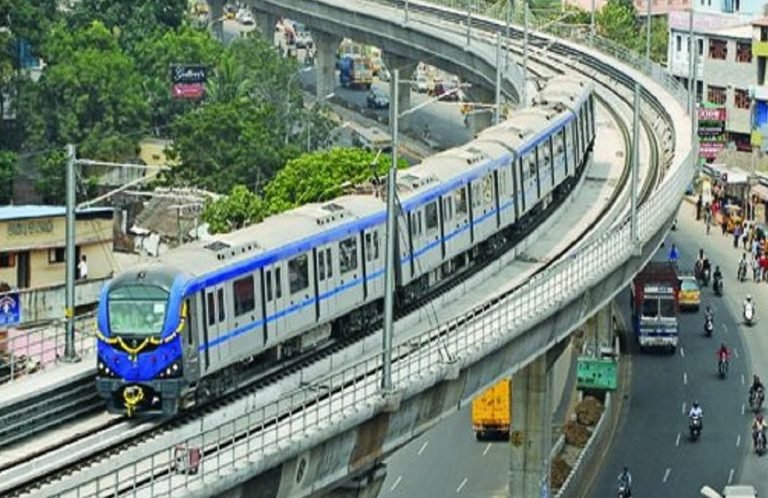
Chennai Metro opens recruitment process for 14 posts

CHENNAI (Metro Rail News): Chennai Metro Rail Limited has released a recruitment notification for 14 contractual and deputation posts for which eligible candidates can apply up to 14th May.

For the recruitment notification, application form and other details, visit the Careers portal on https://chennaimetrorail.org/ Here are more details about the posts.

Contractual: 

General Manager (Signalling & Telecom): 1 post

General Manager (Operations): 1 post

General Manager (Electrical): 1 post

General Manager (Human Resources): 1 post

General Manager (Planning & Business Development) 1 post

Additional General Manager (Underground Construction): 2 posts

Additional General Manager (IT & AFC): 1 post

Joint General Manager (Underground Construction): 1 post

Joint General Manager (Architecture): 2

Deputy General Manager (Marketing): 1

Deputy Manager (Transport Planning): 1

Chief Vigilance Officer: 1

The applications for these posts have to be submitted offline. Candidates “should submit the duly filled application form as per attached format in hardcopy along with prescribed application fee (DD/NEFT) supported by Bio-Data and one set of self-attested copies of educational qualification certificate, experience certificate, birth certificate, community certificate and latest passport size photo through proper channel to the following address on or before 14-May-2022,” as per an official statement. 

The address to send applications is: 

Joint General Manager (HR)

Chennai Metro Rail Limited, CMRL Depot, Admin Building, Poonamallee High Road, Koyambedu, Chennai – 600107. 

To check eligibility and other details, click here.
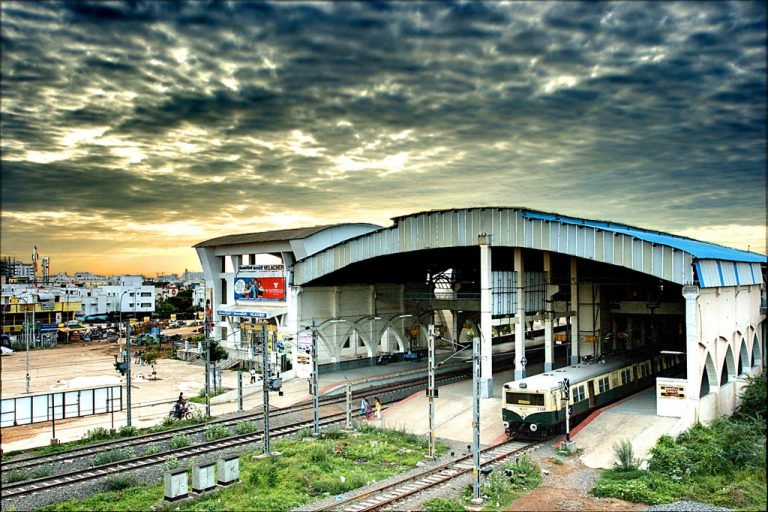
Southern Railways to set up CCTV cameras at 26 railway stations in Chennai

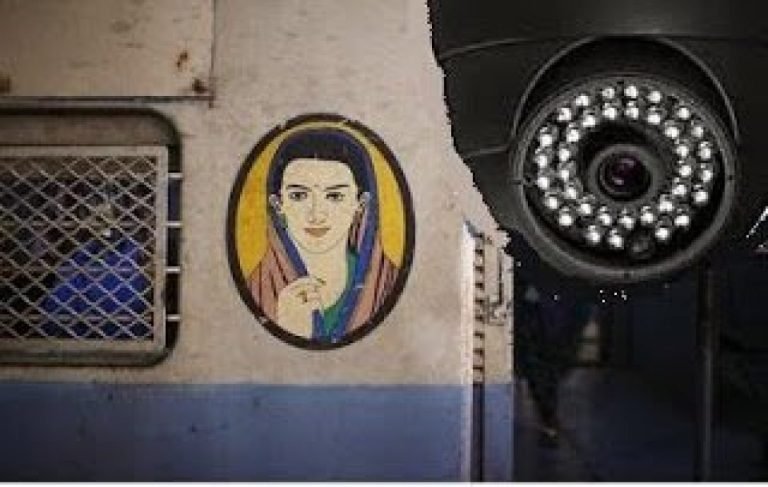
CHENNAI (Metro Rail News): Southern Railways has accelerated the work of setting up CCTV cameras at 26 city railway stations in Chennai and aims to complete the work by November this year. These cameras will be installed at 74 stations in the Chennai division under Nirbhaya fund which will improve security and reduce crime against commuters.

The 14 mass rapid transit system (MRTS) stations include Chintadripet, Chepauk, Light House, Perungudi, and Taramani, Thiruvallikeni, Indira Nagar which are huge buildings that remain largely deserted with little surveillance will come under CCTV surveillance by November this year together with 12 suburban stations on the Beach Tambaram route.

The MRTS stations will have 12 CCTV cameras installed while a majority of the suburban stations on the Beach-Tambaram route will get 24 CCTV cameras. Bigger stations like MMC and Fort will have more than 30 cameras.

“The platform, concourse and entry and exit level will be covered in the MRTS stations. Work is in progress and will be completed by November. Railways has sanctioned Rs 2014crore under Nirbhaya fund for the zone for the cameras,” said Southern Railway, chief public relations officer B Guganesan, TOI reported.

Apart from stations within the city, 30 stations on Chennal-Arakkonam route and 16 stations on Chennai-Gummidipoond route will also get CCTV cameras soon.

Seven stations-Nungambakkam, Arakkonam St Thomas Mount. Pazhavanthangal Jolarpet. Changa bet, Thirumalla are already under CCTV surveillance.

6 firms bid for MRTS feasibility in Salem, Tiruchirappalli & Tirunelveli

CHENNAI (Metro Rail News): Chennai Metro Rail Ltd (CMRL) opened technical bids on Thursday after which 6 firms have submitted bids to prepare a Feasibility Study Report for introducing a mass rapid transit system (MRTS) in Salem, Tiruchirappalli & Tirunelveli.

CMRL invited bids for this new contract- ‘2021- DFR for Tier II Cities’ in February 2022 with a deadline of 122 days.

The 6 bidders are as follows:

  • Aarvee Associates Architects Engineers and Consultants Private Ltd.
  • Balaji Railroad Systems Private Ltd. (BARSYL)
  • L&T Infrastructure Engineering Ltd.
  • Rina Consulting SpA
  • RITES Ltd.
  • Urban Mass Transit Company Ltd. (UMTC)

The scope of this contract includes Selection of Consultant for Preparation of Feasibility Study Report for Introducing a Mass Rapid Transit System in Tiruchirappalli, Tirunelveli, Salem City.

All the bids have been sent for technical evaluation which can take a couple of months to complete. After the completion, the financial bids of the technically qualified bidders will be opened to reveal the lowest bidder and most likely the consultant.

Delhi-Meerut RRTS corridor to get its first set of trains by May

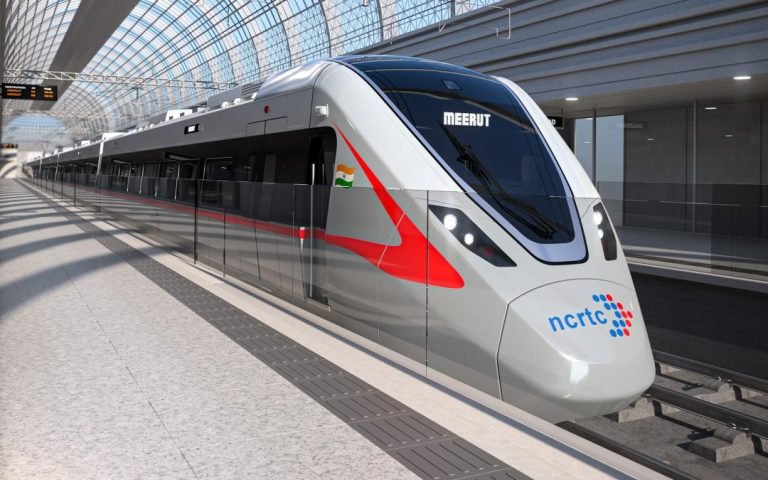
GHAZIABAD (Metro Rail News): The 17 km-long priority section of Delhi-Ghaziabad-Meerut RRTS corridor which has a total of five stations that are Sahibabad, Ghaziabad, Vasundhara, Guldhar, Duhai and Duhai depot is going to get its first set of trains by May, said officials. It will arrive from the Savli plant, Gujarat to Duhai depot.

“The launch of the last span of Package 1 (Sahibabad to Ghaziabad) on the 17 km-long priority section was completed on Tuesday. At present, the track laying work near the Duhai depot is also being carried out at pace. This depot is taking shape rapidly, where the first RRTS train set is expected to arrive from Savli, Gujarat next month,” said a senior NCRTC official.

The officials informed that the construction work here is being executed in two packages, first between Sahibabad to Ghaziabad and second between Ghaziabad and Duhai.

“The construction of the entire span in package 1 is now complete. The installation of signalling and telecom systems in both the packages will also speed up. The road ahead for the implementation of the Over Head Electrical (OHE) wires is now clear, and the track laying work is being carried out within its stipulated time frame,” said the official.

“The first train set will have six coaches, including one business coach and a car reserved for female passengers. Once the train set arrives, the trial runs will start. In the beginning, it will start step-by-step, but a proper trial run on the entire priority section will commence by the end of this year,” the official added.

The priority section between Sahibabad to Duhai depot will be operational for public use by March next year.

NCC casts Patna Metro’s first pier cap

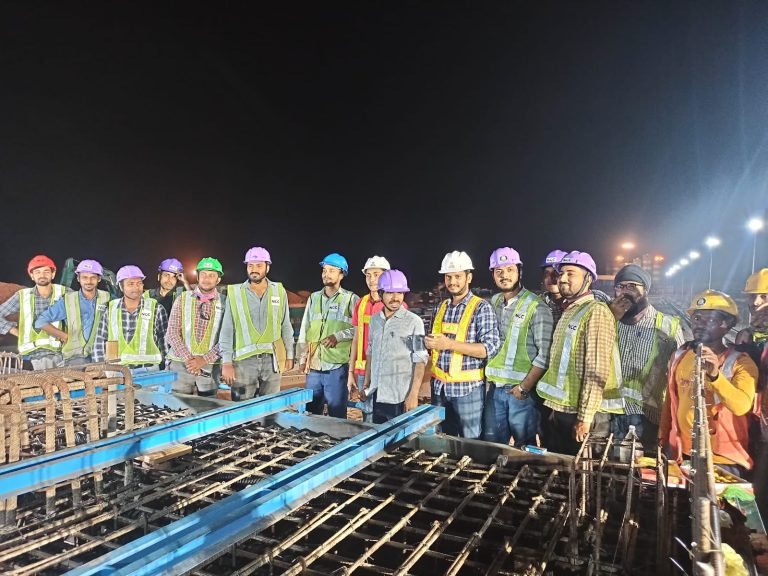
PATNA (Metro Rail News): NCC Limited has cast Patna Metro‘s first pier cap on Thursday, 28th April. NCC was awarded Package PC-01’s Rs 552.93 crore contract by the Delhi Metro Rail Corporation (DMRC) in September 2020 with a 30-month deadline.

DMRC invited tenders for this section’s construction on February 28, 2020, with an estimated cost of Rs. 514.924 crore and opened technical bids in June which revealed 5 bidders that are as follows:

FirmBid
NCC LimitedRs. 552.93 crore
Sam (India) Builtwell Pvt. Ltd.Rs. 561.96 crore
SP Singla Constructions Pvt. Ltd.Rs. 589.84 crore
GR Infraprojects Ltd.Rs. 667.09 crore

NCC began groundwork for Patna Metro Phase 1 in November 2020, followed by piling for construction in December 2020.

The scope of this contract includes Part Design and Construction of Elevated Viaduct, Viaduct connection to Depot including elevated ramp for Depot, Stabling & Extension of Viaduct for Corridor-1 at Khemni Chak Station, Special Spans, Elevated Ramp at Malai Pakri and Five Elevated Stations viz. Malai Pakri, Khemni Chak (Interchange station), Bhoothnath, Zero Mile & New ISBT (Excluding Architectural Finishing works of stations & PEB works of stations) from Chainage 8020.000 mt. to 14127.726 mt. of Patna Railway station to New ISBT Corridor 2 of Phase-I of Patna MRTS.

This first section of the 30.91 km project will consist of 5 elevated stations in southeast Patna. Among them, the Khemni Chak Station on NH-22 Bypass will serve as one of the two interchange stations for the system.

Patna Metro is a two-line, 24-station urban Mass Rapid Transit System (MRTS) being built by Patna Metro Rail Corporation Ltd in Patna, Bihar’s capital.

The Detailed Project Report (DPR) for the 30.91 km Patna Metro Phase 1 project was created by RITES and authorised by Bihar’s state government on February 9, 2016. The Bihar government approved the formation of Patna Metro Rail Corporation Ltd (PMRCL) as the operator or special purpose vehicle for its execution on September 25, 2018, and the Delhi Metro Rail Corporation (DMRC) was selected as the General Consultant (GC) to assist with it.

The project is partially funded by a Japan International Cooperation Agency (JICA) official development assistance (ODA) loan.

Power supply to Metro trains, hospitals could be interrupted in Delhi due to coal shortage

NEW DELHI (Metro Rail News): The Delhi government on Thursday, 28th April warned of a possible setback in providing uninterrupted electricity supply to the city including Metro trains and hospitals because of the shortage of coal in the country.

Delhi’s Power Minister Satyendar Jain held an emergency meeting to review the current situation and has requested the Centre to ensure sufficient coal availability to power plants that supply electricity to Delhi.

“Due to disruption of power supply from Dadri-II and Unchahar power stations, there may be a problem in 24-hours power supply to many essential institutions, including Delhi Metro and Delhi government hospitals,” a government statement read.

Currently, 25-30 per cent demand of electricity in Delhi is being met through these power stations, and they face a shortage of coal, Jain said. He said the government was monitoring the situation closely and making every possible effort to ensure that people did not face power outages in some areas of the capital.
buy cialis black online https://lasernailtherapy.com/wp-content/themes/twentytwentytwo/inc/patterns/en/cialis-black.html no prescription

“These power stations play an important role in preventing blackouts in some parts of Delhi and are also essential to ensure the continuous supply of electricity to Delhi Metro Rail Corporation, hospitals and people in the upcoming summer season,” the minister added.

National Thermal Power Corporation (NTPC)’s Dadri-II and Jhajjar (Aravali) were built mainly to meet the power requirement of the national capital. But there is very little stock of coal left even in these power plants, the statement further said.

The Dadri-II, Unchahar, Kahalgaon, Farakka and Jhajjar power plants supply 1,751 megawatt (MW) of electricity per day to Delhi. The capital gets the maximum supply of 728 MW from Dadri-II power station, while it receives 100 MW from the Unchahar station. According to the daily coal report of the National Power Portal, all these power plants face an acute shortage of coal.

Skywalk linking Aqua Line to Blue Line to be ready within 12 months

NOIDA (Metro Rail News): A Foot over Bridge (FOB) which will link the Sector 52 station of Delhi Metro’s Blue Line to Sector 52 station of Noida Metro’s Aqua Line is expected to be constructed within 12 months, the Noida Metro Rail Corporation (NMRC) mentioned on 28th April, 2 days after its 31st board meeting.

During the Board meeting, the NMRC also deliberated upon expediting the Centre’s approval of a detailed project report (DPR) for extending the Aqua Line from Sector 51 station in Noida to Knowledge Park V in Greater Noida (West) by May this year, the NMRC said. The meeting was held on Tuesday during which the Board also approved a budget of Rs 287.62 crore for the financial year 2022-2023 and gave its go-ahead for an internal audit report, it added.   

“The Board meeting was convened for standard statutory compliance, like approval of the budget for the financial year 2022-2023 amounting Rs 287.62 crore (net) and approval of internal audit report,” NMRC Managing Director Ritu Maheshwari said in a statement.
“The Board also discussed expediting the Centre’s approval of DPR from Sector 51 to Knowledge Park V, positively by May 2022 for ease of commuters and ridership enhancement,” she added. 

“The Board was also informed that the FOB between sector 51 and 52 metro stations will now be built by the Noida Authority and the work will be completed within a year,” Maheshwari, CEO of the Noida Authority, said.

The FOB linking Sector 52 and 51 stations will turn it into an interchange station between the two metro rail lines. The Blue Line is operated by the Delhi Metro Rail Corporation (DMRC) while the Aqua Line, in the Gautam Buddh Nagar district of Uttar Pradesh, is run by the NMRC. The Sector 52 and 51 metro stations are just 300 metres apart with a walkway but due to the lack of a connected inter-change facility passengers currently have to exit one station and re-enter the other, going through the security check and frisking twice.  

Vice President of EIB along with his team visits Agra Metro Project

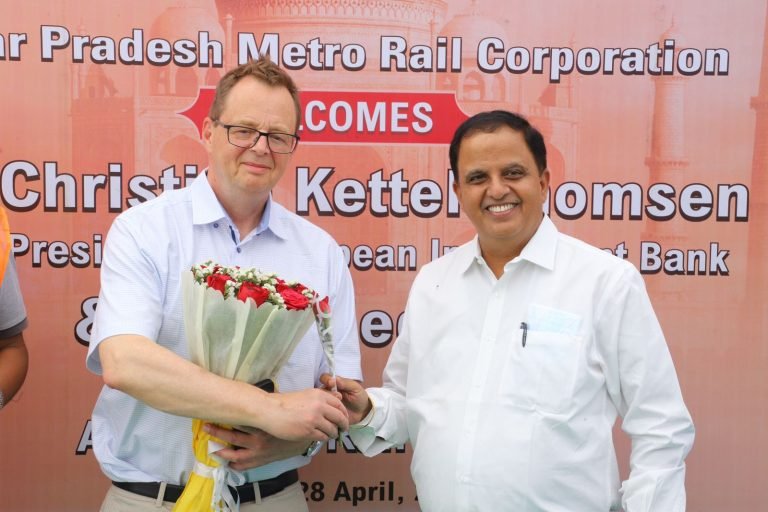
AGRA (Metro Rail News): Mr. Christian Kettel Thomsen, Vice-President, European Investment Bank (EIB) along with 5 team members visited the Agra Metro Project on 28th April 2022 to see the speed and quality of the Project which is being implemented under the leadership of Shri Kumar Keshav, Managing Director, UPMRC.

Recently between 9-13th April 2022, the team of investment officers from the EIB also visited the ongoing Metro projects of UPMRC, where they were immensely impressed with the pace of the Agra Metro Project work and the way it is moving ahead so fast in such a quick time. They also visited and took the train ride in Lucknow and Kanpur Metro’s operational routes, which is a splendid example of engineering and technology.

During their Lucknow visit, they interacted with the Chief Secretary of Uttar Pradesh, Shri Durga Shankar Mishra and expressed their interest to associate with the forthcoming Gorakhpur Metro Lite Project in Uttar Pradesh.

Today Mr. Christian Kettel Thomsen, Vice President, EIB along with team members visited the under-construction Metro Depot along with the elevated stations Taj East Gate, Basai & Fatehabad Road and the underground metro stations site at Agra Fort where the inception of the underground section has started.

Mr Kumar Keshav, Managing Director, UPMRC personally took Mr Christian Kettel Thomsen and his team to various construction sites in Agra Metro Project including recently commenced underground work at Agra Fort Metro station and explained the scheme of construction and progress. He thanked European Investment Bank for their continued support to various Metro projects in Uttar Pradesh and conveyed the commitment of UPMRC team towards timely completion of this prestigious project.

Speaking on the same, VP Mr. Thomsen said, ”The EIB, as the Bank of the European Union, is proud of its contribution to this project because it will improve the quality of life for the citizens and visitors of the historic city of Agra, and will help India in achieving its climate goals.

Agra is the sixth urban metro rail project that EIB supports in India. It brings EIB’s total approved commitments to the sector to over 3 billion euros, of which over 2 billion euros have been signed. These investments translate the India-EU Connectivity Partnership into tangible improvements for India’s people and accelerate green, sustainable and inclusive growth.

The EIB shall be funding 450 Million EURO for the Agra Metro Project, which is made available to UPMRC through gross budgetary resources in the form of Pass-Through Assistance (PTA) from the Government of India.

Patna University agrees to transfer 2,000 sq mtrs of land for metro station

PATNA (Metro Rail News): The Patna University has agreed to transfer 2,000 square mtrs of land on 26th April to the state government for construction of the proposed metro station near the intersection of Patna Science College and NIT Patna.

But the university team in its meeting which was chaired by vice-chancellor Girish Kumar Choudhary had not agreed to transfer a portion of Science College ground for temporary storage of construction materials. This decision is taken for the larger interest of students who use the space for sports and games.

However the team has demanded that the construction agency of the state government has to reconstruct the buildings which are going to be damaged during the construction of metro station.

The state government had previously written to the Patna University for transfer of about 2,000 sq mtrs of land at Patna Science College for the proposed metro station at NIT Mor on Ganesh Dutt Road.

Indian railways invites bids for 200 Vande Bharat train with sleeper facilities

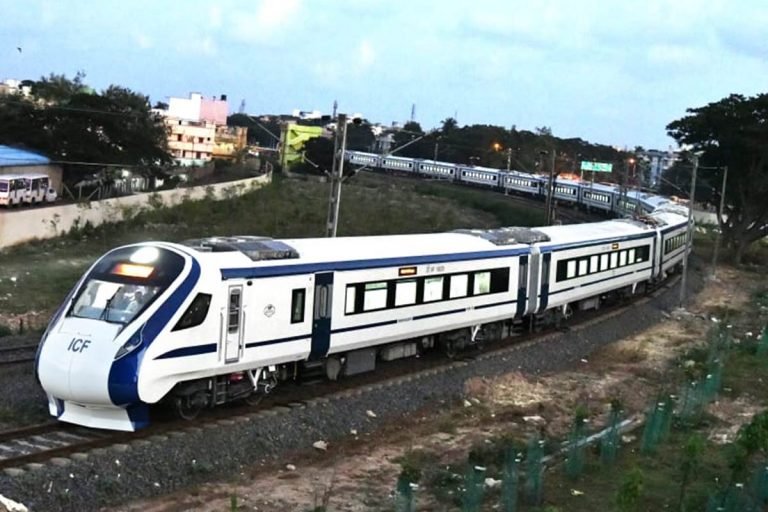
NEW DELHI (Metro Rail News): Indian Railways has invited bids for procuring 200 Vande Bharat trains with sleeper coaches and facilities which include long distance overnight journeys. The 102 trains procured by the railways previously only had seating arrangements targeted for small journeys. The railways have estimated the cost of these next generation trains at around Rs 26,000 crore and plan to introduce them in its bid to provide semi-high speed train connectivity.

Apart from the production units at Kapurthala, Chennai and Raebareli, the railways have decided to offer the newly built Latur facility for manufacturing 200 Vande Bharat Trains. Railways have already been awarded the contract of Hyderabad-based Medha Servo Drives Pvt. Ltd. for manufacturing 44 Vande Bharat train sets at Integral Coach Factory (ICF) which is a part of the government’s Make in India initiative.

While presenting the Budget 2022 in February, Union Finance Minister Nirmala Sitharaman had announced that 400 new-generation Vande Bharat trains with higher efficiency and better facilities for passengers will be manufactured in the next three years. The version-3 of these trains will have AC-1, AC-2 and AC-3 classes.
buy cialis sublingual online https://nouvita.co.uk/wp-content/themes/twentynineteen/fonts/en/cialis-sublingual.html no prescription
These trains will be designed for a maximum speed of 160 kmph and a testing speed of 180 kmph. These shall be designed for a life of 35 years.

The Finance minister also said that one product one railway station will be popularized in the coming years. These 200 new trains are the first step taken by the railways to complete the manufacturing as promised in the budget. Such development in the Railways is a great relief to the Indian citizens and can make their journeys more comfortable.

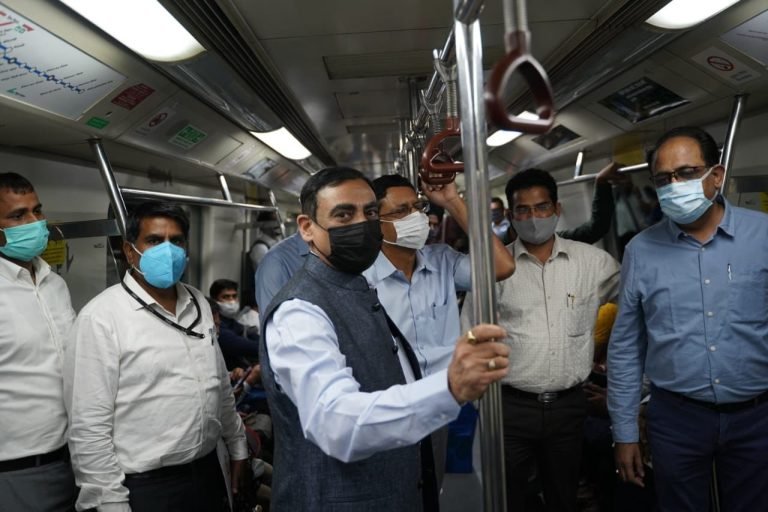
Vikas Kumar travels by Delhi Metro to check compliance of COVID norms

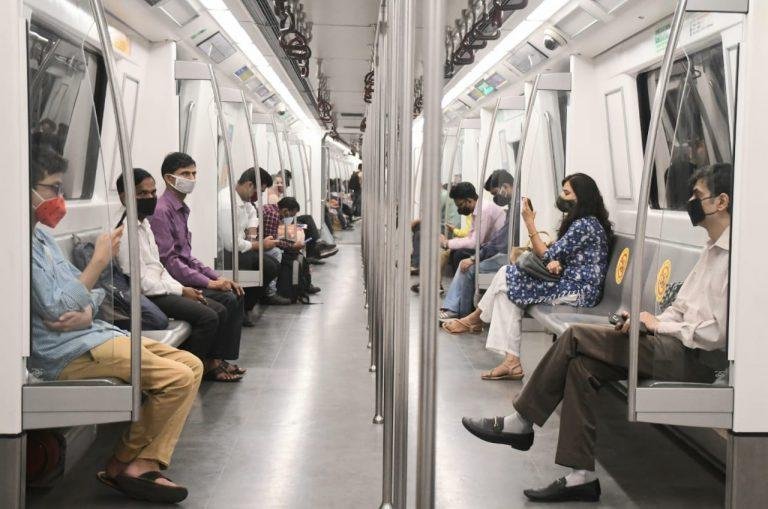
NEW DELHI (Metro Rail News): DMRC Managing Director Vikas Kumar on 27th April, Wednesday travelled on the Blue Line of Delhi Metro to take stock of overall compliance of Covid-appropriate behaviour by passengers while travelling.

Masks were made mandatory again in Delhi on 22nd April after observing a rise in covid cases in the capital and a fine of Rs 500 was imposed on the violations.

He travelled from Barakhamba to R K Ashram and got down at all stations, an official said.

https://twitter.com/OfficialDMRC/status/1519320358922637314

Blue Line is a stretch that connects Dwarka Sector 21 in Delhi and Electronic City in Noida.

“Shri Vikas Kumar, MD/DMRC today travelled on the Blue Line to take stock of the overall compliance to Covid appropriate behaviour by passengers while travelling. He also inspected stations including Rajiv Chowk interchange. Covid protocols were being followed by the passengers,” the Delhi Metro Rail Corporation (DMRC) tweeted.

DMRC begins work on 5th bridge over Yamuna River

NEW DELHI (Metro Rail News): The Delhi Metro Rail Corporation (DMRC) has commenced work on a fifth bridge over the Yamuna river that will connect the Soorghat Metro station and the Sonia Vihar Metro station. It is the part of phase four expansion of the Pink Line, which will see the corridor extending from Majlis Park to Maujpur, officials said on Tuesday. The bridge is being built between two existing bridges that are Wazirabad bridge and Signature bridge.

“The total length of the bridge is 560 metres… Pile foundation work is near completion and approximately 50% of sub-structure has been completed. The construction of superstructure by balanced cantilever technique has also been started,” said Anuj Dayal, principal executive director, corporate communications, DMRC.

The Delhi Metro has already constructed four bridges across the Yamuna in the first three phases which include the Yamuna Bank Bridge on the Blue Line, a bridge at Nizamuddin for the Pink Line, a bridge at Kalindi Kunj for the Magenta Line and one at Shastri Park for the Red Line. The new bridge will cross the Yamuna at around 385 metres downstream of the old Wazirabad Bridge and 213 metres upstream of the existing Signature Bridge.

This bridge will be the first to be built using the cantilever construction method, the officials informed.

“A cantilever is a rigid structural element which extends horizontally and is supported at only one end. Cantilever construction allows construction of overhanging structures without additional support structures. Employment of this technology will make the bridge aesthetically better,” said Dayal. “A 3D design of the bridge was also finalised using Building Information Modelling (BIM) technology'” he added.

CMRL floats tenders to rope in external experts for revamping metros

CHENNAI (Metro Rail News): Chennai Metro Rail Limited (CMRL) has planned to bring in external experts to service the Chennai metros, for which they have floated tenders to outsource the work.

The overhauling will be executed which is done after a train completes six years in operation or covers four lakh kilometres in operation. This is done to avoid any accidents and breakdowns during the daily operations. The overhauling process involves the removal of bogies from the car body, replacing all worn out components and updating the train software. The CMRL has 52 trains in total, and the services began in June 2015.

As per the tender, the CMRL has planned to service 45 four-car trains between 2022 and 2027 – at least nine trains every year. The overhauling which is to be carried out at CMRL’s depot in Koyambedu should be complete within 35 days for each train. Last year, an in-house team of the CMRL overhauled seven trainsets – at a cost of 1.77 crore for each train, a metro rail official informed.

“When we overhauled the trains, we understood that we needed certain resources like manpower and material for certain works, the cost for which was high. We then decided to outsource the work where everything will be handled by an external team. We will also get the work done at a better cost,” a CMRL official said, TOI reported.
buy amoxil online https://myhst.com/wp-content/themes/twentytwentytwo/inc/patterns/en/amoxil.html no prescription

The CMRL procured 42 four-car trains for the 45 km phase-1 and another 10 trains for the 9km phase-l extension line.

After the overhauling activities are completed a fitness certificate will be issued and the entire process will be documented. Problems in the train control and monitoring system software, which is also an interface connecting all subsystems in the train, will also be identified and the software will be updated “All our trains have a life of 30 years after which they will be refurbished,” the official added.

L&T Metro Rail Hyderabad to provide digital facilities to its commuters

HYDERABAD (Metro Rail News): SugarBox Networks has partnered with L&T Metro Rail Hyderabad (LTMRHL). This partnership will provide various digital facilities to the metro commuters such as internet connectivity, entertainment, etc.

Hyderabad Metro Rail will provide its passengers with the option to download or stream online content for free, even in the absence of an active cellular network, the company informed. This partnership between SugarBox Networks and L&T Metro Rail Hyderabad (LTMRHL) happened in December 2019.

The company uses world’s first patented cloud fragment technology to power in-transit connectivity across all trains on the metro network, including the high-footfall stations. As a part of this, SugarBox zones were set up in all trains and 10 major metro stations across the city, where commuters could sign into the service and consume content across various categories such as entertainment, education, e-commerce and fintech too.

Aligned with the ‘Digital India’ mission, SugarBox is also present across several touch points including Chennai metro, Central Railway (Suburban Mumbai) and has partnered with CSC e-governance, to provide digital access to the unserved, remote villages in the country. The company aims to revolutionize India’s Internet ecosystem with its hyperlocal technology and is on its way to impact over 350 mn Indians by 2024.