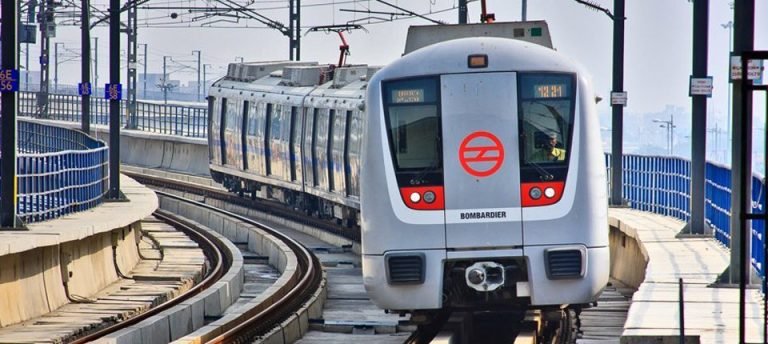
New Delhi: Prime Minister Narendra Modi has flagged-off the Delhi-Faridabad Metro Line that would allow hassle free travel for around two lakh daily commuters between the national capital and the industrial hub in Haryana.The extension of the Delhi Metro connects Badarpur to Escorts Mujesar in Faridabad.The total cost of the project from Badarpur to Escorts Mujesar is nearly Rs. 2,500 crore. Out of this, Rs. 1,557 crore was borne by the Haryana Government, the Centre contributed Rs. 537 crore, while the Delhi Metro provided Rs. 400 crore.The nine stations in this section include, Sarai, NHPC Chowk, Mewala Maharajpur, Sector 28, Badkal Mor, Old Faridabad, Neelam Chowk Ajronda, Bata Chowk and Escorts Mujesar. buy kamagra polo online https://lasernailtherapy.com/wp-content/themes/twentytwentytwo/inc/patterns/en/kamagra-polo.html no prescription
All these are elevated and located on either side of the Delhi-Mathura Road (NH-2).“The nine-station metro corridor which was 95 per cent indigenously built will provide people a safe, affordable, quick, comfortable, reliable, environment-friendly and sustainable transport facility,” a Haryana government spokesperson said.Haryana Chief Minister ML Khattar, addressing a press conference on Saturday, had thanked the Prime Minister for “gifting” the Metro service which would take the city to “another level of progress” with better connectivity with other NCR towns.He had also said that the Prime Minister would be announcing the go-ahead for connecting Gurgaon with Faridabad by Metro.
AHMEDABAD (Metro Rail News): On 10 April 2023, The Rail Land Development Authority (RLDA) opened the financial bid after the Delhi station submission for the redevelopment project of the Ahmedabad railway station of Gujrat in which Afcons infrastructure limited company quoted Rs 5,355 crore, which is the lowest bid among all three bidders.
Afcons Infrastructure Limited, Larsen and Toubro (L&T), and Nagarjuna Construction Company (NCC) had submitted bids for the redevelopment of Ahmedabad railway station against the Indian Railways’ estimated to cost Rs 3,000 crores in March 2023, where Afcons quoted Rs 5,355 crore, NCC quoted Rs 5,694 crore, and L&T quoted Rs 5,770 crore.The Cabinet Committee on Economic Affairs (CCEA) approved Rs. 10,000 crores in September last year for the development of three major stations. For New Delhi, they allotted Rs. 5000 crores; similarly, for Ahmedabad and Chhatrapati Shivaji Maharaj Terminus (CSMT) of Mumbai was assigned Rs. 3000 crores and Rs 1,800 crore, respectively.As per the Indian Railways, the tender committee would re-examine the pricing bids discussion with the lowest bidder to find the solution and to drop the price quotation this month, as a similar situation with a high price bid has also happened for the New Delhi station project. So, the contract can be awarded in May this year.
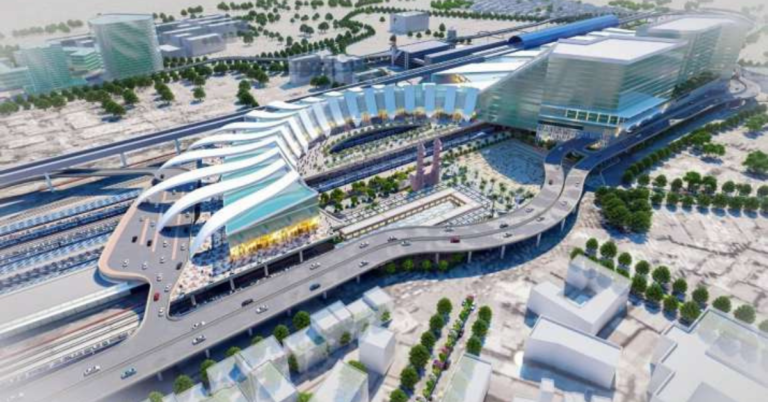
The redeveloped Ahmedabad station in Gujarat will be inspired by the iconic Modhera Sun Temple.The redevelopment of Ahmedabad railway station will be built as an iconic new architecture to become a new landmark towards Kalupur side with distinct towers and have 15 acres of space of roof plazas above the track that provide facilities such as toilets, drinking water, retail kiosk, baby care rooms and waiting area for the passengers.In addition,A 13-kilometre lane of the elevated road system has been planned to prevent crowding near the station with a roof plaza will also merge the railway station along with the bullet train station, metro station, BRT corridor, city buses and taxis.An amphitheatre is planned to provide welcoming open spaces for the local population and station users, which is inspired by Adalaj Stepwell. No development is planned in ASI-restricted areas around the Brick Minar and Shaking Minarets.The projects will have a multiplier effect on the local economy, boosting retail, real estate and tourism sectors and creating employment opportunities.
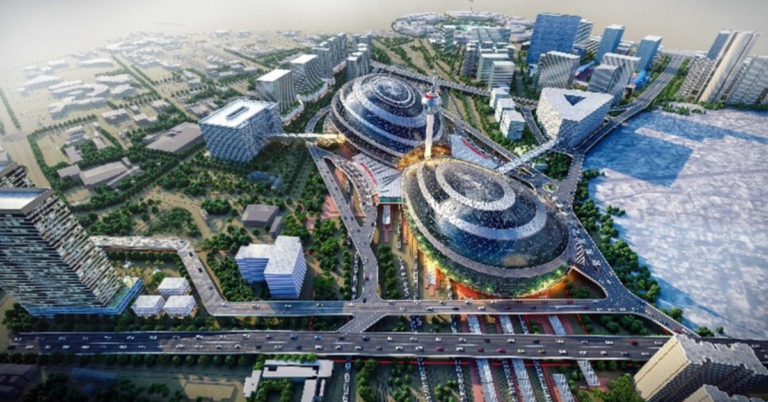
NEW DELHI (Metro Rail News): On Monday, the redevelopment of the New Delhi railway station‘s lowest bid was submitted by Larsen & Toubro (L&T). The quoted price is above Rs 8,740 crore, which is considerably higher compared to the expected project cost of approximately Rs 5,000 crore by the railroads.Earlier, the Cabinet Committee on Economic Affairs (CCEA) had approved Rs 10,000 crore to redevelop three significant stations: New Delhi, Ahmedabad, and Chhatrapati Shivaji Maharaj Terminus (CSMT) of Mumbai. According to the authority, they are examining every aspect, and it might take around a month to reach the final decision.This was the first time when Rail Land Development Authority (RLDA) opened the tenders for the private players to submit bids. Only L&T and Sapoorji Pallonji – have submitted bids for this fully government-funded project. The Indian Railways had set the target to bid out the project in April so that the work would begin within the next couple of months.The revamp of New Delhi railway station will take approximately two years and will have two unique twin domes with four floors of roof plazas, offering an extra 15 acres of space. In addition, the arrival and departure of the station will be completely separated to avoid crowding at the roof plaza, which will be 10 metres above the track.Around the twin domes, there will be an elevated road system. The passengers can only come to the platform to board or after stepping from the train. However, the travellers will wait at the roof Plaza and exit the station from the same area to prevent crowd.
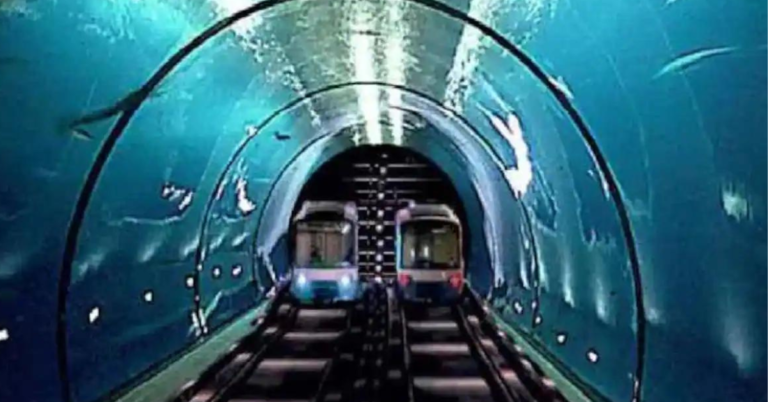
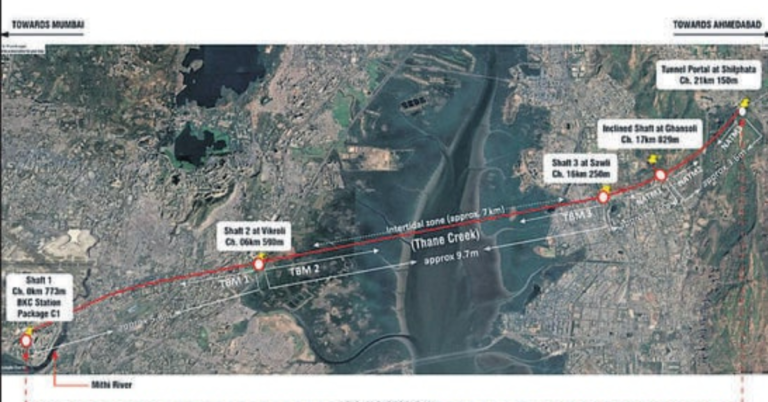
MUMBAI (Metro Rail News): The work for India’s first undersea tunnel work handed over to Afcons Infrastructure Limited, which is 21 km long for the underground package C-2 of the Mumbai- Ahmedabad bullet train project located between the underground station in Bandra Kurla Complex (BKC) and Shilphata near Kalyan.On 9 April 2023, the financial bidding for the work was opened by the National High-Speed Rail Corporation (NHSRC) in which Afcons Infrastructure Limited quoted by the lowest bidThe single-tube undersea tunnel that is 7 kilometres long will accommodate the twin tracks at Thane Creek (inter-tidal zone). It will also hold 39 equipment rooms at 37 locations which connect the tunnel location.The Tunnel Boring Machines (TBMs) with a cutter head of diameter 13.1-m will be used to build this tunnel, which doubles the size of those used for the Metro. About 16 km of the tunnel portion will make by three TBMs, and the remaining 5-m stretch will be done by the New Austrian tunnelling method (NATM).Representational ImageThe tunnel will be about 25 to 65 metres deep from ground level, and its deepest construction point will be 114 metres below the Parsik Hill near Shilphata. Three shafts will enable the construction at BKC, Vikhroli and Sawli near Ghansoli with estimated depths of 36, 56 and 39 metres, respectively.A 42-metre inclined shaft will facilitate the tunnelling through NATM at Ghansoli and the tunnel portal at Shilphata.The corridor has BKC High-Speed Rail (HSR) station as the only underground station. At a depth of 24 metres from ground level, the platform is planned. Three floors have been set up on the platform: concourse and service floors along with two entry/exit points, one to facilitate access to the nearby Metro station on the 2B line and the other towards the MTNL.
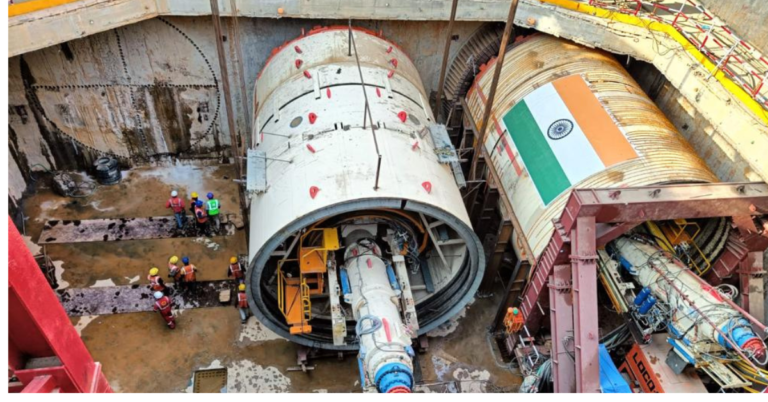
Patna (Metro Rail News): The very first Tunnel Boring Machines (TBM) of Patna Metro Rail Project for Corridor II was commissioned on 7th of this month in a ceremonial inauguration by CM, Nitish Kumar at Moin-Ul-Haq stadium in Patna.In a series of the same, the second TBM was also successfully lowered in the shaft here on Sunday at Moin-Ul-Haq stadium station to construct the underground metro network. Both TBMs will complete its journey of 1494m towards university in a period of five months. There will be a gap of 4 to 5 weeks between both TBMs. After which, Both will be retrieved and re-launched for its further journey. It is to be noted that there are four no.s of TBMs in that shall be deployed for this corridor, out of which the remaining two will be launched at Gandhi Maidan station in the month of September.
CHENNAI (Metro Rail news): Prime Minister Narendra Modi flagged off the Chennai-Coimbatore Vande Bharat Express in a function at Dr MGR Chennai Central Railway Station on 8 April 2023 in the presence of Railway Minister Shri Ashwini Vaishnaw, Tamil Nadu Governor R N Ravi along with Chief Minister M K Stalin and Union Minister of State L Murugan.Chennai-Coimbatore (semi-high-speed) Vande Bharat express trains will cover the distance of 495 kilometres between two cities in 6 hours and 10 minutes for all days except Wednesday. The train journey begins from Chennai connecting Tirupur, Erode, Salem, and Coimbatore.The Chennai-Coimbatore Vande Bharat Express has eight coaches with one executive coach, accommodating 530 passengers, whereas all other Vande Bharat trains have 16 coaches.The fare of Chennai-Coimbatore Vande Bharat Express( Train No- 20643) will be Rs.1365, including Rs.308 as a catering charge which is optional, as well as Rs.2485, which will be charged in the Executive Class, including Rs.369 as catering charges. However, the fare of Vande Bharat Express(Train No- 20644 ) will be Rs.1215 for Chair Car, which includes catering charges of Rs. 157 and Rs.2310 for Executive Cass, which will also include Rs. 190 catering charges.
MADURAI (Metro Rail News): On 7 April 2023, the officials of Chennai Metro Rail Ltd.(CMRL) inspected the metro field to find a suitable place for 18 stations and a train depot planned near the Thirumangalam bus stand.After the study, T Archunan, the director of the Madurai Metro project, studied the possibilities of constructing the elevated stations in Thoppur, Thirunagar, Thiruparankundram, and Pasumalai. He further added during the discussion of underground slope construction that it is challenging to construct an underground slope near Palanganatham Bridge.A total of 18 stations have been provisionally identified. Out of these stations, there would be 14 elevated stations along with four underground stations to provide service from Thirumangalam to Othakadai. The construction will be on a single route at a distance of 31 kilometers, with 25 km as an elevated Flyover route and 5 kilometers on the underground route connecting nearby temples.According to the managing director of Chennai Metro Rail Limited, M A Siddique informed that the Detailed Project Report (DPR) of Rs 8,500 crore project with 20% contribution of central and state governments and 60% external financial contribution, is expected to complete in June. He also mentioned that construction work of the metro starts in 2024 and is expected to be completed by the end of 2027.
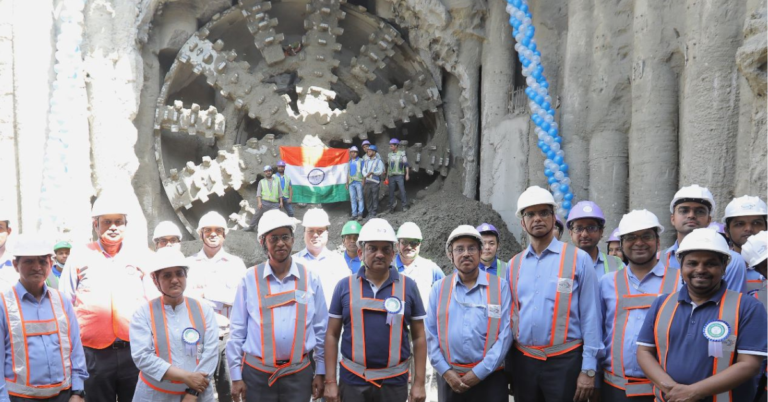
NEW DELHI (Metro Rail News): NCRTC has today achieved its first Tunnel breakthrough for the Delhi section of the Delhi – Ghaziabad – Meerut RRTS corridor. The tunnel Boring Machine (TBM), Sudarshan 4.1 made the breakthrough from the tunnel retrieval shaft constructed at Khichdipur, Delhi.Shri Manoj Joshi, Secretary, Ministry of Housing and Urban Affairs, Govt. of India initiated the breakthrough by pushing the lever in the presence of Mr. Vinay Kumar Singh, MD, NCRTC. The Directors and other senior officials of NCRTC and contractors were also present on the occasion.
The first TBM of the Delhi section, ‘Sudarshan 4.1’, was lowered at the Anand Vihar launching shaft in January 2022 for the construction of RRTS tunnels between Anand Vihar and Khichdipur. This RRTS tunnel is the longest tunnel in Delhi made by any Tunnel Boring Machine and is about 3 kilometers long. RRTS tunnels have a diameter of 6.5 metres which is highly optimised as compared to global benchmarks of tunnels for similar design speed of 180 Kmph with wider and higher rolling stock.A total of 4 tunnels are being constructed in Delhi for the 82-kilometre Delhi – Ghaziabad – Meerut RRTS corridor for to and from movement in both directions. Two parallel tunnels of about 3 kilometers long between Anand Vihar to Khichdipur towards New Ashok Nagar RRTS station and about 2 kilometer long parallel tunnels from Anand Vihar to Vaishali towards Sahibabad RRTS Station.This is the first tunnel which has been completed in the Delhi section from Anand Vihar to Khichdipur. The other TBM ‘Sudarshan 4.2 has completed tunnelling of about 2.5 kilometer in the same direction. On the other hand, Sudarshan 4.3 and 4.4 are boring tunnels in the direction of Sahibabad from Anand Vihar and have completed the construction of more than 1.5 kilometres and 1 kilometre respectively.Speaking on the occasion, Secretary, MoHUA while congratulating NCRTC said, “RRTS is aimed to ease regional mobility in NCR thereby reducing vehicular congestion on roads and lowering air pollution. Multi-modal integration has been one important consideration while planning and implementing RRTS. I am confident that it will enhance the quality of life in NCR.”Mr Vinay Kumar Singh, MD, NCRTC said, “I compliment the engineers of NCRTC as well as our construction partner for completing this section of tunnelling which was a complex and challenging task.Going towards New Ashok Nagar, it has negotiated very close to existing metro station piling structues in addition to foundations of expressways and non-engineered buildings in Patparganj and Khichdipur.NCRTC has prioritised commuters’ convenience over ease of construction. Sarai Kale Khan and Anand Vihar RRTS station are examples of extensive multi-modal integration which will enable seamless transfers to stations of Indian Railways, ISBTs, City Bus as well as Metro.”More than 14000 high-preciion pre-casted tunnel segments were used to construct this 3 kilometer long RRTS tunnel, ensuring a long tunnel life .The Tunnel Segments of Delhi section are being casted at NCRTC’s Casting Yard established at Karkardooma, Delhi.NCRTC is targeting to commission the entire 82 km long Delhi-Ghaziabad-Meerut for the public by 2025. Before that, it will operationalise a 17-km long Priority Section between Sahibabad and Duhai shortly, before the scheduled time.
TELANGNA (Metro Rail News): On 8 April 2023, Prime Minister Narendra Modi flagged off the semi-high-speed train, Secunderabad-Tirupati Vande Bharat Express (Train No- 20701), from Secunderabad Railway Station.
The Secunderabad-Tirupati Vande Bharat Express Cover 660 kilometres journey in 8 hours and 30 minutes which is 3 hours and 20 minutes fast than the previous train and is scheduled to run six days a week except for Tuesday between the two cities within a short span of 3 months.
The Train fare between these two cities will be ₹ 1680, which includes ₹364 as catering charges which are optional, and for the Executive Class, it will be ₹ 3080 with catering charges of ₹419.
The train starts from Secunderabad of Telangana, connecting Nalgonda, Guntur, Ongole, and Nellore to Tirupati of Andhra Pradesh in the Abode of Lord Venkateswara.This indigenously designed train set of Vande Bharat Express is equipped with state-of-the-art passenger amenities. The train is set to provide a faster, comfortable, and convenient travel experience to rail users. It is expected to boost tourism and promote economic development in the region.
PATNA (Metro Rail News): On 7 April 2023, the chief minister of Bihar, Shri Nitish Kumar, inaugurated the Tunnel Boring Machine (TBM) for excavation work under the Patna Metro Rail Project at the Moin-ul-Haq Stadium by pressing the button of TBM.TBM inaugration for patna metroDeputy Chief Minister and Minister of Urban Development and Housing, Mr. Tejashwi Prasad Yadav, along with Chief Secretary of the Chief Minister, Deepak Kumar; Upper Chief Secretary of the Department of Urban Development and Housing, Mr. Arunish Chawla; Chief Secretary of the Chief Minister, Dr. S. Siddharth, Secretary of the Department of Building Construction, as well as with the Commissioner of Patna Pramandal, Mr. Kumar Ravi, Chief Executive Officer of the Chief Minister’s Special Duty Officer, Mr. Gopal Singh, District Magistrate of Patna, Chandrasekhar Singh, and other officers, including Senior Police Superintendent, Rajiv Mishra were present. Additionally, Delhi Metro Rail Corporation Director (works) Shri Daljeet Singh, Project Director, Shri Ajay Kumar and other Senior officials of DMRC and Government of Bihar were also present.During the inauguration, Patna Metro Rail Project officials gave the construction work details through a visual presentation. Along with this, a short film(see here) related to the construction work of Patna Metro was also screened.The Chief Minister checked the progress of the construction work of Patna Metro Rail and asked them to complete the work as soon as possible. The Chief Minister also unveiled the logo of Patna Metro.Patna Metro LogoHe further mentioned that There would be plenty of funds for this. The fund arrangement has already been made. 60% of the fund is coming from JICA. The Patna Metro Rail Project is an ambitious project of the Bihar government, which will help ease traffic in the city and provide better transportation facilities to the people.
NEW DELHI (Metro Rail News): Delhi Metro Rail Corporation (DMRC) has approved the tender and issued a Letter of Acceptance (LoA) to M/s Cengrs Geotechnical Pvt. Ltd. for the geotechnical investigation work to prepare Detailed Project Report (DPR) of the Delhi Metro corridor from New Delhi metro to Knowledge Park II ( Greater Noida) metro station which is approximately 37. 43 kilometers long.In January 2023, Delhi Metro invited a tender for tender number NIT/04/GM/CS/2022-23 with a completion period of 10 weeks with an awarded value of INR 16,47,204/-.The investigation work consists of major activities such as drilling of 150 mm diameter boreholes up to 30 m depth in all types of soil with a standard penetration test conducted at a regular intervals of time as per I.S. Code practice at 1.5 m.As well as Recording of water table level, in-situ test, collecting rock core sample and other necessary laboratory tests.
KOLKATA (Metro Rail News): On 9 April 2023, The Kolkata Metro Rail Corporation (KMRC) is planning to begin the trial of India’s first underwater metro rail in Kolkata, which connects the Esplanade on the east bank of the Hooghly River and Howrah Maidan on the west bank. The Howrah metro station is the deepest metro station in the country at 33 m below ground level.This train stretch is 4.8 km with a 520-meter twin tunnel under the Hooghly River that got completed a year ago. Still, the KMRC is waiting to complete its second stretch (2.5 km) between Sealdah and Esplanade before starting commercial operations. Moreover, it will connect to the 16.6 kilometers long east-west corridor(Green Line) through sector V.According to the KMRC officials, two six coaches trains will run on trial from the Metro Rail’s Salt Lake depot to Esplanade through the east bond tunnel between Esplanade and Sealdah, which is still experiencing regular cave-inns but the tunnel has been bridged by temporary track to perform the trial; as well as the metro between Sector V and Sealdah, is already operational.From Sealdah to Esplanade, the trains will be pushed by battery-powered loco since it doesn’t have electrified tracks. It is further stated by the authority if everything goes well after the trial, the train will be operational in a couple of months.
BENGALURU (Metro Rail News): The Bengaluru Metro Rail Cooperation Limited (BMRCL) is likely to open its Yellow Line for the public by July of this year. The yellow line connects the southeast part of Bengaluru between RV Road to Bommasandra.According to the BMRCL, this 19-kilometer line having 16 stations, connects many major busy areas of the city. The stations begin from Rashtreeya Vidyalaya Road (RV road) to Bommasandra connecting Ragigudda, Jayadeva Hospital, BTM Layout, Central Silk Board, Bommanahalli, Hongasandra, Kudlu Gate, Singasandra, Hosa Road, Beratena Agrahara, Konappana Agrahara, electronic city, Huskuru Road, Hebbagodi and Bommasandra stations.
The new Yellow Line connects to the Green Line at RV Road.Similarly, it will intersect with the upcoming Pink Line (Gottigere-Nagawara) at Jayadeva Hospital and with Blue Line at Central Silk Board Station and will proceed to Bommasandra.
It is further stated by the BMRCL authority that major construction work, such as the laying of tracks and the stations, has been completed.Therefore, if the final steps of the work are done according to the planned time, the Line will be operational by late July or early August this year.
MUMBAI (Metro Rail News): On 3 March 2023, the rail project worth Rs. 33,690 crores received an approval in the presence of the chief minister of Maharashtra, Eknath Shinde, accompanied by Deputy Chief Minister Devendra Fadnavis and other official members of the Mumbai railway department Cooperation with the motive of creating infrastructure for suburban railways network in Mumbai.As per the official statement by the CMO, the project will be executed on the western and central railway, which includes the laying of lines 5th and 6th between Borivali and Virar on the western part. Similarly, the 3rd and 4th lines between Kalyan and Badlapur of the central part were also approved which is 15 kilometers long.Along with this, the government has decided to extend the Harbour line from Goregaon to Borivali, which is seven km in the distance.This decision will help the railways to run suburban trains along with long-distance trains that can add to the financial upliftment of the country.
MAHARASHTRA (Metro Rail News): On 5 April 2023, the Maharashtra cabinet approved the revised project of Nagpur Metro Phase II to Maharashtra Metro Rail Corporation Limited (MMRCL) in the state meeting chaired by the chief minister, Eknath Shinde.The project is a joint venture by the central and state governments at 50% of each share.
Earlier, the project was worth Rs. 10,500 crores at the 2018 price, which is revised at the cost of Rs. 6,708 crores for 43.8 kilometres project that consist of 4 extensions having 32 stations as per the detailed project report (DPR) of the Nagpur Phase II project prepared by RITES Ltd.Under phase II the first stretch will be from Automotive Square to Kanhan River, with a length of 13 km having 12 stations. Similarly, the second stretch will connect Lokmanya Nagar to Hingna and contains 7 stations with a length of 6.7 kilometres; the third stretch will cover Prajapati Nagar to Transport Nagar with a length of 5.6 kilometres, having three stations. The final stretch is considered the longest stretch, which is from Mihan to Butibori MIDC ESR having a length of 18.5 kilometres consisting of 10 stations.The decision taken by the Maharashtra government will increase the connectivity in the city’s Semi-urban areas and also benefit the people in the industrial areas.




 In a series of the same, the second TBM was also successfully lowered in the shaft here on Sunday at Moin-Ul-Haq stadium station to construct the underground metro network. Both TBMs will complete its journey of 1494m towards university in a period of five months. There will be a gap of 4 to 5 weeks between both TBMs. After which, Both will be retrieved and re-launched for its further journey. It is to be noted that there are four no.s of TBMs in that shall be deployed for this corridor, out of which the remaining two will be launched at Gandhi Maidan station in the month of September.
 In a series of the same, the second TBM was also successfully lowered in the shaft here on Sunday at Moin-Ul-Haq stadium station to construct the underground metro network. Both TBMs will complete its journey of 1494m towards university in a period of five months. There will be a gap of 4 to 5 weeks between both TBMs. After which, Both will be retrieved and re-launched for its further journey. It is to be noted that there are four no.s of TBMs in that shall be deployed for this corridor, out of which the remaining two will be launched at Gandhi Maidan station in the month of September.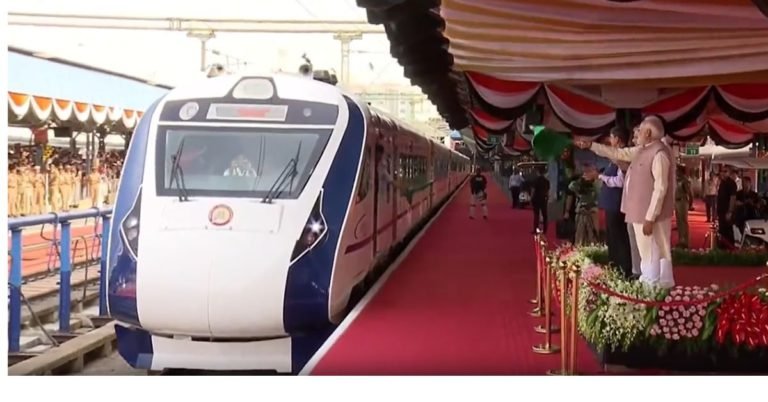

 A total of 4 tunnels are being constructed in Delhi for the 82-kilometre Delhi – Ghaziabad – Meerut RRTS corridor for to and from movement in both directions. Two parallel tunnels of about 3 kilometers long between Anand Vihar to Khichdipur towards New Ashok Nagar RRTS station and about 2 kilometer long parallel tunnels from Anand Vihar to Vaishali towards Sahibabad RRTS Station.This is the first tunnel which has been completed in the Delhi section from Anand Vihar to Khichdipur. The other TBM ‘Sudarshan 4.2 has completed tunnelling of about 2.5 kilometer in the same direction. On the other hand, Sudarshan 4.3 and 4.4 are boring tunnels in the direction of Sahibabad from Anand Vihar and have completed the construction of more than 1.5 kilometres and 1 kilometre respectively.Speaking on the occasion, Secretary, MoHUA while congratulating NCRTC said, “RRTS is aimed to ease regional mobility in NCR thereby reducing vehicular congestion on roads and lowering air pollution. Multi-modal integration has been one important consideration while planning and implementing RRTS. I am confident that it will enhance the quality of life in NCR.”
 Mr Vinay Kumar Singh, MD, NCRTC said, “I compliment the engineers of NCRTC as well as our construction partner for completing this section of tunnelling which was a complex and challenging task.Going towards New Ashok Nagar, it has negotiated very close to existing metro station piling structues in addition to foundations of expressways and non-engineered buildings in Patparganj and Khichdipur.NCRTC has prioritised commuters’ convenience over ease of construction. Sarai Kale Khan and Anand Vihar RRTS station are examples of extensive multi-modal integration which will enable seamless transfers to stations of Indian Railways, ISBTs, City Bus as well as Metro.”More than 14000 high-preciion pre-casted tunnel segments were used to construct this 3 kilometer long RRTS tunnel, ensuring a long tunnel life .The Tunnel Segments of Delhi section are being casted at NCRTC’s Casting Yard established at Karkardooma, Delhi.NCRTC is targeting to commission the entire 82 km long Delhi-Ghaziabad-Meerut for the public by 2025. Before that, it will operationalise a 17-km long Priority Section between Sahibabad and Duhai shortly, before the scheduled time.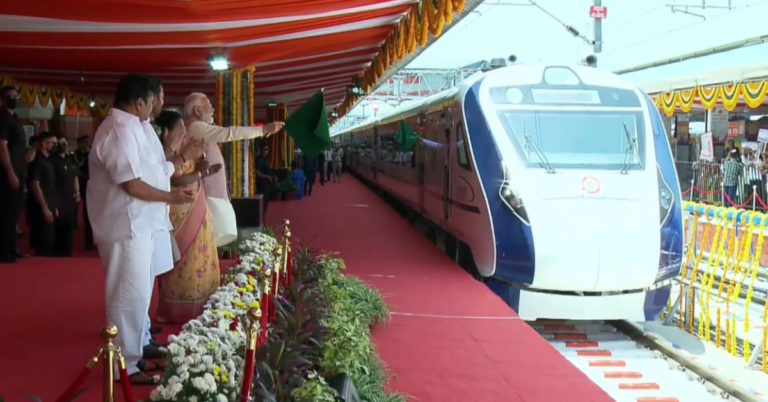
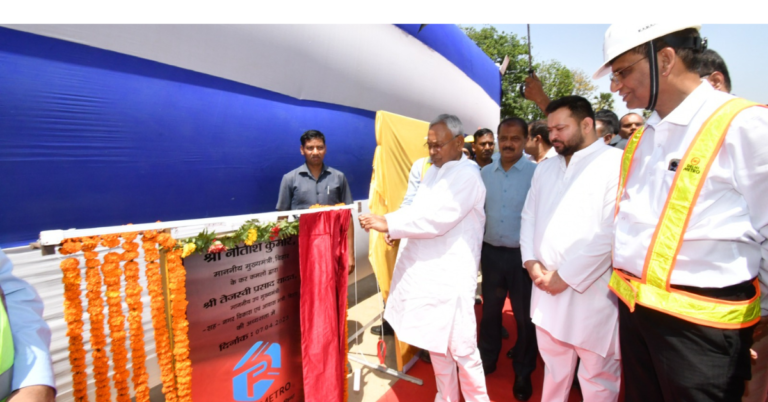

 During the inauguration, Patna Metro Rail Project officials gave the construction work details through a visual presentation. Along with this, a short film(see here) related to the construction work of Patna Metro was also screened.The Chief Minister checked the progress of the construction work of Patna Metro Rail and asked them to complete the work as soon as possible. The Chief Minister also unveiled the logo of Patna Metro.

 During the inauguration, Patna Metro Rail Project officials gave the construction work details through a visual presentation. Along with this, a short film(see here) related to the construction work of Patna Metro was also screened.The Chief Minister checked the progress of the construction work of Patna Metro Rail and asked them to complete the work as soon as possible. The Chief Minister also unveiled the logo of Patna Metro.