



Introduction
In Jaipur, rising population and rapid motorisation have placed sustained pressure on the city’s transport network. The city records an estimated daily travel demand of 36 lakh passenger trips, with peak-hour demand reaching 3.6 lakh trips. Its population is approaching 4.45 million, and vehicle density at 25,048 vehicles per square kilometre, far above the state average of 4,299. Average travel times have stretched to 28 minutes and 28 seconds per 10 kilometres.

Against this backdrop, the Jaipur Metro was introduced as a mass transit solution to reduce congestion and improve urban mobility. The project also reflects the broader challenges of planning and operating metro systems in Indian cities with evolving demand patterns.
This article examines the metro’s progression from initial planning and political debate to its current operational status. It also assesses proposed expansions and highlights the financial and operational constraints that will determine its long-term role in the city’s transport system.
A Brief History: From Vision to Reality
The conception of the Jaipur Metro dates to the early 2000s, when rapid urbanisation began to overwhelm the city’s road infrastructure. The Detailed Project Report (DPR) was initially submitted by the Delhi Metro Rail Corporation (DMRC) in March 2010, proposing two corridors: an East-West Corridor and a North-South Corridor. The Jaipur Metro Rail Corporation (JMRC) a state-owned Special Purpose Vehicle was formally established on 1 January 2010 to oversee implementation.
Physical construction of Phase 1A commenced on 24 February 2011, covering 9.63 kilometres from Mansarovar to Chandpole Bazaar, largely elevated with a short underground stretch. The project consulted DMRC on rapid transit operation and construction techniques, and notably set a national record by conducting trial runs on 18 September 2013 the fastest from construction commencement for any Indian metro at the time.
Commercial services on the Jaipur Metro commenced on 3 June 2015, inaugurated by Vasundhara Raje, the then Chief Minister of Rajasthan. With this, Jaipur joined the ranks of Kolkata, Delhi, Bangalore, Gurugram, and Mumbai as one of India’s six rapid transit cities. Phase 1B a 2.34 km underground stretch from Chandpole to Badi Chaupar, adding two underground stations at Chhoti Chaupar and Badi Chaupar completed the Pink Line and began operations on 23 September 2020, bringing the total operational length to approximately 12 km across 11 stations.
The metro holds the distinction of being India’s first to feature a triple-storey elevated structure, combining road and metro tracks, an engineering achievement that set new benchmarks for urban infrastructure in the country.
Existing Routes
The Pink Line Jaipur’s Sole Operational Corridor
As of 2026, Jaipur Metro operates a single corridor: the Pink Line, spanning 11.97 km from Mansarovar in the west to Badi Chaupar. The line serves 11 stations, a mix of 8 elevated and 3 underground, connecting residential neighbourhoods to the commercial and heritage core of the city.
Line-1 – Pink Line: Mansarovar – Badi Chaupar
- Length: 9.63 km (Phase 1A) and 2.35 km (Phase 1B)
- Type: Elevated & Underground
- Depot: Mansarovar
- Number of Stations: 11
- Station Names: Mansarovar, New Aatish Market, Vivek Vihar, Shyam Nagar, Ram Nagar, Civil Lines, Railway Station, Sindhi Camp, Chandpole, Chhoti Chaupar, and Badi Chaupar
Upcoming Expansions of Jaipur Metro
Phase 1C: Extending the Pink Line East
Line-1 – Pink Line: Badi Chaupar – Transport Nagar (Phase 1C)
- Length: 3.41 km
- Type: Underground (2.65 km) & Elevated (0.76 km)
- Number of Stations: 2
- Station Names: Ramganj Chaupar (underground) & Transport Nagar (elevated)
- Status: Approved
This extension would deepen metro connectivity into the densely populated old city and improve access to one of Jaipur’s key commercial and transport hubs. Once completed, estimated ridership across the full Mansarovar-Transport Nagar stretch is projected to exceed 1.38 lakh daily passengers by 2031.
Phase 1D Western Extension to Ajmer Road
Line-1 – Pink Line: Mansarovar to Ajmer Road Chauraha (Phase 1D)
- Length: 1.35 km
- Type: Elevated
- Number of Stations: 1
- Station Names: Ajmer Road Chauraha
- Status: Proposed
Phase 1D is a more modest extension of 1.312 km, taking the Pink Line westward from Mansarovar to Ajmer Road Chauraha. It connects the metro terminus to Ajmer Road, one of Jaipur’s primary arterial roads and a gateway to the city’s densely populated western suburbs.
Phase 2: The Orange Line: Jaipur’s North-South Corridor
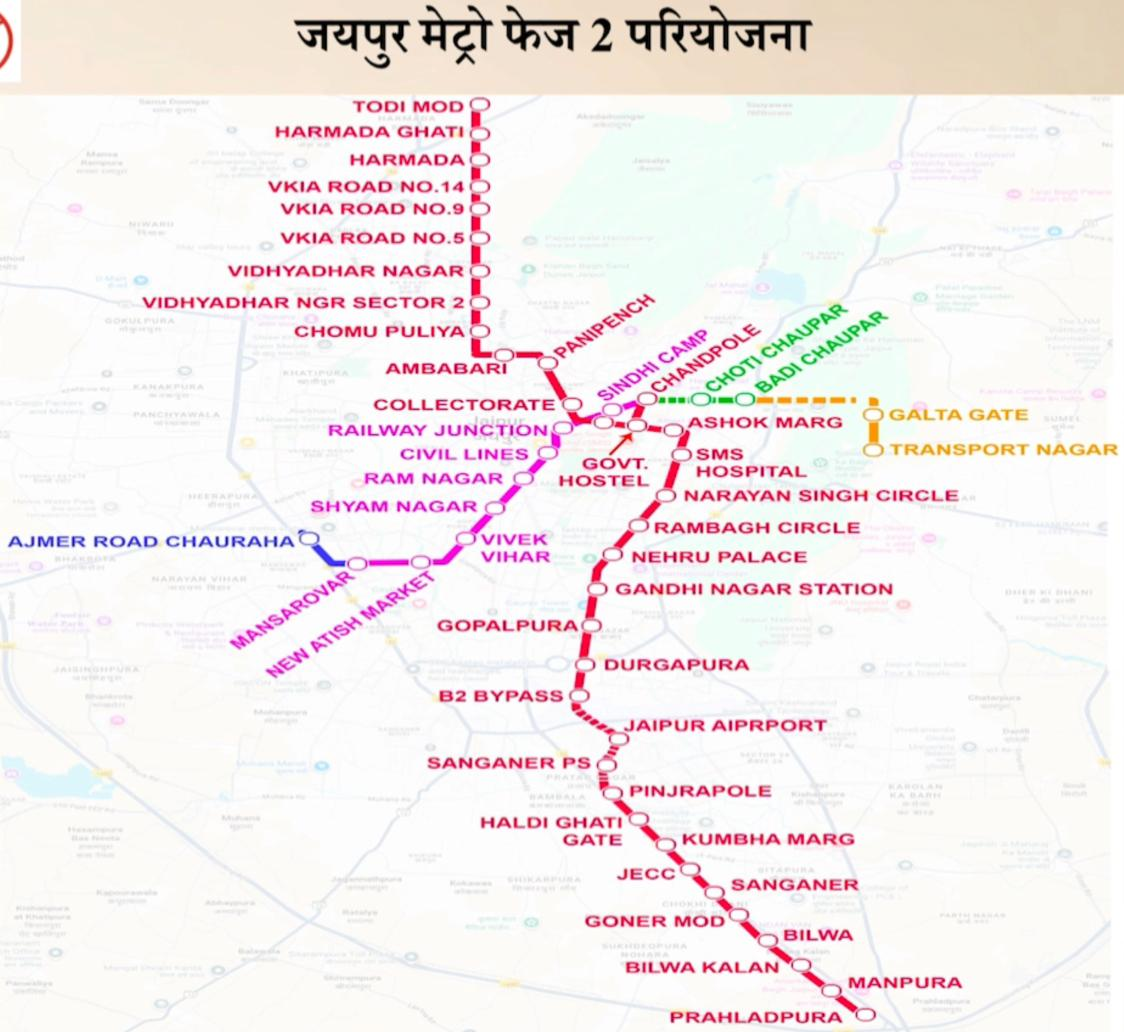
The centrepiece of Jaipur Metro’s expansion ambitions is Phase 2, the Orange Line, a 41 km corridor that will form the city’s north-south transit backbone. The project, announced in the State Budget 2025-26, proposes 36 stations (34 elevated, 2 underground) connecting Todi Mod in the north to Prahladpura in the south.
Key commercial and residential destinations along the proposed Orange Line include Sitapura Industrial Area, Jaipur’s major IT and manufacturing hub along with Tonk Phatak, Rambagh, Sindhi Camp, and Bani Park, connecting densely populated and economically active zones
Union Cabinet’s Approval
Jaipur Metro received a big push in the first week of April 2026 with the Central Government’s approval. The Union Cabinet approved the project at a cost of ₹13,037.66 crore. The Rajasthan Metro Rail Corporation Limited will be responsible for implementing the project.
Business and Economic Impact
Real Estate and Urban Development
One of the most measurable business impacts of the Jaipur Metro has been its effect on real estate values. The areas near operational and planned metro corridors have seen property prices and rental demand rise since 2015. The Phase 2 expansion is expected to accelerate this trend, particularly along the Sitapura and Tonk Road corridors. Against this backdrop, the residential and commercial projects are emerging rapidly in anticipation of improved connectivity. Metro expansion is widely projected to drive 15-20% appreciation in property prices near new corridors.
Employment and Commercial Activity
The construction and operation of metro infrastructure has contributed to employment generation across engineering, construction, security, operations, and retail sectors. JMRC has entrusted station security to the Rajasthan Police, while operations employ a substantial permanent workforce. The planned Phase 2 connectivity to Sitapura Industrial Area is expected to boost economic activity, improve last-mile access to the city’s commercial and IT clusters, and make Jaipur more attractive to businesses and investors.
Tourism and Heritage Connectivity
Jaipur’s economy is deeply anchored in tourism and heritage, and the metro plays a growing role in this ecosystem. The Pink Line’s eastern terminus at Badi Chaupar places visitors within walking distance of iconic landmarks such as Hawa Mahal and Jantar Mantar, while Chandpole provides access to the Walled City’s markets and temples.
Environmental Sustainability
As Jaipur’s population is projected to reach 8.1 million by 2031, the metro’s role in reducing private vehicle dependency is central to the city’s sustainability agenda. Phase 2 is projected to meaningfully decrease the city’s carbon footprint, aligning Jaipur’s growth with national Smart City and climate commitments.
Challenges: The Business Case Under Scrutiny
Ridership and Revenue Gaps
The Jaipur Metro’s most persistent business challenge has been ridership. In its first 22 months of operation, average daily ridership reached only 19.17% of projected figures a deficit that drew sharp criticism from the Comptroller and Auditor General (CAG), whose 2018 report questioned whether a metro was necessary.
However, the ridership has improved over the years, growing from a prolonged plateau of 19,000 to 25,000 daily passengers to approximately 55,000- 60,000 passengers per day in recent years, a positive trajectory, but still well below full operational capacity and the volumes needed for financial self-sustainability.
Financial Sustainability
JMRC continues to face financial challenges rooted in the structural economics of public transit. Operating costs covering salaries, maintenance, administrative expenses, depreciation, and debt servicing on the massive initial capital investment are substantial and fixed, regardless of ridership levels. Ticket revenue, the primary income stream, is inherently limited by the fare structure, which is deliberately kept affordable for public accessibility but constrains revenue maximisation.
JMRC has explored supplementary revenue streams including advertising within stations and commercial space leasing, though these contribute relatively modestly compared to fare box revenue. In financial year 2022-23, JMRC achieved a net profit of ₹14,329.51 lakh but primarily due to the sale of land assets, rather than operational profitability. Without such one-off gains, operational losses persist.
Competition and Limited Network Coverage
The metro competes directly with Jaipur’s dense network of buses, auto-rickshaws, and increasingly, app-based ride-sharing services modes that offer greater geographic flexibility at comparable or lower cost. The Pink Line’s 12 km coverage, while valuable, does not yet reach enough of the city’s key origins and destinations to drive mass modal shift. Delays in Phase 2 execution have compounded this limitation.
Execution and Governance Risks
The JMRC has seen more than 12 chiefs in nine years of operation a rate of leadership turnover that has raised governance concerns. Phase 2 delays, driven by multiple DPR revisions, contract disputes, and funding uncertainties, have extended from an originally projected 2021 completion to a current target of 2031. Each delay defers the business case for the expanded network and erodes public confidence. The state government’s decision to conduct yet another feasibility survey for Phase 1C in 2025 was widely seen as a setback for project momentum.
Conclusion
The Jaipur Metro is a system caught between its past ambitions and future potential. As a business proposition, it has delivered real but incomplete dividends: improved urban mobility, real estate appreciation along its corridor, and a foundation for a more sustainable city. Yet it has not achieved financial self-sufficiency, its network remains too limited to drive transformative modal shift, and its expansion has been marked by delays that have tested public and political patience.
The next five years are critical. The successful delivery of Phase 1C and 1D extensions, combined with timely execution of Phase 2’s Orange Line, could fundamentally alter the metro’s business case unlocking the ridership volumes, real estate value capture, and economic multipliers that the project was always designed to generate.
Jaipur Metro’s story is, in many ways, the story of urban India’s infrastructure ambitions that are bold in vision, complex in execution, and ultimately indispensable for the cities of tomorrow. For the Pink City, the rails are laid; now it is a question of will, capital, and execution to realise their promise.
Also Read: Agra Metro: Finding Balance Between Urban Need, Tourism Pressure, and Conservation Mandates