Bengaluru: Bengaluru based innovative company Primerail Infralabs Pvt Ltd is developing a cycleloop PRT solution for Urban Transport and last mile connectivity solution.
The company is developing intelligent last mile mobility solution called Tietran – an autonomous self-balancing e-bike rides in air-conditioned guided tube. They already conducted 25m trials successfully and creating 400m prototype for demonstration.
Tietran is an e-bike based green urban mobility solution for last mile connectivity from metro stations to dense hinterlands or between dense traffic hubs. Commuter rides e-cycle in an air conditioned light elevated tube over the medians/footpaths. Bike is the most energy efficient transport mode in the world. Bike in a dedicated lane provides reliability to commuting and offers health benefits of pedalling. Autonomous e-bike in a semi-controlled environment with self-balancing ability combined with smart switching and intelligent algorithms makes it the most convenient, safe, lean and clean mobility disruption.
Electronics in e-bikes intelligently communicates with field sensors & central process server and travels autonomously from origin to destination at pre-determined speeds. 3rd rail DC power supply to BLDC motor facilitate comfortable power assisted ride. Modular quick construction, near-zero land acquisition, rapid scalability and optimum LCC makes it an attractive innovation and exportable to global markets. ·
Tietran technology ensures safety and comfort at par with Metro Rail.
Hyderabad: The Telangana Government made an allocation of Rs 600 crore in its budget for the Metro Rail project. Accordingly an amount of Rs 200 crore was granted for the present Hyderabad Metro Rail project being executed by L&T Hyderabad Metro Rail Limited.
Telangana State Cabinet
“The amount will be used for urban landscaping, creating better facilities and also improving the infrastructure at end points. The Old City alignment works will also be carried out,” said N.V.S. Reddy, Managing Director of Hyderabad Metro Rail Limited (HMRL).
Land acquisition process would be carried out by Hyderabad Metro Rail and it was expecting this budgeted amount to help it expedite works. The Metro Rail route till Airport had got Rs 400 crore which would help plan, acquire land and also push forward the stretch to be taken up in the next phase.
The Budget sanction showed the Government was keen on developing Metro Rail which would be the future mode of transport.
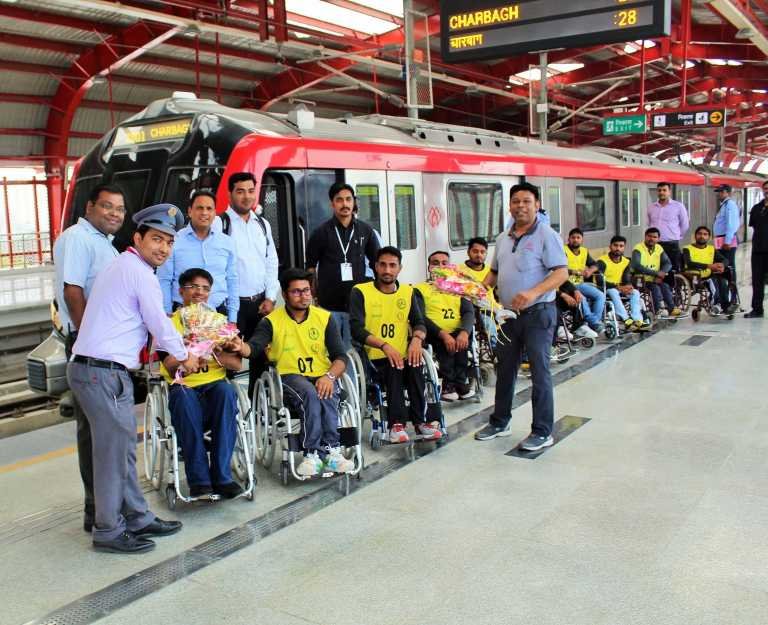
On the occasion of the World Disabled Day today, LucknowMetro Rail Corporation (LMRC) organized a special Metro train ride for a team of para-sports players (wheelchair players) between Transport Nagar to Charbagh. It marked the observance of this exclusive day for these exclusive wheelchair bound cricket players who hail from different city and districts of Uttar Pradesh.
A team of 11 (eleven) para cricket players from the state wing of the Para Sports Foundation today arrived at Transport Nagar Metro station at 11.30 AM and traveled to and fro in a Metro train between Transport Nagar and Charbagh Metro station.
During their visit, they were briefed about the facilities available for the differently-abled at Metro stations and inside the Metro Train. They were very happy to see the specially marked spaces for them and talk the facility of the back button through which commuters can talk to the Metro train operators in case of an emergency.
Mr. Somjeet Singh, Captain, Para Sports Players (Cricket)said “We are overwhelmed to see such an advanced technology in the city of Lucknow. We thank LMRC for providing us with such a Metro system in the shortest possible time and giving us an opportunity to travel in the Metro train”.
“It is an unforgettable moment for us and we thank the Metro staff for their love, respect and affection that they have showered on us”, he further added.
LUCKNOW METRO OBSERVES WORLD DISABLED DAY
1 of 6
Mr. Abhay Pratap Singh, Ex- Squadron Leader and now a player in the team said “We are very happy to see that Lucknow Metro is a completely ‘barrier-free’ public mode of transport and every care has been taken for them right from the ground level of the station to the platform & concourse level and also inside the Metro trains”.
Mr. Irfan Haider, another player of this special cricket team recited poems and songs impromptu in the Metro train to entertain everyone. Everyone on the train including the Metro officers and staff cheered and appreciated the lively nature of Mr. Irfan.
Other para-sports players who were part of the team included Mr. Aviral Jain, Mr. Anmol Vashisht, Mr. Umesh Kaushik, Mr. Gaurav Yadav, Mr. Pawan Mishra, Mr. Sirajuddin, Mr. Manoj Chauhan, Mr. Shailesh Rai and Mr. Kaushal Pal.
New Delhi: The Government of India has invited expression of interest (EoI) to execute pod taxi project on Delhi-Gurgaon Metrino corridor. The development follows a high-level panel recommending inviting fresh bids for the project, also known as Personal Rapid Transport (PRT), conforming to the strictest safety standards on the lines of those prescribed by an American body.
“EoI has been invited for development of PRT Delhi-Gurgaon pilot project corridor (length 12.30 km) from km 24 at NH 8 (Delhi-Haryana border) – km 33.5 (Rajiv Chowk, Gurgaon) NH 248A Sohna Road on design, build, finance, operate and transfer (DBFOT) basis, Minister of State for Road Transport and Highways Mansukh L Mandaviya told the Lok Sabha in a written reply.
“A high level committee has recommended following Automated People Movers (APM) standards prepared by American Society of Civil Engineers (ASCE) along with the general safety requirements, system safety principles, traffic control and protection etc,” he said.
The ambitious project has been plagued by delays as government think-tank Niti Aayog raised some red flags, asking the highways ministry to direct initial bidders to prepare a 1-km pilot stretch as all the technologies were unproven. Subsequent delays were caused due to the formation of the high-powered committee to lay down safety and other specifications.
PRT is an advanced public transport using automated electric pod cars to provide a taxi-like demand responsive feeder and shuttle services for small groups of travellers and is a green mode of uninterrupted journey.
The committee in its report also recommended framing of a request for quotation (RFQ) based on discussions with interested players and stressed the need for evaluation, based on performance in the test sections.
The APM standards include minimum requirements for the design, construction, operation and maintenance of the various sub-systems of an APM system and are in general relevant for a PRT.
The model is in place at London’s Heathrow airport, Morgantown and Masdar city.
Earlier, three global companies, including New Zealand’s Metrino Personal Rapid Transit, that later called off its joint venture with Indian partner Gawar Construction, were picked during initial bids for the project.
Metrino, along with PNC-SkyTran and Neel Metal Products Ltd had bid for the pod taxi project last year. The companies were to build a 1 km of pilot stretch to showcase their technology.
Three bidders had made a technical presentation to the government last year Neel Metals Product Ltd-Ultra Personal Rapid Transport (technology partner), Gawar Construction-MIPL, which later said that instead of Metrino, they are roping in LSD by MND Group, and PNC-SkyTran that provided details of specifications in the prototype being developed for commercial operation in Israel.
If all goes according to plan, the first phase will be linking the 70-km stretch from Dhaula Kuan in Delhi to Manesar in Haryana to decongest NCR, Gadkari had said.
Important Dates:
Invitation of Expression of Interest: 23.01.2018
Deadline for Downloading Documents: 22.03.2018 (up to 11.00hrs)
Deadline for Submission of applications online: 22.03.2018 (up to 11.00hrs)
Deadline for Submission of applications (physically): 23.03.2018 (up to 11.00hrs)
Opening of applications (physically and online): 23.03.2018 (at 11.30hrs)
Dy. Chief Project Manager / Rolling Stock – 1 post
Joint General Manager (HR) or Dy. General Manager (HR) – 1 post
Joint General Manager (Contract) – 1 post
Senior Manager (Design) or Manager (Design) – 3 posts
Assistant Manager (Architecture) – 1 post
Dy. General Manager- Architecture or Senior Manager (Architecture) – 1 post
How to apply: Eligible candidates should submit their filled application in proscribed format to General Manager (HR), National High Speed Rail Corporation Limited (NHSRCL), Asia Bhawan, Road-205, Sector-9 Dwarka, New Delhi – 110077.
The last date for submitting the applications is 02/04/2018
Just one question ‘what is the best thing about Delhi NCR?’ and 80% of the people will answer in unison as ‘the metro’. For almost every Delhiite, from someone residing here for the past many years to somebody who recently shifted, Delhi Metro is like their daily local.
Delhi Metro celebrated its 15th birthday on 25th December, 2018 and since then, it has become the heart of the Dilliwaale. Residents of Delhi have become so accustomed to the metro that now most of them dump their cars and take a metro to their offices. This changeover has happened mainly due to the sheer convenience that it provides and also because we never see a traffic jam in metro land. For a person like me who hates driving, metro is like an Angel sent from the heaven!
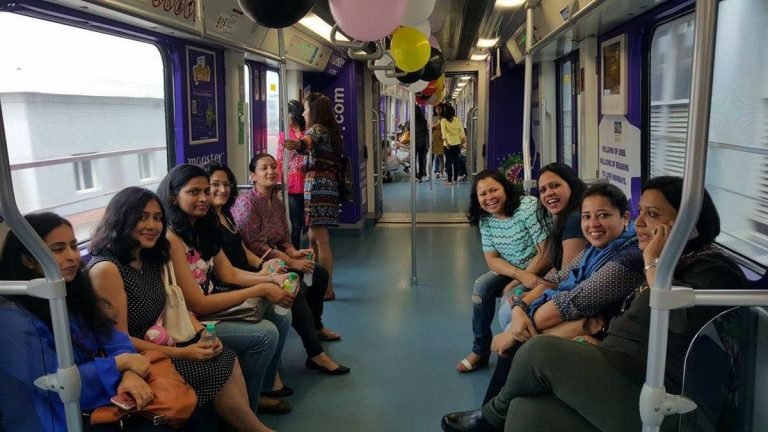
Arrangement of special women coach and platform area in Delhi Metro
Especially, Delhi metro was no less than a saviour to me when I first shifted to this place as a student. With only a limited amount of pocket money to survive through my entertainment and shopping routines, I could, with my remaining meagre savings, take a daily metro from anywhere to everywhere within Delhi NCR. Plus, metro felt so much safer than any other means of transportation available here. My parents back home at least could rest in ease knowing that I’m not travelling in a crowded bus to and from any place.
I once had a good chat with a couple who stays in Bahadurgarh which is a small tehsil in Haryana, 2 km away from Delhi. The family of six, including an 85-year-old grandma, were travelling from Faridabad to Bahadurgarh in the violet line of Delhi metro. While we were talking, they confessed that this is the first time in many years that the grandma was going to see her sister in Bahadurgarh, all thanks to the extended metro line. She could not visit her for so many years because of the long and rigorous hours of bus journey that involved in it. But now, the metro is bringing the sisters together. That day, I was travelling from Faridabad to Dwarka to meet my local guardians. Metro does connect the hearts and helps keep families connected.
Delhi Metro violate line
Professionals like me, for whom reaching on time to office is important, Delhi metro is the best available options. But I have to travel for so long that it bores me and more than often I’m irritated and think to take an alternative. But once my friend’s father told me that he had a hard time to accept a job offer in Okhla as he knew about the amount of journey which involved in commuting from Gurgaon sector 56. It was like a total wastage of time and the buses used to be over full and would stop everywhere due to heavy traffic jams. He used to catch a bus at 6:30 am to reach his job at 9 am. That day, I sat inside the metro and heaved a sigh of relief that today we have the Delhi metro for us. It is actually making my job life as comfortable as it should be.
Over the past 15 years, Delhi metro has constantly kept on extending and today it connects almost every major areas of the capital region. It is extending so rapidly that somewhere or the other, you are bound to find the signboard ‘metro construction ahead’. I once betted with one of my colleagues that there probably will be a station under construction near his house in the next one year. And lo and behold, after three months we saw the metro construction board actually being set up near his house. I won the bet! No wonder, it is one of the longest transport systems in the world.
Delhi Metro Airport Express Line
Today, Delhi Metro has 173 operational stations at the moment, and DMRC (Delhi Rail Metro Corporation) is all set to add 120 km in 2018. Its current network spans for an awesome 231 km following the recent opening of the Botanical Garden-Kalkaji Mandir section of the Magenta Line. This is a good news for people like me who hates to travel to Noida because of the enormous number of stations.
Well, it did not come as a surprise to me when in the year 2014 Delhi metro was recognised as the second most popular metro system globally. Yes, like with everything good comes its cons, so is the case with our Delhi metro. One of the underlying problems with the metro is that it gets over crowded during the peak hours. It sometimes gets so crowded that it becomes difficult even to breathe. This leads to uneasiness and people start blaming the metros. But again, the same people dump their vehicles and swipe their metro cards at the entrance the next day. Life in Delhi is impossible without it.
As for me, the uber comfortable air-conditioned journey, the velocity at which the vehicle moved, the view from the window, and the rapid availability of the trains, just sold me to Delhi. I fell in love with the place. And from my own personal experience I would like to quote that “Wherever you go, you’ll find yourself missing the Delhi Metro”.
The views expressed are personal. The author can be contacted at ankissrose@gmail.com. This article has been first published in Metro Rail News Magazine (January Edition).
If you have similar story or want to share your riding experience in metro rail in India you can write your story to editor@metrorailnews.in. You can also share your tweets with tag @metrorailnewsin.
New Delhi: The Delhi Metro Rail Corporation (DMRC) launched 21.56 km stretch of Pink Line between Majlis Park-Durgabai Deshmukh South Campus on Wednesday. Union Minister of Housing & Urban Affairs Hardeep Singh Puri, Delhi Chief Minister Arvind Kejriwal along with Delhi Government Chief Secretary flagged off this section at 4 pm today from Metro Bhawan. Passenger services will begin from 6 pm.
While addressing the Media in Metro Bhawan Arvind Kejriwal said, “We want Delhi Metro to expand. Delhi government will clear Phase IV shortly. We are committed for expanding of Delhi Metro and no one should have the slightest doubt about that. Some routes of Delhi Metro’s Phase IV not financially viable. The project can be divided in two parts and the viable routes can be approved immediately.”
“Delhi Metro’s fare is a bit high. I request we should all work together to bring a solution,” he added.
Inauguration of section of Line 7 (Pink Line) of the Delhi Metro by MoS H&UA Hardeep Singh Puri and Delhi Chief Minister Arvind Kejriwal in the august presence of Dr. Harsh Vardhan, Meenakshi Lekhi, Parvesh Sahib Singh and H.E. Mr. Kenji Hiramatsu, Ambassador of Japan to India.
After opening of this section DMRC has completed nearly 250 km routes. This section has total 12 stations namely Majlis Park, Azadpur, Shalimar Bagh, Netaji Subhash Place, Shakurpur, Punjabi Bagh West, ESI Hospital, Rajouri Garden, Mayapuri, Naraina Vihar, Delhi Cantt and Durgabai Deshmukh South Campus. Out of the 12 stations, eight are elevated and the rest underground.
Here are some highlights of Delhi Metro’s Pink Line:
The Pink Line is a 59-km line connecting Majlis Park to Shiv Vihar under Delhi Metro’s Phase III project.
This is the longest metro line till date and is expected to be fully operational by June 2018.
Interchange stations at Azadpur, Netaji Subhash Place and Rajouri Garden will connect the Yellow, Red, and Blue lines, respectively, to the Pink Line. The line will also bring Delhi University’s South Campus under the Metro system.
The new corridor will also, for the first time, connect the north and south campuses of the Delhi University, on the metro network, which can be covered in 40 minutes.
The average speed of the train on the line is 34 kmph and the line will have only six-coach trains, with a frequency of 90-100 seconds.
Total 19 trains will be in service on the line. Trains will also run on two shorter routes — between Durgabai Deshmukh South Campus and Shakurpur, and Majlis Park and Shakurpur stations.
The trains will be driverless, with multi-coloured seats (orange, blue, pink and red), darker shades for reserved seats, a special demarcated area for persons on wheelchairs, USB and three-pin recharge ports and three-handle poles for those who commute standing.
This section (first stretch) will also reduce metro travel time between Dwarka 21 (Blue Line) and Rithala (Red Line) by over 16 minutes; and Rajouri Garden and Azadpur by nearly 23 minutes.
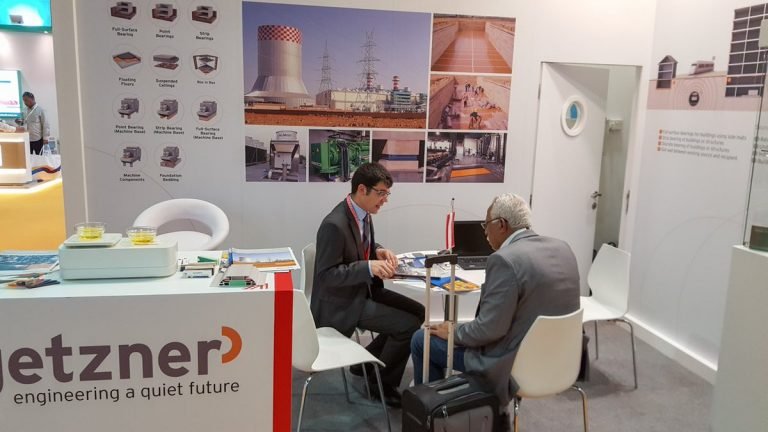
Pune: Urban train operations generate vibrations and noise, which affect the people living and working in its surroundings. The mass-spring system from Getzner efficiently mitigates such vibrations and the secondary air-borne noise. Getzner’s mass-spring system is installed in over forty cities worldwide – amongst them are the Indian cities of Bangalore, Delhi, Lucknow and Mumbai.
The train operations generate vibration energy at the track superstructure because of high dynamic loads. This vibration energy propagates through the ground and once it reaches a building, depending on the dynamic characteristics of the building, it can be perceived as vibrations or can be heard as secondary air-borne noise, adversely impacting the lives of people in the vicinity of the metro corridor. “The effect of vibration and noise is different in every building depending on it structural characteristics. That is why we aim to control the vibrations at the source itself – the metro railway track”, explains Sanjay Risbood, CEO and Resident Director of Getzner India. “The goal of mass-spring systems is to elastically decouple the track superstructure from its surrounding in order to reduce the transmission of vibrations.” The Austrian company Getzner is the world technology leader in the field of vibration isolation in the railway, construction and industry sectors.
Installation of the Getzner mass-spring system at the Delhi Metro
The mass-spring system from Getzner uses the high quality micro-cellular polyurethane materials Sylomer® and Sylodyn®. Risbood: “These high-quality PU materials guarantee the long-term performance of the mass-spring system. This is of utmost importance because the maintenance or replacement of a mass-spring system after the installation and the start of train operations is very expensive, time consuming and sometimes not feasible, too. Hence, the mass-spring system should necessarily perform throughout the life of the track”. Until today, Getzner has supplied more than 450 mass-spring systems worldwide. They all are performing effectively from the last 40 years without a need of maintenance or replacement.
Full surface mass-spring systems in India
Depending on the economic and technical requirements of the customers, Getzner offers three types of mass-spring systems: Full surface, strip bearing and point (discrete) bearing. Sanjay Risbood: “We have supplied full surface mass-spring systems for projects in cities of India like Delhi, Bangalore, Lucknow and Mumbai. The full surface mass-spring system is the most cost effective, it is easy to construct and gives the desired long-term performance.” With a full surface mass-spring system, the natural frequency in the range of 14 to 25 Hz can be achieved.
Mr. Risbood explains: “Getzner has already supplied several point and strip type mass-spring system solutions to various urban, mainline and high-speed train systems worldwide, wherever there is a need for lower natural frequency.”
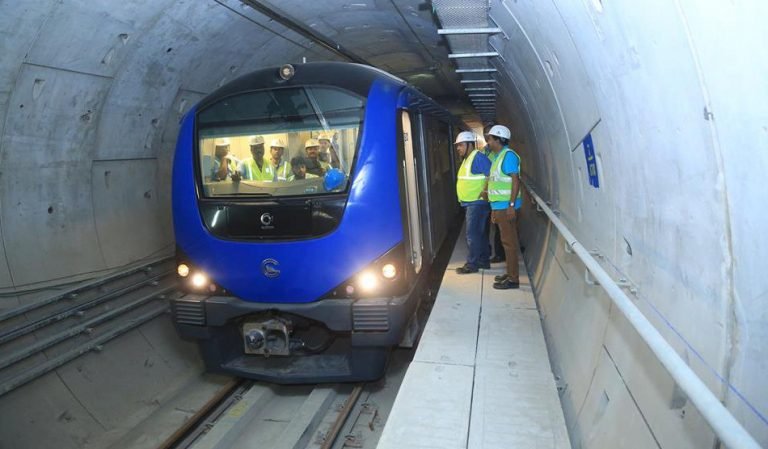
Chennai: The Chennai Metro Rail Limited (CMRL) started metro trial run in the underground line between Saidapet and AG-DMS stations on this Monday. During trial run, trains are operated back and forth to test the working of various systems of the train and the route.
After opening of commercial run on this stretch, commuters can take a direct ride from AG-DMS station to the Chennai airport.
This 4-km stretch from Saidapet station (located near Directorate of Medical and Rural Health Services, Teynampet) to AG-DMS station (located near Panagal Maaligai) covers four stations — Saidapet, Nandanam, Teynampet and AG-DMS.
According to a CMRL official, “Around 1 p.m., the train that departed from Little Mount station (which is already operational) went underground through a ramp to the Saidapet station. It moved at a speed of 35 km per hour and reached AG-DMS in half an hour, officials said. “It will take less than half hour when the services start in May. Today, it took half hour since we stopped at every station to check for any possible issues.”
Sources said that the trial run was carried out only on downward track. While officials claim the other track (upward track) is also ready, it is not clear why the trial run was not carried out. Various systems including, tunnel ventilation, signalling, platform screen doors and automatic fare collection have been installed.
Eight months ago, for the first time, Chennai Metro Rail tested a locomotive on this stretch. After completion of electrical and signalling work and integration of these systems, trial run with a train started on Monday. This exercise will continue till the operations begin on this stretch in May.
Before this stretch is thrown open to public, one last inspection by Commissioner of Metro Rail Safety will be done in late April or early May and after they give their approval, the operations will start.
According to CMRL official, construction of stations is almost completed.
Work on this stretch faced a severe disruption three years ago. Gammon India and Russian firm Mosmetrostroy got a joint contract to carry out the work but the Russian firm walked out of the project owing to funds crunch and later Gammon India’s contract was terminated.
Another contractor Afcons Infrastructure Limited took up this work.
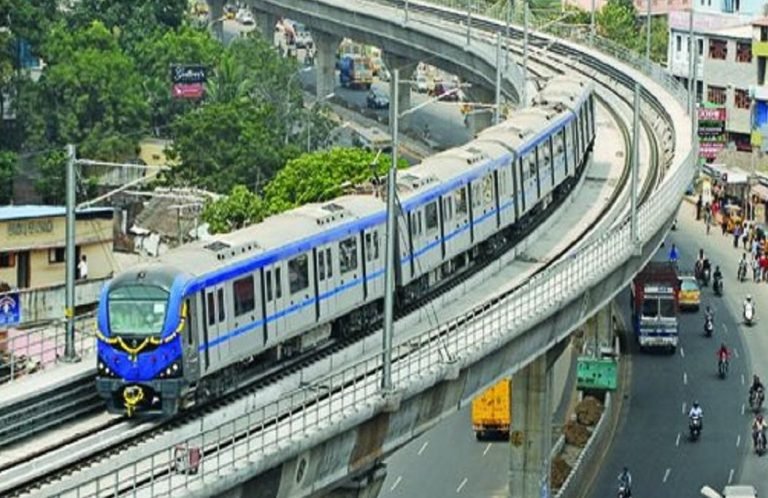
Chennai: Chennai Metro Rail Limited has officially released a route map for its ambitious phase 2 metro project that will connect far-flung areas of the city through three corridors.
In February, Metro Rail floated nine tenders for detailed design consultants and for soil tests. In one of the tenders, it has released a map of phase 2 with 104 stations, covering 107km. The estimated cost of the project is Rs 85,047 crore.
Chennai Metro Phase II Network Map (PC: CMRL)
However, after a review of the alignment, CMRL officials said they had increased the number of stations to 116 covering a total 107.55km along three corridors.
The tenders CMRL has floated are also for corridor 3 (Madhavaram Milk Colony to Siruseri SIPCOT) that covers the IT hub on the OMR and corridor 5 (Madhavaram to Sholinganallur).
Corridor 4 that connect Light House to CMBT is likely to be extended up to Poonamallee at an additional cost of Rs 3,850 crore.
A feasibility study is at present underway following which a detailed project report will be submitted to both the central and the state governments for approval.
“We will then decide whether to include it in phase 2 or to take it up as a separate project like phase-1 extension,” said a CMRL official.
Nearly 80% of the phase 2 project will be underground. The elevated sections is expected to have cantilevered stations that will be built in the middle of the road to reduce consumption of space and time.