



Today cutter head of #Godavari-1 TBM lowered at Vidya Nagari launching shaft. It will soon start tunneling for 2.9 km stretch between Vidya Nagari and CISA Domestic Airport.
Here are some photographs taken from the construction site:


Advertisement1



Today cutter head of #Godavari-1 TBM lowered at Vidya Nagari launching shaft. It will soon start tunneling for 2.9 km stretch between Vidya Nagari and CISA Domestic Airport.
Here are some photographs taken from the construction site:
Chennai: Chennai Metro Rail Corporation Organise an Educational trip for Government School Students From Arumbakkam to Nehru Park Metro Station.
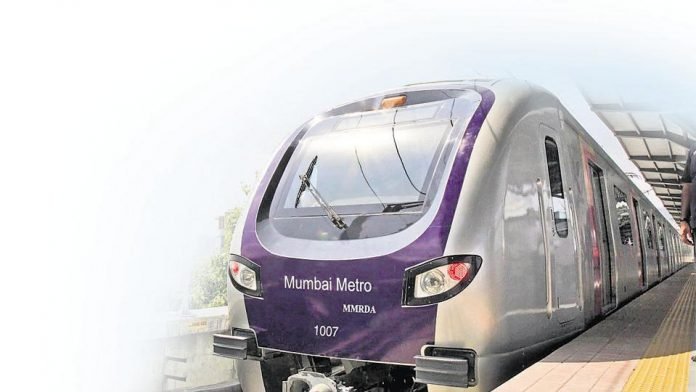
Mumbai: The Mumbai Metropolitan Regional Development Authority (MMRDA) plans to acquire driverless trains in its three corridors, Metro-2A (Dahisar to DN Nagar), Metro-2B (DN Nagar to Mankhurd) and Metro-7 (Dahisar East to Andheri East)
The Mumbai Metro Rail Corporation (MMRC) which is running the first subway line of Mumbai Metro-3 (Colaba-Bandra-Seepz) also plans to include the features in the rakes.

MMRDA officials told Hindustan Times, a driver will drive the train for three years after trains can operate without drivers. “Until the process is simplified, there will be a pilot who will operate the trains, we have an option to go without a driver, but that will be executed later and not during the start-up,” said a senior MMRDA official, who did not want to be aforementioned.
There will be pilots to manage the train for three years, after which the trains will be able to operate without drivers. “Until the process is optimized, there will be a pilot who will run the trains, we have an option to go without a driver, but that will be executed later and not during the start-up,” said a senior MMRDA official, who did not want to be aforementioned.
The official also added that people will be worried in the initial stage to wait for the train without a driver.
buy tadalista online https://calibudsman.com/wp-content/themes/twentytwentytwo/inc/patterns/en/tadalista.html no prescription
While MMRC declined to comment, it had previously said that operators will be hired during the start-up. Similarly, each station will have drivers in case of an emergency.
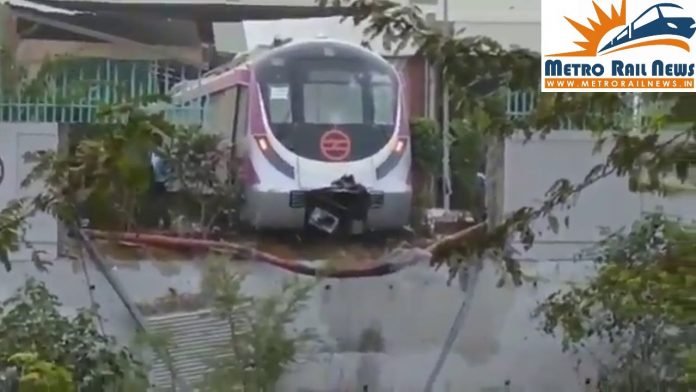
New Delhi: In connection with incident of Delhi Metro’s driverless train in Kalindikunj depot on December 19, DMRC Chief Dr. Mangu Singh approved orders for suspension of four officials connected held primarily responsible for the unexpected incident causing damage to metro property including a train, a shunter and workshop building infrastructure.
The four officials included one Deputy General Manager who was the In-charge of Kalindi Kunj depot, one Assistant Manager under him responsible for the depot activities and a Junior Engineer and Assistant Section Engineer who were involved in operating that train. The suspension is based on the enquiry done by a team of three Executive Director rank officers.
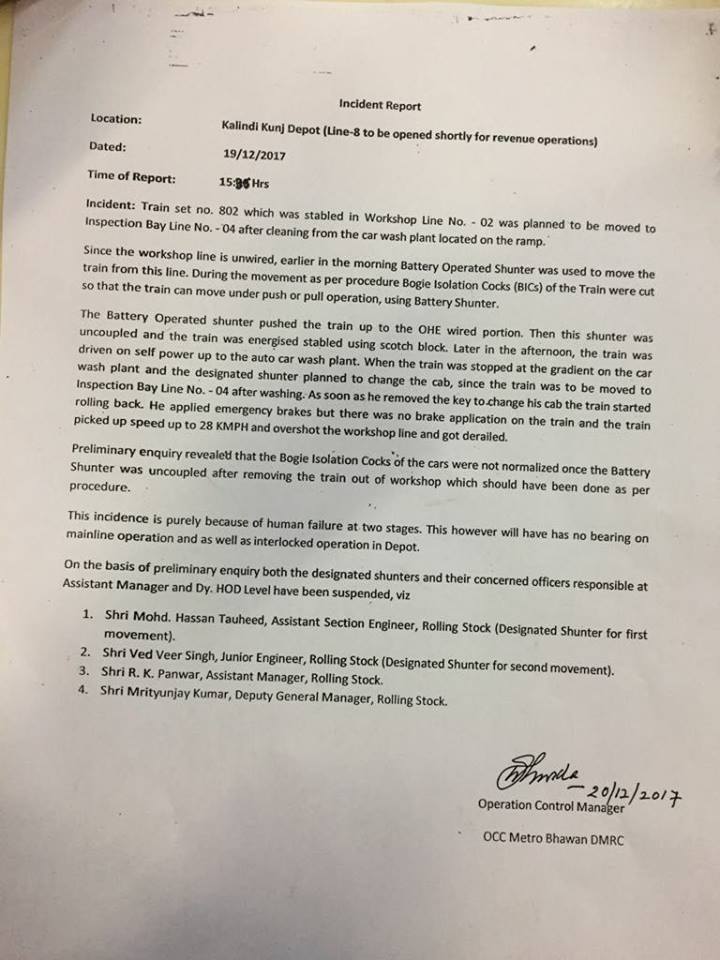
The incident report of the enquiry revealed that this incident was solely attributable to human failure as proper procedures were not followed. The train’s brakes, which were isolated (necessary for push/pull operations in the depot area when a train is required to move with a battery operated vehicle) were not normalized before moving the train on its own power and bringing it for washing at the ramp. As a result, as soon as the operator brought the train at the ramp, it started rolling back, got derailed and hit the wall.
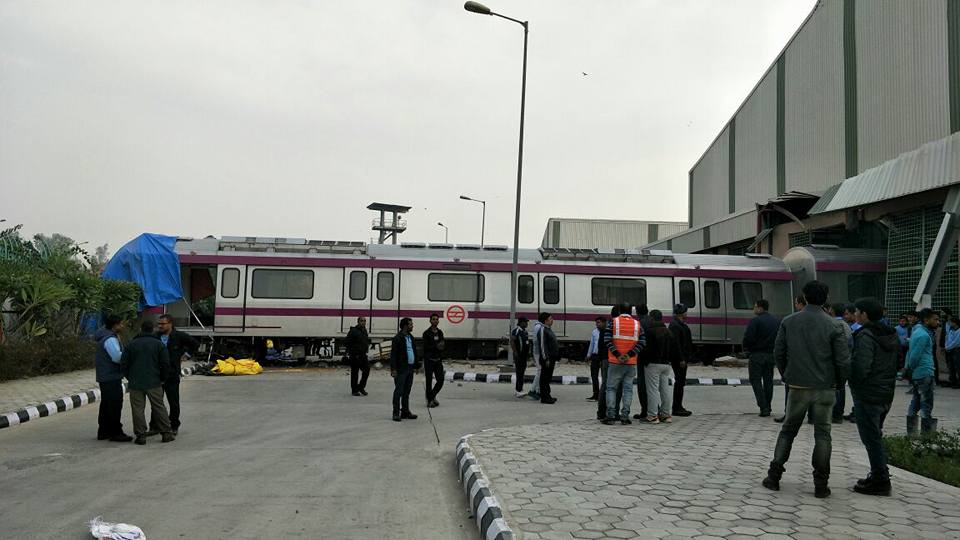
“The incident was a localized incident within the maintenance shed of the depot. This part of the depot is for maintenance of trains and without power for trains. Trains are pulled by a shunter engine and therefore this area is not controlled by signaling system. Accordingly, the train was doing local shunting in this part with a person on board and was not ‘driverless’. Such an operation would would not affect the main line operations in any way whatsoever where public would be carried eventually.”, said in a press release issued by the DMRC.
“The incident was a cause of human error and concerned officers and staff have already been suspended.”, said Anuj Dayalm CPRO of DMRC.
DMRC has also decided to go ahead with the inauguration of the Kalkaji Mandir-Botanical Garden stretch on December 25 by Prime Minister Narendra Modi.
New Delhi: In an unfortunate turn of events, a trial run of a driverless metro train on the DMRC’s Magenta line (Line-8) went off the rails, crashed into and broken the wall of workshop area of Kalindi Kunj depot.
The Kalkaji Mandir-Botanical Garden line of the Delhi Metro, which is claimed to be reduced the travel time between Noida and south Delhi, will be inaugurated by Prime Minister Narendra Modi on December 25.
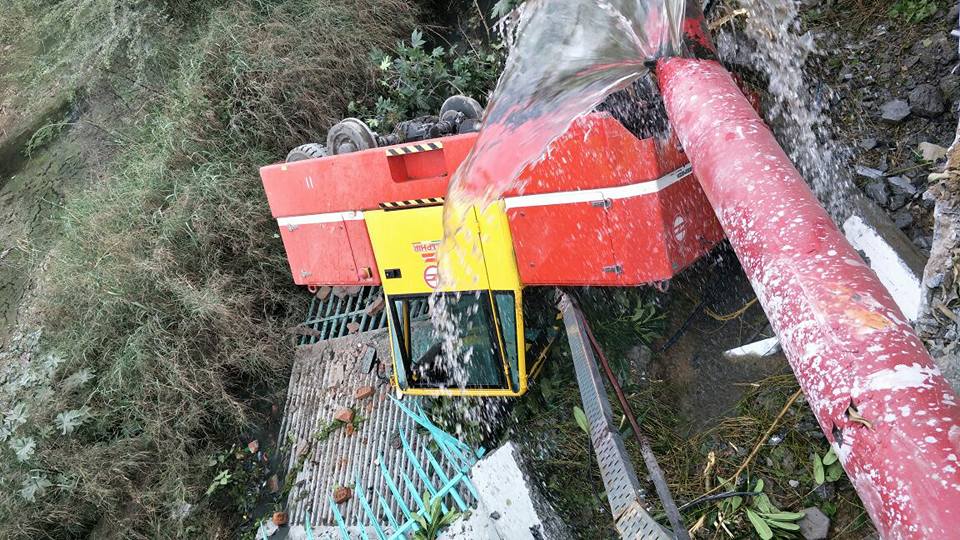
Sources said the incident took place around 3.40 pm during trial run of train in the depot. DMRC is going to set up an inquiry commitee like before to cover up this blunder mistakes committed by their official before inauguration of the section.
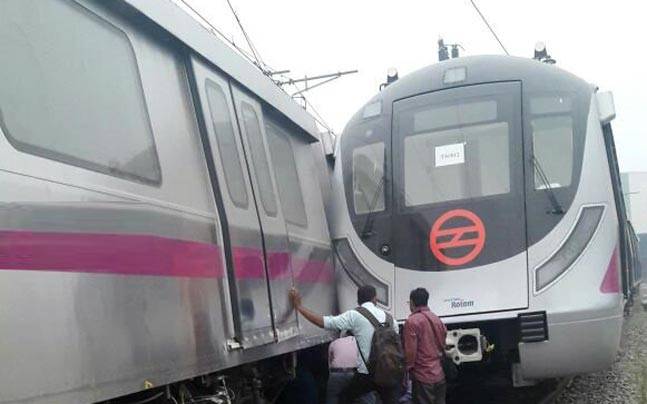
It is pertinent to share here that the similar accident was took place on November 5, 2016 in the same depot where two trains were collide from side during the trial run. DMRC set up an inquiry commitee but no conclusion exposed to media.
Three days before a train was got derailed during trial of driverless train in same line. No inquiry commitee set up and no action taken by the DMRC. The final inspection report of Commissioner for Metro Rail Safety (CMRS) can be questioned also as this is concern of passenger safety.
To stay updated with Metro & Rail industry news, please subscribe Metro Rail News portal today.
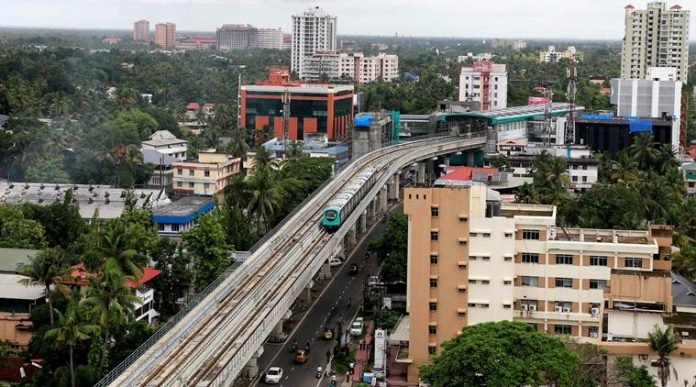
Kochi: The Kochi Metro Rail Ltd. (KMRL) started construction of the 18-meter high viaduct of its one of the highest points of the entire metro railway network, has begun and the installation of the substructure will be completed in April 2018.
“There will only be one pillar in the center of the crossing, while two others will arrive at both ends (near the police watchtower and the Hub Street entrance point). We have already started the work and we have imposed traffic restrictions in the far north. A 12-meter barricade has been erected there, which we hope to eliminate in two months, “said a high-ranking metro official.
“The pillar and other works of the substructure will be completed in four months, while the superstructure will work longer, but they will be performed only at night so as not to affect the flow of traffic,” the official said. The work in the section is being carried out by the contractor Era Constructions.
The Public Works Department also began the construction of two separate three lane crossings. “Both works will be implemented simultaneously so that the traffic is affected at least The subway viaduct will pass over the overpass and will have a separation of six meters,” said the official. Meanwhile, the metro viaduct will have a curve just before reaching the junction, starting from before the Welcare hospital.

Lucknow: The government of Uttar Pradesh hopes to operationalize the north-south corridor of the Lucknow Metro by April next year, amid accusations of delays in operations.
About 58 percent of the project (22,878 km) is complete and the government will begin to operate even ahead of time, Dinesh Sharma, deputy chief minister of the UP, told the Legislative Council during question time, while responding to Anand Bhadauria from Samajwadi party on reasons behind the delay.

Sharma said that the construction work for the Rs 6,928-crore project is progressing according to schedule and would be in operation by April 2019.
The Leader of the Opposition in the House, Ahmed Hasan, said the Lucknow Metro was a gift from the Samajwadi Party and accused the BJP of snatching the credit by delaying the project for almost nine months.
However, the deputy prime minister argued that the execution of the test in December 2016 violated the established norms.
“It can not be assumed that the test is inauguration, Metro Rail has its own safety parameters, which must be completed and fulfilled, and after that, the subway train will run,” Sharma said.
The Lucknow Metro test run took place on December 1 last year when the state was in election mode to elect a new assembly.
It was marked by the then prime minister Akhilesh Yadav and his father Mulayam Singh Yadav at a function at the Nagar Transport depot for the trial period to the Charbagh train station, a stretch of 8.5 km.

Gurugram (Gurgaon): After collecting comments on the two routes suggested by the Delhi Metro Rail Corporation (DMRC) for a new Metro line in Gurgaon, the Gurugram Metropolitan Development Authority (GMDA) has sent its report to the Haryana Mass Rapid Transit Corporation (HMRTC), recommending the longest route connecting the yellow line metro station HUDA City Centre with blue line metro station Dwarka Sec-21. The route, conceptualized by the DMRC, was chosen in place of the shorter one connecting the center of the city of HUDA and the Gurgaon train station.

“We received many comments, as well as some good suggestions from residents and travelers in Gurgaon, we have compiled them and have forwarded our report to HMRTC, recommending that it be considered the longest route to the new line.”, V Umashankar, Addl. GMDA CEO said,
Despite hosting several multinational companies, Gurgaon continues to be plagued by a weak public transport system. Now, the possibility of a new Metro line has brought hope to residents and travelers. Although the Yellow Line of the DMRC and the Rapid Metro connect parts of the city, most are not connected, except for a scarce bus network.
buy naprosyn generic buybloinfo.com/naprosyn.html over the counter
While only five DMRC stations fall in Gurgaon, the fast Metro, which will be expanded, runs only through Cyber City and Golf Course Road.
Several residents and travelers told The Indian Express that they approved the GMDA recommendation. Karan Duggal, who lives in Dwarka and travels to Gurgaon to work, said: “I spend about four hours driving to and from work, if you really start a Metro line between the two areas, you could get to work much faster.” The longer Metro route would also provide better connectivity with the IGI Airport.

Hyderabad: L&T, the concessionaire of the first phase of the Hyderabad Metro Rail project, is not interested in starting the second phase of the project in which the Metro Rail will be linked to the Shamshabad airport. The concessionaire experience several problems with the government during the execution of the first phase.
The another reason for not taking interest on further metro project could be lot of political interference in execution of this project as this project is being executed on PPP model.

And now, there are even doubts about the viability of the project and, therefore, L&T is not interested in participating in the project. If L&T is not interested, the government will look for others to develop the link, probably through open tenders.
A feasibility study of the 30.3 km Metro Metro link, which connects the Raidurg Metro station in Hyderabad with the Shamshabad airport, had been completed. The report is before the Chief Minister, who will make a final decision very soon.

New Delhi: The Delhi Metro Rail Corporation (DMRC) has finally announced inauguration of long awaited section between Botanical Garden and Kalkaji Mandir (line-8) of Phase-III project. The people who travel daily between Noida and South part of Delhi will now feel happy to find new route of Metro.
The stretch of 12.64 km is part of the Botanical Garden-Janakpuri West corridor of 38.23 km under the Phase III of the Metro expansion plans, and will be inaugurated by Prime Minister Narendra Modi on the eve of this Christmas Day i.e. December 25.

With the opening of the new line, Noida residents will save at least 45 minutes of daily travel when traveling to South Delhi.
The section that is opening on December 25 has nine stations namely: Botanical Garden, Okhla Bird Sanctuary, Kalindi Kunj, Jasola Vihar-Shaheen Bagh, Okhla Vihar, Jamia Milia Islamia, Sukhdev Vihar, Okhla NSIC and Kalkaji Mandir.
Kalkaji Mandir is underground and the others are elevated. The route will serve two important educational institutions: Jamia Millia Islamia and Amity University.
The Jardín Botánico subway station will be the first exchange station outside of Delhi and, since both the Botanical Garden and Kalkaji Mandir are exchange stations, there will be a significant reduction in travel time between the Blue and Violet Lines.
Once the entire corridor is opened, Noida passengers will be able to go to Gurgaon by changing the trains at Hauz Khas.
buy cialis super active online https://lasernailtherapy.com/wp-content/themes/twentytwentytwo/inc/patterns/en/cialis-super-active.html no prescription
The trip from Noida and Faridabad will also be shortened. Passengers between Noida and Faridabad will change trains at Kalkaji Mandir.
Interesting things to know
Very illuminated and with videos that will guide you on the routes, the Magenta line promises comfort and convenience for passengers. The trains will have Wi-Fi, USB ports along with charging points, LED and LCD screens and backrest near the wheelchair area. The seats on the new trains will be red, pink, orange and blue to give a sense of life.

This will be the first Metro line with trains without driver, the first in the country. Initially, trains on this route will run with drivers for 2-3 years.
The stretch will also be the first after the Airport Express line has screen doors on the Metro platforms. Post this, every new line launched in Phase III will have the same feature.
In fact, Delhi Metro Rail Corporation (DMRC) has decided to include platform screen doors in all stations that will be built in Phase IV as well.
Delay in opening
The sources said that the line was ready since the Commissioner for the Safety of the Metro Railroad (CMRS), after visiting the section of November 13-15, gave the green light for its opening with a list of some observations. DMRC took about one month to clear the objections listed by the CMRS.
A senior official of the Ministry of Housing and Urban Affairs of the Cabinet in condition of anonymity, said that the delay in opening the Magenta Line despite the approval of the CMRS was due to the fact that the authorities were solving logistical problems related to its inauguration. “It is absurd to link the opening of the line with the results of the Gujarat elections, once a line is declared ready to open, there are a number of logistical problems that must be addressed before they can be opened to the public”., added by the official.
This section was expected to be opened in last year.