Home Blog Page 722

Delhi Metro | CMRS to start inspection of Durgabai Deshmukh-Lajpat Nagar section

0
Delhi Metro’s driverless trains start their operation from Thursday between Majlis Park to Shiv Vihar
Image Source: Twitter

New Delhi: The Pink Line is the second new line of Phase III of Delhi Metro which was partially opened on 14 March 2018. There will be an inspection of Delhi Metro’s Pink line, from Durgabai Deshmukh South Campus to Lajpat Nagar stations. The inspection will be done by the Commissioner for Metro Rail Safety (CMRS) on July 23.

The inspection will concentrate on the way for the opening of the section, which is likely to be inaugurated early next month, the official said.

This stretch will have two interchange points INA and Lajpat Nagar. There are six new stations on this 8.10 Km stretch which are are Sir Vishveshariah Moti Bagh, Bhikhaji Cama Place, Sarojini Nagar, INA, South Extension and Lajpat Nagar.

The INA commuters now an can easily interchange with the Yellow Line and Lajpat Nagar station with Violet Line a big congratulation for all the shopping lovers for connectivity for two big hubs of shopping.

interchange plan of INA Metro Station
interchange plan of INA Metro Station (photo: steelguru)

Another achievement of DMRC as with the opening of this section, the Majlis Park to Lajpat Nagar section will become 29.66 km long and the entire operational project of the DMRC will reach 296 km with 214 stations.

Pink Line of Delhi Metro has not only extended the network of Delhi Metro but has also facilitated the commuters in large scale. Pink Line is connected with almost all the Line of Delhi Metro which has saved the time of commuters. Now it will be very easy for commuters to interchange line as Pink Line interconnects almost all the line of Deli Metro. It connects almost all the line of Metro at Azadpur for Yellow Line, Netaji Subhas Place for  Red Line, Punjabi Bagh West for Green Line, Rajouri Garden for Blue Line, Lajpat Nagar for Violet Line, INA for Yellow Line and soon Mayur Vihar-1 for the blue line.

Advertisement1
InnoMetro_2026

Delhi Metro | DMRC pulled up for deceptive co-branding of its station

0
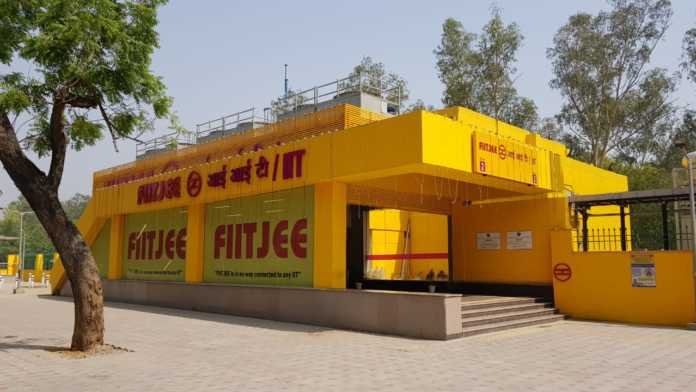
FIIT-JEE Metro station opposite IIT

New Delhi: The Delhi Metro Rail Corporation (DMRC) faced High Court ire for deceptively co-branding station located opposite Indian Institute of Technology (IIT). HC has directed DMRC to put a disclaimer notice for Delhi Metro station named FIIT-JEE. This comes as the coaching institute is not connected to IIT any which way.

DMRC was pulled by HC for maligning IIT’s name as it does not promote any coaching class.

HC was hearing a complaint filed by IIT against DMRC and sough direction on not using its name in conjunction with that of FIIT-JEE. The station situated opposite IIT premise bears the name FIIT-JEE which tarnishes the image of foremost engineering institute of the country.

Disposing the petition,Justice Vibhu Bakhru has asked DMRC to put a disclaimer indicating that FIIT-JEE is no way associated with IIT. The HC also directed that the font as well as size of the disclaimer be similar to those used in FIIT-JEE.

During the hearing DMRC was also asked as to why a disclaimer was not issued while inviting tender. The counsel representing DMRC replied that they had given the rights to an advertising firm while invited tenders for the same.

The court rebuked DMRC, stating, “Don’t you have control over co-branding or control over the name to be put on your station board?”

The counsel representing IIT also told the court that if DMRC wanted to IIT’s name to brand its station, it should have consulted the institute before naming the station.

DMRC counsel has agreed to the disclaimer and that they will follow HC’s directives with regards to font and size suggested by the court.

On the hand the counsel of FIIT-JEE wanted to file its response to the complaint and asked court’s permission during the hearing. The court denied the permission and stated that the coaching institute is not at fault as it participated in the tender bid and won the contract.

HC also made it clear that it was not barring IIT from taking further action with regards to trade infringement. The order further stated that it will also not prevent FIIT-JEE from initiating any action.

IIT in its plea had stated that the co-branding was misleading people with many thinking that the institute had partnered with them. IIT officials shared that they have been receiving queries from aspirants, parents and alumni post naming the station as FIIT-JEE.

Since 2014 Delhi Metro has been auctioning the naming rights of a number of its stations as means to generate revenues.

Post the naming controversy, FIIT-JEE has put up a disclaimer stating ‘FIITJEE is in no way connected with any IIT’.

V Ramagopal Rao, IIT Director has articulated While addressing the press he stated that the institute is not satisfied with the disclaimer. He made it clear that IIT- Delhi does not want any association with a private coaching institute. He said the institute does not want to partner with a private coaching class to facilitate their commercial interests.

Advertisement1
InnoMetro_2026

Whitepaper | Electrical Traction Control using PWM and IGBT Technology

Electrification system in Metro Railways
In recent years the importance of environmental problems has increased. Because of this electrical traction has replaced the internal combustion engine for mass transit systems. At first DC locomotives were used but they have many drawbacks, such as commutation, sparks on the brushes and difficulty in maintenance. However dc motors have now been replaced by 3-phase squirrel cage induction motors. To allow speed control the dc bus bar is available (+750Vdc) with a digital inverter built into the train. Pulse width modulation (PWM) is commonly used to convert a dc voltage to three symmetrical ac components. Moreover the GTO thyristors is changed to an Insulated Gate Bipolar Transistor (IGBT Technology) for its many advantages. Most metro systems in the world now use this approach. In this paper the mathematical modelling and simulation results are presented and commented on.

Introduction

The population of big cities needs major projects to solve their transportation problems.  The provision of mass transit systems is considered to be the most effective way of overcoming this critical situation.  These projects use electrical traction criteria to obtain the higher forces necessary to provide higher speeds [i].  So ac and dc electrical drives are considered to be the backbone of any metro project.  At first dc motors were used in the locomotives, but now many countries have changed to the use of ac locomotives.

There are many well-known advantages of AC locomotives over DC ones, such as simplicity, maintenance and low costs [ii].  On the other hand ac motors require an additional unit, the inverter, to convert the dc supply to an ac input for the motor.  The first generation of these inverters used GTO thyristors.  In modern designs these GTO inverters have been replaced by IGBT technology because of its advantages, such as increased reliability [iii].  IGBTs also have a higher rate of current carrying capacity, which is required for electrical traction.

Application Technology

Digital Inverter
The reasons for using IGBT technology in power and electrical traction circuits are:

  • It can produce the ideal 3-phase sine waveform current to the induction motor, so reducing the noise occurring from the motor.
  • The applied voltage on one piece of equipment is half the power source voltage.
  • Equipment can be smaller because of high frequency switching.
  • Drive power is very small.
  • No limitation of di/dt or dv/dt in the power circuit.

In the 1500Vdc rated catenary its change width is from 900V to 1900V, so IGBT can stand the average voltage equal to 1300V or 1500V repeating voltage.

To read complete whitepaper/research paper, please subscribe Metro Rail News Magazine or read July 2018 Issue.

Advertisement1
InnoMetro_2026

Mumbai Metro | Core activities to be in-house assert authorities

0
Mumbai Metro Rail
Mumbai Metro

Mumbai: The Mumbai Metropolitan Region Development Authority (MMRDA) is exploring possibility of keeping maintenance and operating activities in-house.  The authorities feel that it would be easier to manage things if all of it is managed internally for Mumbai Metro.

MMRDA that is constructing all metros in the city might not hire external contractors for operation and maintenance of metros. Usually all the public projects it handles like building roads, bridges and other works are handed over to local bodies post completion. But with metros MMRDA is looking to manage things in-house.

As per senior officials from MMRDA, they will be starting recruitment process to hire people to operate and maintain metros. They shared that the country has sufficient talent to operate metro rail networks. The external contractor too will hire people from outside. Instead of that MMRDA will hire and operate the Mumbai Metros.

Assuring best quality control

MMRDA feels that it will be able to offer better quality control if it takes care of operational aspect too. As per plan, the official shared that MMRDA will look into core activities which includes – signalling and tracks as well as maintenance of rolling stock. Whereas non-core activities like housekeeping will be given to contractors.

The decision to manage things in-house came with bitter sour experience with regards with dealing with operators of other commissioned projects. This comprises of Monorail and Metro Line 1.

It is in regular discussions with Mumbai Metro One Private Limited on a variety of topics. One of the topics is increasing the number of coaches given the popularity, and ticket prices. The authority is also facing snags in appointing a new contractor to manage and maintain the Monorail.

A senior official shared that MMRDA is building several metro lines and it is time consuming to identify right operator and then keep a track of their work. It is best to manage things in-house which will ensure best services to commuters.

MMRDA is at present working to execute work on four Metro lines in the city.
buy doxycycline online https://lasernailtherapy.com/wp-content/themes/twentytwentytwo/inc/patterns/en/doxycycline.html no prescription

Of these, lines 2A and 7 are under different stages of construction and are likely to be concluded by 2019. Whilst initial soil testing has started for lines 2B and 4, full-fledged construction is scheduled to begin only after the monsoon. The MMRDA will also invite tenders for Line 7’s extension from Dahisar to Mira-Bhayandar in the coming month.

Advertisement1
InnoMetro_2026

Mumbai Metro | Night ban on Metro 3 might cause Rs 6,100 crore loss annually

0

Mumbai: Restriction placed by Bombay High Court on Mumbai Metro work on Metro 3 might lead to an estimated loss of Rs 6,100. As per the orders metro work cannot be carried out from 10 pm to 6am – the ban is on late night construction. This ensued after a complaint from Cuffe Parade residents.

The ban has resulted in a loss of nine-month delay in work. The officials feel that if the ban is imposed for three more months, the project is likely to run in losses.  A projected annual loss comes around Rs 6,133 crore to the economy as per the experts associated with underground Mumbai Metro rail project.

As per the plan the Colaba-bandra-Seepz Metro 3 corridor construction comes to over Rs 23,000. The project is taken by Mumbai Metro Rail Corporation (MMRC).

The website of MMRC shows the detailed project report that indicates the costs that would be saved via operation new line. These are the FIRR (financial internal rate of return) and EIRR (environmental internal rate of return).

The EIRR indicates the advantage in terms of saving fuels bringing down pollution levels. These eventually help in protecting the environment and helps in economic development. FIRR on the other hand indicates the financial returns from the project.

Project FIRR is 2.19% and EIRR is 17.99% as per MMRC’s annual projection. Both the parameters together accounts for 20% of the project coast which comes to around Rs 4,600 crore. As per affidavit by MMRC the daily loss due to delay in building work was estimated at Rs 4.2 core or 1,533 crore annually.

If all the cost is added up it comes to around Rs 6,133 crore, a sum that can be used to construct 10km underground metro corridor.

SK Gupta, project director of MMRC stated the figures are arrived after micro assessment by experts and consultants. This is visible and invisible impact on the economy and the ban has adversely started affecting MMRC.

Advertisement1
InnoMetro_2026

Lucknow Metro | LMRC to complete special cantilever span over Gomti River by September

0

Highlights:-

  • Lucknow Metro set target to install special cantilever span over Gomti Nagarby September this year.
  • Construction of special span of 180 meters is started between Indira Nagar Metro Station and Munshipulia.
  • The construction work for the stairs at all metro stations are in full pace whereas on other side the construction work for concourse area’s base slab of all metro stations are completed.

New Delhi: The Lucknow Metro Rail Corporation (LMRC) today informed that the LMRC  Managing Director, Kumar Keshav reviewed the development progress of Metro construction work on the North-South Corridor of Section (1B). The contractors were also accompanied with him during the entire inspection. He first oversaw the ongoing construction work of KD Singh Metro Station which will be the first metro station of this section. The work of this metro station is at full pace with the work of framing, stairs, entrance and exit gates have done in their advance form.

The work of Metro Cantilever Bridge (45 Meters) going through Subhash Chandra Park has been completed with the installation of U-girders. Now the work of linking the two sides of the Special Cantilever Bridge is being done. The MD Lucknow Metro has expressed his  satisfaction while visiting the construction site.

The Managing Director, in his visit, also saw the work of the University and I.T. Metro Station. He has inspected the work of making concourse slab with the work of entrance and exit etc. The work of Second Special Cantilever Bridge(60 Meters) near Karamat College is also in full progress.

After this, The Managing Director also saw the ongoing works of the Badshah Nagar, Lekhraj, R.S. Mishra, Indiranagar and Munshipulia Metro Stations where he oversaw the work of making the staircase at all Metro stations which are in progress. From the Indiranagar Metro Station, on the top of the polytechnic flyover, the Metro has started work of its Cantilever Bridge. And the process of connecting this cantilever bridge with the metro pillar near the flyover is being done. The total length of this Bridge will be of 180 Meters.

Where on one side U-girder are installed which is also followed by laying of tracks and OHE Mast in all elevated S of this section. The remaining work for keeping the U-Girder at the kukrail Nala, Polytechnic, Nishatganj, and IT crossing will start soon.

Advertisement1
InnoMetro_2026

Noida Metro | DMRC to begin train trial run in Noida extn line by October

0

Noida: The stretch of Noida Metro extension from Noida City Centre to Noida Sec -62 trial will start by the October. As per the sources from DMRC (Delhi Metro Rail Corporation), people can use the metro by the end of this year.

The Blue Comprises 44 station from Noida City Centre to Dwarka Sec 21 and 8 stations from Vaishali to Yamuna Bank. The stretch lies at the end of Noida City Centre station.

In 2014, The extension of the line from Noida City Centre to Noida sec -62 was granted by Delhi government and there would be 6 new station which covers 6 km.

The work of the extension lies almost at the end. 70%of the finishing of the track is done and it is at the end and 80% of the work of Civil has been done. The work of making span is still in the process.

The Cabinet Approved the investment of 1967 crore for the extension. The Union Minister, Mr. Ravi Shanker Prasad stated that “Noida is also expanding in terms of commerce and facilities”.

The Union Minister, Mr. Ravi Shanker Prasad stated that “Noida is also expanding in terms of commerce and facilities”.

For the successful trial, there will be a need of almost 3 months as the extension is too long the trial period would be of 45 -55 days.
buy clomiphene online https://pavg.net/wp-content/themes/twentytwentyone/inc/en/clomiphene.html no prescription

The trial of Noida-Greater corridor will start from September,

NMRC (Noida Metro Rail Corporation) keeps eye on the functioning of the metro in the Noida and Greater Noida region.

As the Noida is the fast-growing town so there is more need for connectivity. NMRC ensures that the plan, design and provide financial need to urban transport in Noida and Greater Noida Region.

NMRC is working on connecting Noida and Greater Noida by making 29.707 km long corridor which is called as Noida-Greater Metro Rail Corridor and it comprises 21 stations.

Currently, NMRC stated that the work for 10 km of Noida – Greater Noida is done.

Advertisement1
InnoMetro_2026

Delhi Metro | Finance ministry approves Phase IV project of DMRC

0
DELHI METRO
DELHI METRO

New Delhi: Under the fourth phase of Delhi Metro, the proposal which has been given the theoretical approval by the Finance Ministry, will make three corridors. Their total length will be 60 km. These three corridors will be like one at Yamuna Pahar, the other in West Delhi and the third in South Delhi. The total construction cost of these three projects will be Rs 34 thousand 580 crores. According to sources in the Ministry of Housing and Urban Affairs, the Finance Ministry gives its approval only after analyzing the funding pattern of the total project cost. It is done only after this approval that the note is prepared for the opinion of all the parties and ministries and it is then approved by the Public Investment Board. By law, the third phase of the Delhi Metro should have been completed in 2016 and the construction of the fourth phase from 2017 had to start but neither the phase three was completed and nor the Fourth phase was approved.

Although the first Delhi Metro had proposed six corridors of 103 km for the fourth phase, meanwhile the new policy was implemented last year on the Metro. After the coming of this policy, the Delhi project has been prepared with fresh renewal report. Three Corridors have been given priority in this report.

The first corridor in this area is to connect the area of South Delhi’s Tughlaqabad with aerosity. This corridor will be 20 km and through this corridor, several areas of South Delhi will be connected to the airport. Similarly, the second corridor will be from East Delhi. This corridor will start from Maujpur and connect with Mukundpur in northern Delhi. The 12-km corridor will have a way to get the metro ring ready. It is now operational from Mukundpur to South Campus, while the South Campus is being constructed from Shivpuri to Shiva Vihar. In this way, the line between Maujapur and Mukundpur will also be directly connected to the metro of the population near the Wazirabad road in the north-eastern Delhi of Yamunapar. The third corridor will be built between Janakpuri West and RK Ashram Marg.

Recently, the corridor has been started between Noida and Janakpuri West. After its construction from Janakpuri West, a large area of Outer Ring Road will be connected to the Metro network. This metro line, R.K. Asharam is being started from Outer Ring Road and will be till ashram. This line will be 28 km and the longest line of the fourth phase.

Advertisement1
InnoMetro_2026

Jaipur Metro | Stakeholders okay extension of Phase II project

0
Jaipur Metro
Jaipur Metro/ Representational Image

Jaipur: The stakeholders of Jaipur metro approved the updated project report for Phase II of Jaipur metro on Friday. Phase II has been proposed on the length of 29.5 km between Sitapura and Vishwakarma Industrial Area and has a further agreement of extension of the route by 8 km as the plan is for the extension of Sitapura, which needs to be connected with Ring Road by the year 2031.

Ashwani Saxena, director project Jaipur Metro Rail Corporation (JMRC) said “In the initial detailed project report submitted by Delhi Metro Rail Corporation, the second phase was proposed on the length of 23.8 kilometers between Sitapura and Ambabari. This has been extended to connect Airport and Collectorate circle.”

Ashwani Saxena, director project Jaipur Metro Rail Corporation (JMRC) said “In the initial detailed project report submitted by Delhi Metro Rail Corporation, the second phase was proposed on the length of 23.8 kilometers between Sitapura and Ambabari. This has been extended to connect Airport and Collectorate circle.”

The stakeholders involve traffic police, representatives of trade, urban development agencies, and social bodies. They have been asked to submit their final suggestion on the metro route by next week after that the final project report will be sent to the State government.

JMRC had appointed an international constancy firm to draft a comprehensive mobility plan for the city. The comprehensive mobility plan submitted by the agency insists on an urgent need to develop the north-south corridor of Metro in the second phase intersecting the already existing phase at Sindhi Camp. Phase II is considered crucial for the success of the Metro operations by adding more destinations on the Metro route.

The CMP further suggests improvement of existing public transport system. It means Jaipur needs to focus on its last mile connectivity system as it is also important for the commuters.

The Jaipur Metro Rail Corporation (JMRC) says “The plan suggests the implementation of transportation infrastructure including, junction improvements, development of bus and truck terminals and radial routes that help connect the Metro with the Outer Ring Road by the year 2031”

Advertisement1
InnoMetro_2026

Delhi Metro | Heavy water flood in tunnel hits metro services in magenta line

0

New Delhi: On 14 July by late evening large number of commuters awaited and trapped as Delhi metro between Janakpuri West- Botanical Garden (Magenta Line) was delay by 2 hour 30 minutes due to technical snag. This was time when most of commuters were returning from work place faced hard to reach to their home. there was water logged in most of surrounding area.

This the second incident occur in this month in same line, it was 25 December 2017 when first services was started from Botanical Garden to Kalkaji  Mandir and on 28 May 2018 second phase services was started from Kalkaji Mandir to Janakpuri West. It is hardly one month completed and within short period two incidents occur which could largely affect the life of commuters. Now the main issue is that who is responsible for this, the main focused of Metro was to provide affordable and safe services to Delhiites but after the sudden fare hike it has neither affordable nor safe for commuters. If government cannot provide safe transport services then how commuters can trust on them. Delhi Metro is one of the largest metro networks in India, if it will suffer from technical snag then what will happen to other metro in India.

DMRC official said that, “the snag could have been triggered by the rain, but the exact cause has not been ascertained yet, and short loop services were run on both sides of the section i.e. Botanical Garden-R K Puram and IGI Airport-Janakpuri West”.

Delhi Metro Rail Corporation said, train operations were hampered due to a problem in the overhead electrical equipment (OHE), but it was clear if the problem was triggered by the heavy rains that lashed Delhi-NCR during that period.


Delhi Metro Rail Corporation spokesperson said that services were affected on the Magenta line due to some OHE problem between RK Puram and IGI Terminal-1 metro stations on the line around 4.10 pm. As a result a single line operation was carried out between RK Puram a IGI-Terminal-1 metro station, which caused the delay.

Advertisement1
InnoMetro_2026