Home Blog Page 718

Sreedharan- India’s metro man to head Modi’s bullet train project

0
Chennai-Mysuru high speed rail line project is on full swing
Image for representation purpose only copyright: respective Authority

New Delhi: From 1995 to 2012, Sreedharan, a retired Indian Engineering Service (IES) served as the managing director of Delhi metro. Now the Narendra Modi government has chosen E Sreedharan to head the committee for the bullet train project and to lay down standards for metro rail systems in the country. Now the Sreedharan has banged the Prime Minister Modi’s ambitious bullet train project.

During an interview, the Sreedharan said Bullet trains will cater only to the elite community. It is highly expensive and beyond the reach of ordinary people. What India needs is a modern, clean, safe and fast rail system.

During an interview, the Sreedharan said Bullet trains will cater only to the elite community. It is highly expensive and beyond the reach of ordinary people. What India needs is a modern, clean, safe and fast rail system.

By August 2022 the bullet train is expected to be constructed. The Japan-backed Mumbai-Ahmedabad bullet train project costs $17 billion.

For the Modi’s pet ‘Make In India’ campaign this project is being called as a crucial project. Modi has aimed at lifting the share of manufacturing in India’s $2 trillion economies.  Through this project, the government is also hoping to generate hundreds of jobs.

Sreedharan has also claimed that the railways have improved. A lot of things including engines, trains, and stations to food and bookings are getting a makeover under the Modi’s ambitious project to transform the railways.

As the next Lok Sabha elections are less than a year away, the Modi government is trying to complete all its promises and to changing the way Indians travel on trains.

Sreedharan is not impressed however he said I do not agree that the Indian Railways has made rapid progress. Apart from bio-toilets, there is no technical upgradation. Speed has not increased. In fact, the average speed of most prestigious trains has come down. Punctuality is worst – officially 70%, actually less than 50%. Accident record has not improved. Many also die on tracks, at level-crossings, in suburban sections. Almost 20,000 lives are lost on tracks yearly. I feel Indian Railways is 20 years behind those of advanced nations.

Sreedharan said on standardization of the metro service across the country, I have been pushing for standardization and indigenization of metro service for long. It is a welcome move. With standardization, efficiency will go up and reduce the cost considerably. We can manufacture coaches and other parts indigenously. I feel we can convert the metro into a ‘Make in India’ project. Delhi Metro has set a standard and triggered a metro revolution in the country. Results are there to see. Today there are 13 metros under construction. Within 20 years, Delhi Metro has reached a size of 260 km and is the fastest growing metro in the world. I also feel really proud of the work culture of Delhi Metro Rail Corporation (DMRC).


Advertisement1
InnoMetro_2026

Bhoiguda underpass to unclog by Hyderabad Metro Rail Over Bridge

0

Hyderabad: Hyderabad Metro Rail Limited (HMRL) officials shared the news that they have completed erection of a Metro Rail Over Bridge (ROB). The facility has come up at the congested and narrow Bhoiguda underpass. NVS Reddy, managing director, HMRL post inspection on Sunday of ROB made an announcement that the project has been completed successfully.

This project had to face several hurdles and challenges with regards to engineering, location and covering issue of space. But despite of these challenges, HMRL authorities completed the ROB within the stipulated period of time.

Having completed this ROB that is part of Corridor- II (JBS-Falaknuma) of the Hyderabad Metro rail, L&T—the concessionaire for the Metro project has constructed 8 ROBs in across the city till date.

At a special factory located in Ghaziabad, the complete steel bridge was made employing simulating site conditioning technique at Bhoiguda.

The dismantled bridge was then transported to the location in special containers at the Old Gandhi Hospital premises in Monda Market area of Secunderabad, informed the authorities.

Once the dismantled bridge reached the location, it was reassembled as per the design. The authorities used high strength steel plates and about 51,000 imported HSFG (high strength friction grip) bolts, between Secunderabad West Metrostation (of Corridor – II) and Bhoiguda Road Under Bridge (RUB).

HMRL explained that the reassembled steed bridge weighed nearly 960 MT. It was transported gradually and pulled using special pulling arrangements provided above the Metro pillar and on top of specially erected steep support structures.

Reddy shared with the Time of India that “Due to the curvy nature of the rail track, which takes a sharp left turn over the existing Bhoiguda RUB of Indian Railways, the Metro ROB had to be designed as a very wide steel bridge with a width of 64 ft and a length of 221 ft at a height of about 40 ft over the road level in the shape of a box. Inside this box bridge, a composite deck slab — a mixture of steel and reinforced cement concrete slab is being laid to accommodate two tracks.”

During the final installation process, the entire task was successfully carried out in within six hours of ‘traffic block’ – a time given by Indian railways that had temporarily suspended train operations during the process.

Advertisement1
InnoMetro_2026

Ahmedabad Metro | Experts confused for parking facility at metro stations

0
Vastral Gaam Station
Vastral Gaam Station (Ahmedabad Metro)

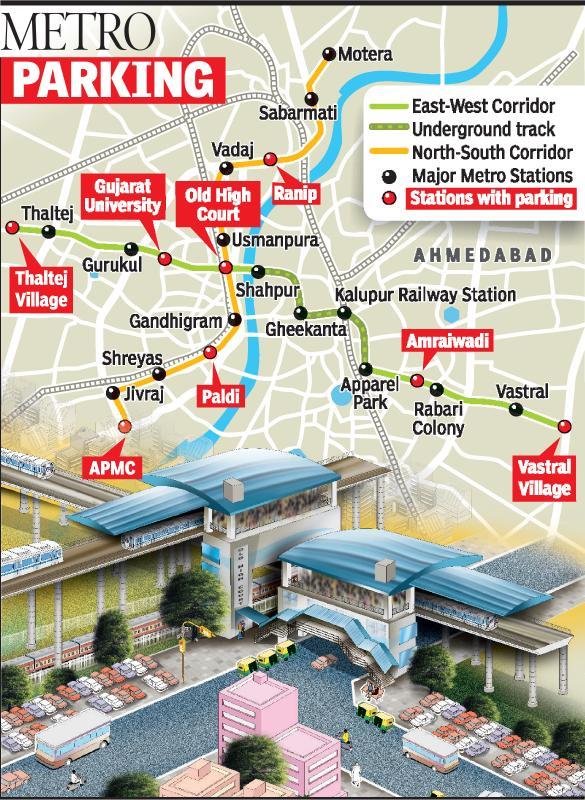
Ahmedabad: Urban planners are themselves confused about lack of adequate parking facility at the Ahmedabad metro rail station. It is expected that on 30% stations will have proper parking system. Out of 32 stations, only 8 stations will have a proper parking system whereas, Two other stations, Gandhigram and Sabarmati, will share parking facilities with the railways.

One urban planner, Utpal Sharma, feels that the provisions are inadequate, while another, Shivanand Swamy, says “parking should be arranged for only at the terminal stations.”

Sharma said, “We need more parking facilities to convert road vehicle commuters into metro rail passengers. In Ahmedabad, there are few stations where there can be parking facilities. I personally feel that no survey for parking requirements have been carried out.”

Authorities are also speaking to traffic police for understanding more about different areas and it’s traffic condition.

Master plan for parking
plan for parking system for Ahmadabad metro (photo: times of India)

Sharma added, “Parking is a major issue in Ahmedabad, and even without the metro rail, 40% of road space is occupied by parked vehicles. We need multi-level parking areas close to the stations.”

A senior Bus Rapid Transit (BRT) officer said, “If the metro fails to provide commuters adequate parking facilities, it will turn out to be another BRT. Instead of adding public transport users, the BRT reduced their numbers. The BRT had promised last-mile connectivity but failed to provide it as the proposed feeder buses are now plying on Ahmedabad Municipal Transport Service (AMTS) routes. If we fail to provide adequate parking facilities at stations, the project will not convert car or two-wheeler users to metro users.”

Swamy, however, said, “You don’t need parking at each station. One cannot provide adequate parking for cars anywhere on the route. Across the world, parking facilities are being removed and people are made to use mass transport system.”

Advertisement1
InnoMetro_2026

Soil testing for a few months in Madhavaram to prevent cave-ins Phase II

0
Chennai Metro Rail Project
Chennai Metro/ Image for representation purpose only

Chennai: There were several road caves in Phase 1, of Chennai Metro Rail. Now, Chennai Metro Rail Limited (CMRL) in order to be safe from loopholes in upcoming phase II. Planned for soil testing for a few months in Madhavaram before carrying out tunneling work.

Chennai Metro Rail Limited (CMRL) has also decided to make some changes in the alignment according to soil conditions as per officials’ decision. Even though these changes will be minor ones.

CMRL Phase II Network Map
Chennai Metro Phase II Network Map (PC: CMRL)

Official said that these changes will be only minor ones. We have planned to do it as we had issues of roads caving-in some areas in phase I because of loose soil and want to avoid them in this phase.

About Phase II Project

The Phase II will criss-cross the city which will consists nearly 108km with 116 stations of this, about 81km out of which 88 stations will be underground while the elevated track will be 27 km long with 28 stations. This is such huge length of section which needs to be constructed in small section; at first the CMRL will construct a 52 km stretch from Madhavaram to CMBT and Madhavaram to Sholinganallur.

Now, the most important step for the project soil testing which has to begin at Madhavaram and will go on for a few months. This is only possible when we have idea the soil conditions are. And how can tunnel work for nearly 81 km is possible that to without affecting the residents or buildings located along this alignment. Based on the results, we will make some changes in the alignment,” official said.

Further he added that our experts say it may be challenging to make changes in the alignment according to the soil conditions. An engineering expert from IIT-Madras said mixed soil conditions prevail in many of the areas. “If the He also share expert view, expert from IIT-Madras said the CMRL drilled holes to identify soil type underground, but there are more sophisticated methods which can help in knowing the conditions accurately.
buy cialis super force online https://sextherapyhawaii.com/wp-content/themes/twentytwentyone/inc/en/cialis-super-force.html no prescription

“They can do geophysical testing of soil which will give them continuous profiling of soil conditions. But above all this, instead of making changes in the alignment, they can safely carry out tunneling with ‘soil stabilization’ — a process of altering soil properties to better its strength.”

Advertisement1
InnoMetro_2026

Hyperloop | Does India really need the Hyperloop Transportation?

0
Maharashtra Chief Minister Devendra Fadnavis visited Virgin Hyperloop One test site
Hyperloop is a new form of transportation that moves people quickly and safely. Passengers are loaded into the hyperloop vehicle via electric propulsion through low-pressure tubes. The pods carrying passengers travel through tubes from which most of the air has been removed to reduce friction. This allows the pods to travel at up to 750 miles per hour, rather than using the wheel like in train the pods are designed to float on air skis by using magnetic levitation to reduce friction.

Does India Really Need the Hyperloop Transportation?

India is a developing country and a growing global economy requires faster, cheaper, safer and more efficient mode of transportation and will help the ecosystem as well. Transport vehicle has created a huge level of pollution which makes difficult to breathe in large cities of India. Where India has also planned to switch or to reduce the use of non-renewable source as much possible. In such a case, Hyperloop is one of the best transport communications. In the long run, the Hyperloop ecosystem can also give lots of profit to India and it doesn’t need to be subsidized. Even private investors can invest their money in it.

But the main question arises that how far India has invested in this project; does this investment will give more emphasis to the Transport Industries?

Mumbai-Pune project will cost around 3,50,000 crore (55billion USD) and will carry only 28 commuters at a time whereas if we really want to invest in transportation technology we can invest in bullet train project which will cost us 17 billion USD and will carry much more number of passengers at a time as compared to hyperloop and at this time our country is already facing deficit pf finance, it needs to be asked if there is really a need to invest lakhs of crores for experimental transportation technology instead of promoting our existing resources. There is no disagreement about the benefits of the technology if we ignore the cost.

Maharashtra Chief Minister Devendra Fadnavis visited Virgin Hyperloop One test site

Current scenario of Hyperloop in India

Pune-Mumbai hyperloop project goes from a vision to reality as it starts detailed planning. This transport connectivity will connect the 26 million people with access to affordable infrastructure that will highly boost the significant economic and social value. The Pune-Mumbai Hyperloop is expected to finish this summer as it has currently reached the mid-point of the in-depth feasibility study.  Andhra Pradesh government and US-based Hyperloop Transportation Technologies (HTT) have joined hand to introduce the Hyperloop transportation system in upcoming future in the state capital region, Amrawati. This will cover the distance of over 35 km only in five minutes.

But whatever happens, happens for a reason keep that in mind the state government has gone ahead and signed a Memorandum of Understanding (MoU) with Richard Branson’s Virgin Air to build a Hyperloop-based transportation system between Mumbai and Pune.  On 18 June 2018 Shri Devendra Fadnavis Chief Minister of Maharashtra met to the board members at Virgin Hyperloop One’s developing test tracks to view technology. If everything goes as per plan general public can travel from Mumbai to Pune within 25 min where usually it takes 2.5-3 hours by road and it will reduce the cost to the environmental assessment as the project will be completely self-powered with electricity generated by solar panels, it can reduce greenhouse emission by up to 1,50,000 tons annually.
Now, if we are talking about enhancement in the technology of our developing country we need to keep in mind about our focused project which is “Make In India” launched by our Prime Minister in September 2014.

If you want to share your views and experience with urban mobility projects in India and around the world please share us your story/article at editor@metrorailnews.in
Advertisement1
InnoMetro_2026

Jaipur Metro | JMRC faces delay in the ATO operations

0
Jaipur Metro
Jaipur Metro/ Representational Image

Jaipur: The Jaipur Metro Rail Corporation (JMRC) is facing delay on automatic train project. As the permission from commission railway safety has not be granted. Even the Mumbai driverless project result is still awaited.

After successfully completing trial Jaipur Metro Rail Corporation will start the operation work of ATO system by the mid or end of the August as the permission has not been received by Commission Railway Safety.

ATP is the automatic train system it is one of the smartest and modern types of train protection system. It keeps a minute to minute speed of the train by signaling. If it doesn’t get any signal the train will automatically stop.

The Jaipur metro official stated that they had sent the report of the impact safety accessor (ISR) to CMR and waiting for the approval. After the approval, they will commence the work. Jaipur Metro senior official said that “once the ATO system is Operational, Metro train would function without any intervention from drivers. It could control the speed and movement and braking among other key function. The role of driver, when the trial is in ATO mode will limit just pressing a button to open and close to train door at the metro stations”.

The JMRC will conduct trials on the non-operational hours and the officials of JMRC believes that when the project will start, it reduces the time between Mansarovar and Chandpole corridor. The system allows works at high frequency and has built in-safe mechanism.
buy vibramycin online https://pridedentaloffice.com/wp-content/themes/twentytwentyone/inc/en/vibramycin.html no prescription

The official of JMRC said, “ Trains when on the ATO  mode work on communication-based train control system that allows control of train movement through signal between a train and trackside equipment”.

The official of JMRC said, “ Trains when on the ATO  mode work on communication-based train control system that allows control of train movement through signal between a train and trackside equipment”.

Currently, 80 % of civil work has been completed and now the department started the work of laying track and electrification. The contract is also given for signal and telecommunication and fare collection work”.

Advertisement1
InnoMetro_2026

Mumbai Metro | Application withdraw for height exemption plea for Metro cables

2
MMRDA Review Report 2018

Mumbai: Application for Height exemption permission to install overhead cables forMumbai Metro Rail Junction has been withdrawal by Mumbai Metropolitan Region Development Authority (MMRDA). Height clearance granted in March would cause no safety issues for Juhu Aerodrame, said Airport Authority of India (AAI). MMRDA mainly took decision to withdraw application after this statement of AAI.

Metro 2B route which is passing through a funnel area of Juhu Aerodrome, along SV road in santacruz, MMRDA wanted height exemption for part of elevated corridor. This route is being implemented by MMRDA.

On 13 July a division bench of justice SC Dharmadhikari and Bharthi Dangre allowed MMRDA to withdraw it application. An email was forwarded by the AAI offices and signed by general Manager (ATM-NOC) New Delhi. Which was later informed to High Court by Shilpa Kapil. A grant of NOC for height of 16.
buy valtrex online https://www.mydentalplace.com/wp-content/themes/twentytwelve/inc/en/valtrex.html no prescription

76m AMSL stands was mention in email.

Mumbai Metro 2B line

Since a 2014 PIL by Yeshwant Shenog on height restriction was already disposed of by the High Court in April- lifting a two year embargo on aviation authorities deciding on application for height restriction exemption in buildings in the vicinity of the airport- MMRDA may withdraw the case, it mention in the email.

When MMRDA view the email, MMRDA counsel S B Talekar sought to withdraw the plea and court allowed its withdrawal S Mangala senior AAI office was present in court.

ON March when AAI has granted NOC, MMRDA had moved to High court as previous approval was necessary.

At first hearing when High Court could not receive email from AAI, it soughed on AAI as AAI is putting their workload on HC instead of finalizing it.

Advertisement1
InnoMetro_2026

Chennai Metro | Metro services disrupted owing to technical snag

0
Chennai Metro Rail Project
Chennai Metro/ Image for representation purpose only

Chennai: On Sunday when commuters would want a hassle-free travel, many who took Chennai metro had to face trouble due to technical snag. As per reports, metro services were disrupted for nearly 30 minutes at the Kilpauk station. The issue happened in the evening when a train malfunctioned.

Commuters had to wait for almost 30 minutes before the services were resumed. On the other hand Chennai Metro Rail Limited (CMRL) spokesperson asserted that the services resumed within 10 minutes.

While asking metro rail commuters who took the train to the Kilpauk route share that the services were disrupted for over 30 minutes. Till that only single line was operational, until the metro rail that developed technical issues was towed back to Koyambedu Metro station with the help of another train.

Due to this issue, direct metro trains plying from Chennai Central to St Thomas Mount and Airport were affected for some time with the trains were run up till Shenoy Nagar.

Metro rail sources on the basis of anonymity shared that the engaging contractual employees are to be blamed for the disruption. The source further added that these employees lacked necessary training which is imparted to metro rail employees.

The source who did not wish to be named said that the entire issue could have be resolved had trained engineers handled the issue. Those trained adequately who have done a better job to handle the problem. The unnecessary delay could have been avoided that caused problem to commuters.

Metro riders who take this mass transit mode of transport in order to reach early where upset with the delay. Such an incident taking place on Sunday evening sends wrong message to public who are warming up to the idea of travelling in a metro. Authorities need to take cognisance of this incident and take corrective actions in order to avoid delays in future.

Advertisement1
InnoMetro_2026

Jaipur Metro | JMRC again ready to increase its non-fair revenue system

0
Jaipur Metro
Jaipur Metro

Jaipur: The Jaipur Metro Rail Corporation (JMRC) is once again ready to increase its non-fare revenue from the Jaipur Metro. The tenders are invited to sublet the retail space for setting up the ATM machine at the metro station.

The corporation has decided to lease out space and will provide an extension after the completion. The form for the tender applicant can deposit till August 21, 2018.

JMRC had decided to sublet the three-metro station Vivek Vihar, Chandra pole, Ramnagar. The corporation has decided to lease out spaces for a five- year extension after completion.

The about 472.70 square meter at concourse level and 165 square meters at the Vivek Vihar metro station will be leased out and for Ramnagar 2038 square meter for starting 15 years and extension for 5 years.

JMRC had suffered operational losses due to the decrease in ridership. Jaipur is the first metro station in India to run on Double story elevated road and Metro track. Some questions raised upon the corporation about the continuous failure of the Jaipur metro. It is India’s sixth metro rail system after Kolkata, Delhi. Gurgram, Mumbai

JMRC was also funded by the state government through Rajasthan Transport Infrastructure Development Fund funded 45 crores and in past few years JMRC earned revenue of Rs 19 crore and suffered loss about 46 crores. The agency has almost spending of 36 crores in the year of 2016-2017.

The state government is funding money throughout the losses and helping to cure this problem and now they planned to lease space for ATM so as they get financial support from rent that corporation will get.

“Twenty-five percent of the total revenue accrued to RTIDF is forming green Tax surcharge on taxes on registration of vehicles. More 25% of total revenue accrued to RTIDF its form of sub charge and duty of registration building and planned exchange etc “as per a report.

Advertisement1
InnoMetro_2026

PPP in Metro Rail Projects: Constraints and Opportunities

0
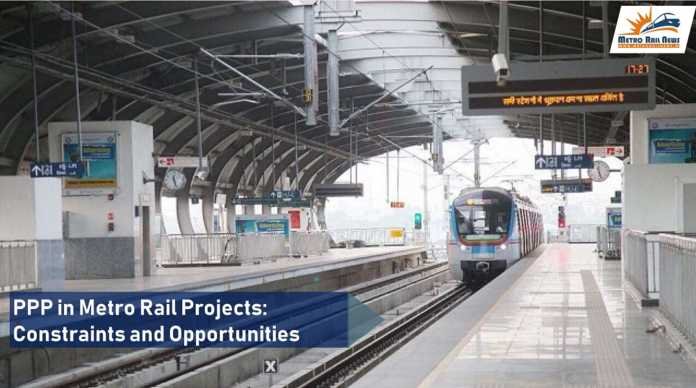
PPP in Metro Rail Projects: Constraints and Opportunities
The Government of India has made Public-Private Partnership (PPP) component mandatory for states for availing central assistance of new metro projects as part of its New Metro Rail Policy, 2017. Private investment and other innovative forms of financing of metro projects have been made compulsory to meet the huge resource demand for capital intensive high capacity metro projects. As per the Metro Policy, “Private participation either for complete provision of metro rail or for some unbundled components (like Automatic Fare Collection, Operation & Maintenance of services etc) will form an essential requirement for all metro rail projects seeking central financial assistance”. This development has raised the question whether PPP model can be successful for metro rail projects in India.

The PPP model as a part of the New Metro Policy aims at lessening the burden on the Central government in funding metro projects. This is not the first time that the PPP model has been tried in India. The first partnership model had been tried in the airport line of Delhi Metro Rail Corporation (DMRC). However, this attempt was not successful. Reliance Infrastructure became the country’s first private company to join the initiative, but abandoned it due to huge losses. Mumbai Metro Line-1 and Hyderabad metro rail have been taken up as PPP project with Viability Gap Funding (VGF) from Government of India. The Rapid Metro in Gurugram is an initiative of Government of Haryana where full funding is by the private concessionaire.

Constraints

The major issues, related to PPP in metro projects in India are commercial viability and procurement of Right of Way (RoW) and land. Metro projects are high capital intensive. Private players look for a return of around 12-15 per cent, while no metro project has yielded an investment return of more than 3 per cent. Metro projects are also long-haul projects and will take long time to break-even. The returns can only be generated by steep hike in their fares, but this is a problematic prospect for various reasons. The collection of revenues is highly uncertain in most of public transportation projects. The private investment has not been successful in Airport Metro Express Line because the usually unstable revenues which make them commercially unviable.  A trade-off is then often present in the case when the financial rate of return is below the market rate for private funds; some form of public support is required to make the project feasible (viability gap funding). The financial rate of return may be improved by way of additional user charges then economic rate of return may be affected negatively.

Another issue is the procurement Right of Ways (RoW) and Land. The responsibility of procuring RoW and land rests with the concerned state government. Private acquisition is very difficult with lengthy procedures and social considerations also need to be addressed, which is a challenging assignment.   In Mumbai Metro Line 1, Reliance Infrastructure took almost 7 years to complete 11 km of the relatively easier elevated line. This is due to delay in receipt of unencumbered Right of Way (RoW) / land by Government & Mumbai Metropolitan Region Development Authority (MMRDA). So delay of procurement of RoW and land is another obstacle for PPP projects.

In India, it is seen that political and bureaucratic constraints, such as fragmented decision making due to the involvement of multiple public agencies, the prevalent emphasis on administrative procedures rather than on strategies and results and lengthy tendering process (normally split in three or four phases, from planning to final operation) lead the problems for implementation of PPP projects in public transportation.

Opportunities

But there are also reasons in favour of PPP in metro projects. The PPP structure will help speedy, efficient and cost effective delivery of projects apart from better value of money and high performance incentives. The accountability and risk is with the private sector. But the success of the project will depend on the contract agreement (PPP framework) that the owners enters into with the construction company.

Way Forward

As cities are growing at a fast pace, metro will be an important constituent of the transport mix. Metro is more capital-intensive as it requires everything from land acquisition to civil works, signalling, and rolling stock. The capital-intensive nature of such projects does not allow private players to get a return on their investments easily. The metro has several externalities that make it imperative for the government to subsidize it. From enhanced mobility, to its relatively low carbon footprint, metro usage has benefits that cannot be measured through the purely commercial yardstick of profit and loss. So instead of PPP, state governments should give more emphasis for adopting innovative financing mechanisms like Value Capture Financing tools to mobilize resources for financing metro projects by capturing a share of increase in the asset values through ‘Betterment Levy’. The government has also to ensure affordable public transport and hence it must invest in it. To ensure that least cost mass transit mode is selected for public transport, the New Metro policy mandates Alternate Analysis, requiring evaluation of other modes of mass transit like BRTS (Bus Rapid Transit System), Light Rail Transit, Tramways, Metro Rail and Regional Rail in terms of demand, capacity, cost and ease of implementation.

(The author is Manager (Transportation), Bangalore Metro Rail Corporation Ltd.)
If you want to share your views and experience with urban mobility projects in India and around the world please share us your story/article at editor@metrorailnews.in
Advertisement1
InnoMetro_2026