

Home Blog Page 681

Alstom to Increase coach production at Sri City facility

0
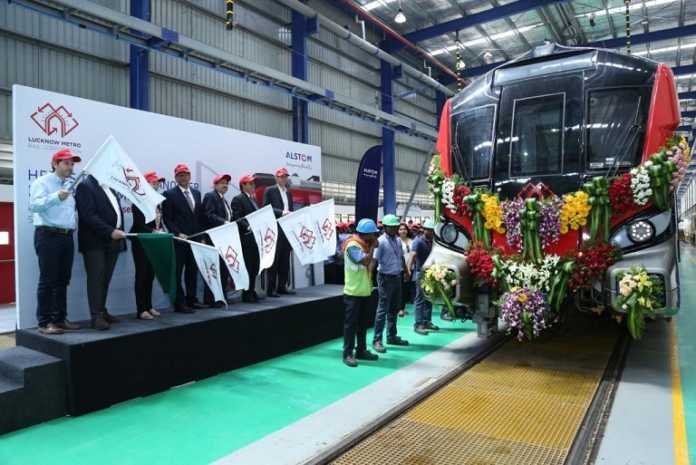
Alstom dispatched last train set to Lucknow Metro

Chennai, Metro Rail News: France-based Global Giant Alstom, a company operating in rail transport, Thursday announced a plan to increase production in its facility at Sri City, about 100 km from here.

On the capacity of the unit, MD of Alstom (India and South Asia) Alain Spohr said, “Today, we have the capacity to produce 20 cars per month. We will add four more cars to make it 24.”

“We are going to set up a new line for 20 cars to take the capacity to 44 cars. This will happen in 2019-end,” he told PTI.

Earlier, Alstom flagged off the last set of the 22 six-car train for Sydney Metro and unveiled the communications-based train control signalling system for North West Rail Link, Australia. Also, the last train for Chennai Metro Rail Ltd was flagged off.

Alstom completes fully-indigenous export order for Sydney Metro

The facility at Sri City commenced production in 2014 and has a capacity of producing 240 cars annually. The unit had also delivered metro trains to Chennai, Kochi and Lucknow.

The factory would begin work on the second export order for light metro project in Montreal, Canada, early 2019, an official said.

He declined to reveal the proposed investments to expand the facility. However, he said the employees at the facility would increase to 1,000 from the existing 450 following the increase in production.

Spohr said Alstom won an order to make 248 metro cars for Mumbai Metro Rail the production of which would begin in November 2019 and delivery in 2021-22.

He said the company had won the Rs 2,500-crore order in June 2018 for 31 trains with eight cars.
Advertisement1
InnoMetro_2026

L&TMRHL CEO KVB Reddy wins international award

0

Hydrerabad, Metro Rail News: L&T Metro Rail Hyderabad Limited (L&TMRHL) Managing Director and CEO KVB Reddy has been conferred with the ‘International Leadership Innovation Excellence Award’ by the Institute of Economic Studies (IES) at the International Economic Summit held recently in Bangkok, Thailand.

L&T Metro Rail Hyderabad Limited (L&TMRHL) has also been conferred with a gold medal for enhancing the image of India globally, according to a press release issued here on Thursday. Reddy received the award from Korn Dabbaransi, former Deputy Prime Minister of Thailand and Princess Isabelle Lafforgue of Mindanao.

The IES was established in 1980 by a group of economists, parliamentarians and industrialists who came together to study and discuss problems concerning various aspects of the economy and economic development and offer their expert advice and services.

Reddy said the award represents the success of Hyderabad Metro Rail and the gold medal commemorates HMR’s exemplary service and its first anniversary.

Advertisement1
InnoMetro_2026

Final inspection for Aqua Line nod as Its open for public on Xmas

0
Noida Metro Phase 2

Noida, Metro Rail News: The commissioner of metro rail safety (CMRS) will inspect the 29.7km Aqua Line from December 11 to 13 for the final certification needed to start commercial operations on the Aqua line corridor that is likely to be inaugurated by Prime Minister Narendra Modi on Christmas day.

The Noida Metro Rail Corporation (NMRC) has been expecting an inspection by commissioner of metro rail safety (CMRS) S K Pathak for the past one month. The final inspection includes exhaustive checks and re-checks on different public safety mechanisms, including security system, alarms, emergency stops, and entries and exits at all 21 stations of the corridor.

Earlier, in the first phase of the checks, the deputy CMRS had conducted a
full trial of the metro line along with a two-day test of the rakes that will run along the entire corridor. That was completed on September 20. The inspection was described as “good” by officials.

According to the official “It takes at least three days as this is the last stage when each and every aspect related to commuters’ safety is studied and checks are carried out,”

“If any loophole is found, the CMRS will direct it to be fixed. Usually, a final invitation is sent to the CMRS only when the metro line is fully ready for commissioning,” the official added.

While December 25 is the proposed date for commissioning, NMRC officials have not yet confirmed it. “The dates for the CMRS inspection have been confirmed for December 11 to 13. We are gearing up for the same,” said PD Upadhyay, ED of NMRC, adding the inauguration date will be finalized after the CMRS inspection.

While in most metro projects, commissioning has followed the final inspection, sources said the CMRS had pointed out shortcomings during the inspection of the Botanical Garden-Kalkaji line due to which the commissioning was delayed by a few months. “Usually, if the CMRS points out shortcomings, they would ask for quick redress and issue a new date for another round of inspection,” the official said.

Advertisement1
InnoMetro_2026

Delhi Metro | DMRC gets nod to run PPP Model

0
KEC Awarded Delhi Metro Pink Line's DE-14 Electrification Contract
Image Source: DMRC

Delhi, Metro Rail News: The Ministry of Housing and Urban Affairs (MoHUA) has granted the approval wherein the DMRC, in a first for any of its corridors since it was launched, will involve private operators to run the operations. After getting the much-delayed nod for Phase IV of Metro, the Delhi Metro Rail Corporation (DMRC) has also got green signal to run it on Public-Private Partnership (PPP) model.
buy cialis super active online https://pavg.net/wp-content/themes/twentytwentyone/inc/en/cialis-super-active.html no prescription

As per the proposal, while the DMRC will lay down the track, a private company will be roped in to get coaches on the lease. The private player will be decided through a bidding process. The Delhi Metro is also likely to pay a private firm to run its trains. Besides, other essential services across all the metro stations like elevators, escalators and AFC (automated fare collection) gates will also be outsourced to private companies in the coming time.

“The proposal to engage private operators was submitted to the Ministry of Housing and Urban Affairs Secretary last month to involve their services for at least three to six corridors. Under the plan, Delhi Metro will give a guarantee to a private operator on ridership while the operator may run a train on the basis of per kilometer expenses” Said, Senior officials

According to the source, The Delhi Metro has sought permission to complete phase IV in two phases. The first one will be the section between Mukundpur-Maujpur, Tughlakabad-Terminal 1 section and Janakpuri (west)-RK Ashram section, while the second one is the section between Rithala-Narela, Inderlok-Indraprastha section and Lajpat Nagar-Saket G-Block section. The latest Detailed Project Reports of six corridors of Metro phase IV states that the 104-km Metro Phase-IV network is expected to be completed by December 31, 2024. The proposed lines are Mukundpur-Maujpur, Rithala-Narela, Tughlakabad-Aerocity, Inderlok-Indraprastha, Lajpat Nagar-Saket G-block and Janakpuri (west)-RK Ashram. The 104-kilometre network is expected to increase the ridership by 1.5 million passengers daily, with south Delhi residents benefitting particularly from it, connecting them to the airport and other areas.

Advertisement1
InnoMetro_2026

Greater Noida Authority approves Noida Metro Phase 2

4
Noida Metro Phase 2

Noida, Metro Rail News: This news bring cheer to residents of Greater Noida West. The Greater Noida Industrial Development Authority (GNIDA) on 4th December 2018, approved the Noida Metro Phase 2 from Noida Sector 71 to Knowledge Park 5 in Greater Noida. The extension will comprise nine stations and cost Rs 2602 crore, top officials said

This decision was taken at the Authority’s 113th board meeting. “Noida Metro Rail Corporation would be the nodal agency for the project. The first phase of the Metro project comprising five stations from Noida Sector 71 to Greater Noida Sector 2 is expected to cost around Rs 1521 crore, officials said.

The Akhilesh Yadav government had earlier approved construction of a 15-km metro project to connect Noida Sector 71 with Greater Noida’s Knowledge Park 5 via Ace Divino.

“The modalities and details on the DPR would be given later,” Chief secretary AC Pandey was quoted as saying.

The extended line of Noida Metro’s Aqua Line will have a total of nine metro stations out of which two will be in Noida and seven will be in Greater Noida. The metro stations in Noida include sectors 122 and 123 and the metro stations in Greater Noida include sector 4, Ecotech 12, sectors 2, 3, 10, 12 and Knowledge Park V.
The metro stations in Noida include sectors 122 and 123 and the metro stations in Greater Noida include sector 4, Ecotech 12, sectors 2, 3, 10, 12 and Knowledge Park V.

Almost a year ago, Noida and Greater Noida authorities, which will fund the Metro link, had decided to put the project on hold citing a fund crisis. They had also said that the project was not feasible as ridership would be low along the route.

Noida Metro Rail Corporation (NMRC), that was set up in November 2014, would construct the link. It has also constructed the over Rs 5,000-crore Noida-Greater Noida Metro link that is expected to be operational by end of 2018.

Homebuyers of Greater Noida West, that now has a population of about 30,000 residents, have welcomed the decision. They hope that work would begin soon. “Also by the time construction is completed, over 50,000 residents would have moved into the area,” said Abhishek Kumar of NEFOWA.

Over 3.5 lakh residential units are expected to come up in the area.

Advertisement1
InnoMetro_2026

Delhi Metro’s Blue Line services affected due to Signal failure

0
DELHI METRO
DELHI METRO

New Delhi: Services on the Delhi Metro’s Blue Line were affected for nearly two hours on Wednesday due to signaling issues on the Karol Bagh-Dwarka section, said Delhi Metro Rail Corporation (DMRC) officials. The snag resurfaced around 7 p.m. leading to the increased frequency on the line. When trains on the route lost contact with the control center, first intermittently then completely, resulting in at last in total “loss of view” for trains on the entire line.

The line that connects Dwarka in west Delhi to Vaishali in Ghaziabad and Noida was hit by signal failure between its Karol Bagh and Dwarka section first, and later between 3 p.m and 3.30 p.m on the entire route.

According to commuters “The trains during this time took inordinately long halts at stations” even lasting up to 15-20 minutes. The long delay between trains resulted in huge crowded at such stations as Rajiv Chowk, Yamuna Bank and Mandi House, which see a heavy footfall anyway.

“Even after an hour, the train moved barely three stations and stopped for several minutes at each station,” a commuter, who boarded the Metro from Rajiv Chowk for Noida Finally, the issue was resolved at 4.23 p.m and since then trains were reported to be running smoothly.

“The view and control of the signalling and Automatic Train Control system on Blue Line (Dwarka Sec-21 to Noida City Centre/Vaishali) at OCC were intermittently getting lost today (Wednesday) between Karol Bagh and Dwarka section.

As a result, trains were being locally controlled as and when such loss happened, resulting in bunching/ hold-up of trains for brief spells.

“Between 3 p.m and 3.30 p.m, the loss of view was for the entire Blue Line which created bunching on overall line before being restored again at 3.30 p.m,” an official from the Delhi Metro Rail Corporation

Advertisement1
InnoMetro_2026

Platform screen doors likely at new underground Bangalore Metro stations

0
Bangalore Metro
Image Source: BMRCL

Bengaluru, Metro Rail News: The Bangalore Metro Rail Corporation Limited (BMRCL) is
thinking of installing platform screen doors (PSDs) at Metro stations along
upcoming underground sections. PSDs act as barriers between the platform and the tracks and help prevent untoward incidents.

Unlike other Metros in the country, Namma Metro has not recorded any untoward incident, except one in 2012 when a 17-year-old boy threw himself on the track at the MG Road station.

Metro rail corporations in Delhi and Chennai have already installed PSDs, which also keep platforms cooler by preventing the air generated by ACs from flowing into tunnels. Installed in sync with Metro coach doors, PSDs open only after the train stops.

Metro systems in foreign cities like Shanghai, Beijing and Paris too have PSDs. BMRCL sources said they are now thinking of installing PSDs at underground stations in Phase 2 as well as crowded stations like Kempegowda (Majestic). The move comes in the wake of rising footfall and difficulties in managing crowds at stations. The ridership of Namma Metro
has seen a steady rise, with footfall touching the 4-lakh mark in a single day. These PSDs could also generate revenue as the panels can have advertisements.

BMRCL spokesperson BL Yeshwanth Chavan said they are thinking of setting up PSDs at 12 underground stations in Phase 2. “These PSDs will help reduce air-conditioning costs at underground stations. However, we have not taken a decision on installing them in the existing ones as they are expensive.” According to BMRCL, the 72km Phase 2 is likely to be completed by 2023.

Many passengers welcomed the proposal. “It’s high time these glass screens are introduced, at least in crowded stations like Byappanahalli and Kempegowda (Majestic). Security guards at Metro stations find it difficult to manage the swelling crowd, particularly during peak hours.

PSDs can prevent accidents, especially when stations are extremely crowded. They will make commuters feel more secured,” said Arun Kumar, a Metro user.

However, a BMRCL source said they are mainly looking at installing PSDs at underground stations. “Compared to the underground ones, elevated stations have enough space to handle crowds. Also, the elevated stations have no airconditioning,” an official added.

Advertisement1
InnoMetro_2026

Noida Metro to set up kiosks for cabs at Aqua Line stations

0
Noida Metro Rail (Aqua Line)

Noida, Metro Rail News: The Noida Metro Rail Corporation is planning to identify pick-up and drop points for e-rickshaws and allow prepaid booking kiosks for app-based taxis such as Ola and Uber at stations on the Aqua Line.

As per officials, Tenders will soon be floated for these kiosks, adding that the traffic police would decide where these cabs could be parked around the metro station. The Aqua Line is expected to be functional by the end of this month. NMRC is of the view that if dedicated space is identified for cabs — like in airports — it will help ease congestion around metro stations.

PD Upadhyay, ED at NMRC, said tenders for cab kiosks would be floated soon.
buy forzest online https://sextherapyhawaii.com/wp-content/themes/twentytwentyone/inc/en/forzest.html no prescription

“Similar to what we see in airports if there is a facilitation booth at metro stations, those who prefer a cab to feeders or e-rickshaws will welcome such a facility,” he said.
Most app-based cab aggregators have special zones or kiosks at different airports across the country.
Asked if the kiosks would lead to traffic jams, Upadhyay said app-based taxis were anyway expected to queue up outside metro stations, irrespective of a dedicated facility or not.
“We are working on a time limit when these cabs could be allowed to stand outside a particular metro station. The matter was discussed with the traffic police in a meeting held recently,” Upadhyay said.

The traffic police, however, expressed concern over the shortage of staff for handling the number of cabs outside each metro station. Officers said there was need for discussions over the volume of traffic likely at the metro stations in sectors 71, 76, 142, NSEZ, Knowledge Park II and Pari Chowk. Aqua Line will have 21 stations in total.

“We need a detailed plan from NMRC about the available parking space and the design for each metro station. We need to know where such pick-up and drop points will be allowed. Otherwise, such points can become a headache rather than a means to ease congestion. A proper parking space needs to be allotted for such vehicles along with dedicated lanes for
pedestrians,” a senior traffic officer said. SP (traffic) Anil Jha said the traffic police would discuss the nitty-gritties of the project once the NMRC shared details of the plan. “Any plan for easing traffic congestion is welcome. We hope to get details from NMRC soon,” he said.
Officials said a representative of each of app-based cab aggregator would be present at the kiosk for assistance. Travelers, who don’t have an app to book cabs, can also avail of the taxi service from the kiosks.

Advertisement1
InnoMetro_2026

ONE Card will be available for sale from today across all Metro stations

0
Transport Minister Kailash Gahlot with transport commissioner Varsha Joshi and DMRC managing director Mangu Singh launching the new common mobility card titled ‘ONE’ in New Delhi on Monday

New Delhi, Metro Rail News:  Today, the ONE card will be available across all Metro stations and a few DTC pass counters. The existing Metro smart cards will continue to be valid as well. To provide seamless travel to people and ensure transparency in public transport system, Delhi government today along with the Delhi Metro Rail Corporation (DMRC) launched the rebranded common mobility card, One, with the tagline “One Delhi, One Ride.”

Common Mobility Card ONE for Metro & Buses in Delhi
Common Mobility Card ‘ONE’ for Metro & Buses in Delhi

The newly-designed cards, which will now carry the logos of all three transport operators in the city – DMRC, DTC, and Delhi government, will be available for sale starting Today in place of the Metro smartcards at all Metro stations and DTC pass counters. The existing smartcards will continue to be valid but any new card or replacement will be through One card.

Aam Aadmi Party (AAP)-led Delhi government has now launched a common mobility card which can be used by people for travelling in metro trains, Delhi Transport Corporation (DTC) buses and clulster buses.

On the occasion DMRC Managing Director Mangu Singh, Commissioner of Transport Varsha Joshi, DTC MD Manoj Kumar, DDC vice-chairperson Jasmin Shah and other senior officials of the Department were present.

Launching the common travel facility, transport minister Kailash Gahlot said, “For majority of the people to switch over to public transport, they need to see and experience Delhi’s Metro and buses in the same light – as part of a well-integrated and seamless public transport system.”

With the launch of common mobility card in August, extending the 10 % discount of fares on usage of card in buses, and now the re-branding of the Metro card as One card, we wish to tell the people of Delhi that their government is committed to providing them a seamless, high-quality travel experience in Delhi’s public transport system, he added.

The minister said that Delhi government will soon be launching a common app through which commuters can plan multi-modal trips including buses and Metro from any point to any in Delhi. They will also be able to see the live locations of Delhi’s buses.

Gahlot launched the card at the Rajghat Bus Depot in presence of DMRC Managing Director Mangu Singh, Commissioner of Transport Varsha Joshi, DTC MD Manoj Kumar, DDC vice-chairperson Jasmin Shah and other senior officials of the department.The One card will have a background of cubic grid in bright shades of red and yellow. It will also have a circular unit with sketches of Metro trains, DTC buses, auto rickshaws and Delhi’s monuments around it.

The ONE card will be available for sale starting Tuesday (December 4 ) at all metro stations and DTC pass counters. The existing Metro smart cards will continue to stay valid but any new card or replacement will be through ONE card, an official said.

Advertisement1
InnoMetro_2026

Soon, Travel To Dubai From Mumbai In High-Speed Underwater Train

3
Underwater rail travel between UAE and Mumbai? - Khaleej Times
Image for representation purpose only copyright: respective Authority

After driverless flying cars and Hyperloop, the UAE has come up with yet another fanciful mode of transport — an underwater rail network which will be its joint venture with India.

As per a report in Khaleej Times, National Advisor Bureau Limited managing director and chief consultant, Abdulla Alshehhi announced that the underwater rail network will become a reality soon. “This is a concept. We plan to connect Indian city of Mumbai with Fujairah through ultra-speed floating trains. The project aims to boost bilateral trade,” he said.

Alshehhi further added, “There will be an export of oil to India from Fujairah port and import of excess water from Narmada River, north of Mumbai. In addition, other GCC partners can also improve export and import.”

Alshehhi also said that they will do a feasibility study of the project and finds the infrastructure concept a ‘cool’ project to develop. It will not only benefit the UAE and India but the near-by region as well. The total rail network will be less than 2000 km.
buy lipitor online https://healthcoachmichelle.com/wp-content/themes/twentytwentyone/inc/en/lipitor.html no prescription

Globally, there are many similar projects in the pipeline. China has plans to connect Russia, Canada, and the US via high-speed train. In India, Mumbai and Ahmedabad will also be connected by high-speed rail corridor by 2022. A section of the high-speed rail corridor will also go underwater.

Floating trains or ‘Maglev’ use magnet repulsion system to go the ‘train’ at an excellent speed benefiting from having less friction. The high-speed Maglevs trains are under operations in China and Japan currently, but several countries like Australia, US, UK and israel have plans to introduce the rail system.

Advertisement1
InnoMetro_2026