New Delhi: Prime Minister Narendra Modi has flagged-off the Delhi-Faridabad Metro Line that would allow hassle free travel for around two lakh daily commuters between the national capital and the industrial hub in Haryana.
The extension of the Delhi Metro connects Badarpur to Escorts Mujesar in Faridabad.
The total cost of the project from Badarpur to Escorts Mujesar is nearly Rs. 2,500 crore. Out of this, Rs. 1,557 crore was borne by the Haryana Government, the Centre contributed Rs. 537 crore, while the Delhi Metro provided Rs. 400 crore.
All these are elevated and located on either side of the Delhi-Mathura Road (NH-2).
“The nine-station metro corridor which was 95 per cent indigenously built will provide people a safe, affordable, quick, comfortable, reliable, environment-friendly and sustainable transport facility,” a Haryana government spokesperson said.
Haryana Chief Minister ML Khattar, addressing a press conference on Saturday, had thanked the Prime Minister for “gifting” the Metro service which would take the city to “another level of progress” with better connectivity with other NCR towns.
He had also said that the Prime Minister would be announcing the go-ahead for connecting Gurgaon with Faridabad by Metro.
Bullet train will consume 40% more power than Delhi Metro
India’s first super-fast bullet train, which will connect Mumbai and Ahmedabad, will consume 40% more electricity than what the entire Delhi Metro network requires, according to an estimate by the National High Speed Rail Corporation Limited (NHSRCL), which is executing the project.
NHSRCL said the project, once operational, will require 1,100 million units of electricity per year to power the train and the stations it will stop at. In comparison, Delhi Metro, which runs on eight lines spanning 350 kilometres serving 236 stations and connects the capital with satellite towns like Gurugram and Noida, consumes 850 million units per annum.
Officials said this difference in consumption is because bullet trains need to attain a certain speed — much higher than what a metro train is capable of — and because metro trains deploy regenerative braking, a technology that recovers some energy while stopping and converts it back into usable electricity.
According to NHSRCL, approximately 350 kilometres of transmission lines and high voltage cabling would be constructed in Gujarat and Maharashtra for the bullet train, for which the foundation stone was laid by Prime Minister Narendra Modi and his Japanese counterpart Shinzo Abe in September 2017.
The introduction of the country’s first bullet train, known as the Shinkansen in Japan and expected to be operational in 2022, will mark India’s shift to an era of high-speed trains capable of hitting speeds of up to 350 kilometres per hour. Train 18, which will connect New Delhi and Varanasi, hit a top speed of 180 kilometres per hour during a test run in December, and is billed as India’s fastest train. buy xenical online https://calibudsman.com/wp-content/themes/twentytwentytwo/inc/patterns/en/xenical.html no prescription
NHSRCL has already tied up with power generating companies, which will supply the 1,100 million required per year to power the inaugural bullet train.
Power requirement will grow as the number of train services increases in 2033, 2043, and 2053.
“After finalizing the alignment in October 2017, we appointed consultant to decide the power requirement for the project. After a detailed study, we have finalized the locations of substations and how much power will be required at how many locations. We have also tied up with power distribution companies so that they can start work on the transmission lines,” NHSRCL managing director Achal Khare said in an interview in November.
The official added that the consumption estimates are in line with what similar networks elsewhere consume.
According to NHSRCL, traction power requirements are assessed by electrical works contractors that carry out power system simulation studies. The maximum projected train traffic and time table is simulated using software and the electric power requirement at each power substation, location and spacing of substations is assessed.
“The power requirements of all the 29 substations and locations were finalised by January 2018 and the power utility companies in Gujarat and Maharashtra were approached. The joint surveys with power utility companies were completed by April 2018. The utility companies are now going ahead with related works,” said a spokesperson for NHSRCL.
As part of a green energy initiative, the Mumbai–Ahmedabad bullet train corridor will tap solar energy at the rolling stock depots in Sabarmati and Thane, the High-Speed Rail Training Institute in Vadodara, and Sabarmati HSR Complex.
“Power requirement is not an issue in India today, because installed capacity is almost double the peak demand. The good thing is Railways is going for solar, which will take care of lighting of stations,” said SR Sethi, a former member of Delhi Vidyut Board.
Of the 508.17-km-long bullet train corridor, 155.76 km will be in Maharashtra, 348.04 km in Gujarat and 4.3 km in Dadra and Nagar Haveli.
The Narendra Modi government has set the ambitious deadline of completing the project by August 15, 2022, when India marks 75 years of Independence.
Land acquisition process for ambitious bullet train project might be going at a slow pace but the National High Speed Rail Corporation (NHSRCL), which is executing the project between Mumbai and Ahmadabad, has finalised the electricity requirement for the project.
Ghaziabad, Metro Rail News: On Friday the Ghaziabad development authority (GDA) said that the Public Investment Board (PIB) has approved the 9.41-km Metro extension project in Ghaziabad. The project, which will connect the Rithala-Dilshad Garden Line to Ghaziabad’s New Bus Stand, which is in the trial run stage.
The project was placed before the Board during a high-level meeting on December 19, 2018. The Delhi Metro Rail Corporation (DMRC) has conveyed to the GDA that the revised completion cost of the project is close to ₹1,805 crore, instead of the earlier estimated cost of ₹2,210 crore.
The revised cost included lesser share of DMRC of ₹272 crore and Centre’s share of ₹330 crore. The revised share of UP agencies also came down from the earlier ₹1,480 crore to ₹1,203 crore (inclusive of taxes).
“The final approval by the Centre will help us get the pending share. The project has been approved by the Board and has been forwarded to the Cabinet without any objections and with a recommendation for funds from the Centre,” Kanchan Verma, GDA vice chairperson, said.
For final clearance, the project will now move to the Cabinet Committee on Economic Affairs. The DMRC had said it will invite the commissioner of Metro rail safety (CMRS) for inspections once the project gets approval from the Centre. “The project will be taken up by the Cabinet which is expected to hold a meeting next week. Once we get clearance, the project will be inaugurated and opened for public after safety clearance inspection,” she added.
In a meeting held January 3, the Ghaziabad district magistrate had directed DMRC to complete all pending works by January 20.
District magistrate Ritu Maheshwari had said finishing works on this Link should be completed beforehand, apart from repairs of broken dividers, painting of Metro pillars and repairs of broken road stretches.
The 9.41km Metro network has stations eight at Shaheed Nagar, Raj Bagh, Rajendra Nagar, Shyam Park, Mohan Nagar, Arthala, river Hindon and New Bus-Stand. “Besides this, we have also asked the DMRC to complete the revised detailed project report of Sector 62 to Mohan Nagar (Phase III) project and submit it at the earliest. We have paid ₹20 lakh to the DMRC for the preparation of the revised report. Once this is received, the phase III project will be sent to the state government for a decision on the funding pattern,” an officer from the authority said.
Additional Metropolitan Commissioner reviews work on Metro-2A and Metro-7 Corridors
Mumbai, Metro Rail News: The Additional Metropolitan Commissioner Mr.Pravin Darada has issued directions to complete all civil work on the Dahisar to DN Nagar Metro-2A and Andheri (East) to Dahisar (East) Metro-7 corridors before monsoon. This will facilitate removal of the barricades to ease traffic movement.
The work on both these corridors is progressing despite various challenges. 85% of foundation work, 69% of pier construction work and 50% of girder launching has successfully been completed on both the Metro corridors. Likewise, many underground utilities such as gas pipes, electrical, telephone lines have successfully been shifted and Mr.Darade has thanked all the concerned organizations for their cooperation.
Besides the fact that work on all stations is in progress, the Authority has also received Metro tracks and work related to laying of the tracks is expected to begin soon. All concerned organizations that are working towards fulfilling the Metro dream, concerned Consultants, Contractors and officers “deserve the praise”, concluded Mr.Darade.
Mr.PRK Murthy, Director, Metro Project Implementation Unit; Mr.Tanaji Bhosale, Chief Engineer; Mr. buy Lopressor generic bloonlineandnew.com over the counter
PK Sharma, Director, DMRC; Mr.Yashpal Mehta, Chief Engineer, DMRC and other senior officers, consultants and contractors were present during the visit
BMRCL to get Rs 1,700 crore loan for Metro Phase-2
Bengaluru, Metro Rail News: The Bangalore Metro Rail Corporation Limited (BMRCL) signed a project agreement with the European Investment Bank (EIB) for 200 million Euros (approximately Rs 1,700 crore) for Phase-2 of the Namma Metro project.
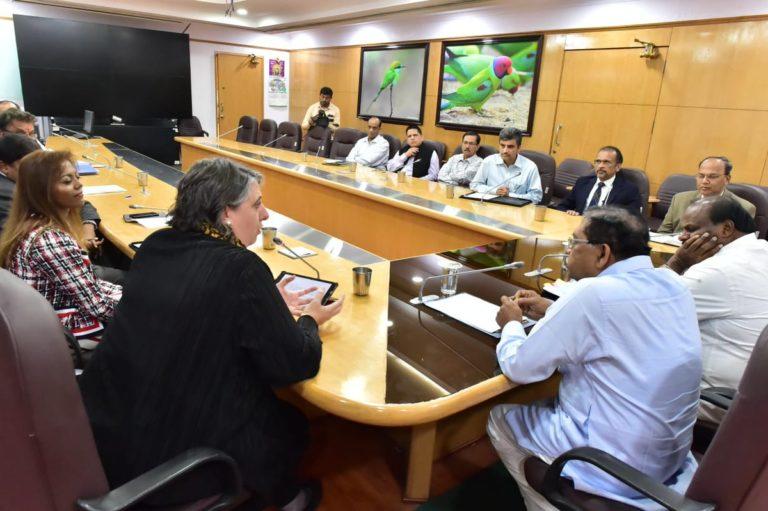
The agreement was signed by BMRCL MD Ajay Seth and Maria Shaw Barragan, the director of Global Partners Department, EIB, on Friday, in the presence of Chief Minister HD Kumaraswamy, Deputy CM and Bengaluru Development Minister G Parameshwara and other senior officers. At the signing of the agreement between the Karnataka government and the EIB, deputy chief minister G Parameshwara thanked the Bank for funding Rs 1,540 crore (200 million Euros) for funding the Bangalore Metro Rail Corporation Limited for its Phase-2 Reach-6 project from Nagawara to Gottigere in the city.
PIC 1: Karnataka government & European Investment Bank sign MoU to fund Rs 1,540 crore for phase-2 of Bengaluru Metro project
PIC 2: Karnataka government & European Investment Bank sign MoU to fund Rs 1,540 crore for phase-2 of Bengaluru Metro project
The CM thanked EIB for offering loans at a low interest rate with no conditions for the Metro project. “This is a positive development in the interest of developmental projects in the city and we look forward for assistance from the EIB in the future as well. The Metro project is being developed to control pollution due to increasing number of vehicles in Bengaluru, which has a population of over 11 million.”
“While thanking EIB of this, I would like to reiterate our chief minister’s request that EIB may consider funding other infrastructure and sustainability projects in the state,” Parameshwara told the delegation.
The EIB had agreed to lend Euro 500 million in two tranches to BMRCL for funding part of project cost for Reach 8 (Gottigere to Nagawara) Line, Phase-2. Asian Infrastructure Investment Bank (AIIB) will co-finance it along with EIB for Euro 300 million. Thus, the total loan amount will be Euro 800 million for Reach-8.
The sovereign loan agreement for the first tranche of Euro 300 million was signed between Government of India and EIB in October 2017. The loan agreement for the second tranche of Euro 200 million was signed in September 2018. These loans are untied and have a 20-year tenure, which includes 4 years’ moratorium for principal repayment. In all, 800 million Euro funding has come for the project, he said.
Maria Shaw Barragan of EIB and others were present besides Karnataka government officials, an official release said.
The failure of the first phase of monorail has cast a doubt on any further expansion plans.
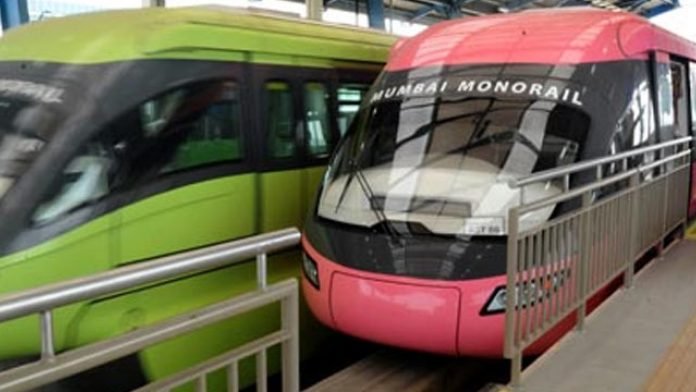
On December 14, the Mumbai Metropolitan Region Development Authority (MMRDA) abruptly terminated its contract with the Indo-Malaysian consortium L&T-Scomi Engineering Bhd to manage the city’s monorail. The authority said that there had been issues such as poor maintenance of the monorail fleet since many rakes were found unfit. This ended another chapter in the sorry saga of a transportation experiment that was doomed from its very inception.
India’s first monorail was flagged off on February 1, 2014, with the hope that it would resolve Mumbai’s transport woes – or some of them, at least. The MMRDA initially spent a total of Rs 2,716 crore on the 19.5 km Chembur-Wadala-Jacob Circle corridor.
Experts had warned even then that it was a foolhardy idea, which would have no practical or substantive impact on the city’s transportation since monorail rakes have low carrying capacity, the planned route is unnecessary and expensive and the technology untested – it hasn’t been used as a mode of mass transportation anywhere in the world – and will have low cost-recovery rate.
Additionally, cheaper modes, such as the bus rapid transit system – which could achieve the same ridership and speed at a lower cost – were not considered.
“Monorail is a new experiment, one that has hardly any use for the city,” said Ashok Datar, chairman of the Mumbai Environmental Social Network.
MMRDA first conceptualised monorail in 2005 and approved its implementation in a meeting conducted on September 28, 2007. A Consortium of Larsen & Toubro with Malaysian partner Scomi Engineering Bhd was awarded the contract On November 11, 2008, to build and operate the monorail.
Now, eight years later, it has become apparent that the project has neither served the purpose of taking the load off the suburban train network nor act as an efficient feeder system. If anything, it has suffered from a string of accidents, maintenance issues, and stagnant passenger load. Its services were shut for ten months after a coach caught fire in November 2017.
Post the closure, monorail saw a decrease in ridership – from almost 15,000 per day to around 10,000, barely 10% of the estimated daily ridership of at least 1.5 lakh passengers.
The stated objective behind bringing monorail was that Mumbai needed a supplementary system to the existing suburban rail network, which carries more than 80 lakh passengers per day, far in excess of its capacity. The bus services in the city are crowded and traffic congestion makes bus services slow. The MMRDA justified the monorail as best suitable for congested places since it requires less space, is capable of taking sharp turns and has the capacity to carry 20,000 passengers per hour per direction.
However, there was a vast difference between what was stated and what was eventually implemented.
What went wrong?
MMRDA started the monorail project in a corridor that passes through some of the most vacant areas of Mumbai on the eastern side. The first phase was routed through areas of marshy lands with no shops, offices or residential blocks.
The original plan was to start construction from the other side, where the human density was higher, but land acquisition in the crowded parts was not easy. “The route planning and prioritisation of phases went wrong, MMRDA should have given priority to the other route,” admitted B.C. Khatua, project director at the Mumbai transformation support unit, a state government think-tank that had the mandate to advise, monitor and coordinate projects undertaken by various government bodies, including the MMRDA in Mumbai.
“Or the MMRDA could have completed the entire route in one go, instead of two phases. We can’t blame the monorail technology. It’s a failure of planning,” Khatua added.
In addition, the monorail on its route was barely integrated with other modes of transport. Its stations are neither properly connected to suburban train stations nor are there frequent buses nearby to take passengers to their destinations. The closest suburban railway station where the monorail ends is 4 km away. Moreover, some stations are located away from residential areas. This increased the travel time and cost for passengers.
In 2017, the Maharashtra legislatures’ public accounts committee sharply criticised the MMRDA for poor planning, misjudging the ridership estimation, not studying the overall feasibility of the monorail route and wasting public money.
But it was dogged by other problems too. The implementation kept on getting delayed because of lack of permissions from different authorities, difficulties of acquiring land, changes in route alignment and a slowdown in government decision making in the wake of the November 2008 terror attacks. The overall cost jumped to Rs 3,000 crores.
Activists have long suspected that the monorail was pushed through to open up the vacant land in the eastern corridor of Mumbai to development, which will allow for more buildings. “One can see this as a push towards development on the eastern side,” says Madhav Pai, director of EMBARQ India, a network of professionals and part of the World Resources Institute Ross Centre that focuses on sustainable urban transport.
P.R.K. Murthy, the former chief of transport of MMRDA confirmed this, stating that “the long-term purpose is to open up the land for development and spur economic growth, this is what the monorail project will do”. Some major residential projects by big builders have already begun construction in the area, which offers tremendous future possibilities.
Future of monorail
The failure of the first phase of monorail has, however, cast doubt on any further expansion plans, which included a total of nine corridors. Getting funding for them is going to be highly difficult.
With little or no public demand or consultation, the decision to go ahead with the project without studying its impact was a poor one. The shoddy planning and failure of a showpiece project have several lessons for city policymakers all over the country – that vanity projects taken up by governments and supported by politicians and urban planners for their own agendas do not end up serving the very people they are designed for.
Ahmedabad, Metro Rail News: The Gujarat Metro Rail Corporation (GMRC) Thursday terminated the contract awarded to IL&FS Engineering & Construction citing project delays and awarded the same to J Kumar Infrastructure. The Rs 374.64-crore contract was to build four stations and lay a 4.6-km viaduct for the metro project in the city.
Due to financial constrains at the parent group, the company had stopped the work since September 2018. The corporation has also decided to en-cash the bank guarantee given by the IL&FS group company. The IL&FS Group is being run by a government-appointed board after it began defaulting on debt payments from late August last. The group and its 348 subsidiaries owe over Rs 94,000 crore to the lenders. The corporation said it had given a number of notices to the company to finish the work by the March 2018 deadline, but due to the cash crunch, they were not able to complete the work as per the schedule. “We have terminated the contract of IL&FS Engineering & Construction.
Alignment of Ahmedabad Metro Rail Project Phase -1
They were to build four stations and a 4.6-km viaduct for the Ahmedabad Metro at a cost of Rs 374.64 crore,” corporation said in a statement. The company was served numerous notices since October 2017 for not meeting the deadlines and by end-September 2018 the contractor stopped the work unilaterally, it said. “A final show cause notice was given in November 2018 and today (Thursday) we decided to terminate the contract,” the statement said, adding the company had neither performed satisfactorily in accordance with the terms and conditions of the contract and nor was in a position to continue the work, therefore contract termination.
The statement further said the corporation has awarded the balance work to J Kumar Infrastructure and has also started to encash the bank guarantee of IL&FS.
Exclusive Interview with Mr. Kumar Keshav, Managing Director,LMRC
Mr. Kumar Keshav, an IRSE (Indian Railway Service of Engineers) officer and a gold-medallist engineer from IIT- Kanpur (M.Tech) and IIT-Roorkee (B.E.), took over as Managing Director of the company on 18th August 2014. As Director (Projects & Planning) at Delhi Metro Rail Corporation (DMRC), he is credited with successfully completing and commissioning various projects in Delhi Metro.
He held the prestige of the nation high during the XIXth Commonwealth Games, 2010 when he commissioned the Central Secretariat -Badarpur Metro project on 3rd October 2010 – just on the day of the start of the Commonwealth Games – when approximately 70,000 public traveled by Delhi Metro to reach the main venue of the global sporting extravaganza – the Jawaharlal Nehru Stadium.
As regards the Lucknow Metro Project, it is a dream which is being realized by him. Lucknow Metro is a dream project of the people of Uttar Pradesh which is being executed by Metro engineers under the leadership of Shri Kumar Keshav. Work for this project is going on day and night without any break with the Managing Director leaving no stone unturned to see that the 8.5 km priority Metro corridor is commissioned for trial runs on 1st December, 2016 in just two years and two month period which is a record in itself, thereby achieving the distinction of being the fastest ever Metro project execution that has ever happened in the Country as stated by ‘Metro Man’ Dr. E. Sreedharan.
Lucknow Metro is a rapid transit system serving the city of Lucknow in the northern Indian state of Uttar Pradesh. Construction of the line began on 27 September 2014 with the 8.5 km (5.3 mi) stretch from Transport Nagar to Charbagh Railway Station which began its commercial operation on 5 September 2017, making it the fastest built metro rail system in the country. Lucknow Metro recently completed the successful load testing of the remaining section of the North-South corridor. Metro Rail News has conducted an interview with Mr. Kumar Keshav,Managing Director of Lucknow Metro Rail Corporation. Here are the excerpt from the interview:
What are the key concerns you faced while making the Metro what it is today?
Lucknow Metro, City’s pride. It feels just like yesterday when we commenced the Commercial Operations for Lucknow Metro for the first time on 5th September, 2017. From the dream of a Metro plying through the city of Nawabs to opening the entire stretch of the North-South Corridor for the public, this journey has been a roller coaster ride of challenges, accomplishments and a storm of emotions and hard work of the entire team behind the Lucknow Metro project and since then there has been no looking back. Lucknow, being the capital city, metro construction was a difficult subject. Fortunately, we were able to garner favorable public opinion through consistent interaction with the public. Lucknow Metro has achieved the distinction of being the fastest Metro Project execution that has ever happened in the country so far. Racing against time to complete the project was in itself a big challenge for us. The other challenges we faced were related to engineering construction. Lucknow being an old heritage city, construction at populated areas was the most challenging.
Please brief us on the current status of the metro rail project?
Lucknow Metro recently completed the successful load testing of the remaining section of the North-South corridor. We have also started the trial run on this stretch. This is being seen by many technical experts here and elsewhere in the country as yet another milestone for the 22.878 km long corridor from the Chowdhary Charan Singh International Airport to Munshipulia. The Metro work is likely to be completed by February, much ahead of the initial deadline of April 2019.
Kumar Keshav, MD- LMRC with the team during the trial runs of the remaining section of North South Corridor.
The journey hasn’t been easy but it’s definitely worth the outcome. We faced uncountable challenges throughout the construction phase but as is rightly said ‘Determination gives you the resolve to keep going in spite of the roadblocks that lay before you’, we kept going and the rest is history. With a team made of steel Lucknow Metro has emerged as a fine example of excellence in the field of Mass Rapid Transit System.
What is the step LMRCL has taken for environment safety and utilization of solar energy?
To conserve energy and use renewable sources of energy, Lucknow Metro
has taken many initiatives such as regenerative braking in the trains which
will result in saving 30-35% traction energy, use of 1% criteria for
underground stations in the air conditioning system, using Variable Voltage
Variable Frequency (VVVF) drive for all lifts and escalators, provision of LED
lights at stations, use of energy efficient equipment for Environmental Control
System (ECS) and Tunnel Ventilation System (TVS) system for the underground stations
etc. Currently, Lucknow Metro has planned 1.5- 2MW solar energy under the RESCO
model from the roof mounted photo voltaic cells on stabling and inspection
sheds in Transport Nagar Car Maintenance Depot. Because of all these novel
measures, society will be able to recover the entire investment cost on the
project in just 5 years, Economic Rate of Return (EIRR) of the Project being
19.46%. To create sustainable environment LMRC’s Metro stations and Depot have
been designed and built as ‘Green’ buildings in accordance with the standards
of the Indian Green Building Council (IGBC). Apart from this, on the occasion
of the World Environment Day on 5th June, 2017, LMRC has been awarded
International Organization for Standardization (ISO) 14001:2004 &
Occupational Health & Safety Assessment Series (OHSAS) 18001:2007
certifications in recognition of the organization’s compliances with
international standards.
Lucknow Metro has so far relocated 410 trees and a total of 537 trees have been saved through changes in design. LED Lights are used in all stations and trains of LMRC. 1.0 MWp capacity solar-roof plant has been installed in the Transport Nagar Depot. Along with it, a Waste Composting Machine has been installed in the depot
The work of the North-South corridor is likely to be completed by February 2019 please elaborate about this corridor.
The 23-km stretch from the Chaudhary Charan Singh airport to Munshipullia will have 21 stations. For this long route, the maximum fare will be Rs 60.Currently, it takes around 90 minutes to reach from Munshipulia to the airport, but once the route is operational, this distance will be covered in 40 minutes, and no one has to face the problems of a traffic jam.
What are the challenges specific to this corridor and how has it been overcome?
The most difficult work on this stretch was the construction of a 177-metre-long cantilever bridge on the Gomti River. By using high skill technology, tools and most important the continuous day and night effort of our team has made the challenge to overcome.
What are the unique features of this corridor and do you expect that this corridor will help boost the overall ridership of Lucknow Metro?
The operation of this corridor will definitely
boost the overall ridership of Lucknow Metro.
We have also taken some unique initiatives keeping in mind the commuters. Lucknow Metro is the first Metro in the country which has tied up with Radio City 91.1 FM and launched its very own FM Radio. It is now providing specialized content, public announcements, jingles and melodious music at all Metro stations for the commuters of Lucknow Metro. In order to provide a push to government’s ‘Digital India’ campaign and an extended benefit for the Metro commuters, Lucknow Metro started providing free Wi-Fi facility to its ‘Go Smart’ card users at all its operational Metro stations.
Transport Nagar to Charbagh Railway Station was built in record time making Lucknow metro as the fastest built metro rail system in the country. A similar feat is being achieved for the second corridor as it is two months ahead of its deadline. How this has been made possible?
Construction of Metro ina city like Lucknow has been a challenge in itself. In a period of just less than three years, Lucknow Metro has created a world record and has earned the distinction of being the fastest Metro which has ever been implemented so far. The 8.5 km “Priority Corridor” of the North – South Metro Corridor (Phase 1A) between Transport Nagar & Charbagh consisting of eight elevated Metro stations has been completed in a very stiff time-frame. It’s been a landmark achievement in the history of Metro Rail Project execution which has set a new benchmark in Metro construction in the Country. Similarly we recently completed the successful load testing of the remaining section of the North-South corridor. This is being seen by many technical experts here and elsewhere in the country as yet another milestone for the 22.878 km long corridor from the Chowdhary Charan Singh International Airport to Munshipulia. The Metro work is likely to be completed by February, much ahead of the initial deadline of April 2019. All this has been achieved purely because of team work and a dream that we all started off with of giving Lucknow a world class transit system. I would also attribute this achievement to the people of Lucknow, who have been immensely supportive for this project ever since its inception. It is because of their patience and cooperation that we have been able to realize this dream of a Metro in the ‘City of Nawabs’.
Any other information, you want to share with us with respect to technology development in metro rail industries.
Ticketing has been amongst the most innovative areas within rail and metro, perhaps most visible in smart-card systems overtaking paper tickets in a growing number of the world’s transport networks. The next development could well be Virtual Agents, essentially at station computer offering a combination of ticket office, vending machine and call centre. A passenger using the Virtual Agent is able to talk to a ‘real person’ in ‘real time’ offering a similar experience to being at the ticket window except over a video link. The ticket agent you speak to would be likely at a central ticket office hub.
Apart from publishing daily news updates on Metro Rail News portal, Our Monthly Magazine covering chronicle development in urban transport in India. How do you thinkwe can partner with railway industries across the country to popularize their project developments?
The urban transport in India is undergoing a revolutionary upgrade; it would be wonderful if you capture this journey through your Magazine. You can take projects from the Railways, Rapid transit systems and the Highways and feature them in your magazine. These feature stories should cover the entire journey of conception, development and execution of the project.
(The interview appears in Metro Rail News February 2019 edition)
Subscribe Now to Discover magazine today and receive in-depth articles and more delivered directly to your door as well as all of these great online features.
Lucknow Metro to Complete North-South Corridor by February
Lucknow, Metro Rail News: Lucknow Metro Rail Corporation (LMRC)‘s remaining section of North-South corridor running from Munshipulia to Airport has finally completed all the trial runs on Wednesday and is expected to open soon!
“We today completed the successful trial run of the remaining section of the North-South corridor. The work is likely to be completed by February, much ahead of the initial deadline of April 2019,” said Kumar Keshav, the MD, LMRC
This 23 kilometer long line was supposed to be finished by April, but all the work is now expected to be completed two months earlier, by February.
This 23-km stretch has 21 stations and the maximum fare will be Rs 60. Currently, it takes around 90 minutes to reach from Munshipulia to the airport, but after the route is operational, the distance will be covered in 40 minutes and people would get a respite from traffic congestion.
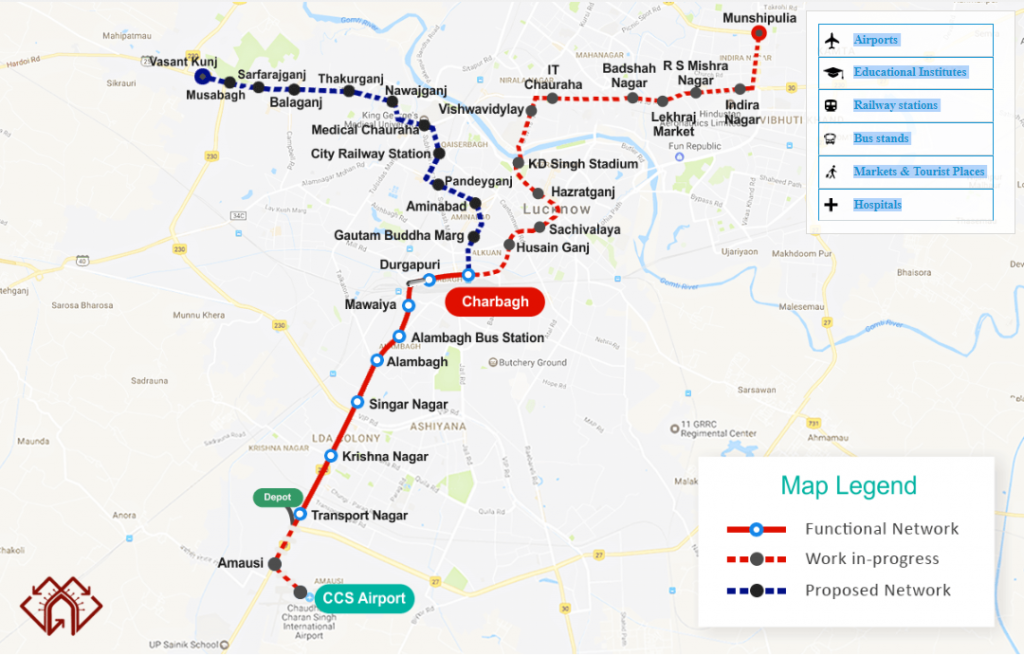
Lucknow Metro Map
Starting from Munshipulia the stations would be, Indira Nagar, R S Mishra Nagar, Lekhraj Market, Badshah Nagar, IT Chauraha, Vishvavidyalay, K D Singh Stadium, Hazratganj, Sachivalaya, Husain Ganj, Charbagh, Durgapuri, Mawaiya, Alambagh Bus Station, Alambagh, Singar Nagar, Krishna Nagar, Transport Nagar, Amausi and would finally terminate at Chaudhary Charan Singh Airport.
The priority route from Charbagh to Transport Nagar which has eight stations is already operational since 2017. The rest of 13 stations are expected to be operational soon, after which commuters would have to spend hardly 40 minutes to reach from Munshipulia to CCS Airport. The metro route will not only save time of the commuters but would also provide a respite from heavy traffic congestion.
And the best part is that the maximum fare on this route would be ₹60.
LMRC has proposed an East-West Corridor that would run from Charbagh to Vasant Kunj and would have 12 stations, bringing the total stretch of Lucknow Metro to 34 kilometers.
“Construction of Metro in a city like Lucknow has been a challenge in itself. In a period of less than three years, the LMRC has created a world record and has earned the distinction of being the fastest Metro (project) which has ever been implemented so far,” said Mr. Kumar Kesav, MD LMRC
“The early operations of the metro corridor will be our New Year gift to the city of Lucknow,” he added
Chennai Metro Rail Limited to launch electric auto feeder service today
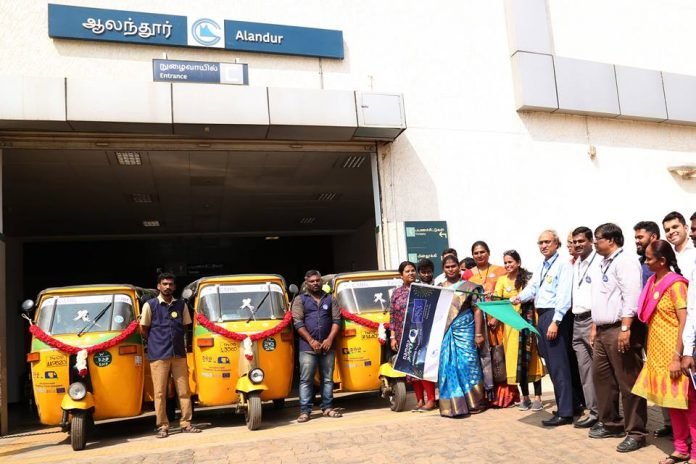
Chennai, Metro Rail News: Chennai Metro Rail Limited (CMRL) in association with the Namma Auto project has launched electric autos as a feeder service to the metro as a pilot project. This novel initiative by CMRL is another step towards the promise to build a more sustainable and convenient transport for the people of Chennai. The launch of operations for electric auto-rickshaws in Chennai is further proof to the narrative of how sustainable and green public transport is the need of the present as well as the future.
CMRL has provided free charging and parking facilities for these autos for the duration of the pilot while the launch of operations will be from Alandur metro station and will cover other stations in the coming months. The auto-rickshaws are meant to be noise free with zero tail-pipe emission and will provide commuters with a clean and green option to reach their respective locations.
The event was inaugurated at Alandur Metro Station by Thiru Narasim Prasad, Director (Systems & Operations), CMRL, Manju Menon, Project Manager, Namma Auto project along with Senior Officials and staff of CMRL and Namma Metro were present during the occasion.
Speaking on the occasion of the launch, Thiru Narasim Prasad, Director (Systems & Operations), CMRL appreciated the European Union funded Namma Auto Project for taking the initiative and supporting Chennai metro with an electric alternative as a feeder. He was quoted saying “CMRL has always worked towards the betterment of public transport in Chennai and while we are running feeder services from various metro stations, the launch of an electric feeder system is an extension of CMRL’s mandate to offer our customers an effective means of transport for a sustainable future”.
Speaking during the launch, Manju Menon, Project Manager, Namma Auto project said “This pilot project has been initiated to establish electric auto-rickshaws as a convenient, customer friendly and viable option of first and last mile metro connectivity for the people of Chennai, asserting a strong step towards sustainable urban transport.
This project also provides backing to our focus on implementing the sustainable development goals (SDG’s) which includes building a sustainable community and promotes action to improve climate change. We are thankful to CMRL for giving us the opportunity to run this feeder and spread the word of sustainability among the residents of Chennai.”
The Namma Auto project is implemented by four consortium partners, Fondazione ACRA (Italy), Enviu Foundation(Netherlands), Women Health and Development( WHAD) and The Energy and Resources Institute(TERI) from India.
As a pilot project, a total of 3 nos of electric autos at a flat rate of Rs.10/- will be shuttling between Alandur and DLF IT Park, Porur, Chennai.
• Meeting 13.12.2018 held at BEC with participating companies and the organisers.
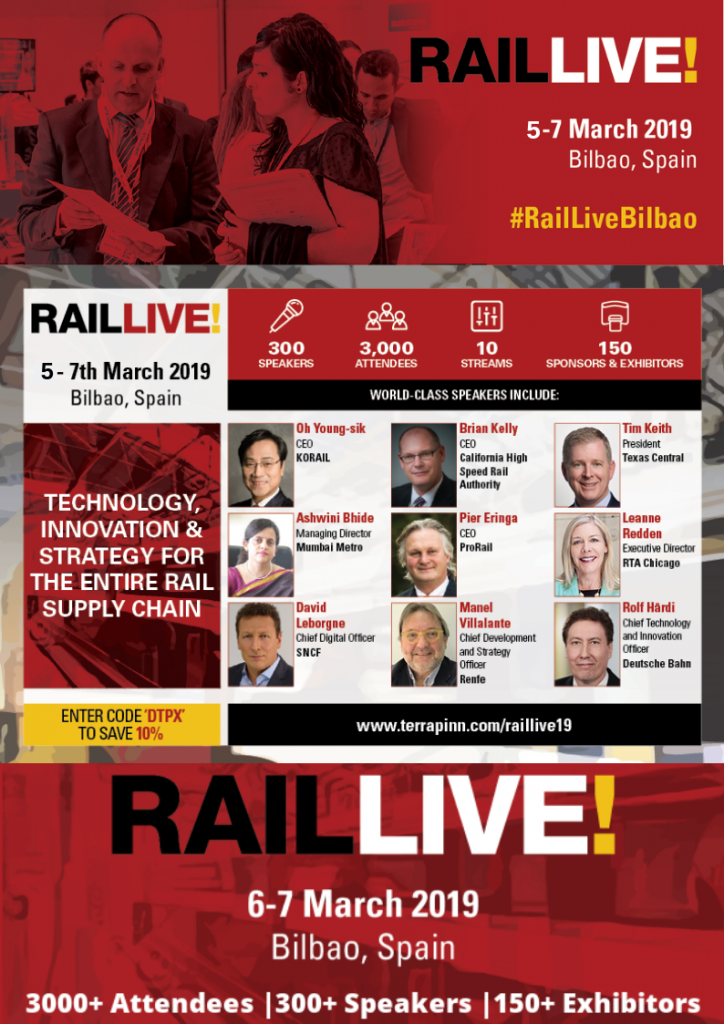
The organisation, Terrapinn Holdings Limited, which has the backing of Mafex – the Spanish Railways Association, is putting together an intense agenda of talks and round tables in which the latest trends in rail transport and the main challenges of the future will be addressed over two days. Digitisation or mobility as a service are just two of the topics that will be covered in the 300 planned addresses. More than 3,000 attendees from 80 countries and 150 exhibiting companies will make Bilbao the world centre of the sector.
Bilbao, Metro Rail News: Bilbao will be the venue for the second consecutive year of the international fair and congress entitled “Rail Live!” running from March 6 to 7, 2019. This is one of the most pertinent professional platforms in the underground, light rail and commuter transport sector that will bring together experts from all over the world. In this edition, which will be held at the BEC (Bilbao Exhibition Center) once more, it is expected to surpass last year’s attendance figures. It is estimated that there will be 3,000 attendees from 80 countries, 300 speakers and 150 exhibiting companies.
In the words of Sean Willis, Terrapinn’s Managing Director “this year’s edition exceeded all our expectations in terms of industry attendance and participation. For the next one, our aim is to make it grow in all aspects “
Presently,
the organisation works in tandem with Mafex, on the drafting of a comprehensive
agenda in order to address for two days the latest trends in rail transport.
Amongst them, the challenges it faces in an environment of digital transformation,
new ways of travelling, as well as the future needs of users.
Pedro
Fortea, Managing Director of Mafex stresses the
“commitment” of the Spanish railway industry with
internationalisation as a way for its “competitive improvement” and
highlights that this event returns to place it “in a sectorial showcase of
great relevance” within the important pole of industrial reference that
the Basque Country represents.
Rail Live brings together speakers from Renfe, Central Japan Railways, California High Speed Rail Authority , Mumbai Metro Rail Cooperation and many others!
The
main international speakers have already been confirmed to date include, Executives
from the Korea Railway Corporation (Korea), California High Speed Rail
Authority and RTA Chicago (United States); SNCF and RATP Group (France); SBB
(Switzerland), Indian Railways (India), as well as NS Reizigers (Holland) and
Rail Baltica (Latvia), as well as the participation of ETS, Euskotren, Adif and
Renfe in the congress schedule.
Under the banner: “Technology, innovation and strategy for the entire railway supply chain”, the congress and the round tables of Rail Live!2019 will become the fulcrum of international debate on the many advances and their impact on the connection of the cities of the 21st century. A forum in which the viewpoint of national and international railway managers and operators will be known, as well as the role of industry and how R&D contributes to the mobility model in cities and their surroundings.
The
main topics on which this edition will focus are on metropolitan and light rail
networks, smart infrastructures, the digital revolution, Internet of Things
(IoT), telecommunications and control and the new concept of stations. These panels also include other key aspects
such as MaaS (Mobility as a service), financing models or advances in ticketing
processes. To the foregoing, the presentation of the “mega projects”
that are currently carried out around the world cannot be overlooked.
In
parallel, in the exhibition area, the exhibiting companies will present the
latest developments that are incorporated into the market to respond to these
new technological demands.
The
event also has the presence of the main companies in the sector such as Grupo
CAF, ArcelorMittal, Teltronic, Ingeteam, Amurrio, Danobat, Idom, Jez, Nem
Solutions and Stadler Rail Valencia, amongst others. It is expected the
participation of more than 150 companies, along with start-ups who will present
their latest innovations that will revolutionise the sector of the future.
Rail
Live! Boasts the backing of Mafex, the Spanish railway association, in the
organisation of the event, alongside that of the Basque Government. The SPRI
Group, ETS, Euskotren and Metro Bilbao collaborate in the event’s development.
The exhibition also has the support of Adif and Renfe.
More details about the fair and congress, the speakers and the companies taking part can be found on the following website: https://www.terrapinn.com/conference/rail-live/index.stm
Metro Rail News is Official Media Partner for all industry events being organized by the Terrapinn in the year 2019 including the Rail Live 2019.