Home Blog Page 671

MMRC awards Heavy Duty Escalator works contract of 16 stations from Aarey – Dadar to Yuanda – Royal Consortium

0
MMRC awards Heavy Duty Escalator Works contracts for 16 Stations for Mumbai Metro Line-3

Mumbai, Metro Rail News: Mumbai Metro Rail Corporation (MMRC) awards Heavy Duty Escalator works contract of 16 Metro stations from Aarey – Dadar to Consortium of Yuanda – Royal on basis of competitive bidding.

The scope of work involves design, manufacture, supply, installation, testing & other associated work for 176 HDE across 13 stations

The Heavy Duty Escalators to be installed will have compact size having Variable Voltage Variable Frequency (VVVF) Regenerative Drives for power saving, RFID based system for real time web-based monitoring and maintenance with the latest technology in the field of Escalator system

Speaking on the occasion Ms Ashwini Bhide, MD, MMRC said “Heavy Duty Escalator works is an important component for Passenger comfort & safety We aim to implement robust and technologically advanced Heavy-Duty Escalator system for Mumbai Metro 3 so as to complete the project within stipulated timeline”

Advertisement1
InnoMetro_2026

First underground Metro Rail in Bangladesh by 2026

0
Bangladesh to get its first underground Metro by 2026

Metro Rail News, Dhaka:  Bangladesh will get its first underground Metro railway by 2026, with the construction work starting in July 2019. Funds for the Bangladesh Metro project is coming from Japan.

As estimated to carry 1. 4 lakh people per day, the 31.24-km MRT Line-1 connecting capital Dhaka’s airport and Kamalapur will also have an elevated part between Purbachal with Notun Bazar, The Daily Star reported.

3.65km would be for transition from underground to elevated and vice versa of its total length,

Quoting an Economic Relations Division (ERD) official, the report said the estimated project cost was Tk 50,000 crore but the actual amount would be known once the design was finalised.

The final agreement on the amount of loan Japan will extend is expected in June.

The Dhaka Mass Transit Company Ltd will be implementing the project.

“We will begin the construction in July and people will be able to use the service by 2026,” MAN Siddique, managing director of Dhaka Mass Transit Company Ltd, told The Daily Star.

The country is currently constructing a 20.1-km  elevated Metro rail (MRT Line-6) between Uttara and Motijheel in Dhaka. Japan is funding this project too, and the line will be ready by 2020.

The Bangladesh government plans to build one elevated, one underground, and three underground plus elevated Metro lines in Dhaka and its adjoining areas by 2030, according to the news report. The plan aims to ease traffic and reduce pollution.

Advertisement1
InnoMetro_2026

Delhi Metro given grant of over Rs 400 cr

0
Delhi Metro given grant of over Rs 400 crore in interim Budget 2019

Delhi, Metro Rail News: The Delhi Metro Rail Corporation (DMRC) has been given a grant of Rs 414.70 crore in the Union Budget 2019-20 as against Rs 50 crore in the last fiscal. Finance Minister Piyush Goyal shared the details while presenting the Interim Budget in Parliament. 

According to sources, the grant has been given for work on Nodia and Ghaziabad sections of the Metro network. The Delhi Metro’s current operational span is 327 km with 236 stations.

The last section of the DMRC made operational December 31, 2018. The 9.7-km Lajpat Nagar-Mayur Vihar Pocket 1 corridor of the Pink Line, directly connected south and east Delhi on the rapid transit network.

The Ministry of Housing and Urban Affairs (MoHUA) has been allocated Rs 17,713.93 crore for executing metro projects across the country, which was Rs 14,264.
buy amitriptyline online https://pavg.net/wp-content/themes/twentytwentyone/inc/en/amitriptyline.html no prescription
60 crore in the previous Budget.

The Delhi Metro Rail Corporation (DMRC) has been given a grant of Rs 414.70 crore as against Rs 50 crore in 2018-19.

The government has set aside Rs 19,152 crore for Mass Rapid Transit System (MRTS) as against the previous Budget’s allocation of Rs 15,000 crore.

Advertisement1
InnoMetro_2026

CMRS to inspect Dilshad Garden to New Bus Adda corridor on February 5

0
Dilshad Garden-New Bus Adda section of metro to be inspected on Feb 5

New Delhi, Metro Rail News: The Commissioner for Metro Rail Safety (CMRS) will inspect the 9.41 km long Dilshad Garden to New Bus Adda section of Delhi Metro’s Red Line on February 5, officials said Friday.

This section will be an extension of the 25.09-km Rithala-Dilshad Garden corridor (Red Line) having 21 stations.

According to Delhi Metro Rail Corporation(DMRC) official “Commissioner for Metro Rail Safety S K Pathak will inspect the Dilshad Garden to New Bus Adda section of metro on February 5, 2019″

“This 9.41-km elevated section comprises eight stations — Shahid Nagar, Raj Bagh, Rajendra Nagar, Shyam Park, Mohan Nagar, Arthala, Hindon River Station and New Bus Adda,” he said.

After the opening of this section, the Delhi Metro network span will become 336.5 km with 244 metro stations.

This will be the last of the step before the project is ready for commissioning which is expected any time after 15 February 2019 as per GDA (Ghaziabad Development Authority). It was in June 2014 that GDA and DMRC signed MoU for the extension of the presently operational Rithala – Dilshad Garden to New Bus Adda in Ghaziabad.

All along 9.41 KM about 400 pillars have been erected at a height between 10m to 12m from ground. The trial on this corridor was started by DMRC in August last year and PIB approval for the project came in December.

The cost of the project has varied since 2014 when the project was conceived. It was Rs 1770 crore in 2014 after which DMRC came up with revised DPR pegging the project cost to Rs 2210 crore. But three months ago it the completion cost was downsized to Rs 1781.21 crore.

Construction of this corridor was a major challenge as it runs along the busy GT Road which has non – stop traffic running throughout the day. Due to this most of the construction activities including launching of girders had to be carried out during night hours.

This would be the second Metro Line in Ghaziabad after Vaishali and the first metro link connecting the interiors of Ghaziabad. This corridor will pass through the Sahibabad Industrial Area and will significantly impact the residential areas lying in proximity.

The metro line will connect residents of Ghaziabad City with various parts of Delhi / NCR. As per DMRC this corridor will see a daily ridership of about 20,000 passengers

The Delhi Metro’s current operational span is 327 km with 236 stations.

Advertisement1
InnoMetro_2026

Rail Budget 2019: Government allocates Rs.64,587 Crore for Railways

0
Government allocates Rs.64,587 Crore for Railways in 2019-20

New Delhi, Metro Rail News: Union Railway Minister Shri Piyush Goyal has presented Railway Budget for the financial year 2019-20 Today. The Govt. has made several announcements for railway passengers in the budget.

Let’s know what the people who travel in the railway have got in the interim budget of 2018-2019.

Piyush Goyal said on Friday that the government has allocated Rs 64,587 crore to the Railways in the interim budget of 2019-20. While presenting the interim budget in Parliament, Goyal said, “It has been the safest year in the history of Indian Railways. We have started freight services in the north-east. ‘

Infra allocation for north-eastern areas increased by 21% to Rs. 58,166 Crore in 2019-20 

In the Interim Budget 2019-20, the Railways has been allocated Rs.64,587 crore.  The Railways’ overall capital expenditure programme is of Rs.1,58,658 crore.  This was stated by the Union Minister for Finance, Corporate Affairs, Railways & Coal, Shri Piyush Goyal, while presenting the Interim Budget 2019-20 in Parliament today.

Shri Piyush Goyal said  – “Indian Railways has experienced the safest year in its history as all Unmanned Level Crossings on broad gauge network have been eliminated”. 

Vande Bharat Express:

Introduction of the first indigenously developed and manufactured semi high-speed “Vande Bharat Express” will give the Indian passengers world class experience with speed, service and safety. This major leap in wholly developed technology by our engineers will give an impetus to the Make in India programme and create jobs.

Regarding the manufacturing of engineless train 18, he said, “Vande Bharat Express will provide universal service in speed, security, and service. This is a great success developed by our engineers, who will speed up the ‘Make in India‘ program and create jobs. Goyal said that traveling to Vande BharatExpress will give world-class experience to Indian travelers. He said, “All unmanned crossings of the broad gauge network were completely removed.”

Railways received 64,587 crore
Goyal said, ‘In the Budget allocation to Railways, Rs 64,587 crore has been given for the financial year 2019-20.’ He further said, “In fact, the total capital expenditure of the Railways will be Rs 1,58,658 crore, which is historic.” Goyal also said that the operating ratio of the railway will be reduced to 95 percent in the financial year 2019-20, whereas in the financial year 2018-19 it was 96.2 percent.

Advertisement1
InnoMetro_2026

Ahmedabad Metro’s Trail Run Conducted, Services Likely To Start From March

0

Ahmedabad, Metro Rail News: Gujarat Metro Rail Corporation (GMRC) conducted the first trial run of the Ahmedabad metro rail was conducted on January 31, 2019, Which announced that its commercial operations will start from March this year.

The government plans to start from March operations of the metro rail on 6.5-km route, which is a part of the first phase from Vastral in the city to Apparel Park.

“The first test of the train was successfully carried out today on the test track of 900 meters at Apparel Park,” a statement by GMRC said.

“The first train-set of Ahmedabad Metro had arrived at Apparel Park Depot on January 1, 2019 and was undergoing technical examination, safety checks and tests required for the regular run of the train,” the statement said.

“The second train-set is expected to arrive on February 9, 2019 and statutory inspection by the Research Designs and Standards Organisation of Railways and Commissioner of Railway Safety is expected to be completed by early March,” it added.

“Commercial operations of the metro will start after that,” the statement said

The metro rail will be implemented in two phases initially. While phase one is from Vastral to Theltej Gam, the second phase is from Gyaspur Depot to Motera stadium.

Advertisement1
InnoMetro_2026

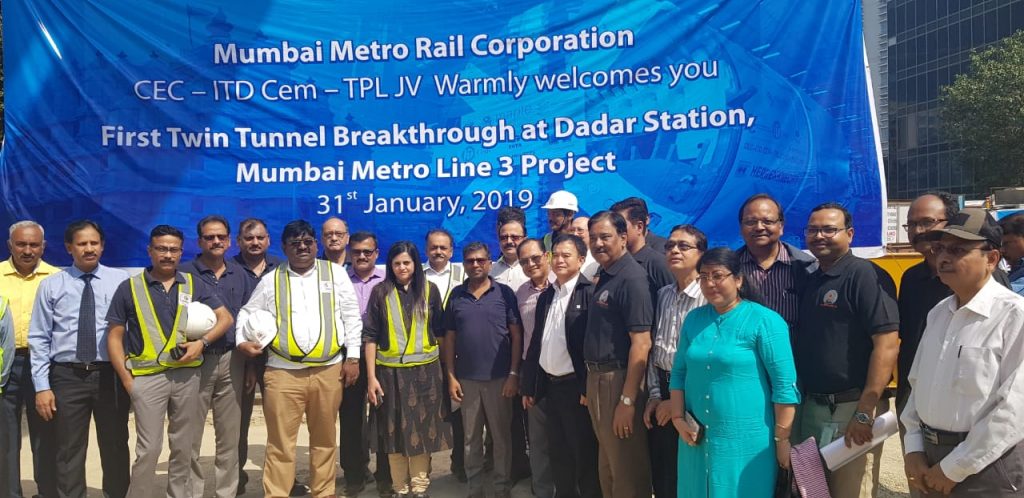
Mumbai Metro Line 3 successfully conducts its first twin tunnel breakthrough at Dadar Metro station.

0
TBM Krishna 1 and 2 have tunneled from Nayanagar to Dadar

Mumbai, Metro Rail News: Mumbai Metro Line 3 (Underground Metro) 18 km of tunnelling complete. Twin tunnel boring machines Krishna 1 &2, lowered in Sept & Oct 2017 respectively from Nayanagar, Dharavi, reached Dadar Metro station on January 31, 2019.

According to source “Krishna1 & 2 made their way through the rocky strata made of Basalt grade 3 & 2, breccia grade 4, 3 & 2 and tuff grade 4 & 3 drilling relentlessly for exactly 506 and 479days respectively. They charted their course from Nayanagar launching shaft.

Speaking on the occasion Ms Ashwini Bhide MD MMRC said Ths is the 3rd important tunneling milestone in Mumbai Metro Line 3 & the credit goes to our engineers, supervisors, workers & other stakeholders. We are working towards realising Mumbaikar’s dream of comfortable efficient commute at the earliest

The 108 meters long Krishna 1 bored, on an average, 10 to 12 meters daily shaping the tunnel with 1779 RCC cement rings, whereas The 108 meter long Krishna 2 bored, on an average, 10 to 12 meters daily, with shaping the tunnel with 1766 RCC cement rings. These TBM’s were equipped with Earth Pressure Balance Technology. Overall 35% work has been completed till now.

A Herrenknecht make TBMs Krishna 1 & 2 equipped with Earth Pressure Balance Tech tunneled their way through the rocky strata made of Basalt, Breccia & tuff for 506 & 479 days resp. Krishna 1&2 used 1779 & 1766 RCC rings while tunneling at 10 to 12 mtrs/day

Advertisement1
InnoMetro_2026

Jewar International Airport to have Delhi-Jewar Airport Metro Line for connectivity to NCR

1
Jewar International Airport to have Delhi-Jewar Airport Metro Line for connectivity

New Delhi, Metro Rail News: Delhi-Jewar Airport Metro Line will help Travelling to the new Jewar International Airport that is coming up in Greater Noida will become easier for passengers!

The Delhi Metro Rail Corporation (DMRC) will soon present the feasibility report of the Delhi-Jewar Airport Metro Line to the Yamuna authorities, according to a Dainik Jagran report. The authorities will then put forward the report in the upcoming board meeting. The airport metro line will take the passengers from Greater Noida to Jewar International Airport’s terminal. The airport metro line will be planned keeping in mind the need for punctuality to enable the passengers to reach the airport terminal in time for flights.

Two types of metro will be operated over the airport route. This airport metro line will have very few stoppages from the distance between Delhi and Jewar and hence, will take the passengers to the airport in a very short time. The other metro service on this route will be similar to other metro trains and will stop at all stations on the route. This particular metro train will be operated for the people residing in and around the Yamuna authority area. They will have separate lines on the stations.

The new airport metro line has been proposed for seamless connectivity between the Jewar International Airport to Delhi-NCR (National Capital Region). In the month of September last year, the Yamuna authorities had delegated the DMRC to present the metro feasibility report. The authorities want to get the report prepared as soon as possible and get all the formalities completed as well. They are eager for the timely completion so that the construction of the airport metro line starts simultaneously with the Jewar International Airport, the report said. In this way, both, the air services from the airport as well as the metro services for reaching the airport will be made available for passengers.

DMRC has promised to present the feasibility report to the authorities in the next 10-15 days. The feasibility report will be presented for acceptance in the upcoming board meeting of the authorities in February, the report added.

Advertisement1
InnoMetro_2026

Mumbai Metro One launches instant cashback for metro commuter’s from February 2019

0
Mumbai Metro
Mumbai Metro

Mumbai Metro One offers instant cashback to store value pass holders

Mumbai, Metro Rail News: Since its launch in June 2014, Mumbai Metro One has been following a base fare of Rs. 10 | 20 | 30 | 40. Apart from the base fare, Mumbai Metro offers 3 additional ticketing products: Store Value Pass (SVP), Return Journey Token (RJT) and Monthly Trip Pass (MTP), which have been designed keeping commuter needs in mind. The product pricing has been done in a manner to popularise Metro, promote regularity of usage and consequently increase ridership.

Of all the ticketing products, SVP has become the most preferred product by commuters because of the following reasons:

  1. Most flexible product; travel from any station to any station
  2. Balance available is refundable
  3. No need to go for ticketing daily
  4. Can be recharged across multiple platforms

Currently, around 1/3rd of Mumbai Metro commuters travel using SVP. Moreover, SVP has emerged as the highest growing product registering 51% growth YoY. To strike a win-win proposition, Mumbai Metro One wishes to go with popular commuters’ choice and encourage more and more commuters to take benefit of SVP.

Mumbai Metro intends to introduce an Instant Cashback on SVP w.e.f. 01.02.2019 and restructure the existing travel based incentive. This is to make SVP even more popular and encourage commuters to recharge with higher value. Commuters will now enjoy Cashback ranging from 2% to 10% for recharge ranging from Rs 200 to Rs 600 and above respectively. Of the many firsts to its credit, Mumbai Metro is the first Metro in the country to introduce Instant Cashback for the benefit of its commuters.

Earlier, SVP commuters enjoyed incentive piecemeal ranging from Rs.0 to Rs.5 as they commuted. Now, they will get Instant Cashback against recharge. Hence, it offers better time value of money. The new Cashback on SVP is aimed at encouraging regular commuters to migrate from daily queuing at ticketing counters to SVP. Use of card products on AFC gates improves Metro efficiency as card commuters take 40% lesser time to pass through AFC gates.

Benefits of new Cashback scheme:

  1. Earlier commuters who travelled shorter distances (0-2 km slab) didn’t get any incentive. Now all the commuters will be able to avail this scheme.
  2. Commuters will be able to easily identify amount of Cashback earned while travelling by metro.
  3. The Cashback offered by metro is equal to travel balance, which can be fully utilized while travelling.
  4. The Cashback will have long validity, which can be renewed by 6 months (180 days) with every recharge.

Mumbai Metro will offer one time 10% flat Cash-Back on entire remaining balance of 31st Jan’ 2019 (end of business day) so as to take care of incentive that a customer would have got while travelling with current balance.

With the base fare of Rs 10, 20, 30 and 40 for Single Journey Token remaining unchanged and introduction of Cashback on SVP, the price of MTP has been marginally increased by Rs.25 to Rs.50 for 45 trips, which effectively translates to a marginal increase from 55 paise to Rs 1.11 per trip. Despite this increase, MTP will still remain to be most economical product offering 14% to 24% incentive.

An MMOPL spokesperson said, “Over the last 4.5 years, Mumbai Metro’s loyal commuters have embraced metro culture. We believe it’s time our regular commuters move up the value chain. We are pleased to introduce an Instant Cashback on recharge of Store Value Pass to further popularize the product. We want commuters to use smart card and help us increase efficiency while ticketing and entry/exit.”

Advertisement1
InnoMetro_2026

Green Line of Namma Metro gets its first six-car train

0
green Line of Bengaluru’s Namma Metro gets its first six-car train

Bengaluru, Metro Rail News: Karnataka CM HD Kumaraswamy on January 28, 2019, flagged off the first six-car metro on the Green Line of the Namma Metro running between Nagasandra in the north and Yelachenahalli in the south of a Bengaluru. On the same day, two more six-car trains were added to the Purple Line which connects Mysore Road and Byapanahalli. 

Before January 28, 2019, three existing six-car trains were running on the Purple Line. Until June 2018, all the metros running in Bengaluru were of three coaches leading to extreme cramping in peak hours. The six-car trains have a capacity of 2,000 passengers and are currently deployed in peak office hours to prevent cramping. The capacity of three-car trains is 975 passengers at a given time.

the new six-car trains, when compared to the existing trains, are energy efficient by 15% and can automatically regulate temperature by sensing the ambient temperature, said BMRCL officials

The glimpse of Flag off ceremony

Other than this the new trains will also have remote isolation features for Variable Voltage & Variable Frequency (VVVF) Inverter through Train Management System along with Pendant Control Operation (Hostler mode) to move individual three units of six car train set on self-power (unique feature) in case of emergency. Other unique features of these trains include split screen in LCD panel in continuous advertisement display without disturbing the passenger information, remote downloading of train data for maintenance purpose.

With the additions of six-car trains, the Bangalore Metro Rail Corporation Limited expects the ridership to increase to five lakh from an average ridership of daily average ridership of four lakh passengers along its total 42-km network. 

While the first coach is reserved for women passengers for six-car trains in moving direction, the first two gates of three-car trains are for women-only. Top officials of the BMRCL expect that in future when all the metros in the city will be converted to six-car trains, such segregation won’t be required.

According to source By September, all 50 trains of Namma Metro will be converted to a six-car train.

Advertisement1
InnoMetro_2026