New Delhi: Prime Minister Narendra Modi has flagged-off the Delhi-Faridabad Metro Line that would allow hassle free travel for around two lakh daily commuters between the national capital and the industrial hub in Haryana.
The extension of the Delhi Metro connects Badarpur to Escorts Mujesar in Faridabad.
The total cost of the project from Badarpur to Escorts Mujesar is nearly Rs. 2,500 crore. Out of this, Rs. 1,557 crore was borne by the Haryana Government, the Centre contributed Rs. 537 crore, while the Delhi Metro provided Rs. 400 crore.
All these are elevated and located on either side of the Delhi-Mathura Road (NH-2).
“The nine-station metro corridor which was 95 per cent indigenously built will provide people a safe, affordable, quick, comfortable, reliable, environment-friendly and sustainable transport facility,” a Haryana government spokesperson said.
Haryana Chief Minister ML Khattar, addressing a press conference on Saturday, had thanked the Prime Minister for “gifting” the Metro service which would take the city to “another level of progress” with better connectivity with other NCR towns.
He had also said that the Prime Minister would be announcing the go-ahead for connecting Gurgaon with Faridabad by Metro.
Mumbai, Metro Rail News: French Rail transportation major, Alstom has bagged Rs. 700 crore contracts to provide the CBTC signalling system for Mumbai metro lines 2A (Dahisar to DN Nagar), 2B (DN Nagar to Mankhurd) and Line 7 (Andheri East to Dahisar), and Pune Metro lines 1 and 2, with Urbalis 400, Alstom’s latest generation of Communications Based Train Control (CBTC) technology, the company said in Press release
The contract for Mumbai Metro, awarded by Delhi Metro Rail Corporation Ltd (DMRC), is to provide the CBTC signalling system as well as a state-of-the-art telecommunication system for the three elevated lines. The combined lengths of lines 2A, 2B and 7 make it one of the most extensive signalling projects in the country.
The signalling scope includes design, manufacture, supply, installation, testing and commissioning of Urbalis 400 and includes supply and commissioning of on-board equipment for 63 trains.
The telecommunications scope includes public address systems, passenger information display systems, fibre optic transmission systems, CCTV, and access control systems.
The contract for Pune Metro, awarded by the Maha Metro Rail Corporation Ltd (MMRCL)[, will see Alstom provide Urbalis 400 for Corridors 1 and 2, to control 31 trains on the 32-kilometre-long stretch, allowing them to run at higher frequencies and speeds in total safety.
“We are proud to have been selected by our customers for these prestigious projects. Our cutting-edge technologies will help enhance the quality of life of the citizens of both Mumbai and Pune and will contribute to the overall development of the cities. We are also proud to be a key partner, via these projects, in the growth of sustainable transportation in the region,” said Alain Spohr, Managing Director for India & South Asia.
Both Mumbai and Pune, located in the state of
Maharashtra, are among the fastest growing cities in India and are both grappling
with issues related to vehicular traffic, air quality and road safety. The
prime objective of Mumbai’s lines 2 and 7 is to provide mass transit services
to those residing in areas not served by the existing suburban rail network. In
Pune, CBTC will significantly boost the metro’s ability to mitigate air and
noise pollution in the city by offering an attractive mass transit alternative.
Urbalis 400 boasts a proven service record in over 30
cities across the world. Constantly upgraded, the solution aids urban operators
in maximizing their performance and capacity while requiring standard
interlocking for their operational needs. Designed specifically for heavy
ridership metros, the system offers a considerable range of functions that
improve headway and average speed performance.
Delhi, Metro Rail News: Senior bureaucrat and Indian Railway Service of Electrical Engineers (IRSEE) officer, Shri Janak Kumar Garg appointed as the Commissioner of Metro Railway Safety (CMRS) on March 25, 2019.
He is responsible for ensuring the safety of the metro rail network in india.
As per the order issued by the Department of Personnel and Training (DoPT), He has been appointed as CMRS in the Commission of Railway Safety till the date of his superannuation, without citing further details.
Prior to this he was working as executive director Rolling stock at Maha Metro Rail Corporation.
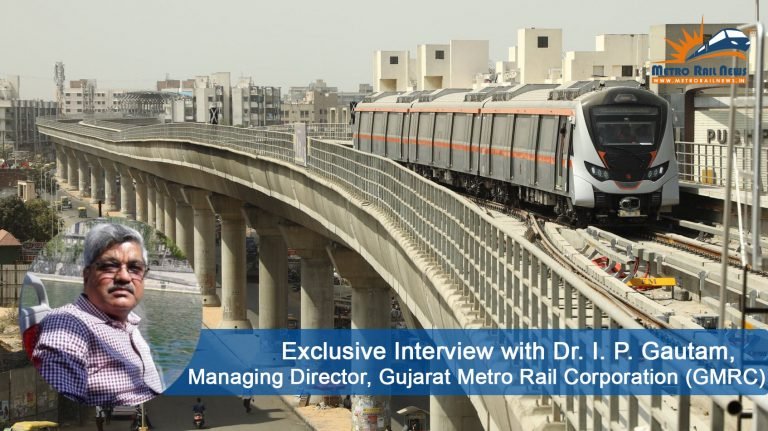
An IAS
officer of the 1986 batch, Dr. I P Gautam, an exceptional bureaucrat who worked
really hard for Ahmedabad, retired as the principal secretary of urban
development. An exclusive interview with Dr. I. P. Gautam, MD, GMRC shared an overview of the
work going, last mile connectivity and interesting initiatives planned by the
officials for commuters. Here is an excerpt from the interview:
Metro Rail News: Ahmedabad Metro started its first trial run on February 6th, 2019. When will it be commercially open to the general public?
Dr. I. P. Gautam: Ahmedabad Metro Rail project held its first trial run on 6th February 2019 and the project was dedicated to the nation by the Hon’ble Prime Minister on 4.3.2019. The commercial service for the public at large has started from 6.3.2019.
PM Narendra Modi Flags off Ahmadabad Metro Rail Project on March 4, 2019.
Metro Rail News:With other metro starting slew of interesting initiatives, what are the plans for GMRC once the metro rail is made operational?
Dr. I. P. Gautam: The first stretch which is now open, i.e., from Apparel Park to Vastral Gam does not have any major origination and destination. Thus, the focus is on attracting people to get them into the habit of using public transport. For this purpose, low fares, in fact the lowest in India, i.e. Rs.5/- for 2.5 kms range and Rs.10/- for 2.5 kms to 7.5 kms distance have been introduced.
Other than this, some of the features are:
Some Metro stations are in congested & fully developed / CBD areas
MEGA is exploring ways to create space around metro stations for traffic circulation & parking
Joint arrangements with upcoming developments near Metro stations
Ground floor area of properties is utilized for Metro parking & traffic circulation
Property Development opportunities such as,
CASE-1 (SABARMATI RLY STATION)
Off-road station located at end the of Ahmedabad CBD
Provision has been made in station structure for future development of 3 floors of commercial property development.
CASE-2 (GUJARAT UNIVERSITY)
Station rail level is higher due to the flyover
Extra floor provision has been made to be used for property development.
Metro Rail News:Could you throw some light on offering last mile connectivity to riders like other metro services are offering to passengers?
Dr. I. P. Gautam: Ahmedabad Gandhinagar Metro Rail has followed network approach where in the entire Phase-I and Phase-II with Bus rapid transit system (BRTS) will function as a single network to achieve last mile connectivity. Other than BRTS system, Ahmedabad Metro is also integrating with Ahmedabad Municipal Transport Service (AMTS), Gujarat State Road Transport Corporation (GSRTC), Indian Railway and High-Speed Rail (HSR). However, the above provisions will be fully functional only when the entire net-work of 40 kms is made operational.
Metro Rail News:Could you brief about the phase II project status and challenges. What precautions are taken to safeguard the monuments, if any?
Dr. I. P. Gautam: Ahmedabad Gandhinagar Metro Rail Phase – II has been approved by the Central Cabinet Ministry. We don’t need to take any precautions for monuments in Phase-II because there are no monuments falling into the vicinity of Phase-II alignment.
Metro Rail News:How prepared is GMRC in terms of dealing with monsoon? Will work be on hold or have you taken some steps to ensure work goes on according to the plan?
Dr. I. P. Gautam: We have Monsoon Preparedness Team and Machinery to ensure that the work goes as per the plan. GMRC team and Ahmedabad Municipal Corporation (AMC) team stays on alert at AMC control room for emergency, they constantly monitor the activities and takes timely updates from all the areas.
Metro Rail News:What is the status of Surat Metro Rail project?
Dr. I. P. Gautam: Detailed Project Report (DPR) has been submitted by DMRC for Surat Metro Rail Project Phase-I. Government Gujarat has already approved it and forwarded it to Central Government for further approval. Surat Metro Rail project Phase – I has been approved by Public Investment Board (PIB) and is awaiting Cabinet sanction.
Metro Rail News:What interesting features will GMRC offer to its commuters?
Dr. I. P. Gautam: ‘CATC’ (Continuous Automatic Train Control System) Based On “CBTC” (Communication Based Train Control System) which includes ATP (Automatic Train Protection), ATO (Automatic Train Operation) and ATS (Automatic Train Supervision) Sub-Systems using Radio Communication between Track Side and Train
Metro Rail News:Can you share some features of the coaches and how different will they be from other metro coaches?
Dr. I. P. Gautam: Integrated System with Fiber Optic Cable, SCADA, Train Radio, PSD System,
Train
Information System, Control Telephones and Centralized Clock System
Automatic Fare Collection System with POM and Smart Card
Metro Rail News:How does GMRC plan to educate its riders of travelling in metro rail?
Dr. I. P. Gautam: As of now GMRC has put up signage and posters at different locations of station to guide passengers/commuter of metro rail, and GMRC operation team staff is available at the station area to guide passengers commuting in Ahmedabad Metro Rail. There are news articles and ads about the metro alignment, ticket charges, technology and all timely updates to make citizens aware about the system and technology adopted by Ahmedabad Metro Rail Project.
Metro Rail News:Do you think once metro becomes operational, traffic situation will improve?
Dr. I. P. Gautam: Yes, definitely traffic situation will improve in the Ahmedabad city. Rapid urbanization in Ahmedabad has resulted in an exponential increase in vehicle population in our city roads. This has resulted in traffic jams, and major air and sound pollution. A well running Metro Rail can be a major contributor for reducing carbon emissions in Ahmedabad city.
Metro Rail News:We would also like to know how our magazine can help in promoting and encouraging metro transport among common public. Do share what edit pieces can help in motivating people to opt for metro over other mean of transport?
Dr. I. P. Gautam: We would like you to highlight few points to motivate citizen to travel in Public Transport,
Metro will solve future Traffic problems
Metro Rail system is a relief for city commuters
Metro Rail will certainly improve health of city and citizens through reducing carbon emissions and a major reduction in air and noise pollution
It will make safer travel for woman, all the stations and coaches will be under CCTV surveillance
Now travelling in public transport will be much more comfortable
There is a huge potential of growth along the Metro corridors
Delhi, Metro Rail News: The National High-Speed Rail Limited (NHRCL) create training tracks for India’s first bullet train project at the High Speed Rail Training Institute (HSRTI).
To train staff for the operations of the Mumbai-Ahmedabad bullet train project, two 50 metre track slabs have been developed from high strength concrete using Shinkansen technology of Japan. The training tracks, which include 50 meters for straight line and another 50 metre for the curved line, which is setting up the High Speed Rail Training Institute (HSRTI) in Vadodara, Gujarat. The High Speed Rail Training Institute (HSRTI) is being set up to train manpower in high speed rails.
The High-Speed Rail Training Institute (HSRTI) being set up over a land area of five hectares on the campus of the National Academy of Indian Railways (NAIR) is being developed at an estimated cost of Rs 600 crore. Out of this, an amount of Rs 38 crore will be spent in phase one of the project.
In December 2018, Deputy Chief Project Manager Anupam Awasthi told that in the first two phases of the project, the NHSRCL is developing the hostel building and establishing the slab track for training. The slab track is being set up at the institute to train those who will be recruited by the corporation for operation and maintenance of the Mumbai-Ahmedabad bullet train.
“Unlike the sharp curves that could be seen in conventional Indian Railways, the radius of the curve on the bullet train corridor will be around 6000 metres. This has been done considering the fact that the bullet train will run at a speed of 320 kmph“. he added.
As India lacks the technology to manufacture slab tracks, a total of 20 slabs were imported from Japan last year to train people at HSRTI. Additionally, 200 metres rail of JIS (Japan Industrial Standard), 13 mm diameter rebar have also been imported from Japan.
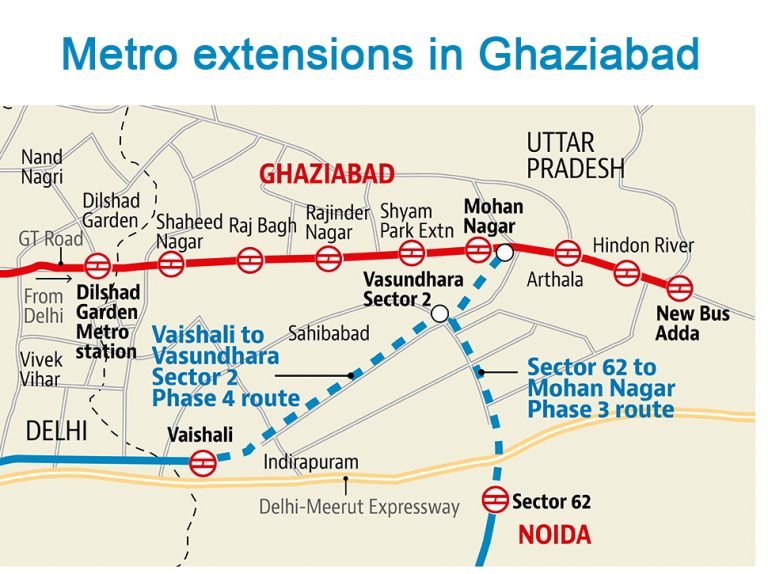
Delhi, Metro Rail News: On March 19, 2019, The Delhi Metro Rail Corporation (DMRC) submitted a revised detailed project report (DPR) for further extensions of its Blue Line from Noida Sector 62 (Noida Electronic City to Mohan Nagar (Ghaziabad) under Phase-III project and Vaishali to Vasundhara Sector 2 under Phase IV.
According to the detailed project report (DPR), the estimates cost of Noida Sector 62 to Mohan Nagar corridor stands at Rs 1,866 crore with six elevated stations while the cost of Vaishali to Vasundhara Sector 2 under phase 4 stand at Rs 1,866 crore. Phase 4 work will be started after completion of the phase 3 project.
Key figures
Name of Blue line Extension
Phase
Distance
Estimated Cost
Name of Stations
Noida Sector 62 to Mohan Nagar
III
5.91 Km
1866 Cr
Vaibhavkund, DPS Indirapuram, Shakti khnad, Vasundhara sector 5, Vasundhara sector 2, will connect further to Mohan Nagar
Vaishali to Vasundhara Sector 2
IV
4.16 Km
1438 Cr
Prahlad Garahi, Vasundhara sector 14 and Shaibadbad, will connect further to vasundhara sector 2
“DMRC has submitted a revised DPR of extensions of Blue line in Ghaziabad , A copy was also received by (Ghaziabad Development Authority) GDA. As per revised DPR, Sector 62-Sahibabad line will now be extended to Mohan Nagar, while Vaishali-Mohan Nagar corridor will be extended to Vasundhara Sector 2,” said Kanchan Verma, Vice-Chairperson of Ghaziabad Development Authority (GDA).
In February 2018, the DMRC had submitted the first DPR for two extensions, from Noida Sector 62 to Sahibabad under phase 3 and Vaishali to Mohan Nagar under phase 4. After the detail discussion, the Ghaziabad Development Authority (GDA) decided to extend the line to Mohan Nagar and requested the DMRC to submit revised project reports for the two Metro extensions.
“ The construction work of Vaishali to Vasundhara Sector 2 under phase 3 will be started first. The regional rapid transit system (RRTS) corridor will pass near the metro route at Sahibabad. Construction of a foot over the bridge of 150-200 metre possible to provide interchange facility between the two systems.” Verma added.
Both extensions of Blue line provide direct connectivity to commuters from Sahibabad, Vasundhara and Indirapuram to Noida and from Vasundhara, Sahibabad and even Vaishali to connect them directly to Central Delhi.
Presently, Delhi Metro has two operational routes in Ghaziabad, Vaishali to Anand Vihar (phase 1) and Shaheed Sthal (New Bus Adda) to Dilshad Garden (phase 2).
As per Feb 2018 DPR, the estimated completion cost of the phase 3 was pegged at Rs 1,926 crore, while the cost of phase 4 was stated at Rs 1,785 crore.
Now, with the revised DPR estimates, the authority will be able to save about Rs 407 crore.
New Delhi, Metro Rail News: As Metro rail systems Expanding across India, the Ministry of Housing and Urban Affairs (MoHUA) has turned its focus to improving last mile connectivity, one of the objectives articulated in the 2017 national metro policy.
The ministry has started focusing on feeder bus services, electric rickshaws, smart cycles (that can be rented out), electric scooter services, and partnerships with cab aggregators for providing hassle-free last mile connectivity to passenger.
Each states must make the metro self-sustaining, enhance other kinds of mass rapid transport systems, such as monorails or buses, and provide last mile connectivity, between the metro station and the commuters’ destinations.
Union minister of housing and urban affairs Hardeep Puri said in an interview. “We have already drafted a last-mile connectivity plan across all operational metros; the aim is to provide a safe and economical ecosystem for daily commuting,”
The Union government has already drafted a last-mile connectivity plan for 10 metros in cities such as Delhi, Bangalore and Kochi.
The national metro policy had also aims to enhance metro rail revenues through a feeder system. “Every proposal for metro rail should necessarily include proposals for feeder systems that help to enlarge the catchment area of each metro station at least to 5 km. Last-mile connectivity through pedestrian pathways, Non-Motorised Transport (NMT) infrastructure, and induction of facilities for para transit modes will be essential requirements for availing any central assistance for the proposed metro rail projects,” the policy noted.
Around 329 feeder bus services have been made operational by the Centre already.
This includes an ambitious plan for Delhi and the National Capital Region, served by Delhi Metro Rail Corporation (DMRC).
“With the objective of strengthening feeder bus services with defined service quality parameters, DMRC is in the process of inducting (through open e-tenders) 427 buses (MIDI size battery operated/CNG air-conditioned buses) on 48 routes on cluster model. However, approval of Government of National Capital Territory of Delhi (GNCTD) on sustaining the project by way of viability gap funding is awaited,” a ministry official said on condition of anonymity.
The Centre is also working on a pilot project involving cab aggregators which have been alloted space on rent at metro stations to set up kiosks where cabs can be booked.
According to the official “Process of allotment of bare spaces to the cab aggregators at all the metro stations is also underway for which the DMRC has already floated a tender,”.
The policy also mandates an analysis of alternatives, requiring evaluation of other modes of mass transit such as Bus Rapid Transit System (BRTS), light rail transit, tramways, metro rail and regional rail in terms of demand, capacity, cost and ease of implementation.
According to officials “The alignment of metros such as Ahmedabad metro rail project phase-I is such that it integrates with BRTS, Indian Railways, and the city bus service at various strategic locations in both East West and North-South Corridors for seamless connectivity. Future transit systems such as the Mumbai–Ahmedabad high-speed bullet train will also integrate with phase-I at two locations,”.
Metro connectivity with BRTS at Ahmedabad is provided at nine stations currently. The Centre is also working towards integrating electric vehicle transportation.
A pilot is being undertaken by DMRC in five metro stations; in Chennai it is already operational in two stations; and it is also operational in Hyderabad, according to the ministry.
Another aspect of non-motorised transport includes cycle sharing services which are currently operational in metros across eight cities.
“Last mile connectivity is very important especially in cities such as Delhi because of its circular structure. Another very important reason for having connectivity is safety especially for women,” said KT Ravindran, professor and head of urban design at the School of Planning and Architecture of New Delhi.
According to the urban ministry , over 326 km of metro lines — part of what is known as Mass Rapid Transport System that aims to provide urban commuters an alternative to private transportation — have been made operational in the last five years and 373 km are in the pipeline.
According to former DMRC chairman Elattuvalappil Sreedharan the country must have the vision to introduce metro trains in more than two million cities and light metros in around one million cities within the next 10 years. “This would need metros to be built at the rate of at least 200 km per year,” he said.
Hyderabad, Metro Rail News: The Governor of Telangana & Andhra Pradesh Shri. E.S.L. Narasimhan flags off the much-awaited metro rail services of Hyderabad Metro from Ameerpet to Hitech city metro, the IT hub of Hyderabad on March 20, 2019.
The 10-km long section (Ameerpet to Hi-Tec City) of Hyderabad Metro Rail Corridor-III was launched by the Governor at Ameerpet metro station.
This section have nine stations, including Ameerpet, would establish the crucial Metro Rail connectivity to the highly congested IT/ITES service areas of Hi-Tec City, Madhapur, Gachibowli, Jubilee Hills, Hyderabad Metro Rail Limited (HMRL) officials said.
Regular operations
In November 2017, PM Narendra Modi had inaugurated the 30km stretch (between Miyapur and Nagole) out of the 72km long elevated Hyderabad Metro Rail project.
The 16-km stretch between Ameerpet and LB Nagar was launched in September last year.
Regular operations will start from 4pm on March 20, 2019,.
Among the nine stations (Ameerpet-Hi-Tec City stretch), Taruni-Madhura Nagar station is being developed as a women managed station and in due course would have shops mostly catering to their needs and that of children.
“The Jubilee Hills check post station was a single level one unlike other stations which are mainly on two levels.” Said NVS Reddy, MD, HMRL.
The concourse level was avoided to reduce the already high level of the station due to gradient related problems, he said. HMRL officials said trains would initially run on a five km stretch between Jubilee Hills Check Post and Hi-Tec City station following a traditional railway practice of ‘twin single line method’.
In this method the two tracks are treated as two separate single lines and trains are operated in both ‘up and down’ direction on each line separately, till the ‘reversal’ beyond Hi-Tec City station is completed.
Train Frequency
the frequency of trains between Ameerpet-Hi-Tec City will be nine to 12 minutes as against six minutes in other parts of the operational Metro corridors. Efforts are being made to add additional trains in the stretch to improve frequency and to cater to the huge rush that is expected, they said.
The concessionaire L&T Metro Rail (Hyderabad) Limited is building the Hyderabad Metro Rail project across three corridors.
Glimpse of flags off
The Governor of Telangana & AP Shri. E.S.L. Narasimhan flagging off the Metro Train Services
The Governor of Telangana & AP Shri. E.S.L. Narasimhan, Dr. S.K. Joshi Chief Secretary, Telangana, HMRL MD Shri. N.V.S. Reddy & other officials Takes Metro Ride after inauguration.
The Governor of Telangana & AP Shri. E.S.L. Narasimhan, Dr. S.K. Joshi Chief Secretary, Telangana, HMRL MD Shri. N.V.S. Reddy & other officials
Hyderabad, Metro Rail News: Finally, the most awaited metro rail service of the 10-km Ameerpet-Hitec City Metro Rail service will become operational from March 20.
Official Twitter handle of The Hyderabad Metro Rail Limited (HMRL) announced that the metro services will be flagged off by the Telugu states Governor E.S.L Narasimhan at 09:15 AM on March 20, 2019.
The metro train line which is supposed to be opened in last December is finally available to public. 3 out of 8 stations – Jubilee Hills Checkpost, Peddamma Thalli temple and Madhapur stations – will not be open for public now but will be opened after few weeks because works are still underway announced by Hyderabad Metro officials. This is Coming under the Phase 3 of the blue line that covers eight stations stretched in 10 km – Taruni-Madhura Nagar, Yousufguda, Jubilee Hills Road No 5, Jubilee Hills check-post, Peddamma temple, Madhapur, Durgam Cheruvu and Hitec City. This metro train service will be definitely helpful to the commuters especially IT professionals who often travels between the Ameerpet and Hitec City.
In view of the Lok Sabha elections ahead, Hyderabad Metro Rail Limited (HMRL) has decided to launch the services on the new route as a low-key affair. The CMRS( Commissioner of Metro Rail Safety ) has accorded the mandatory approval for commencing commercial operations on the 10 km Ameerpet- Hitec city route a few days back.
Train Frequency
Due to Hitec City Metro Rail station not having a reverse facility, the trains will be operated in the ‘twin single line method’. The two tracks are treated as two separate single lines and trains are operated in both ‘up’ and ‘down’ directions on each line separately.
The frequency of trains between Ameerpet and Hitec City will be 9 to 12 minutes till the reversal system is ready, On other corridors it is six minutes.
“The construction of reverse facility beyond Hitec City station is being carried out in a sequential manner. With the narrow passageway between Cyber Towers on one side and flyover on the other side it will take a couple of months to complete the work.” Said Mr K.V.B. Reddy, MD of L&T Metro Rail Hyderabad Ltd,
Bengaluru,Metro Rail News: Bangalore Metro Rail Corporation Limited, a Joint Venture of Government of India and Government of Karnataka, is a Special Purpose Vehicle (SPV) entrusted with the responsibility of implementing the Metro Rail Project in the city of Bangalore. BMRCL invites applications from qualified and experienced personnel for appointment to Engineering positions in the Project Wing. All appointments proposed will be on “contract basis” only.
Total No of post: 100
Name of the Post: Executive Engineer
BE/B.Tech. in Civil Engineering with a minimum of 12 years of work experience in large infrastructure project execution. Candidates with experience in Metro construction for Viaduct / Stations / Underground station / Tunneling with TBMs will be preferred.
Name of the Post:Assistant Executive Engineer
BE/B.Tech. in Civil Engineering with a minimum of 8 years of work experience in large infrastructure project execution. Candidates with experience in Metro construction for Viaduct / Stations / Underground station / Tunneling with TBMs will be preferred.
Name of the Post: Assistant Engineer:
BE/B.Tech. in Civil Engineering with a minimum of 5 years of work experience in large infrastructure project execution. Candidates with experience in Metro construction for Viaduct / Stations / Underground station / Tunneling with TBMs will be preferred. Candidates with Diploma Engineering qualification should have a minimum of 8 years of work experience in the respective field.
Name of the post: Section Engineer
BE/B.Tech. in Civil Engineering with a minimum of 3 years of work experience in large infrastructure project execution. Candidates with experience in Metro construction for Viaduct / Stations / Underground station / Tunneling with TBMs will be preferred. Candidates with Diploma Engineering qualification should have a minimum of 6 years of work experience in the respective field.
Age Limit
Executive Engineer – 50 years
Assistant Executive Engineer – 45 years
Assistant Engineer – 40 years
Section Engineer – 35 years
Pay Scale (excluding allowances)
Executive Engineer – Rs.80,000/-
Assistant Executive Engineer – Rs.65,000/-
Assistant Engineer – Rs.50,000/-
Section Engineer – Rs.36,000/-
How to apply and selection procedure
Candidates should fill in the application online, take a print out of the same and submit along with copies of all certificates in support of qualification and experience prescribed for the post. Candidates who fail to send a hard copy of the online application along with relevant documents will not be considered even though they have submitted the application online. Shortlisted candidates shall be called for a personal interview.
Last date and where to apply
Eligible candidates may fill in the application online, take a print out of the same and forward along with relevant documents in support of qualification and experience. Such applications may be addressed to –
The General Manager(HR), Bangalore Metro Rail Corporation Limited, III Floor, BMTC Complex, K.H.Road, Shanthinagar, Bengaluru 560027
Last date for receipt of hard copy of the application is 08.04.2019 up to 4.00 pm.
Banglore, Metro Rail News: The much-delayed 72 km long Phase 2 project of the Namma Metro is finally on track. The Bangalore Metro Rail Corporation (BMRCL) officials said that they have acquired land to construct three stations and a depot on the east-west corridor between Baiyappanahalli and Whitefield of 44.45 acres (18.11 hectares) of forest land.
Although the land acquisition for the proposed depot at Whitefield (44.8 acres) on the Byappanahalli-Whitefield line will be taking two months as the clearance from the Union ministry of environment, forest and climate change is the only thing Namma Metro is waiting for.
13 conditions from MoEF
The ministry of environment, forests and climate change (MoEF) last week approved in principle the diversion of forest land for a period of 20 years, subject to the fulfillment of 13 conditions. In exchange, the ministry will receive 11.87 hectares (about 30 acres) of land in six villages of Kali Tiger Reserve forest and another 6.56 hectares (16.21 acres) of non-forest land in Thippagondanahalli village.
Where as BMRCL had to acquire 30 acres of land from private individuals, the 16.21 acres belongs to the revenue department. Among the 13 conditions.
According to source the BMRCL is directed to bear the cost of compensatory afforestation, which will be taken up in both the non-forest lands given to the forest department. The legal status of forest land, the letter says, shall remain unchanged.
It’s yet to acquire some portion of Railway land along Old Madras Road near Baiyappanahalli Metro station. Channappa Goudar, general manager (land acquisition) at BMRCL said. “We had requested the forest department for the land about two years ago, but the process got delayed due to multiple reasons. The acquisition will help us construct three Metro stations and a depot,” he added.
“We are providing one acre of land to the police department as it, too, has Vidyalaya and Whitefield — will come upon some portions of the land. Recently, the BMRCLissued tenders for the construction of Metro rail depot at Kadugodi, which is expected to be complete in 2-3 years.
Much delay for Phase II
The BMRCL had awarded the contract for building 14-km elevated Metro corridor and 13 stations on the Baiyappanahalli-Whitefield stretch in April 2017. While most of the land for the project had been acquired, acquisition of forest land had become a hurdle for the construction work. Of the 80 acres identified for acquisition on the 14-km stretch, almost half of it was forest land.
Construction major ITD Cementation has been tasked with the construction of the corridor on the busy stretch connecting central parts of Bengaluru to the IT corridor. The civil wor is expected to be completed in 2-3 years. They are, however, not happy with the progress, which has slowed down after a good start said BMRCL official.
Phase II Corridor of BMRCL has now taken possession of about 98.3% of land required for 19-km Metro corridor and 13 stations on eastern extension of the east-west corridor of phase II (Reach 1) 13 Conditions The ministry of environment and forests has approved in principle the diversion of forest land for a period of 20 years, subject to fulfilment of 13 conditions