Home Blog Page 662

Chennai Metro Phase 2 Construction Work likely to begin by mid-2020

Chennai, Metro Rail News: The Chennai Metro Rail Limited (CMRL) is likely to begin construction for the remaining 66.8km part of the total 118.9km Phase-2 corridor by mid-2020, with talks on for funding from international banks. Construction for the 52.01km priority corridor will be taken up first, and is expected to begin by the end of 2019.

According to Chennai metro official, soil tests are being conducted in several localities in the 66.8 km stretch, including Lighthouse, T Nagar and Poonamallee. It is likely to be completed by end of this year.

Official Said “We have floated tenders in small packages for soil tests. The test reports will help us float construction tenders faster”.

Tenders for the construction of 52.01 km priority corridor will be floated in June 2019. The 118.9-km phase-2 has been planned with three corridors will have 128 stations and to be built at an estimated cost of Rs 69,000 crore.

The remaining 66.8 km section of phase 2 will have 71 stations. It will cover Sholinganallur to Siruseri Sipcot, along with the OMR, covering around 10km, and a 26.1km line from Lighthouse to Poonamallee linking several localities, including core areas like Mylapore, T Nagar, Kodambakkam and Vadapalani. It will also link Porur, Karayanchavadi, Iyyapanthangal and Poonamallee, which are poorly connected by public transportation. The third 30.7km stretch is from CMBT to Sholinganallur, linking the western fringes of the city.

The CMRL has been in talks with four international banks – World Bank, Asia Development Bank, New Development Bank and European Investment Bank – to get loans for the construction of the 66km corridor. The construction cost is estimated to be around Rs 28,000 crore, which would come as loans from banks and funding from the state and the central governments.

For the construction of the 52.01 km priority corridor, In December 2019, the CMRL has signed an agreement with JICA to get Rs 20,196 crore, which is nearly 50% of the total Rs. 40,941 crore. JICA also sanctioned the first tranche of Rs 4,760.67 crore. The 52.01km priority corridor comprises 57 stations from CMBT to Madhavaram and Madhavaram to Sholinganallur.

Alstom wins a contract worth €15 million to deliver traction electrification & sectioning posts for Pune Metro Line 1 and 2

Pune, Metro Rail News: Alstom continues to expand its footprints in Pune as it wins a contract worth €15 million towards traction electrification and sectioning posts for 28kms corridor of Pune Metro Line 1 &2 from Maha-Metro. This is the second contract win for Alstom in the city of Pune after CBTC signaling contract for Pune Metro line 1 and 2.

The scope of the contract awarded includes design, supply, installation, testing and commissioning of 25KV flexible & rigid overhead catenary system (OCS/OHE) and sectioning posts for Pune Metro Rail Project.  The execution of this project will be completed in four phases with the commissioning of 28 kms stretch to be completed by 2023.   

Mr. Alain Spohr, Managing Director, India & South Asia said, “We would like to thank Maha Metro for their trust and confidence on Alstom. We are committed to deliver world class deliveries to help strengthen India’s urban mobility infrastructure and look forward to more such opportunities.  Our footprint in systems and infrastructure is growing rapidly, and this project will give us an opportunity to extend our cutting-edge capabilities and solutions to the customer.”

Globally, Alstom designs, builds, delivers, tests and commissions all types of rail electrification infrastructure with a strong focus on customer needs and ensures maintenance of the entire system. The company’s feeding systems capabilities are constantly enhanced though continuous R&D and innovation efforts, which have produced breakthroughs making Alstom more responsive to customer needs and market changes.

Delhi Metro Phase IV stuck over funding dispute

New Delhi, Metro Rail News: The expansion plan of Delhi Metros Phase 4 has put another roadblock due to fresh funding dispute between the Centre and Delhi government. Delhi Metro Phase IV project was finally approved by the Union Cabinet on March 7, after a long wait of 2 years before hitting this obstruction.

On March 20, Delhi Transport Minister, Kailash Gahlot, Directed his department to tell the Delhi Metro Rail Corporation (DMRC) not to start working on Phase 4 until it got further clarifications on the project’s funding, reported Hindustan Times. Gahlot raised The objection and said that the share of expenditure of the state government had increased by 30.86% for the construction of three corridors by 2024 after it received approval from the Union Cabinet.

“The matter was brought to my notice when DMRC wrote to the Delhi government seeking Rs 200 crore to start initial works on the project. As per DMRC’s new funding plan, after the Centre cleared the three routes, the share of Delhi government increased to Rs 7,844.70 crore from Rs 5,994.50 crore that was earlier approved by the state cabinet for the same lines”, said Delhi Transport Minister, Kailash Gahlot.

In December 2018, The Delhi Cabinet had approved the construction of all 6 corridors of Phase 4.

Delhi Metro Rail Corporation (DMRC) refused to comment on the matter. However, a metro official was quoted by the daily saying that the designing work for Phase 4 has started, “The preparation of drawings, including structural drawings will take up to three months. The process of finalizing and floating tenders can only start after the drawings are prepared”.

The initial deadline for the completion of Phase 4 project was 2022. However, it has now been extended to December 31, 2024.

Opinion: Race to acquire Metro rail is both futile and expensive

Currently in India, 10 cities have a operational Metro rail system and five are under construction. A Metro signifies that a city has arrived. It is a modern speedy mass transit system that lifts up the image of a city and makes it feel like it is a ‘Smart City’. 

Many cities are still vying to seek clearance from the Central government for Metro rail projects. The Metro has some definite advantages, such as being cheaper and more energy-efficient than private transport.  

But is it the answer to urban India’s mobility problems and does it serve a majority of the population? 

some transport experts believe that Metros are white elephants sucking public money dry. An effective Metro system needs a good feeder bus service to transport passengers from the station to their homes. It needs security personnel inside the vehicle and around the station, real estate to construct stations, personnel to keep the stations looking good and modern ticket counters.

The much-touted eco-friendliness of mass transit does not take into account the ecological damage caused during the construction phase, which increases atmospheric dust manifold.

There are social implications, as hundreds of  poor families are displaced to some corner of the city because their settlement came in the way of a Metro line. Can everyone afford the Metro? A 10-km one-way ride in Delhi and Kolkata would be Rs 10, in Chennai, Bengaluru and Lucknow about Rs 30 and in Mumbai as high as Rs 60.  

A person commuting daily would spend double the fare per day. Millions of people can never afford this fare because most urban poor can barely spend Rs 10 on a shared auto.  

That is the reason why nearly half of India’s working population walk to work, according to data from the last census. About 15 per cent use cycles. An approximately equal number goes by bus. Should not the money then be spent on improving these modes of transport? Is not urban mobility better served through investments in smarter pavements, dedicated cycle paths and simple but effective intra-city bus services?  

In some districts of Tamil Nadu, which has historically had a strong public bus network, bus ridership for commuting to work is as high as 40 per cent, which means where decent buses are provided, they are eagerly used, primarily because a one-way bus ticket in interior towns is typically no more than Rs 5 one way.

The Metro is also not the solution to places with low population density because the ridership will never be high enough for ticket price to come down, unless it is deliberately subsidised.  

Greater Noida is one such city. I travelled in the newly-inaugurated Greater Noida Aqua Line, an extension of  Delhi’s Metro network. From central Delhi’s ITO, I took a Metro to Noida City Centre, the last point on the blue line. I exited the station and while looking around cluelessly at the bottom of the Metro stairs and being hounded by auto drivers, I discovered the shuttle bus service run by the Metro Corporation. For Rs 10, it took me to Sector 51 where the new Aqua Line to Greater Noida begins, but it took a good half-an-hour to reach there.  

From Sector 51, it took another hour to reach Greater Noida, while a bus ride would take about 40 minutes. There were a dozen stops on the way, and in most there was  practically no one entering or exiting, despite it being a weekday evening.  

When I finally reached my destination of Delta 1, I got off and exited to find the road deserted with not an auto in sight. (Greater Noida has no bus system and autos are not as frequent as in Delhi). Had I not had a private transport from there to my home, I would have been stranded.  

Studies show that another important reason for low ridership on some Metro lines is the absence of last mile connectivity, particularly important for women passengers in the late evenings.  

A UP state transport bus can ferry a passenger between Greater Noida and Noida  for one fourth the cost of a Metro ticket and faster. Villagers and construction workers in the city will never move to the Metro, which therefore will never have enough passengers to reduce cost in the near future.  

This article was originally published on (DNA)


Serco wins £140m Operation & Maintenance Contract extension for Dubai Metro

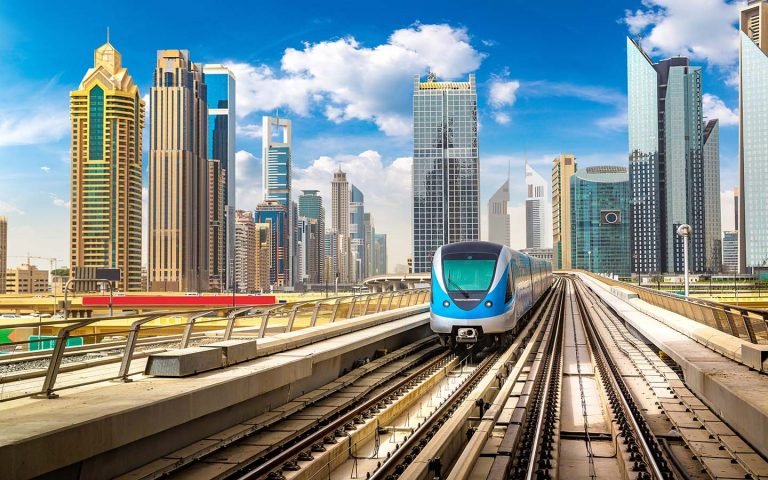
Dubai (Metro Rail News): On March 31, 2019, British Serco Group has signed a two-year contract extension worth £140m with the Roads and Transport Authority (RTA) to continue operating and maintaining the Dubai Metro until September 2021.

The contract extension includes the operation and maintenance of the Red Line expansion which is currently under construction; the test-run of the expanded service is expected to start in February 2020 in readiness for full operation ahead of Expo 2020 which begins in October 2019. The total value of the fixed base fee for the contract extension is around AED680m (equivalent to about £140m).

Image 3

In 2009, Serco first began operating and maintaining the initial ten stations on the Red Line from the official opening of the Dubai Metro.  Expansion of the Metro has seen the Red Line grow to 29 stations, while the Green Line, opened in 2011, added an additional 20 stations.

The Red Line expansion for Expo 2020 adds 15 kilometers and connects seven stations. At that point, the Dubai Metro will have a total network length of 90 kilometers and over 120 trains running at peak times. Serco’s more than 2,000 employees on the Dubai Metro continue to deliver excellent operational performance and record numbers of passenger journeys.

“Serco has delivered operational performance levels on the Dubai Metro with a high train service availability of 99.9% and a punctuality of 99.8%, achieving a record of 204 million journeys in 2018″, said HE Mattar Al Tayer, Director-General and Chairman of the Board of Executive Directors of the RTA, who signed the contract at a ceremony yesterday in Dubai alongside Rupert Soames, Serco Group Chief Executive.

“We are delighted to have agreed this extended and expanded contract to continue operating and maintaining the Dubai Metro, which is amongst the largest and most reliable rail services in the world. This contract demonstrates the high confidence that RTA has in Serco to continue delivering world-class levels of safety, operational performance, and customer service.  We look forward to working in close partnership with the RTA in support of the preparations for Expo 2020 and beyond”, said Rupert Soames.

The above information was shared by the Serco through its press statement.

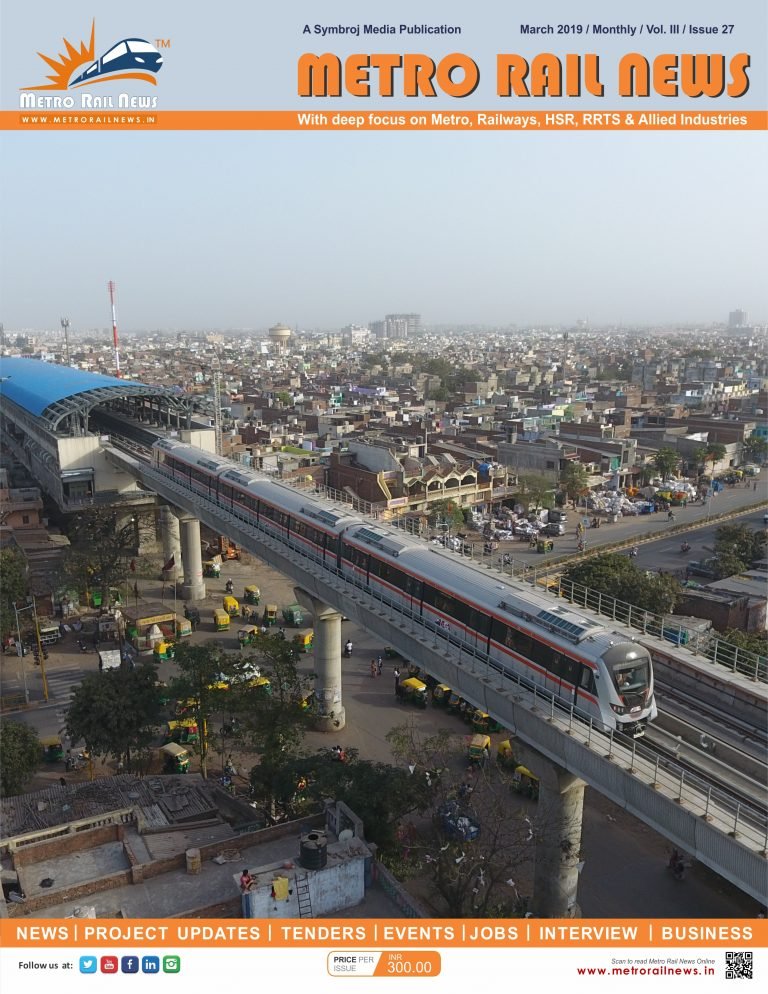
Metro Rail News March 2019 Issue Published

Metro Rail News March 2019 issue focuses on varied topics such as Civil Construction, Viaduct & Tunneling Equipment, Cover Story on tunneling technology, coverage of Ahmedabad & Surat Metro Rail Project, along with regular monthly sections such as exclusive interviews, new development in metro projects, pre event coverage, opinions, articles, industry contract, , live tenders, upcoming events and current job openings.

Hyderabad Metro Commuters will have Common Mobility Card soon

Hyderabad, Metro Rail News: The Govt. of Telangana is planning to introduce a common mobility card for the commuters who use metro train, RTC buses and other transport systems for capital city Hyderabad.

On 27 March 2019, In the view of common mobility card, a meeting held in State Government Secretariat under the chairmanship of S K Joshi, Chief Secretary along with other officials namely; Arvind Kumar, Principal Secretary, Municipal Administration, Jayesh Ranjan, CEO of Department of Information Technology, Sunil Sharma, CEO and NVS Reddy, MD of Hyderabad Metro Rail, KV Rao, Chief General Manager, South Central Railway, Purushottam Naik, Executive Director, TSRTC and representatives from the cab aggregators Ola, Uber and other transporters attended the meeting.

Mr. S. K. Joshi issued the direction to the concern officials to explore the possibilities of introducing a common mobility card which would be valid for travelling in Hyderabad Metro, RTC buses and other transport vehicles plying in the city.

“In accordance with the recommendations of Central Government various steps are necessitated to extend the facility to the city commuters by introducing National Common Mobility Card (NCMC)” He Added.

After the introduction of card, the commuters will be eligible to travel by Metro Rail, MMTS, TSRTC buses, autos and other private vehicles like Ola, Uber, etc. They do not need make payments in cash for any of mode of transport facility. Simply, they have to swipe the card for arranging payments digitally.

According to the sources, this step is being taken after reviewing the use of card technology universally and after launching the National Common Mobility card by the Prime Minister Narendra Modi in last month. It was decided to finalize the plan after receiving suggestions received from the concerned departments.

Kochi Metro Rail all set to open solar power plant at Muttom yard

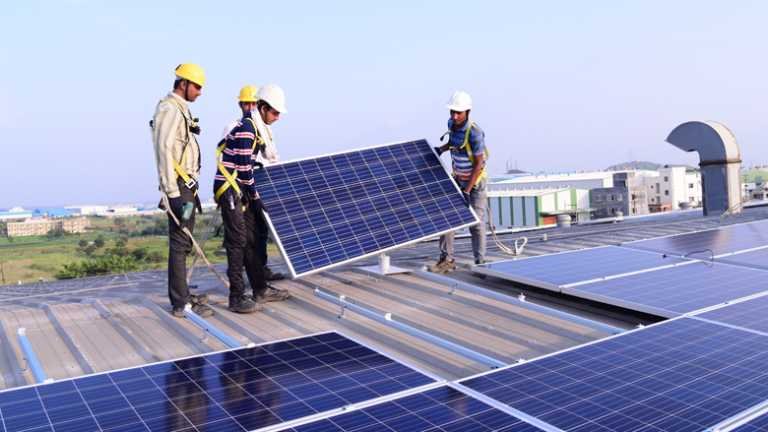
Kochi, Metro Rail News: The Kochi Metro Rail Ltd (KMRL) all set to open new solar plant having a capacity to generate 2719 KW. at Muttom Yard to increase the capacity of its solar power production on April 1, 2019

KMRL’s officials said that With the opening of the new solar power plant, which will have panels installed over four hectares, KMRL will be able to meet nearly 40 per cent of its total power requirements by itself. The agency is planning to produce an additional 5,400 KW power by next year by setting up solar panels in another two hectares of land at Muttom and in nine metro stations,”

Presently KMRL generates 5,389 KW per day from its solar power plant at Muttom and the solar panels erected over 13 metro stations. KMRL will also set up solar panels by the side of tracks and ramps.
buy dapoxetine online https://pridedentaloffice.com/wp-content/themes/twentytwentyone/inc/en/dapoxetine.html no prescription
With the opening of a new plant, the will be able to save `1.2 crore in electricity cost every year.

Kochi Metro celebrates 2 cr happy journeys,

On 23 March, 2019 Kochi Metro is having a prestigious moment as the number of passengers reached to 2 crore. Kochi Metro Rail Limited (KMRL) organised a grand
A fashion show and musical programme to celebrate the achievement of 2 crore riders.

Mollywood actors Jayasurya and Nikhila Vimal attended the celebrations titled ‘Metro 2 Crore Fiesta’ on Saturday at Metro junction in Edappally.

The actors took a ride in metro from Edappally to CUSAT. “I travelled in many metro trains. But I think Kochi Metro is the best,” said actor Jayasurya.

KMRL MD APM Muhammad Haneesh stated that the number of passengers will go up once the metro extension work on the stretch of Ernakulam Maharaja’s college ground to Petta.

Varanasi Metro – RITES to submit Revise DPR in Next Month

Varanasi, Metro Rail News: The survey agency RITES (Rail India Technical and Economic Service) will submit the revised report for Varanasi Metro in next month. There were some drawbacks in the previous detailed project report. In this report, it will also prepare proposals for linking small routes with metro through Ropeway/cable cars.

Around four kilometers of the existing light metro rail route plan has been reduced.
buy clomiphene online https://www.facebeautyscience.com/wp-content/themes/twentyseventeen/inc/en/clomiphene.html no prescription
According to the new survey, now Metro will not go Sarnath so that budget has been reduced from Rs.16,000 crores to Rs.7,000 crores.

In the recent meeting held on Thursday, The provision of light metro and the rope-way was first time presented to improve traffic congestion in the city. In this presentation meeting before the City commissioner and VDA officials, the first fixed route for the Light Metro was reduced.

According to the new report, the first route of the Light Metro will be from BHU to BHEL, while the second route from BHU to Kashi via Beniyabagh. In the report given for the Metro, the second route was from Sarnath, which has now been separated.

According to previous DPR, the route of the Metro was 29 km, which was reduced to 25 km. This has reduced the cost to less than half. as per presentation, the route from BHU to BHEL will be elevated, whereas somewhere in the route of the Kashi, an underground corridor will be built.

When the officials of the RITES presented the report for the Light Metro and the Ropeway, it was mentioned in the construction but the details of the expenses on the maintenance were not reported.

It was said in the presentation that now a total of Rs.7,000 crores will be spent on the light metro, while Rs.1700 crores will be spent on the ropeway projects. Commissioner Deepak Agarwal said that the joint detailed project report of Ropeway and Light Metro should be prepared. Also, include the cost of repairs. Officials including VC VDA Rajesh Kumar, city planner Manoj Kumar were present in the meeting.

Top Five Trends that will Shape the Global Rail Industry in 2019

Amidst growing liberalization, competition, and changing passenger expectations guided by the rise of digital technologies, global rail companies and OEMs must have a clear view of the opportunities, threats, and challenges that lie ahead in their industry.

2018 turned out to be a good year for the rail industry—a 2.7% growth rate was projected at the start of the year for freight-rail traffic. But the actual volume toward the end of the year stood at 2.9% with almost all segments showing improvement. The impending mega-merger between Siemens and Alstom is expected to come through in H1 of 2019 (pending regulatory approvals) to forge a formidable defense against the Chinese rival CRRC.

The buzz on the convergence technologies and the benefits of digitalization has been on the rise in the industry for the last 5 years. While the adoption rate and scale of these technologies can be far better, there has however, been an increasing emphasis to improve reliability, availability and passenger connectivity to ensure maintenance and operational costs are optimized. 

In the wake of such highlights and changes in the rail transportation sector, the trends expected to continue in 2019 can be viewed under the following heads:

Increased M&As to Further Industry Consolidation

Consolidation continues to be the dominant tactic in the industry. Setting aside the merger of the behemoths Siemens and Alstom, 2018 also saw few other major developments. Japanese multinational Hitachi that already owned 50.77% interest in Italian rail transportation service provider Ansaldo STS purchased an additional 31.79% of its share capital taking the aggregate stake up to 82.56% in November 2018. Wabtec Corporation signed an agreement to combine its operations with GE Transportation. Finland-based Transtech manufacturing double-deck carriages, low-floor trams, vehicle transport carriages, and electrical units sold its 25% stake to Skoda Transportation Group.

The increasing rate and scale of such deals indicate that the rail industry is set for more consolidation. In the fragmented industry, companies have realized that their general business interests and innovation in the industry can be more successfully promoted if they are more vertically or horizontally integrated in their supply chains. For e.g. standardization and harmonization of asset platforms, supply chain optimizations and wider global footprint are few of the critical drivers leading to such exercises. The rail industry is often one of the critical backbones of the economic framework of countries, therefore leading to increasing interference from regulatory bodies and competition commissions in fructification of such deals. 

Increased Focus on Digitalization

Digitalization has emerged as the key driver for innovation in the railways. It provides significant opportunities to streamline operations, improve reliability of assets and enhance passenger (or customer in case of freight) experience while reducing costs. It is being used to derive real-time information on rail movements and is an enabler of predictive maintenance for fixed assets and rolling stock.

IoT driven asset management technique is now leading up to the possibility of creating Digital Twins of critical assets to replicate real-time performance of a live asset and thereby draw useful and powerful insights on asset performance and its design effectiveness.

Augmented and Virtual Reality (AR/VR) techniques that are already enhancing training sessions for rail personnel can also help to unlock the value associated in remote asset management routines , thus reducing the dependency on physical availability of subject matter experts while training, fault isolation and fault resolution exercises. 

The adoption trend of such technologies has been slow but has been on the rise and we hope that 2019 will be better than its yesteryears.

The emphasis on smart trains and connected railways at reduced costs demonstrate that the adoption rate of these digitalization techniques will be on the rise for 2019 and beyond. For example, a report by Cisco suggests that around $30 billion will be spent in the next 12 years in IoT projects in the rail sector. The potential applications range from advanced passenger information systems to insights on better manufacturing procedures to preventive maintenance and real-time incident alarms. Demand for advanced analytics, machine learning, simulation related services shall be on the rise to support the adoption trend above.

Cyber Security will Gain Center Stage

The flipside of digitalization for railways is the associated risks and exposure to vulnerabilities that emerge while bridging the legacy ecosystem with new technologies. As the boundaries between different segments of railways continue to thin with the presence of increased digital tools on the rail network, the threat landscape is expanding.

Rail companies must comprehensively assess all the components of the digital infrastructure on which the network relies and operates on. They will need to partner with the right blend of rail domain and cyber security experts for solutions to identify and to thwart the hacking attempts before they imperil passenger safety and rail assets. Security protocols will also have to be frequently updated to stay two steps ahead of the malicious attacks that are becoming increasingly sophisticated.

The narrative on the need for robust cyber security guidelines for the rail industry has been emerging over the last 24 months and will be on the forefront in 2019 and the years to come thus driving the industry from the principles of safe by design to those of safe and secure by design.  

Shift in Spend Patterns – Increasing Investment in the APAC Region

The high population and increasing urbanization in the Asia Pacific (APAC) region have led to a growth in the demand for expansion and upgrade of their existing rail infrastructure. The railways, at present, is the third largest travel segment in the region and recorded the highest growth in online travel bookings for 2017.

Global rail companies must observe that the governments in APAC countries are actively making big budget investments in their railway infrastructure planned for the next 20 years. Among the recent developments, there are plans of connecting Kunming-Singapore railway with China, and also a proposal for a high-speed rail link between Singapore and Kuala Lumpur. It is estimated that the rail network in Singapore will double in length by 2030.

China approved a total budget of $15.7 billion for urban railway projects in the capital of the northern Jilin province.

Metro and urban transit systems are now the center piece of the transport solutions in the emerging economies. In India, there is an increased emphasis on metro rail connectivity with the finance ministry approving projects worth Rs 1.07 lakh crore for cities across northern and central states.

With such opportunities, rolling stock manufacturing companies, OEMs, and technical expertise service providers will focus harder on these regions in the coming years.

The UK-EU Brexit Impact      

Although the legal position of UK in the European Union has not yet changed and there is uncertainty on terms that will govern this exit, there could be critical impacts on its economy once the country formally leaves the EU.

Railways that generated passenger revenue of £8.8 billion in 2014-15 owed a large part of this amount to the immigrants and tourists who came to the UK from EU. The growth in number of travelers had led to higher investment in commuter rails, metros and high-speed lines. With restrictions on immigration and free movement of European tourists, revenue generation may take a hit.

The impacts of a final Brexit may also be manifested in train franchise competitions and the policy of separating operations from infrastructure. Paucity of skills is a critical driver for globalization of the rail industry. There are concerns on the ease of transfer and mobility of skills between EU and UK to drive realization of the massive infrastructure projects planned in UK. Furthermore, if the value of the GBP continues to depreciate the products supplied by manufacturers who accept payments in Euros are likely to become more expensive for UK rail companies.

As we look forward to 2019 for the rail industry, the impetus towards supply chain consolidation, adoption of digital technologies, and enhanced passenger experience is evident. For sustainable growth, the improvements in the performance of rail-based transportation will also be accompanied by efforts towards de carbonization and environmental protection – thanks to smart propulsion techniques and lighter car body frames being developed by the industry.