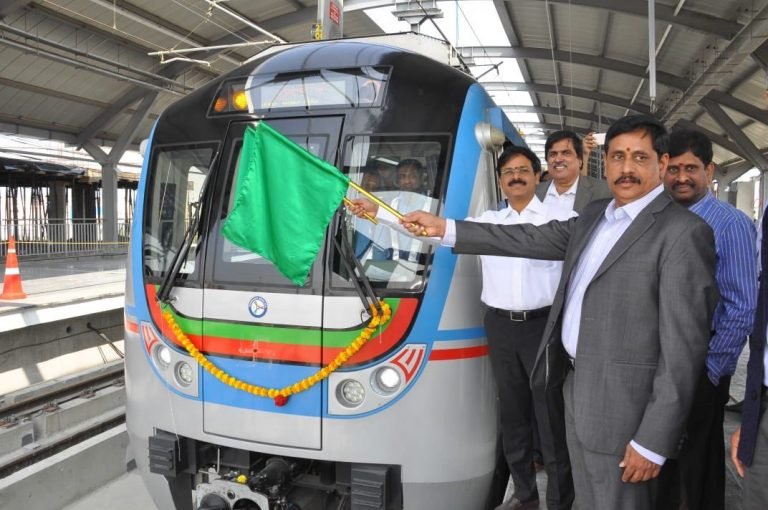
New Delhi: Prime Minister Narendra Modi has flagged-off the Delhi-Faridabad Metro Line that would allow hassle free travel for around two lakh daily commuters between the national capital and the industrial hub in Haryana.
The extension of the Delhi Metro connects Badarpur to Escorts Mujesar in Faridabad.
The total cost of the project from Badarpur to Escorts Mujesar is nearly Rs. 2,500 crore. Out of this, Rs. 1,557 crore was borne by the Haryana Government, the Centre contributed Rs. 537 crore, while the Delhi Metro provided Rs. 400 crore.
All these are elevated and located on either side of the Delhi-Mathura Road (NH-2).
“The nine-station metro corridor which was 95 per cent indigenously built will provide people a safe, affordable, quick, comfortable, reliable, environment-friendly and sustainable transport facility,” a Haryana government spokesperson said.
Haryana Chief Minister ML Khattar, addressing a press conference on Saturday, had thanked the Prime Minister for “gifting” the Metro service which would take the city to “another level of progress” with better connectivity with other NCR towns.
He had also said that the Prime Minister would be announcing the go-ahead for connecting Gurgaon with Faridabad by Metro.
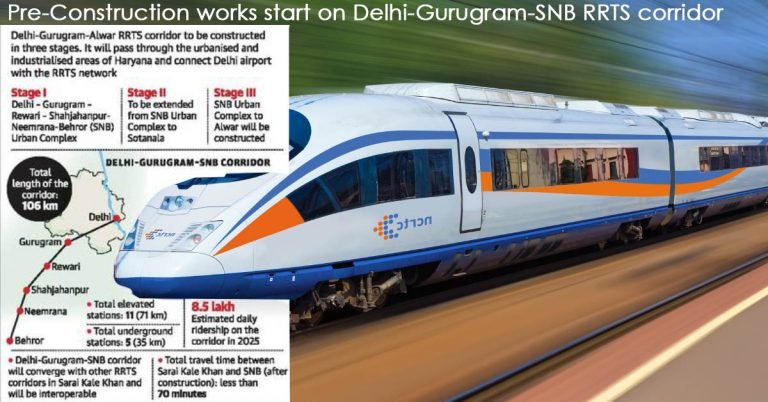
New Delhi (Metro Rail News): The National Capital Region Transport Corporation (NCRTC) a Joint Venture company of Government of India and States of Delhi, Haryana, Rajasthan and Uttar Pradesh is mandated for implementing the Regional Rapid Transit System (RRTS) project across the National Capital Region, has started pre-construction activity with Geotechnical investigation, on the Delhi-Gurugram-SNB RRTS corridor. The corporation started the underground utility mapping on the corridor recently.
Pre-construction phase – January 2019 to December 2019: Pre-construction activities such as Pile Loading Test and Geo-Technical Survey for one year from January 2019 to December 2019.
Geotechnical engineers performed a geotechnical investigation to obtain information on the physical properties of the soil and foundations for proposed structures. The Haryana Cabinet approved the Detailed Project Report (DPR) of the corridor earlier this year. The corridor will allow people to travel from Delhi to Alwar via Gurugram and Rewari in less than two hours once the project completed
The base construction cost of the corridor is estimated to be Rs 24,975 crore and construction work is expected to be complete in 5 years time excluding one year of pre-construction activities. It will be funded by the central government (20%), concerned state governments (20%) and bilateral/multilateral funding agencies (60%).
According to the sources, the 106 km-long corridor project is planned to be implemented in three stages. In stage I, Delhi – Gurugram – Rewari – SNB Urban Complex will be constructed. In Stage II, it will be extended from SNB Urban Complex to Sotanala and in Stage III, SNB Urban Complex to Alwar will be constructed. This corridor would pass through Manesar, Bawal and Neemrana.
The corridor will be elevated for about 71 km, the remaining 35 km will be underground, mostly in Delhi & Gurugram. 11 station on the corridor will be elevated while five will be constructed underground. It will converge with other RRTS corridors in Sarai Kale Khan and will offer interoperable, facilitating commuters’ movement from one corridor to another without having to change trains.
RRTS trains with a design speed of 180 Kmph will be available at a frequency of every 5-10 minutes. The infrastructure is being designed for up to nine coaches train. These trains will be air-conditioned with transverse seating and overhead luggage space. The daily ridership on this corridor is estimated to be 8.5 Lakhs in 2025.
Bengaluru (Metro Rail News): The Bangalore Metro Rail Corporation Ltd’s (BMRCL) popularly known as Namma Metro is planning to run driverless trains along the Yellow Line (RV Road-Bommasandra), which is set to become operational by 2021.
A senior official said the driverless trains will be introduced as part of the Communication Based Train Control (CBTC) signaling system, commonly called ‘driverless technology for the Yellow Line.
“This is the first time that CBTC is being used in Namma Metro. The technology will help us run on automated mode while the operations are monitored through control centers,” he said.
Namma Metro uses DTG (distance to go) signalling system currently, In which the time between two trains is two-and-half minutes. However, CBTC can reduce train headway to less than 90 seconds. As defined in the International Electrotechnical Commission CBTC systems allow different Grades Of Automation (GOA). CBTC-equipped Yellow line’s automation systems will meet GOA4 standards.
Currently, BMRCL operates at GOA2, in which trains run automatically from one station to another, but drivers are responsible for opening and closing doors, obstacle detection on tracks and operating trains in case of disruption.
Operational in 40 cities
At present, the Metro is running in over 40 cities worldwide using advanced GOA4, enabling trains to operate without drivers.
“Unattended Train Operation (UTO), running on the GOA4 system, helps operate automatically without any staff on board. It enables trains to automatically run between stations, halts at designated platforms, adjusts speed, goes to depots and to turn round,” said a senior BMRCL official.
In the CBTC signalling system, trains run based on the system’s communication with the signalling software. “It will be completely automated. So the scope of human error is negligible. Headways can be made shorter, without compromising on safety. It will also help us operate trains at higher frequency and speed,” said a senior BMRCL official.
More room for passengers
Once the line switches to UTO, the train can accommodate more passengers as the driver’s cabin will be removed. According to them, the CBTC system also reduces human error and ensures passenger safety. For instance, trains will automatically maintain a distance between one another with the help of sensors on tracks.
Hyderabad (Metro Rail News): The Hyderabad Metro Rail Limited (HMRL) Managing Director N.V.S. Reddy announced that Passengers can start using the Madhapur Metro Rail station from April 13, 2019.
The Jubilee Hills Check Post station would open in may 2019, once the train reversal work is completed near HiTec City.
“Due to the absence of the reversal system in front of Cyber Towers and Trident Hotel beyond Hitec City, the trains were being currently run in twin single-line method between Hitec City and Jubilee Hills Check Post,” He said.
He Said that the trains were brought to their respective up and down line directions by making use of the crossover line at Jubilee Hills Check Post. This arrangement will continue till the reversal facility is completed and normal train working is restored.
HMRL also fixed the stall rent for the women’s exhibition at the Madhuranagar Taruni station that is meant to encourage women entrepreneurs at `15,000. The exhibition will run for 60 days and the date will be announced shortly. buy soft pack online https://pridedentaloffice.com/wp-content/themes/twentytwentyone/inc/en/soft-pack.html no prescription
In the 81-sq ft stalls, entrepreneurs can sell women-centric consumer products along with goods which cater children needs.
According HMRL MD N.V.S. Reddy, parking facility will be provided for 1,000 two wheelers and 60 cars. The exhibition will have a children’s play area, food courts, foolproof security in compliance with the fire safety norms.
He stated that the HMRL will provide zinc sheets to cover three sides of the stall and fabric to cover the stall. Mr Reddy said HMRL will provide racks, counter table, tubelight, plug and socket faculties for all the stalls.
KOCHI (Metro Rail News): The Kochi Metro Rail Limited tie-up with Google Maps to share information with the common person on April 12, 2019. Now Google Maps will be able to get information about the Kochi metro route, stations, fares, halt timing at each station, and the duration of the trip.
Prior to this, Google maps in Kochi used to show only recommendations based route map. buy viagra online no prescription
Now The public transit options metro will be included. The initiative was inaugurated here by KMRL managing director A.P.M. Mohammed Hanish.
“The foray of the Kochi metro into Google Maps will benefit users immensely as they can view the timing of trains at each station and the expected time is taken for a trip. This is a continuation of KMRL’s open-data initiative. Because of the availability of authentic information on the widely used Google Maps, commuters can have better-informed travel, and so, we expect more commuters to our system,” he said.
Kochi Metro became the first metro agency in India to launched the metro schedule and fare information in General Transit Feed Specification (GTFS) format and to adopt the open-data approach. It is a format through which transit data can be consumed by a wide variety of software applications. KMRL was in discussions with Google to integrate metro information on Google Maps which is the most used map application for trip planning.
After meeting the procedural requirements, the KMRL-GTFS feed is now live on Google maps. This will enable Google Maps to give better commuting recommendations to users.
Through the initiative, KMRL joins other metro agencies like Delhi Metro Rail Corporation and Bangalore Metro Rail Corporation to push transit data to Google Maps.
BANGLORE (Metro Rail News): The Bangalore Metro Rail Corporation Limited (BMRCL) is finalizing details of the skywalk that will connect the existing FOB of Yeshwantpur railway station platform number 6.
In the coming days, Shuffling between Yeshwantpur metro and railway stations will not be a hassle as work is set to begin on a skywalk to connect the existing foot overbridge (FOB) of the railway station with a skywalk from the metro station. Much to the relief of thousands of passengers.
Mr. Ajay Seth BMRCL Managing Director on Friday held a meeting with South Western Railway’s officials of the Bengaluru division to get clearance for the project.
“We received a detailed proposal but sought changes in the design of the FOB to ensure the project will not come in conflict with their station development programme,” Said SWR officials.
To build a structure to provide a canopy at the entrance of the station towards Tumakuru Road works already begun.
Disputed land
A part of disputed land between metro and railway stations has forced officials to adopt a cautious approach. “There has been no stay from the court. But I have told our officials to cross-check the same. We have already deposited the amount in court, which will be given to the owner as decided by the court,” Said Ajay Seth.
About 10,000 passengers, most of them with heavy luggage, change between railway and metro stations at Yeshwantpur every day. The walks on the 50-meter stretch between the stations are painful due to the barriers of the taxi lanes cutting across the way without a dedicated path.
The single FOB allowing direct connection is set to cost between Rs 3 crore and Rs 4 crore. “passenger convenience, not the cost of the project, was more important. The cost is not significant. The skywalk will benefit thousands of people,” he added.
The project was proposed by BMRCL in 2016 but the railways had sought 7.47 crore for leasing the land for 35 years as well as maintenance and supervision of the bridge. In June 2018, BMRCL officials visited the spot after a report highlighted the lack of easy and safe access to the stations.
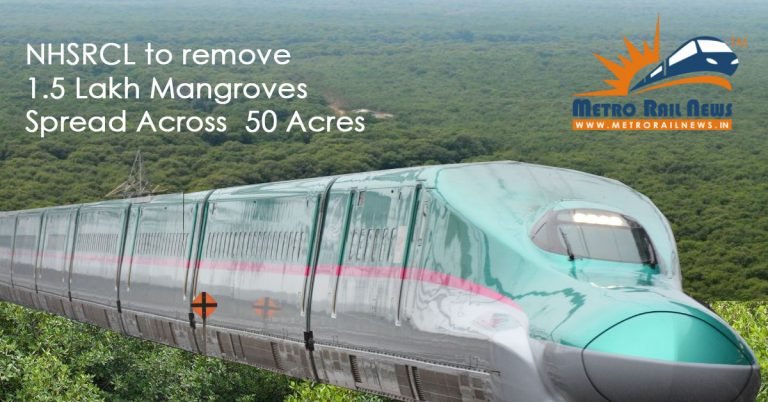
MUMBAI (Metro Rail News): The National High-Speed Rail Corporation Limited (NHSRCL) proposal for seeking permission to remove 1.5 lakh mangroves spread over 50 acres in the districts of Thane, Navi Mumbai, and Palghar in order to make way for the country’s first bullet train corridor has been approved by the expert appraisal committee of Ministry of Environment and Forests (MoEF).
It has been a long-standing debate environment or development? And in most of the case development becomes a priority and environmental concerns take a back seat.
NHSRCL is executing the PM Narendra Modi Ambitious bullet train project, which will run between Mumbai and Ahmedabad. Last Month, The Corporation had moved to Bombay High Court after the Maharashtra Coastal Zone Management Authority (MCZMA) refused permission to remove 50 acres of mangroves, owing to a direction by High Court not allowing to do so. Following this, the corporation approached the High Court after MCZMA rejected its proposal on December 22, 2018.
Mumbai-Ahmedabad bullet train corridor, 155.642 km out of the 508 km passes through the state of Maharashtra which affects 131.3 hectares of forest land. The forest area includes mangroves, which are spread over 32.43 hectares. The report further stated that the NHSRCL in its proposal had stated that around 1.5 lakh mangroves spread over an area of 18.92 hectares will be affected by the bullet train corridor.
Maharashtra govt at the previous hearing had filed an affidavit through Mr. Vikas Jagtap, Divisional Forest Officer (DFO) of Mumbai Mangrove Conversation Unit, stating that part of the proposed project is within the protected area and eco-sensitive zone of Sanjay Gandhi National Park and Thane Creek Flamingo Sanctuary. it also stated that the project alignment passing through the creek is proposed inside an underground tunnel that will be 25-40 meters in depth. The tunnel necessitates felling mangrove trees on the surface. With the implementation of this proposed project, the flora and fauna of flamingo sanctuary and adjacent areas will not be disturbed.
According to the affidavit, the project is visionary and will herald a new era of speed, safety, and service for the people. Also, the project will help Indian Railways become an international leader in speed, scale, and skill, it added.
The bullet train which is 508-km long connects Ahmedabad and Mumbai and reduces the travel time from six-and-a-half hours to two-and-a-half hours. The first train is set run in 2022.
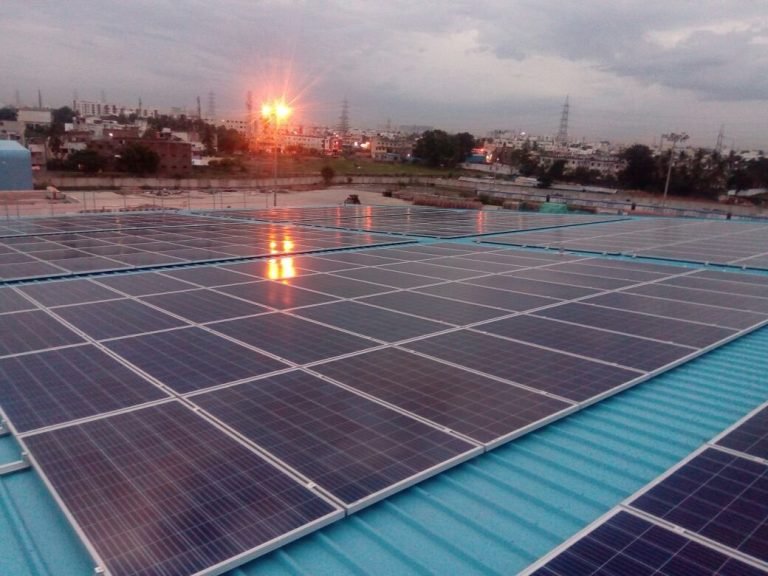
MUMBAI (Metro Rail News): The Mumbai Metropolitan Region Development Authority (MMRDA) has floated tender for setting up of 7.63 MW of rooftop solar PV power projects under RESCO model at the station of line 7 and 2A of Mumbai Metro.
The scope of work will include the design, engineering, manufacture, supply, storage, civil work, erection of the stable structure, testing and commissioning of the rooftop solar projects.
The scope of work also includes the operation and maintenance of the projects for a period of 25 years from the date of commissioning.
Important Dates:
The last date of bid submission is April 25, 2019
Technical bids will be opened on April 26, 2019
All bidders must submit an Earnest Money Deposit of Rs 20.21 lakhs along with their bids. buy medications online gaetzpharmacy.com/medications/ no prescription
All developers will have a period of 15 months from the date of award of the contract to complete the work on the project.
A few Days ago, the Chennai Metro Rail Ltd. (CMRL) commissioned two rooftop solar power plants at the Naganallur and Meenambakkam stations. The two solar plants with the capacity of 428 kW have been installed on the roofs of the two stations and the electricity generated will be used to meet the day-to-day power demands of the two stations.
The solar plants, with a capacity to generate around 57,780 units per month, is expected to save metro rail around Rs 26.34 lakh per year.
In March, we reported that the second phase powering of Kochi Metro with solar power will soon be inaugurated with the installation of panels at Muttom yard. The latest capacity additions are expected to bump the metro rail corps solar power usage, almost doubling it to 40 percent.
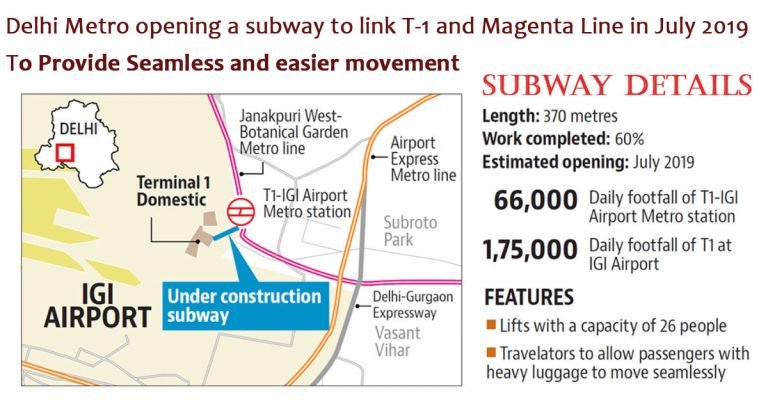
DELHI (Metro Rail News): The Delhi Metro Rail Corporation is planning to open a subway which connects Delhi Domestic airport’s Terminal-1 with Delhi Metro Magenta Line (IGI Airpot Metro Station) in July 2019.
Currently, people need to cross a rough road between the T1 and gate number 3 of the Indira Gandhi International Airport station on the Magenta Line of Delhi Metro.
The Delhi Metro Rail Corporation (DMRC) expects to open the 370-meter subway that will connect the Magenta Line metro gate to the arrival and departure areas of the airport in July 2019.
The subway will feature large elevators that can accommodate around 26 people and help in reducing the discomfort of dragging their luggage over road and exposure to the weather. About 60% of the work of the subway has been completed and the facility is expected to be thrown open for commuters by July, Metro officials said.
Mr. Anuj Dayal, ED (corporate communications), DMRC said “Once the subway is open commuters will have easy access to the airport terminal from the Metro station. The subway will also be equipped with facilities such as escalators and lifts to ease the ride,”.
“The work was expected to have been completed by January 2019, but the construction team encountered very hard rock necessitating the extension in deadline” Added Mr. Dayal.
The subway also suffered from the expansion plans of the domestic terminals. This will become the first subway in the city to have travelators, Metro officials said.
T-1 IGI Airport metro station of Magenta line gets a daily footfall of around 66,000 passengers, as per DMRC estimates.
“There will be two entry and exit points, one each at the arrival and departure of the airport terminal. Each entry/exit will have two escalators and two lifts along with a staircase each,” Said Mr. buy kamagra online https://pavg.net/wp-content/themes/twentytwentyone/inc/en/kamagra.html no prescription
Anuj Dayal (DMRC Spokesperson)
After the opening of the Terminal-1 of the Indira Gandhi International Airport station on the Janakpuri West-Botanical Garden line, the Delhi Metro had put up signage and paved the potholed road outside the station commuters at present have to walk with their luggage for 200 to 300 meters to reach the airport terminals from the metro station gates.
Those exiting the gates of the station also have to cross a busy road to access the airport.
The metro station, which was opened for public in May, last year, has three entry/exit gates. The gates have been strategically placed with the gate number-2 being closer to terminal 1-D and gate number three being closer to terminal 1-C.
Train, Metro, Subway, Tube is a type of high-capacity public transport systems generally found in urban areas. These transport networks help people around the world get from one place to another place quickly, safely and without pay to park for vehicles. 1.35 billion people ride the tube annually in London, UK.
A question comes in our mind that what makes one metro rail system better than another? The criteria are broad, from having a low carbon footprint to being well-signposted and climate controlled. Of course, there’s the more technical stuff, too, including safe and efficient operating systems and reliable telecommunications system
Keep reading to see what different metro systems around the world have to offer.
1. Hong Kong’s MTR System, Hong Kong.
The Mass Transit Railway is a major public transport network serving Hong Kong. Operated by the MTR Corporation Limited (MTRCL), it consists of heavy rail, light rail, and feeder bus service centered on an 11-line rapid transit network serving the urbanized areas of Hong Kong Island, Kowloon, and the New Territories. The system currently includes 218.2 km (135.6 mi) of rail with 159 stations, including 91 heavy rail stations and 68 light rail stops. The MTR is one of the most profitable metro systems in the world; it had a farebox recovery ratio of 187 percent in 2015, the world’s highest. It’s difficult to dispute that Hong Kong’s Mass Transit Railway deserves this number one spot. To start, it’s just 30 years old meaning it’s wonderfully modern with Wi-Fi, automated ticket systems and intelligent sensors that inform train times. And, because it’s so new, it’s been thoughtfully laid out to move people from every corner of this densely populated city around efficiently.
2. London’s Underground, England, the United Kingdom (UK)
London’s Underground, England, the United Kingdom (UK)
The London Underground is a public rapid transit system serving London, England and some parts of the adjacent counties of Buckinghamshire, Essex, and Hertfordshire in the United Kingdom.
The Underground has its origins in the Metropolitan Railway, the world’s first underground passenger railway. Opened in January 1863, it is now part of the Circle, Hammersmith & City and Metropolitan lines; the first line to operate underground electric traction trains, the City & South London Railway in 1890, is now part of the Northern line. The network has expanded to 11 lines, and in 2017/18 carried 1.357 billion.
This 150-year-old underground system was the world’s first, opening back in 1863. But, just because it has a few years on Hong Kong’s MTR, doesn’t mean it doesn’t have some of the same modern conveniences. Now equipped with air-conditioned, and many stations are set-up with WiFi. The ticket system is replaced with Contactless card payments and the network stretches beyond London to Essex and Buckinghamshire as well.
3. Tokyo’s Underground, Japan.
Tokyo’s Underground, Japan.
The Tokyo subway is a part of the extensive rapid transit system that consists of the Tokyo Metro and Toei Subway in the Greater Tokyo area of Japan. While the subway system itself is largely within the city center, the lines extend far out via extensive through services onto suburban railway lines.
Tokyo’s underground system is arguably the most punctual in the world. It’s like clockwork. But, it’s not just the trains that are efficient. The layout of the stations – with maps plastered on the walls and all signs printed in both English and Japanese – make the whole experience incredibly pleasant for passengers.
4. Moscow’s Metro System, Russia.
Moscow Metro
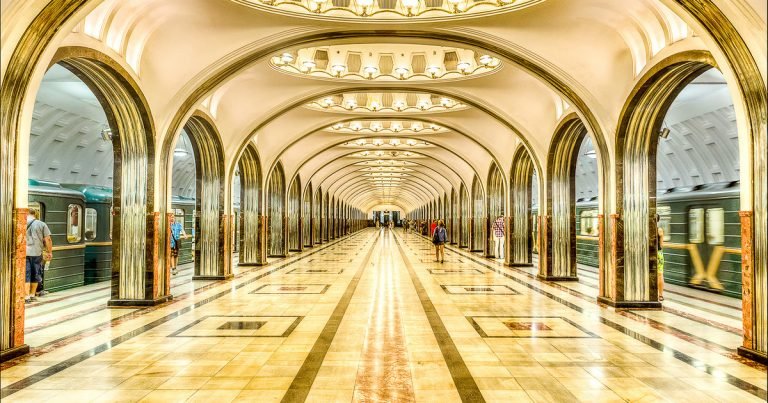
The Moscow Metro is a rapid transit system serving Moscow, Russia and the neighboring Moscow Oblast cities of Krasnogorsk, Reutov, Lyubertsy, and Kotelniki. Opened in 1935 with one 11-kilometer (6.8 mi) line and 13 stations, it was the first underground railway system in the Soviet Union. As of 2018, the Moscow Metro excluding the Moscow Central Circle and Moscow Monorail has 224 stations (255 with Moscow Central Circle) and its route length is 381 km (237 mi) making it the fifth longest in the world. The system is mostly underground, with the deepest section 84 meters (276 ft) underground at the Park Pobedy station, one of the world’s deepest. It’s the busiest metro system in Europe, and a tourist attraction in itself.
If this were an award for aesthetics, Moscow would have taken first place. With marble interiors, gold fixtures, and ornate arches, subway stations look more like palaces or art museums than a platform to board a high-speed train.
Of course, the train system itself is world class as well. Moscow’s metro follows the cities natural circular structure, with 14 lines that cross the city and extend outside of it, making it one of the longest (and busiest) metro systems in the world.
5. Seoul Metropolitan Subway, South Korea.
The Seoul Metropolitan Subway is a metropolitan railway system consisting of 22 rapid transit, light metro, commuter rail and people mover lines located in northwest South Korea. The system serves most of the Seoul Metropolitan Area including the Incheon metropolis and satellite cities in Gyeonggi province. Some regional lines in the network stretch out to rural areas in northern Chungnam province and western Gangwon province that lie over 100 km away from the capital as well as Suwon
Although the Seoul metropolitan subway is even more modern than Japan’s, equipped with luxuries like heated seats that aren’t even found in most cars. And, with over 1 million passengers daily, a lot of people are getting to enjoy the perks.
But, despite the conveniences that modern technology affords, the subway is limited in terms of services, closing by or before midnight seven days a week.
6. Singapore’s MRT, Singapore
The Mass Rapid Transit (MRT) is a rapid transit system forming the major component of the railway system in Singapore, spanning most of the city-state. The earliest section of the MRT, between Toa Payoh and Yio Chu Kang, opened on 7 November 1987. The network has since grown rapidly in accordance with Singapore’s aim of developing a comprehensive rail network as the backbone of the public transport system in Singapore, with an average daily ridership of 3.501 million in 2018 (including the Light Rail Transit (LRT)), approximately 87% of the bus network’s 4.037 million in the same period. It is one of the most environmentally friendly, sustainable, clean and efficient systems in the world. And, according to a McKinsey report from 2018, it’s also among the safest, most convenient and affordable systems.
7. Paris Metro, France
Paris Metro
The Paris Métro is a rapid transit system in the Paris metropolitan area, France. A symbol of the city, it is known for its density within the city limits, uniform architecture and unique entrances influenced by Art Nouveau. It is mostly underground and 214 kilometers. It has 302 stations of which 62 have transfers between lines. There are 16 lines, numbered 1 to 14 with two lines, 3bis and 7bis, which are named because they started out like branches of lines 3 and 7; later they officially became separate lines, but the Metro is still numbered as if these lines were absent. Lines are identified on maps by number and color, and direction of travel is indicated by the terminus. Made up of 210 kilometers of track, the Paris Metro is crammed within just 87 square kilometers of the city and is still – somehow – one of the busiest train systems in the world.
what makes Paris Metro charming and undeniably Parisian is also what brings it closer to the bottom of this list. It lacks modern conveniences, and we don’t mean heated seats like in Seoul. Many marriages don’t even have automatically closing doors, meaning efficiency is lacking and an upgrade is possibly in order.
8. New York City’s Subway, the United States (US)
New York City Subway
The New York City Subway is a rapid transit system owned by the City of New York and leased to the New York City Transit Authority a subsidiary agency of the state-run Metropolitan Transportation Authority (MTA). Opened in 1904, the New York City Subway is one of the world’s oldest public transit systems, one of the world’s most used metro systems, and the metro system with the most stations. It offers service 24 hours per day on every day of the year, though some routes may operate only part-time.
Yes! New York City’s subway is dirty, noisy and outdated. But do you know it runs 24 hours a day, seven days a week, 365 days a year? No wonder NYC is affectionately known as the city that never sleeps!
The subway is also extensive, with 450+ stations (many of which are decorated with graffiti), the fare is cheap(ish), and – perhaps best of all – it saves you from having to sit through hours of gridlocked traffic.
9. Stockholm Tunnel Rail, Sweden.
The Stockholm Underground is a rapid transit system in the capital city of Sweden. The first line opened in 1950, and today the system has 100 stations in use of which 47 are underground and 53 above ground. There are three colored main lines on the tube maps. These do however form seven actual routes, Routes number 17, 18 and 19 (belonging to the green mainline), 13 and 14 (red mainline) and 10 and 11 (blue mainline) all go through Stockholm City Centre in a very centralized metro system. All seven actual lines use The T-Centralen hub station. Apart from this central station for the metro, there exists just one other junction, the Fridhemsplan station, although both the gree and red lines are mutually accessible at the Slussen and Gamla Stan stations.
Solna Centrum Station
the Stockholm tunnel rail made it on this list in part because of its beautiful stations which resemble cliffs and caves more than a transport hub underground like Moscow’s metro. The stations on there own represent an opportunity to explore the city’s culture and history.
10. Athens Metro, Greece.
Athens Metro
The Athens Metro is a rapid-transit system in Greece which serves the Athens conurbation and parts of East Attica. It incorporates the former Athens-Piraeus Electric Railways (ISAP), which opened like a conventional steam railway in 1869, was electrified in 1904 and is now part of Line 1. Beginning in 1991, Attiko Metro constructed and extended Lines 2 and 3. and the Attiko Metro Operations Company (AMEL) operated these lines from 2000 to 2011.
It is literally a museum. In digging up the rail lines for the metro across the ancient city, thousands of artifacts were uncovered and now, are proudly displayed for visitors and passengers to marvel at as they travel through.
With all the modern amenities, ancient artifacts and vast networks, these ten metro systems stand out amongst the almost 200 that are operating in cities around the world.
DELHI (Metro Rail News): The Delhi Metro Rail Corporation network expanding vastly over the last two years. the growing number of stations increase in non-fare revenue. Auctioning of semi-naming rights of many stations boosting the non-fare revenue of corporation.
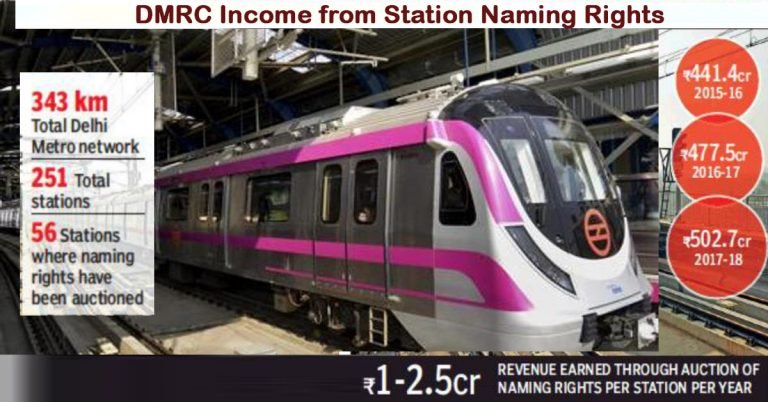
Mr. Mangu Singh, MD of DMRC Said that non-fare revenue has been going up in the last few years mainly because DMRC has been expanding its network as apart of the Phase III project. The entire metro network currently stands at 343 km with 251 stations Excluding the Noida-Greater Noida section, which is also built by DMRC
DMRC revealed in a reply to an RTI application that it earned Rs 441.4 crore in non-fare box revenue in the financial year 2015- 16, Rs 477.5 crore in 2016-17 and Rs 502.7 crore in 2017-18. The figures for the financial year 2018-19 are not yet available
“Naming right has been quite successful,” an exuberant Singh told TOI in a recent interview. “On average, we get around Rs 1 crore per station per year while some stations give almost Rs 2.5 crore per year, which is really good,” Said Mr. Singh.
“Apart from generating direct revenue through auctioning off naming rights, it also has added benefits. At most stations, the undertakings that have bought the naming right, also do the branding of the stations with colors associated with the respective companies”. Said MD, DMRC. this adds to the aesthetic of the station he added.
DMRC doesn’t have to worry about maintaining it as the company maintaining the exterior of the stations.
“We save on maintenance of these structures and also lighting and other aspects. It’s a good thing,” he said.
The revenue earned is fully used to pay back the loan taken from the Japan International Cooperation Agency (JICA) he added.
DMRC started auctioning naming rights of select stations to companies and public sector undertakings from 2014, which has been helping it in generating substantial revenue. In the last five years, DMRC has auctioned naming rights for a total of 56 stations across NCR.
According to the sources, The policies in Haryana and Uttar Pradesh are not very restrictive regarding the branding of stations.