Home Blog Page 629

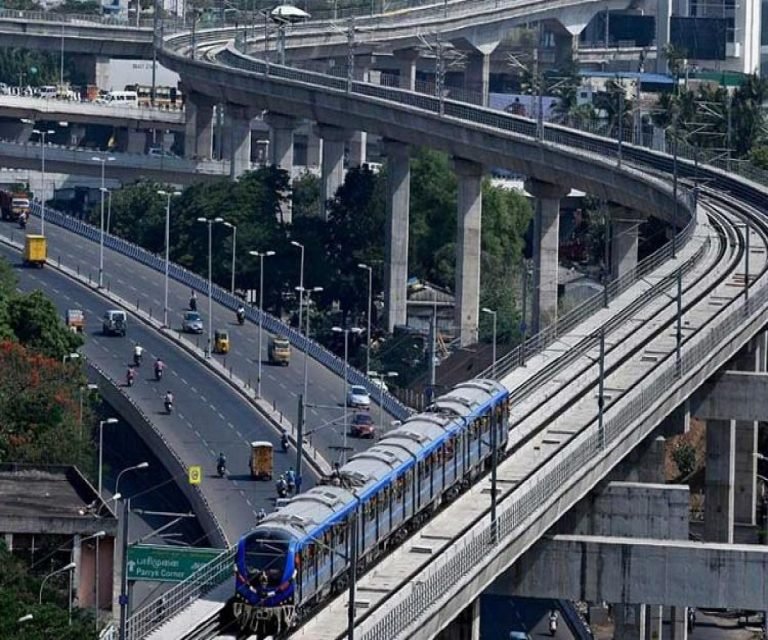
MoUD, NITI Aayog raise questions about Chennai Metro’s phase II cost

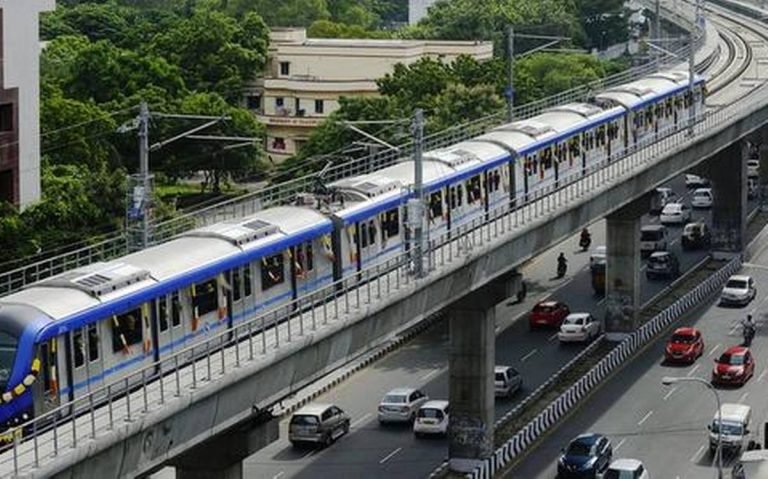
CHENNAI (Metro Rail News): The Union Ministry of Urban Development (MoUD) and NITI Aayog have questioned the estimated cost of phase II of the Chennai Metro Rail at ₹69,180 crore, running for a length of 118.9 km in three corridors.

 NITI Aayog had written to the MoUD and the Department of Economic Affairs about the huge cost involved in the project told by the Highly placed sources.

A source said “They wanted to know how the project would be funded, the amount of loan, if the State government could bear the cost and many other details. On its party, the MoUD wrote to CMRL officials for the third time, asking them to justify the entire project cost and find ways to cut it down.

MoUD has sent a slew of questions asking why certain elements of the project cost so much and if it could be cut down, according to the sources.

CMRL officials said they had already cut the cost from ₹80,000 crore to the present ₹69,000 crore.

In the initial plan, there were many underground stations, but several of them were converted into elevated stations, and their sizes too were reduced, officials said.

“We have explained how and why each element of the project cost a certain amount,” a CMRL official said.

Officials also claimed that queries on the high cost of projects by MoUD and NITI Aayog were routine, especially when the cost was enormous.

Of the total cost of ₹69,180 crore, the State will bear ₹13,723 crore.

For the remaining ₹55,457 crore, funding agencies will be tapped for 60% funds and the Centre and the State will fund 20% each.
Nagpur Metro giving infra projects a good name

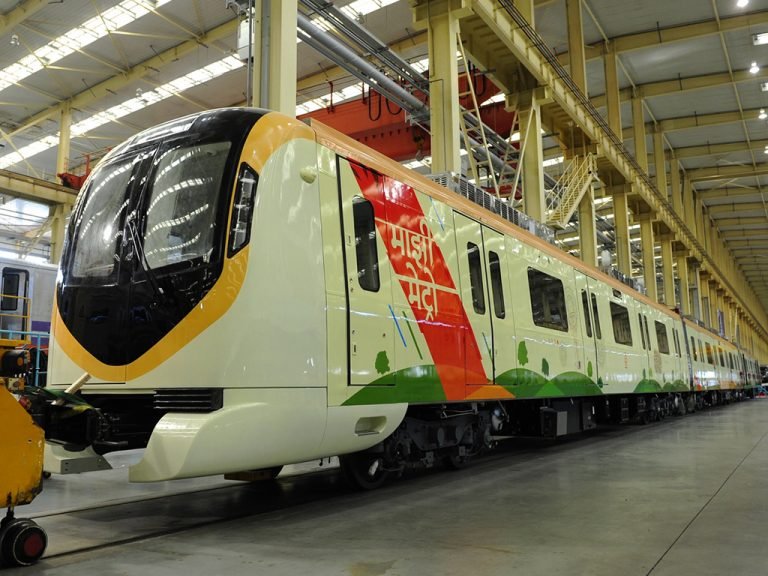
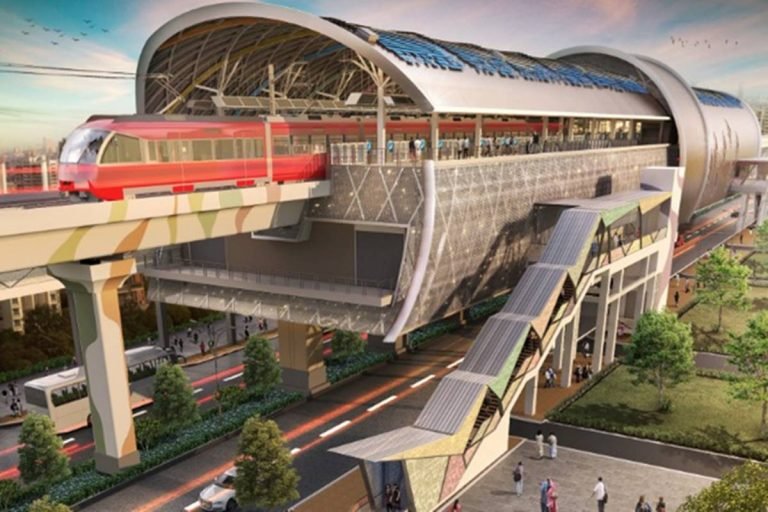
NAGPUR (Metro Rail News): In a country where infrastructure projects hog headlines for time and cost overruns, the Nagpur Metro is ahead of targets, with the backing of two political leaders ensuring that hurdles in the way of the project are removed in double-quick time.

Says Brijesh Dixit, MD of Maharashtra Metro Rail Corporation Ltd. (Maha Metro), “it is common for such projects to suffer delays and cost overruns of 50-100% but the Nagpur Metro will be finished ahead of schedule and at around 10% fewer costs than estimated”. And it has certainly helped that Maharashtra Chief Minister Devendra Fadnavis and Union Road Minister Nitin Gadkari both hail from Nagpur and are closely involved with the project.

Since construction started in May 2015, more than 80% of the physical work and 60% of the investments have been done, says Dixit. Operations on the first 13.5-km stretch between Khapri Metro Station and Sitabuldi Interchange Station were inaugurated in March this year, and the next stretch of 11 km from Sitabuldi to Lokmanya Nagar Metro Station is scheduled to get operational next month.

With that, around 25 km of the 38.215-km network to be built in Phase I of the project would be ready. The entire network is expected to be operational by mid-2020.

Meanwhile, the state government has given its nod to the `11,216-crore Phase II of the project, which is slated to add 48 km of lines to the network. The detailed project report (DPR) for the purpose is awaiting the Centre’s nod.

The `8,680-crore Phase-I has two lines – the North-South Orange corridor from Automotive Square to Khapri (19.658 km) and the East-West Aqua corridor from Prajapati Nagar to Lokmanya Nagar (18.557-km). Ridership on the project’s completion has been estimated at 3.63 lakh per day.

The Nagpur Metro is being funded by the Centre and the state government through a mix of equity and debt.

Highlighting the steps taken for efficiency, costs have been cut by `500 crores so far.

Among these is the procurement of rolling stock from China for `718 crores instead of the envisaged 920 crores. Instead of investing in an automatic fare collection system, Maha Metro has asked a State Bank of India-led consortium to build and run the system and pay it a royalty of `30 crore. This has resulted in savings of `300 crores said Dixit.

Generation of solar power from panels that have been installed on station rooftops, depot roofs, boundary walls, and administrative offices would meet 65% of the network’s requirements, allowing Maha Metro to save 5.95 per unit of power. In what is a first for India, the network would allow multiple transport modes to share the right of way with a three-layer system that includes a road, a flyover and the Metro line on top. In the pipeline is a four-decker system that includes a railway line.

While Metro projects in most cities have followed the wheel of development, Nagpur might see the project becoming an engine of its economic development. Already the third-largest city of Maharashtra with a population of 35 lakh, the city is billed to be an aviation and logistics hub in the coming years and economic activity along the Metro network may well prove the catalyst for the transformation of its landscape.

PMRDA seeks local bodies’ inputs on Metro extension

PUNE (Metro Rail News): The Pune Metropolitan Region Development Authority (PMRDA) has sought suggestions from Pune Cantonment Board and Pune Municipal Corporation on extending the Hinjewadi-Shivajinagar Metro line to Hadapsar.

The Delhi Metro Rail Corporation had prepared a draft detailed project report (DPR) suggesting the extension, and PMRDA officials said were awaiting “suggestions and comments” from PCB and PMC.

The plan originally sanctioned provides for a 23km elevated Metro corridor from the IT hub of Hinjewadi to Civil Court in Shivajinagar. The draft DPR suggests connecting Hinjewadi to the Hadapsar industrial hub, which would mean a 14km extension. “The extension would connect Shivajinagar to Phursungi or Saswad Road.

This will boost connectivity to the Phursungi IT park and even to the proposed Purandar airport,” a PMRDA official said, adding that the extension if approved, will be taken up only in the second phase of the work on this Metro line. “The draft DPR has been submitted to the local authorities (PMC and PCB) for their comments, as the proposed extension will pass through both their jurisdictions.

Once PCB and PMC give their suggestions, we will forward them to DMRC, which will include it in the final draft of the DPR. The state government will then clear the proposal,” the official added, explaining the road ahead. In 2015, PMRDA appointed DMRC as a project consultant for this Metro corridor.
buy red viagra online no prescription

DMRC carried out a passenger survey and a feasibility study and, taking into account citizens’ demands to connect the two IT hubs of Hinjewadi and Phursungi, prepared a draft DPR, suggesting an extension of the corridor till Hadapsar The Hinjewadi-Shivajinagar corridor will comprise 23 stations, while the 14km extension will have a further 14 stations.

The other two Metro corridors being developed by Maharashtra Metro Rail Corporation Limited – Pimpri-Swargate and Vanaz-Ramwadi – will intersect with the PMRDA line at the Civil Court station, which is being planned as a multimodal transport hub.

The Pimpri-Swargate is elevated for 11.57km, till the Range Hills station, after which is runs underground till Swargate, while the 16.67km Vanaz-Ramwadi route is completely elevated. “If the Metro line is extended, the cost of the project will increase. The state government will have to decide whether the second phase of the project too will be implemented on the public-private partnership basis,” a PMRDA official said.

At the moment, the Hinjewadi-Shivajinagar Metro corridor costs Rs260 crore per kilometer. The 14km extension is expected to add Rs3,000 crore to the project cost.

NCRTC organizes ‘Vendor Meet-Consultation with Prospective Construction Partners’

NEW DELHI (Metro Rail News): Regional Rapid Transit System (RRTS) is a first of its kind mobility service being implemented in India. Keeping this in mind, since its inception, NCRTC is having regular consultations with stakeholders, industry leaders, etc. for the timely and efficient execution of RRTS project. In this direction, a ‘Vendor Meet – Consultation with Prospective Construction Partners’ was organized on August 5, 2019, in New Delhi. Representatives from more than 45 reputed and leading civil, electrical and architecture firms including IRCON, HCC, ABB India Ltd, AFCONS, Siemens Ltd, Simplex India, L&T, Tata Projects, etc participated in the meet.

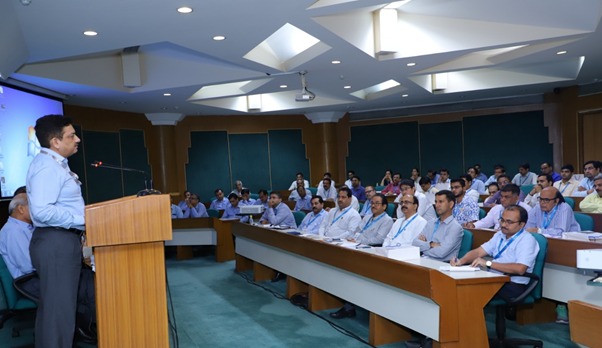
Shri Vinay Kumar Singh MD NCRTC addresing the vendor meet
Shri Vinay Kumar Singh, MD, NCRTC, Addressing the vendor meet

During the meet, NCRTC officials gave a detailed overview of the project with special emphasis on procurement strategy and packaging plan of the Delhi-Ghaziabad-Meerut Corridor. The industry captains shared their valuable insights, expectations, suggestions, and ideas about the project execution, contract design, and risk allocation framework. 
Addressing the gathering, Shri Vinay Kumar Singh, MD, NCRTC, said, “Projects like RRTS are imperative for sustainable economic growth required to realize the Government’s vision of making India a $5 trillion economy. The responsibility given to NCRTC is huge and NCRTC is committed to facilitate and create a work environment – an ecosystem in which our partners can work efficiently & confidently.” Shri Singh further called on the industry to join hands with NCRTC in its endeavor to deliver excellence in this socially-oriented infrastructure project aimed at improving the quality of life of people and catalyzing polycentric, sustainable development of NCR.

“We are looking for partners to work with us and take up challenges while being a part of this ambitious project with the idea of New India and next-generation infrastructure,” said Shri Singh.

Notably, the construction work between 17km-long Duhai to Sahibabd section of Delhi-Meerut (82km) RRTS corridor is in full swing. The priority section is expected to become operational by March 2023 while people of the region can travel on the full corridor from March 2025.

Rail based mass transport system for Metrolite more viable

PUNE (Metro Rail News): The metro rail system being developed at present is of high capacity which is required for bigger cities with very high ridership and peak hour peak direction traffic (PHPDT).

Seeing the success of metro rail in the country, several other cities with a lower projection of ridership are also aspiring for the rail-based mass rapid transit system, which could be fulfilled by light urban rail transit system named ‘Metrolite’ with lesser capacity at much less cost.

Metrolite would also act as a feeder system to the high capacity metro. In addition to less capital cost, the operation and maintenance cost of Metrolite would also be less, making the system more viable.

Zebra crossings shall be provided on either side of the platforms for passenger movement from the wide footpaths. Respective municipal corporations shall identify all possible paths for providing at least single-track operation of Metrolite trains between two parallel roads. Ring network shall be planned to reduce the headway.

Station area can be planned with more natural lighting and natural ventilation instead of heavy closed structures. AFC gates, platform screen doors, X-ray baggage scanner, and DFMD are not suggested in the Metrolite shelters. This will remove any signaling and PSD equipment rooms in the station platform making it unattended station. The system shall have a dedicated path separating the road traffic with Metrolite system.

Fencing can be provided on either side of the network. Shelter platforms shall be planned in a staggered manner in the alternate side for Up and Down lines to reduce the actual road space.

Hyderabad metro on a tricky track, running on losses

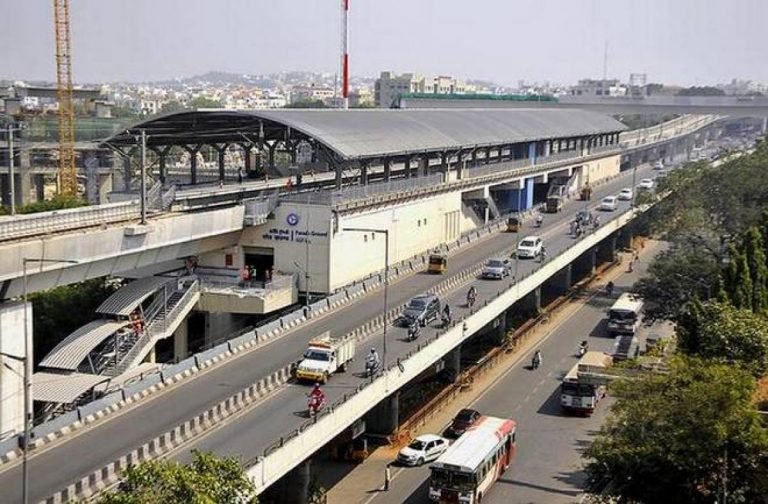
HYDERABAD (Metro Rail News): Metro Rail MD NVS Reddy said that L&T Metro project is running in losses. Reacting to allegations of Hyderabad Intellectuals, a forum on Twitter, which alleged that “the Metro project has been reduced to world-class real estate project, and L&T is milking the project as they want”, Reddy said that L&T was losing money in the project. “Rs 1,300 crore per annum is the interest burden alone on the Hyderabad Metro project.

They have built only 1.2 million sq ft so far as against eligible 18.5 million sq ft. Metros all over the world lose money and are heavily subsidized by governments,” Reddy said. L&T has spent about Rs 16,000 crore on the project in which the viability gap funding is Rs 1,200 crore from the Centre.

The rest, Rs 14,800 crore was spent by L&T, of which Rs 3,000 crore is equity and Rs 12,000 crore debt.

Reddy said, “There are around 200 Metro projects in the world, and no Metro makes a profit. Governments subsidize Metro projects for survival and for increasing liveability condition of the city. In public-private partnerships, there are four or five attempts made, including Bangkok Metro, which is 35-km long, the biggest in PPP mode.” Reddy said, “I studied financially successful Metros such as the ones in Hong Kong, Tokyo, Singapore, and Taipei.

They are originally built by governments and handed over to the private sectors. We have adopted the same.” He added that 50% of the revenue came from passenger fare, 45% from property development, and 5% from advertisements. “As per the original financial model, Metro will run into losses for five to six years, and break-even only in the seventh year, that is 2025. Currently, revenue is Rs 1 crore per day.”

When it came to the number of passengers, Reddy said compared to other Metros, Hyderabad was doing much better. “In Chennai, even after four to five years and with several incentives, there are only 50,000 to 60,000 passengers a day. After seven years of Bengaluru Metro, the figure has now reached to four lakh a day.

Hyderabad Metro will reach four to five lakh passenger figure in the next year.” He said, “There are some companies that are into construction, and some into signaling and telecom. But L&T has end-to-end experience.” Reddy said, “They have built real estate projects in Panjagutta, Irrum Manzil, Hitech City and now in Moosarambagh. They are doing good so far.”

Hyderabad Intellectuals replied to Reddy, saying, “If L&T Hyderabad Metro project is losing money, why subsidize such huge values of public property for an unviable project? 1.2 million sqft itself looks huge, 18.5 m sqft would be staggering. If values calculated for 33 years of the lease, it’s definitely profitable multiple times.”

Subscribe Metro Rail News to get Latest update from Railway and Metro Industries

Delhi Metro Put on High Alert After J&K Reorganisation Bill

DELHI (Metro Rail News): A ‘high alert’ has been sounded in the Delhi metro network in the wake of the developments related to J&K Reorganisation Billand the forthcoming Independence Day celebrations, officials said on Monday.

A fresh advisory has been issued, over an existing one, to ensure that no untoward incident takes place in the mass-rapid rail network that runs across the National Capital Region, the security officials said.

Commuters will have to go through additional checks by the CISF personnel at many stations, the officials said.

The ‘high alert’ is based on non-specific inputs and it has been issued keeping in mind the latest developments in the Parliament on Jammu and Kashmir and the Independence Day celebrations slated for August 15, according to officials.

BEML bags orders worth Rs 834 cr for Mumbai Metro

MUMBAI (Metro Rail News): Bharat Earth Movers Limited, now known as BEML has bagged further orders for Metro Coaches from Delhi Metro Rail Corporation (DMRC) for MMRDA Mumbai line 2&7 for additional 21 trainsets (126 Nos.) valued at Rs 834 crore approx.

The above order is in addition to the order received from DMRC for supply of 378 metro coaches (63 metro trains) worth about Rs.3015 crore.

On August 2, 2019 BEML Ltd reported narrowing of its consolidated profit to Rs 98.21 crore for the quarter ended June 30.

The company had posted a consolidated profit of Rs 162.56 crore in the year-ago period, BEML Ltd said in a filing to the BSE.

Its consolidated income during June 2019 quarter increased to Rs 589.10 crore, compared with Rs 457.91 crore a year ago.BEML Ltd serves core sectors such as defence, rail, power, mining and infrastructure. The company operates under three major business verticals — mining and construction, defence, and rail and metro.

Johnson Lifts bags Rs. 210 Cr. order from Bengaluru Metro

BENGALURU (Metro Rail News): Johnson Lifts has bagged Rs. 210 crores order to provide 225 escalators for the Phase 2 project of Bengaluru Metro Rail.

Johnson Lifts has provided infrastructure to public service projects and have done 12 Metro Projects, 25 Airports and over 800 plus elevators in railway stations across the country said it was also expanding its presence to other cities in Karnataka like Mysore, Hubli, Gulbarga, Belgaum and Mangalore.

“We are happy to be granted the Additional requirement in Phase 2 of the Metro Rail project comprising 225 escalators valuing to 210+ crores,” Ramesh Chari, General Manager, Karnataka, said adding that Johnson Lift had installed over 200 Heavy-duty escalators in the 1st phase at various metro stations in Bangalore.

The central government schemes on major Urban Infra Structure Development programmes in India like Metro Rail Projects, UDAN – Regional Airport development and connectivity scheme and the modernization of Airports, Railways Stations, Bus Terminals and Foot Over Bridges at important junctions has given the company a great opportunity for heavy-duty escalators used in Mass Transportation systems, he further added.

Alstom India hits a century, rolls out 100th Made-in-India metro trainset

Sri City (Metro Rail News): Alstom India continues its noteworthy innings in India by rolling out the 100th ‘Make-in-India’ metro trainset today from its state-of-the-art rolling stock manufacturing facility in Sricity, Andhra Pradesh. The delivery of the centurion trainset to Kochi Metro Rail Corporation Limited (KMRCL) also marks completion of the Kochi Metro order for 25 trainsets by Alstom. Kochi operates a 100% ‘Make in India’ metro fleet entirely custom-built at the flagship manufacturing facility at Sricity. 

The facility was set up as Alstom’s first global manufacturing centre for rolling stock in the Asia-Pacific region. This plant commenced operations in November 2013 and delivered its first metro trainset to Chennai Metro Rail Corporation (CMRL) in February 2014. The facility currently employs more than 600 employees and has a production capacity of 240 cars per year. The factory is currently scaling up to double production capacity and also introducing latest industrial technologies. 

Till date, Alstom’s Sricity facility has made on-time deliveries of more than 420 metro cars for its Indian and international customers. This includes delivering completely indigenous trainsets to metro rail corporations of Chennai, Lucknow, Kochi and Sydney (its first international order).

Speaking on this occasion Alain Spohr, Managing Director for India and South Asia, said “We have hit a century by delivering the 100th trainset. This milestone signifies many things, but most importantly, it is a vote of confidence of our customers in our capabilities to deliver world class, custom-made solutions. This achievement has been possible by our belief in our Indian talent that includes more than 4200 team members working across various locations in India. We are confident to reach greater heights with our commitment to ‘Make in India’ and aligning our business goals with the country’s vision.”

In just six years since its commencement, Sricity facility has cemented its position as a manufacturing hub for Alstom’s domestic and international clients. The supply chain is close to being 75% domestic to ensure localised manufacturing. Locally, it is also a preferred workplace due to its regular employee development and inclusive programmes with more than 10% of the staff strength being women in various roles as supervisors, planners, engineers etc.

Alstom_100 TS from Sricity_Infographic
Alstom 100 TS from Sricity Infographic

Before end of this year, the facility will commence production for 248 metro cars (31 train sets of 8 cars each) for Mumbai Metro Line 3, 212 metro cars (106 train sets of 2 cars each) for Montreal Metro (Réseau express métropolitain) and 10 more train sets for Chennai Metro, which is already under execution.