Home Blog Page 616

Delhi metro Phase IV project Operational loss to be borne by Delhi govt: SC tells AAP govt

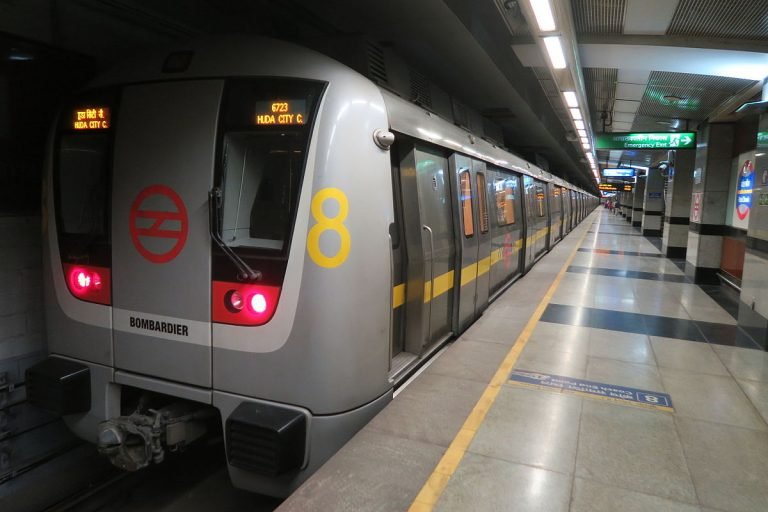
NEW DELHI (Metro Rail News): Aam Aadmi Party government to use public money wisely says the Supreme Court on September 6, 2019 and refrain from providing free metro rides to women in the national capital as that would make Delhi Metro Rail Corporation (DMRC) an unprofitable venture.

The Supreme court bench headed by Justice Arun Mishra and comprising of Justice Deepak Gupta told the Delhi government lawyer: “If you will allow people to travel for free, then the Delhi metro may go into loss. If you will give freebies, we will stop you. You are fighting for a cause here and you want them to incur loss. Do not give sops, it is public money.”

A bench also directed the Centre and the Delhi government to bear the land cost for Phase IV of the Delhi Metro project on a 50:50 basis. It also directed the authorities to ensure that the roll out of the project is not delayed and land cost of ₹2,447.19 crore is released forthwith.

The lawyer of Delhi govt. said the proposal has not been implemented yet. Delhi Chief Minister Arvind Kejriwal in June had announced that his government proposed to make metro and bus travel free for women in the national capital and the plan would be implemented within two-three months.

Issue between Centre and Delhi Govt.

The supreme court dealt with three issues related to Phase-IV of Delhi metro bearing of operational loss, repayment of Japan International Cooperation Agency (JICA) loan in case of default and sharing of land cost and are yet to be resolved between the Centre and Delhi government.

Phase IV Operational loss to be borne by Delhi Govt.

The bench said that operational loss, if any, in the 103.94 km long Phase-IV of the Delhi Metro project would be borne by the Delhi government as it is a mode of conveyance in the national capital.

“The GNCTD (Government of National Capital Territory of Delhi) is bound to ensure that financial health of DMRC is maintained properly and no steps are taken so that it may run into loss,” the bench said.

The bench directed the Centre and Delhi government to work out the modalities and release the amount of land cost within three weeks from today.

The 103.94 km long phase-IV of Delhi metro will consist of six corridors — Aerocity to Tughlakabad; Inderlok to Indraprastha; Lajpat Nagar to Saket G Block; Mukundpur to Maujpur; Janakpuri West to R K Ashram and Rithala to Bawana and Narela.

The Ministry of Housing and Urban Affairs had on 9 March approved the 61.66 km, three priority corridors — Aerocity to Tughlakabad, R K Ashram to Janakpuri (west) and Mukundpur to Maujpur — at a cost of ₹24,948.65 crore.

Regarding the remaining three corridors of phase-IV, the bench on Friday said that it would hear the issue on 23 September.

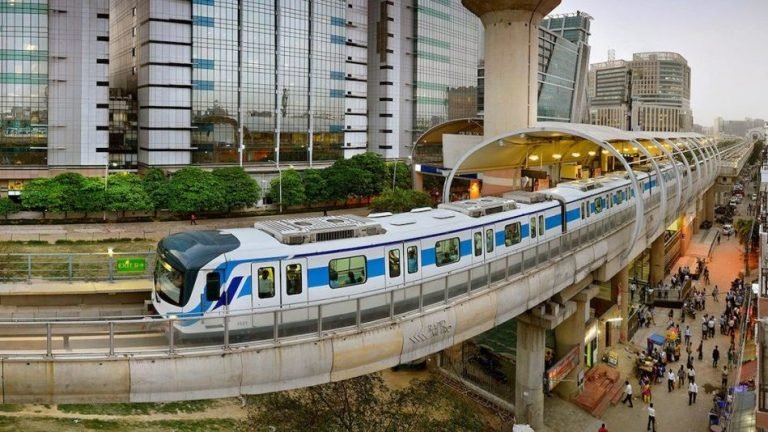
HUDA to take over operations of Rapid Metro Gurgaon

GURGAON (Metro Rail News): IL&FS Infrastructure got legal permission to hand over operations of the Rapid Metro Gurgaon to the Haryana Urban Development Authority (HUDA) on September 9, 2019.

HUDA will have the right to decide whether to engage IL&FS in managing the rapid rail project or not, according to an IL&FS official after taking over the operations of the metro.

The country’s first fully privately financed rapid metro project was built by IL&FS, which is now facing bankruptcy proceedings in the NCLAT, and had commenced operations on its first phase in November 2013 and second phase in March 2017.

Rapid Metro Rail Gurgaon Limited (RMGL) and Rapid Metro Rail Gurgaon South Limited (RMGSL) are the two special purpose vehicles (SPVs) running the metro services since 2013 and 2017.

According to IL&FS spokesperson said that due to various breaches in contract by HUDA, the two SPVs had served termination notices to HUDA on June 7, giving a 90 days’ notice as per the concession agreement Pursuant to direction of the NCLAT order on August 8, RMGSL and RMGL being ‘red entities’ were required to seek prior approval from Justice (retd) D K Jain, former SC judge mandated to oversee the IL&FS resolution process – before selling, transferring, encumbering, alienating, dealing with or creating any third party right, title or interest on any movable or immovable assets.

In compliance with the order, RMGSL and RMGL had filed for an order seeking Justice Jain’s approval for handing over the Metro Link to HUDA, the spokesperson said. “Justice D K Jain, after hearing all parties concerned involved – including authorities and lenders, allowed RMGL to hand over the Metro Link project on or before September 9 to HUDA, upholding the termination notice served by the company on June 7,” he said.

The judge in the order has also said that HUDA shall be free to engage the services of RMGL at mutually discussed charges to run Metro Link till such time appropriate/alternate arrangements are made to run the same. After September 9, it will be incumbent on HUDA to ensure the operations of metro run unhindered once the project is handed over by IL&FS SPVs, the spokesperson added.

The Rapid Metro is a fully-elevated rapid transit system with stations at Cyber City, DLF Phase 2,DLF Phase 3, NH-8 and Golf Course Road up to Sector 55-56, among others and provides connectivity to the Delhi Metro from Sikanderpur Station.

PM Modi lays foundation stone for three new metro lines in Mumbai

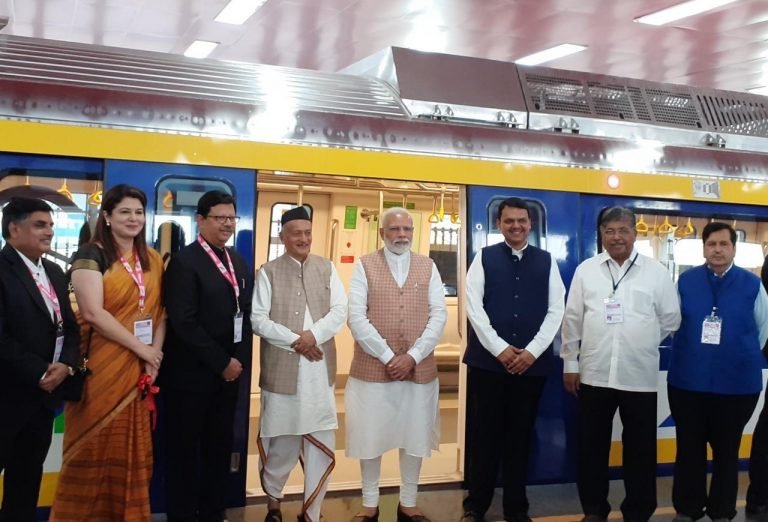
MUMBAI (Metro Rail News): Prime Minister Shir Narendra Modi on September 7, 2019 laid the foundation stone for Mumbai metro line 10, 11 and 12 corridor, which will together add more than 42 km to the metro network of Mumbai.

The three corridors are 9.2 km long Metro-10 corridor from Gaimukh to Shivaji Chowk (Mira Road), 12.7 km long Metro-11 corridor from Wadala to Chhatrapati Shivaji Maharaj Terminus and 20.7 km long Metro-12 corridor from Kalyan to Taloja .

The Prime Minister also laid the foundation stone for a state-of-the-art Metro Bhavan, which will operate and control 14 metro lines measuring around 340 km.

PM Modi Inugrated
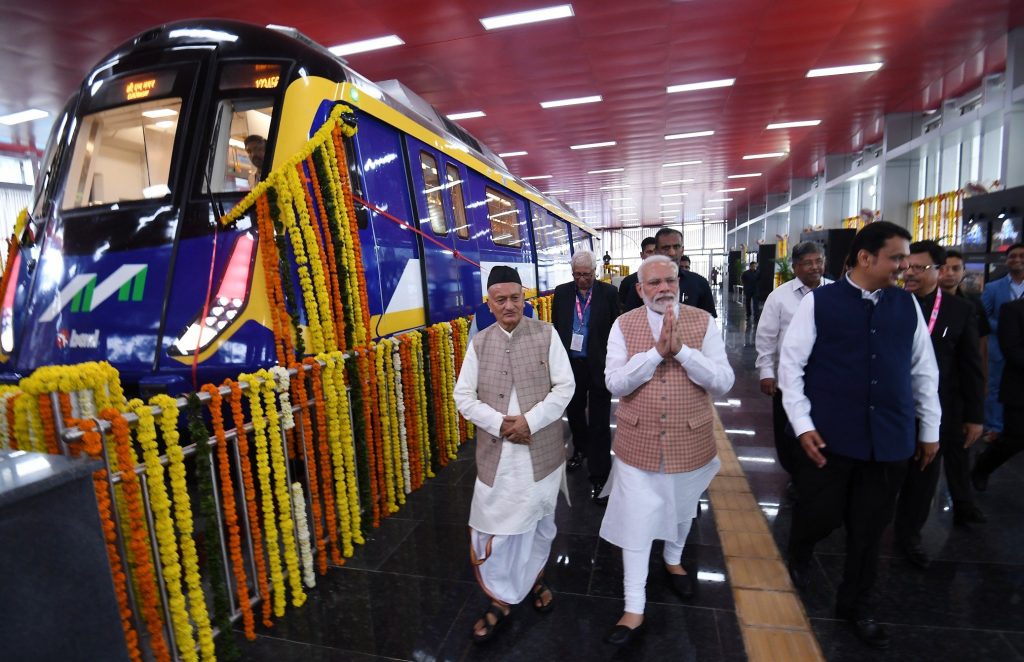
PM Modi inaugurated a state-of-the-art metro coach, the first metro coach under the Make in India initiative.

During his visit, PM Modi inaugurated Bandongri Metro Station in Kandivali East.
buy viagra super dulox force online no prescription
He also inaugurated a state-of-the-art metro coach, the first metro coach under the Make in India initiative.

At an event in Mumbai, the Prime Minister also released a Brand Vision Document for Maha Mumbai Metro.

Earlier in the day, Prime Minister Narendra Modi offered prayers at the Lokmanya Seva Sangh Tilak Mandir in Vile Parle. He visited there on the invitation of his old acquaintance Uday Taralkar, chairman of the organisation.

After Mumbai, Modi will visit Aurangabad, to address a state-level Mahila Saksham Melava (Empowered Women’s Meet) of Self Help Groups, being organised by Maharashtra State Rural Livelihood Mission (UMED).

The Prime Minister will also inaugurate AURIC Business and Administrative Building and Dedicate DMIC AURIC City to the nation.

Delhi Mumbai Industrial Corridor (DMIC) Project is the first Industrial Corridor project announced by the central government. Once fully completed, the DMIC project will bring an investment of approximately Rs 1 lakh crore and will provide employment opportunities to nearly 10 lakh people. The project is branded as Aurangabad Industrial City or ‘AURIC City’.

AFCONS Infra wins Rs 676 crore Civil Contract For Kanpur Metro

KANPUR (Metro Rail News): The civil works tender for building nine metro stations of the Kanpur Metro Rail project wins AFCONS Infrastructure limited as It emerg the lowest bidder among other competitors Larsen & Toubro Limited, KEC-CCECC JV and NCC.

AFCONS Infrastructure will be responsible for constructing the nine metro stations in Kanpur and elevated viaduct structures for the same.

9 Metro Stations are:-

The nine stations are IIT Kanpur Station, Kalyanpur Railway Station, Motijheel Station, Gurudev Chauraha Station, Geeta Nagar Station, Rawatpur Railway Station, Kanpur University Station, SPM Hospital Station and Lala Lajpat Rai Hospital Station.

Cost of the tender

The civil contract is worth Rs 676 crore while the whole project will cost an estimated Rs 11,076.48 crore.

The technical bid for the project was also opened earlier last month (August 2019), and work will be contracted out for an estimated Rs 105.00 crore.

A number of cities in Uttar Pradesh are set to get their own metro rail systems in the coming years, with Agra and Kanpur metros already having received approval from the Centre, while metros for Meerut, Gorakhpur and Varanasi in various stages of planning.

The first phase of its construction will connect IIT to Moti Jheel and the second one from Harsh Nagar to Naubasta, making for a total of 33km.

The other proposed corridor will cover a distance of 10 km and connect CSA University to Jarauli. Kanpur metro certainly comes as a boon for the residents of the city as it will connect a number of major areas of the city and reduce travel times. The metro could also help in reducing the vehicular traffic on main city roads thereby lowering the city’s pollution.

PM Modi to perform ‘bhoomipujan’ for new Metro lines in Mumbai

MUMBAI (Metro Rail News): Prime Minister Shri Narendra Modi will perform the bhoomipujan for the new Metro rail lines 10, 11, 12 and for Metro Bhavan, inaugurate the newly manufactured first Metro coach, the Bandongri Metro station (Kandivli East) and release the Brand Vision Document for Maha Mumbai Metro at a function in Mumbai on Saturday.

The function, to be held at the Convention Center at the Bandra-Kurla Complex, will take place at 11 am. MMRDA is undertaking work on additional Metro lines of 42.6km on three more corridors: the 9.2km-long Gaimukh to Shivaji Chowk (Mira Road) Metro 10 corridor, the 12.7km Wadala to Chhatrapati Shivaji Maharaj Terminus Metro 11 corridor and the 20.7km Kalyan to Taloja Metro 12 corridor. The new lines will cost about Rs 18,000 crore. Implementation of six corridors Dahisar to DN Nagar 2A corridor, DN Nagar to Mandale 2B corridor, Colaba-Bandra-Seepz 3 corridor, Wadala to Kasarvadavli 4 corridor, Swami Samarth Nagar to Vikhroli 6 corridor and Andheri (East) to Dahisar (East) 7 corridor has begun.

The Metro coach under the ‘Make in India’ initiative has been manufactured in a record 75 days as against 365 required. In this noiseless coach, one can hang bicycles in a dedicated space, officials said. At Bandongri metro station, there will be energyefficient elevators, escalators, LED fittings with use of solar energy and elevators with buttons in Braille. The Metro Bhavan will consist of a state-of-the-art operation control centre.

LMRC Metro Diwas 2019, Glorious two years in pursuit of Excellence

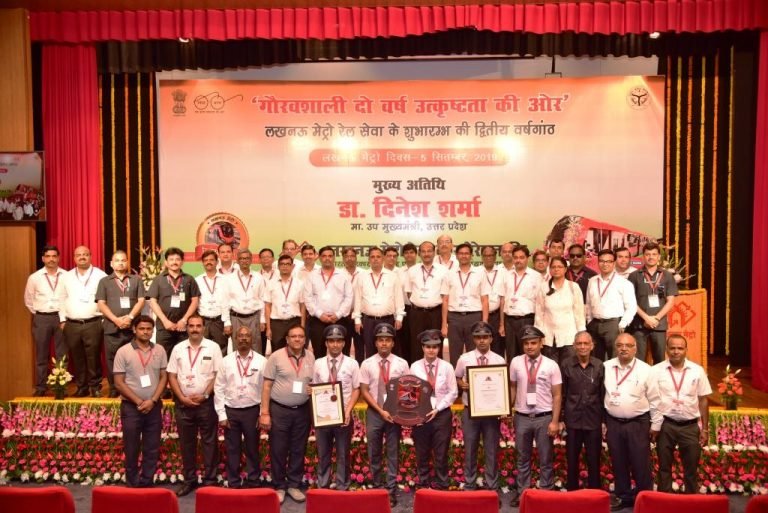
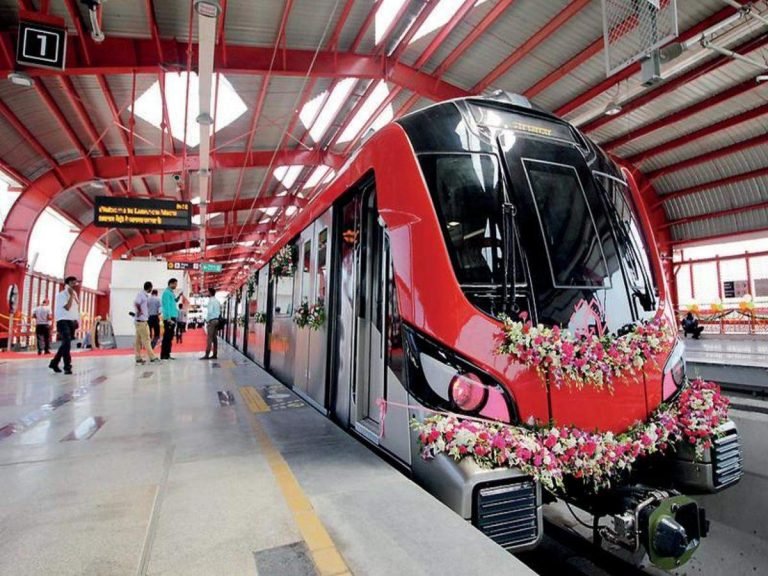
LUCKNOW (Metro Rail News): Lucknow Metro Rail Corporation (LMRC), a joint venture of the Government of India and the Government of Uttar Pradesh, which has set a benchmark of excellence in the Mass Rapid Transit System (MRTS) of India, will be celebrating its second anniversary on 5th September, 2019. LMRC shall be organizing this occasion as ‘Lucknow Metro Diwas’ dedicating this day to the Lucknowites.

The Chief Guest of this event will be Deputy Chief Minister of the state, Honorable Shri Dinesh Sharma. Many other dignitaries from Central and State Government will also be present on the occasion. On this occasion various programs will be organized and conducted on behalf of Lucknow Metro to make the people of Lucknow aware about the successful journey of 2 glorious years of Lucknow Metro.

The celebration will start in Metro depot located at the Transport Nagar with the welcome of Honorable Deputy Chief Minister on 5th September, 2019. ‘Lucknow Metro Diwas’ will be inaugurated in the auditorium located inside the Center of Excellence for Training building by the Hon’ble Deputy Chief Minister with Shri Kumar Keshav, Managing Director, LMRC delivering the inaugural speech. The esteemed chief guest will also launch the official Corporate Film of Lucknow Metro along with unveiling of “Lucknow by Metro”book in the auditorium.

Prize distribution ceremony will be held to felicitate and recognize the outstanding contributions in various fields for the year 2018-19. MD’s Gold Medal and MD’s Silver Medal will be awarded to the best LMRC employees associated with Metro Project, Metro Operations & Metro Maintenance. In addition, the best maintained metro station will also be awarded with the ‘Best Kept Metro Station’ award by the Managing Director.

To mark the occasion, students from the prestigious schools and colleges of the city have been invited to take part in the technical exhibition and become familiar with the Lucknow Metro’s journey and achievements so far at Sachivalaya Metro station.

Two years in pursuit of Excellence!

In the 2 years of its commercial operations, the Lucknow Metro has added 1.5 crore passengers with its journey. Remarkably, this figure is more than the 5 times the total population of Lucknow. Lucknow Metro has successfully achieved the milestone of ‘Zero Accident’ this year as well.

The Metro trains have travelled 24 lakh kilometers which is equivalent to taking 60 round trips around the earth. LMRC is the first metro in the world to have camera at the roof for continuous pantograph and overhead wire monitoring. Lucknow Metro trains have achieved a commendable feat of attaining punctuality of 99.6% in its Metro services.

Lucknow Metro is the first Metro in India to have fire sensors in all electrical cubicles and cars. Braille stickers are installed inside all Metro trains for differently abled persons. There is a provision of long stop button near wheel chair space inside Metro trains for longer stoppage for specially abled passengers. For the safety and security of commuters live streaming of CCTV images of moving train interiors to centralized control room in Metro Depot is done continuously.

Lucknow Metro Accolades: National and International Awards!

Lucknow Metro’s North-South corridor (phase 1-A) from CCS Airport to Munshipulia metro station has been completed and commissioned for public services in less than three years. It is, therefore, the fastest metro project which has ever been implemented in the country. In addition to completing the work in record time, LMRC has also set up several records for quality of construction work and safety.

There is a long list of exceptional achievements in this regard for LMRC. Lucknow Metro has been awarded with the IGBC Green MRTS Platinum rating for entire North-South corridor (23 km stretch comprising 21 metro stations), ‘Technology Sabha Award’ (2019), ISO 9001:2015, ISO 14001:2015, OHSAS 18001:2007 certification, International British ‘Royal Society for the Prevention of Accidents (RoSPA)’ Award 2018, ‘International European Society for Quality Research (ESQR) Choice Prize’ (2016), ‘International Quality Summit Award’ (2016), Best Metro Project for ‘Excellence in Innovative Designs’ (2016), ‘Dr. APJ Abdul Kalam Memorial Award’ (2016), and many other prestigious national & international awards.

Lucknow Metro creating a bond of compassion with people!

Lucknow Metro now gives you an opportunity to showcase your talent at the performing arena at the Hazratganj metro station and take part in singing, dancing and drama performances. Metro Marvel-a new initiative by Lucknow Metro gives people a chance to become a part of the LMRC family and witness the behind the scenes working of Metro Operational & Maintenance System. Metro Marvels will also get special invites and updates of the latest events and happenings at LMRC. Students of schools can now celebrate their birthday inside Metro in groups!

Committed for environmental protection!

Lucknow Metro has contributed towards a greener city by making 10-16% reduction of particulate matter pollution in the last one year after the commencement of Metro operations. Metro has harvested more than 2 crore litres of rainwater annually. LED Lights have been installed at all metro stations and inside metro trains of LMRC.

Lucknow Metro safe for both Human life and belongings!

Commuters often forget their belongings in Metro Trains or within Station Premises but due to alert and vigil metro staff, passengers get back their luggage safely. In the last one year, a total cash of about Rs 4,00,000 has been returned to the Metro passengers. On an average, one laptop is returned by LMRC to its rightful owner every 20 days while one mobile and one purse/bag is returned to metro commuters every third day. On the humanitarian aspect, three persons are helped/assisted every month on medical grounds on an average by LMRC staff & security personnel.

Lucknow Metro now has official Facebook page and Twitter handle!

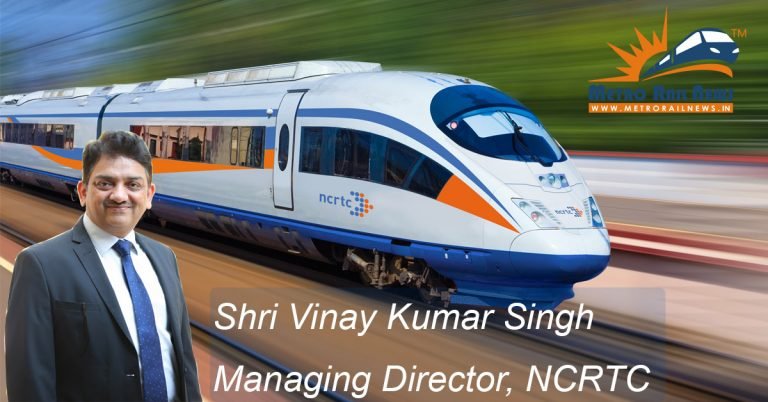
Exclusive Interview of Shri Vinay Kumar Singh, MD, NCRTC on RRTS Project

The National Capital Region (NCR), a planning region located around Delhi, is India’s fastest growing urban agglomeration. To provide a public transport solution to this economic region, the central government and four states formed a joint venture to develop a high speed rail system. Vinay Kumar Singh, managing director of National Capital Region Transport Corporation (NCRTC) which is building the regional transit system, speaks to Sanjiv Shankaran on the way things are shaping up:

Was NCR chosen for India’s first rapid transport project because of its population?

Mr. Vinay Kumar Singh:There are two reasons. One, is that it’s the national capital and many things start from here. Two, is the population. In the last census (2011), it was 46 million for the entire NCR. In the next census it is expected to be around 64 million.

Currently, there are three separate lines planned?

Mr. Vinay Kumar Singh: Originally, there were eight corridors. There was a task force in 2006 which decided we should first go in for three which are the heaviest ones in terms of traffic. These are capital intensive projects; before investing you have to think twice. Earlier there were three separate lines planned (Delhi-Meerut; Delhi-Alwar; Delhi-Panipat). But today it’s a network and all three are interoperable. This change was done in the last two-and-half years; it gives a lot of value. Our focus is the commuter. If you see things from the commuter’s angle, it makes his journey very simple. They can travel seamlessly between two corridors. The time penalty is gone.

Now, there is no terminal. A train coming from Meerut will not stop (terminate) anywhere. So, we have reduced the capital cost by a few thousand crore. We have reduced the number of depots by just doing this. If you have separate corridors your rolling stock cannot move from one corridor to another, unlike cars. If the same rolling stock has to move everywhere, it has to be standardised for all three corridors.

Today we have sanctioned only one corridor, Delhi-Meerut. But our standards of each line are fixed.

Will part of the journey be underground?

Mr. Vinay Kumar Singh: In the first corridor about 14 km are underground. In the next corridor (Delhi-Alwar) 33 km will be underground. The third corridor is to Panipat.

What will be the profile of your average commuter?

Mr. Vinay Kumar Singh: The cross-section is wide. The USP of the system is speed. Therefore, even a person using a private car will prefer this system. The speed is approximately 100 km/hour, including stoppages. The average speed for a car should be about 40 km/hour (Delhi-Meerut). There is a clear advantage in terms of time and safety. This is controlled by a high technology command system.

Other than car owners, people using public transport will prefer this system because we are trying to integrate various modes of travel. We want to reduce chaos at stations.

What will be your benchmark when tickets are priced?

Mr. Vinay Kumar Singh: What we have proposed is Rs 2 per km. Benchmarking is with other modes of transport.

When will the Delhi-Meerut portion be commissioned?

Mr. Vinay Kumar Singh: The first portion will be commissioned by March 2023. It won’t be the full route. It will be from Duhai to Sahibabad, outside Delhi. Then every six months we keep adding 20 km. By March 2025, the whole section will be commissioned.

What is the cost of this line?

Mr. Vinay Kumar Singh: The base cost is Rs 260 crore per km. The total project cost is about Rs 30,000 crore. This is after we have reduced the cost, including by providing facilities to run the metro services in Meerut on our system. Rather than having another line, there will be 13 stations which will be metro stations. Separate metro trains, which we will be operating on the same system, will be running in Meerut. We are saving Rs 6,300 crore for metro.

We are getting all the passengers of metro on to our system. From the commuter angle, from the same platform they can switch over from metro to RRTS (Regional Rapid Transit System).

Which country would you cite as an ideal example of a large scale multimodal transport system?

Mr. Vinay Kumar Singh: Many countries have done it. The best example is Paris. Paris has regional trains, high speed regional trains and they have a metro. It’s very successful. At the time of the growth of the city, they introduced these trains. Economic opportunities are always in big cities. Here too.

First, you have to provide good public transport. Then you can push people to move towards it. Good public transport needs multimodal integration

CMRS nod for Aqua Line of Nagpur Metro for commercial operation

NAGPUR (Metro Rail News): Chief Metro Rail Commissioner Safety (CMRS) Shri Janak Kumar Garg along with his team inspected the 11 Km Aqua Line section of Nagpur Metro Line from 3rd to 5th September, 2019. After comprehensive examination of stations, OHE, signaling, traction and other systems and inspection of the line both by motor trolley and metro train, CMRS has authorized the opening of the section of Aqua Line for passenger operations.

The authorization by CMRS to start operations and to carry the commuters has been granted using the statutory power conferred on CMRS under Section 15 (1) of Metro Rail Operations and Maintenance Act, 2002. The section of Aqua Line being opened will intersect with the Orange Line at Sitabuldi Interchange Station.

With the scheduled opening of Aqua Line section nearly 150000 commuters from Higna (workers from 1000 medium/small industries, more than 50000 students and citizens of Hingna town) will soon be added to Nagpur Metro. The industrial and educational hub of Higna shall also get connected with the key areas of Airport, Railway Station and intercity and interstate bus terminal using Orange Line through Sitabuldi Interchange.

Maha-Metro has completed the opening of 25 km of Metro Rail (two third of the total Project Length) with 50 months at the rate of one kilometer every month.

Pre-construction activities gain momentum on Delhi-SNB RRTS corridor

NEW DELHI (Metro Rail News): Pre-construction activities associated with the Delhi-Gurugram-SNB (Shahjahanpur-Neemrana-Behror Urban Complex) RRTS corridor has been gaining momentum. While activities like soil testing, geotechnical investigation, and utility diversion have been in progress on the corridor, the National Capital Region Transport Corporation (NCRTC) has recently started a pile load test at Rajiv Chowk of Gurugram. 

A pile load test is carried out to check the resistance and load-bearing capacity of the soil. It ensures the load-carrying capacity of deep foundations before the construction of piers and viaduct. 

NCRTC has recently floated a tender for the engagement of Detailed Design Consultant (DDC) for civil, architectural, and E&M works for the design of three elevated stations in Gurugram -Udyog Vihar, Sector 17,  Rajiv Chowk; and for elevated viaduct between IDPL complex ramp to Rajiv Chowk Ramp for Delhi- SNB RRTS corridor.

One of the three RRTS corridors prioritized for implementation, 106-km long Delhi-Gurugram-SNB corridor will be elevated for about 71 km (11 stations), the remaining 35 km (5 stations) will be constructed underground, mostly in Delhi & Gurugram.

Haryana government had approved the Detailed Project Report (DPR) of the corridor in February while the Rajasthan government has given nod to the project in June this year.

The corridor will converge at Delhi’s Sarai Kale Khan with the other two RRTS corridors – Delhi-Meerut and Delhi-Panipat. The three corridors will be interoperable and will be integrated with other modes of public transport wherever possible. 

RRTS trains with the operation speed of 160kmph and average speed of 100kmph will be available at a frequency of every 5-10 minutes. These trains will be air-conditioned with transverse seating and overhead luggage space for commuter comfort. There would be priority seating arrangements for people with special needs and a business class coach and ladies coach in every train. 

This RRTS smart line will pass through the urbanized and industrialized areas of Haryana and connect Delhi airport with the RRTS network, increasing the overall productivity of NCR. The corridor will strengthen the regional transport infrastructure by providing a fast, safe, comfortable and reliable mobility option to the residents of Delhi, Gurugram,  Manesar, Daruheda, Bawal, and nearby areas.  

Once operational, the corridor is expected to bring down the travel time between Delhi-SNB to about 70 minutes. This corridor will not only offer mass transit benefits but also bring in a wide range of economic benefits to the society including effectively curbing pollution, improving safety & reliability of commute and creating employment as well as new economic opportunities. Apart from unlocking the economic development potential of the region, such high-speed commute will bring people and places closer enabling polycentric growth in NCR.

Lack of pipeline map to hit a metro railway

AGRA (Metro Rail News): Jal Sansthan’s inability to provide a map of the network of water pipelines in the city is going to pose a hurdle in implementation of the Agra metro rail project.

Two months ago, the Uttar Pradesh Metro Rail Corporation (UPMRC) had sought a map of the water pipelines in the city before starting to dig up for the project to avoid damaging the pipes and disrupting water supply in the city.

However, the Jal Sansthan, which is responsible for maintenance of pipelines in the city, does not have a proper map of the network of water pipelines in the city passing through its main roads, by market places and residential areas. According to Jal Sansthan records, the city has pipelines that are some 131 years old.

The work to lay pipelines first started in 1888. Some of these old pipelines are still being used. The Jal Sansthan has no map of these pipelines. Senior officials of the Jal Sansthan claimed that the 100 municipal wards of the city are crisscrossed by a 1,500-km water pipeline network.

Following the state government orders to expedite Agra metro rail project, UPMRC had asked the district administration, Agra Development Authority (ADA), Agra Municipal Corporation (AMC), Jal Sansthan, power distribution companies and mobile companies to provide a map of their existing infrastructure in the city.

The Jal Sansthan was asked to provide the maps by June 20 so that required shifting of sewer and water pipelines could be planned for the development of metro rail infrastructure.
buy flomax online salempregnancy.org/wp-content/languages/new/flomax.html no prescription
General manager, Jal Sansthan, RS Yadav said, “City’s water supply pipelines were laid over 100 years ago.

We don’t have maps of these pipelines. The records are also very old. We are trying to compile details of the water pipeline network in the city to help in a hassle-free implementation of the Agra metro rail project”.

According to the detailed project report (DRP) approved by the Union cabinet, the Agra metro rail project will comprise two corridors which will pass through the heart of the city and connect prominent tourist places, including the Taj Mahal, Agra Fort and Sikandara, as well as ISBT, Raja Ki Mandi railway station, medical college, Agra Cantt railway station, collectorate, Sanjay Place and other densely populated areas.

The UPMRC will first start work on corridor 1 from Sikandra to Taj East Gate. This corridor proposes to have its depot at the PAC ground near Taj Mahal. For this, a technical team of UPMRC started a land survey last month.