Home Blog Page 610

Afcons bags Rs. 1262 cr contract from BMRCL

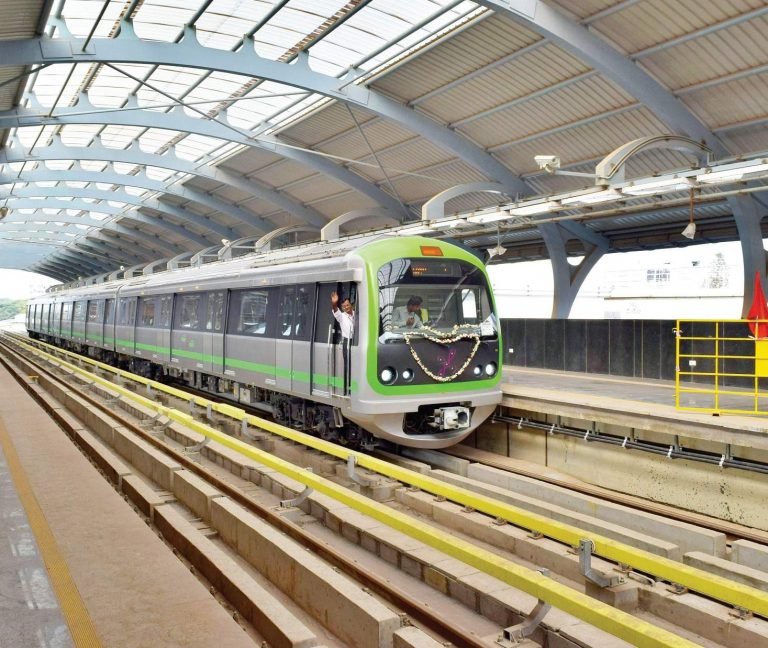
BENGALURU (Metro Rail News): The Indian major infrastructure company, AFCONS Infrastructure Limited has emerged as the lowest bidder (L1) for the Rs. 1262.33 Cr crore contract for construction of Underground Structure (Tunnels & station) from the south ramp (including) to Vellara Junction station (excluding) along with allied work and 3 No. of UG metro station in Reach -6 Line of Banglore Metro rail Project, Phase-2. However, Afcons has quoted Rs. 1526.33 crores to work on this project.

Bid Opening for Bangalore Metro Underground Contract RT-01

The Bangalore Metro Rail Corporation (BMRCL) has opened the Financial Bid for 3.655 km of Namma Metro Phase II, Reach 6 contract on September 26, 2019, at 11.00, where 3 bidders were found technically qualified out of 5 for the contract. These are AFCONS Infrastructure, Larsen & Toubro Limited, ITD. The L&T, ITD were found L2, L3 respectively.
The technical bid was submitted on May 28, 2019.

Name of the Bidders

  1. Afcons : Rs. 1526.33 cr. L1
  2. L&T: Rs. 1624.50 cr. L2
  3. ITD: Rs. 1684.36 cr. L3
  4. Patel-SMU JV: Disqualified
  5. HCC-GULERMARK JV: Disqualified

Scope of work

Contract BMRCL/PHASE-2/REACH-6/(R-6-CC02)-RT01/2019/41: Construction of Under ground Structure (Tunnels & station) from south ramp (including) to Vellara Junction station (excluding) (Cha. 7521.161) m to 11176.615 m) including allied work and 3 No. of UG metro station Viz, Dairy circle, MICO Industries and Langford town in Reach -6 Line of Banglore Metro rail Project, Phase-2.

About AFCONS

Afcons Infrastructure Limited is part of Shapoorji Pallonji Group which has a legacy of over 150 years in developing key infrastructure projects across the world. The company has significant experience and a strong track record in several infrastructure segments in India.

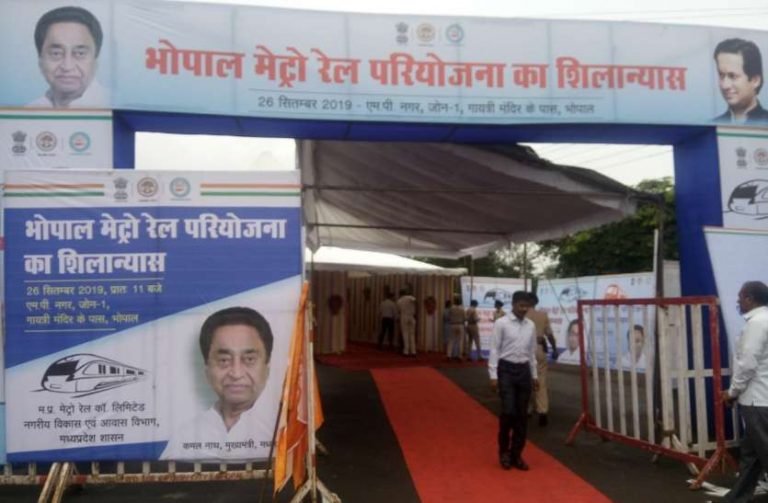
CM Kamal Nath lays foundation stone for Rs. 6941 Cr Bhopal Metro Project

BHOPAL (Metro Rail News): Madhya Pradesh Cheif Minister Shri Kamal Nath laying the foundation stone of Bhopal Metro Project today in the capital.

It will comprise two corridors of 27 km, the work will be done in two phases. The first phase is targeted to be completed by 2022.

Bhopal Metro Foundation Lays Banner at Hosangabad Road 3
Preparation for Bhopal Metro Foundation Stone

After a long wait, finally, Bhopal is going to get the gift of Metro train. Chief Minister Kamal Nath M.P. Near Gayatri Mandir in Nagar Zone I, he is laying the foundation stone of this project. However, it will still take about three years to run on the metro track.

Bhopal Metro Map
Bhopal Metro Map

27 km of Journey of Bhopal Metro


At present, 27.87 km of lines will be laid in the metro rail project in Bhopal. 2 corridors will be built in it. A corridor will be from Karond Circle to AIIMS with a length of 14.94 km. Another track of 12.88 km will be laid from Bhadbhada Chauraha to Ratnagiri Square. The metro will cost 6941 crore 40 lakh.

The 28 stations of Bhopal Metro

be the elevated section of 26.08 km in the Bhopal metro project, in which a total of 28 stations will be built. The underground section will be 1.79 km, which will have 2 stations. The first part is targeted to be completed by December 2022. The schedule of the metro train in Bhopal will be like Delhi. The train will run every five minutes and there will be a 30 second stop at each station.

Bhopal Metro Foundation Lays Banner at Hosangabad Road 2
Bhopal Metro Foundation Stone Banner

The train will be like Jaipur Metro


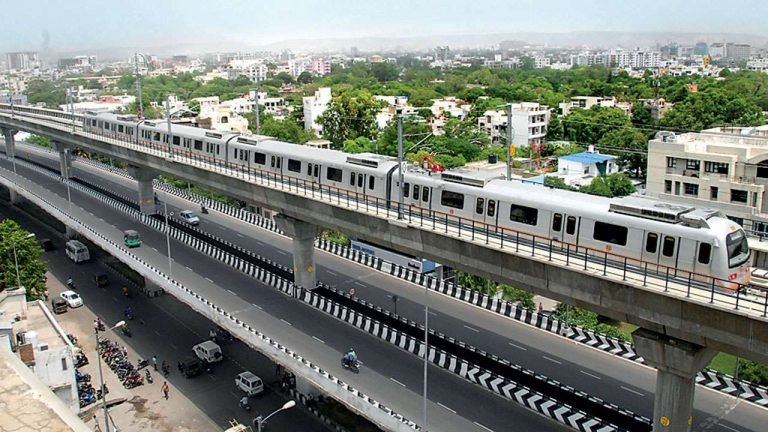
The Bhopal Metro will be like the Jaipur Metro. It will have three coaches, Coaches will also be increased as the number of passengers increases. A 6.22 km route will be built in the first phase. There will be 8 stations on this route and it will take 10 minutes to travel.
journey from AIIMS to Subhash Nagar Gate will be completed in 10 minutes. Subhash Nagar Underpass, Aayakar Bhawan, DB City, Sargam, Habibganj Station, DRM Office, Alkapuri and AIIMS Station have been placed on this route.

Bhopal Metro Foundation Lays Banner at Hosangabad Road
Bhopal Metro Foundation Stone

What has happened so far:

Tenders worth Rs 278 crore have been received for Bhopal Metro. Soil testing and design testing are done. Pile testing has also been successful for a load capacity in the ground. Pile testing was done at three locations below-ground. The technical background work of the metro has been completed.

Speed: 80 km per hour – the speed limit will be up to 90 km / h on the metra rail track. However, the Metro train will run at a maximum speed of 80 km / h. 

Fare: Not yet fixed for metro – The fare of Jaipur Metro is five to 15 rupees. However, the fare of Bhopal Metro is yet to be decided.

When will it run – the target of running the Bhopal Metro is 2023. However, the Chief Minister has asked to complete the work before the scheduled time.

The big question: will the traffic bottleneck be less? –  The population of Bhopal is around 25 lakh, while the number of vehicles in the city is 18 lakh 47 thousand. Such traffic pressure is high. Nearly two lakh vehicles pass through the peak hours of the morning and evening on this route, thus the introduction of Metra rail on this route will reduce the traffic load.

Today the traffic plan will change – will be applicable from 9 am to 1 pm. During this time, there will be traffic divert from Gurudev Gupta intersection towards Government Press and in front of Reserve Bank of India headquarters towards MP Nagar, Arera Hills, Ministry etc.

Congress did not do everything… I have never lived in the narrowness of the battle for credit. All the formalities of Bhopal and Indore metro were completed by the BJP government, only the foundation stone was left. Congress should lay its foundation stone, but do not say that they have done it in 9 months. – Shivraj Singh Chauhan, former Chief Minister


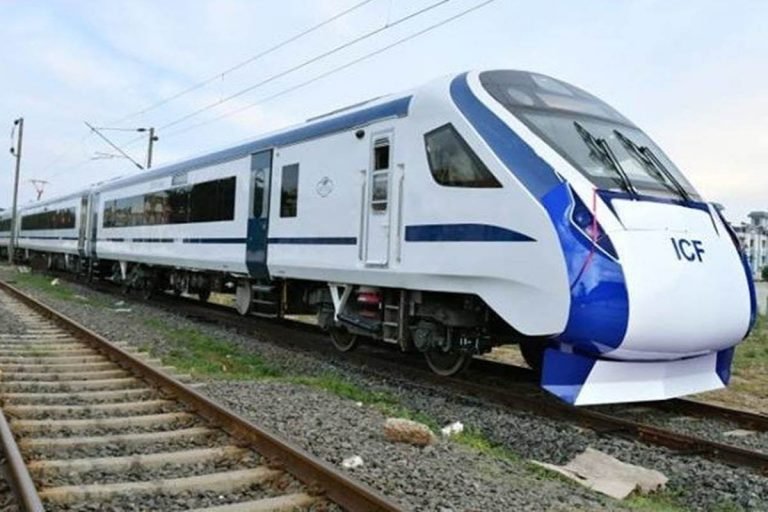
The much-awaited Vande Bharat Express plying from Delhi to Katra is due to start in October

NEW DELHI (Metro Rail News): To accommodate the growing number of devotees to Mata Vaishno Devi pilgrimage and to provide smooth and comfortable journey during the festival season, Indian Railways will roll out the Vande Bharat Express during the Navratri-Durga puja festival.

The second Vande Bharat Express train will start operations on the Delhi-Katra route in October. The first Vande Bharat Express (initially named Train 18) was launched on the Delhi-Varanasi route.

Union Railway Minister Piyush Goyal turned to Twitter on 18 September to inform people that the second Vande Bharat Express has completed its trial run to Vaishno Devi and it would be rolled out during the Navratri festival.

According to Railway Board chairman VK Yadav, the Vande Bharat train from Delhi to Katra will help capitalize on the high volume of traffic on the route.
buy levitra soft online https://gilbertroaddental.com/wp-content/themes/twentyseventeen/inc/en/levitra-soft.html no prescription
“For Mata Vaishno Devi devotees, the new Vande Bharat Express means a faster and more convenient mode of transport,” the chairman said.

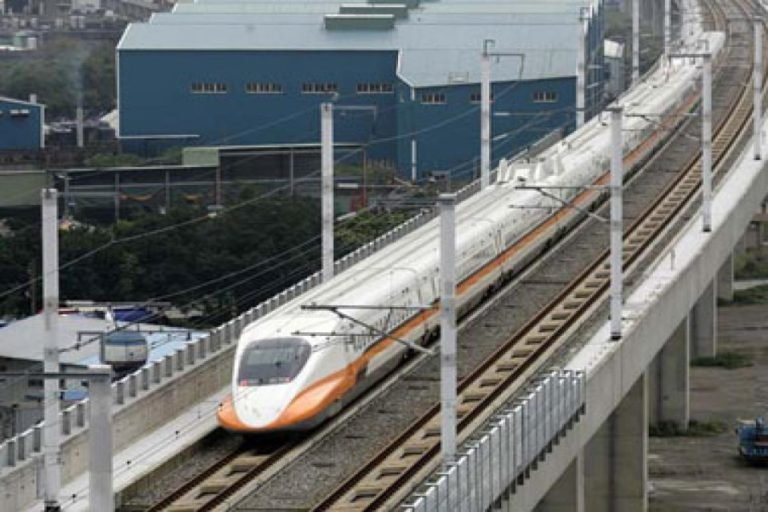
It is shaped like a bullet train, Vande Bharat Express is a fully air-conditioned train. Maximum speed: 130 km/hr. It will run from Delhi to Katra. Stoppages in-between will include Ambala, Ludhiana, and Jammu.
The distance between Delhi and Katra is 655 km. While superfast trains usually take 12 hours to reach Katra from Delhi, Vande Bharat Express will take only eight hours.

It will depart from Delhi at 6 am and reach Katra at 2 pm. Return journey from Katra at 3 pm and reach Delhi at 11 pm. Halt duration at junctions: Two minutes.

Vande Bharat train has been equipped with several mod-cons including automatic doors, comfortable seating, bio-vacuum type toilets, GPS-based audio-visual passenger information system, onboard hotspot WiFi for entertainment purposes, LED lighting and sufficient pantry space. To guard against stone-pelting cases, a special anti-spall film on train windows has also been provided. The train has a total of 16 coaches.

To cut costs Jaipur Metro Phase-2 to run on elevated tracks

JAIPUR (Metro Rail News): To reduce project cost, the Jaipur Metro Rail Corporation (JMRC) is mulling a proposal to keep the major portion of the 24-km Jaipur Metro Phase II (Ambabari to Sitapura) above the ground (elevated) and not below.

If the proposal gets the nod, the cost of the Rs 10,500cr project will be reduced by a whopping 40%.
buy viagra oral jelly online no prescription
A senior JMRC official said, “ To reduce costs, we have proposed to construct an elevated corridor on a major part of the route. While the construction cost of an elevated corridor is Rs 200 crore per km, it goes up to Rs 550 crore per km underground.”

In the detailed project report (DPR) prepared in 2014, it was mentioned that project required land worth Rs 875 crore and construction cost to the tune of Rs 9,500 crore. “It is believed, if the same amount of land is acquired for the project in today’s date, the JMRC would require Rs 1,600 crore.

Delhi Metro Rail Corporation (DMRC) officials said if the major part of the project is carried overground, it would require less amount than mentioned in the previous DPR. The estimated cost of acquiring land will be reduced to Rs 800.” The corporation has also suggested constructing a 10-km elevated corridor from SMS Hospital to Sansar Chand Road via MI Road.

 “If all the suggestions are approved and implemented, the entire project cost could be reduced to Rs 6000 crore. While construction cost will be Rs 5,200 crore, Rs 800 crore will be needed for land acquisition,” added an official. Officials also said the cost of the project could be brought down as GST on rolling stock (train) and other construction items had been reduced in the recent past.

“Suggestion to run three coaches, instead of four to cut costs, was also proposed,” added the official. The state will seek financial assistance from the Centre to construct the PhaseII corridor. Both the Centre and the state would invest 50-50% to develop the project. After the change in regime, the hope of launching the phase-II project has revived as Metro was the pet project of chief minister Ashok Gehlot in his previous tenure. The JMRC prepared its first DPR in 2011 during the Congress government’s tenure.

However, the project has not seen the light of day even after seven years. The official said the (JMRC) had already appointed Delhi Metro Rail Corporation (DMRC) to review the detailed project report (DPR) of Jaipur Metro Phase-II. “After terminating the contract of French company EGIS Rail SA, the corporation appointed DMRC for reviewing a revised DPR which will be submitted in December,” an official said.

In Phase II of Namma metro no need to buy tickets, smartphones to open fare gates

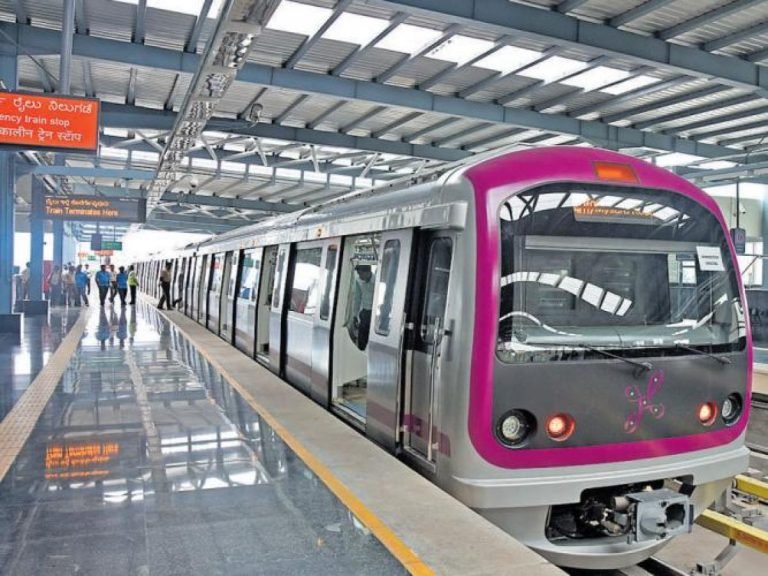
BENGALURU (Metro Rail News): Namma Metro commuters will no longer have to wait in long queues to buy tickets or even carry their smart card on phase II as the Bangalore Metro Rail Corporation Ltd (BMRCL) is working on a plan to introduce QR code-based tickets. The new arrangement will allow Metro users to buy tickets through a mobile app.

The app will display the QR code which could be tapped at the automatic fare collection (AFC) gates at the Metro stations with AGS Transact Technologies Ltd providing the digital payment solutions and automation technology, BMRCL reports stated.

The service provider will manage end-to-end AFC system (supply, installation, and maintenance) across Namma Metro’s 61 new stations in Phase II over three years, BMRCL said.

A senior BMRCL official told Deccan Chronicle, “QR code-based tickets will be introduced for smartphone users. Plans are afoot to introduce national common mobility card (NCMC) in Phase II, which will help in the transition from tokens and tickets to QR code-based tickets. Soon BMRCL commuters will feel the efficient and hassle-free experience.
buy aurogra online https://pavg.net/wp-content/themes/twentytwentyone/inc/en/aurogra.html no prescription

The AGS-MSI consortium AFC-based ticketing system will use a combination of open-loop smart cards, radio frequency identification devices and QR codes to collect fares from the users, minimizing the need for cash transactions.

Works on the 72-km Phase 2 lines such as Yelachenahalli-Anjanapura, Mysuru Road-Kengeri, RV Road-Electronics City, Byappanahalli-Whitefield and Nagasandra-BIEC section are progressing.

Ahmedabad-Mumbai bullet train project gets green signal by Gujarat HC

GUJARAT (Metro Rail News): On Thursday, the Gujarat high court gave green signal to the Ahmedabad-Mumbai High-Speed Rail or Bullet train project by rejecting a petition filed by 100 farmers challenging the land acquisition process by the state government.

A bench of Justices Anant Dave and Biren Vaishnav termed the process, followed by the Gujarat government for acquiring land for National High-Speed Rail Corporation, valid.

The court, however, has kept open the issue of higher compensation demanded by the farmers, who want to sell land as per the current market rate and not circle rate of jantri of 2011 as fixed by the Gujarat government.

Of the total 1,400 hectare land required for the 508-km-corridor between two western states, over 1,000 hectares fall in eight districts of central and South Gujarat.

Farmers from the south Gujarat districts of Surat, Navsari, Valsad, and Vapi challenged the legality of the acquisition process done as per Right to Fair Compensation and Transparency in Land Acquisition Rehabilitation and Resettlement Act (Gujarat Amendment 2016).

The new act has done away with social and environmental impact survey included in the original act passed by the center in 2013. The farmers claimed that acquisition should be done as per central law as the Ahmedabad-Mumbai High-Speed Rail project was one by the central government.

After the setback, the petitioners’ counsel, Anand Yagnik, said the farmers are likely to approach the Supreme Court against the order.

“The high court has observed that land acquisition going on by the Gujarat government is legally and constitutionally right,” said Anand Yagnik, farmers’ counsel, adding, “But the court has kept the issue of compensation open. So this cannot be called total defeat of the farmers. We are likely to move the SC.”

Yagnik said that of 6,900 affected farmers and 8,800 house owners, 4,000 haven’t taken any compensation so far and some 3,000 have accepted whatever was offered by the government.

“Along with 4,000 farmers who have rejected the government’s offer so far, rest, who have accepted but at the same time unhappy with the compensation amount, can also join the petition to be filed in SC,” Yagnik added.

The farmers’ lobby labeled the BJP government as anti-farmer. “By opposing the petition, the Gujarat government has proved that it is against the interest of the farmers,” said Darshan Nayak of Gujarat Khedut Sangh, the group that has been leading the cause.

The bullet train project, which will cost Rs 1.1 lakh crore, is touted to revolutionize the travel in India by reducing the time period to 2 hours from 8 hours to cover a distance of 500 km between Ahmedabad and Mumbai.

Financed by Japanese International Corporation Limited, the foundation for the project was laid on September 2017 by PM Modi and his Japanese counterpart Shinzo Abe. The project is expected to be completed by 2023.

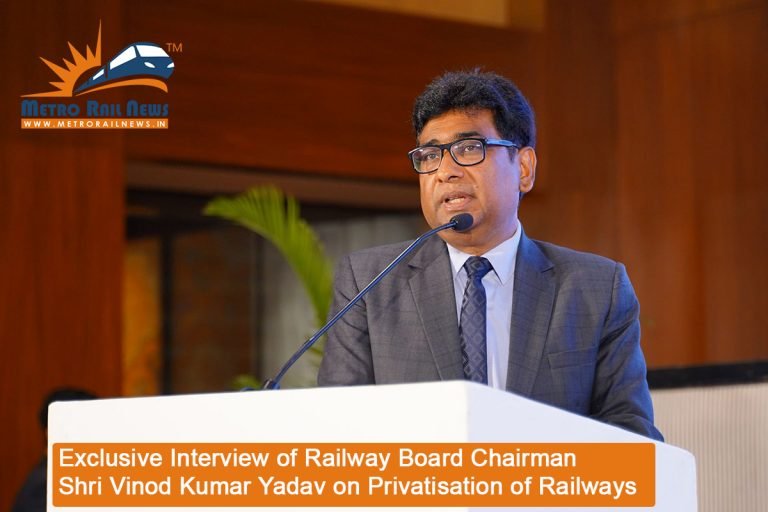
Exclusive Interview of Railway Board Chairman Shri Vinod Kumar Yadav

Shri Vinod Kumar Yadav, Chairman Railway Board, Ministry of Railways makes it amply clear that the Indian Railways is readying bidding documents to bring in private train operators. In an interview, Chairman Railway Board explains why the railways need private trains, and how and where these will be rolled out. Here are edited excerpts:

Why is the Indian railways planning to bring in private trains?

Mr. Yadav: By December 2021, we should be able to complete our dedicated freight corridors (DFCs) connecting Delhi and Mumbai, and Delhi and Howrah (Kolkata). At present, the permissible maximum speed for freight trains is 60 km/h. But the DFCs are being developed for 100 km/h. All this would mean that 90% of freight traffic on these routes will shift to DFCs.

Meanwhile, the Union cabinet has approved nearly Rs 13,000 crore to upgrade the Delhi-Mumbai and Delhi-Kolkata stretches for trains running at 160 km/h.

So, in four to five years, we will be able to run trains according to demand. There will be no waiting lists. But that will also mean that a large number of new trains will be required. The role of the private trains comes in here.

But the Indian railways can also manufacture more trains and fill the gap. Why do we need private trains?

Mr. Yadav: Private operators are expected to bring in their own trainsets, state-of-the-art technology and innovative ways of providing passenger amenities and finding new luggage-handling solutions.

To prove the concept of private train operations works, we recently handed over two luxurious rakes called Tejas to our own company, IRCTC. It is an experiment before allowing pure private operators. Now, IRCTC has announced value additions such as Rs 25 lakh insurance on every ticket, wheelchairs, home pick-up and delivery of luggage, etc. IRCTC can even pick you up from your home and drop you at the station. In Delhi and Lucknow (to be connected by the IRCTC-run train by October 4), passengers can also avail accommodation at retiring rooms.

How many private trains will there be? And where will they run?

Mr. Yadav: The Indian railways will have 150 private trains to start with. We are still working on the routes that will go for bidding. We will run these trains in the Delhi-Mumbai and Delhi-Howrah corridors and also in other viable stretches.

Will it be mandatory for private operators to manufacture coaches and locos in India?

Mr. Yadav: During bidding, we will give options — import, buy rakes from an Indian company or from us. They can get coaches on lease too. But our expectation is that new types of trainsets will arrive.

How much investment are you expecting from private players? When will these trains start running?

Mr. Yadav: We can’t give the exact investment numbers as of today. These are being worked out. We are hoping private trains should run by 2023-24. And for that to happen, the bidding process needs to be initiated soon.

But who will be the arbitrator if the railways fail to honour its commitments?

Mr. Yadav: When private train operators are brought in, we will need a regulator. The regulator will take a call on disputes, including those on routes and fares.

But the railways has faced criticism for not being able to successfully run private container trains, which have been around for 13 years.

Mr. Yadav: We regularly sit down with private container operators. Their problems are being sorted out. The operators feel they are unable to compete with Container Corporation of India. It is a railway PSU and a big player.

You have also decided to corporatise production units despite opposition from workers. Why?

Mr. Yadav: The corporatisation of production units is essential because we will need more coaches and locomotives fit for 160 km/h. Once more autonomy is given, our production units will bring in new technology and produce rolling stocks for internal consumption and for export. There is a huge demand for rolling stocks from Sri Lanka and Bangladesh. Australia may also show interest. It has already imported some coaches.

We are debating whether we should have one holding company or two to club our eight production units. One argument is that we should have two PSUs — one for locos and one for coaches.

But trade unions are opposed to private trains. How will you deal with that situation?

Mr. Yadav: Before taking a final decision, we will consult all stakeholders, which include trade unions. We will ensure the interests of railway employees are fully protected.

(This Interview first appears in ET)

This interview to be covered in Metro Rail News October issue. Click here to subscribe

By November Elevated Metro Rail corridor in north Chennai to be completed

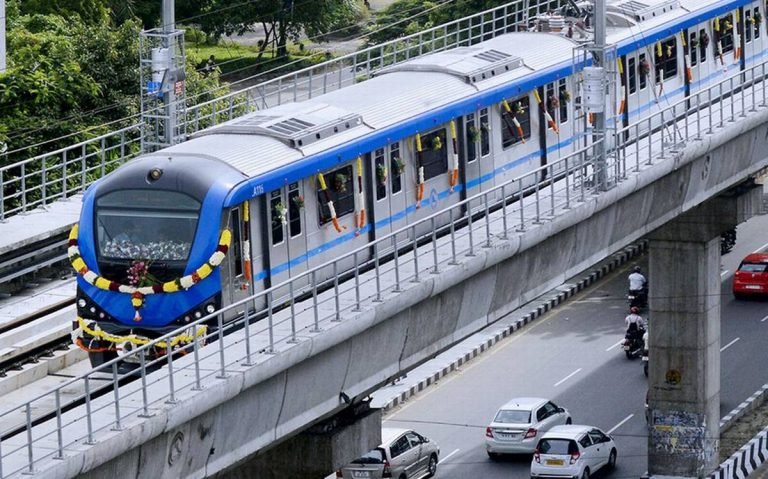
CHENNAI (Metro Rail News): A CMRL official said, the construction of elevated corridor for the Metro Rail route in north Chennai will be completed by November. 

The nine-km phase-1 Metro Rail extension connects North Chennai with the rest of the city. The elevated corridor runs for about seven km from Wimco Nagar to Tondiarpet while the remaining route up to the Washermenpet station is underground. 

The official said, ‘’The construction of elevated corridor has neared completion and viaducts will be laid by November. Traffic on the Thiruvottriyur High Road on the Tondiarpet stretch will be made two-way immediately after that’’. 

Currently, vehicles going towards Tollgate are diverted from TH Road to the narrow Arunachaleshwar Kovil Street. During rush hour, the street is crammed with share autos and buses apart from private vehicles.

Almost all important buses such as 6D (Thiruvanmiyur to Tollgate) and 159 A (CMBT to Thiruvottriyur) ply through the route.

The diversion has also moved the Lakshmi Kovil bus stand which has caused discomfort to commuters.  Moreover, hawkers and street-vendors have encroached on one lane of the TH Road ever since it was made one-way. The condition of the road to have become worse in recent times. 

Pon Vel, a share auto driver, said traffic would ease if the road was restored to the two-way system. However, he feared a decrease in patronage for share autos once Metro train started functioning. 

The Metro Rail corridor runs along the bus and share autoroutes in north Chennai. Also, the stations are expected to be kept at prime spots. For example, in Thiruvottriyur, the station is placed just near the bus terminus while it is the same at Tollgate as well. 

In Tondiarpet, it is located very close to popular hospitals and government offices and in Old Washermenpet, it is placed near the popular Thegaraya College and Maharani Theatre.

Meanwhile, CMRL officials said the phase-1 extension should be operational by June next year. The Metro line connects two poles 31 km away — from Wimco Nagar to Chennai  Airport.
buy flagyl online https://herbalshifa.co.uk/wp-content/themes/twentytwentytwo/inc/patterns/en/flagyl.html no prescription

Namma Metro timings extended for India vs South Africa T20

BENGALURU (Metro Rail News): In view of the India vs South Africa ICC T20 clash scheduled to be held on Sunday, the BMRCL has extended the metro operations by 30 minutes during the night.

The last service from the four metro stations will depart at 11.30 pm instead of the regular time of 11 pm. The departure from Kempegowda Metro Station will be at 11.45 pm.

Bangalore Metro Rail Corporation Limited (BMRCL) has also fixed Rs 50 base fare to travel from Cubbon Park to any metro station after 10 pm, except for those traveling by smart cards. Paper tickets will be provided to avoid the rush.
buy hard on oral jelly online https://myhst.com/wp-content/themes/twentytwentytwo/inc/patterns/en/hard-on-oral-jelly.html no prescription


Kanpur, Agra district bodies to share Metro expenditure

LUCKNOW (Metro Rail News): Kanpur and Agra district authorities will have to shell out Rs 350 crore and Rs 200 crore respectively for Metro projects in the two cities.

In a meeting chaired by principal secretary, housing and urban planning, Deepak Kumar it has been decided that the two cities will have to contribute a small percentage of the total expenditure since they “would be benefitting from Metro corridor”.

The estimated cost of the Kanpur Metro Rail project is Rs 16,975 crore of which the state government will provide Rs 1,332 crore, the city development authority will contribute Rs 100 crore while UPSIDC will pay Rs 50 crore in the first phase.

The first phase of the project will come upon a 23.78-km long stretch which will connect 22 key areas of the city. The estimated cost of the Agra Metro Rail project is Rs 12,901 crore of which Rs 1,009 crore will be provided by the state government and Rs 200 crore will have to be arranged by city authorities.

The state housing development board’s share is Rs 117 crore while the Agra Development Authority will contribute Rs 57 crore. UPSIDC will have to pay Rs 26 crore. Earlier this month, the government had transferred Rs 100 crore to each of the cities from the initial budgetary provision of Rs 175 crore for each of the projects.

Work on the alignment of the Kanpur metro has already begun and an official said that they were targeting to start work by October. “We have already identified land and procedure for its transfer to Kanpur Development Authority has already started,” he said.

The detailed project report of the Agra Metro has already been approved by the Centre and directions have been issued to expedite work. Land survey for the Rs 8,415-crore project has also commenced. Officials said soon the government would initiate the process for the borrowing of funds for both the projects.