Home Blog Page 608

Telangana High Court Chief Justice flags off Hyderabad Metro shuttle services

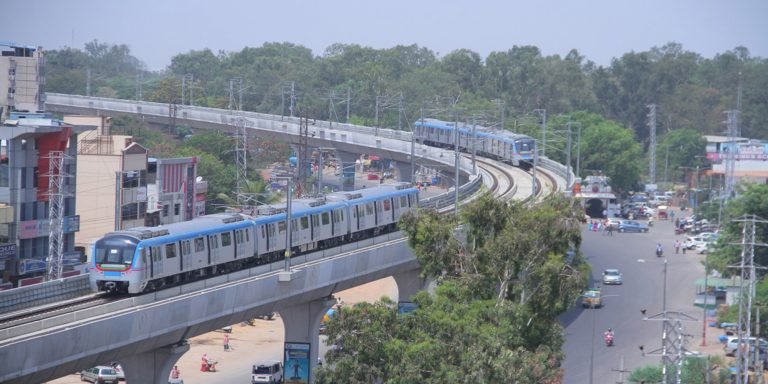
HYDERABAD (Metro Rail News): On Monday, Telangana High Court Chief Justice Raghvendra Singh Chauhan flagged-off shuttle services offered by the Hyderabad Metro Rail Limited (HMRL), between the high court and the MGBS Metro station from the high court premises.

The shuttle service will be available from Monday to Saturday from 9 am to 6 pm at an interval of 15 minutes. The services will be free for the first week, and thereafter, passengers will be charged `15. 

Speaking on the occasion, the chief justice asked HMRL managing director NVS Reddy to increase the shuttle service frequency from MGBS Metro Station to the high court during peak hours and also requested him to introduce similar shuttle services to all other district courts located in the twin cities from the nearest Metro station.

The Chief Justice also underlined the importance of the public transport system as it will help reduce traffic congestion and pollution level and advised the MD to give wide publicity, put up signboards, etc. so that people are aware of the facility.

On Sundays Metro Rail mulls 50% fare discount

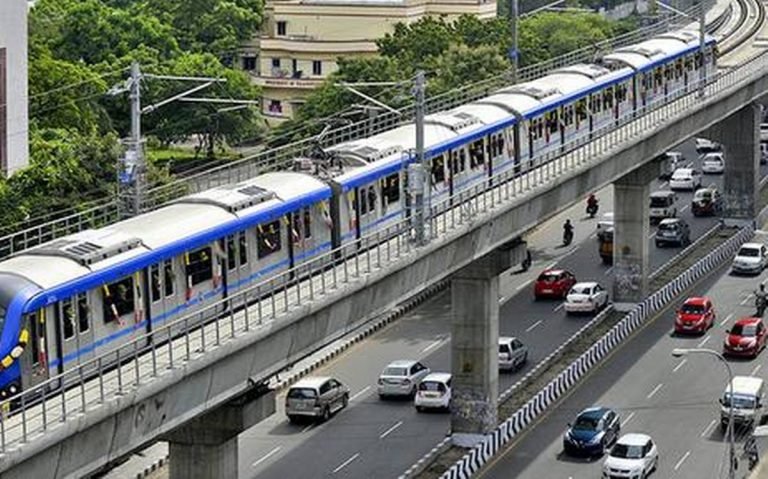
CHENNAI (Metro Rail News): In a bid to boost ridership, Chennai Metro Rail is planning to give a 50% fare discount on Sundays.

Sources told, “A combination of plans is being worked out. It may either be a 50% discount on Sunday alone or on Sundays and other public holidays. It could be for a few months or up to one year. After carefully deliberating on what may work out to be the best option, the proposal will be sent to the board of Chennai Metro Rail”.

One of the main reasons behind the proposal is that while the ridership has been growing consistently during weekdays, it is very poor on Sundays and public holidays.

Another official said “On weekdays, about 1.15-1.20 lakh people travel by Metro Rail. But on Sundays, only 60,000-70,000 people use the system. If this plan is implemented, there is a possibility that more people will use Metro Rail”.

A board member told that the proposal could be considered if it will prove beneficial to the commuters.

Sources said that they have started running feeder services at many stations. For instance, there is a service from Government Estate and AG-to the Marina beach. Since a large number of people gather at the Marina on Sundays and other public holidays, a 50% discount will draw more crowds to the Metro.

Last year, when Metro Rail offered a 40% discount for one week to test if more people prefer it when fares are reduced, the ridership grew by 67%.

For Agra, Kanpur metro rail projects Niti Aayog assures funding

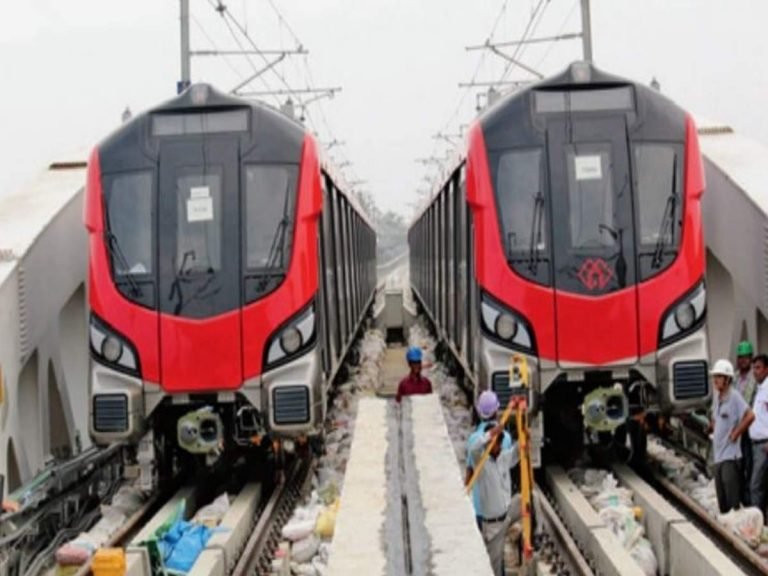
LUCKNOW (Metro Rail News): On Monday, The government think tank, Niti Aayog, assured the UP government to expedite the funding for construction of metro rail projects in Agra and Kanpur. The decision was taken at a high-level meeting between Niti Aayog vicechairman, Rajiv Kumar and a delegation led by cabinet minister Siddharthnath Singh, principal secretary (Micro, small and medium scale industry) Navneet Sehgal and managing director of Lucknow Metro Rail Corporation Kumar Keshav.

After the meeting, Singh said that the vice-chairman has assured to expedite the clearance process of the funding for the ambitious project in the two cities.

The Aayog has assured the state government of forwarding its recommendation to the department of economic affairs very soon,” Sigh told. Singh, who is also UP government’s spokesperson, said that the European Union investment Bank is keen to fund both the projects.

The estimated cost of the Kanpur metro rail project is Rs 16,975 crores of which the state government will provide Rs 1,332 crore. The Kanpur Development Authority will have to shell out Rs 100 crores while UP State Industrial Development Corporation will have to pay Rs 50 crores in the first phase.
buy augmentin online www.adentalcare.com/wp-content/themes/medicare/fonts/engl/augmentin.html no prescription

Likewise, the estimated cost of the Agra metro rail project is Rs 12,900 crores, of which Rs 1,009 crores would be provided by the state government and Rs 200 crores will have to be arranged by the local bodies. Earlier this month, the state government had transferred Rs 100 crores each to both the cities from the initial budgetary provision of Rs 175 crores.

Deposit plastic bags, bottles at metro stations, get a jute bag

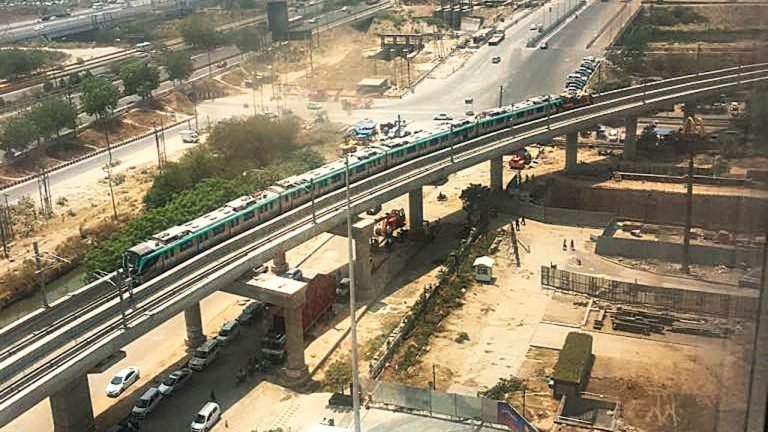
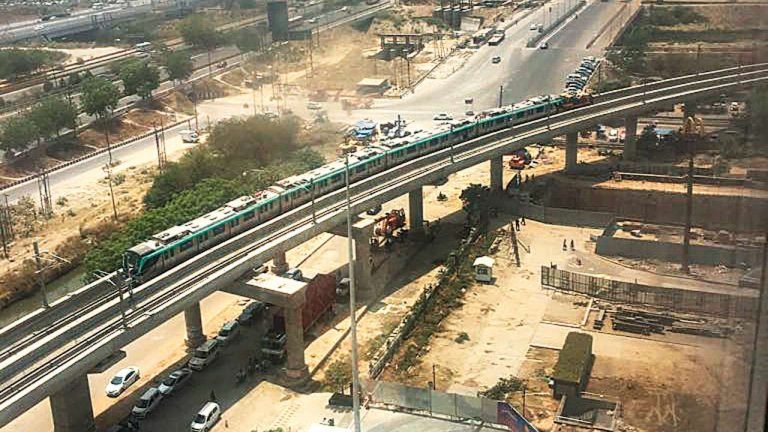
NOIDA (Metro Rail News): Noida Metro Rail Corporation (NMRC) will soon let passengers deposit plastic bags and bottles into disposal machines at metro stations and get jute bags for free.

The metro stations will also install disposal machines or kiosks where one can put the bottles, which will then be crushed into tablets.

These tablets or granules will further be recycled and used for various purposes such as making roads. Officials said that people will also get shopping coupons for putting more number of bottles in the kiosk.

“This is an initiative to ensure that maximum plastic waste is recycled. We hope to set them up within a week to coincide with the Prime Minister’s national ban on single-use plastic. Plastic bottles are a huge menace, especially when they reach the landfill. We had seen such a machine at an airport and have asked a private vendor to set it up at some of the metro stations,” said P D Upadhyay, executive director, NMRC.

The stations where these vends will be set up and a deadline has not been finalized yet. The jute bags, however, are ready and counters for their distribution will be set up within this week at all metro stations of Aqua line.

Officials said that a jute bag will be given in exchange for 10 plastic bottles or 20 polythene bags to commuters using the metro. “We will have the counters within the payment area. Unlike the cloth bags usually available, we have ensured that these bags are sturdy enough to be reused multiple times for vegetable or grocery shopping,” said Upadhyay.

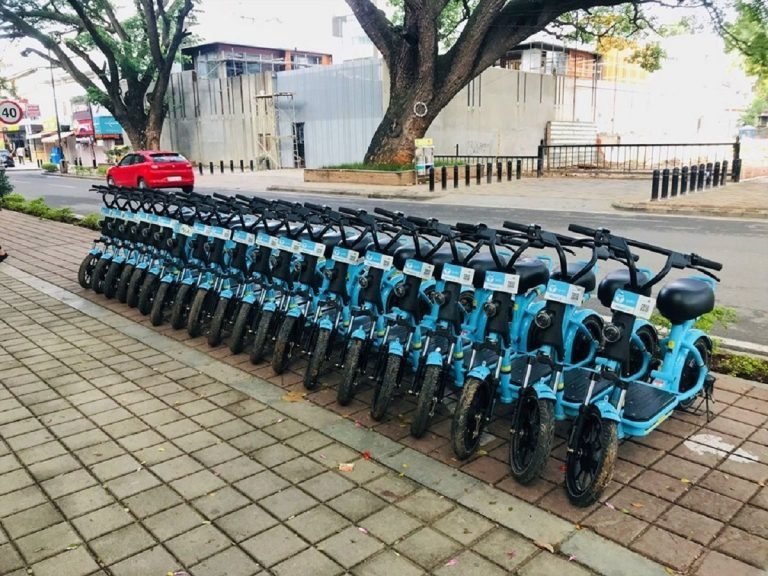
Adding to its green initiatives, the NMRC is also in the process of setting up electric vehicle charging stations at some of its metro stations and will soon have electric bikes and cycles for last-mile connectivity from the metro stations. “We have finalized the stations where these will be set up and an agency will provide the electric cycles and set up parking bays. The agency for providing the e-bikes will also be finalized soon,” added Upadhyay.

Dwarka-Najafgarh corridor launch this Friday

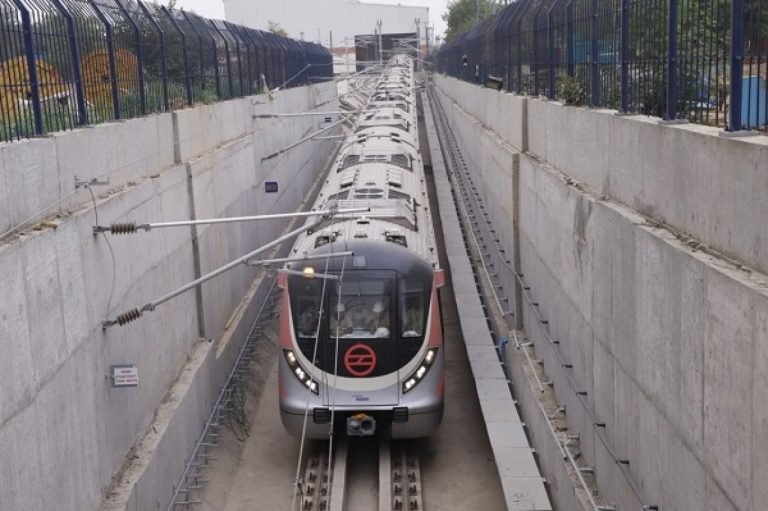
NEW DELHI (Metro Rail News): Delhi Metro Rail Corporation’s (DMRC) Dwarka-Najafgarh corridor is all set to open soon. The over 4.2 km-long Grey Line of the Delhi Metro will connect urban village area of Najafgarh to the rapid transit network.

The grey line will connect Dwarka sub-city with the locality of Najafgarh through Nangli, reducing the congestion in this locality. The Dwarka – Najafgarh corridor of Delhi Metro will be formally flagged off on 4th October 2019 according to release by DMRC.

The flagging off ceremony will take place at Metro Bhawan at 12:15 PM and passenger services on the section shall commence from 5 pm on the same day. The corridor consists of three stations—Dwarka (interchange with Blue Line), Nangli and Najafgarh.

“This corridor called Grey Line is a standard-gauge section and out of the 4.295 km, 2.57 km is elevated and 1.5 km underground. With the opening of this section, the Dwarka metro station is all set to emerge as an interchange facility that will connect the sub-city with the locality of Najafgarh” said by Anuj Dayal, executive director, corporate communications, DMRC.

With the opening of this section, the Delhi Metro network will expand to 377 km and 274 stations. Delhi Metro’s gray line corridor does not have platform screen doors (PSD) facility and the reason for that is a low volume of traffic assessed for the corridor, according to a report.

Delhi Transport Minister Kailash Gahlot meanwhile tweeted appreciating the efforts put in by the DMRC to make it operational despite many challenges.

Commissioner of Metro Rail Safety (CMRS) Janak Kumar Garg had accorded the mandatory approval for starting passenger operations after inspecting the corridor for safety on Wednesday.

An 80-meter passageway connects the old Dwarka station of the Dwarka Sector 21 to Noida Electronic City/ Vaishali corridor or the Blue Line with the new station on the Grey Line, which has come up as part of the extension to Najafgarh. After the Dwarka Sector 21 station, now Dwarka will become the second interchange facility in the Dwarka sub-city.

Grey Metro Line: Number of metro stations

  • Dwarka
  • Nangli
  • Najafgarh

The Dwarka section will be the interchange with Blue Line.

Delhi metro grey line: Other information

  • The peak hour frequency, as per the information, will of 7 minutes and 30 seconds. The total travel time on these three stations will be of 6 minutes and 20 seconds
  • There will be a total of 3 metros on this line and the fourth one will be planned
  • As per the information available, the line will be the Delhi Metro Rail Corporation will extend the by another 1.18 km till Dhansa Stand, which is slated for completion by December 2020.
  • The new corridor does not have platform screen doors (PSD) facility and the reason for that is a low volume of traffic assessed for the over 4.2-km corridor
  • On all the three metro stations, solar panels will be installed.

Bookings open for Delhi-Katra Vande Bharat Express

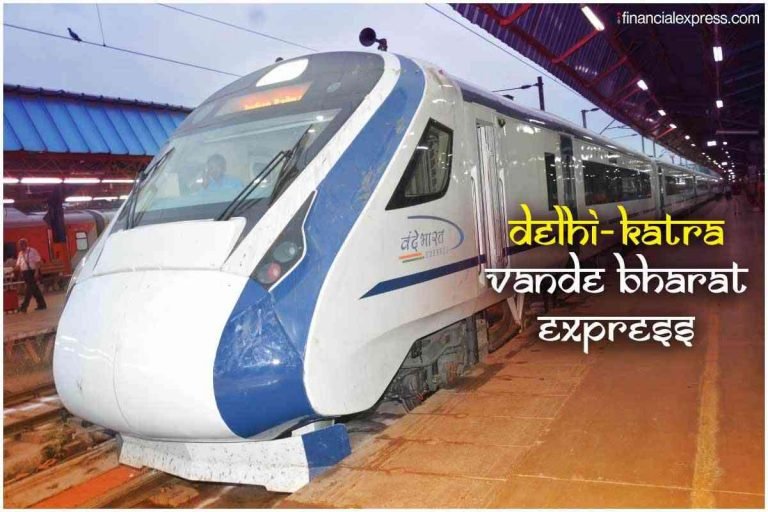
NEW DELHI (Metro Rail News): Bringing cheer to people planning to visit the Vaishno Devi shrine near Jammu, Indian Railways have opened bookings for the high-speed Vande Bharat Express that will ply between Delhi and Katra from the coming October 5.

Bookings have opened on the IRCTC website www.irctc.co. for the indigenously built Train 18, which has been rechristened as Vande Bharat Express. It will be flagged off by Home Minister Amit Shah on October 3 and will be available for regular passengers from October 5.

The railways have not applied the dynamic pricing principle for its fares on the new train. The minimum fare for traveling between New Delhi to Sri Mata Vaishno Devi Katra station in the chair car is Rs 1,630, while the fare for the executive chair car is priced at Rs 3,015.

The Vande Bharat Express will run on all days of the week except Tuesday and will cut the travel time between Delhi and Katra to just 8 hours, as compared to 12-14 hours required earlier to cover the distance of 655 km.

The train will depart from the New Delhi Railway Station at 6 a.m. and will reach Katra at 2 p.m. It will commence its return journey on the same day from Katra at 3 p.m. and reach New Delhi at 11 p.m.

Railway officials here pointed out that the train would be run at a maximum speed of 130 kmph on the Delhi-Katra route with three stops – Ambala, Ludhiana, and Jammu Tawi -before reaching Katra.

According to them, the decision to run the indigenously built high-speed train between Delhi and Katra, the base for the trip to Vaishno Devi, was taken following the success of the Vande Bharat Express currently plying between New Delhi and Varanasi.

Prime Minister Narendra Modi had flagged off the first Vande Bharat Express on February 15 this year. The official said the route was identified by the Railway Board in order to capitalize on the high traffic volume on account of the Vaishno Devi temple pilgrims.

The Train 18 manufactures, Integral Coach Factory (ICF), have made changes to the existing design of the train. “To avoid damage due to stray cattle, the train has been equipped with a sturdy aluminum-clad nose cover.

And to guard the window shields against stone-pelting, a special film on windows has been provided,” a railway official said. More space has been provided to store meals for passengers.

Besides the changes in the exterior and interior designs, the ICF has added a slew of modern features like adjustable seats, improved washbasins, automatic doors, WiFi and infotainment system, among others.

For Noida Metro Commuters NMRC to Introduce e-Cycles, e-Bikes

NOIDA (Metro Rail News): After Delhi Metro Rail Corporation (DMRC)’s decision to equip the metro stations with e-cycles, the Noida Metro Rail Corporation (NMRC) has also decided to follow the league. In a bid to improve last-mile connectivity, the NMRC is planning to explore various multimodal options at the Aqua metro line.

A senior NMRC official said the board said that it will soon introduce e-bikes and cycles for the public. In addition, they will also have identified spots for parking lots near metro station and housing societies.

We have identified spots for parking of electric bikes and cycles at the stations and other locations in the city. We are tying up with housing societies and colleges in Noida for providing such parking spaces and the Noida Authority will soon come out with bids for them. We will also improve the shuttle and feeder bus network soon, said by Ritu Maheshwari, chairman of the NMRC in an official statement.

The decision was passed in a board meeting on Tuesday, September 24. While parking lots near nine metro stations have been identified, NMRC has also chosen about 50 locations around housing societies for parking. For the e-cycle sharing system, NMRC has signed an agreement with a private company.

This company will be providing 10 cycles at eight metro stations, including sectors 51, 50, 76, 148, Pari Chowk, Knowledge Park 2, Alpha 1 and Delta 1. More cycles might be added later.

The cycles would be fitted with GPS so that they are not stolen. They will be two proposed rates for hiring the cycles. It is Rs 5 for five minutes or Rs 15 for half an hour, whereas Re 1 will be charged for every additional minute in both cases. For e-bikes, NMRC has identified five stations, including sectors 51, 76, 142, Alpha 1 and Delta 1. NMRC is still in the process of finalizing a private company to run this system.

NMRC plans ‘Metrolite’ in Noida to reach interior areas

NOIDA (Metro Rail News): Considering the increasing cost of construction, Noida Metro has decided that all future development of the metro rail network in the city will be metrolite. This is because metrolite a light urban rail transit system with smaller coaches is nearly 50% cheaper as compared to the normal metro network, officials said.

According to Noida Metro officials, the metrolite will be more useful as the demand will be optimized by increasing its frequency during peak hours and reducing it during non-peak hours.

Moreover, its tracks are narrower than the standard gauge used in most of the existing normal metro lines and there is no overhead extension for wiring, making it safer. And metrolite can be built on the surface as well as elevated track.

“The Centre had proposed that we go for a metrolite system as it’s less cost-intensive. A metrolite system is economically more viable as the overall cost of the entire system is almost half of the normal metro network,” PD Upadhyaya, executive director of NMRC.

Currently, the cost of constructing the metro is around Rs 200 crore per km, while the metrolite system is expected to cost around Rs 60-100 crore, depending upon the infrastructure requirement.

Though the carrying capacity of a metrolite coach is anywhere between 70 and 300 which is much less as compared to the current metro coach that can carry 1,034 people at a time, Upadhyay said, “it can be managed by increasing frequency during peak hours and reducing headway during non-peak hours”.

“It would be better for us often we need to operate a metro even if it’s going empty. In such cases, the cost of operating the metrolite will be much less than operating a normal metro,” he said. According to Upadhyay, the metro network may also be at grade at some places in Noida as the metrolite can be made at the ground level as well be elevated. The metro system has been either elevated or underground so far.

“Noida has wide road space where we can use the green belt and wayside for the metrolite track, unlike smaller cities with narrow roads. We just need to create a crossing like a small bridge or an underpass near intersections to avoid mixing with usual traffic.

The surface system will be very convenient for people as it will be easily accessible. There will be no need for an extensive platform and security checks,” the NMRC executive director said.

The metrolite network will need entirely separate infrastructure, including a separate track network, rolling stock (coaches), electrical and civil work, and separate platforms. The problem, however, is that an interchange station will have to be made to connect the existing metro lines with the new metrolite lines.

The NMRC has also suggested that the proposed metro lines from Pari Chowk to Jewar also be converted to a metrolite system, which will also mean another interchange requirement at Pari Chowk station.

Hyderabad Metro line extension to Raidurg gaining pace

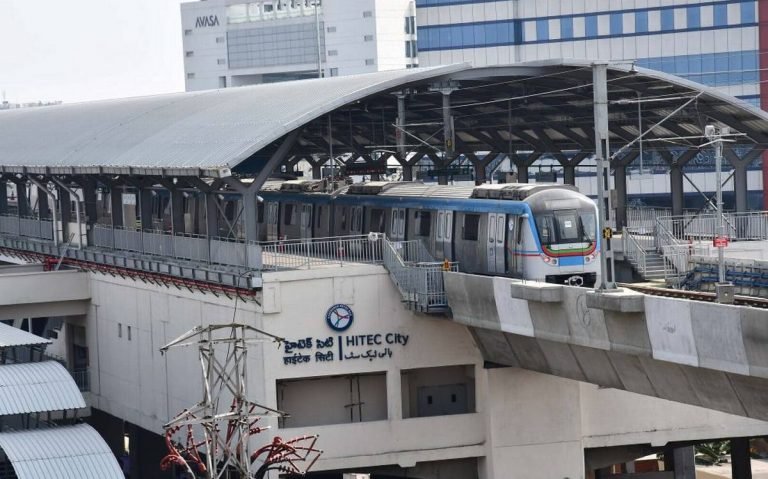
HYDERABAD (Metro Rail News): The extension of Hyderabad Metro Rail services till Raidurg (Mindspace) is gaining pace with the Chief Electrical Inspector for Hyderabad Metro Rail (HMR) project DVS Raju inspecting the 33V/415V Raidurg indoor substation here on Friday.

He also inspected balance works of Overhead Electric Traction (OHE) of HMR project from Hitec City to Raidurg. The Auxiliary Substation (ASS) and Overhead Electric Traction are a part of Corridor – III (Nagole to Raidurg) of the HMR project.

The inspection was conducted for according sanction for energization of ASS and OHE, which will facilitate the testing and commissioning activities of rail systems such as signaling, telecommunication, trial run and automatic fare collection etc on the sector.

After the inspection, DVS Raju said commissioning of the ASS and OHE would boost the progress and hasten the completion of rail system related works between Nagole and Raidurg of Corridor III.

L&T MRHL MD and CEO KVB Reddy said, “This is an important development for Corridor III. With the commissioning of Raidurg station and OHE between Hitec City and Raidurg will complete energization of the entire Corridor III,”.

BMRCL to finalize 2 firms for Red Line underground section

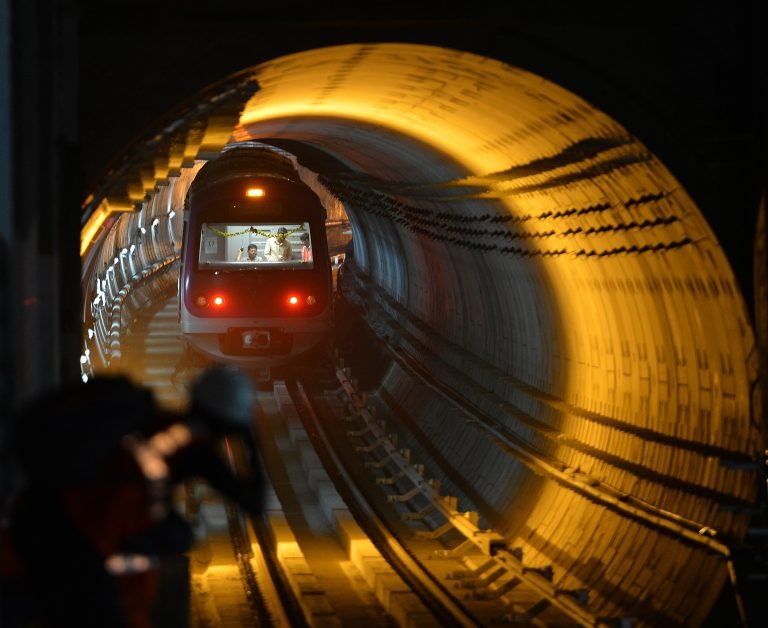
BENGALURU (Metro Rail News): Decks are likely to be cleared to take up work on the city’s longest underground Metro corridor between Dairy Circle and Nagawara (14km), with the Bangalore Metro Rail Corporation Ltd (BMRCL) set to finalize two underground packages along the Red Line (Gottigere-Nagawara) in a few weeks. On the Red Line, the Gottigere-Swagath Road Crosssection is elevated, while the Dairy Circle-Nagawara stretch runs underground.

Sources said ITD Cementation India Ltd has emerged as the lowest bidder for construction of the 4.59km underground section with four stations: Tannery Road, Venkateshpura, Arabic College and Nagawara.

The firm reportedly quoted Rs 1,771.3 crore in the tender. Other firms — Afcons Infrastructure Ltd and L&T Construction — quoted Rs 1,783.8 crore and Rs 1,790.1 crore. Similarly, Afcons Infrastructure emerged as the lowest bidder for the 3.7km underground section with three stations: Dairy Circle, MICO Industries and Langford Town.

While Afcons Infrastructure quoted Rs 1,526.3 crore, L&T Construction and ITD Cementation India quoted 1,624.5 crore and Rs 1,684.4 crore. BMRCL sources said a formal letter of acceptance (LoA) will be issued to the two firms after evaluation of financial bids. When contacted, BMRCL managing director Ajay Seth said: “We have not finalized the tender yet. NOC from EIB and approval of project management committee will be obtained”.

In February, Larsen & Toubro was awarded the bids for two other underground sections along the corridor: Vellara Junction-Shivajinagar (2.7km) and Shivajinagar-Pottery Town (2.8km). It had quoted Rs 1,329.1 crore and Rs 1,299.2 crore, respectively, for the two sections.

The firm will build five stations, including Vellara Junction, MG Road, Shivajinagar, Cantonment and Pottery Town. In June, BMRCL and Asian Infrastructure Investment Bank (AIIB) signed an agreement for financial assistance of $335 million (about Rs 2,359 crore) for this underground section.

BMRCL has set 2024 as the deadline to commission the section. Metro staff allege irregularities in roof work at stations The Bangalore Metro Rail Employees Union (BMREU) alleged irregularities in the installation of rainwater flashing sheets at several stations on the Green Line.

With many stations leaking during the rainy season, BMRCL is installing these sheets to seal building joints from water seepage and prevent leaks due to expansion and contraction of materials. The union, however, alleged that work is being executed without following tender procedures.

“BMRCL is installing rainwater flashing sheets in stations like Rajajinagar, Yeshwantpur, Peenya and Sandal Soap Factory for Rs 2 crore. They are engaging contractors in piece work (less than Rs 5 lakh), with each costing between Rs 4.5-4.9 lakh. This is to evade tender procedures, which are mandatory for all work above Rs 5 lakh,” said BMREU vice-president Suryanarayana Murthy.

He alleged that some of the contracts were awarded to relatives of some employees. BMRCL managing director Ajay Seth said they will look into the matter.