Home Blog Page 576

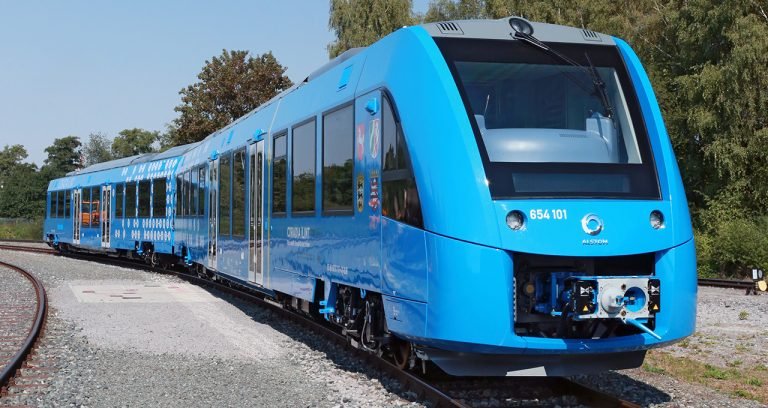
Indian Railways to inaugurate Hydrogen-powered Train

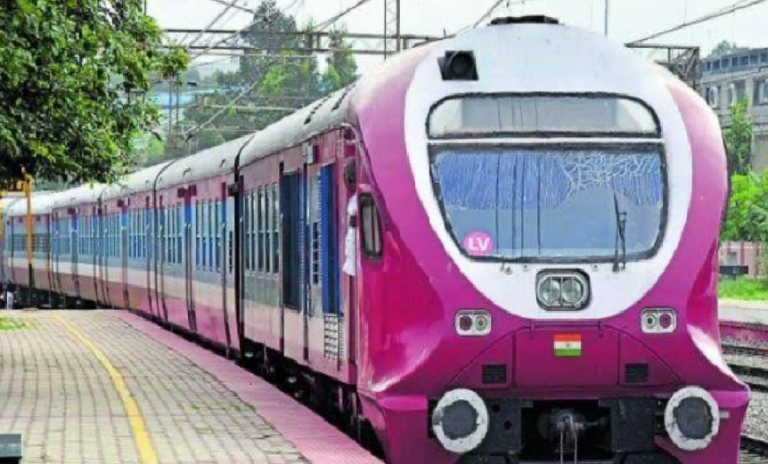
NEW DELHI (Metro Rail News): India Railways is working on the development of a Hydrogen-powered suburban train and has floated an Expression of Interest for industry participation, rail minister Piyush Goyal said.

“Hydrogen is planned to be sourced from industry in India. Hydrogen production is not planned by Indian Railways. The decision on deployment of hydrogen-propelled trains for long-distance routes will be based on the development of the technology,” Goyal said in a written reply in Parliament.
buy clomid generic rxxbuynoprescriptiononline.net/clomid.html over the counter

TATA Motors has developed seven hydrogen fuel cell buses which comply with International Safety Standards of Hydrogen Safety. Also, the International Standards Organisation, Society of Automotive Engineers and United Nations have published stringent safety standards for use of hydrogen in transport vehicles.

“Type test of these vehicles have shown that Hydrogen as a transport fuel is safe to handle and use. Similarly, safety aspects concern for passengers shall be an integral part of the technical specifications of the hydrogen-powered trains,” the minister said.

The move is part of the railway’s efforts at greening its fuel use. Indian Railways has already fitted solar panels on rooftop of Diesel Electric Multiple Unit (DEMU) trains of capacity 4.5 Kilowatt for catering to hotel load.

Also, the blending of high-speed diesel with 5 per cent Bio-diesel has also been started for railway locomotives. The transporter has also started pilot projects involving running DEMU trains with Compressed Natural Gas (CNG) over 18 trains.

L&T-Power China JV bags contract worth USD 509.1 million from Etihad Rail

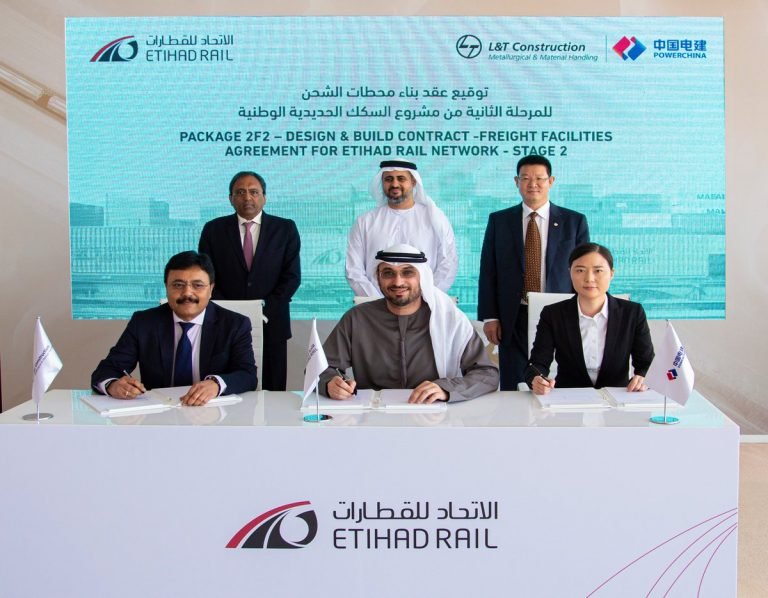
ABHU DHABI, UAE (Metro Rail News): Etihad Rail ( UAE’s National Rail Authority) has awarded a contract worth USD 509.1 million (AED 1.87 billion) to a consortium of Larsen & Toubro Limited (L&T) and Power China International for the formation of Package A of Stage 2 of the national railway network. The 139 km long distance Package A is part of the 1,200-kilometre national rail network of UAE.

The agreement contract was approved on 30 January 2020, by Shadi Malak, Chief Executive Officer, Etihad Rail; Anupam Kumar for Larsen & Toubro Limited and Hong Lee for Power China International (PCI), in the presence of S N Subrahmanyan, Managing Director, President, L&T and Wu Wenhao, Power China International.

The Construction works supporting the Package A was approved and started by HH Sheikh Theyab bin Mohamed bin Zayed Al Nahyan, chairman of the Abu Dhabi Crown Prince’s Court, and the chairman of Etihad Rail.

As per the contract package, L&T-PCI JV will be the in-charge for constructing freight facilities for the railway network which is supposed to AED 1.87 billion (equivalent to USD 509.1 million). The scope of work includes survey, design, construction, testing, equipment installation, and pre-commissioning of each facility.

The total distance coverage of Package A will 139 km length, which starts from Ghuweifat on the UAE border with Saudi Arabia to Ruwais, where the line connects with Stage 1 of the national rail network.

Throughout the construction activities under Package A, the contractor will use 700,000m3 of ballast, 27,215,542 tonnes of earthwork, and the installation of over 450,000 concrete sleepers provided which would be implemented by Etihad Rail through its own manufacturing plant that produces up to 45,000 railway sleepers each month.

While the award of Package A contract, Etihad Rail has now achieved the contract process of Stage 2 of the national rail network which will connect Fujairah and Khorfakkan on the Emirates’ east coast to the UAE border with Saudi Arabia at Ghuweifat.

H.H Sheikh Theyab bin Mohamed Al Nahyan, our Chairman, attended a contract signing with a joint venture of Larson and Toubro Limited and Power China International, to construct freight facilities for the railway network at a cost of AED 1.87 billion.

— Etihad Rail (@Etihad_Rail) January 30, 2020

Commenting on the contract award, HH Sheikh Theyab bin Mohamed said:

The launch of construction works under Package A witnessed Etihad Rail’s transition from planning and design to the actual implementation of the project on the ground.

The national rail authority UAE’s Etihad Rail is developing a group of freight facilities in Ruwais, Industrial City of Abu Dhabi, Khalifa Port, Dubai Industrial City, Jebel Ali Port, Al Ghayl and Siji, Fujairah and Khorfakkan Ports.

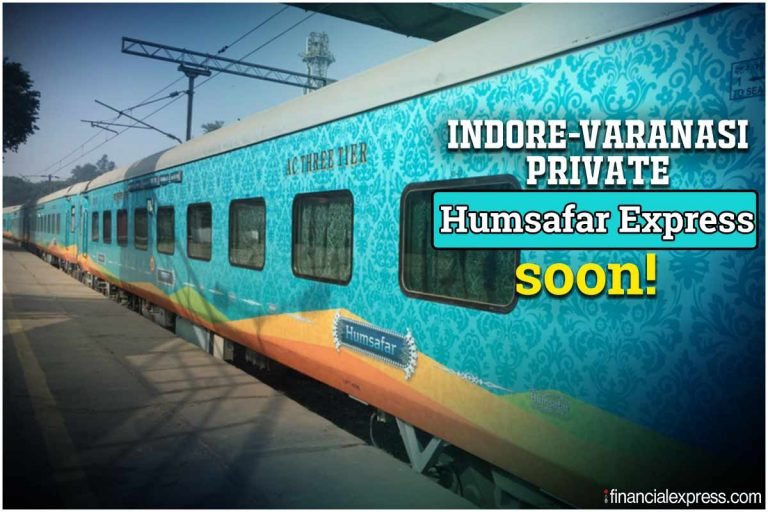
IRCTC third ‘private train’ Humsafar Express roll out between Indore-Varanasi route

New Delhi (Metro Rail News): Indore-Varanasi private Humsafar Express is coming soon! IRCTC’s third private train on the Indian Railways network would run in the middle Indore and Varanasi! Recently, Vinod Kumar Yadav Railway Board Chairman was stated in a PTI report saying that the overnight train would have same rakes as those of Indian Railways’ Humsafar Express. Further, he added that the upcoming train service would ply on the Indore-Varanasi route. Currently, the catering and e-ticketing arm of Indian Railways, IRCTC operates the first two private trains of India – Ahmedabad-Mumbai Tejas Express and Lucknow-Delhi Tejas Express.

As mentioned in the report by the officials, the upcoming private train Indore-Varanasi would run three days in a week – two days through Lucknow and one day through Allahabad. The new Humsafar Express will be the first private train by IRCTC to have sleeper coaches, and not chair car coaches. The upcoming private train is possibly to inaugurate its services around February 20.

Features of Humsafar Express

The private Humsafar Express trains of Indian Railways are an upgraded version of the premium Rajdhani Express trains, best suitable for overnight long-distance routes. The fully air-conditioned train service boasts various modern features such as comfortable berths, excellent fire retardant, and suppression system, tea/coffee/soup vending machines, multiple mobile charging points, GPS-based passenger information system, LED lights, toilet occupancy indicators, CCTV cameras, modular bio-toilets, etc.

As stated by Yadav, more than a couple of dozen private firms, including global majors Alstom Transport, Bombardier, Macquarie, and Siemens AG have shown interest in the proposal.
buy viagra soft online no prescription
He more added that among all the companies Tata had shown interest to run private trains on the Indian Railways network.

As per the Railway Board Chairman, while up to 150 trains that are to be run by private operators are in the pipeline, till the modalities are complete, IRCTC, the catering and e-ticketing arm of Indian Railways, will continue to operate the trains.

In fact, the step by Indian Railways to let private operators run passenger trains has attracted more than a couple of dozen companies. While the infrastructure, safety, operations, and maintenance will be handled by the national transporter, the private players can use rakes on lease and offer better onboard experience and services to railway passengers, in terms of comfort, entertainment, food, among others, he said.

recently, a discussion paper was issued by NITI Aayog and Piyush Goyal chaired Railway Ministry has forecast expense of around Rs 22,500 crore to run the 150 private trains across 100 Indian Railways’ routes. The private firms will have to bid for a network of routes, however, the bids will be finalized on a revenue-sharing model.

Govt to rethink on bullet train project, it’s White Elephant: CM Uddhav Thackeray

MAHARASTRA (Metro Rail News): The chief minister of Maharastra, Uddhav Thackeray has termed Prime Minister Narendra Modi’s Pet Mumbai-Ahmedabad bullet train project a “White Elephant”.CM Udhhav Thackery has indicated that his government need to reformulate about the project.

“I feel we need to sit and discuss it…Who will benefit from a bullet train?… How many businesses and industries are going to be benefited?… Please explain….we will go before the public and decide what to do,” Thackeray said.

He also said in an interview to Marathi daily Saamana and Hindi tabloid Dophar ka Saamana – both mouthpieces of his party, Shiv Sena. “We have to prioritise the developmental work of the state…we have to look at the economic situation and carry out development.”
The officials of the Ministry of Railways in New Delhi said that they had not received any communication from the State Government about halting the bullet train project. The officials also stated that the Ministry of Railways was in touch with the Maharashtra Government the process of taking land was expected to be over soon.

India’s first National high-speed rail project was to be built with Shinkansen Bullet Train technology of Japan with 81% of the estimated investment to be funded by Japan International Cooperation Agency (JICA) as a soft loan.

“If someone gives a loan without interest or loan with minimal interest, that does not mean we take it…and snatch land from farmers….after all this is a white elephant and no need to have it,” CM said.

while intimated that the bullet train was “dream project” of Prime Minister, he said: “It may be dream project… but once you wake up, the reality is before you… the reality is not dream.”

The JICA inked an agreement with the Ministry of Finance of the Government of India on September 18, 2018, pledging a soft loan of 89,547 million Japanese Yen (approx. Rs 5,500 Crore) for the project.

The two sides discussed the High-Speed Rail-Link project when Modi and Japanese Prime Minister Shinzo Abe had met in Bangkok on the sideline of the East Asia Summit on November 4 last year. To speed up its implementation Abe had requested Modi for his personal intervention. It was expected to discussed again during The two Prime Ministers annual summit in Guwahati in December. But the summit was indefinitely postponed, due to widespread protest in the north-eastern region against the Citizenship (Amendment) Act.

The initial task to build the high-speed rail corridor could start from Gujarat where the acquisition of land had not to meet any resistance officials of the Ministry of Railways in New Delhi said.

The National High-Speed Rail Corporation Limited (NHSRCL) is performing the project.

The 508.17 km long bullet train track will cover 155.64 km distance in Maharashtra, 2 km distance in Dadra & Nagar Haveli and 350.53 km distance in Gujarat. The 12 stations on the Mumbai-Ahmedabad bullet train project are Bandra-Kurla Complex, Thane, Virar, Boisar, Vapi, Billimora, Surat, Bharuch, Baroda, Anand/Nandiya, Ahmedabad and Sabarmati. Before reaching Mumbai the train will cross Palghar and Thane districts of Maharashtra.

The project required 1,380 hectares of land. 1,005 hectare was private land of which we have acquired 471 hectares. 149 hectare was state government land of which we have got 119 hectares. The remaining is 128 hectare which is railway land which has been given to the high-speed corporation,” earlier Railway Board Chairman V K Yadav said.

Yadav also said that five bids for civil engineering work which includes track work and tunnels will be opened in March and finalised within six to eight months thence.

KMRL signs pact with AFD to improve metro corridor

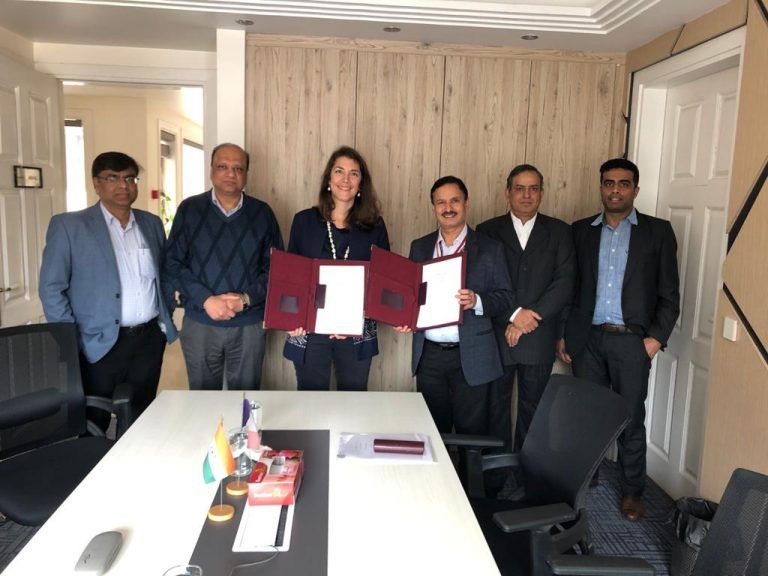
KOCHI (Metro Rail News): Kochi Metro Rail Limited (KMRL) has signed a project agreement with AFD (French Development Agency) for Non-Motorised Transport projects and urban place-making initiatives along the metro corridor for an amount of ₹239 crores.

Ms. Clémence Vidal de Lablache, Deputy Director at New Delhi AFD’s Office and KMRL managing director Alkesh Kumar Sharma signed the agreement.

Jaideep Kumar, Joint Secretary, Urban Transport, Ministry of Housing and Urban Affairs, Sanjay Kumar, Director, Urban Transport, and Kumar K.R., Director, Finance, KMRL, were also present.

“Through this funding, KMRL is planning to improve land planning and landscaping around Kochi metro stations and on arterial roads to facilitate access of cycles and pedestrians. There is also a plan to improve junctions like Pettah, Vadakkekkotta and S.N. Junction,” said Mr. Sharma. All these junctions are congested and witness heavy traffic.

KMRL was also trying to construct parking spaces for vehicles at metro stations including multi-level car parking, revamping of footpath pavement in front of stations and manholes, he added.

The AFD partnership would help improve connectivity to metro stations and other mobility hubs, he said.

UP Govt to approve DPRs of two proposed metro corridors in Ghaziabad

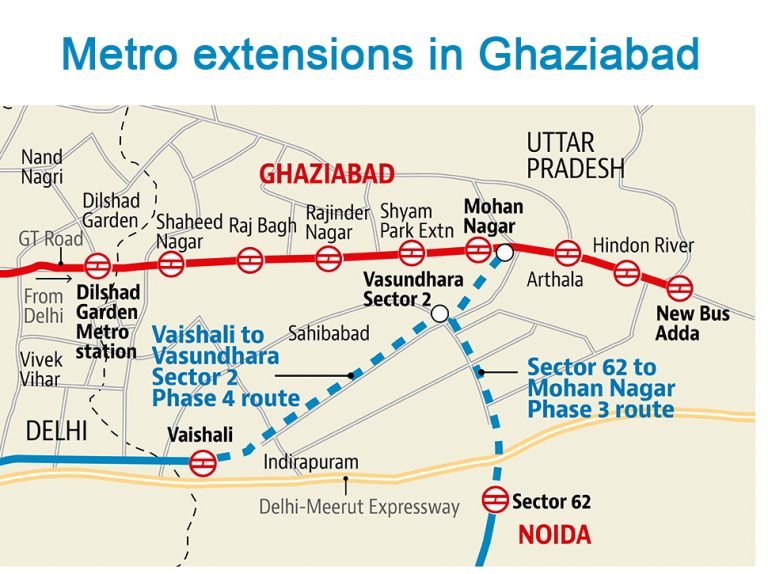
GHAZIABAD (Metro Rail News): Government of Uttar Pradesh gets detailed project reports (DPRs) of two proposed metro corridors – Vaishali to Mohan Nagar and Noida Electronic City to Sahibabad by The Ghaziabad Development Authority (GDA) on Tuesday for approval. Delhi Metro Rail Corporation (DMRC) prepared the Both DPRs after several round deliberations with GDA.

The GDA (Ghaziabad Development Authority) has also asked the Government to reform the funding model of the metro rail projects. The authority has recommended that projects be financed in a manner that 20% of the total cost is borne by Central Government, 50% by the State Government and the remaining 30% by agencies like GDA, Ghaziabad Municipal Corporation (GMC), Uttar Pradesh State Industrial Development Corporation (UPSIDC) and Uttar Pradesh Housing Board (UPHB).

The total project cost of both corridors is tightened to Rs 3,325 crore, according to the detailed project report (DPR). Out of, Rs 1,808 crores is estimated for Vaishali – Mohan Nagar corridor and Rs 1,517 crore is estimated for Noida Electronic City – Sahibabad corridor. Kanchan Verma, Vice-Chairperson, GDA said:

It has been made clear that the GDA is facing a financial crisis and is in no position to fund the two proposed metro corridors. The DMRC had suggested that 74% of the total cost of each project be shared by the state and 17% by the Centre.
buy caverta online https://www.mydentalplace.com/wp-content/themes/twentytwelve/inc/en/caverta.html no prescription
The remaining cost will be adjusted with the land price and taxes.

“While forwarding the DPRs to state government, we suggested the funding model in the 5:3:2 ratio, which means that 50% of the cost will be shared by UP government, 30% by agencies, like GDA, UPSIDC and UP Housing Board and 20% by the government of India”, she added.

Funding model recommended in DPR for Vaishali – Mohan Nagar corridor:

  • Total Project Cost: Rs 1,808 Crores
  • Funding pattern suggested by DMRC (74:18): Rs 842.68 Crore (State Government) and Rs 210.67 Crore (Central Government)
  • Funding pattern proposed by GDA (50:20:30): Rs 962 Crore (State Government), Rs 304 Crore (Central Government) and Rs 542 Crore (GDA, GMC, UPSIDC and UP Housing Board).

Funding model recommended in DPR for Noida Electronic City – Sahibabad corridor:

  • Total Project Cost: Rs 1,517 Crores
  • Funding pattern suggested by DMRC (74:18): Rs 878 Crore (State Government) and Rs 219 Crore (Central Government)
  • Funding pattern proposed by GDA (50:20:30): Rs 758 Crore (State Government), Rs 303 Crore (Central Government) and Rs 455 Crore (GDA, GMC, UPSIDC and UP Housing Board).

MMRDA cancels Rs 348 cr civil contract of Simplex Infrastructure for Mumbai Metro Line 7

MUMBAI (Metro Rail News): Mumbai Metro Line 7 Civil contract cost Rs 348 crores awarded to Simplex Infrastructure Limited cancelled through Mumbai Metropolitan Region Development Authority (MMRDA) mentioning poor performance in executing the project.

Simplex Infrastructure Limited bags a civil contract with value Rs 348 crores from MMRDA for construction of the Andheri – Goregaon section of the Metro Line 7 (Dahisar East -Andheri East) of Mumbai Metro Rail project.

MMRDA issued several notices for expediting the civil work for Mumbai Metro line 7 but the contractor has not speed-up the work and the work remained virtually stuck at the 75% stage for some months now as it should have been finished by now as per the timeline of the project.
buy viagra online no prescription

MMDRA official Said that The MMRDA has terminated the contract and fresh tenders have been invited to appoint a new contractor to complete the balance work of Simplex Infrastructures Ltd.

By October 2020, MMRDA has set the deadline to commission the Mumbai Metro Line 7 along with Metro Line 2A and the same was intimated to the contractor well in advance. Now MMRDA will encash the bank guarantee of Rs 35 crore given by Simplex Infrastrure against security money.

The 16.5 km long Mumbai Metro Line 7 will connect Andheri (East) to Dahisar (East) with an elevated line running largely along the Western Express Highway (WEH). The total cost of this project is estimated at Rs 6,208 crore.

In December last year, MMRDA commissioner RA Rajeev announced that they will commence trial runs of metro trains on Metro 2A and Metro 7 by September this year but after the termination of the contract the project may miss its deadline once.

Bengaluru suburban rail Project fares on Metro model

BENGALURU (Metro Rail News): The price structure of Bangaluru suburban rail network project will be based on the metro rail model, according to the 2020-21 Union Budget revealed on Saturday.

It means there won’t be a major difference between the ticket prices of Metro and suburban rail in Bengaluru, else in Mumbai and Chennai where rail reduce the price much less than Metro trips, according to a railway official.
“The 148-km-long Bengaluru suburban transport project, with a cost of Rs 18,600 crore, will have fares on the Metro model. The finance minister Nirmala Sitharaman announced in Parliament that central government will provide 20% of the equity and help outer assistance of up to 60% of the project cost,”.

However, the cost of the Bengaluru suburban rail project has already increased by 1,600 crores. Still, Bengaluru suburban rail project is yet to take shape and facing repeated planning delays. The former Finance Minister Arun Jaitley had mentioned Rs 1,7000 crore as the price of developing a 160 km suburban rail network in 2018-19 budget.

The ‘Pink Book’ of Indian Railway 2018-19 which follows the budget proposals and list funding for projects, had mentioned allocation of only Rs 1 crore for the year of the Bengaluru suburban rail. After the document is tabled in parliament next week, most probably Feb 5th this allocation will be known. In 2019-20 Pink Book, the amount was Rs 10 crore. It’s been 37 years of telling that transport experts and Bengalureans who have been tracking the project were not impressed by the budget announcement but there had been little progress on the ground.

In July 2019, RITES, a government undertaking, submitted a revised detailed project report of including four corridors: KSR Bengaluru City Devanahalli, Byappanahalli-Chikkabanavara, Kengeri-Cantonment-Whitefield, and Heelalige-Rajanukunte to the railway.
The number of suburban stations was decreased to 53 from 82 introduced earlier, and the length of the network was also revised from 161km to 148km.
They will be executed through a special purpose vehicle called Karnataka Rail Infrastructure Development Enterprises, or K-RIDE.
The final cabinet note is yet to be processed by the finance ministry. In November 2019, the Railway Board began the project. Once that happens, it will be placed before the Cabinet Committee on Economic Affairs.

It is likely to be the country’s first modern suburban train system, the network that rail planners have envisioned in Bengaluru. its stations will be going to have a different modern look than traditional stations as well as offering more facilities. There will be automated fare collection gates for smart card-based cashless travel. Fifty-three air-conditioned trains, with automated double-leaf sliding doors, will be deployed in the first phase.
Railway sources said the minimum fare could be Rs 13 for less than 3km. In Chennai and Mumbai, a train trip for the same distance costs Rs 5 currently. “For a 15-km trip, the fare will be Rs 35 as against Rs 45 in Metro,” an official said.

BSI 1
Here, providing an image of proposed fares.

Kolkata East-West Metro is all set to begin Operations on 13th February

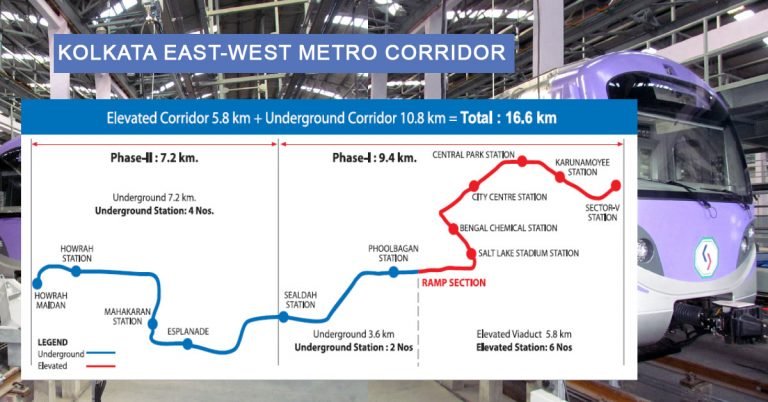
KOLKATA (Metro Rail News): The East-West Metro is all set to begin its journey on February 13, 2020, after the inauguration the distance between Information Technolgy hub of Sector-V in Salt Lake City to the Yuva Bharati Krirangan Stadium will be reduced, a Kolkata Metro official said on Monday.
The construction of the East-West Metro, scheduled to cover a stretch of 16.6 kilometres, has been delayed owing to an aquifer burst at Bowbazar in central Kolkata in August 2019 during tunnel boring work.

The inaugural service of East-West Metro will start from February 13,” a Metro spokesperson said. As stated in the report, the necessary safety trials have been done in various areas like railway tracks, power cables and railway stations along with others for this operation.
The shortened services of 5 km from Sector V to the stadium is likely to provide some relief to office goers and students of various educational institutes as well as different locations of the area.

The Kolkata East-West Metro, for connecting two cities of Kolkata and Howrah, expected to be completed by June 2021. However, its completion is likely to be delayed by up to one year due to an accident caused by an aquifer burst in Bowbazar area during drilling operations on August 31 last year.

Due to the accident, the Tunnel boring for the East-West corridor was stopped and it would restart only when the Calcutta High Court gives its nod. It is said by the KMRC to a division bench presided by Chief justice TBN Radhakrishnan in early September in connection with a PIL against tunnelling work in the crowded area in the city.

Several buildings at Durga Pituri Lane and Syakra Para Lane in Bowbazar had collapsed or developed cracks after an aquifer broke during tunnel boring and water and silt gushed in, leading to severe ground subsidence in the vicinity.

Telangana CM KCR to inaugurate JBS-MGBS corridor on Feb 7, 2020

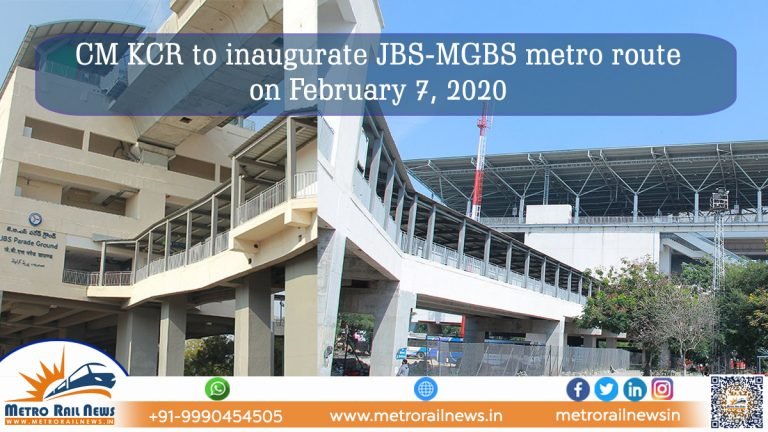
HYDERABAD (Metro Rail News): Chief Minister Telangana Shri K Chandrashekhar Rao (KCR) will flag off the much-awaited Metro Rail services on the Jubilee Bus Station (JBS) – Mahatma Gandhi Bus Station (MGBS) of Hyderabad Metro on Friday at 4 pm. This will be an extension of the public transportation facility for passengers shuttling between the north and south ends of the city.

With services on the LB Nagar-Miyapur and Nagole-Raidurg corridors, Hyderabad Metro already extends east and west connectivity in the city, another 11 km of Metro network will be added to the existing 58 km with the launch of commercial operations on the JBS-MGBS route. The 69-km network signals the completion of Phase I of the Metro project in the city.

Municipal Administration and Urban Development Minister KT Rama Rao tweeted “Chief Minister K Chandrashekhar Rao will inaugurate the JBS-MGBS Metro line on February 7 at 4 pm.”

The Commissioner of Metro Rail Safety (CMRS) had issued the mandatory safety certificate for the route last month. JBS-MGBS section is part of the JBS-Falaknuma corridor and has nine stations — JBS-Parade Grounds, Secunderabad West, Gandhi Hospital, Musheerabad, RTC Crossroads, Chikkadpally, Narayanguda, Sultan Bazaar and MGBS.

All the technical specifications and safety standards, especially dummy passenger evacuation tests and degraded mode operation tests etc., were completed as Hyderabad Metro Rail has been conducting trial runs for the last 45 days.

The emphasis was on signalling and safe train separation tests, brake test by the signalling and train control system, OHE-Rolling stock (Metro coaches) current collection tests, and passenger information announcements and display tests.
buy amitriptyline generic buynoprescriptionrxonline.net/amitriptyline.html over the counter

Currently, over four lakh passengers are travelling daily on the other two corridors. Every day, about 780 trips are being operated, covering 18,000 km, with the punctuality of 99.8 per cent.