Home Blog Page 569

UPMRC invites bids for supply of Rails for Kanpur and Agra Metro projects

LUCKNOW (Metro Rail News): The Uttar Pradesh Metro Rail Corporation (UPMRC) Limited on February 21 invited Bids for the supply of 19320 MT head hardened rails Rails for Kanpur metro and Agra Metro Rail projects.

Contract KNPAGT-1

Uttar Pradesh Metro Rail Corporation (UPMRC) Ltd. invites Open Tenders on International Competitive Basis (ICB) from eligible applicants from all countries and all areas, who fulfil qualification criteria as stipulated in Section III of bid documents, for the work, “Contract KNPAGT – 1: Supply of 17,700 MT Head Hardened Rails (60 E1, IRS-T-12-2009, 1080 grade HH) for Kanpur and Agra Metro.

  • Estimated cost: Rs 126.90 Cr
  • Tender Security amount: Rs 1.269 Cr
  • The completion period of the Work: 18 months
  • Pre-bid Meeting: 8th April 2020 at 3 pm
  • Tender Submission Date and time: 29 April 2020 up to 3 pm.
  • Date & Time of the opening of Technical Bids: 29th April 2020 at 03.30 pm

Contract KNPAGT-4

Uttar Pradesh Metro Rail Corporation (UPMRC) Ltd. invites Open Tenders on International Competitive Basis (ICB) from eligible applicants from all countries and all areas, who fulfil qualification criteria as stipulated in Section III of bid documents, for the work, “Contract KNPAGT – 4: Supply of 1620 MT Rails (UIC 60 / 60 E1, IRS-T-12-2009, 880 grade, Class-A) for Kanpur and Agra Metro.

  • Estimated cost: Rs 11.25 Crore
  • Tender Security amount: Rs 11.25 Lakh
  • The completion period of the Work: 12 month
  • Tender Document available for sale: 29th February 2020 to 18th March 2020
  • Pre-bid Meeting: 20th March 2020
  • Tender Submission Date and time: 31st March 2020 up to 03 pm
  • Date & time of opening of Technical Bids: 31st March 2020 at 03:30 pm

Contact Point and Pre-Bid Meeting Venue

The Chief Engineer Contract
Uttar Pradesh Metro Rail Corporation (UPMRC)
Administrative Building, Vipin Khand, Gomti Nagar,
Near Dr. Bhimrao Ambedkar Samajik Parivartan Sthal,
Lucknow-226010, Uttar Pradesh, India

Systra to submit DPR for Thiruvananthapuram–Kasargode SHSR project by March 2020

KANNUR (Metro Rail News): The houses located on both side of the proposed semi-high-speed rail track survey number is being collected in order to transfer the information about the owners to the revenue department. Kerala Rail Development Corporation Ltd. has consigned an agency for a digital version of this report.

V Ajith Kumar the MD of KRDCL said that the agency Kerala State Remote Sensing and Environment Centre (KSERC), would submit the survey report by March.
buy super avana online https://www.mydentalplace.com/wp-content/themes/twentytwelve/inc/en/super-avana.html no prescription
After land purchase order a detailed project report will be provided by the govt. French consultation company Systra has been entrusted with this contract.

The alignment of Thiruvananthapuram- Ernakulam locality of Silver Line has been made. The alignment was determined on the basis of the aerial survey done by Hyderabad’s Giono company.

After presenting the houses located on both side of the track, survey number and alignment, the DPR will be submitted to the State and Central governments by March. The final approval regarding this would have to be issued by the Central government.

IRCTC to launch new Delhi-Dehradun Tejas Express soon

DELHI, (Metro Rail News): The Indian Railways Minister has agreed and is set to launch a new Tejas Express train equipped with modern onboard facilities between Delhi-Dehradun via Haridwar.

According to an agreement in principle to launch a Tejas Express train between Delhi-Haridwar-Dehradun has been given on a request by the Uttarakhand CM, an official release here on Friday quoted Piyush Goyal as saying. 

Uttarakhand CM Trivendra Singh Rawat joined Goyal in Delhi regarding the matter. Goyal said that work on the project would commence as soon as a pathway is ready. There will be no budgetary shortage for railway projects in Uttarakhand, he added.

The train Tejas Express can cover a maximum speed of 160 kmph and boasts of several modern features like swanky coaches and ergonomically designed seats.

The Tejas Express train allows passengers including aircraft-like facilities like baggage pick up, comfortable seats, onboard infotainment for passengers, attendant calling buttons, modular bio-toilets, tea and coffee vending machines, mobile charging points and CCTVs.

Gujarat CM Vijay Rupani flagged off the Ahmedabad-Mumbai Tejas Express in January, the 2nd semi high-speed train to be run by IRCTC. The Tejas Express connecting Ahmedabad and Mumbai Central will run 6 days a week except on Thursday.

The train will halt at Nadiad, Vadodara, Bharuch, Surat, Vapi and Borivali stations in each direction. The train would have AC Chair Car Executive Class and AC Chair Car coaches. Meals would be provided to passengers by onboard service staff.

Aaditya Thackeray defends stay on Aarey car shed work of Mumbai Metro-3

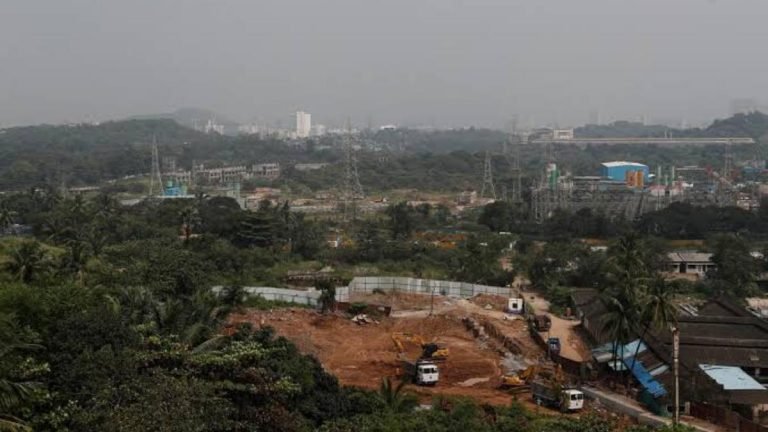
MUMBAI (Metro Rail News): Aaditya Thackeray, State environment minister said the “environmental cost of everything” needs to be considered before a decision is taken on the construction of a car shed for the Metro-3 corridor at Aarey Colony, on Saturday. Talking at an event in Mumbai organised by a Marathi news channel, Thackeray was answering to a question on allegations made by BJP leader Kirit Somaiya that the stay on development of the car shed was leading to an escalation in the cost of the project.

In December a committee set up by chief minister Uddhav Thackeray to investigate the possible alternative sites for the car shed, in January decided in its report that the Aarey Colony spot was viable for construction work of the depot. It also recommended lifting the stay on construction work of the car shed to expedited the Metro project.
buy xifaxan online https://gilbertroaddental.com/wp-content/themes/twentyseventeen/inc/en/xifaxan.html no prescription

“The issue about the construction of the Metro car shed [at Aarey] needs to be studied before a decision can be made. Without disregarding the cost [escalation] factor, we need to consider what the environmental cost of the project can be when we are doing a good project like the Metro,” Thackeray stated.

The Metro project is being implemented in full speed, said the minister. “There should not come a time in the future when we recount our successes [in terms of] which are the good public transport system — the Metro, or WiFi hotspots at every station…but [we] have to promise oxygen hotspots to citizens as a deliverable future,” he added.

In October 2019 almost 2,000-odd trees were being cut down for constructing the car shed following a nod from the high court, at Aarey, the Shiv Sena had backed those protesting the felling of trees. Being part of its pre-Maharashtra Assembly election promise, the Sena had convinced that Aarey would be declared a forest when the party comes to power.

In a conversation with Mr. H. K. RAGHU, ED (Urban Transport & High Speed), RDSO

Metro Rail News Team conducted an Interview of Mr. H. K. RAGHU, ED (Urban Transport & High Speed), RDSO, Lucknow. He talks about his journey and current roles and responsibilities at RDSO, Here are the edited excerpts of the conversation

1. Please let us know about your journey in RDSO? What have been the most challenging projects you have come across in your very eminent experience in Indian Railways?

 Mr. H.K. RAGHU: My journey in RDSO has started only from 8 Aug 2019 in the capacity of

 Executive Director of Urban Transport and High-Speed Directorate, but my association with RDSO as a Railway Executive is started since 1994 when I was posted in Rail Spring Karkhana Sithauli Gwalior.

2: In the last few years, RDSO has been on a Vendor Development Drive, promoting localization and new suppliers. Can you please share some insights into the same and what are some components for which RDSO is still seeking for new suppliers? Further, what components are you looking for localization for components for metro projects? 

 Mr. RAGHU: RDSO has made tremendous improvement in its vendor development procedure. Now online vendor approval is done. RDSO is always looking for increasing its vendor base due to ever-increasing demand and change in technologies. All details are available in RDSO official website www.rdso.indianrailways.gov.in

3: As we know that in India, We are aiming for standardization in metro rail systems and currently, 600+ km of metro lines are operational, so please give us some suggestions on how can the standardization be achieved? Additionally, how many km of projects do you foresee will be tendered in India in the next 3 years? 

 Mr. RAGHU: For standardization of Metro Systems in INDIA, Ministry of Urban and Housing Affairs, dealing with Urban Transport and mobility, has made the required efforts, by publishing its report “STANDARDIZATION AND INDIGENIZATION OF METRO RAILWAYS, SYSTEMS AND SUB-SYSTEMS” in NOVEMBER 2013. After that Delhi Metro Rail Corporation Ltd (DMRC) and other Metros have made further efforts in Indigenization of its components and systems. DMRC has already indigenized its 18 Subsystem and 17 UNIT EXCHANGE SPARES costing 18.7 Lakh US $ and 34 Sub Systems costing 3.83 Lakh US $ are identified for Indigenization.

Nagpur Metro is Looking forward to the indigenization of 28 different items costing Rs.13.74 Crores per train set.

Similarly, other Metro systems are also working for Make in INDIA efforts, Mumbai Metro Line-3 has finalized its Rolling Stock Tender on M/s Alstom based at Shricity Andhra Pradesh and Pune metro has given its order of Rolling Stock on Titagarh Fima, based in Kolkatta.

Real standardization and interoperability of the Rolling Stock will be achieved only after the development of its own CBTC Systems in India. DMRC is working on this in collaboration with M/s BEL for ATC (Supervisor System) in the First stage, after that on the successful implementation of ATC the work on CBTC will be undertaken.

NITI Aayog is giving a lot of emphasis on “Make in INDIA” and indigenization of Metro Systems, accordingly policies are framed to support it . as per the recent published NITI Aayog STRATEGY FOR NEW INDIA 2020, there are many incentives to the Indian Industries for achieving Industry 4.0 standards, required for producing Metro systems and Metro Components.

3: Presently, the viability of costly metro rail projects, especially in smaller cities is under review, and the Government is planning to adopt the Metro-neo and Metro-lite transit systems. So how do you think that these transit systems can help smaller Indian Cities and also bring convenience to the passengers?

Mr. RAGHU: Metro-lite and Metro-neo both the concepts, though new to India, but both exist the world over. While we make this infrastructure in INDIA, we need to keep in mind that operating of these facilities is to be funded by the state to provide better and respectable transport facilities at affordable rates. Here it is pertinent to mention that these facilities need to be energy efficient and preferably green. Metro-neo is less efficient than Metro-lite, due to pneumatic wheels over the road, having higher friction loss of energy. For saving our climate, we need to look forward to Hydrogen fuel cell technology, rather than going for electric energy, which at present is produced in INDIA, through Coal energy-based Steam Thermal power plants, which is less efficient and a major cause of environmental concern. Till we become self-sufficient in energy, we must keep exploring the alternate methods of energy generation, especially for transportation.

4: In terms of PPP Collaboration with the Private Sector, What are the key points which are the most important for a successful collaboration between the Govt. and Private companies? 

Mr. RAGHU: Metro is already in PPP mode, Hyderabad and Pune Metro are the example. For Private partnership, this should be taken as one of the Corporate Responsibility The project, rather than looking for profit out of it. For supplying of items related to Metro systems, Private firm need to be Industry 4.0 level, for which NITI Aayog has already given its broad outlines in its report on New INDIA 2020.

5: Any suggestions on how the Passenger experience in metros can be improved in India along with making the projects sustainable for the long term?

Mr. RAGHU: Controlling the crowd per train and increasing the frequency of trains in peak hours, is the need for requirements, with better reliability. Metro stations are to be made Multy utility, Commercial hubs so that the total cost on metro operation can be compensated, most of the new cities are looking for malls and party joints, this should be clubbed with the metro stations. The basement is to be provided with taxi cab/e-rickshaw facilities for point to point connectivity up to the last mile, in fact, the home itself.

6: Anything you would like to share with our readers?

Mr. RAGHU: Readers need to go through and get them well acquainted with the latest government policies published through NITI Aayog New India 2020 and Accelerating Vision 2030: India Investment Grid

Pune Metro corridors to be operational by 2022

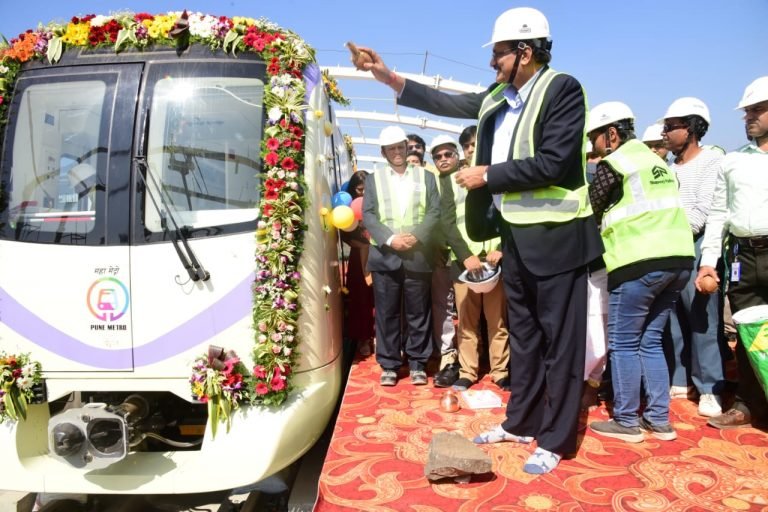
PUNE, INDIA (Metro Rail News): The 2 Pune Metro corridors are expected to be completely operational by 2022. The much-awaited Pune Metro rail project that will connect the Pune Central location and the extended city limits of Pimpri and Chinchwad has been targeted for services by 2022, a Pune Metro rail official said. The two corridors of the Pune Metro network namely, Pune Metro Line 1 PCMC, Swargate and Pune Metro Line 2 Vanaz-Ramwadi are expected to be available for passenger services by 2022. However, Sant Tukaram-Phugewadi section of Pune Metro Line 1 will become operational in the upcoming few months itself. This Metro project has become the country’s fastest metro project to reach the milestone of trials in 30 months.

Pune Metro project: Current status

  • The previous month, the first inaugural trial run of the Pune Metro was successfully directed at the Sant Tukaram Nagra station of the PCMC-Swargate line. The trial run was directed at the Sant Tukaram Nagar metro station by the distance of 1.4-kilometre overhead electric cable which had been activated as part of the project.
  • On 5 January 2019, the second tunnel work by the TBM was inaugurated. By the tunnel boring work, 2 parallel tunnels in the route are being dug among the Range hill and Swargat of the Pune Metro Line 1 PCMC–Swargate
  • The work of the metro pillars, rail laying, span, metro stations works, overhead cables, electric poles, electrical substation, charging of above cable works and the opening of the first Pune Metro rail coaches have been finished in record time.
  • The Sant Tukaram – Phugewadi sector of Pune Metro Line 1 PCMC-Swargate, with 4 metro stations will make operational in the upcoming few months.

Details route, stations, features of Pune Metro:

  • Once fully operational, the Pune Metro network will have 2 corridors. The first corridor will be the 16 kilometres Pune Metro Line 1 PCMC – Swargate including 14 metro stations and the 2nd will be 14 kilometres Pune Metro Line 2 Vanaz-Ramwadi including 16 metro stations.
  • Country’s first aluminium-bodied coaches boasted by Pune Metro. The aluminium coaches would be lightweight having regenerative braking, advanced communication system, like the broad gangway.
  • There would be an automatic fare collection system in Pune metro with a combination of smart cards as well as digital paper tickets.
  • Pune Metro coaches would be ready to achieve a likely speed of 31-33 kmph. The stations are being developed by the world-class modern amenities such as CCTV cameras, escalators, lifts, tools for differently-abled passengers.
  • In the initial stages, the Pune Metro train sets will comprise 4 coaches, which will then be extended to 6 coaches, depending on the commuter footfall and demand.

Bids invited for 210 Delhi-Meerut RRTS coaches

DELHI (Metro Rail News): India’s first RRTS corridor to have top-class train sets procured under ‘Make In India’ guidance! The Delhi-Meerut regional rapid transit system, which will decrease the distance between Delhi-Meerut to just 55 minutes will have ‘Make In India’ rolling stock. NCRTC which is mandated for executing the RRTS project in the NCR has invited bids for the rolling stock of the Delhi-Meerut RRTS corridor. Chief Public Relation Officer Sudhir Sharma, NCRTC said that the last date for submission of the bids is March 11, 2020.

A total of 210 coaches are being procured for the corridor works, for the RRTS project. Sudhir Sharma added, 30 RRTS train sets comprising 6 coaches will be made operational for the local services, where ten train sets comprising 3 coaches will be made operational for the city services in Meerut. Being a part of the bidding process for the rolling stock of the RRTS corridor, foreign firms interested in the infrastructure project will also be allowed to join. The procurement of the rolling stock is being made by PM Narendra Modi’s flagship ‘Make In India’ guidance.

The 82 km Delhi-Ghaziabad-Meerut RRTS project will boast of 160 kmph capable coaches and will be executed in phases, in the two cities. With 22 stations out of which 16 will be the regional stations and 6 stations will be in Meerut. The lead phase of Delhi-Meerut RRTS which is 17-kilometre long Sahubabd-Duhai locality has been expected to start operations by 2023.

The RRTS stations like Sarai Kale Khan, Anand Vihar and Sahibabad will be combined with different modes of public transport such as metro, bus terminals, Indian Railway stations for facilitating the multi-modal combination for commuters. It was reported that the final design for the Sahibabad station will also be prepared by the end of this month and work will be commenced soon.

Chennai Metro gets 12,722 Sqm Land by GCC for Phase II

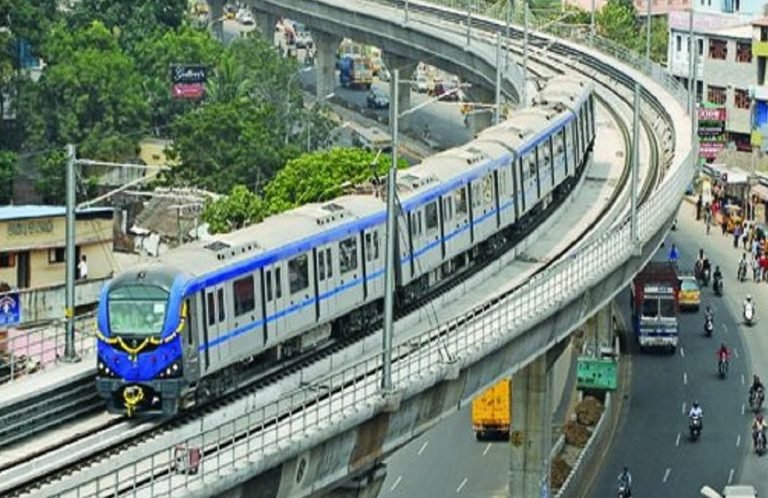
CHENNAI (Metro Rail News): The Greater Chennai Corporation (GCC) has decided to give 12,722 sqm of land worth Rs 41.99 cr for its phase-II construction to CMRL. The land owned by the civic body, adds an Amma canteen, two parks, an open playground with a portion of a road.

Besides the land cost, Chennai Metro Rail would have to bear the cost of reconstructing these facilities at a different location along with taking permission from the govt wherever over 5% of open land is being transferred. In November, the decision was taken in the corporation council meeting as follows.

As per the documents, six parcels of the corporation’s land would be given.

  • In region 6, the GCC has decided to take over the 657sqm of land permanently for the construction of Ayanavaram station. This includes the corporation’s ward building and a portion of a road. This portion cost is Rs 1.18 cr.
  • In region 13, Chennai Metro will receive 1,203 sqm of land, That is a third of Dr Muthulakshmi Reddy park which the civic body initiated in 2010. The GCC will give the area to CMRL in conditions that the park is brought back to its original condition after work is done.
  • In region 6, the GCC has decided to provide two more parcels of land for construction work of Perambur Market metro station. For this, 42 sqm accommodates an Amma canteen, which Chennai Metro rail Ltd. would have to relocate to another area.
  • In region 70, 1,361 sqm of metro rail will be given permanently and 2,515 sqm temporarily. This land abuts a part of the Murasoli Maran park that the transport agency would have to repair after construction work is completed. The GCC has also informed that CMRL constructs a building for them. These parcels would cost Rs 21.56 lakh and Rs 6.5 cr.
  • In region 9, for construction work of Tirumailai metro station, a shopping complex-cum-toilet over 108 sqm run by the GCC will be awarded to metro rail for Rs 1.55 cr. CMRL will have to replace and reconstruct the complex. In the region, CMRL will take 1,751 sqm permanently and 5,224 sqm temporarily for construction work of Greenways Road metro station. This will cost CMRL Rs 20.4 cr.

The GCC does not have an elected council for the last four years. The special officer is commissioner G Prakash.

L&T infra Awarded DDC contract for 3 Stations of Delhi-SNB RRTS corridor

New Delhi (Metro Rail News): on Friday, Larsen & Toubro Infrastructure Engineering Ltd. received a letter of acceptance (LOA) from the National Capital Region Transport Corporation (NCRTC) for providing detailed design consultant (DDC) worth Rs 6.75 crore for the design of three stations including viaducts of 164 km long Delhi–SNB (Shahjahanpur-Neemrana-Behror) RRTS corridor.

NCRTC issued Letter of Acceptance to L&T infra for 3 Station of the Delhi-SNB RRTS corridor DDC Contract

L&T infra needs to providing civil, architectural and E&M works for the design of Udyog Vihar, Sector-17, Rajeev Chowk and elevated viaduct between IDPL Complex Ramp (Gurugram) to Rajiv Chowk Ramp for Delhi-SNB RRTS corridor.

The NCRTC invites tender was floated on 24th August 2019 vide reference no. DA/DD/COR-OF/011 and the technical bid was opened on 19th November 2019. After the opening of financial bids on 12th February 2020, L&T Infrastructure Engineering Limited has emerged as the lowest bidder (L1).

The 106 km long Delhi-SNB RRTS corridor will be elevated for about 71 km i.e 11 stations, the remaining 35 km i.e. 5 stations will be built underground, mostly in Delhi & Gurugram.

This corridor will connect with other RRTS line in Sarai Kale Khan and will be interoperable, facilitating commuters’ movement from one line to another without the hassle of changing trains.

The Delhi-SNB Regional Rapid Transit System (RRTS) corridor will enhance transport infrastructure by given a fast, safe, comfortable and reliable mobility option to the residents of Delhi, Gurugram, Rewari, Manesar, Daruheda, Bawal, and nearby areas.

The fast commuting connecting Delhi to nearby regions will be immensely beneficial in decongesting Delhi and its roads, providing citizens with the choice to live & work in different regional nodes to lead a better quality of life.

The corridor is planned to be constructed in about 5 years’ time excluding 1 year of pre-construction activities at a base construction cost of Rs 24,975 crores, financed by Government of India (20%), concerned State Governments (20%) and bilateral/multilateral funding agencies (60%). Once built, the corridor is expected to bring down the travel time between SKK-SNB in less than 70 minutes (106 km). The daily ridership on this corridor is predicted to be 8.5 Lakhs in 2025. For more information, be stay connected with our Delhi-SNB RRTS section.

UPMRC New Tech to expedite metro work

KANPUR (Metro Rail News): Uttar Pradesh Metro Rail Corporation (UPMRC) has initiated a new technique to speed up the ongoing construction work of Kanpur Metro project and assures the safety of the workers at the site and the common people.

On Saturday a UPMRC official said that since the starting, its civil engineers, based on their experience from the Lucknow Metro Project, we’re trying to innovate civil construction work techniques while executing the Kanpur Metro Project. Earlier he said that concourse slab of the elevated station, a portion just above the road was constructed on sacrificial shutters were laid over the erected precast beams.

The station concourse slab will now be constructed the new innovative technology. The slab with beam will be built in advance at the casting yard and placed at the assigned place. By the help of this technique, the work will gain momentum, and simultaneously safety-related apprehensions will be reduced. Along with this, the outer beauty of the stations will also be improved”, an official added.

As per the source in MRC, the civil work of the KMP is progressing at full-speed from the starting. According to a result of the state-of-the-art technology, UPMRC is completely confident that the construction of the Priority Corridor between IIT-Kanpur and Motijheel would be finished within the stipulated time frame.

During three months since the construction work commenced on Kanpur Metro at the IIT-Kanpur gate, above 500 piles and 35 pillars have been prepared under the project. Concurrently he casting of the U-girder is also continuing in the casting yard.