Home Blog Page 550

Indian Railways Plans to resume select passenger train services from May 12

NEW DELHI (Metro Rail News): Indian Railways plans to gradually restart passenger train operations from 12th May 2020, initially with 15 pairs of trains (30 return journeys). These trains will be run as special trains from New Delhi Station connecting Dibrugarh, Agartala, Howrah, Patna, Bilaspur, Ranchi, Bhubaneswar, Secunderabad, Bengaluru, Chennai, Thiruvananthapuram, Madgaon, Mumbai Central, Ahmedabad and Jammu Tawi. 

Thereafter, Indian Railways shall start more special services on new routes, based on the available coaches after reserving 20,000 coaches for COVID-19 care centres and an adequate number of coaches being reserved to enable operation of up to 300 trains every day as “Shramik Special” for stranded migrants. 

“Railways plans to gradually restart passenger train operations from May 12, 2020, initially with 15 pairs of special trains connecting New Delhi with major stations across India. Booking in these trains will start at 4 pm on May 11” Tweeted confirmation Railways Minister Piyush Goyal

List of Train proposed to be introduced as a special train

List of Special trains to run on May 11 2020
List of Train proposed to be introduced as a special train

How to book select passenger train ticket

Booking for reservation on these trains will start at 4 pm on 11th May and will be available only on the IRCTC website (https://www.irctc.co.in/). Ticket booking counters at the railway stations shall remain closed and no counter tickets (including platform tickets) shall be issued. Only passengers with valid confirmed tickets will be allowed to enter the railway stations. 

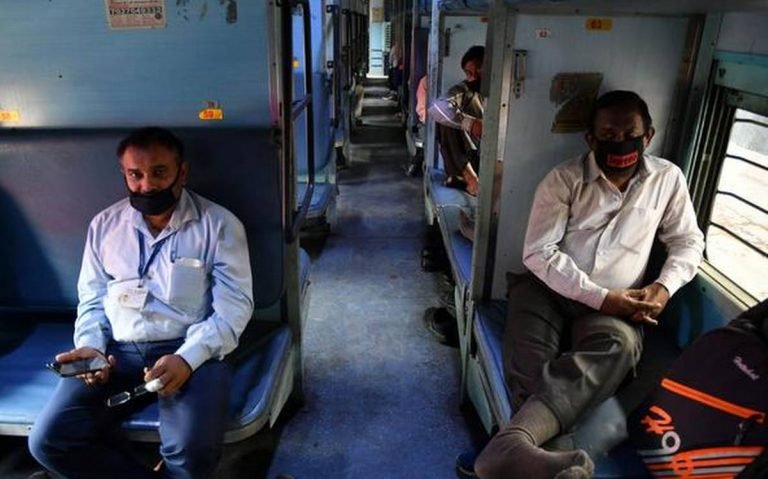
It will be mandatory for the passengers to wear face cover and undergo screening at departure and only asymptomatic passengers will be allowed to board the train. Further details including train schedule will be issued separately in due course.

Shramik Special Train

But the existing Shramik Special trains will continue to run as per the present system at the request of the respective State Governments.

Ticket cost and Concession

No concession will be allowed on the trains. The fares of these trains will be that of Rajdhani trains, which means all these will be all air-conditioned trains and will be available on premium fares.

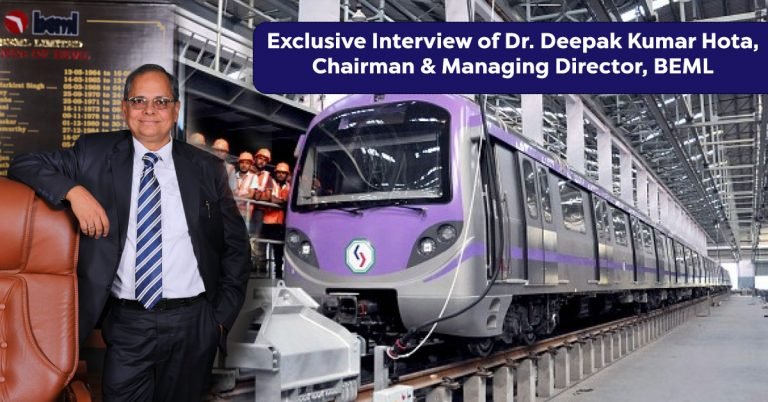
Exclusive Interview of Dr. Deepak Kumar Hota, Chairman & MD, BEML

In an exclusive interaction with Mr Narendra Shah, Managing Editor of Metro Rail News, Dr. Deepak Kumar Hota, Chairman & Managing Director, BEML Says technology up-gradations and quickly adapt with continuous innovations help us for rapid transformation from manufacturing standard Metro coaches to driverless Metro trains. Here are the edited excerpts:

Heartiest congratulations for winning Most Admired Leader Award. How can organisations focus on Developing People and Capability?

Ans: Thank you very much, for your compliments. As the leader of the organization, I believe that, this recognition is a reflection of the commitment and unstinted support of my team at BEML. 

BEML operates in a highly competitive business environment. The competitive advantage of an organization is defined by how well it manages its People; how well Human Resources Management is incorporated into Business Strategy. The greater reliance on intellectual capabilities for success in business, therefore calls for dedicated, suitably skilled and prudently deployed workforce.

BEML believes that people are the differentiating element for BEML to be a successful organization. They are being nurtured and developed so that they strive to take the organization forward to achieve its laid down goals.

BEML has one of the biggest rail coach factory in India, what are your current capacity and future expansion plan?

Ans: BEML Limited, has state-of-the art manufacturing facilities at Kolar Gold Fields, Mysore, Bangalore and Palakkad; manufacturing Defence, Mining & Construction equipments and Rail & Metro products, for the national and international markets. The manufacturing units are accredited with ISO 9001, ISO 14001 – 2004, BS OHSAS 18001 and other certifications.

BEML’s Bangalore factory is the first rail coach manufacturing unit in India and till date, BEML has manufactured and supplied more than 18,500 passenger coaches to Indian Railways.  In 2002, BEML forayed into the manufacturing of state-of-the-art Metro Coaches. Since then, more than 1600 metro coaches have been supplied to various metro rail corporations in India such as Delhi, Bangalore, Jaipur, Kolkata and Mumbai. BEML holds over 48 percent market share in Metro coach segment in India against stiff competition with MNCs. 

To cater for burgeoning metro orders, BEML recently set up an additional assembly line, and currently the Company has the capacity in its units to produce over 700 rail coaches per year and 300 metro cars per year. Further expansion plans would be based on market demand to augment the annual production capacity by 360 metro cars.

BEML signed an MoU with IRCON International to explore and address opportunities in the overseas market for large infrastructure projects in the transportation sector; What are the key focus area?

Ans: BEML’s MoU with IRCON is to explore and address overseas business opportunities. IRCON under Ministry of Railways is a leading turnkey construction company and executes entire spectrum of construction activities in the areas of railway infrastructure. It has an extensive presence in Malaysia, Nepal, Bangladesh, Mozambique, Ethiopia, Afghanistan, UK, Algeria, Sri Lanka and they have completed over 100 projects in more than 21 countries.

 The MoU was signed with the objective to synergize respective strengths for identifying / bidding / executing railway projects, including supplying and maintaining the rolling stock manufactured by BEML in countries where both have business interest.

 While addressing overseas Rail & Metro projects, BEML will manufacture, supply the rolling stock, provide spare parts and service support as per project requirements while IRCON will execute civil and construction work, facilitate design and other technical support

BEML is a government-owned company, certain procedural and other obligations are absent in private companies. What are the steps taken to minimise?

Ans: BEML as a Public Sector Undertaking under the Ministry of Defence is guided by laid down policies and guidelines. BEML in turn has formulated transparent and clear-cut procurement procedures based on the mandated rules and regulations, to deliver world class products to customers. In order to align with market sentiments, BEML constantly interacts with its vendor ecosystem by conducting vendor meets, pre-bid meetings and seeking customer responses and feedback, to modify the internal processes to meet customer expectations.

How did BEML make the rapid transformation from manufacturing standard Metro coaches to driverless Metro trains?

Ans: BEML has the requisite skilled manpower that can absorb technology and deliver products. The R&D setup is also able to rise upto meet the technology up-gradations and quickly adapt with continuous innovations. BEML successfully delivered 384 driverless metro coaches for Delhi metro under RS10 project. Apart from the above, BEML is also executing 504 driverless metro coaches for Mumbai Metro under MRS1 project.

What are the key differences between metros in other countries when compared to India?

Ans: In terms of technology, BEML metro cars are at par with global standards. Hence, there is no difference in metro cars manufactured in other countries vis-a-vis the state-of-the-art BEML metro cars.

What is your outlook on the metros in India?

Ans: The vehicle population has been growing phenomenally, leading to air and noise pollution resulting in health problems; besides, heavy congestion on the roads causing traffic jams and reducing the pace of vehicular movement. Inadequacy of the public transport system has led to the huge growth of vehicles on the road in our cities. An efficient Metro network helps in decongesting traffic in an efficient manner, reducing the overall carbon footprint. Metro is also preferred by commuters due to the comfort, safety and saving in commuting time. Most of the cities are planning to implement metro corridors and Tier 2 cities are planning to introduce ‘Metrolite’ cars. BEML is poised to contribute in meeting such requirements.

Which, according to you, is the landmark metro project in India and abroad?

Ans: Undoubtedly it is the DMRC (Delhi Metro Rail Corporation); for the exemplary standards it set, whether in terms of quality, adherence to delivery timelines or indigenization. There have been vast improvements since the initial days of Delhi metro execution, and BEML, as a key stake holder, has always risen to the occasion – truly embodying the spirit of ‘Make in India’. Some of the innovations of BEML include for the first time in India, manufacturing CBTC based metro cars for KMRCL, Driverless metro coaches for Delhi Metro (RS10) and driverless Metro car project under execution for Mumbai Metro Line 2 & 7. The Ministry of Housing and Urban Affairs (nodal ministry for metro rail in India) has also played crucial role in development of metro rail ecosystem in India.

Globally, there are many successful mass transit systems including Singapore, Hong Kong, Dubai, Moscow and London (one of the oldest), just to recall a few, which have played crucial roles in decongesting the urban transit system, thereby reducing the carbon footprint and creating a healthier planet.

Detail of the latest technologies being used by BEML to manufacture the metro coaches?

Ans: BEML uses state-of-the-art technology to manufacture metro cars. BEML technological base along with the manufacturing facilities available at Bangalore complex such as: Robotic welding systems, Laser / CNC / Optical tracer cutting machines, tailor-made project wise jigs and fixtures and Bogie traction motor run test facility conform to ISO certifications and global standards. BEML’s unique modular concept of assembly process enables minimum lead time for manufacturing and delivering the metro cars.

Key learnings from your experience and how they can be applied to the forthcoming projects?

Ans: Every Metro Project is unique by itself, bringing in newer and latest technology and features into the product. Apart from learnings, there is continuous innovation involved which is based on feedbacks and observations from execution of previous projects. This enables BEML to deliver the metro cars on time with highest quality standards, to our customers.

Any interesting highlights or features which distinguish BEML from other metro coach factories?

Ans: BEML’s metro coach facility at Bangalore is at par with other state-of-the-art facilities in the world. It is benchmarked for best practices in stainless steel manufacturing with high-quality centricity. BEML Bangalore complex is equipped with systems, machines, jigs and fixtures and test facilities which are exceptional facilities.

BEML strives for continuous quality improvements and is a proud recipient of numerous quality awards from prestigious bodies worldwide, which is a true testament to its commitment to quality.

What are the challenges, and how has it been overcome?

Ans: Keeping up with the current technology, skill and technology up-gradation, continuous training, and seamless collaboration with technological partners are the key challenges which BEML was able to overcome to become the leading metro manufacturer in India. BEML has also able to get most of its partners to set up their manufacturing facilities in India in the true spirit of  ‘Make in India’.


The Article first appeared in Metro Rail News May 2020 (Volume IV, Issue 41) | Subscribe Now

Metro Rail News May 2020 issue Published

Dear Readers,

Currently, The world is facing a vital crisis due to COVID-19 outbreak. It has impacted on every sector of health and economy.

As our Prime Minister finally addresses the nation in view of getting back to the normality of life with the mindset that we have to get used to our life with this pandemic.and also said that from now we all need to be Self-dependent, in every sector in terms of that, India has also started making N-95 Masks which is currently producing in lakhs in India.

Also, the government announced some plan to enhance the condition as well.

We have to grow a habit of using face masks or sanitizer while travelling out through metro or any public transport. Along with that, we also need to keep distance to other commuters.

In regards to this, Metro Rail News is determined to keep you updated with industry news and project
development.

Our May issue focuses on exciting topics such as contactless ticketing and provides a cover story on Improving Public Transport In India. Jammu & Srinagar Metro covered under the featured project. Exclusive Interviews of Dr. Deepak Kumar Hota, Chairman & Managing Director, BEML, and Vimal Kejriwal, MD & CEO, KEC, International along with other regular columns such as new development in the metro project, event coverage, technology updates, News analysis, Article, opinions, Awards, appointments, News around the world, live tenders, Industry contract, upcoming events and current job openings.

I highly appreciate your support and hope to continue our collaboration further. Please feel free to provide your valuable feedback and suggestions on this issue to my email address mentioned below.
We encourage everyone to take extra precautions necessary to safeguard their health and that of others.

Stay informed about the situation in your local community by consulting and following the advice of your local health authorities.

Together we will get through this.
Stay safe. Stayhealthy. Stay strong

To read the Metro Rail News May 2020 issue, kindly subscribe

Know about the Latest Innovation Strategy of Metro Rail News to promote your sales, branding, increase market share in Metro & Railway Industry of India.

Dahisar East – Andheri East corridor to begin construction this year

MUMBAI (Metro Rail News): On Thursday Dahisar East-Andheri East metro seven corridor project, town planning authority MMRDA stated about the progress that it has received twelve escalators and 2 elevators from China.

The state govt has permitted the construction of key infrastructure projects during the lockdown. “Development work has started on line 7 and MMRDA has got twelve escalators & 2 elevators in the last 3 days from China.

These will be installed at 3 different stations of the metro line,” the declared an authority. The MMRDA proposes to start this Rs 4,830 cr 16.5 km corridor before Dec 31, 2020.

Among the twelve escalators, 4 each will be installed at Poisar, Magathane & Dindoshi stations of the corridor, another 2 elevators will be installed at the Akurli station. Earlier, the MMRC had announced it has finished tunnelling on one of the corridors on the Colaba-SEEPZ corridor.

During the construction movements in the megapolis have been suspended amid the COVID-19 crisis, CM Uddhav Thackeray has approved the continuation of critical activities on significant infrastructure projects.

Vaitarna-2 tunnel boring machine, that was approved on 2nd Feb 2018 from Chhatrapati Shivaji Maharaj Terminus launching shaft has finished their longest run at Mumbai Central station with 2,730 RCC rings, announced in a statement of MMRC.

This was the 28th tunnel invention in the metro-3 corridor, and Vaitarna-2 has become the 1st TBM in the corridor to finish the range of 4 km in an individual drive as per the authority.

Further, they added that another hurdle posed before the team was the COVID-19 outbreak. However, we assured physical distancing & surely followed each guideline stipulated through the state govt.

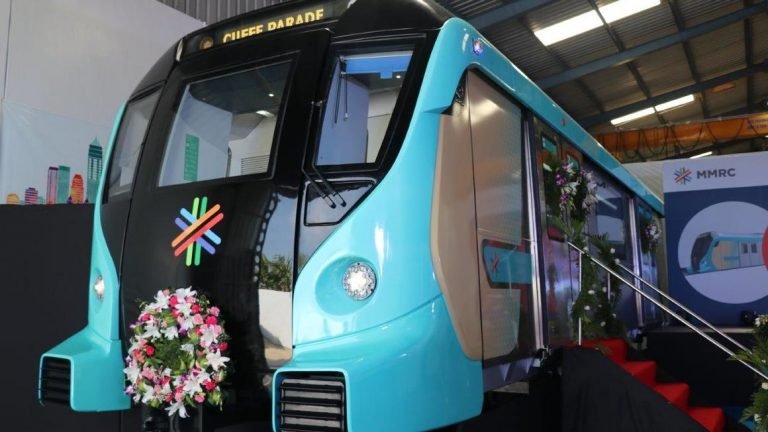
MMRC had alleged that 100% tunnelling work of the project would be done by Sept 2020. Nearly Rs 30,000 cr project would connect Cuffe Parade business district in the city’s extreme south to SEEPZ in the north-central with twenty-six underground and one at-grade stations.

The migrant worker’s crisis may hit Namma Metro work

BENGALURU (Metro Rail News): Bangalore Metro Rail Co Ltd (BMRCL) was the 1st to continue the construction on 23rd of April 23. With the migrant workers arriving restive, tension is brewing at many labour camps, especially those set up via contractors engaged in Namma Metro construction work.

BMRCL senior official said that It’s harvest season in north India & these workers want to go back home. Contractors achieve to get new workers when the single batch goes back.

But now workers are not arriving at Bengaluru due to the COVID-19 & train operations too have been delayed. This would affect construction work. On August 15 Metro officials are hopeful of opening the Kanakapura Road range Yelachenahalli –Anjanapura section.

An official further added that most of the work on this corridor has been closed. So the last date is on track. It’s also possible to meet the last date Nov for the Mysuru Road stretch but other corridors may be paused.

“The contractor is not paying us wages. We are staying in cramped rooms & there is no security there, a worker from Jharkhand Anil Gupta said.

“Being the leading employer, BMRCL should assure contractors to take care of their workers,” union vice-president Suryanarayana Murthy, replied.

Made in India Trainsets for Delhi-Ghaziabad-Meerut RRTS

DELHI (Metro Rail News): The National Capital Regional Transport Corporation (NCRTC), the nodal agency executing first RRTS project of the country has recently finalized procurement of rolling stock of Delhi-Ghaziabad-Meerut RRTS corridor under Make in India initiative of the Government of India. The Trainsets will be manufactured by Bombardier Transportation India Private Limited in their Savli plant in Gujarat.

Against the Make in India bid requirement of at least 75% quantity to be mandatorily manufactured in India and purchase preference to manufacturers using more than 50% local content, the winning bid offered to manufacture 100% of the rolling stock in Savli, Gujarat, using 83% local content.

  • Entire rolling stock for Delhi-Ghaziabad-Meerut RRTS corridor will be manufactured in India, marking 100% local manufacturing
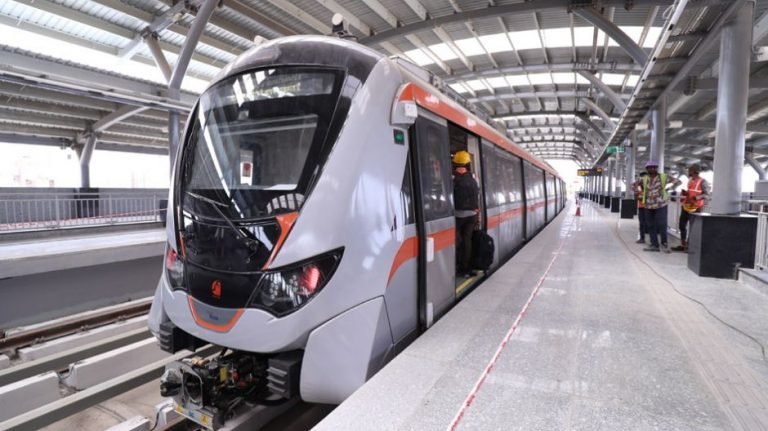
  • The high-speed aerodynamic Trainsets will be self-propelled on electric traction
  • As per the terms, the delivery of the rolling stock will start in 2022. The broad scope of work includes design, manufacture, supply, testing, and commissioning of:

– 30 Trainsets of 6 cars each for operating regional transit services

– 10 Train sets of 3 cars each for operating local Meerut transit services

  •  The RRTS rolling stock will be first of its kind in India with a design speed of 180 kmph.
  • The RRTS train will be designed keeping in mind high-acceleration and high-deceleration that the train needs to undergo given the maximum operational speed of 160kmph and stations at every 5-10km. 
  • The train will have automatic plug-in type doors reducing air-friction and noise. 
  • A key feature of the RRTS is interoperability of all its priority corridors which facilitates seamless commuter movement across the corridors without the hassle of changing the trains. The Trainsets will be operated with ETCS Level 2 signalling system, which is being used in India for the first time. ETCS Level -2 signalling system will not only facilitate interoperability but will also ensure train movement at quick frequencies, thus reducing the waiting time for passengers. 
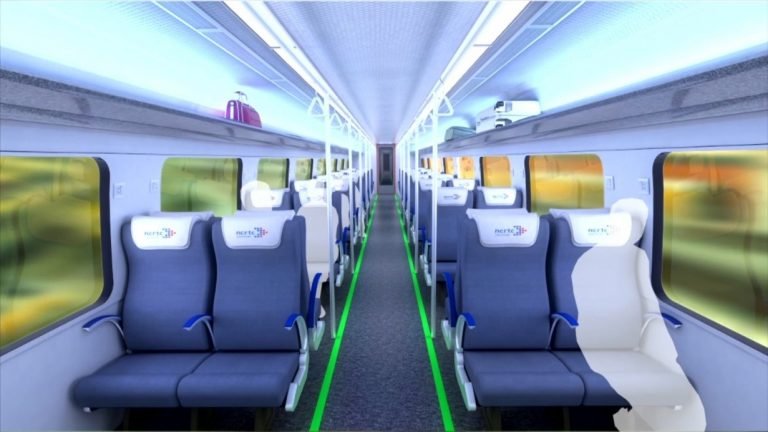
  •  Keeping the commuter convenience in mind, the 3.2 meter wide RRTS trains will have 2 by 2 transverse seating arrangement like Shatabdi Express besides comfortable standing space.
  •  Enough space for luggage, CCTV cameras, and other modern amenities will mark other features of the train.
  • The air-conditioned RRTS trains will have the economy as well as business class (one coach per train) along with one coach reserved for women passengers.

Rolling stock for Delhi-Meerut RRTS to be manufactured indigenously

NEW DELHI (Metro Rail News): On Wednesday the National Capital Regional Transport Corporation (NCRTC) announced in a statement that the rolling stock for the Delhi-Ghaziabad-Meerut RRTS would be manufactured marking 100% local manufacturing in India.

The NCRTC told Bombardier Transportation has acquired the rolling stock for the tender. The tender expense is around Rs 2,577 cr including procurement along with maintenance of the train sets.

The air-conditioned RRTS trains would have an economy with business class and a women commuters coach reserved.
According to officials, the construction is carrying out in the corridor.

Stocks that would be manufactured through the Bombardier transportation India Private Ltd at Gujrat Savli Plant under the “Make in India” action of the central govt would begin appearing
by 2022. 

Contract going to M/s Bombardier Transportation India Private Ltd total 40 trainsets would be manufactured in India, announced NCRTC chief public relations officer Sudhir Kumar Sharma.

RRTS train would operate at 180 kmph speed and with stations at every 5 to 10 km. It is designed that the train needs to undergo keeping in mind high acceleration & high deceleration.

“NCRTC would serve both the Rapid Rail & Metro Rail in Meerut on the same tracks. The ETCS Level two signalling system would be utilised for these trains for the 1st time to facilitate inter-operability, quick frequencies, to decrease waiting time for passengers,” an official replied.

With enough space for luggage, CCTV cameras, & other modern facilities would mark other features of the train, the NCRTC added.

Budget cuts affected Mumbai’s landmark projects escape

MUMBAI (Metro Rail News): The deep cuts in each capital expenditure projects may have announced by the state govt but infrastructure plans in the capital have appeared unscathed.

The ability of Mumbai to package their infrastructure projects attractively to multilateral lending agencies & formal lending institutions indicates that the landmark projects of the state have been spared budget cuts.

Mumbai Metro line 3 expansion projects Rs 30,000 cr, the bullet train project Mumbai-Ahmedabad Rs 90,000 cr, and the Mumbai Trans-Harbour Link Rs 14,260 cr are off-budget projects funded through multinational agencies foreign most prominently via Japan International Cooperation Agency.

The Mumbai-Nagpur expressway Samruddhi Corridor, state govt obtained financial closure of Rs 50,000 cr using a formal banking consortium headed by SBI where the Municipal Corporation of Greater Mumbai independently supports the Rs 14,000 cr coastal road project connecting south Mumbai with the western suburbs of the city and is unaffected through the budget cuts.

Ajoy Mehta the State Chief Secretary issued the govt resolution declaring the cut in expenditure on development plan and curbs on recruitment.

“The departments should carry out a review of continuous schemes and take a call on its deferment or the cancellation. This would be applicable even to those projects selected by the state cabinet before March 31, 2020. No new schemes are offered,” the govt resolution said.

The state govt announced a 67% cut in spending for developmental works this fiscal yr on Sunday in view of the expected revenue losses dua to the nationwide lockdown.

Only 33% of the entire outlay for project expenditure of about ₹1.15 lakh cr for this fiscal yr would be released by March 2021.

In Maharashtra, provided the scale & volume of extensive infrastructure projects, the state has been ready to attract funding from multilateral agencies.

In India, Maharashtra is on the top 3 states spending on infrastructure,ICRA vice-president Rajeshwar Burla said.

One of the areas that would be impacted is affordable housing, where two-thirds of the funding is divided among the Centre and the state, Burla further added.

Manoj Saunik additional chief secretary of Maharashtra Public Works Department said that every primary project is funded independently and would not be affected by budget cuts.

He further added that in some projects the govt would have to inject a little investment over the course of the project or would have to provide bank guarantees. But the project’s funding won’t be affected. Still, secondary road projects which is under PWD would be impacted.

Possible challenges and way ahead for Metro Rail Organization Post Lockdown

Covid-19 has changed everything around us. Our Financial decisions, our moral values and most importantly, it has changed the way think. We all know that coronavirus is going to stay with us a litter longer and as per our honourable prime minister, “we need to learn to live with it”. To learn to live with Covid-19, we need to encounter certain challenges. Most unavoidable challenges lie before the Metro Rail Industry. In this article, I will discuss the possible challenges for Metro Railway Industries and their possible solutions. 

  1. Air-Conditioned Coaches: – None of us would have ever thought that the comfort of seating in an Air-Conditioned coach could ever turn in to a nightmare for us. But today our realities have changed. Due to the presence of a single Covid-19 patient inside the A/C coach, there is a high chance that all other passengers might get infected. Post this lockdown, after the resumption of metro rail services, and metro rail organizations will have the most challenging job to decide how to run the trains for passenger service without compromising the passenger comfort. Other challenges would be “how cooling and ventilation can be maintained without putting the lives of the passenger at risk?”. When we think in this direction, an obvious solution comes to our mind is the screening of passenger before entry. However, we must note that screening before entry will work only for symptomatic patients but recently, we have learned that most of the cases in India are asymptotic. To deal with this, an SOP can be made which may comprise of the following: – 
  2. Cooling Trains before boarding of passengers and then switching it off till next few stations. 
  3. Sanitizing Train after passengers have deboarded and repeating point 1. 
  4. Trains shall avoid long Journey to prevent suffocation. 
  5. Availability of UV disinfectant lamps to disinfect the trains. 
  6. Maintaining Strict Social distancing parameters.

Additionally, Metro Rail organization may organize online competition for accommodating innovative devices to deal with this problem.  

  1. Ticket and Carriage Rules, 2014:  Ministry of housing and urban affairs, has omitted the clause of preventing entry of people with contagious diseases. Preventing people on the ground of illness would be a violation of the fundamental rights and the violation of Ticket and Carriage Rules, 2014. Therefore, the government should come with an amendment for allowing screening of people for a temporary basis. 
  1. Cash Management:  Metro Railways will face a challenge to sanitize the cash on a daily basis. Completely opting the digital payment can also not be an efficient solution. As there are still a large part of our population, don’t have digital literacy. Therefore, we must think out of the box to counter this problem. In my opinion, a single point cash handling system can be made to reduce the hand to hand transfer of cash. Metro Rail Organizations may also organize an online competition to generate ideas on better cash management. 
  2. Prevention of overcrowding at Station Area: In places like Delhi, overcrowding of stations can also prove to be a serious concern for Metro Rail Organization. Therefore, it is required that Metro Rail Organizations should think in this direction as well. Although I am no expert, I strongly believe that the following measures can aid in dealing with this problem: – 
  3. An airport like Security measures. 
  4. Not allowing passengers without Masks and Gloves. 
  5. Circles on Platform and concourse to maintain the social distancing protocol. No more passengers than the number of circles should be allowed to enter the station premises. 

Opinions shared above are purely mine, and It doesn’t reflect the opinion of the organization I am associated with. 

A Metro train being cleaned and sanitised at the Najafgarh Metro depot. All trains are regularly sanitised at the depots to keep them ready for safe resumption of services. (Video CopyRight: DMRC)

In case you want to discuss more on my suggestions, then please write to me at ranjesh1994@gmail.com

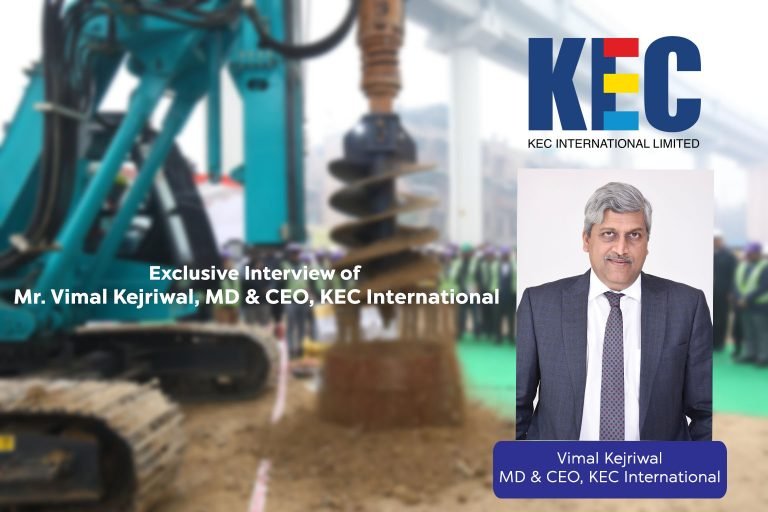
Exclusive Interview of Mr. Vimal Kejriwal, MD & CEO, KEC International

KEC International, an Engineering, Procurement, and Construction (EPC) headquartered in Mumbai, India, is the flagship company of the RPG Group. Which executes projects in Metro & Railway, Electricity transmission & distribution (T&D), civil, solar, smart infra and cables, did not face problems linked to payments or renegotiation of contracts during the lockdown, the company has seen delays in orders from its clients. In an exclusive interview of Vimal Kejriwal, Managing Director of KEC International, He talks about labour shortages might lead to alternative strategies by companies to increase productivity through mechanisation, automation and digitalisation of projects. Here are the edited excerpts:

How do you see the removal of restrictions on projects in the construction sector to help companies such as KEC?

Things are gradually getting back into action after the restrictions removed on April 20, 2020. We think that it will take at least another four-five days to get back to normal since we require the related suppliers for the construction work to continue in full swing.

Our projects require cement, steel and other materials for which we need to line up the logistics as well. We usually have stocks which are good enough for a week, but if the supply chain does not get cleared, then one starts to feel the stock-outs. The same things can happen in factories as well if they do not allow the vendors to open their shops. However, projects are slowly getting into shape.

As you are already in various segments like T&D, railway electrification, cabling and civil work for industries, which projects according to you are getting into shape?

The T&D projects have started at various places. Railway electrification work has also begun in Maharashtra. Civil projects like construction of cement factories and other industrials have got approvals. We are doing four metro projects; the one in Kochi has got approval for starting the construction activity, but the three projects in Delhi are stuck due to complete lockdown. In Maharashtra, we have got approval for railway electrification now. But unfortunately, we could not work during the lockdown on electrification, which we had requested.

What has been the impact on the completion of projects in FY20 due to lockdown?

There was not a serious impact on project completion due to lockdown in FY20 since only six days’ work was lost. Though, going ahead, we will require an extra effort to make up for the lost time of over 45 days. We will take at least two weeks to ramp up. So some of the lost time can be recovered, but if the lockdown continues beyond May, then the recovery could be complicated. The restoration for us will depend on two things — how much of logistics and the raw material is ready for ramp-up, and how many migratory workers we can retain.

How many workers do you have at present and will it help to ramp up your projects?

We had around 30,000 workers reached across 150 project sites before the lockdown. Currently, we are left with 20,000 workers, while 30% have left for their hometowns. These workers are staying at temporary quarters at the project sites, where their food, shelter and medical requirements are taken care of. So we have the advantage of starting the projects and ramping up immediately if the workers continue to remain with us.

How do you see the rise in transportation cost to impact your overall operations?

Overall the cost curve has gone down if we look at the cost of materials, such as aluminium, copper, steel or oil. This drop-in cost will help us to offset whatever little raise in the price we have seen in transport or otherwise unless there is an extended shutdown.

Do you see an essential part of your revenue coming from international operations in Q1FY21 since most of your factories and projects began abroad?

We suppose the international revenues to go up in Q1FY21 to at least 50% from 45% earlier as most of our projects are operational in more than 35 countries that we operate in. But the way domestic operations are coming up, the impact will only be for one month, that is April.

What is your outlook on overall improvement in coming quarters? Have you encountered payment related issues or order delays from your clients?

We have an order book of Rs 20,000 crore as of March 31, while Rs 3,000 crore is as L1. So for us, it is a question of revenue delay rather than revenue loss. For us, the revenue will come if not in this quarter then next quarter. By God’s grace, we have not had any issues related to payments or renegotiation of contracts. But we have seen a delay in orders from our clients. Going ahead, we foresee a dramatic change in our project executions as a lot of shift is seen in terms of mechanisations, automation and digitalisation of projects due to social distancing and labour shortages.

Can you explain in detail about the change in project execution?

With government mandating only 25% to 50% employee attendance due to social distancing, companies will have to find alternative ways of raising productivity. One way of doing it will be to mechanise, automate and digitalise the projects. It may take at least five-six months to automate the factories since it will require redesigning the factories or relocating them. Still, mechanisation, such as getting an excavator or a loader, can be done immediately.

Digitalisation will have to be done at different levels to overcome the issues of social distancing. However, it should be understood that the intent is to maintain social distancing and not reduce labour count.

What according to you, has been the most significant shift in the way companies have been operating since the lockdown?

In my   opinion, a bigger paradigm shift due to lockdown has been the ability of employees to work from home, which until now was unimaginable. We believe 15-20% of our office workforce can be shifted back to home, although it may not be possible for people deployed at project sites where physical presence is a must. But if mechanisation is introduced at project sites, then these people can be re-deployed to other projects.


(The Article First Appeared in Financial Times)