New Delhi: Prime Minister Narendra Modi has flagged-off the Delhi-Faridabad Metro Line that would allow hassle free travel for around two lakh daily commuters between the national capital and the industrial hub in Haryana.
The extension of the Delhi Metro connects Badarpur to Escorts Mujesar in Faridabad.
The total cost of the project from Badarpur to Escorts Mujesar is nearly Rs. 2,500 crore. Out of this, Rs. 1,557 crore was borne by the Haryana Government, the Centre contributed Rs. 537 crore, while the Delhi Metro provided Rs. 400 crore.
All these are elevated and located on either side of the Delhi-Mathura Road (NH-2).
“The nine-station metro corridor which was 95 per cent indigenously built will provide people a safe, affordable, quick, comfortable, reliable, environment-friendly and sustainable transport facility,” a Haryana government spokesperson said.
Haryana Chief Minister ML Khattar, addressing a press conference on Saturday, had thanked the Prime Minister for “gifting” the Metro service which would take the city to “another level of progress” with better connectivity with other NCR towns.
He had also said that the Prime Minister would be announcing the go-ahead for connecting Gurgaon with Faridabad by Metro.
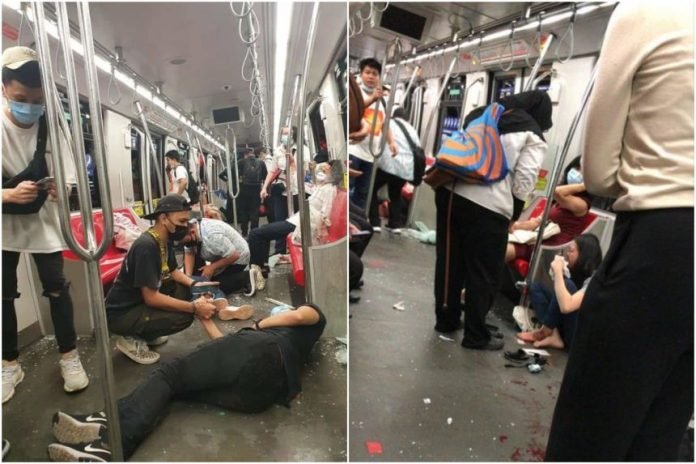
Two metro trains collide in Kuala Lumpur injured more than 200 people
KUALA LUMPUR (Metro Rail News): More than 200 people have been injured, including 47 suffering serious injuries, as two metro light rail trains collided in a tunnel in Malaysia’s capital Kuala Lumpur on Monday.
The accident happened around 8:30 p.m. local time as an empty train collided head-on with another one carrying 232 people on the Kelana Jaya Light Rail Transit (LRT) line at an underground section near the KLCC station outside the Petronas Towers.
The empty train had just been repaired and was travelling on the same track as the full train.
As per officials, the trains were not travelling fast at the time at the accident as one was going at 20 km per hour and the other at 40 km per hour.
They also said there was no sign of foul play and the accident appeared to have been caused by miscommunication.
According to Malaysian Transport Minister Wee Ka Siong, 166 people suffered light injuries while 47 were seriously injured, adding that some of the injured were sent to the hospital.
MUMBAI (Metro Rail News): The Mumbai Metropolitan Region Development Authority (MMRDA) will soon begin a trial run on a 20 km stretch from Aarey to Kamraj Nagar for Mumbai Metro Line 2A and Line 7 as MMRDA achieved another milestone in the overhead cable work of Metro Line 2A (Dahisar to DN Nagar) and Line 7 (Dahisar East to Andheri East).
On Monday, the chief electrical inspector of the government of India (CEIG) carried out an inspection through a video call of the Over Head Equipment (OHE) line of Metro Line 2A successfully for the section from Dahisar to Kamraj Nagar.
Overhead wire trials of Mumbai Metro Line 2A. Salute to the engineers and workers who made this happen! pic.twitter.com/hwQAb5Tef8
MMRDA shared updates to the officer through digital means because of the ongoing corona crises and imposed restrictions so that proposed plan of metro trial run could be carried out as stipulated. On Tuesday, the charging OHE on the Metro Line 2A for the said stretch will be done paving way to began trail run on 20 km stretch (Aarey to Kamraj Nagar).
On the other hand, the OHE line charging on Metro Line 7 (Aarey to Dahisar) has been done successfully after getting the required approval from CEIG.
As per MMRDA, an inspection of OHE by the CEIG is a prerequisite statutory requirement before the OHE is charged on 25kV 50Hz AC Supply. It is essential to commence the metro trial runs. The total length of these two metro lines is 35.1 km (Metro Line 2A-18.60 km and Metro Line 7–16.5 km), of which initially on 20 km stretch the trial run will be held. Currently due to the uncertainty owing to the Covid-19 pandemic the civil work on both these Metro lines has been affected largely and completion of entire work may take some more time. Therefore, the trial run will be held on the stretch where work has been attained. Also, simultaneously as work on other stretches on these Metro as and when completed the length of the trial run will be eventually increased, said R.A Rajeev, Metropolitan Commissioner, MMRDA.
MUMBAI (Metro Rail News): The Mumbai Metropolitan Region Development Authority (MMRDA) has decided to take over the operations and maintenance of Mumbai Metro Line-1 of route length 11.4 km connecting Versova-Andheri-Ghatkopar. For this purpose, MMRDA has approved the appointment of a Consultant to carry out the due diligence of assets before a takeover.
Mumbai Metro Line-1 is operated by the Metro One Operation Pvt. Ltd. (MOOPL) which is a special purpose vehicle (SPV) incorporated for the implementation of the project. Anil Ambani owned Reliance Infrastructure holds 69% of the equity share capital of MMOPL, while MMRDA holds 26% and the remaining 5% is held by RATPDEv Transdev Asia.
Last year, as per source, Reliance Infrastructure had written to the State Government asking to buy its stake in MMOPL, which runs the 11.5-km Line 1. It is Mumbai’s first Metro line, which was built on a Public-Private Partnership (PPP) model and was commissioned in 2014.
“Since MMRDA is constructing all Metro lines across the region, the acquisition will add synergy to the operation of other lines. Also since it is a public transport infrastructure and MMOPL is unable to run it, it is incumbent upon the government to take over,” said MMRDA commissioner R A Rajeev, adding that as a shareholder, the authority had the first right to buy R-Infra’s stake.
According to sources, Reliance Infrastructure evaluated its share value in MMOPL between INR 2,500-2,600 crores. The consultant will visit all the assets created by MMOPL, assess their value and compare against their book value, which will enable MMRDA to decide on the amount to be paid to R-Infra. The consultant’s report is expected in the next four months.
A major source of friction between MMRDA and MMOPL is the fare structure with the latter asking for a fare hike citing an increase of INR 1,935 crore in project cost over the original cost of INR 2,356 crore.
This line ridership is 4.5 lakhs commuters per day with average revenue of INR 1 crore every single day. However, the line is operating under losses and amidst the outbreak of the Covid-19, the situation further worsens as the line had been shut for several months last year due to the lockdown.
NEW DELHI (Metro Rail News): Delhi Metro Rail Corporation (DMRC) faced losses amounting to INR 1784.87 Crores in the FY 2020-21 as operations were either curbed or stopped because of Covid-19, as per reported by HT.
Delhi Metro was closed for more than five months last year as the nationwide lockdown was imposed and as Covid-19 cases increased again in the capital, the metro system has been closed again for the past two weeks to curb the menace of rapid increase of Covid-19 cases in Delhi.
According to Anuj Dayal, Executive Director of (Corporate Communication), DMRC,” There has already been a significant impact on DMRC’s revenues, and as long as the pandemic and associated travel norms are in place, losses are likely to remain or even increase with the passage of time. However, as a public service system, we are also committed to the cause of stopping the spread of the disease and will always extend all possible cooperation in this regard.”
“Even though operations resumed after five-and-a-half months of complete shutdown — from March 22 to September 7 — last year, services were restricted to ensure Covid-appropriate behaviour. After the Metro restarted, the passenger capacity of each coach was reduced from 300-350 to just 50. To ensure that the trains are sanitised after each trip, the waiting time on each route also increased from an average of three to six minutes earlier to 15 minutes”, said an official, as reported by HT.
Revenue records for the FY 2020-21 of DMRC shows that revenue from traffic operations, which includes income from tickets, feeder bus services and rentals, and other services stood at INR 895.88 Crores in comparison to INR 3,897.29 Crores in FY 2019-20.
DMRC financials books also show that in 2020-21, the agency ran into deficits of INR 1,784.87 Crores, as against a surplus of INR 758.01 Crores in 2019-20. In 2018-19, DMRC recorded a surplus of INR 1,027 Crores.
DMRC is also repaying loans amounting to INR 808.70 Crores and INR 433.85 as interest to the JICA (Japan International Cooperation Agency) which was utilized in the expansion of Delhi Metro rail network.
As the lockdown in the capital has been extended by another week, Delhi Metro will remain shut for another week and service can resume after 31st May if the government ease lockdown restrictions after 31st May. Covid-19 cases are now lowering in the capital from last one week.
NEW DELHI (Metro Rail News): Giving major assistance to the country in the wake of rising corona crises and overcoming the shortage of oxygen supply across various States battling Covid-19, Indian Railways has delivered till now more than 15284 MT of Liquid Medical Oxygen (LMO) through more than 936 tankers to various States across India.
A total of 234 Oxygen Expresses have completed their journey so far and brought relief to various States. First Oxygen Express to Assam with 80 MT of LMO in 4 tankers reached Assam on 23rd May. Delivery of Liquid Medical Oxygen (LMO) by Oxygen Expresses to Karnataka crossed 1000 MT. Oxygen Expresses have been delivering more than 800 MT of LMO to the Nation each day now.
Oxygen relief by Oxygen Expresses reached out to 14 states namely Uttarakhand, Karnataka, Maharashtra, Madhya Pradesh, Andhra Pradesh, Rajasthan, Tamil Nadu, Haryana, Telangana, Punjab, Kerala, Delhi, Uttar Pradesh and Assam.
According to Ministry of Railways, till date a total of 614 MT of Oxygen has been offloaded in Maharashtra, nearly 3609 MT in Uttar Pradesh, 566 MT in Madhya Pradesh, 4300 MT in Delhi, 1759 MT in Haryana, 98 MT in Rajasthan, 1063 MT in Karnataka, 320 MT in Uttarakhand, 857 MT in Tamil Nadu, 642 MT in Andhra Pradesh, 153 MT in Punjab, 246 MT in Kerala, 976 MT in Telangana and 80 MT in Assam.
It is Indian Railways endeavour to deliver as much LMO as possible in the shortest time possible to the requesting States. Criss crossing the country, Indian Railways is picking up oxygen from places like Hapa , Baroda, Mundra in the West and Rourkela, Durgapur, Tatanagar, Angul in the East and then delivering it to States of Uttarakhand, Karnataka, Maharashtra, Madhya Pradesh, Andhra Pradesh, Rajasthan, Tamil Nadu, Haryana, Telangana, Punjab, Kerala, Delhi, Uttar Pradesh & Assam in complex operational route planning scenarios.
In order to ensure that Oxygen relief reaches in the fastest time possible, Railways is creating new standards and unprecedented benchmarks in running of Oxygen Express Freight Trains. The average speed of these critical Freight trains is way above 55 in most cases over long distances. Running on high priority Green Corridor, with the highest sense of urgency, operational teams of various zones are working round the clock in most challenging circumstances to ensure that Oxygen reaches in the fastest possible time frame. Technical Stoppages have been reduced to 1 minute for crew changes over different sections.
Tracks are kept open and high alertness is maintained to ensure that Oxygen Express keeps zipping through. All this is done in a manner that speed of other Freight Operation doesn’t get reduced as well.
Central Vista Project to have Delhi Metro connectivity
NEW DELHI (Metro Rail News): Under the final phase of Central Vista revamp project, 10 office complexes comprising the Central Secretariat will have connectivity to the existing Delhi Metro network after they are built.
According to an official of the Central Public Works Department (CPWD), the company that will win the tender for the development will only construct an underground tunnel for this purpose.
The architectural consultant of the Central Vista project, the 10 office complexes of the Central Secretariat will emerge on the two parallel horizontal axes of the Rajpath. Designed along the lines of transit-oriented development (TOD), each complex will be interconnected through a loop and to the existing Delhi Metro lines (Yellow and Violet Lines), as per the design created by HCP Design, Planning and Management Pvt. Ltd.
During a presentation last year by Dr. Bimal Patel, head of HCP Design, Planning and Management Pvt. Ltd, “At the underground level, a people mover and an underground loop will connect to the Metro station. You get off the Metro and get inside the people-mover. It will go around in circles of the Secretariat and will be connected to the Metro. Such people-movers are seen in various international airports.”
A tender was floated in April, 2021 by CPWD for the first three secretariat office complexes which will emerge in front of the National Archives, where the Indira Gandhi National Centre for the Arts is situated and pre bid meetings with various firms also held in April end.
A total of seven firms participated in the pre bid meetings, they were Shapoorji Pallonji & Company Private Limited, MEP, L&T, JMC Projects (India) Ltd, Girdhari Lal Constructions Pvt Ltd, Montecarlo Ltd, and PSP Projects. The final date for submission of EOI (Expression of Interests) is June 15, 2021 and technical bids will open on May 25.
As per the notice inviting tender by CPWD, “ The work is estimated to cost (composite) Rs 34,08,81,22,602 (Civil & Horticulture component: Rs 21,12,09,34,804; Electrical & Mechanical component: Rs 11,57,18,41,562; Rs 1,39,53,46,236 for operation & maintenance for 5 years). This estimate, however, is given merely as a rough guide.”
The finalised plans for the three complexes show they would have two basement parking levels.
As per CPWD official,” The construction of the TOD will take time as the underground Metro network can be connected only when all Secretariat buildings are completed. This will be taken up in the last phase. Meanwhile, part of the underground tunnel for the Metro falling within the plot for buildings 1, 2 & 3 will be completed to avoid disruption at a later stage as these will be in use by then.”
Since the announcement of the “Atmanirbhar Bharat Abhiyan”, to support the Make in India policy and for springing back the Indian economy and further boosting it to make our county, INDIA a Five Trillion Economy, there are various doubts in the minds of a common person, the industries, and even the bureaucracy who are directly not involved in the framing this policy, which need to be clarified.
The real work done by the Government of India, including the Ministry of Urban and Housing Affairs in coordination with the Ministry of Railways at RDSO, needs to be brought to the light and clarified for the better understanding and for the total involvement of a common Indian citizen, the upcoming entrepreneurs and the MSME industries for realizing the noble goal of self-reliant India, the Atmanirbhar Bharat.
Under the Ministry of Railways in RDSO Lucknow one directorate has been set up exclusively to deal with the Safety Certification and Technical Clearance of the upcoming Metro Systems over Indian Territory. This directorate is named as “Urban Transport and High-Speed Directorate”. This Directorate acts as a single window service provider to all the upcoming metro rail systems in India, at the very planning stage itself, for its ensuring that a safer Metro System is created, with international safety standards. By the end of the year 2020 this directorate at RDSO has given the approval of 14 different Metro systems in the different cities. The documents and data provided by these Metro systems were analyzed and it was found that none of these 14 metro systems is having similarity to the other. This is basically due to the lack of adequate standardization done for the Metro Systems at Central Government level, up to the year 2013.
Now let us first understand, various policies and the stimulus packages announced by the Government of India to push up the ongoing Indian economy , with the active participation of MSME industries , other Business Houses and the financial institutions which can play a decisive role in bringing back the desired rate of annual growth of the Indian economy and further keep it boosting to achieve the “Five Trillion Mark” and making our country as self-reliant specially in the core sectors and finally achieving the goal of Aatmnirbhar Bharat.
Five main pillars support the framework of Atmanirbhar Bharat Policy
5 main pillars support the framework of Atmanirbhar Bharat
Economy: economy being its first pillar Government of India is looking for a Quantum jump instead of an incremental growth target is to make the Indian economy from existing 2 billion 5 billion by 2024
Infrastructure: when we say about the infrastructure it needs to be developed as per the world-class standards and represents the picture of modern India
Systems: this system needs to be developed to boost the economy has to be e technology-driven so that it helps take a big leap and sustained growth.
Demography: India is the richest country in its vibrant demography, we have an ample amount of trained workforce and trained engineers and business executives who are at present performing lesser than their capacity e due to various bureaucratic hindrances.
Demand: There is a huge demand of power supply I and also we have the capacity to upgrade the existing power plants to produce more Clean Energy to fulfil the requirements of industries to come up under Atmanirbhar Bharat.
Stimulus Packages for Atmanirbhar Bharat
Government of India has announced its stimulus packages for 5 different areas
Manufacturing and MSMEs
Here we will be concentrating the discussion only on the First Pillar : Business including the MSME,s.
Government has announced Emergency Credit Line to Businesses/MSMEs from Banks and NBFCs up to 20% of entire outstanding credit as on 29.2.2020
Borrowers with up to Rs. 25 crore outstanding and Rs. 100 crore turnover eligible
Loans to have 4 year tenor with moratorium of 12 months on Principal repayment
Interest to be capped
100% credit guarantee cover to Banks and NBFCs on principal and interest
No guarantee fee, no fresh collateral7. 45 lakh units can resume business activity and safeguard jobs
8. Subordinate Debts.
1.Rs 20,000 Crs. Subordinate Debt for Stressed MSMEs : As after the jolt of Corona Wave Stressed MSMEs need equity support , GoI will facilitate provision of Rs.20,000 Crs.as subordinate debt. From this about two lakh MSMEs are likely to be benefited. The Functioning MSMEs which are NPA or are stressed will be eligible
2. Govt. will provide a support of Rs. 4,000 Cr. to CGTMSE , CGTMSE will provide partial Credit Guarantee support to Banks . Promoters of the MSME will be given debt by banks, which will then be infused by promoter as equity in the Unit.
9. Rs 50,000 Crs. Equity Infusion for MSMEs : MSMEs face Severe Shortage of Equity. Fund of Funds with Corpus of Rs 10,000 Crs is set up. Provide equity funding for MSMEs with growth potential and viability. FoF operated through a Mother Fund and few daughter funds Fund structure leverages Rs 50,000 cr of funds at daughter funds level Expand MSME size as well as capacity. Encourage MSMEs to get listed on main board of Stock Exchanges.
10. Revised Definition of MSMEs : Indian Government has redefined the definition of MSME,s , which is summarized below :
Revised Definition of MSMEs
11. No Global tenders up to the value of Rs 200 Crs :
Indian MSMEs and other companies have often faced unfair competition from foreign companies. Therefore No Global tenders in Government procurements up to Rs 200 Crs. Necessary amendments of General Financial Rules will be done. This is an important Govt. step towards Atmanirbhar to support Make in India Environment.This is expected to help MSMEs to boost their business by multifold.
12. Other Measures:On the request of the Government of India, RBI raised the Ways and Means advance limits of States by 60% and enhanced the Overdraft duration limits.
Issued all the pending income-tax refunds up to ₹5 lakh, immediately benefiting around 14 lakh taxpayers
Implemented “Special Refund and Drawback Disposal Drive” for all pending refund and drawback claims
Both the above measures amount to Rs 18,000 crore of refund.
Sanctioned Rs 15,000 crores for Emergency Health Response Package
Provided Relaxation in Statutory and Compliance matters
Extending last date for Income Tax Returns to June 30, 2020
Extending filing GST returns to end of June 2020
24*7 custom clearance till 30th June, 2020
Relaxation for 3 months for debit cardholders to withdraw cash free from any ATMs, etc
Allowing payment before 15 May, 2020 for Motor Vehicle and Health Insurance Policies
Mandatory Board meetings extended by 60 days till 30 September
Allowing Extraordinary General Meetings through Video Conference with e-voting/simplified voting facility
13. Measures taken by Reserve Bank of India :
Reduction of Cash Reserve Ratio (CRR) has resulted in liquidity enhancement of Rs.1,37,000 crores
Targeted Long Term Repo Operations (TLTROs) of Rs.1,00,050 crore for fresh deployment in investment grade corporate bonds, commercial paper, and non-convertible debentures.
TLTRO of Rs.50,000 crore for investing them in investment grade bonds, commercial paper, and non-convertible debentures of NBFCs, and MFIs.
4. Increased the banks’ limit for borrowing overnight under the marginal standing facility (MSF), allowing the banking system to avail an additional Rs.1,37,000 crore of liquidity at the reduced MSF rate.
Announced special refinance facilities to NABARD, SIDBI and the NHB for a total amount of Rs.50,000 crore at the policy repo rate
Announced the opening of a special liquidity facility (SLF) of Rs.50,000 crore for mutual funds to alleviate intensified liquidity pressures.
Moratorium of three months on payment of instalments and payment of Interest on Working Capital Facilities in respect of all Term Loans
Easing of Working Capital Financing by reducing margins
For loans by NBFCs to commercial real estate sector, additional time of one year has been given for extension of the date for commencement for commercial operations (DCCOM)
14. Relief to the Contractors:
Extension of up to 6 months (without costs to contractor) to be provided by all Central Agencies like Railways, Ministry of Road Transport & Highways, Central Public Works Dept, etc)
Covers construction/ works and goods and services contracts
Covers obligations like completion of work, intermediate milestones etc. and extension of Concession period in PPP contracts
Government agencies to partially release bank guarantees, to the extent contracts are partially
Completed, to ease cash flows
15. Extension of Registration and Completion Date: For Real Estate Projects under RERA
Adverse impact due to COVID and projects stand the risk of defaulting on RERA timelines. Time lines need to be extended.
Ministry of Housing and Urban Affairs will advise States/UTs and their Regulatory Authorities to the following effect:
Treat COVID-19 as an event of ‘Force Majeure’ under RERA.
Extend the registration and completion date suo-moto by 6 months for all registered projects expiring on or after 25th March, 2020 without individual applications.
Regulatory Authorities may extend this for another period of up to 3 months, if needed
Issue fresh ‘Project Registration Certificates’ automatically with revised timelines.
Extend timelines for various statuary compliances under RERA concurrently.
These measures will de-stress real estate developers and ensure completion of projects so that homebuyers are able to get delivery of their booked houses with new timelines.
16. Rs 30,000 Crs. Special Liquidity Scheme for Financial Institutions ( NBFCs/HFCs/MFIs:
NBFCs/HFCs/MFIs are finding it difficult to raise money in debt markets.
Government will launch a Rs 30,000 Crs. Special Liquidity Scheme
Under this scheme investment will be made in both primary and secondary market transactions in investment grade debt paper of NBFCs/HFCs/MFIs
Will supplement RBI/Government measures to augment liquidity
GoI will fully guarantee securities
This will provide liquidity support for NBFCs/HFC/MFIs and mutual funds and create confidence in the market
17. Rs. 90,000 Cr. Liquidity Injection for DISCOMs:
Revenues of Power Distribution Companies (DISCOMs) have plummeted.
Unprecedented cash flow problem accentuated by demand reduction
DISCOM payables to Power Generation and Transmission Companies (GENCOs) is currently ~ Rs.94,000 Crs.
PFC/REC to infuse liquidity of Rs 90,000 Crs. to DISCOMs against receivables
Loans to be given against State guarantees for exclusive purpose of discharging liabilities of DISCOMs to GENCOs
Linkage to specific activities/reforms: Digital payments facility by DISCOMs for consumers,
Liquidation of outstanding dues of State Governments, Plan to reduce financial and operational losses. Central Public Sector Generation Companies shall give rebate to DISCOMs which shall be passed on to the final consumers (industries)
18. Rs 45,000 Crs.Partial Credit Guarantee Scheme: For NBFCs , NBFCs, HFCs and MFIs with low credit rating require liquidity to do fresh lending to MSMEs and individuals
Existing PCGS scheme to be extended to cover borrowings such as primary issuance of Bonds/ CPs (liability side of balance sheets) of such entities
First 20% of loss will be borne by the Guarantor i.e., Government of India.
AA paper and below including unrated paper eligible for investment (esp. relevant for many MFIs)
This scheme will result in liquidity of Rs.45,000 Crs.
19. Tax Related Measures:
Rs 50,000 Crs. liquidity through TDS/TCS rate reduction
In order to provide more funds at the disposal of the taxpayers, the rates of Tax Deduction at Source (TDS) for non-salaried specified payments made to residents and rates of Tax Collection at Source (TCS) for the specified receipts shall be reduced by 25% of the existing rates.
Payment for contract, professional fees, interest, rent, dividend, commission, brokerage, etc. shall be eligible for this reduced rate of TDS.
This reduction shall be applicable for the remaining part of the FY 2020-21 i.e. from tomorrow to 31st March, 2021.
This measure will release Liquidity of Rs. 50,000 Crs.
20. Other Direct Tax Measures:
All pending refunds to charitable trusts and non corporate businesses & professions including proprietorship, partnership, LLP and Co-operatives shall be issued immediately.
Due date of all income-tax return for FY 2019-20 will be extended from 31st July, 2020 & 31st October, 2020 to 30th November, 2020 and Tax audit from 30th September, 2020 to 31st October, 2020.
Date of assessments getting barred on 30th September, 2020 extended to 31st December,2020 and those getting barred on 31st March,2021 will be extended to 30th September, 2021.
Period of Vivad se Vishwas Scheme for making payment without additional amount will be extended to 31st December, 2020
21. Industry 4.0 : Directives of NITI Aayog on this issue are :
Launch a major initiative to push industry to adopt Industry 4.0. Industry 4.0 is characterized by increasing digitization and interconnection of products, value chains and business models.
It will significantly impact sectors like automobile, pharmaceuticals, chemicals and financial services and will result in operational efficiencies, cost control and revenue growth.
Experts feel that emerging markets like India could benefit tremendously from the adoption of Industry 4.0 practices.
The development of industries that produce the key building blocks forming the basis of Industry 4.0 could be incentivized.
Incentives could be focused on MSMEs that manufacture products including sensors, actuators, drives, synchronous motors, communication systems, computer displays and auxiliary electromechanical systems.
Similarly, industries adopting Industry 4.0 standards could be provided support for a fixed period of time
22. Opportunities For Indian Industries: Work Already done by Metros and NHRCL :
Delhi Metro has already Indigenized 18 Subsystem and 17 UNIT EXCHANGE SPARES costing 18.7 Lakh US $ and 34 Sub Systems costing 3.83 Lakh US $ are identified for Indigenization .
Nagpur Metro is Looking forward for indigenization of 28 different items costing Rs.13.74 Crores per train set..
National High Speed Rail Corporation Limited has also identified various items, where Indian Industries can make a substantial Impact:
In Track Engineering related items, 12 items out of total 20 Items, Items required for Civil Engineering construction work 50 items out of total 52 Items, Items of Electrical Engineering, Signaling and Telecommunication Engineering 48 items out of total 78 Items and for Rolling Stock 6 items out of total 24 items, are identified and thrown open to the Indian entrepreneurs, for Make In India
23. Work Already Done By MoUHA with MoR :To facilitate further the Make in India initiative , Ministry of Urban Transport and Housing Affairs , in association with Ministry of Railways have taken following steps :
The Std. of Rolling Stock and Signaling System of Metro Rails in India Have been notified in 2017, after the approval of Railway Board.
The Standards of Rolling stock fixes the Standards of the Civil structure.
The Standards of Electrical System have been concurred by Railway Board and going to be notified soon.
Various Metro Rails have already started procurement as per notified standards.
To Further strengthen the efforts for Make in India MoUHA may consider floating of Unified Tender for Rolling stock and Signaling system for all new Metro Rails planned for next 10 to 15 years of requirements , and if not for all the metros but at least Metros Coming up in one state. This will give the minimum brake even quantities, which give the economic viabilities to the investors.
Manufacturing of Rolling Stock can be taken up by Indian Railways Production Units like Modern Coach Factory , Raibereli, Integra Coach Factory , Rail Coach Factory Kapurthala with Transfer Of Technology and Testing and Validation facilities . This will not only lead to the reduction of coast of Metro Projects, but also facilitate export and utilization of installed capacities.
Manufacturing of Propulsion System in INDIA may be taken up by Public Sector Units and Private Indian Industries like BHEL, BEL, L&T, Kirloshkar Electrical, Crompton Greaves, etc.
Manufacturing of Signaling Systems in INDIA can be taken up by BEL, CDAC, BHEL, TCS.
Teri can allocate licensed Communication frequencies for Train Control for better Security and Reliability.
25. Immediate future Need : There is an Urgent Needto propagate the concept of : “ One Nation – One Metro System” . This is the time for consolidation of Indian Industries for manufacturing of Metro Rolling Stock in India.
As a starting step Pune Metro has given its order for manufacturing and supply of 102 Ultra-Modern Rolling Stock to a newly formed Indian Industry in collaboration with Italian Firm “TITAGARH FIREMA” while deciding its international bid.
MoR and MoUHA are there for Facilitating the Investments, by Standardization.
NITI Aayog has already published its policy to help INDIAN Industries. Industries need to gear up itself for industry 4.0 standards
26. Current and Future Trend of Indian Economy:
Current and Future Trend of Indian Economy | Image Copyright: India Today
Due to adverse impact of Covid-19 on the Indian Economy , the expected Economic growth for the Financial Year 2020-2021 is at best will be (-) 7.5% .
However considering various steps taken by the Government of India and various stimulus financial packages announced in the Revised Budget 2020 and General Budget 2021-22 , IMF has expected the Indian Economy to take a quantum jump and touch the mark of (+) 11.5% . We the Indian also believe that if we decide we will be Atmanirbhar. Let us break our inertia and the condition of inaction and start taking the steps forward towards the goal of Atmanirbhar Bharat.
Los Angeles, California (Metro Rail News): The California Transportation Commission (CTC) in its May meeting has allocated a total of $924 million to improve transport infrastructure throughout the State including $27.8 million to purchase new light rail vehicles for the Los Angeles County Metropolitan Transportation Authority (L.A. Metro).
L.A. Metro will use this fund to buy 78 new light rail vehicles with an option to buy an additional 39. For the fiscal Year2022, the Los Angeles transit agency has proposed spending $92 million for light and heavy railcar purchases for replacement and expansion.
Other projects for which funds are allocated by CTC includes $6.5 million to purchase 05 zero-emission battery-electric buses and for the construction of charging infrastructure to create “a zero-emission over-the-road coach commuter route” between the Greater Long Beach area and the University of California, Los Angeles (UCLA).
Funds amounting to $5 million allocated to complete the environmental documentation for the Vermont Transit Corridor which will result in either a Bus Rapid Transit (BRT) or rail transit service between Hollywood Boulevard and 120th Street.
According to Toks Omishakin, Director of Caltrans, the State’s transportation department, “Caltrans is building a brighter future through a transportation network that serves all Californians. buy kamagra gold online https://myhst.com/wp-content/themes/twentytwentytwo/inc/patterns/en/kamagra-gold.html no prescription
This significant investment will help us fortify and enhance our state’s vast network of highways, bridges, transit facilities, bikeways and pedestrian routes”.
NEW DELHI (Metro Rail News) : In the FY 2021-22, Indian Railways registers a growth of 59.38% in freight loading. In the given year, Indian Railways total loading is 185.04 million tonnes (MT) which is 59.38% higher than the previous year loading figures of 116.1 MT for the same period and 10.37% higher compared to the year 2019 loading figures (167.66 MT) for the same period.
In this period, Indian Railways earned INR 18542.8 Crores from freight loading which is 4.92% higher than the year 2019 earning from freight which was INR 17674 Crores and 75.93% higher than the year 2020 (INR 10540.1 Crores) for the same period.
Indian Railways has maintained the momentum of highest ever loading in consecutive 09 respective months from September, 2020 to May, 2021. On mission mode, Indian Railways’ Freight loading for the month of May 2021 crossed 2019 & 2020 year’s loading and earnings for the same period.
Coal sector has shown a sustained growth. Indian Railways loaded 88.15 MT Coal in this FY 2021-22 which is a growth of 54.03% compared to the last year 2020 (57.23 MT) and 1.39% compared to the year 2019 loading (86.94 MT).
In the month of May 2021 (till date), Indian Railways loading was 73.45 million tonnes which is 44.99% higher compare to last year’s loading for the same period (50.66 million tonnes). It is 10.27% higher than the year 2019 loading figures (66.61 MT) for the same period.
Indian Railways loading was 73.45 million tonnes which includes 35.62 million tonnes of coal, 9.77 million tonnes of iron ore, 3.38 million tonnes of foodgrains, 2.22 million tonnes of fertilizers, 2.02 million tonnes of mineral oil and 3.15 million tonnes of cement (excluding clinker).
In May 2021, Indian Railways earned INR 7368.00 Crores from freight loading which is also 62.20% higher compared to last year’s earnings for the same month (INR 4541.21 Crores) & 4.93% higher compared to the year 2019 earning figures (INR 7021.75 Crores) for the same period.
It is worth mentioning that a number of concessions/ discounts are also being given in Indian Railways to make Railways Freight movement very attractive.
It may be noted that freight trains speed has also registered significant increase in the existing network. Covid-19 has been used by Indian Railways as an opportunity to improve all round efficiencies and performances.
NEW DELHI (Metro Rail News): Alstom Transport India emerged as the single bidder for the supply and commissioning of Train Control and Signaling system along with Virtual Signal implementation for Delhi Metro’s Red Line (Line-1) from Shaheed Sthal to Rithala of length 34.4 km with 29 stations.
Delhi Metro Rail Corporation (DMRC) invited bids for this work in March 2021 with an approximate cost of work to be INR 90. buy strattera online https://pavg.net/wp-content/themes/twentytwentyone/inc/en/strattera.html no prescription
27 Crores and completion of a period of 15 months. Technical bids were opened on Thursday which reveals Alstom as the only bidder for this contract. Red Line of Delhi Metro is presently equipped with Alstom’s Urbalis 200 Train Control and Signaling Solution.
Contract Number: CS56
Name of Work: Design, Manufacture, Supply, Installation, Configuration/Customization, Testing and Commissioning of Train Control and Signaling System for Short looping train movement along with Virtual signal implementation and Six car to eight car trains conversion along with Head stopping at all platforms of Line-1 and Integration of Train Control and Signaling system of Line-1 with Third Party ATS system.
DMRC initiated the process of signaling upgradation in 2019 on its Red, Yellow and Blue Lines with the purpose to identify glitches and upgrade systems as per requirement so that affected trains still runs at regular speeds of 33-37 km per hour along with providing smooth operations of trains and prevent stations from overcrowding.
For the Blue Line, the contract is awarded to Siemens with value of INR 86.21 Crores in June 2020 while for Yellow Line upgradation, there is also Alstom is the single bidder with financial bid opened in March 2021 and the award of contract for the same is still pending.