Home Blog Page 436

Overview of Hydrogen Powered train on World Environment Day

0
Hydrogen Powered train: Alstom Coradia iLint
Hydrogen Powered train: Alstom

The environment is one of today’s main issue with all societies being concerned. According to the annual ‘State of Global Air 2020’ report, around 6.7 million deaths were reported globally due to long-term exposure to air pollution in 2019. China (1.8 million) and India (1.6 million) together accounted for more than half of such deaths. Researchers from McGill University stated that over half of the world’s population lives without the protection of adequate air quality standards. Nitrogen dioxide (NO2) and particulate matter are two of the most dangerous air contaminants to human health. While stating that air pollution is globally the fourth highest cause of death, the report suggests that it is the largest risk factor for deaths in India.

With the global demand for passenger traffic expected to increase by more than double between 2015 and 2050, there is an urgent need to take substantive steps to cut emissions from transport. Sustainability is going to be the biggest game-changer going forward. Leading societies to a low carbon future, Alstom develops and markets mobility solutions that provide the sustainable foundations for the future of transportation. When it comes to hydrogen cell-powered trains, Alstom is the only company in the world to have a product on tracks and not merely on the drawing board. The Coradia iLint is the world’s first passenger train powered by a hydrogen fuel cell, which produces electrical power for traction. This zero-emission train emits low levels of noise, with exhaust being only steam and condensed water. It is a perfect illustration for the company’s commitment to designing and delivering innovative and environmentally friendly solutions.

In line with the aim to facilitate a global transition to a low-carbon transport system, it was at InnoTrans 2016 in Berlin that Alstom presented the Coradia iLint for the first time. The launch of the CO2-emission-free regional train that represents a true alternative to diesel power positioned the company as the first railway manufacturers in the world to develop a passenger train based on hydrogen technology. The Coradia iLint is special for its combination of different innovative elements: clean energy conversion, flexible energy storage in batteries, and smart management of traction power and available energy. Specifically designed for operation on non-electrified lines, it enables clean, sustainable train operation while ensuring high-performance levels. And just two years later, in 2018, the iLint entered into commercial service in Germany. This is the first time in the world that commercial trains powered by hydrogen-based cell have gone into use for transporting passengers.

This technology is gaining momentum quickly. Alstom has performed ten days of tests of the Coradia iLint hydrogen fuel cell train on the 65 kilometres of line between Groningen and Leeuwarden in the north of the Netherlands. The tests follow 18 successful months of passenger service on the Buxtehude–Bremervörde–Bremerhaven–Cuxhaven line in Germany, where total of 41 Coradia iLint have already been ordered. The latest tests make the Netherlands the second country in Europe where the train has proven itself a unique emissions-free solution for non-electrified lines. Alstom has received follow-up orders in Italy and France, led a pilot project in the UK and ran successful test runs in Austria, and Germany. Other countries already looking into buying their trains including U.K, Netherlands, Denmark, Norway, Italy and Canada.

The iLint was designed by Alstom teams in Salzgitter (Germany), the centre of excellence for regional trains, and in Tarbes (France), the centre of excellence for traction systems. This project benefitted from the support of the German Ministry of Economy and Mobility and the development of the Coradia iLint was funded by the German government, as part of the National Innovation Program for Hydrogen and Fuel Cell Technology (NIP).

Some specifications of Coradia iLint:

  • According to the company, the trains are low-noise, zero-emission and can reach speeds of up to 140km per hour.
  • For now, the train will only operate on 100 km of line running between Cuxhaven, Bremerhaven, Bremervörde and Buxtenhiede though they are capable of running longer distances.
  • These will replace the current diesel fleet on the train line and help reduce emission.
  • Alstom plans to delivers a further 14 Coradia iLint trains to the network by 2021.
  • Hydrogen is seen as a low-emission and efficient alternative to diesel, ensuring that the trains are environment friendly.
  • Each train cost $7 million (around 50 crore rupee)   

How does it work?

The Coradia iLint is the first low floor passenger train worldwide powered by a hydrogen fuel cell which produce electric power. This zero-emission train is silent and only emits steaming condensed water and any excess energy is stored in iron lithium batteries on board. The train hydrogen tank feeds a fuel cell that generates energy, which is then pushed to an electrical drive train and has a small battery which help to maintain power continuity as well as storing energy safe from regenerative braking. These new hydrogens can run for about 600 miles or 1000 kilometer on a single tank of hydrogen. Similar to the range of diesel trains, it will run 100 kilometer trips at up to 87 miles or 140 kilometers per hour, so they operate in the same way as existing diesel trains to avoid any culture shock for passengers and crew except that they need to refuel their 1000 kilometer capacity tanks are dedicated h2 fueling stations these trains would be a great addition to any regional area where diesel trains can’t be run. They may be more expensive to buy but it’s cheaper to run out to mention they are quiet and have zero-emission.

Why Germany has launched this train

CORADIA iLINT Chart
CORADIA ilint Train Chart

Air pollution has become an increasing problem in Germany, with nitrous dioxide causing over 10,000 premature deaths in 2016. Germany is very sensitive in these matters and took it seriously. Alstom is optimistic that the Coradia iLint trains will catch on, with a focus on making non-electrified train lines more environmentally friendly.

India on hydrogen powered trains

Indian Railway plans hydrogen-powered engine for passenger trains by end of 2021

Alstom Coradia iLint

As part of efforts to find alternative sources of fuel to power its trains, and to reduce reliance on fossil fuel-based energy sources like diesel and electricity, Indian Railways has set in motion efforts to build a hydrogen-powered rail engine that can propel a passenger train on a suburban route by the end of 2021.

Bids Invited for Hydrogen Fuel Cell-Based Hybrid Train Between Kalka and Shimla. The tender was initially floated in October 2019, and the bid submission deadline was December 31, 2020. The Indian Railways Organization for Alternate Fuels (IROAF) has issued a request for proposals to build a hydrogen fuel cell-based hybrid power train for retrofitting the 700 HP diesel hydraulic locomotives that operate on the narrow-gauge Kalka-Shimla segment in Himachal Pradesh. The scope of work will include the design, supply, and retrofitting, testing, certification, prove out, and field trials of fuel cell and battery-based power stack modules, hydrogen storage, power electronics, and related facilities, as well as engineering and supervision work for retrofitting on diesel-hydraulic locomotives.

As per the tender document, the total energy requirement for up and down trips based on actual driving cycles, is 1,556 kWh and 1,170 kWh, respectively. The power train, consisting of the primary energy source as the proton exchange membrane fuel cell and secondary energy source, which is the battery bank, should meet the peak power requirement. The power train should have minimal weight and not exceed the structural limits of the locomotive underframe, bogies, and superstructure. The energy management strategy should be designed such that the battery state remains the same from the start of the cycle to the end.

The diesel-hydraulic locomotive could be designed to operate in temperatures ranging from 10 to 55 degrees Celsius. The locomotive can have to run in an extremely dusty setting, necessitating the use of lithium-ion batteries. Alternative batteries, however, would be approved depending on efficiency. Indian Railways has been pursuing clean technology solutions to become a net-zero emitter by 2030.

Impact:

  • Cost

Purchasing and assembling hydrogen-powered trains is more costly than diesel locomotives. Nonetheless, since lithium-ion batteries are rechargeable, the operating and replacement costs will be smaller in the long term.

  • Speed

These hydrogen-powered trains can travel at a top speed of 140 km/h, which is comparable to diesel and electric trains.

  • Green economy

Using hydrogen propulsion in trains would help to reduce vehicular emissions.

  • Revenue

Hydrogen-powered trains emit no noise and can have new amenities, enticing more people to ride by rail.

  • Capacity

Hydrogen-powered trains can transport up to 300 passengers at once, increasing vehicular capacity.

Challenges:

  • Production

Hydrogen is not abundant in the atmosphere. As a result, it necessitates an energy input as well as a set of procedures to generate, transport, and then use it. The challenge is to find the most cost-effective and convenient one by extensive research and development.

  • Infrastructure for refuelling and delivery

If hydrogen must be refilled into onboard cylinders, technology and distribution infrastructure must be built.

  • High production costs

While hydrogen-powered trains prove to be more cost effective in the long run, they are still more costly than diesel locomotives, costing about Rs. 53.29 crore per engine.

  • Uncertainty over freight applications

The technology is efficient enough to shuttle passenger services. However, it is unclear if the same can be used to pull heavyweight freight traffic. 

Conclusion:

According to a report by Strategy&, the strategy consulting arm of management consulting firm PwC., global demand for hydrogen will almost double from 71 to 137 million metric tons per year by 2040, compared with 2019. The growth will be primarily due to the decarbonization of various sectors such as transportation, aviation and industry. Demand is expected to reach 519 million metric tons by 2070.

In India, the year 2021 is projected to be the year of hydrogen fuel cells. Certainly, this will be the most powerful driving force in meeting the goal of electrifying the entire rail network by 2024. This will make it the world’s first railway of this scale and complexity to operate solely on electricity. So far, 37,500 km (58%) of routes are electrified with 25 KVAC electric traction in India.               

In the future, hydrogen is projected to be the most exciting technology for establishing a zero-emission railway network in India by 2030, paving the way for a more prosperous future.

World First Hydrogen Fuel Train | How do hydrogen trains works?
Advertisement1
InnoMetro_2026

Clean Metro, Green Metro: Regenerative Braking Technology in Metro Trains and Lifts will save electricity

0

KANPUR (Metro Rail News): Uttar Pradesh Metro Rail Corporation Ltd. (UPMRC) has always intended to provide not only a safe and convenient mode of transport to the citizens in the form of Metro Services but also the Metro Project being constructed inside the city should be the top in the list of Environmental Protection. After Lucknow, UPMRC continued this expedition in Kanpur. Recently, Kanpur Metro’s Priority Corridor has received ISO 14001 for environment management. – Kumar Keshav, MD, UPMRC

On the special occasion of Environment Day, Special arrangements have been made by Kanpur Metro to conserve electricity, water and trees:

1- The Metro Trains that is going to be operational in Kanpur will be equipped with Regenerative Braking Technology. Under this technique, the energy generated during the braking in the train is conserved and used back in the metro system. Kanpur Metro will be saved almost 45% energy through this technology, it means out of 1000 units being used in running of Trains almost 450 units are generated through Regenerative Braking Technology, which will be used back in the Metro system.

In addition, lifts to be installed at stations and depots will also be able to save energy with the above-mentioned technology. These will have up to 37% energy efficiency.

All the metro premises will have 100% LED lighting for energy saving. Apart from this, the plan is also being prepared to install solar panels at Metro Depots and Stations.

2- The Polytechnic Depot of Kanpur Metro will be equipped with a ‘Zero Discharge Facility’ i.e. the wastewater will not be disposed or discharged but inclusively recycled and used for various purposes. There will be two water treatment plants to be installed in Depot.

A sewage treatment plant (STP) of 10,000 liters per day capacity will be used to recycle gray water i.e. water that comes from the kitchen, washroom, and floor cleaning, etc.

At the same time, an Effluent Treatment Plant (ETP) with a capacity of 70 thousand liters per day will be installed in the automatic washing plant for the cleaning of the trains and to recycle the chemical-rich black water which comes from the repair of trains in the maintenance shed.

3- Kanpur Metro will have the capacity of ‘Rain Water Conservation’ up to 15 lakh liters

All the arrangements are being prepared for Rain Water Conservation. The all stations of the Corridors, the Metro Depot, and the 32.4 km long viaduct, a target has been set to develop a water conservation capacity of about 15 lakh liters. The viaduct will also have a system for carrying water at every other span down to the pit in the median. Around 180 pits to be built from October this year under the Priority Corridor (IIT to Motijheel) will be ready for water conservation.

4- 10 ‘Saplings’ will be planted in place of ‘One Tree’

Primarily, it is the endeavor of UPMRC that the Metro alignment should be designed in such a way that the situation of tree removal would not come up. If the situation arises, efforts are made to translocate (to move them from one place to another) them, if possible, keeping in view the age, thickness, and other factors of the tree. Trees that cannot be translocated are removed and then 10 new saplings are planted in the place of one tree. Till now 183 trees have been translocated in Kanpur.

Not only this but also saplings will be planted in the middle of the entire Elevated Corridor of Kanpur Metro and will be taken care of regularly by UPMRC. Plantation work is still going on at every possible place in the Polytechnic Metro Depot.

Advertisement1
InnoMetro_2026

First pier of elevated RRTS corridor in Delhi has been constructed

0
First pier of RRTS corridor constructed in New Ashok Nagar

DELHI (Metro Rail News): The first pier of elevated section of the RRTS corridor in Delhi portion has been constructed near upcoming New Ashok Nagar RRTS station. The height of the constructed pier is 6.5 meters, and average height of the piers in the stretch varies from 5.6 meter to 17 meters.

Delhi Portion of Elevated RRTS section starts from Sarai Kale Khan RRTS Station and passing above existing Barapulah Flyover in way of crossing Yamuna river to reach New Ashok Nagar RRTS station. A first RRTS Yamuna bridge is also under construction for crossing Yamuna river almost parallel to the DND Flyway.

The foundation work including piling and pile caps is in full swing between New Ashok Nagar to Kondli under package 6 contract and around 2 km of foundation work has already been completed out of the 9.2 km elevated corridor in Delhi.

NCRTC team is keeping the pace of the project intact to meet the stringent timelines despite the unprecedented challenges faced due to COVID-19. All construction activities are being carried out while following Covid appropriate behaviour on sites, with due safety protocols in compliance to COVID SOP & Government guidelines.

Presently construction is in progress on the entire 82km long corridor with the help of 12 Launching Gantries (tarini), probably the most in any urban infrastructure project for making RRTS viaduct.

RRTS is a rail based semi-high speed (design speed 180 kmph), high-frequency commuter transit system, which aims to improve quality of life of people by providing equitable, fast, reliable, safe comfortable, efficient & sustainable mobility solution enabling economic development of NCR and address issues of vehicular pollution and road congestion.

Advertisement1
InnoMetro_2026

RLDA to redevelop Charbagh Railway Station of Lucknow

0
Charbagh Railway Station of Lucknow

LUCKNOW (Metro Rail News): Rail Land Development Authority (RLDA) has floated a Request for Qualification (RFQ) for the redevelopment of Charbagh Railway Station in Lucknow. Under the Lucknow Railway Station Redevelopment Project, a complete integrated development and redevelopment of both LKO (NR) and LJN (NER) stations will be carried out including development of commercial land parcel on 12.23 acre land.

The station project will require an investment amounting to INR 556.8 Crores and to be redeveloped on a Design-Build-Operate-Finance-Transfer (DBFOT) model in two phases.

The objective of the station redevelopment project is to equip it with state-of-the-art amenities like segregation of arrival and departure, air-Concourse, foot-over bridges, lifts and escalator, conducive facilities for the specially-abled passengers to ensure a hassle-free travel experience.

As per RLDA, the redevelopment process involve two components –

  • Station or Mandatory Component – the station redevelopment
  • Station Estate Component – development of the surrounding railway land for pre-approved commercial & residential development

The cost of Phase 1 redevelopment is estimated at INR 442.5 Crore over 3 years, whereas Phase-2 is expected to incur INR 114.3 Crores over 2 years.

According to Shri Ved Parkash Dudeja, Vice Chairman, RLDA, “Lucknow is among the fastest-growing cities in North India. The city is home to several manufacturing and processing units and possesses a robust administrative, banking, and financial network of institutions. The redevelopment of the Lucknow Railway Station will augment the tourism potential and lead to employment generation. It will also boost real estate in the vicinity and have a formidable socio-economic impact on the region.”

The pre-bid meeting for developers held on 9th April 2021 elicited good participation, with many Developers from all over the country evincing great interest in the prestigious project. The deadline for the submission of Request for Qualification (RFQ) from intending bidders is 24th June 2021.

The design shall be incorporating the Green Building concept and shall adhere to the life-cycle cost minimization approach, which will be the hallmarks of the newly-redeveloped station. At the same time the heritage look of the existing grand station building will be retained.

The bid intends to pre-qualify and short-list suitable applicants who will be eligible for participation in the bid Stage. The concessionaire will be mandated to undertake up-gradation and redevelopment of the Lucknow Railway Station, including the ‘Station Component’ or ‘Mandatory Component’ and the ‘Station Estate Component,’ followed by its operation and maintenance.

Under the Railway Station Redevelopment Program of the Union Government, 400 railway stations in India will be redeveloped to provide them world class stature in terms of providing improved amenities to the passengers.

Advertisement1
InnoMetro_2026

KMRL signs MoU with Kerala govt to form SPV for operation of Kochi Water Metro

0
kochi-water-metro
Kochi Water Metro Limited (KWML)

KOCHI (Metro Rail News): Kochi Metro Rail Limited (KMRL) on Tuesday signed a memorandum of understanding (MoU) with the Kerala government to form a Special Purpose Vehicle (SPV) to look after the operation and maintenance of the Kochi Water Metro.

The MoU was signed between KMRL Managing Director K. R. Jyothilal and Chief Secretary V. P. Joy in Thiruvananthapuram. The SPV to be formed will be a joint venture of the state government and KMRL to be called as Kochi Water Metro Limited (KWML) and the state government and KMRL will have 74% and 26% cent stakes respectively in the KMRL.

The overall responsibility and authority to operate, maintain and manage this water metro transportation system will be given to KWML. Technical and administrative assistance will be provided by KMRL to set up KWML which will consist of eight members in the board of directors. The state government will have five members while three members will be from KMRL.

In February 2021, Kerala Chief Minister Pinarayi Vijayan inaugurated the first route (Vyttila-Kakkanad) and terminal buildings of the INR 747 crore Kochi Water Metro Project. It will serve as a feeder service connecting islands and city suburbs. A total of 23 boats will be built by Cochin Shipyard Limited (CSL) for the project with each boat can accommodate 100 passengers and the first boat is being already launched by CSL in April.

Although the operations were expected to start by the April end on Vyttila-Kakkanad sector, the operations got delayed as the work on the boat is still not completed.

As per the official, “The work was delayed due to the lockdown and other reasons. The CSL authorities had been facing shortage of workforce as many of their employees tested positive for Covid-19.”

”We expect that they will hand over the first boat without delay. They have also started the work on four more boats,” he further added.

The project is funded by KfW, a German Development Bank. It will comprise of 38 stations in 15 routes with total distance of 78.6 Km. The boats will be air-conditioned with the service of Wi-Fi along with latest safety and communication devices. The boats will also be environment friendly using green energy for its operation.

Advertisement1
InnoMetro_2026

Chennai Metro to select General Consultant for Line 4 & 5 and part of Line 3 under Phase-2

2
Chennai Metro
Representational image only.

CHENNAI (Metro Rail News): CMRL invites online tender through E-procurement bids on Quality-Cost Based Selection (QCBS) for the NIT No- CMRL-P2-GC-02-2021- “Selection of General Consultant (GC) for Chennai Metro Rail Phase 2 Project – Corridor 4 and part of Corridor-3&5”.

Important Details

Tender Number – CMRL-P2-GC-02-2021

Name of Work – Selection of General Consultant (GC) for Chennai Metro Rail Phase 2 Project – Corridor 4 and part of Corridor-3 & 5.

Period of Work – 63 Months

Pre Bid Meeting Date – 16-Jun-2021 03:00 PM 

Document Download Start Date – 02-Jun-2021 09:00 AM

Document Download End Date – 14-Jul-2021 06:00 PM

Bid Submission Start Date – 01-Jul-2021 09:00 AM

Bid Submission End Date – 14-Jul-2021 06:00 PM

Bid Opening Date – 15-Jul-2021 06:00 PM

For more information and details on scope of work, tender documents can be downloaded by applicants from the CPP Portal – http://eprocure.gov.in/eprocure/app

Corridor-4 of Chennai Metro Rail Project under Phase-2 comprises construction of 26.1 km long corridor connecting Light House with Poonamallee with 28 stations on the route. The corridor will be both elevated and underground (18 elevated & 10 underground stations) with 16.03 km will be elevated while 10.07 km to be underground.

Phase-2 of Chennai Metro comprises construction of three lines covering a total of 118.9 km to be built at a cost of INR 61,843 crores with all three corridors are expected to be operational by the year 2026.

Advertisement1
InnoMetro_2026

IAS Officer SVR Srinivas appointed as the new metropolitan commissioner of MMRDA.

0
Shri S V R Srinivas, Metropolitan Commissioner, Metropolitan Region Development Authority

MUMBAI (Metro Rail News): S V R Srinivas was named Metropolitan Commissioner of the Mumbai Metropolitan Region Development Authority by the state government on Thursday (MMRDA). R A Rajeev, who was refused a second three-month extension by the state government, is replaced by Srinivas. Rajeev was set to retire in February 2021 and was given a three-month contract to lead the MMRDA.

Srinivas, an IAS officer from the 1991 batch, formerly worked as an additional commissioner for MMRDA and the BMC.

Forest Secretary Milind Mhaiskar, who was also a candidate for Metropolitan Commissioner, will take over as the state’s new housing secretary in lieu of Srinivas. SICOM’s Managing Director, B Venugopal Reddy, has been appointed as the next Forest Secretary.

BEST’s new General Manager is Lokesh Chandra, who replaces Surendra Bagade, who is on central deputation.

Vikas Chandra Rastogi, Project Director of the Nanaji Deshmukh Krishi Sanjeevani Project in Mumbai, has been appointed Principal Secretary of the General Administration Department at Mantralaya.

S N Bhange, Managing Director of the Maharashtra State Fisheries Development Corporation in Mumbai, has been appointed Secretary (SDC) and Special Enquiry Officer (2) in the GAD.

Advertisement1
InnoMetro_2026

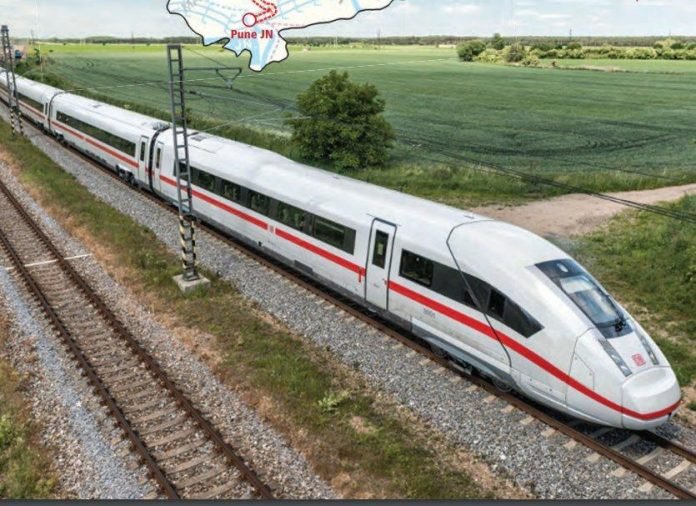
Central Government approves Pune-Nashik Semi High-Speed Railway Line

1
Pune-Nashik Semi High Speed Rail Train
Representational Image | Photo Copyright - Respective Authority

MUMBAI (Metro Rail News): The Central Government has approved the much awaited Pune-Nashik Semi High Speed Railway Project in Maharashtra. According to Chhagan Bhujbal, Gaurdian Minister of Nashik District, Government of Maharashtra, the central government has approved a proposal for the Nashik-Pune High Speed Railway project, which will give boost to the development of Nashik-Pune-Ahmednagar districts.

All the approvals have been received for starting this project and the work of this high speed railway line is being started expeditiously, he said while speaking at a review meeting on land acquisition of Nashik-Pune railway line held in the central hall of the Collectorate on Monday.

He informed that the project is expected to be completed in three and half years with land acquisition and the train will run at a speed of 200 kmph. The project will not only help in the development of three districts but also facilitate transportation of agriculture produce, he added.

For this project, 1300 hectares of land will be acquired in 101 villages from these three districts with proper compensation as per the government decision to farmers whose lands will be acquired for the project, the Minister Bhujbal said. He also said that along with these three districts, a proposal will be submitted to start Igatpuri to Manmad semi high speed railway line.

This Semi High Speed Corridor will reduce the travel distance between the two cities to 1 hr and 45 minutes from 6 hrs at present.
buy cialis professional online https://pavg.net/wp-content/themes/twentytwentyone/inc/en/cialis-professional.html no prescription
The project will be executed by Maharashtra Rail Infrastructure Development Corporation Ltd (MRIDC), an equal joint venture between the state and the railways.

The expected cost of the project is Rs. 16,039 crore. The total length of the corridor will be 235 km and passengers trains will operate at top speed of 200 km per hour while freight trains will operate at top speed of 100 km per hour. There will be 24 stations along with 18 tunnels and 19 viaducts on the route. It will be completed by 2024

Advertisement1
InnoMetro_2026

NHSRCL began LiDAR Survey for Mumbai-Hyderabad High Speed Rail Corridor

1

MUMBAI (Metro Rail News): Aerial LiDAR survey has commenced on Mumbai-Hyderabad High-Speed Rail Corridor by the National High-Speed Rail Corporation Limited (NHSRCL) to prepare the final alignment as Detailed Project Report (DPR) for the corridor.

In January 2021, Monarch Surveyors & Engineering Consultants Pvt. Ltd. wins a contract from NHSRCL for the work – Final Alignment design including Aerial LiDAR survey and other related works for Mumbai-Hyderabad High-Speed Rail Corridor with completion period of 150 days and cost of INR 13.26 Crores.

LiDAR survey (Light Detection and Ranging) is a technique in which laser enabled equipment is mounted on a helicopter or plane to carry out ground survey. This technology gives accurate survey data and findings in less time.

According to NHSRC spokesperson, “We are adopting LiDAR technology which provides all the ground details and data in 3-4 months. Wherein this process normally takes 10-12 months.”

NHSRCL has been entrusted the work to prepare the Detailed Project Reports (DPR) for seven High Speed Rail Corridors in India and LiDAR survey technology will be utilized for ground survey in all these corridors.

Mumbai-Hyderabad High Speed Rail project is a proposed 711 km high speed railway line connecting Mumbai with Pune and Hyderabad through 11 stations in Maharashtra and Telangana. The proposed stations are Mumbai, Navi Mumbai, Lonawala, Pune, Daund, Akluj, Pandharpur, Solapur, Kalaburagi , Zaheerabad and Hyderabad.

Once operational, distance between Mumbai and Hyderabad will be covered in less than 3 and half hours with high speed trains operating on the route at top speed of 350 km per hour. At present, it takes 14-15 hours to complete journey between both cities.

Similar Aerial LiDAR survey has already started for the 865 km long Delhi-Varanasi High Speed Rail in January 2021 and also recently in March for the 741 km long Mumbai-Nagpur High Speed Rail.

Recently, Growever Infra Pvt Ltd emerged as the lowest bidder for the work of final Alignment design including Aerial LiDAR survey and other related works for Varanasi-Howrah High Speed Rail Corridor (about 760 km long).

Advertisement1
InnoMetro_2026

Maha Metro held trial run on Nagpur Metro Reach II from Zero Mile to Kasturchand Park

0

Nagpur (Metro Rail News): Despite adverse conditions prevailing due to Covid-19 pandemic, Maha Metro successfully held trial run of a Metro train on Reach II between Zero Mile Freedom Park and Kasturchand Park stations, on Wednesday morning. This is the first step towards making Reach II (Sitabuldi to Automotive Square) operational in December 2021.

A distance of 1 km was covered at a speed of 20 km per hour. The work of signaling, overhead equipment (OHE) and track had been completed in this portion and proved to be perfect during the trial run. Work on remaining portion of Reach II is going on at full swing under leadership of Maha Metro Managing Director Dr Brijesh Dixit.

The train passed through Zero Mile Freedom Park station building, which will be 20 storied, located on the fourth floor. Special precautions were taken in the form of train supported on floating slabs to minimize the transmission of train vibrations to the building. Such unique feature does not exist in other Metros of India.

Maha Metro is developing Zero Mile Freedom Park and Kasturchand Park stations. A tender has been flotaed for the Zero Mile Freedom Park station for construction of a dedicated electronics goods market above the station. 21 shops will be built here. Around 2.40 lakh square feet commercial space will be created above the market on public private partnership (PPP) basis, tender for which will be floated soon.

Part of station as the Freedom Park will have theme of Indian Freedom Struggle and Indian Defence Forces. The station will depict various incidents and happenings related to the freedom Struggle of 1857 and 1947 – the year of Indian independence. These both momentous events have their historical legacy in the city. The events related to Nagpur in general and Civil Lines locality, in particular would be on display at the Freedom Park Station. A two-level basement parking is under construction adjacent to Kasturchand Park station for use of Metro commuters.

This portion of Reach II is very important as the track passes near prominent landmarks of the city like Vidhan Bhavan, Reserve Bank of India (RBI) and Kasturchand Park. The Zero Mile and Kasturchand Park stations cater to Civil Lines, which has a large number of government, semi-government and private offices. Thousands of people work in these offices.
Once Reach II becomes operational, people from various parts of the city will be able to reach their workplaces in Civil Lines using Nagpur Metro. Feeder vehicles like shared cabs, shared autorickshaws, e-rickshaws, e-scooters, low speed scooters, e-cycles, etc. will be available at Metro stations for last mile connectivity.

Advertisement1
InnoMetro_2026