Home Blog Page 419

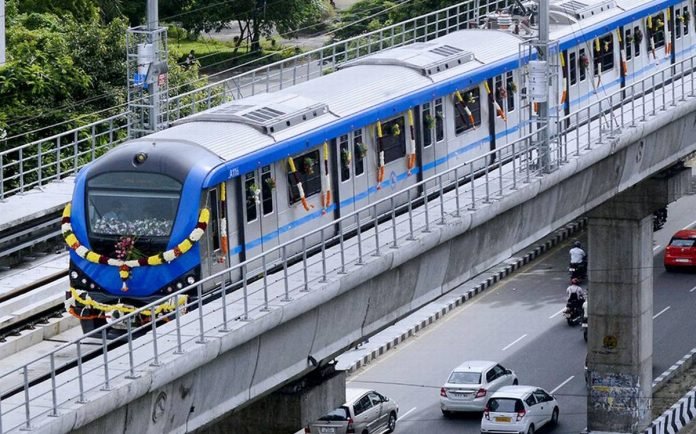
3 Firms in race to construct Chennai Metro’s Line-3 Southern Elevated Section

1
28 interchange stations to help commuters to travel across the Chennai Metro

CHENNAI (Metro Rail News): Chennai Metro Rail Limited (CMRL) opened technical bids on Monday for the work related to construction of Elevated Viaduct of length 10 km approximately for Line-3 of Chennai Metro. It also includes construction of 09 Elevated Metro Stations from Sholinganallur Lake to SIPCOT-2.

Total three firms submitted bids for this contract, tenders for which were invited in January this year with completion period of 36 months.  However, the estimated cost for this work is not known. The names of three bidders are –

  • Larsen & Toubro
  • ITD Cementation
  • JMC Projects

Tender Number – CMRL/CON/PHASE-II/C3-ECV-01/2021

Name of Work – Construction of Elevated Viaduct (approximate Length of 10 km), Nine (9) Elevated Metro Stations at Sholinganallur Lake, Sri Ponniamman Temple, Sathyabama University, Semmeancheri, Gandhi Nagar, Navallur, Siruseri, SIPCOT-1 and SIPCOT-2 and Stabling Viaduct at SIPCOT.

Now bids for this civil contract will be sent for technical evaluation which will take a couple of months. After that, financial bids of the technically qualified bidders will be opened which will reveal the name of the lowest bidders and the most likely winners of this contract. This elevated section will be financed by Asian Development Bank (ADB). The package also includes construction of stabling viaduct at SIPCOT.

This elevated section comprising 09 Elevated stations is at the extreme southern end of the 45.8 km long Line-3 from Madhavaram to Siruseri Sipcot 2 which is a part of Phase-2 of Chennai Metro which comprises construction of three lines covering a total of 118.9 km. This Phase is expected to become operational by 2026.

Advertisement1
InnoMetro_2026

YFC Projects is the lowest bidder for Patna Metro’s Line-1 Elevated Section

2

PATNA (Metro Rail News): YFC Projects Ltd. emerged as the lowest bidder for Package PC-04 of roughly 8 km with two different elevated sections on Line-1 of Patna Metro after Delhi Metro Rail Corporation (DMRC) opened financial bids on Monday.

The first section is from Danapur to Pataliputra Junction of roughly 4 km passing through four stations. The second section is from Mithapur Ramp to Khemni Chak Station of another roughly 4 km passing through three stations. Khemni Chak Station is the interchange station for Line-1 and Line-2 under Phase-1 of Patna Metro.

The package also includes the construction of seven stations namely – Danapur, Saguna More, RPS More, Patliputra, Mithapur, Ramkrishna Nagar and Jaganpura Station.

DMRC invited bids for this package in September 2020 with an estimated cost of INR 527.62 Crores and completion period of 36 months. Technical bids were opened in November 2020 which revealed name of four bidders.

Later, one bidder disqualified among the four based on technical evaluation and financial bids of the remaining three technically qualified bidders opened yesterday. Name of firms and financial bid values is given below –

  • YFC Projects Ltd. – INR 553.49 Crores
  • Sam India Builtwell Pvt. Ltd.– INR 587.63 Crores
  • NCC Ltd. – INR 614.94 Crores

As the bid value by YFC Projects is slightly on the higher side in comparison to DMRC estimated cost for this contract, based on evaluation, it is still highly likely that the contract will be awarded to YFC Projects in the coming weeks.

Line-1 (East-West Line) of Patna Metro under Phase-2 will have length of 16.86 km from Danapur Cantonment to Khemni Chak with total 14 stations on the route.

These 14 stations are – Danapur, Saguna More, RPS More, Patliputra Junction, Rukunpura, Raja Bazaar, Patna Zoo, Vikas Bhawan, Vidyut Bhawan, Patna Junction (Interchange), Mithapur, Ramkrishna Nagar, Jaganpura  and Khemni Chak (Interchange).

Advertisement1
InnoMetro_2026

L&T wins contract worth INR 1989 Crores for Patna Metro’s Underground section

0
Delhi Metro Phase IV Underground Construction
Underground Construction

PATNA (Metro Rail News): Delhi Metro Rail Corporation (DMRC) opened financial bids on Monday for Patna Metro’s Package PC-03 in which Larsen & Toubro (L&T) emerged as the lowest bidder for this contract by quoting bid value of INR 1,989 Crores.

This contract work includes construction of twin tunnels by TBM connecting underground Ramp at Rajendra Nagar with Patna Junction Railway Station passing through six underground stations for a section of roughly 8 km in length. This is the second and final package out of the two packages for Line-2 under Phase-1 of Patna Metro with the first package (Package PC-01) is under construction at present, the contract for which was awarded to NCC.

The six stations to be constructed for this section are – Rajendra Nagar, Moin Ul Haq Stadium, University, PMCH, Gandhi Maidan and Akashvani. It also includes architectural finishing, water supply and other works on New ISBT to Patna Station.

DMRC invited bids for this package in September 2020 with an estimated cost of INR 1958.81 Crores and a completion period of 42 months. Technical bids were opened in January this year which revealed names of four bidders.

Later, all four qualified the technical evaluation round and financial bids of all four bidders were opened yesterday. Name of firms and financial bid values is given below –

  • Larsen & Toubro (L&T) – INR 1989.00 Crores
  • Afcons Infrastructure – INR 2044.80 Crores
  • ITD Cementation India Ltd. – INR 2098.79 Crores
  • Tata Projects – CAI JV – INR 2122.31 Crores

As the bid value by L&T is very much close to DMRC estimated cost for this contract, it is highly likely that the contract will be awarded to L&T in the coming weeks.

Line-2 (North-South Line) of Patna Metro under Phase-2 will have length of 14.05 km from Patna Junction Railway Station to New ISBT with total 12 stations on the route.

Advertisement1
InnoMetro_2026

Delhi Police asks DMRC to close 7 stations if needed due to farmer protest

0
Delhi Metro
Image for representation

NEW DELHI (Metro Rail News): The Delhi Police has asked the Delhi Metro Rail Corporation (DMRC) to keep extra vigil at seven metro stations and if needed, close these stations in view of the farmers’ protest against the three farm laws outside the Parliament from July 22.

According to Delhi Police, the protesters may use metro to reach the New Delhi area since it is the most favoured form of conveyance in the national capital.

These seven stations are Janpath, Lok Kalyan Marg, Patel Chowk, Rajiv Chowk, Central Secretariat, Mandi House and Udyog Bhawan.

Delhi Police sent a letter regarding this to DMRC after having a meeting with a delegation of farmers, ahead of their planned protest starting from July 22.
buy amitriptyline online https://www.mydentalplace.com/wp-content/themes/twentytwelve/inc/en/amitriptyline.html no prescription

Farmer unions are planning to protest till the scheduled end of Parliament’s monsoon session to demand scrapping of three farm laws passed in September last year and a legal guarantee on Minimum Support Price (MSP).

“DCP, New Delhi district has requested to keep extra vigil at the seven metro stations as well as other stations which lies in the New Delhi area, and may be closed w.e.f 19.07.2021 onwards till the monsoon session is over, at very short notice to refrain the protestors from reaching Parliament via metro and avoid any untoward incident,” the letter said.

According to a senior police officer, it is just on a precautionary basis and if required, only then the metro stations will be closed.

Advertisement1
InnoMetro_2026

DPR of Jammu Metrolite Project reviewed by Divisional Commissioner

2
Metrolite
Image for representation.

JAMMU (Metro Rail News): Divisional Commissioner of Jammu Dr Raghav Langerreviewed the Detailed Project Report (DPR) prepared for the proposed Metrolite train project for the Jammu city on Sunday.

The Managing Director of Mass Rapid Transit Corporation (MRTC) briefed Dr Raghav Langer that the project formulation has got expedited on the directions of the office of Hon’ble Lieutenant Governor.

The MD gave a detailed presentation and apprised Langerthat in October 2016, a memorandum of agreement was signed between RITES Limited and Government of Jammu and Kashmir through JK ERA for techno-economic services and formulation of DPRs for MRTS in the capital cities of Jammu and Srinagar.

The RITES submitted the DPR of Light Metro in 2020 which was approved by the Administrative Council and was then submitted to the Ministry of Housing and Urban Affairs (MoHUA) Government of India for its approval and funding.

However, the Ministry of Housing and Urban Affairs (MoHUA) has raised some observations on the PHPDT (Peak Hour Peak Direction Traffic) figures and feasibility of the Light Rail Metro system in view of the economic viability. Following which, the RITES Ltd shared a revised DPR and recommended Metrolite instead of Light Rail Metro.

The main objectives of the Metrolite are to optimize the mobility pattern of people and goods rather than of vehicles, to focus on the improvement and promotion of public transport, to provide a recognized and effective platform for integrating land use and transport planning, a low carbon mobility growth scenario for the city.

The Jammu Metrolite Rail System will have a length of 23 km with 22 stations between Bantalab and Bari Brahmana Station. The Metrolite will connect Bantalab to Bari Brahmana passing through various stations including Roop Nagar, Janipur, Amphala, Secretariat, Exhibition Ground, Jammu University, Panama Chowk, Railway Station, Greater Kailash, Kalu Chak, Sidco Factories and Bari Brahmana.

It was also informed that no major land acquisition shall be required for the metro train service in Jammu as according to the DPR prepared the whole track will be elevated over the existing roads.

The officers also gave presentations on the alignment of the first phase, stations, Metrolite specifications and other components.
buy zenegra online https://lasernailtherapy.com/wp-content/themes/twentytwentytwo/inc/patterns/en/zenegra.html no prescription
It was informed that each station area will emerge as a major market hub in future.

The Divisional Commissioner has directed the Jammu Mass Rapid Transit Corporation to hold a meeting with all concerned departments for discussing the alignment of the Metrolite as there are other major development projects coming up like Jammu Katra Express Highway, expansion of Jammu railway station, flyovers etc.

He also suggested the early appointment of interim consultants for the project. Once the revised DPR gets approved, the project shall be submitted to GoI for freezing the funding model.

Advertisement1
InnoMetro_2026

MGM Contractors is the lowest bidder for construction of 11 bridges on Mumbai-Ahmedabad HSR Corridor

2
Bullet train/ Representational image

NEW DELHI (Metro Rail News): The National High Speed Rail Corporation Limited (NHSRCL) on Friday opened financial bids for the Package Number-MAHSR-P-1(B) which involves construction of four PSC bridges and seven steel truss bridges located between Zaroli Village at Maharashtra-Gujarat Border and Vadodara in Gujarat for the 508.17 Km long Mumbai–Ahmedabad High Speed Rail Corridor.

Financial bids revealed the bid values of three bidders in which MG Contractors Pvt. Ltd. emerged as the lowest bidder quoting bid value of INR 549.67 Crores in comparison to the bid value of INR 618.05 Crores + 246 million Yen from KEC – SAM India JV and INR 677.77 Crores from GRIL – GPT JV.

NHSRCL invited bids for this package in November 2020 with an unknown estimated cost and completion period of 3 years. Technical bids for the same were opened in March this year which revealed name of four bidders. Later, one bidder disqualified based on evaluation and the financial bid values of the remaining three bidders is mentioned above.

Package No. – MAHSR-P-1(B)

Name of Work – Construction of Bridges for Double Line High Speed Railway for 04 No. PSC Bridges (GAD 9, 10, 11 & 1441) and 07 No. Steel Truss Bridges (GAD 68, 1134, 12, 61, 14, 15 & 62) [excluding fabrication and transportation of steel truss girders] between Zaroli Village at Maharashtra-Gujarat Border (MAHSR Km. 156.600) and Vadodara (MAHSR Km. 393.700), in the State of Gujarat and the Union Territory of Dadra and Nagar Haveli for the Project for Construction of Mumbai-Ahmedabad High Speed Rail.

All these 11 bridges correspond to the under construction 237.1 km Package-C4 which runs from Zaroli Village at Maharashtra-Gujarat Border to the south of Vadodara. Contract for this package was awarded to Larsen & Toubro (L&T). This is the longest section of the line with four stations at Vapi, Bilimora, Surat and Bharuch in Gujarat.

As the NHSRCL estimate for this contract is not known, it will be interesting to know about the awarding of this contract which is still likely to be awarded to MG Contractors on account of being the lowest bidder among the three bidders.

Advertisement1
InnoMetro_2026

GR Infraprojects emerged lowest bidder for balance work of Bangalore Metro Pink Line

0

BENGALURU (Metro Rail News): Bangalore Metro Rail Corporation Ltd (BMRCL) opened financial bids on Friday for completing the balance work on Pink Line stretch of 7.5 km from Kalena Agrahara to Swagath Road Cross stations under Phase-2 of Bangalore Metro in which GR Infraprojects emerged as the lowest bidder for this contract.

The work consists of the construction of an elevated viaduct and five stations on a stretch of length 7.50 Km from Gottigere to Swagath Road Cross including the Kothanur Depot entry line. The metro stations to be constructed are Gottigere, Hulimavi, IIMB, JP Nagar 4th Phase and Swagath Road Cross.

BMRCL invited bids for this work in March this year with an estimated cost of INR 339.21 Crores and completion period of 21 months. Technical bids were opened in June which revealed name of three bidders and after subsequent process of evaluation, financial bids were revealed of the three bidders which is given below –

  • GR Infraprojects – INR 364.87 Crores
  • Afcons Infrastructure – INR 388.51 Crores
  • ITD Cementation India – INR 393.05 Crores

Tender – BMRCL/Phase-2/Reach -6/Elevated/Via&Stn/RC/2021/75

Package – R6-CC-01BW

Name of Work – Construction of Elevated Structures (Viaduct & Stations) of length 7.50 Km (approx.) from Gottigere to Swagath Road Cross (Chainage 00.00m to 7501.818m) including Kothanur Depot entry line, road widening & allied works and 5 numbers of metro stations viz. Gottigere, Hulimavi, IIMB, JP Nagar 4th Phase, Swagath Road Cross in Reach-6 line of Bangalore Metro Rail Project, Phase-2 (Balance Works).

The contract for this work was originally awarded to Simplex Infrastructures in September 2017 with a completion period of 27 months but the contract was terminated due to poor progress of work in February 2021. At that time 37% of the work was completed.

As the bid value by GR Infraprojects is slightly on the higher side in comparison to BMRCL estimate, it is still likely that the contract will be awarded to GR Infraprojects in the coming weeks as the work on this stretch is already got delayed.

As mentioned earlier, the Pink Line (Reach 6) under Phase-2 of Bangalore Metro has a total length of 22.87 km from Kalena Agrahara to Nagawara with 18 stations. The line is expected to become fully operational by 2024.

Advertisement1
InnoMetro_2026

Indian Railways to roll out 10 Vande Bharat Trains connecting 40 cities by August 2022

0
Vande Bharat Express/Representational Image
Representational Image

NEW DELHI (Metro Rail News): In a major development for India’s semi high-speed rail connectivity, Indian Railways is planning to roll out at least 10 new Vande Bharat Trains, also known as Train-18, connecting 40 cities by August 2022 as India celebrates its 75th Independence day.

India’s new Railway Minister Ashwini Vaishnav recently reviewed the project and directed that the rollout plan be advanced to connect at least 40 cities with the Vande Bharat Trains by August 2022 to show a visible upgrade in the country’s rail services, as reported by The Indian Express.

For achieving the same, Hyderabad-based engineering firm, Medha Servo Drives Ltd Medha has been told to advance its production plan so that at least two prototypes can be rolled out by March next year following all trials.  Medha Servo had won the contract worth INR 2,211 Crores to supply the electrical systems for 44 Vande Bharat Trains in January this year.

There is a contract condition that along with all the trials and testing that are needed to give approval to a Vande Bharat Train, the prototype train should also complete 1 lakh Kms of commercial run with passengers before the following lot can be placed for production. As a result of this condition, the Vande Bharat Trains could take months to hit the tracks commercially. Without this impetus, the first set of trains was to roll out in 2 years i.e. by the end of 2022 or early 2023.

A meeting was also conducted by the Railway Board headed by Chairman Suneet Sharma on Saturday to work out the nuts and bolts of the new plan on a war footing. The meeting was attended by Board members concerned, General Managers of production units, the Research Design and Standards Organisation and other engineers.

As per officials estimates, if all three production units are put to use, Indian Railways can manufacture around six to seven Vande Bharat train sets every month. The idea of the new plan is to get maximum train sets rolled out by 2024 by utilising Integral Coach Factory in Chennai, Modern Coach Factory in Raebareli and Rail Coach Factory in Kapurthala.
buy intagra online https://pavg.net/wp-content/themes/twentytwentyone/inc/en/intagra.html no prescription

Vande Bharat Train is India’s first semi-high speed train with the potential to completely change the travel experience for the Indian masses. It is a self-propelled train that runs on distributed power mechanism and does not require an engine to haul them. As a result, the Vande Bharat Train has faster acceleration and deceleration, helping it to maintain a higher average speed despite stoppages. This ensures that the Vande Bharat takes less time in completing its runs than ordinary loco-hauled trains and is even faster than the Rajdhani and the Shatabdi Trains, wherein time and speed are lost when a train has to stop and gather speed again.

Vande Bharat Trains has a modern features like automatic doors, chair car type sitting, side destination boards, automatic intercommunication door, speakers, mobile and laptop charging sockets, CCTVs, emergency talk back units with networking system, diffused lighting for luggage racks, continuous LED lights, GPS antenna and many more other features.

The eventual plan is to roll out 100 Vande Bharat Trains which will criss-cross most of the Indian landscape, providing a whole new modern travel experience with enhanced facilities to the Indian masses. It would cost around INR 11,000 Crores to manufacture 100 such trains, with each individual train of 16 coaches to cost around INR 110 Crores.

Advertisement1
InnoMetro_2026

A scientist has developed an automated and less expensive alternative to the bio-toilets used in Indian railways.

0
automated technique for collecting toilet waste that will be used to maintain the Indian Railways' toilet system
New innovation in Indian Railway Bio-toilet. (for presentation purpose)

ANDHRA PRADESH, (Metro Rail News):  A scientist from Andhra Pradesh has devised an automated technique for collecting toilet waste that will be used to maintain the Indian Railways’ toilet system. This automated device is simple to maintain and seven times less expensive than bio-toilets.

Existing bio-toilets in trains use anaerobic bacteria to convert human waste to gas, however, those bacteria are incapable of decomposing plastic and fabric materials placed into restrooms by passengers. As a result, maintaining and removing such non-decomposed items inside the tank is tough.

Dr. R V Krishnaiah of Chebrolu Engineering College created a mechanism that collects toilet waste from moving trains, separates different elements, and processes them into useable items.

The technology, which was developed with help from the Department of Science and Technology’s (DST) Advanced Manufacturing Technologies program and is associated with the “Make in India” goal, has been given five national patents and is currently being tested.

A septic tank is part of the automated system (which is placed under the track, i.e., train line). When a train reaches the sewage tank location, its top lid opens using a Radio Frequency Identification (RFID) sensor and reader located at the engine and septic tank positions, respectively. When the toilet tanks and the septic tank are synchronised, the sewage material in the toilet tanks is dumped into the septic tank. Finally, when the train moves away from the septic tank, the cover is closed.

The collected sewage material from train toilets is separated such that human waste is stored in one tank and other items such as plastics, cloth, and so on are stored in another.

Separately, human waste is treated to convert it into useable material. Separate processing is performed on the plastic and fabric materials.
buy viagra super force online no prescription

“This technology has been developed exclusively for the Indian Railways with the goal of cost reduction and the elimination of the need for time-consuming anaerobic bacteria generation,” according to the Ministry of Science and Technology.

“In comparison to Bio toilets, which cost one lakh rupees per unit, the new technique reduces the cost to fifteen thousand rupees. Dr. R V Krishnaiah has partnered with MTE Industries to further this technology,” it stated.

Advertisement1
InnoMetro_2026

DMRC suggests a spur line of 5.6 km in Narela to better serve the area developed by DDA

0
Delhi Metro
Representational image only

NEW DELHI (Metro Rail News): Delhi Metro Rail Corporation (DMRC) has suggested a proposal to construct a 5.6 km spur line from Puth Khurd to Holambi Kalan to better serve the Narela area being developed as a major housing hub by the Delhi Development Authority (DDA).

This spur line is in addition to the already proposed 22.9 km long Metrolite Corridor from Rithala to Narela under Phase-4 of Delhi Metro. DDA has planned Narela for large-scale housing and commercial projects and as per a DDA official, the current alignment of the corridor either does not touch or just passes by the periphery of the areas where economic activities have been planned.

The DMRC has suggested that one single alignment cannot serve the entire area with just one corridor. Therefore, in addition to the original corridor already proposed between Rithala and Narela (22.9 km), a spur of 5.6 km, from Puth Khurd to Holambi Kalan, may be planned.

As a result, both DDA and DMRC are working together to better serve the Narela area which is one of the three sub-cities planned by DDA in a big way other than Dwarka and Rohini.

According to a senior DDA official, “We have been holding joint inspections with DMRC officials to finalise the alignment of the line. Our teams recently did a site inspection to assess the feasibility of the proposed line that will cater to a much larger area in Narela sub-city.”

As per officials, DDA has decided to pay INR 1000 Crores to DMRC for the construction of the Metro project and has made provision of INR 400 Crores in its budget for fiscal 2021-22.

According to Anuj Dayal, Executive Director, Corporate Communications, DMRC, “In addition to the original corridor already proposed between Rithala and Narela, a spur of 5.6km from Puth Khurd to Holambi Kalan has been suggested to serve future developments in the area. However, these alignments have not yet received the mandatory approval from the government.”

Meanwhile, DMRC has already prepared and submitted the DPR (Detail Project Report) for the construction of Light Metro Corridor from Rithala to Narela to the Central Government, approval for which is yet to be received.

Advertisement1
InnoMetro_2026