New Delhi: Prime Minister Narendra Modi has flagged-off the Delhi-Faridabad Metro Line that would allow hassle free travel for around two lakh daily commuters between the national capital and the industrial hub in Haryana.
The extension of the Delhi Metro connects Badarpur to Escorts Mujesar in Faridabad.
The total cost of the project from Badarpur to Escorts Mujesar is nearly Rs. 2,500 crore. Out of this, Rs. 1,557 crore was borne by the Haryana Government, the Centre contributed Rs. 537 crore, while the Delhi Metro provided Rs. 400 crore.
All these are elevated and located on either side of the Delhi-Mathura Road (NH-2).
“The nine-station metro corridor which was 95 per cent indigenously built will provide people a safe, affordable, quick, comfortable, reliable, environment-friendly and sustainable transport facility,” a Haryana government spokesperson said.
Haryana Chief Minister ML Khattar, addressing a press conference on Saturday, had thanked the Prime Minister for “gifting” the Metro service which would take the city to “another level of progress” with better connectivity with other NCR towns.
He had also said that the Prime Minister would be announcing the go-ahead for connecting Gurgaon with Faridabad by Metro.
Mumbai, India (Metro Rail News): Construction of the Mumbai Terminus, a part of the Mumbai-Ahmedabad Bullet train project, will get delayed because the building agency, National High-Speed Rail Corporation Limited, still has no land possession Maharashtra Government at the Bandra Kurla Complex. As a result, the NHSRCL has decided to start the project’s construction work by the end of the year 2022. As per the design given by NHSRCL, the proposed station of BKC will have six platforms for the trains on the lowest floor, and the station will be a three-storey underground structure.
As per the official statement, the delay is caused because a structure of Bharat Petroleum Corporation Limited is yet to be shifted to some alternate land given by the Mumbai Metropolitan Region Development Authority so that the construction can start at the given land. Moreover, the other formalities are still pending, like handing over the land and signing the lease agreement for other sites.
The MMRDA has given the other land for the BPCL petrol pump at the G block of the BKC. But still, the relocation has not taken place, and the construction activities by BPCL are also not started at the new location. The total estimated cost of the bullet train project linking the Mumbai-Ahmedabad corridor is around 1,10,000 crores, of which 88,000 crores is funded by the Japan International Cooperation Agency (JICA).
MMRDA officials said that the shifting of the Petrol Pump was stuck for three years, and the allotment of land was also stuck for three years, and now it’s finally completed. So now, the construction work will get started. Seven Indian Companies showed interest in the tender issued for the BKC high-speed railway station construction. The seven companies are ITD Cementation India Limited, Larsen and Toubro Limited; Tata projects limited, Afcons Infrastructure Limited, IRCON International Limited, Hindustan Construction company limited.
After one year of laying of foundation stone, 50% of Agra Metro Rail Project got completed.
Agra, India (Metro Rail News): Prime Minister Narendra Modi, on 7 December 2020, laid the foundation stone of the Agra Metro Rail Project. He even proclaimed that the elevated section of the project would be built at the cost of Rs.273 Crore. After one year of the announcement made by PM Modi, the structure of the metro station at Basai, Fatehabad Road and Taj Mahal East Gate has been erected. It signified that around 50% of the Phase-1 project had been completed.
As per the official statement, the work on the elevated section of the Agra metro will get completed by the year 2022. Moreover, the PMO is also seeking regular updates from the authorities about completing the Agra Metro Rail Project.
MD, Kumar Keshav, Uttar Pradesh Metro Rail Corporation, said that the team deserves appreciation for completing the project in one year. He also added that the elevated section of 3.2 km. It will also have three corridors.
Project Director of Agra Metro, Arvind Rai, said that the construction work on all three stations will be completed by 7 December of next year and till then, they will be building an underground metro station. UPMRC has given the construction of the elevated section to the SAM INDIA BUILT WELL. buy cenforce online https://lasernailtherapy.com/wp-content/themes/twentytwentytwo/inc/patterns/en/cenforce.html no prescription
Arvind Rai also stated that the construction of converge beam, horizontal beam, pillar cap, pillar, U girder, T Girder is done at the casting yard at Barmauli, Katara. It is where the concrete structure is first pre-cast and then transported to the central location.
In addition to it, two more corridors are expected to be built in Tajnagri, Agra. The first corridor will be from Sikandra to the east gate of Taj and will be 14 Km with a total of 13 stations, six elevated and seven underground. The second corridor will be from Cantt railway station to the Kalindi Vihar. UPMRC is expected to spend a total of around Rs.8,384 crore on the Agra Metro Rail Project.
Kanpur, India (Metro Rail News):Kanpur Metro Rail Services are likely to be inaugurated by PM Modi on December 28 2021. Avinash Awasthi, Additional Chief Secretary, UP, has asked the District Magistrate Vishakh G about the details of the project and the IIT-Kanpur convocation. In the letter, Awasthi has clearly stated that the prime minister will attend the convocation ceremony of IIT-Kanpur on December 28 and inaugurate the metro services.
The letter is also marked to the officer on special duty to PMO, Commissioner of Kanpur Division, Sanjay Bhavsar; Managing Director of UP Metro Rail Corporation, Kumar Keshav and the director of IIT-Kanpur. Before the prime minister’s visit, the final inspection by a team of commissioners, metro rail safety, will be done by December 15. buy avana online https://www.mydentalplace.com/wp-content/themes/twentytwelve/inc/en/avana.html no prescription
In its first – phase, the metro will run between IIT-Kanpur and Motijheel on a 9Km stretch. In the second phase, the metro services will start between Transport Nagar – Motijheel. Last month, Chief Minister of UP, Shri Yogi Adityanath, flagged the trial run between the Indian Institute of Technology and Geeta Nagar Crossing. The Metro officials have ensured the people that the metro services are expected to be started for the general public by the end of the month.
Earlier, it was decided to put the inauguration date on December 25 on the former prime minister’s birth anniversary, Atal Bihari Vajpayee. Still, new dates were set up, keeping in mind that PM can also attend the IIT-K convocation and the inauguration ceremony.
MADHYA PRADESH, INDIA (Metro Rail News): Madhya Pradesh Metro Rail Corporation Limited (MPMRCL) has opened the technical bidding for the civil contract for metro construction at Gandhi Nagar Depot for the Ring Line of Indore Metro Rail Project. MPMRCL has revealed that a total of sixteen firms have submitted their bids for the tender issued in September 2021. Following are the names of the bidder:
URC Construction Ltd.
IRCON International Ltd.
SMS Ltd.
Shalimar Corporation Ltd.
Montecarlo Ltd.
Suroj Buildcon Pvt. Ltd.
Vijay Nirman Company Pvt. Ltd.
Quality Buildcon Pvt. Ltd.
KSM Bashir Mohammad and Sons
Engineering Projects (India) Ltd.
Bridge and Roof Company India Ltd.
Dhaya Maju Infrastructure (Asia) SDN Berhad
Bansal Construction Works Pvt. Ltd.
Altis Holding Corporation
Dinesh Chandra R Agarwal (DRA) Infracon Pvt. Ltd.
Amara Raja Infra Pvt Ltd.
The work includes the construction of the Rolling Stock Depot cum Workshop at Gandhi Nagar for the Indore Metro Rail Project. The deadline for the completion of the project is three years, and the project’s total budget is around 283.65 crore. The depot will serve the trains for 33.53 km on the yellow line that will form a ring line around the city of Indore.
NEW DELHI, INDIA (Metro Rail News): Implementing the Delhi-Ghaziabad-Meerut Regional Rapid Transit System (RRTS) requires the felling of around 260 trees and transplantation of 280 trees in the National Capital. The Environment Department has given clearance for 1.69 hectares of land. In the RRTS project, 543 trees will be cut down.
The Ministry has asked the National Capital Region Transport Corporation to transplant 280 trees on the land, joining Delhi-Noida Direct flyway on the Western bank of Yamuna. buy cialis black online https://nouvita.co.uk/wp-content/themes/twentynineteen/fonts/en/cialis-black.html no prescription
NCRTC has also been asked to deposit Rs. 3.09 crore as the security amount as compensation for the plantation of 5,430 saplings of neem, pilkhan, gular, peepal, amaltas, bargad, desi kikar etc. The official notification has stated the 5,430 saplings of native species need to be transplanted by the user agency.
First Special steel Span of RRTS corridor completed in Ghaziabad
Ghaziabad, India (Metro Rail News):NCRTC has successfully completed the installation of the first special steel span of the Delhi-Ghaziabad-Meerut RRTS corridor over the mainline Indian railway crossing near Vasundhara, Ghaziabad. This special steel span is 73 meter long and weighted around 850 tonnes. It has been installed on the piers of about 10 metre height on both side of the Indian railway tracks by using winch and roller arrangement.
With the successful installation of this special steel span, another milestone has been achieved in the construction of India’s first RRTS corridor between Delhi to Meerut. This is the first special steel span of the 17 km priority section from Sahibabad to Duhai, which is targeted to be commissioned by the year 2023.
Another special steel span of around 150 meter is underway just before the Ghaziabad RRTS Station where under construction RRTS viaduct is crossing over a road flyover and Delhi Metro viaduct together.
NCRTC has completed the installation of this special steel span with all safety measures with full cooperation of the Northern Railway. The whole process of movement of this special steel span over Indian Railway tracks was completed within the specified blocks with minimum disruption.
In the installation process of this huge special steel span, first the whole steel structure is fabricated near the actual location on the trestle which is a framework consisting of beams. After the complete structure is ready, it is to be moved on rollers towards the piers erected on both sides. This is a very challenging and complicated process considering the high weight of the steel structure.
For the construction of the elevated viaduct of the RRTS corridor, NCRTC is erecting piers generally at an average distance of 34 meters. Post this, these piers are joined by pre-cast segments with the help of launching gantries (तारिणी) to construct a RRTS viaduct span. However, maintaining this distance between piers is not practically possible in some complex areas where the corridor is set to cross over rivers, bridges, rail crossings, metro corridors, expressways, or other such existing infrastructure.
Image Source: NCRTC
To connect piers in such areas, Special Spans are being used. Special Spans are mammoth civil structures having beams made of structural steel. NCRTC is building Special Spans made of structural steel at a factory which is then transported to the sites on trailers during the night to avoid any traffic problems and assembled in a systematic way with help of specialized process. The size and structure of these steel spans are designed aesthetically in advance, in-line with the overall requirements of construction, installation, and usage.
More than 14,000 workers and 1100 engineers are working tirelessly on the 82 km long RRTS corridor where in more than 1100 piers of the elevated section have been erected, more than 50 km of foundation work and approximately 14 km of viaduct have been completed, most of which is located in the priority section.
Along with the construction of the viaduct in the priority section, the construction work of all five stations – Sahibabad, Ghaziabad, Guldhar, Duhai, and Duhai depot is in advanced stages. Track laying work is going on by connecting rail tracks on the viaduct between Ghaziabad to Duhai.
NCRTC team is working day and night at the sites with 18 launching gantries (तारिणी) in operation for the elevated section in the corridor. The construction work for the underground section has also started where the Tunnel Boring Machine launching shafts are being constructed.
Image Source: NCRTC
NCRTC has managed the pace of the construction while simultaneously taking extensive pollution control measures in and around the construction sites. A dedicated team of experts are regularly monitoring the effectiveness of these measures and step-up the activities wherever necessary. Construction work is being done within barricaded zones of adequate height and thorough cleanliness is being maintained on these sites. Anti-smog guns, water sprinklers are deployed to settle the construction dust. All the raw materials, debris are kept covered at their marked sites
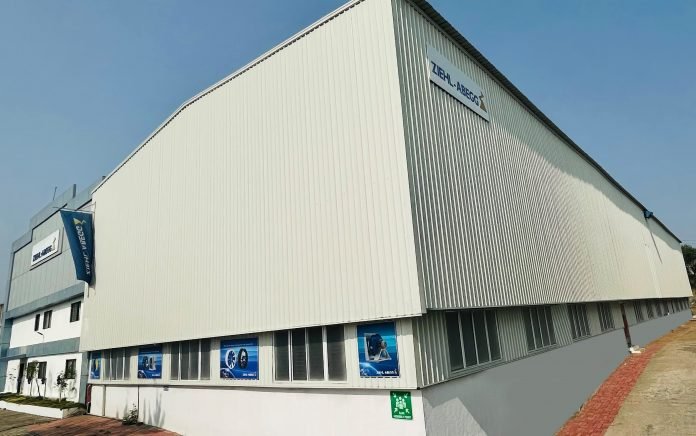
Ziehl-Abegg India expands the factory for Energy saving Fans in Chakan, Pune
PUNE, India (Metro Rail News): “Our customers need highly efficient fans”, says Vikas Kundra, Managing Director at Ziehl-Abegg India. This is the reason why the company expanded its factory at Chakan (Pune). The new factory has warehouse, production and Indian headquarters under one roof. “The benefit for customers is that we are more flexible and faster”, explains Vikas Kundra.
The German based company invested in India because the management trusts in the growing Indian Market. “Our colleagues in India did a great job”, says Peter Fenkl, CEO of Ziehl-Abegg. The employees are well trained, and they are a good partner for the fast-growing industry in this country. The applications for the fans have a broad range: solar power, wind energy, heating ventilation and air conditioning (HVAC), refrigeration, transformer cooling, railways, data center, cold rooms, poultry, electronics cooling for example.
“We are very close to our customers”, emphasizes Vikas Kundra. Sales offices are located in Delhi, Thane, Bengaluru, Hyderabad and Pune. All colleagues strive hard to support customers in the selection of the right system solution for their application. The team provides post sales technical support as and when required by the customers. “Our target is to save our environment”, says the Managing Director; and he repeats the slogan of Ziehl-Abegg India: “Proud to save energy for my Country.”
The company provides the latest technology in highly efficient fans and drives. The production facility is ISO 9001:2015 certified and has AMCA certification for the direct driven plug fans and ECblue fans. All the processes and systems are adopted from the German headquarters. The Managing Director underlines: “Ziehl-Abegg India delivers German quality to all the customers in India.”
The product range that is catered to from India factory includes: Axial fans, centrifugal fans, both with latest IE5 and IP55 rated ECblue motor, direct driven plug fans, MAXvent- (Tube Axial Fans), and more.
CHENNAI (Metro Rail News): The Metro Rail Corridor from Light House to Poonamallee is expected to get ready from many Phase-2 corridors. The CMRL confirmed that the work is in full swing as tracks are already being laid at the city’s busiest areas.
The 26 km stretch will link the core localities of the area such as Mylapore, Vadapalani, T Nagar with popular Western suburbs like Poonamalle and Porur. IRCON International, working under the umbrella organization of Indian Railways, was the lowest bidder for a tender of laying tracks along the corridor. Moreover, the current corridor is part of the 118.9km three corridor, part of Phase-two that has the 2025 deadline. The officials from CMRL have given the utmost priority to the stretch between Porur and Poonamallee. The corridor will be having around 18 elevated stations and 12 underground stations.
According to the official statement, the Phase-2 project has a deadline of 2025.
DELHI (Metro Rail News): To deal with the degrading air quality of the national capital, DMRC has brought 14 Anti-Smog Guns into service at its construction sites. The guns will throw outside fine mist at regular intervals to check the dust pollution emanating from the construction work.
A pollution check is essential as phase-4 construction work and other projects are operational across Delhi-NCR. The ASG’s can spray mist up to the range of 70 to 100 m. Moreover, one Anti-Smog Gun is quite adequate for an area up to 20,000 sqm. For the more significant impact of the sprinkling, the size of the droplets varies from 10 to 50 micrometres.
Anti Smog Gun 1
Anti Smog Gun 2
Anti Smog Gun 3
DMRC also assured that more ASG’s would come into the service with the gradual expansion in the construction work. The sprinkling water is free from viruses, bacteria or coliform etc. The environment section of DMRC is working actively to ensure that ASGs are used regularly and effectively by the contractors at the sites. Conventionally, ASG’s are used at coal and cement manufacturing sites globally. buy advair generic myindianpharmacy.net/advair.html over the counter
DMRC, in November 2016, became the first construction company in the world to use Anti-Smog Gun. Now every construction company in Delhi must install ASG at their sites so that they can grapple with the menace of severe pollution.
The conservation of the environment is the topmost priority of DMRC, and it’s an integral part of its work culture.
NEW DELHI (Metro Rail News): Railway Minister, Ashwini Vaishnav opened up on the bullet train issue on the Agenda Aaj Tak. He informed the Public that land acquisition for the Bullet train is still not completed by assured to be started by the stipulated year.
Railway Minister in the event of Agenda Aaj Tak proclaimed that by 2026, people will start boarding the bullet trains and if it would be late then it would not cross a year and would happen by the year 2027. The target will not exceed 2027 at any cost.
Railway Minister, Ashwini Vaishnav opened up on the bullet train issue on the Agenda Aaj Tak.
PM Modi’s Vision: He stated that PM Modi wants railways to transform the economy. He even quoted multiple examples all over the world like China, Europe etc. He even told the public that Mr. Modi called him around 11 pm and said that things which we are making is being built for next 50 years.
Ashwini Vaishnav on the question of delay replied that Japanese Technology is being used in the bullet train project and it’s their speciality that they do not start the work until everything gets ready and the process of land acquisition is not completed yet. He proclaimed that earlier, we relied on the Maharashtra Government but now the work has been started.
PM Modi wants that with the coming of Bullet trains, the mindset should also get changed. 119 pillars have already been casted and in the next six months, the pillars of about 50 km distance will also be cast. Moreover, there are many challenges in the design too, as the weight of Indian people, dust etc. are different.