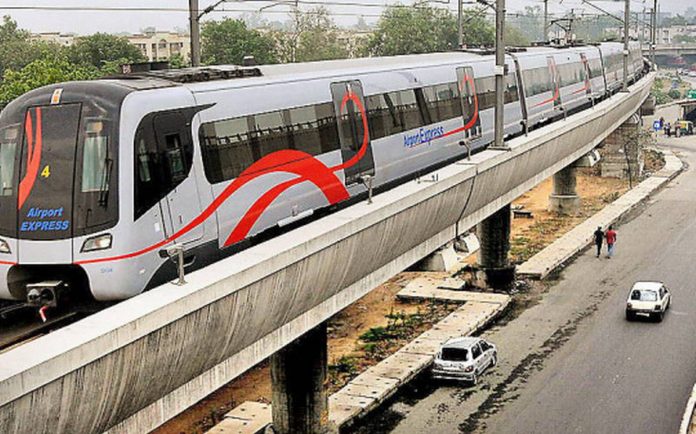
New Delhi: Prime Minister Narendra Modi has flagged-off the Delhi-Faridabad Metro Line that would allow hassle free travel for around two lakh daily commuters between the national capital and the industrial hub in Haryana.
The extension of the Delhi Metro connects Badarpur to Escorts Mujesar in Faridabad.
The total cost of the project from Badarpur to Escorts Mujesar is nearly Rs. 2,500 crore. Out of this, Rs. 1,557 crore was borne by the Haryana Government, the Centre contributed Rs. 537 crore, while the Delhi Metro provided Rs. 400 crore.
All these are elevated and located on either side of the Delhi-Mathura Road (NH-2).
“The nine-station metro corridor which was 95 per cent indigenously built will provide people a safe, affordable, quick, comfortable, reliable, environment-friendly and sustainable transport facility,” a Haryana government spokesperson said.
Haryana Chief Minister ML Khattar, addressing a press conference on Saturday, had thanked the Prime Minister for “gifting” the Metro service which would take the city to “another level of progress” with better connectivity with other NCR towns.
He had also said that the Prime Minister would be announcing the go-ahead for connecting Gurgaon with Faridabad by Metro.
PUNE (Metro Rail News): The PCMC to Swargate stretch of Pune Metro Rail Project has a 6km underground tunnel system starting from Shivaji Nagar to Swargate. This 6km stretch includes Shivaji Nagar, Civil Court, Budhwar Peth, Mandai, and Swargate underground metro stations.
The underground section comprises of two tunnels i.e. one for coming and the other for going. And, out of these two tunnels, Shivaji Nagar to Swargate one-side tunnelling work has been completed today. Today, on 14th January 2022, marks the completion of the one-side tunnel work. From the total 12km underground tunnel stretch, 10.8 km (90 per cent) tunnel work has been completed.
On 14th January 2022, the TBM Pavana achieved a breakthrough at Budhwar Peth. It had started digging from Swargate crossed Mandai, and completed the tunnel digging work at Budhwar Peth metro station.
The complete underground tunnel work will be completed when the 4th TBM reaches Budhwar Peth byMarch 2022.
As of date, Swargate has 45 per cent of the physical work completed followed by Mandai at 20 per cent, Budhwar Peth 40 per cent, Civil Court at 75 per cent and Shivaji Nagar at 70 per cent.
The underground stretch is a very challenging and crucial part of the Pune metro project. Since the tunnel work is nearing completion, further work in the underground section has also begun, the ‘overhead equipment (OHE)’ work has commenced. Signalling and communication-related work are also ongoing. The initial level of track work has also started.
Maha Metro Pune is striving to complete the entire underground stretch work by December 2022. “Without the active support of the citizens of Pune and the administrative bodies, the work on the underground stretch of the Pune Metro project wouldn’t have been achieved swiftly and successfully. Today TBM Pavana has achieved a breakthrough, and one side tunnelling work is completed,” said Dr Brijesh Dixit, MD Maha Metro
KOCHI (Metro Rail News): The K-Rail project has been a hotly discussed topic in Kerala. K-Rail is a proposed government-funded high-speed rail line that would connect Kasaragod in the north with Thiruvananthapuram in the south. K-Rail offers a top speed of 200 km/h and claims to cover a distance of 529.45 km in less than four hours, compared to the Indian Railways’ present time of 10-12 hours.
The Pinarayi Vijayan-led Left Democratic Front (LDF) is rushing to complete this project, and the Chief Minister has taken a firm stance in support of it. However, this speed comes at a cost: more than 10,000 families are expected to be displaced, and 1,198 hectares of the 1,383 hectares that must be acquired will be private land.
Silver Line Alignment
The state government’s obstinacy has raised many eyebrows on a regional and national level, prompting the question: Does Kerala need a K-Rail? Kerala is a highly urbanized and mixed-growth ecosystem with a larger metropolitan. The state could bridge the divide between rural and urban systems because of the remittance economy and migration from the interiors.
The service sector accounts for 70% of Kerala’s gross domestic product (GDP). In effect, this reduced the demand for frequent mass transit and restricted mass employment in densely populated areas. In Kerala, even the definition of urbanization has been changed to include the countryside and villages.
The average daily number of passengers travelling by train between the state’s major cities (Thiruvananthapuram, Ernakulam, Thrissur, and Kozhikode) and some of the state’s minor cities/towns is estimated to be 38,935 people (Mukundan, 2020). Though these figures do not provide a complete picture, they can be used to estimate current connectivity needs.
The typical trip length in Kerala is a short distance. Because of Kerala’s political economy, talented and qualified people are looking for work in neighbouring states. According to the proposed K-Rail proposals, those who commute by speed rail will have to change modes of transportation (to train, bus, or private vehicles) to finish their route. Many of the proposed stations are not located in city or town centres.
Given the time it takes to change modes of transportation, the expense of travel, first/last mile connectivity difficulties, and the discomfort it creates, it’s improbable that many people would choose K-Rail above other options to save an hour or two. Therefore, another issue that needs to be investigated is the viability and future of Kerala’s existing Indian Railway network.
Those in favour of the project argue that it will make Thiruvananthapuram, the state capital, more accessible. In the past, it has been noticed that most people visit the state capital to see the secretariat, the Technopark, the Regional Cancer Centre, and other medical facilities. Instead of the other way around, the government should go where the people are. Why should patients be required to go to Thiruvananthapuram for access to excellent medical facilities when the goal should be to support and improve medical facilities on a local level?
The same logic applies to the concentration on employees who commute to Technopark daily. Daily commuter numbers will not be justifiable for the capital investment and displacement the project causes, with the option of remote working here to stay in some form, paired with digital improvements in the years ahead.
If travel to the capital city is used as an example to assess the demand for a high-speed rail, the other district headquarters have even less to offer, thus complicating the case for K-Rail. Given that Kerala’s population is almost evenly distributed between urban and rural areas, and since alternative modes of transportation are already widely used, attracting commuters from the interior to the limited number of stations would be difficult for K-Rail (11). This is one of the lessons Kochi Metro has learned throughout the years.
Kerala has India’s highest road density. Kerala’s population is ageing, and it will account for 20% or more of the old population in another decade. Kerala will face a new set of issues in the future years due to the rising flight of the younger population from the state in recent years.
In an already-fractured economy, the state must prioritize higher-quality education, job creation opportunities, and environmental protection. Regrettably, the proposed K-Rail fails to meet any of these criteria. Instead, it goes against Kerala’s tradition of decentralization while encouraging involuntary movements through inducement.
Image for representation purpose only copyright: respective Authority
CHANDIGARH (Metro Rail News): The Haryana state government has taken a step forward in improving rail connectivity between Delhi and Hisar. Manohar Lal Khattar, the Chief Minister of Haryana, said the state government has submitted a proposal to the Centre to develop a Regional Rapid Transit System (RRTS) linking Delhi and Hisar.
The Haryana government backed this idea to improve connectivity and ties across the states. Furthermore, they believe that cross-state commutes will become more convenient. On Monday, the Chief Minister met with Railway Minister Shri Ashwini Vaishnaw and the Environment Minister Bhupendra Yadav.
According to Khattar, this train connection will improve communication between Hisar and Delhi airports. In addition, according to reports, this program will benefit individuals in various ways, including making travel more accessible and expanding job prospects for the general public.
Regarding the other projects, Khattar stated that the Ministry of Railways has approved the development of a roadway under Rohtak’s elevated railway line. Aside from that, the Haryana government would begin the land acquisition process for the train route from Palwal to Prithla soon.
In addition, the Chief Minister stated that 10 railway stations would be established on the Eastern Dedicated Freight Corridor and Western Dedicated Freight Corridor, both of which pass through Haryana, in order to speed up the development of various sectors. According to Vaishnaw, time-bound choices were made to expedite several railway projects in Haryana.
Outfitting and shaft alignment are among the pending tasks, followed by basin and sea trials. After that, the vessel would be turned over to Kochi Metro Rail Limited. Finally, in the last week of December, the first ferry was handed over to the metro agency. Its trial run started at the Vyttila Water Metro station.
According to a press release, fast charging and integrated transportation management and communication technologies will be tested for ten days.
DELHI (Metro Rail News): The Delhi Metro Rail Corporation (DMRC) told the Delhi high court on Monday that it has Rs. 6,208.03 crore in its various bank accounts, a day after DAMEPL filed a case in the court seeking contempt proceedings against the former for not releasing its complete bank account details.
DAMEPL, a Reliance Infrastructure company, filed an appeal in the high court on January 7 alleging that DMRC is attempting to stall the execution of an Rs. 4.600 crore arbitral award against it by withholding its bank account information. DAMEPL claims that DMRC attempts to thwart the arbitration process by disclosing only a portion of its bank account information, despite the court’s order requiring it to disclose all of its bank account information.
DAMEPL filed the application in response to a DMRC affidavit on January 5. Metro made a partial/limited disclosure of its bank accounts concerning 1,642.69 crores of the total funds 5,800.93 crores that it had disclosed in the court through its last affidavit filed on December 21, 2021.
Justice Suresh Kait ordered DMRC to provide an affidavit detailing its bank accounts and the balance amount on December 22. While DMRC’s properties could not be attached under Section 89 of the Metro Railways (Operation and Maintenance) Act, 2002, there was no similar restriction on its bank accounts, according to the judgement.
According to the affidavit filed on Monday, out of 6,208.03 crores in DMRC’s bank accounts, 1,642.69 crore is not the company’s earnings. This comprises a committed obligation of 514 crores to staff on leave salary and post-retirement medical expenditures. A provision has been made in DMRC’s books and a 114 crore portion of intelligent card security deposits recoverable to commuters. The case will most likely be heard the following day, on Tuesday.
The Concession Agreement was cancelled in October 2012 by a consortium of Reliance Energy Limited (now Reliance Infrastructure Limited) and M/s Construcciones y Auxiliar de Ferrocarriles, SA, alleging DMRC’s failure to repair deficiencies in the structure supporting the Airport Metro Express Line. As a result, the arbitration clause in DMRC’s contract with the consortium was exercised.
On August 25, 2008, the two parties signed a concession deal. DMRC was to carry out the civil works, except at the depot, and DAMEPL, a joint venture of Rinfra and a Spanish construction company — Construcciones Y Auxiliar De Ferrocarriles — with 95 and 5% shareholdings, was to carry out the remaining works, including the project system works.
Reliance Infra was awarded Rs. 4600 in damages by the Arbitral Tribunal in 2017 and the decision was affirmed by a single-judge bench of the Delhi high court in 2018. However, in 2019, a division bench of the same court overturned the award, prompting Reliance Infra to appeal to the Supreme Court. The apex court overturned the division bench’s verdict of January 15, 2019, and upheld the arbitral award favouring DAMEPL in September 2021, citing a troubling trend of courts overturning arbitral awards.
In November, the Supreme Court denied DMRC’s request to review its decision upholding DAMEPL’s 2017 arbitration award, which was enforceable against it. The DMRC indicated that, due to the corporation’s “financial crunch,” taking on a “sudden burden” would jeopardise the public’s interest and that officials were working on a solution. They further alleged that the sum owed to it was around 5,000 crores.
DELHI (Metro Rail News): Delhi Airport Metro Express Pvt. Ltd (DAMEPL), a Reliance Infrastructure company, has filed a contempt of court petition against the Delhi Metro Rail Corporation (DMRC). DAMEPL filed a case in the Delhi high court alleging that DMRC had failed to comply with a court order issued on December 22.
DMRC was ordered to disclose full disclosure of its bank accounts and funds within one week of receiving the ruling. DAMEPL’s application reacts to DMRC’s late affidavit, which only offered a partial disclosure. In an affidavit submitted on December 21, DMRC divulged 1,642.69 crores of the 5,800.93 crores it had cited in court.
A DMRC spokeswoman declined to comment on the situation, claiming it was still under investigation. Reliance Infra did not respond to requests for information.
DAMEPL has accused DMRC of knowingly concealing its remaining monies, a clear violation of the Delhi High Court’s decision. “The actions of DMRC demonstrates that it is attempting to thwart and postpone the Arbitral Award’s implementation process, as well as guarantee that the upcoming hearing on January 11 becomes ineffectual,” the motion stated.
The taxpayer is paying an additional interest burden of 1.75 crore per day due to DMRC’s delay in paying the arbitral judgement. In its most recent affidavit, the DMRC said that it had total funds of Rs 5,800.93 crore. However, DMRC funds totalled 1,642.69 crores, project funds totalled 2,412.12 crores, and other than DMRC money totalled 1,746.12 crores.
DAMEPL has asked the Delhi High Court to order DMRC to follow the court’s previous decision in letter and spirit and provide complete details of its bank accounts, together with the relevant bank statements, on or before the next hearing date. buy symbicort online https://www.facebeautyscience.com/wp-content/themes/twentyseventeen/inc/en/symbicort.html no prescription
The Supreme Court confirmed DAMEPL’s arbitration award of Rs 7,200 crore on September 7, 2021, then On September 12, DAMEPL filed an execution petition in the Delhi High Court. The plea asked the court to require DMRC to comply with the SC ruling and reimburse the business $7,200 crore. However, DMRC has only paid DAMEPL a total of Rs 1,000 crore so far.
LUCKNOW (Metro Rail News): The Uttar Pradesh government granted Kumar Keshav, the Uttar Pradesh Metro Rail Corporation (UPMRC) ‘s managing director, a four-month extension of service. His term was initially set to conclude on February 16, 2022. However, it was extended until June 30, 2022.
This is Kumar Keshav’s third extension in a row. In August of 2014, he was appointed for a five-year term. On August 17, 2019, he received his first two-year extension after five years of service. He was then given a six-month extension, with his term set to expire on February 16, 2022. Kumar Keshav’s appointment has now been extended until June 30, 2022.
Prime Minister Narendra Modi inaugurated a Kanpur Metro Rail Project segment on December 28. According to a press release from the UPMRC, Prime Minister Modi recognised the MD’s remarkable services. “The managing director of Uttar Pradesh Metro received a service extension from the government for remarkable work in providing world-class metros to several cities in Uttar Pradesh,” according to the press release.
Kudos to Kumar Keshav, known as Uttar Pradesh’s “MetroMan,” and his team for launching these large-scale metro projects in the state’s two most populated cities in such a short time, according to the press release. According to the press release, UPMRC achieved a new national record by giving Kanpurites their very own metro in just two years and two months in December 2021.
According to a press release from the UPMRC, Keshav was appointed as managing director of Lucknow Metro (now UP Metro Rail Corporation Limited) seven and a half years ago in 2014. During that time, he and his team gave Lucknow India’s fastest metro project and then broke his record by launching Kanpur Metro Train services in just two years and two months.
These projects brought the cities of Uttar Pradesh international attention, but they also improved the lives of the inhabitants of Lucknow and Kanpur. According to the statement, the name of the fastest constructed underground metro station in Lucknow, ‘Chowdhary Charan Singh Airport Metro Station,’ is also entered in the Limca Book of Records under Kumar Keshav’s guidance.
According to the statement, the Kanpur Metro (Balance Section) and Agra Metro projects are currently being built by Uttar Pradesh Metro at a rapid speed, day and night, without interruption, while Gorakhpur Metro is currently awaiting sanction from the Central government.
Beijing (Metro Rail News): Former RBI governor Urjit Patel has been chosen as a vice president of the Beijing-based global lending agency AIIB. With the second-highest voting stake behind China, India is a founding member of the Asian Infrastructure Investment Bank (AIIB). Jin Liqun, a former Chinese vice-minister of finance, is in charge.
Urjit Patel will serve as one of the AIIB’s five vice presidents for a three-year term. Next month, he is anticipated to take over his position. According to AIIB sources, he will succeed outgoing vice president D.J. Pandian, who is in charge of the AIIB’s sovereign and non-sovereign loans in South Asia, the Pacific Islands, and South-East Asia.
Pandian, who previously served as Gujarat’s chief secretary, will return to the country later this month. On September 5, 2016, Patel succeeded Raghuram Rajan as the 24th Governor of the Reserve Bank of India (RBI).
Patel stepped down in December of 2018. “I have decided to step down from my current job effective immediately” due to personal considerations. He was a deputy governor handling the monetary policy department at the RBI under Rajan and was renowned as his “inflation-warrior” until taking over on September 6, 2016.”
Patel has previously worked for organizations such as the International Monetary Fund (IMF), Boston Consulting Group, and Reliance Industries. Patel’s appointment to the AIIB is noteworthy since India has emerged as the organization’s largest recipient, receiving $6.7 billion in investment for 28 projects, Pandian said at his goodbye luncheon on Saturday.
In addition, the AIIB is working on a $2 billion loan for India to purchase COVID-19 vaccinations with the Asian Development Bank (ADB). The Manila-based ADB is slated to provide $1.5 billion of the $2 billion loans, while the AIIB considers giving $500 million.
The Asian Infrastructure Investment Bank (AIIB) recently approved a loan of $356.67 million to expand Chennai’s metro rail system. It’s also considering sponsoring a slew of additional infrastructure projects to help the city of Chennai and its environs grow. The bank also financed the Bengaluru metro rail project.
In his parting speech, Pandian sought to debunk the misconception that the AIIB is a Chinese bank, particularly in India. Instead, he claimed that the bank has evolved into a multilateral institution currently the leading lender of Asian infrastructure projects. Except for the United States and Japan, he noted that most developed and developing countries joined the bank.
A readout on AIIB official website said the bank is a “multilateral development bank whose mission is financing the Infrastructure for Tomorrow—infrastructure with sustainability at its core”. “We started operations in Beijing in January 2016 and now have 105 approved members around the world.” We have a $100 billion market capitalization. We are rated Triple-A by the major international credit rating agencies. “It was also added.
PUNE (Metro Rail News): Due to the cancellation of Prime Minister Narendra Modi’s planned visit to the city to inaugurate the Pune Metro due to an increase in Covid-19 cases, metro commercial activities on priority length would be delayed, according to officials.
Pune mayor Murlidhar Mohol said, “We had planned to start operations of Pune Metro from January 18, but as PM’s visit has been cancelled the commercial operations on priority stretch will be postponed.” “It is now confirmed that the inauguration programme will be postponed,” he stated. We’ll make a decision on metro operations soon.”
Before the municipal election, the ruling Bharatiya Janata Party (BJP) in Pune and the Pimpri Chinchwad Municipal Corporation (PCMC) decided to commence metro operations. Prime Minister Narendra Modi will be invited to the ceremony.
An invitation was sent to the Prime Minister’s office with the cooperation of state leaders. However, when the number of Covid-19 cases in Pune escalated, the Prime Minister’s Office postponed the event, according to other BJP leaders.
“The development of priority portions is practically complete between PCMC and Phugewadi and Vanaz to Garware College,” said Maharashtra Metro Rail Corporation managing director Brijesh Dixit. The political leadership will make a decision on when the Pune Metro would begin operations.”
‘Recently, a Delhi Metro team visited the PCMC to Phugewaid section and conducted a safety audit,’ said Maha-public Metro’s relations officer Hemant Sonawane. They have even issued the clearance for PCMC to the Phugewadi section. The Vanaz to Garware segment examination will be completed soon.”
PUNE (Metro Rail News): Pune Metros’ the PCMC-Phugewadi elevated stretch, obtained approval from the Metro rail safety commissioner on Friday (CMRS). Last month, the CMRS inspected the entire line and the five stations positioned along with it. The authorization has made it possible for commuters to use the Metro.
The CMRS had also made some minor comments, according to MahaMetro officials, which would be implemented soon. Next week, a close inspection of another high-priority section — Vanaz to Garware College — is planned.
“We have received authorization for the PCMC-Phugewadi route,” said MahaMetro’s general manager (PR), Hemant Sonawane. All major work between PCMC and Phugewadi stations has already been finished, except for some minor station work that will be done in the coming days. As a result, commuter services will be available soon.
Pimpri station opposite the PCMC building, Sant Tukaramnagar station, Kasarwadi, Nashik Phata, and Phugewadi are the five stops on the route. The three-day CMRS inspection on the PCMC-Phugewadi route was completed.
During the inspections, all aspects of commuter flow at the stations, platforms, and approaches to the stations were examined for safety. Commuters are protected by a CCTV surveillance network and an emergency alarm system at each station.
According to a MahaMetro official, each station on the route has at least two entry-exit points. More of these points will be produced in accordance with the requirements. Although the platforms at the stations can accommodate trains with six coaches, the aim is to run three-coach trains on both routes at first. Meanwhile, MahaMetro stated that solar panels would be installed at the stations.
Work of viaduct crossing Harris bridge in the last phase:
The construction of a Metro viaduct crossing the Harris bridge ahead of Dapodi on its way to Khadki is nearing completion. This viaduct will connect the Pune and Pimpri Chinchwad Metro stations. The viaduct runs between the vehicular bridge’s two wings.
To cross the river, steel girders have been built. The MahaMetro claims that the Metro’s viaduct pillars are not obstructing vehicular traffic on the bridges or at the two ends. Vehicle lanes have been marked with sufficient space, particularly on the Khadki and Bopodi ends of the bridge. The passage of the Harris Bridge is not included in the priority segment. Work on the route outside the priority stretch has also been accelerated, according to MahaMetro authorities.