Home Blog Page 376

Afcons bags DC-07 Contract worth Rs. 1669.20 cr of Delhi Metro Silver Line (Aerocity – Tughalakabad)

0
Underground Metro Tunnel
Image for representation.

DELHI (Metro Rail News): The Delhi Metro Rail Corporation (DMRC) awarded Afcons Infrastructure an Rs. 1669.20 cr contract on Thursday for the construction of Package DC07 of the 23.622 km Silver Line (Aerocity – Tughalakabad).

This 6.981-kilometre segment on the line’s eastern side will connect Sangam Vihar Station’s east end to Sarita Vihar Depot via three stations: Maa Anandmayee Marg, Tughlakabad Railway Colony, and Tughlakabad, where it would make an interchange with the Violet Line’s station built in Phase 2.

DMRC invited bidders for this contract in June 2021, with a 42-month timeframe, for the 65.1-kilometre Delhi Metro Phase 4 project, which is financed by JICA through Rs 8,390 crore loan. In August, technical bids were opened, revealing six bidders. HCC – JMC JV and STEC were disqualified during the technical evaluation. Financial bids and DC-05 and DC-08 were opened in November, revealing Afcons as the lowest bidder.

Design and Construction of Underground UP & Down Tunnels by Shield TBM from the end of Cut & Cover tunnel near Sangam Vihar metro Station up to existing Sarita Vihar depot, Underground Ramp and Cut & Cover Tunnels near Sangam Vihar and Tughlakabad metro station and Underground Metro Stations at Maa Anandmayee Marg, Tughlakabad Railway Colony and Tughlakabad including Retrieval/Launching shafts on Aerocity Tughlakabad corridor of Delhi MRTS Project of Ph-IV are some of the brief scopes for the project.

The package includes:

  • Final Contract Value: Rs. 1608.09 crore + Euro 68,00,000 (Approx. Rs. 1669,20,96,000.00)
  • Contract Date (Notice to Proceed): January 24, 2022
  • Completion Period: 42 months
  • Tunnels will be built all the way up to the existing Sarita Vihar Depot, which will be upgraded to stabilise and maintain Silver Line train sets.
  • DMRC will require Afcons to use a minimum of 5 tunnel boring machines (TBMs)
  • Distance from Sangam Vihar Station to Maa Anandmayee Marg is 3.014 km in order to skirt around Tughlakabad Fort and other significant monuments/tombs strewn around in the area. Twin tunnels here will be the longest tunnels between adjacent stations on the entire network.
  • To allow trains to switch tracks, a crossover will be built north of Tughlakabad Station.
StatusCivil Package
Afcons Infra is the lowest bidderPackage DC-05: Derawal Nagar to RK Ashram, 7.46 km underground section with six stations
Tata Projects is the lowest bidderPackage DC-08: Aerocity to Kishangarh, 6.11 km underground section with four stations
Afcons Infra is the lowest bidderPackage DC-09: Kishangarh to Saket G-Block, 6.88 km underground section with four stations
Awarded to Afcons InfraPackage DC-07: Sangam Vihar to Tughlakabad, 6.477 km underground section with three stations
Advertisement1
InnoMetro_2026

Kochi Metro’s feeder service to extend

0

KOCHI (Metro Rail News): In February 2020, Kochi Metro Rail Ltd (KMRL) launched the ‘Pavan Doot’ feeder bus network between Aluva and Cochin International Airport Ltd. (Cial). Two AC electric buses ran along the line to tap into the airport passenger sector by delivering last-mile connectivity to the Kochi Metro.

Three months ago, KMRL cancelled one of the feeder services due to low passenger turnout. There are now calls for ‘Pavan Doot’ to be run as a circular route connecting other suburban communities than Aluva and Cial. The feeder service ticket costs Rs 50 for a one-way ride. 

There are no further stations for the route beside the starting place and the terminal.

The feeder service would be possible, according to D Dhanuraj of the Centre for Public Policy Research (CPPR), if it operates as a circular route connecting Aluva railway station, Angamaly and Vyttila Mobility Hub, as well as the airport and Aluva metro station.

According to Rajesh Nair of the Kerala Chamber of Commerce and Industry, the service’s failure was primarily due to its unscientific functioning. In addition, hundreds of commuters would benefit if the service-connected important towns in and around Kochi.

The existing service linking Cial and the Aluva metro station, according to Biju John of the V4Kochi organization, is not helpful to many people, since most individuals seek connectivity between the airport and the railway stations at Angamaly and Aluva.

Advertisement1
InnoMetro_2026

Pune Metro Rakes Trial running throughout the Vanaz-Garware College viaduct stretch

0
Joint Venture of Tata-Siemens will develop the metro corridor for Pune Metro
Image Source: Twitter

PUNE (Metro Rail News): Pune Metro’s aluminium coach are being tested almost regularly throughout the Vanaz-Garware College viaduct stretch. Every day, the rake travels 5 km, and the train may reach speeds of up to 80 km/h. According to MahaMetro, the speed reached 40km/h while being introduced to passengers.

The unique aspect of the trial is that multiple technicians are present on the train all the time with their equipment to verify the needed parameters, including cabling and signaling; eventually, the train became their home. 

The rakes feature three coaches, each with a capacity of 320 people, for a total capacity of roughly 960 people. According to MahaMetro, 34 rakes have been ordered, with another two arriving soon. Aluminium-made rakes offer various advantages, including the fact that they are lighter and use less energy.

MahaMetro stated, The rakes have several advanced facilities as other metro rakes in the country, it has CCTV camera, air conditioner, announcement system, seats for disabled people, automatic doors, display boards, of course. 

Aside from this, the team of experts checks numerous technical aspects to set a parameter, including rake jerk, application of rapid braking system, rake pickup, application of acceleration, and reduction. The most significant factor is the load-carrying capacity, which describes how the train operates fully.

The inspection and certification process is lengthy; therefore, we will continue the approach for another month that requires certification. In addition, Maha Metro stated that we would obtain certification from research designs, standard organizations, and railway boards. According to Hemant Sonawane, the general manager of MahaMetro, “every minute detail is critical, and the staff is doing their best to perform the task well and quickly.”

Every aspect needs to be checked; the train tracks and safety are being certified commissioner of metro rail safety. In addition, the rakes are certified by the railway board and RDSO. 

Advertisement1
InnoMetro_2026

Two trains are available for Mumbai metro line 3: MMRC MD Ranjit Singh Deol

0
Mumbai Metro Line 3
Mumbai Metro Line 3

MUMBAI (Metro Rail News): As per MMRCL managing director Ranjit Singh Deol, Two trains for the disputed Mumbai Metro Line 3 are accessible, and a third will be available shortly. He stated that with 15% of the track constructed, big advancements are foreseen in 2022. Although the work has been stalled owing to the Aarey car shed issue, MMRCL has executed activities worth Rs 5,000 crores to date.

The train cannot be positioned without a vehicle shed; thus, the job was finally postponed. Furthermore, Ranjit Singh Deol stated, We have invested 5000 crores in the project in length, and with such much optimism, we launched the project this year.” car shed issue avoided.

“In terms of passenger facilities, 16 escalators have been provided, with two placed at Siddhi Vinayak station and one at MIDC station.” Four lifts have been installed, with one each at MIDC and Siddhivinayak station. The rest are in the process of being assembled.
buy cialis professional online https://www.ecladent.co.uk/wp-content/themes/twentyseventeen/inc/en/cialis-professional.html no prescription
  over 15% of the rail tracks have been laid.”

Apart from this, we have done a 6.7km tunnelling segment ring, 33,514 square meters for the ground floor, 48,336 square meters for the corridor slab, 8,942 square meters for the car park slab, and 58,503 square meters for the roof structure.”

We are doing terrific work right now, operating at full capacity, with 16000 people responsible for tunnelling with a 97% completion rate and civil construction with an 82% completion rate. 11 stations (Cuffe Parade, Vidhan Bhavan, Churchgate, Hutatma Chowk, Chhatrapati Shivaji Maharaj Terminus, Mumbai Central, Siddhi Vinayak, CSMI-T2, Marol, MIDC, and SEEPZ) are nearly completed, with 85% of the completion. Rest stations such as Mahalaxmi, Science Museum, Worli, Dadar, Dharavi, BKC, Vidyanagari, Santacruz, CSMI T-1, Sahar Road, Girgaon, Kalbadevi, Grant Road, Shitaladevi, and Aacharya Are Chowk has a completion rate of more than 75% or 50%.

Because of the Covid 1st and 2nd waves, we had a shortage of workers and technicians, and eventually, we weren’t able to give our all, but now we have all of the resources we need, and there will be plenty of work to do including completion of tunnelling, architectural completion of stations, electrification, track work, air conditioning in stations, etc in 2022, said Ranjit Singh Deol. 

Advertisement1
InnoMetro_2026

Kerala Govt. releases Silverline DPR amid protests

0
k-rail
k-rail

KOCHI (Metro Rail News): The Kerala government released the Detailed Project Report (DPR) of the ambitious SilverLine rail project, better known as K-Rail, amid protests over the proposed semi-high speed rail project on 15 January 2021. The project is scheduled to cost Rs 63,940.67 crore and will be completed in 2025-26. According to the DPR, the SilverLine will reduce the travel time from Thiruvananthapuram to Kasaragod from 12 to four hours.

According to the DPR, road traffic in the state has grown at a pace of 10-11 per cent per year, but road length has grown at a negligible rate. As a result, there is a significant increase in traffic congestion. Faster travel is not possible on the present railway and road networks. The state’s average speed on the road and by train is among the lowest in the country.

As a result, the need for SilverLine corridors has been identified in order to meet the needs of a quickly growing and expanding economy while also reducing high road-based greenhouse gas emissions as per the DPR. “The SilverLine alignment is not passing through any notified area such as National Park, Wildlife Sanctuaries, Biosphere Reserves and other Ecological Sensitive areas. However, the alignment is somewhat parallel to one of the Global Biodiversity Hotspots, the Western Ghats and hence impacts relating to biodiversity need to be carefully assessed,” it said.

The lengthy document, which had previously been kept under wraps, had sparked outrage in the state, with opposition parties expressing their displeasure. As a result, the DPR has been posted on the official website of the state government as well as the state assembly’s portal.

In October, Congress MLA Anwar Sadath filed a privilege motion in the state assembly, which Chief Minister Pinarayi Vijayan promised will be made public soon. However, former state information commissioner S Somanathan Pillai later stated that the DPR should not be made public since it contained national security information.

Advertisement1
InnoMetro_2026

BBMP gives permit to cut white-topped ORR for metro development

0
Bruhat Bengaluru Mahanagara Palike (BBMP) to cut through the white-topped Outer Ring Road (ORR) to facilitate the construction of the airport metro line.

BANGALORE (Metro Rail News): Bangalore Metro Rail Corporation Ltd. (BMRCL) has been granted permission by the Bruhat Bengaluru Mahanagara Palike (BBMP) to cut through the white-topped Outer Ring Road (ORR) to facilitate the construction of the airport metro line. The BMRCL has already begun barricading stretches of the route to conduct preliminary work. Although an increasing number of individuals are working from home, traffic on the popular road will be disrupted once the metro project is completed.

“The BMRCL has stated that elevated corridor piers will be built on the road median and will require around six metres of land along the stretch to construct the pillars, while the median width is three to four metres.” For this, they may cut open one or two metres on either side of the road,” a BBMP official stated.

In 2018-19, the BBMP began white-topping construction on all six lanes of the ORR at the cost of Rs 15 crore per kilometre. When questioned about the lack of planning and futility of white-topping a road that would witness metro work, civic officials claimed that after the white-topping was completed, the BMRCL finalised the alignment of the airport line.

“For the stretch between Kasturinagar and Hebbal. Cutting open the white-topped road may be required wherever the median is narrow,” said a BMRCL official. He went on to say that the piers will be built in the space between the flyovers. “The BMRCL normally restores the road after a project is completed, and the same practise applies here.”

The BMRCL has finished the land acquisition process on the ORR, with the exception of 1,700 square metres necessary for the Kempapura metro station. It requires the land in order to construct entrance points to the station near Nagawara Lake. According to sources, the Lake Development Authority has given its approval. According to officials, the site is said to be between the lake’s route and the fenced area.

“The project will have no impact on the lake, but the Revenue Department will take a final decision,” said an official. Meanwhile, the final notification for acquiring additional land on Ballari Road to build island platform stations has been issued.

Advertisement1
InnoMetro_2026

Delhi to Rewari Alwar in just 70 minutes: Delhi-Alwar RRTS Corridor

2
Delhi-Meerut RRTS
Representational Image

DELHI (Metro Rail News): Under the National Capital Region Transport Corporation (NCRTC), regional rapid rail corridors will be built to connect the cities of Uttar Pradesh (Haryana) and Rajasthan (Rajasthan). The Rapid Rail Corridor of Phase 1 of the Delhi-Meerut RRTS project is under construction. From Sarai Kale Khan to Alwar, a rapid rail corridor will be built.

The distance between Delhi and Alwar is 165 kilometres. Up to Behror, a 106-kilometre section will be built in the first phase. In addition, a railway track will be built from Sarai Kalekhan to Gurugram, Shahjahanpur, Neemrana, and Behror as part of this project.
buy ventolin online https://sextherapyhawaii.com/wp-content/themes/twentytwentyone/inc/en/ventolin.html no prescription
There will be a total of 16 stations erected on this site. However, the federal government’s final clearance is still pending.

Rapid rail corridors are being built to connect Delhi with Uttar Pradesh, Haryana, and Rajasthan. The Delhi-Meerut RRTS project is now under Phase 1. In addition, the rail lines Delhi-Panipat and Delhi-Alwar will also be built.

The RRTS between Delhi and Alwar will be 106 kilometres long, whereas the Delhi-Panipat Rapid Rail Corridor will be 103.02 kilometres long. However, the central government’s final clearance has been awaited for the past two years.

The corridor between Delhi and Alwar will run through three states: Delhi, Haryana, and Rajasthan. The first 83 kilometres will be in Haryana. A 22-kilometer track will be built in Delhi and a 2-kilometre track will be built in Rajasthan. This train track will be elevated for 70.5 kilometres. In addition, a 36-kilometre section will be underground. The journey from Delhi to Alwar will take only 70 minutes after this project is completed.

“The DPR of the Delhi-Gurugram-SNB (Shahjahanpur, Neemrana, Behror Urban Complex) project has been authorised by the Governments of Haryana and Rajasthan,” according to officials from the National Capital Region Transport Corporation (NCRTC).

The Center’s final approval is still pending. This project is presently in the planning stages. Work on the project will begin within a month of receiving the centre’s final approval. Officials have currently identified 22 electric high-tension lines that cross this region. They’ll be relocated. The NCRTC has relocated ten of these. Power Grid Corporation of India is relocating the remaining 12 lines in partnership with the local government.

There will be 16 stations on the 106 km route. These stations will be Sarai Kale Khan , Jorbagh , Munrika , Aero-City , Udyog Vihar , Sector 17, Rajiv Chowk , Kherki Dhaula , Manesar , Panchgaon , Bilaspur Chowk , Dharuheda , MBIR , Rewari , Babal and SNB. 7 Stations (Udyog Vihar , Sector 17, Rajiv Chowk , Kherki Dhaula , Manesar ,Panchgaon , Bilaspur Chowk) will be built in Gurugram.

Two of the stations will be underground, with the remaining five being elevated. After completing this route, the 106-kilometre travel from Delhi to Behror will take only 70 minutes by high-speed train. The train will go at 180 kilometres per hour on this track. The train will be available in 5 to 10 minutes.

Advertisement1
InnoMetro_2026

Namma Metro Phase 3 to be completed by 2024:BMRCL

18
Bangalore Metro Map
Bangalore Metro Map

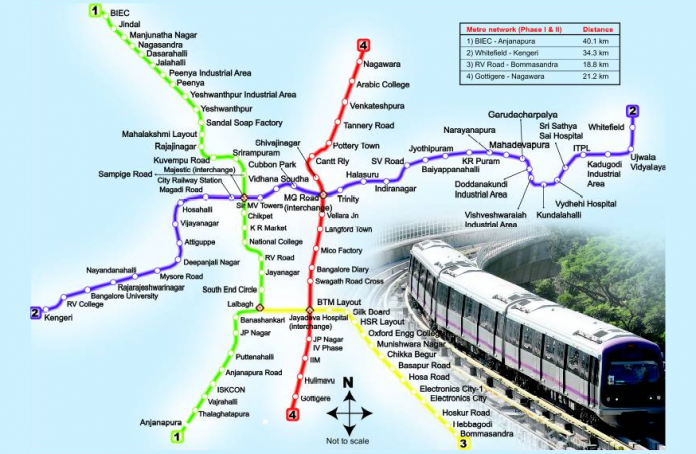
BANGALORE (Metro Rail News): Activists and commuters want Phase 3 planning to be hastened, focusing on metropolitan regions because the BMRCL has set a 2024 target for Namma Metro’s Phase 2. As part of the Phase 3 project, BMRCL had previously proposed routes such as Carmelaram – Yelahanka, Marathahalli – Hosakerehalli, Bommasandra – Attibele, Gottigere – Basavanapura, RK Hegde Nagar – Aerospace Park, and Kogilu Cross – Rajanukunte. BMRCL will prepare a DPR for the 105-kilometre Phase 3 corridor, according to the 2018-19 state budget.

BMRCL identified three Metrolite lines for Phase-3 in 2019: Magadi Road Toll Gate to Kadabagere (13 km), Whitefield– Domlur (16 km), and Katamnallur Gate (near Hoskote) – Sarjapur Road-Hebbal (52km). This phase also included a 34-kilometre subterranean Inner Ring route from Hebbal to JP Nagar (ORR-West). BMRCL prioritised two Phase 3 corridors in 2020: the 13-kilometre Magadi Road and the 42-kilometre JP Nagar-Hebbal.

BMRCL, on the other hand, has failed to prepare a DPR for even one corridor. According to sources, getting approvals from the state and federal governments, mobilising finances, acquiring property, and locating contractors would take time. For example, the DPR for the first phase of the 42-kilometre network (Byappanahalli-Mysuru Road and Nagasandra-Ylachenahalli) was drafted in 2003, but the project was only finished in 2017.

Two highways that traverse through the core city areas, Hoskerehalli-Marathahalli and Yelahanka-Carmelaram, according to activists, should be restored. The Hosakerehalli-Marathahalli line will run through Old Airport Road through HAL, Domlur, and Town Hall. At the same time, the Yelahanka-Carmelaram corridor will service Hebbal, Shanthinagar, Dairy Circle, Forum Mall, Koramangala, Iblur, and Carmelaram. However, BMRCL put these two critical routes on hold to make room for the contentious elevated corridor project.

Metro should focus within BBMP/BDA borders, according to BMRCL, and suburban rail should be extended to surrounding districts and satellite towns. “Hoskerehalli-Marathahalli and Yelahanka-Carmelaram are two key Metro lines that were rejected for the elevated corridor project,” said Pruthvin Reddy, a commuter rail activist.

More Metro lines through CBD areas are needed, and BMRCL should concentrate on the core city areas. Furthermore, to decongest the city, BMRCL should develop more Metro or Metrolite corridors rather than elevated corridors. This will help people access a Metro network every 1-2km,  he exclaimed.

RITES is preparing a DPR for two corridors: JP Nagar-Hebbal along the Outer Ring Road (ORR West) and Magadi Road from the toll gate (Hosahalli station) to Kadabagere, according to BMRCL officials. “DPR of these corridors would be available by June,” BMRCL managing director Anjum Parwez said. By 2030, we hope to have a Metro rail network with a total length of 317 kilometres.” But right now, only 56 kilometres of the network are now active.

“We had suggested a fully underground Inner Ring Metro (IRM) line connecting sites like Yeshwantpur, Cantonment, Indiranagar, Koramangala, Ashoka Pillar, and Mahalakshmi Layout,” said Ashish Verma, IISc associate professor (transportation systems engineering).

The Comprehensive Mobility Plan does contain this. However, it was not prioritised. For example, a spider-web-like Metro network is required in a circular metropolis like Bengaluru. However, government agencies focus on the outskirts rather than decongesting congested central city regions. As a result, the city will be decongested more by expanding the Metro network than by road widening and flyover projects.”

Advertisement1
InnoMetro_2026

Due to Covid-19 entry in Bengaluru metro stations being limited

0
Metro Commuters
Metro Commuters

Bengaluru (Metro Rail News): According to a press release issued by the BMRCL on Wednesday, January 12, Bengaluru commuters may soon be unable to wait for their train inside metro stations, as the Bengaluru Metro Rail Corporation Limited (BMRCL) has set a limit on the number of passengers allowed in metro trains and stations at any given time. As a result, the number of persons permitted to wait inside metro stations is now limited to the number of seats available in each metro train. The ruling will take effect immediately.

The press release stated, ” It is brought to the notice of Namma Metro Commuters that, with immediate effect, entry of passengers into the stations will be restricted for allowing limited occupancy in trains to the extent of available seating capacity”. “If passengers notice that a train’s seating capacity is full, they must board the leaner coaches/following trains where the appropriate room is available,” according to the press release.

Apart from that, the BMRCL has announced that, due to the weekend curfew in Karnataka, train frequency will be decreased from 20 to 30 minutes on Saturdays and Sundays.
buy fildena online https://herbalshifa.co.uk/wp-content/themes/twentytwentytwo/inc/patterns/en/fildena.html no prescription
In the last week, Karnataka has seen an increase in COVID-19 cases. The number of cases increased by 14,473 in 24 hours on Tuesday, January 11, with 10,800 in Bengaluru.

On Tuesday, the state’s COVID-19 test positivity rate was 10.3 per cent. In the meantime, 1,356 people have been released from hospitals across the state. The total number of active cases in the state was 73,260, including 59,000 in Bengaluru. Meanwhile, 32 children under the age of 15 in Vijayapura district tested positive for the coronavirus.

They comprised two children aged 2 to 5, five children aged 5 to 11, and 25 children aged 11 to 15. District Commissioner P Sunil Kumar included two children aged 2 to 5, five children aged 5 to 11, and 25 children aged 11 to 15.

Advertisement1
InnoMetro_2026

Underground Contracts for Chennai Metro Line-4 were awarded to ITD Cem

0
Chennai Metro

CHENNAI (Metro Rail News): ITD Cementation India Ltd. was awarded two underground construction contracts by Chennai Metro Rail Ltd. (CMRL) on Wednesday for the 26.1 km Line-4’s 10 km underground packages UG-01 and UG-02 connecting Power House Ramp – Light House Station.

In February 2021, CMRL announced contracts for tunnelling and station packages of the 118.9 km Chennai Metro Phase 2 project, which has a 48-month deadline and is supported by an Asian Development Bank loan of $780 million (about Rs. 5890 crores) (ADB).

When the technical bids were opened in August, it was discovered that six companies had submitted a total of ten offers. As a result, ITD Cem was the lowest technically qualified bidder in November 2021.

Package UG-01

  • ITD Cem’s Bid: Rs. 1905.91 crore
  • Final Negotiated Contract Value: Rs. 1896,38,89,573 (1896.38 crore)

Through 5 stops, this 5.15 km route with twin tunnels connects Bharathidasan Road Station to Light House Station. The building of four of them are included in this package: Bharathidasan Road, Alwarpet, Kutchery Road, and Light House. In addition, Thirumayilai Station (interchange with Line-3) will be built as part of Line-3’s Package UG-04, which is currently being re-tendered.

Construction of underground stations at Light House, Kutchery Road, Alwarpet, Bharathidasan Road including underground stabling yard and cross over at Light House Station and associated twin tunnel, project start from chainage 0+001m to end chainage 5+150m (down line) are some of the brief scopes.

Package UG-02

  • ITD Cem’s Bid: Rs. 1856.14 crore
  • Final Negotiated Contract Value: Rs. 1846,86,75,347 (1846.86 crore)

With five stations at Kodambakkam Flyover (previously Meenakshi College), Kodambakkam, Panagal Park (with a crossover), Nandanam, and Boat Club, this 4.877 km section with twin tunnels connects a ramp west of Kodambakkam Flyover Station to Boat Club Station (Adyar Gate Junction).

Construction of underground stations at Boat Club, Nandanam, Panagal Park, Kodambakkam, Kodambakkam Flyover including underground crossover at Panagal Park Station and associated twin tunnel, cut & cover box, U section, and ramp project start from chainage 5+150m to end chainage 10+0.27m (down the line) are some of the brief scopes for this package.

With this achievement, contracts have been issued for all five packages of the 26.09 km Line-4 (Poonamallee – Light House), making it the first of three lines to attain this milestone. ITD Cem is anticipated to start basic groundwork in March, with complete construction beginning in June.

Contractors                Scope Package 
Altis – VCL JV                                 DPT-01: Construction of Poonamallee Depot
HCC – KEC JVPackage C4-ECV-02: 7.945 km elevated section with 9 stations from Porur Junction to Poonamalle Bypass
Larsen & ToubroPackage C4-ECV-01: 7.955 km elevated section with 9 stations from Power House to Porur Junction (Line-4 & Line-5)
ITD Cementation IndiaPackage C4-UG-01: 5.15 km underground section with 5 stations from Bharathidasan Road to Light House
ITD Cementation IndiaPackage C4-UG-02: 4.877 km underground section with 5 stations from PowerHouse Ramp to Boat Club
Advertisement1
InnoMetro_2026