Home Blog Page 367

Indian Railways’ longest rail tunnel Udhampur-Srinagar-Baramulla connected

0
The main tunnel of T-49, the longest tunnel of Indian Railways, b/w Sumber &Arpinchala station of Katra-Banihal section of Udhampur- Srinagar-Baramulla Rail Link project has been connected

Jammu & Kashmir (Metro Rail News): Northern Railways announced the completion of India’s longest tunnel between Sumber and Arpinchala stations in the Katra-Banihal section of the Udhampur-Srinagar-Baramulla Rail Link (USBRL) project on February 15. “The main tunnel of T-49 has now been connected,” officials stated.

According to Northern Railways statement, “A major milestone has been achieved by executing the break-through of tunnel T49 between Sumber and Arpinchala Station on the ongoing Katra-Banihal Section. It is worthwhile to mention that the line and level of the tunnel are precisely achieved in break-through.”

Of the 272 km length of the Udhampur Srinagar Baramulla Rail Link Project (USBRL) project, 161 km has already been commissioned and operationalized. According to the railways, the 111 KM route between Katra and Banihal is being built rapidly.

It Stated that the Katra-Banihal Section passes through the steep terrain of the lower Himalayas, where geology poses a significant difficulty. It has several essential bridges and long tunnels that are in various phases of construction.

T49 is a 12.758 KM long tunnel that will be the longest in Indian Railway history, surpassing the Peer Panjal Tunnel, built by USBRL on the Banihal-Qazigund segment and is 11.2 km long. The south portal (S.P.) of Tunnel T-49 is located in picturesque Sumber Village at a distance of 45 km from District H.Q. Ramban of Jammu and Kashmir at an altitude of 1400 meters, while the North Portal (N.P.) of the tunnel is located near Arpinchala village Tehsil Khari, District Ramban, in Mahu-Mangat Valley at an altitude of 1600 meters approximately.

The T-49 tunnel is divided into two sections: the main tunnel and the escape tunnel. The tunnel was built using the NATM (New Austrian Tunneling Method), a modern drill-and-blast technique. The tunnel’s cross-section profile is modified horseshoe-shaped.

This tunnel is extraordinarily long. Three adits, called Urnihal Adit, Hingni Adit, and Kundan Adit, have also been built to ease construction. The tunnel has a 1 in 80 ruling gradient and a designed speed of 100 kilometres per hour.

To simplify rescue and repair operations, the Escape Tunnel, which is being built parallel to the Main Tunnel, is connected by cross passages every 375 metres, as per international standards.

NR entrusted the construction work to IRCON International Ltd., which divided the work into two packages and awarded them to HCC and AFCONS. As a result, HCC is working on a 5.1 KM length from South Portal, while AFCONS is working on a 7.658 KM stretch from North Portal.

According to the railways, Several issues were encountered during construction, including a shear zone, perched aquifer, and highly jointed rock mass, rock problems of squeezing, and high ingress of water.

The team of experienced engineers of Northern Railway, IRCON, and the executing agencies HCC and AFCONS successfully negotiated all challenges and made it possible to achieve this significant achievement.  Agencies employed local people for various works in the region during tunnel building, which transformed the general socio-economic environment.

Advertisement1
InnoMetro_2026

Hyderabad metro rail becomes first in India to start ozone-based sanitisation of Metro coaches

0
Hyderabad Metro Rail becomes first metro in India to introduce Ozone based sanitisation of its coaches

Hyderabad (Metro Rail News): On Tuesday, L&T Metro Rail Hyderabad Limited (L&TMRH) became the first metro rail in India to use ozone to sanitise its train coaches. It introduced three portable Ozycare Mobizone units to sanitise coaches and instil confidence in passengers in the face of the COVID-19 pandemic.

Ozone sanitisation of air and surfaces is extensively used in hospitals, healthcare, food processing plants, and for water disinfection. According to an official announcement, these units were launched following months of rigorous testing on several metro coaches, followed by testing the efficacy of the sanitisation by a NABL-accredited lab.

L&T MRH CEO and managing director K.V.B. Reddy stated, “These units are robust enough to neutralise more than 99% of pathogens both from the surface and air within the train coaches. We hope this would infuse a sense of confidence among passengers, making them choose the metro as their preferred mode of city commute during the ongoing pandemic.”

As per the sanitisation protocol of this machine, the ozone cycle lasts for less than 10 minutes, followed by an ozone destruction cycle that ensures post sanitisation safety as per Occupational Safety and Health Administration norms. During this period, this machine sanitises the entire coach.

The Ozycare Mobizone units are currently being utilised to clean metro coaches at metro depots. These machines supplement the standard, thorough manual sanitisation that takes place throughout the metro system and even reaches gaps and hard-to-reach crevices, he explained.

As per the press release, the sanitation is safe, and the Hyderabad Metro Rail has already implemented COVID-19 safety standards through careful monitoring and adherence to the guidelines. However, passengers must always wear masks, focus on social separation, and undergo compulsory thermal scanning before entering the metro station.

Advertisement1
InnoMetro_2026

DMRC proposes first-ever 72km metro line to connect Noida’s Jewar Airport with Delhi’s IGI Airport

0
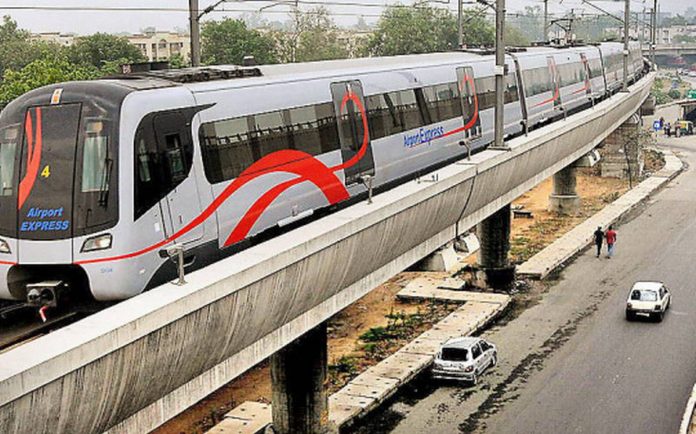
Delhi metro Airport Line
Photo Copyrighted: DMRC

DELHI (Metro Rail News): Delhi Metro Rail Corporation (DMRC) has proposed the first-ever 72 KM high-speed corridor between the forthcoming Noida airport in Jewar and Delhi’s IGI airport to ease up the process of mobility.

The metro will be built in two phases between Jewar and the New Delhi railway station, with 13 stations. In addition, the corridor will connect with Delhi’s Airport Express line to reach IGI 

A DMRC team told authorities from the Yamuna Expressway Industrial Development Authority (YEIDA) on Monday that the first phase, which will be 35 km and include both underground and elevated portions, will connect Knowledge Park 2 on the Aqua Line with the Noida airport.

There will be seven stops between Knowledge Park 2 and this independent corridor, including an interchange. By March 31, the DMRC is expected to present a full project report, followed by a feasibility study for the second phase of the metro link.

According to sources, the second phase will be roughly 37 km and run from Knowledge Park 2 to the New Delhi railway station. In addition, new Ashok Nagar and Yamuna Bank would be stationed along the line, which is expected to run parallel to the Noida expressway.

Arun Vir Singh, CEO – YEIDA, stated, “On Tuesday, DMRC gave a presentation of their proposal to connect Noida airport with Delhi’s IGI. The entire corridor will be 72km long. The first phase will be built from Jewar to Knowledge Park 2 and the second from Knowledge Park 2 to New Delhi railway station. The DPR for the first phase is likely to be ready by March 31.” The 35km first phase of the corridor is expected to cost around Rs 5,000 crore.

In the first phase, there will be seven stations. Apart from Noida airport and Knowledge Park 2, the tentative ones include Techzone, Salarpur Underpass, and sectors 18 and 20 of the Yamuna Expressway. The precise figures will be known only when the DPR is completed. However, trains on this route will travel faster than those on typical metro lines, and it may take an hour to travel between the two airports, including the interchanges.

Advertisement1
InnoMetro_2026

Afcons–SAM JV Bags Rs. 1087.67 cr Underground Contract of Kanpur Metro Phase 1

2
Kanpur Metro
Image for representational purpose only

KANPUR (Metro Rail News): After the Uttar Pradesh Metro Rail Corporation (UPMRC) invited financial bids, Afcons Infrastructure – SAM India JV emerged as the lowest bidder for constructing Kanpur Metro Phase 1’s second underground section (KNPCC-06) between Nayaganj Station and Transport Nagar Ramp.

This section of the 23.785-kilometre Line-1 (IIT – Naubasta), which includes three underground stations at Kanpur Central, Jhakarkatti, and Transport Nagar, is estimated to be 4.65 kilometres long. It will consist of six tunnel boring machine (TBM)-bored tunnels,  for which a minimum of two machines must be deployed.

UPMRC invited tenders for its construction in June 2021, with a 36-month timeline and a budget of Rs. 1250 crore. In October 2021, technical proposals were opened, revealing eight bidders.

Package: KNPCC-06

The work includes: Design and construction of TBM tunnel, cut and cover tunnel, the underground ramp from Kanpur Central end of Nayaganj station to elevated ramp after Transport Nagar and three underground metro stations (viz. Kanpur Central, Jhakarkatti and Transport Nagar) including architectural finishes, E and M, TVS, ECS etc. on Corridor-1 of Kanpur MRTS Project at Kanpur, Uttar Pradesh, India.

The European Investment Bank (EIB) will fund this contract with a €650 million (about Rs. 5661 crores) loan granted in July 2020.

Because Afcons-bid Sam’s of Rs. 1087.67 crore was significantly lower than UPMRC’s estimate of Rs. 1250 crore, the contract should be awarded over the coming weeks. When awarded, this will be Afcons’ second win in Kanpur.  They completed Line-1’s 8.728 km Priority Section (KNPCC-02R) between IIT Kanpur and Motijheel in December 2021.

The underground section of Kanpur Metro Line-1 (Permat Ramp – Tranport Nagar Ramp) is 8.621 km and has seven stations. Gulermak – Sam India JV, which is working on the first underground section (Permat Ramp – Nayaganj) in Kanpur, received their first new TBM S93 last week.

CompanyBid Value (In crore)
Afcons Infra – SAM India JV1087.67
JMC Projects – CAI JV Ltd.1089.99
ITD Cementation India1096.21
Tata Projects Ltd (TPL)1124.80
Gulermak Agir Sanayi Insaat ve Taahh. A.S.1280.66
J Kumar Infra – NCC JV1285.77
Larsen & Toubro (L&T)1449.00
Advertisement1
InnoMetro_2026

Afcons–SAM JV Bags Rs. 1819.79 Cr. Underground Contract of Agra Metro Phase 1 Project

4
Representational image only

AGRA (Metro Rail News): Afcons Infrastructure – Sam India JV was the lowest bidder for the Agra Metro Phase 1 underground segment (AGCC02) between RBS College Ramp and Taj Mahal Ramp, in addition to winning in Kanpur.

Taj Mahal, Agra Fort, Jama Masjid, SN Medical College, Agra College, Raja ki Mandi, and RBS College are all connected by a 7.93 km civil package from chainage 3630.000 to 11564.485 that consists of twin tunnels connecting 7 stations. According to the tender documents for the Uttar Pradesh Metro Rail Corporation (UPMRC), the assigned contractor will be needed to deploy four tunnel boring machines (TBMs).

Package: AGCC-02

The work includes: Design and Construction of Tunnel from start of underground ramp (near Fatehabad Road Metro station) to end of ramp after RBS college Metro station including seven underground metro stations (viz. Taj Mahal, Agra Fort, Jama Masjid, S.N. Medical College, Agra college, Raja ki Mandi and RBS college) including Architectural finishes, E&M, TVS, ECS etc. on Corridor-1 of Agra MRTS Project at Agra, Uttar Pradesh, India.

In August 2021, UPMRC invited bids for this package, which has a budget of Rs. 2200 crore and a four-year completion deadline. In November 2021, technical bids were opened, revealing seven bidders. DRA – Evrascon JV was disqualified during the technical bid examination.

CompanyBid value (In Crore)
Afcons Infra – SAM India JV1819.79
JMC Projects – CAI JV Ltd.1939.30
ITD Cementation India2142.82
J Kumar Infra – NCC JV2249.27
Larsen & Toubro (L&T)2550.36
Gulermak Agir Sanayi Insaat ve Taahh. A.S.2685.25

The European Investment Bank (EIB) will fund this contract with a 480 million Euro loan. Because of Afcons – Sam’s bid of Rs. 1819.79 crore was significantly lower than UPMRC’s estimate (Rs. 2200 crore); the contract should be awarded in the following weeks without a lengthy financial evaluation period.

This summer, construction is expected to start first on the Taj Mahal – Jama Masjid section. Along with Sam India’s 4 km elevated AGCC-01 on Fatehabad Road forms a part of Agra Metro’s 7 km Priority Section.

Advertisement1
InnoMetro_2026

KEC–SAM JV bags Rs. 338.09 cr Subhash Nagar Depot Contract of Bhopal Metro 

0
Bhopal Metro
Representational Image

BHOPAL (Metro Rail News): After the Madhya Pradesh Metro Rail Corporation (MPMRC) opened financial bids, KEC International – Sam India JV emerged as the lowest bidder for the construction work of Bhopal Metro‘s Subhash Nagar Depot (Package BH06).

This station will be developed on a 26.1-acre land parcel directly west of Subhash Nagar Station as part of Bhopal Metro’s Phase 1 project. It will act as a hub for two of the city’s metro lines: the 14.99-kilometre Purple Line (Karond Circle – AIIMS), which is now under construction, and the 12.88-kilometre Red Line (Bhadbhada Square – Ratnagiri Tiraha), which is still in the planning stages.

MPMRCL invited tenders for the depot’s construction in August 2021, with a three-year timeframe and a budget of Rs. 322.91 crore.

Package: BH-06

The work includes: Construction of Rolling Stock Depot cum Workshop at Subhash Nagar for Bhopal Metro Rail Project

In December 2021, technical bids were opened, revealing 13 bidders. However, bids from the following eight firms were rejected during the evaluation process because they were determined to be non-compliant with the tender terms.

  • Altis Holding Corporation – Varindera Constructions (Altis-VCL) JV
  • Bansal Construction Works Private Limited
  • Bridge and Roof Company India Ltd.
  • Cube Construction Engineering Ltd.
  • Engineering Projects (India) Ltd.
  • Amara Raja Infra Pvt Ltd
  • Shalimar Corp Ltd.
  • SMS Ltd.
CompanyBid value (Crore)
Montecarlo – Kunal Structure (MCL-KSIPL JV)483.69
KEC International – SAM India JV338.09
IRCON International Ltd.351.55
URC Construction Pvt. Ltd.351.55
Suroj Buildcon Pvt. Ltd.374.82

Surprisingly, IRCON and URCC both offered the same amount (Rs. 351,55,78992.13). KEC-SAM JV’s bid of Rs. 338.09 crore was only 4.7 per cent more than MPMRC’s estimate (322.91 crores); therefore, the contract should be given without delay in the coming weeks.

SAM India has now won three times in a row. They were the lowest bidders for the AGCC-02 and KNPCC-06 tunnelling contracts in Agra and Kanpur.

The European Investment Bank (EIB) will fund Bhopal’s depot contract with a €400 million loan. It will be built according to IGBC platinum-rated standards, including standard train stabling, washing/cleaning, inspection, maintenance, repairs, and overhaul facilities.

As part of a larger 156 coach rolling stock contract with Indore Metro, the depot will initially house 27 train sets of three coaches (for a total of 81 coaches). Technical bids are set to open on March 4th, and bidding is currently underway.

Advertisement1
InnoMetro_2026

Kochi Metro begin trial on Petta – S.N. Junction stretch

0
Kochi Metro
Kochi MetroImage Copyright: KMRL

KOCHI (Metro Rail News): Kochi Metro Rail Ltd (KMRL) began train trial runs on the 1.78 km section of the Phase 1A project between Petta – Vadakkekotta – S.N. Junction on the late night of 13/02/22.

https://twitter.com/MetroRailKochi/status/1493090727425081344?s=20&t=BUGXVO63VueVdHv17bPuOA

The primary objective of KMRL’s personnel was to check for Schedule of Dimensions (SOD) clearances and examine the train’s interaction with the civil structure to verify there were no physical impediments along the way.

This portion was built under Rs. 299.87 crore contract granted in October 2019 for Package KAC-2 by the KEC-CCECC JV. Besides constructing the viaduct and two stations at Vadakkekotta & S.N. Junction, a new two-lane bridge across the Panamkutty River was also part of their scope.

Delhi Metro Rail Corporation (DMRC) completed the 25 km Phase 1 (Aluva – Petta) and left the city in 2020 & now, KMRL is directly executing the 3.94 km Phase 1 extension, which includes Phase 1A and Phase 1B.

Kochi Metro’s Aqua Line will be 26.78 km long with 24 elevated stations when the Petta – S.N. Junction section opens in the second half of 2022.

KEC – VNC JV is building a 1.163 km expansion to Thrippunithura (Phase 1B) under an Rs. 162.98 crore contract (Package KAC-4) was granted in July 2020.

Advertisement1
InnoMetro_2026

Bullet train from Nagpur-Mumbai soon

0
“CRS has no experience related to high-speed train operations and training will help it identify the shortcoming, if any, regarding bullet trains operations in Indian conditions
image is used for representation purpose copyright: Respective Authority

MUMBAI (Metro Rail News): A projected bullet train that can reduce the current 12-hour journey time between Mumbai and Nagpur to roughly 3.5 hours. The Indian Railways intends to begin bullet train service between Nagpur and Mumbai shortly. The train will travel 766 KMs in less than four hours along the soon-to-be-completed Samruddhi Expressway, with a top speed of 350 KM per hour.

Raosaheb Danve, Union Minister of State for Railways, stated on Saturday that the high-speed connectivity project’s development project report (DPR) would be completed by the end of February. The National High-Speed Rail Corporation Limited (NHSRCL), which is also working on the Mumbai-Ahmedabad Bullet Train Project, will prepare the report.

This superfast railway has been envisioned as part of the Samruddhi Highway project. We have the advantage of having 70% of the land already in our possession. Therefore, we only need to buy 30% of the land from private parties, Danve stated.

Union minister Nitin Gadkari said Danve discussed the bullet train project during a meeting and that the bullet train would provide another solid option for transit between the two cities.

Danve emphasised that no property would be taken up because the entire rail corridor would be elevated. Although the train needs a straight corridor, there is a curve beyond Igatpuri where we must adjust the train’s path. The number of stations along the train’s route would be mentioned in the DPR report,” he noted.

The Mumbai-Nagpur high-speed corridor is one of seven projects proposed by the Centre recently. Meanwhile, on the Gujarat side, development on the Mumbai-Ahmedabad corridor is started, with land acquisition nearly complete. The Japan International Cooperation Agency (JICA) is funding the 508-kilometre Mumbai-Ahmedabad project, which will cost over Rs 1. 1 lakh crore. Given this, the newly proposed Mumbai-Nagpur project will be significantly more expensive, given its 766-kilometre length.

Advertisement1
InnoMetro_2026

Mitsui & Ohmi industries Bid for Chennai Metro Phase 2’s HH Rail Contract

0
Chennai Metro/ Representational image

Chennai (Metro Rail News): Chennai Metro Rail Ltd (CMRL) opened technical bids on Wednesday; Japan’s Mitsui & Co. Ltd. and Ohmi Industries Ltd. emerged as the only bidders for the head-hardened rail contract for line 3 and 5.

These special tracks will be 60E1 – 1080 grade, as per Indian Railway Specification T-12-2009, and will be produced using a unique heat treatment technology to increase strength, reduce residual stress, extend track life, and minimise maintenance.

Both of these new lines will connect Madhavaram – SIPCOT (45.813 km Line-3) and Madhavaram – Sholinganallur (47 km Line-5) with a combination of elevated and underground stations as part of Chennai Metro’s 118.9 km Phase 2 project.

In August 2021, CMRL invited tenders for this track contract, which is being funded by JICA and has a budget of Rs. 88.1 crore and a delivery deadline of 1632 days (4.47 years). Supply of 60E1 Profile, 1080 Grade (Head Hardened) Rails Conforming to IRS T-12-2009 (with latest amendments for CMRL Phase-II Project for Corridor 3&5 are some of the scopes for the project.

Mitsui delivered 10,600 metric tonnes of head hardened rails to the Ahmedabad Metro Phase 1 project and is now delivering to the Bangalore Metro Phase 2 project.

Jindal Steel and Power Ltd. (JSPL) did not bid for this contract, presumably because its internal ROI calculations showed no significant benefits. However, they are the only Indian train company capable of producing these specific rails. Their most recent win was in 2020 for delivering 2,308 tonnes of HH rails to Kolkata Metro’s Line-2.

The bids from Mitsui & Ohmi have now been forwarded for technical bid evaluation, which could take a few months. After that, the financial bids of the technically qualified bidders will be opened to determine who is the lowest bidder and most likely supplier.

Advertisement1
InnoMetro_2026

3 Bidders submits DDC contract of Agra & Kanpur Metro Phase 1’s Line 2

0
Kanpur Metro
Kanpur Metro/Representational Image

LUCKNOW (Metro Rail News): Three firms filed bids for the Detailed Design Consultant (DDC) contract for the second corridors of the 32.385 km Kanpur Metro and 29.40 km Agra Metro Phase 1 projects on Feb 11, 2022.

This is the first critical phase in the tendering process for the new lines that will predominantly comprise elevated stations in both cities. After that, UPMRC will likely spin their development off into a new phase titled Phase 1B or something similar.

Package: KNPAGDDC-01

  • 8.6 km Kanpur Metro Line-2: Chandra Shekhar Azad University – Jaurali; Depot at Agriculture University
  • 15.40 km Agra Metro Line-2: Agra Cantt. – Kalindi Vihar; Depot at Kalindi Vihar

The DDC’s duty often includes developing and suggesting alternate designs for all civil, architectural, building services, electrical, and mechanical works, among other things. In November 2021, the UPMRC will seek bids for this consultation service, with a budget of Rs. 35.57 crore, and hopes the consultant stays on for at least 1460 days (4 years).

Lead Bidders were as follows (Note: they may be in a consortium with others)

  • AYESA Ingenieria y Arquitectura, S.A.U
  • STUP Consultants Pvt Ltd.
  • SYSTRA MVA Consulting (India) Pvt Ltd.

The Work includes the Engagement of a Detailed Design Consultant (DDC) for Civil, Architectural and E and M Works for (a) Corridor-2 of Kanpur Metro Rail Project, at Kanpur, and (b) Corridor-2 of Agra Metro Rail Project, at Agra.

The bids have now been forwarded for technical review, which could take several months. After that, the technically qualified bidders’ financial bids will be released to reveal the lowest bidder and most likely consultant.

The consultant will develop designs and cooperate with Technica Y Projectos, S.A. – Italferr S.P.A JV (General Consultant) and civil contractors to make the designs a reality after the contract is won.

Because the 11-kilometre Line-2 of the Lucknow Metro was a no-go due to ridership concerns and the state government’s decision to focus on other cities, it will take some time before civil work on the Agra and Kanpur metros’ second lines begins.

Advertisement1
InnoMetro_2026