Home Blog Page 304

India’s first high-speed rail route project’s girder launcher erection proceeding quickly

0
MAHSR project's full span girder erection
MAHSR) project's full span girder erection

MUMBAI (Metro Rail News): The Mumbai-Ahmedabad High-Speed Rail Corridor (MAHSR) project’s full span girder erection is proceeding quickly and without interruption, according to a tweet from the Ministry of Railways on 7th September. A time-lapse video was also posted by the ministry.

“The MAHSR Project’s full span girder erection is proceeding quickly and without obstruction over a railway line near Anand (Gujarat). View the time-lapse video, posted by the ministry.

Mumbai-Ahmedabad High-Speed Rail Corridor will link Ahmedabad with Mumbai, India’s financial center. When finished, it will be India’s first high-speed rail route.

Construction reportedly started in April 2020. By the end of December 2023, the project is expected to be finished. The completion timetable for the entire corridor is uncertain because land acquisition in Maharashtra has taken longer than expected. The 352 km route through Gujarat, however, might open in 2027. A 50 km section from Surat to Bilimora is expected to be finished by 2026.

The Mumbai-Ahmedabad corridor was proposed for a feasibility study in the 2009–2010 Rail Budget with five other high-speed rail corridors.

A 650 km long high-speed rail link from Pune to Ahmedabad via Mumbai was proposed. The pre-feasibility study for the Ahmedabad-Mumbai-Pune corridor was finished by RITES, Italferr, and Systra. The corridor’s maximum projected speed was set at 350 km/h.

Advertisement1
InnoMetro_2026

GOI approves 2nd Phase of Kochi Metro Rail Project

0
Kochi metro phase 2
Kochi metro phase 2

KOCHI (Metro Rail News): Union cabinet has approved the second phase of the Kochi Metro Rail project, which would pass through 11 stations and cover a distance of more than 11 kilometers. A central government statement claims that the project’s preliminary work, including the enlargement of the road close to the airport, is in progress. It is estimated that the project will cost Rs 1,957 crore.

The first phase of the project, which started in Aluva and ended at Petta, is fully operational since December 2014. The second phase will be stretched from the JLN Stadium to Infopark and will also pass Kakkanad. It was inaugurated in 2017 by the then Chief Minister Pinarayi Vijayan in the presence of Union Minister Hardeep Singh Puri.

The Kochi Metro Rail project’s first phase, which is its elevated section, is being carried out as a state-sector project. At an estimated cost of Rs. 710.93 crores, a 1.80-kilometre viaduct between Petta and SN Junction is being constructed. The 1.20 km Kochi Metro Phase 1 B Project from SN Junction to Thripunithura Terminal is also being constructed as a state-funded project.

On September 1, PM Modi flagged off Phase 1A, the first section of the Kochi Metro Rail that runs from SN Junction to Vadakkekottaon. He also formally erected Kochi Metro Phase 2’s foundation. Construction work on the Panamkutty bridge, SN Junction stations, and Vadakkekotta stations began on October 16, 2019.

The Kochi Metro Rail project’s combined Phases I and II will connect the city’s residential and commercial districts with important transit hubs. As a result, the idea of multi-modal connectivity will be strengthened.

Vadakkekotta is the largest metro station, With a total area of 4.3 lakh square feet making it the most commercially oriented building in the city.

The city of Kochi, which is situated in Kerala with the highest population density, is a part of a larger metropolitan area. Its urban agglomeration as a whole is home to more than 300,000 residents.

Advertisement1
InnoMetro_2026

Inauguration of Rupsha Rail Bridge- Connectivity of friendship

0
Rupsha Rail bridge
Rupsha Rail bridge/ Daily Sun

NEW DELHI (Metro Rail News): Hon’ble PM Narendra Modi and PM Sheikh Hasina of Bangladesh jointly inaugurated the 5.13 km Rupsha Rail Bridge, which is a key part of the 64.7 km Khulna-Mongla Port Broad Gauge Rail Project. Darshana Jardosh, Minister of State for Railways & Textiles, Government of India, Member of Parliament, Surat Lok Sabha shared this good news on her Twitter handle.

https://twitter.com/DarshanaJardosh/status/1567076314397708289

Bangladesh is a major pillar of India’s neighborhood first policy. Rupsha rail bridge is a part of the Khulna-Mongla port rail line project under the govt of India’s concessional line of credit extended to the govt of Bangladesh.

Rupsha Rail Bridge will help in enhancing people-to-people contact and facilitating regional economic integration.

Several efforts have been taken by both countries to enhance connectivity by building railways and waterways linkages.

The 5.13-km broad-gauge single-track railway bridge has been constructed by an Indian contractor EPC Contractor M/s L and T. The total project (Khulna-Mongla port rail line project) cost US$ 388.92 million while the cost of constructing the Rupsha bridge is US$ 169.26 million.

The bridge construction involved a huge of technology and also has additional features such as navigation fender piles upstream and downstream of the pier, for ensuring navigation safety in the river. The navigational clearance for the main bridge is more than 18 m from Standard High-Water Level (SHWL).

The bridge will greatly increase the connectivity of Mongla Port, the second largest port in Bangladesh, and provide the alternate root of maritime.

It will also allow other countries in the region to use the port and boost sub-regional development.

Advertisement1
InnoMetro_2026

Uttar Pradesh government approves TOD policy around the rapid rail corridor

0
TOD policy around the rapid rail corridor
TOD policy around the rapid rail corridor Image source: HT

GHAZIABAD (Metro Rail News): In accordance with the recently announced TOD policy of the Uttar Pradesh government, the Ghaziabad Development Authority (GDA) has been instructed to develop plans for the transit-oriented development (TOD) zones alongside various mass transit systems, such as the Regional Rapid Transit System (RRTS).

The concept of TOD is fast growing and aims at creating vibrant, sustainable, and liveable communities that are generally cantered near high-quality train systems.

The TOD program, as stated by GDA officials, strives for planned development alongside high-speed mass transit networks in Ghaziabad, these regions include alignments next to the Metro and the RRTS, in addition to motorways and expressways.

“The authority has been asked to make special plans for TOD zones, or mixed land use zones for the development of residential, commercial, and other types of projects. According to Rajiv Ratan Sah, town planner for the GDA, the land within a 1.5 km radius of stations and a 500 m radius of the mass transit line will be developed as TOD zones.

The rapidly expanding TOD concept aims to build thriving, sustainable, and livable communities, typically centered near high-quality train systems.

“The areas nearby these projects need to be developed in a well-planned manner. So, the TOD policy is a welcome step and it will be beneficial for residents, commuters, and businesses. It will also boost the local economy and provide ample employment opportunities. The concept of TOD is already prevalent in many foreign countries,” said Gaurav Gupta, secretary, Confederation of Real Estate Developers’ Associations of India (NCR), a realtor’s lobbying group.

22 of the 25 stations in the 82 km RRTS route are in Uttar Pradesh and are managed by the Ghaziabad and Meerut districts. Similarly, Ghaziabad is served by two stations on the Delhi Metro’s Blue Line and eight stations on its Red Line.

The new policy of the Uttar Pradesh government has specified three categories of TOD zones.

“In TOD projects of up to one hectare, there will be a provision of 3 to 4-floor area ratio (FAR) in developed areas along with coverage (area on which construction is allowed) of 45%. In undeveloped areas, the FAR will be 3.5 to 5 with a coverage of up to 40%. In projects above 1 hectare, the FAR will remain the same for developed and undeveloped areas while the coverage will be 35% and 30%, respectively,” Sah said.

Advertisement1
InnoMetro_2026

TBM S97 and S98 arrive in Chennai for CMRL Phase-2 Project

0
TBM S97 and S98 arrive in Chennai for CMRL Phase-2 Project

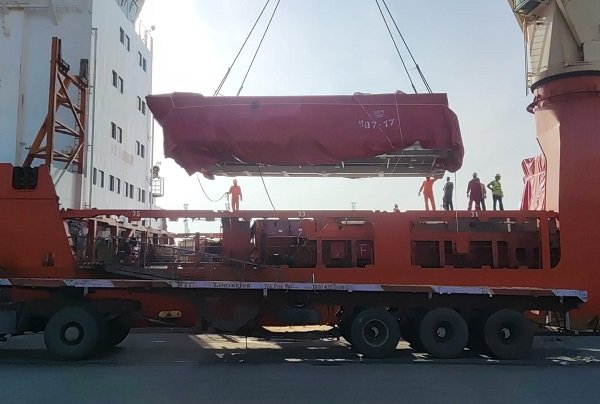
CHENNAI (Metro Rail News): The tunnel boring machines S97 and S98 arrived at Chennai Port in Tamil Nadu last week for the construction of Package TU01 of the 118.9 km Chennai Metro Phase 2 project.

Tata Projects Ltd. (TPL) will use both 6.61m earth pressure balance (EPB) machines made by Terratec in China along with 5 other TBMs to construct about 9 km twin tunnels (total 18 km) on the new 45.813 km Line-3’s Venugopal Nagar – Kellys segment.

This summer, both machines passed factory acceptance testing (FAT). TPL received its first machine, the TBM S96, back in July in Chennai’s Madharavam neighbourhood.

In May 2021, CMRL awarded TPL Phase 2’s Package TU-01 Rs. 1999 crore with a deadline of a 42-month.

Construction of approximately 9 km twin bored tunnels (total = 18 km) from the TBM Retrieval Shaft near Venugopal Nagar (of Line-5) to Kellys Station, and the construction of diaphragm walls, entry/exit structures of Madhavaram Milk Colony Station, Murari Hospital Station, Ayanavaram Station, and Purasaiwakkam High Road Station, including launching and retrieval shafts at the above stations are included in the scope of TU01.

Advertisement1
InnoMetro_2026

Kerala’s Silverline to expand up to Mangaluru

0
Kerala Silverline Semi High Speed rail
kerala silverline semi high speed rail

MANGALURU (Metro Rail News): The request to expand SilverLine of the semi-high-speed rail project, to Mangaluru is accepted, it will cost an additional 6,000 crores as estimated in 2019-2020.

The railway line extension to Mangaluru is not included in the detailed project report (DPR) that was submitted to the Railway Board for approval.

The suggestion was discussed at the Southern Zonal Council’s 30th meeting, which took place on 3rd September in Thiruvananthapuram. The two States have agreed to meet at the chief ministerial level by the end of this month in Bengaluru to discuss this.

V Ajithkumar, managing director of K-Rail stated that there were no major technical or economical challenges to extending the rail line to Mangaluru. A new traffic study had to be done as part of extending around less than 50 km line to the port city of Karnataka. The project will cost an additional ₹6,000 crore as per the estimate of ₹120 crores a km.

The plan to expand the line to Mangaluru was first put forth when the high-speed rail project was first conceived by E. Sreedharan, the Principal Advisor of the Delhi Metro Rail Corporation (DMRC), during the previous United Democratic Front (UDF) govt. The State govt is investigating the possibility of extending the line to Mangaluru in the second phase.

People in the north and central Kerala would have new opportunities as the second-largest industrial city in Karnataka would be nearby, just a short distance from the State.

Tamil Nadu Chief Minister M.K. Stalin, who attended the meeting, focused on the need to link the high-speed rail between Chennai and Coimbatore to the cities in the neighboring States.

Advertisement1
InnoMetro_2026

Excise department start selling liquor at Delhi metro stations premises

0
delhi govt opens liquor shops at metro premises

NEW DELHI (Metro Rail News): The Delhi government’s excise department started selling alcohol at shops situated at Delhi Metro station premises in several areas on 3rd September to meet the demands of tipplers. Officials stated that the decision was made in order to improve sales owing to high footfall in the area.

More than six liquor vends have been opened in Badarpur, Dwarka, Karol Bagh, Rajouri Garden, and Mundka metro station premises.

The official stated that metro stations have a high footfall which is a big factor to ensure more access to liquor products, and thereby more revenue.

The DMRC has also issued licenses to the Delhi Consumers’ Cooperative Wholesale Store Ltd (DCCWS) to open liquor stores at over half a dozen of metro stations.

“We are also planning to give licenses for wine and beer shops which will only sell light alcoholic beverages and rather than those with higher alcohol content like rum and whisky,” said the excise officer.

The built-up shops at Metro station premises are often spacious and suitable to serve the purpose of providing consumers experience of swankier vends.

The four agencies entrusted with running liquor shops are Delhi Tourism and Transport Development Corporation (DTTDC), Delhi State Industrial Infrastructure Development Corporation (DSIIDC), Delhi Delhi State Civil Supplies Corporation (DSCSC), and DCCWS.

The department has already issued around 450 licenses to the four corporations and over 350 liquor stores operated by four agencies that are currently running in the city.

The Excise department has planned to open 500 liquor vends across the city by September and at least 200 more vends by year-end, officials added.

Advertisement1
InnoMetro_2026

KMRC to introduce diagnostic facilities at metro stations

0
Kolkata metro
Kolkata metro Image source: Daily News Raftaar

KOLKATA (Metro Rail News): The Kolkata Metro which is the oldest rapid transit system in India will introduce diagnostic facilities at the Metro Railway stations in an effort to improve the passenger experience. The development was confirmed on 4th September stated by a representative of Kolkata Metro Rail Corporation Ltd (KMRC). As part of efforts to improve passenger comforts, medical diagnostic facilities will now be provided at Metro Railway stations throughout the city, the official added.

The facilities will be made available on the metro railway stations in the north-south corridor, stretching from Garia Station- Kavi Subhas to Dakshineswar an official stated. 

The commuters will now be able to opt for blood tests or any kind of pathological tests in any of the stations on the north-south corridor. 

“Diagnostic and collection centers are going to be set up in unutilized spaces in the Metro premises,” the official added.

“Various reputed diagnostic centers of the city have already shown interest in setting up such units at Metro stations”.

Reports of the tests will be available online.

Advertisement1
InnoMetro_2026

Ministry of Railways shares update of Jhansi- Bina project

1
Representational Image

JHANSI (Metro Rail News): Ministry of Railways has shared the progress report of the Jhansi- Bina 3rd line Project to boost the connectivity of the Bundelkhand region of Uttar Pradesh.

With the Bundelkhand region line connectivity, goods & passenger train operating capacity will be enhanced between Jhansi and Lalitpur in Uttar Pradesh and Sagar (Bina) in Madhya Pradesh.

The 152.57 km long railway line is 59% completed. 

Jhansi-Bina section is a BG double line on the New Delhi-Mumbai CST route. This project will enhance capacity, reduce detention and cater to the future growth of traffic. At present, the number of passenger and goods trains in this section is far more than its capacity, resulting in heavy detention to trains. 

Advertisement1
InnoMetro_2026

MPMRCL shares the progress of Bhopal Metro’s Subhash Nagar Depot

0
the progress of Subhash Nagar Depot construction of the Bhopal priority corridor.

BHOPAL (Metro Rail News): Madhya Pradesh Metro Rail Corporation Limited. (MPMRCL) MD Nikunj Srivastava along with senior officials reviewing and analyzing the progress of Subhash Nagar Depot construction of the Bhopal priority corridor.

https://twitter.com/OfficialMPMetro/status/1565974187071897601

For Bhopal Metro, a total of 27 trains will be stabled at Subhash Nagar Depot out of which 14 trains will serve the under construction 14.99 km Purple Line which is a stretch from Karond Circle to AIIMS while 13 will serve the upcoming Red Line which is a 12.88 km stretch from Bhadbhada Square to Ratnagiri Tiraha.

As for the Indore Metro, 25 trains will be stabled at Gandhi Nagar Depot which will provide service to the 33.53 km Yellow Line which will form a ring line around Indore city connecting Palasia – Railway Station – Rajwara- Airport – Bhawarsala.

A target has been set to build 5 stations from December to January 2023. The construction started by doing a metro station near the Central School. After this, the track sealing work will be done.

Advertisement1
InnoMetro_2026