Home Blog Page 291

Indian Railways accomplishes electrification of 81.51% of the total BG network

0
Image for representation.

NEW DELHI (Metro Rail News): Indian Railways has embarked upon an ambition plan of electrification of its complete Broad Gauge network which would not only result in a better fuel energy usage resulting in increased throughput, reduced fuel expenditure but also savings in precious foreign exchange.

During the FY 2022-23, till September 2022, Indian Railways has achieved 851 Route Kilometers (RKMs) as compared to 562 RKMs during the corresponding period of FY 2021-22. It is 51.4% more than the previous year figures of the corresponding period. The target set for electrification during this Financial Year is 6500 RKMs.

It is worth mentioning that record electrification of 6,366 RKMs was achieved in Indian Railways’ history during 2021-22. Earlier, highest electrification was 6,015 RKM during 2020-21.

As on 30.09.2022, out of 65,141 RKM of BG network of IR (including KRCL), 53,098 BG RKM have been electrified, which is 81.51% of the total BG network.
Advertisement1
InnoMetro_2026

Tamil Nadu CM inaugurates Phase II CMRL tunnelling work

0
Tamil Nadu CM inaugurates Phase II CMRL tunnelling work
Tamil Nadu CM inaugurates Phase II CMRL tunnelling work/ Image Credit: TH

CHENNAI (Metro Rail News): M K Stalin, the chief minister of Tamil Nadu, inaugurated the construction of tunnel under the second phase of the Chennai Metro Rail project at Madhavaram Milk Colony on 14th October.

The State government has approved the construction of three metro rail corridors for a length of 118.9 kilometres under Phase II of the Chennai Metro Rail project.

The corridors 3 and 4 from Lighthouse to Poonamalle Bypass (26.1 km) and corridor 5 from Madhavaram to Sholinganallur (45.8 km each) make up the 128-station Phase II extension (47 km).

The project is expected to cost Rs 63,246 crore. The plan is under process and approved by Central government. By the end of 2026, the project is proposed to be finished.

Funding for a portion of Chennai Metro Rail in Phase II i.e. for 52.01 km – from Madhavaram – Sholinganallur of Corridor 3 and Madhavaram – CMBT of Corridor 5 has been tied up with the Japan International Cooperation Agency (JICA) as State Sector Project, a release said.

The finance of the remaining 66.89 km stretch through multilateral banks such as the Asia Development Bank (ADB), Asian Infrastructure Investment Bank (AIIB), and New Development Bank (NDB) has been given clearance in principle.

Advertisement1
InnoMetro_2026

PM flags off Vande Bharat Express from Una in Himachal Pradesh to New Delhi

0
PM flags off Vande Bharat Express from Una

NEW DELHI (Metro Rail News): The Prime Minister, Shri Narendra Modi flagged off the inaugural run of the new Vande Bharat Express from Amb Andaura, Una to New Delhi, on 13th October.

The Prime Minister inspected the train coaches of the Vande Bharat Express and took stock of the onboard facilities. Shri Modi also inspected the control centre of the locomotive engine of Vande Bharat Express. He also inspected Una railway station.

The Prime Minister was accompanied by Chief Minister of Himachal Pradesh, Shri Jai Ram Thakur, Governor of Himachal Pradesh, Shri Rajendra Vishwanath Arlekar, Union Minister of Railways, Shri Ashwini Vaishnaw and Union Minister of Information & Broadcasting, Shri Anurag Singh Thakur when he arrived at Amb Andaura Railway Station in Una district of Himachal Pradesh.

The introduction of the train will help boost tourism in the region and provide a comfortable and faster mode of travel. The travel time from Una to New Delhi will be reduced by two hours. Running from Amb Andaura to New Delhi, it will be the fourth Vande Bharat train to be introduced in the country and is an advanced version compared to the earlier ones, being much lighter and capable of reaching higher speeds in a shorter duration. Vande Bharat 2.0 is equipped with more advancements and improved features such as reaching a speed of 0 to 100 kilometres per hour in just 52 seconds, and a maximum speed of up to 180 kilometres per hour. The improved Vande Bharat Express will weigh 392 tons when compared to the previous version of 430 tons. It will also have a Wi-Fi content on-demand facility. Every coach has 32” screens providing passenger information and infotainment compared to 24” in the previous version. Vande Bharat Express will also be environmentally friendly as the ACs will be 15 per cent more energy efficient. With dust-free clean air cooling of the traction motor, travel will become more comfortable. A side recliner seat facility provided only to Executive Class passengers earlier will now be made available for all classes. Executive Coaches have the added feature of 180-degree rotating seats

In the new design of Vande Bharat Express, a photo-catalytic ultraviolet air purification system is installed in the Roof-Mounted Package Unit (RMPU) for air purification.  As recommended by Central Scientific Instruments Organisation (CSIO), Chandigarh, this system is designed and installed on both ends of RMPU to filter and clean the air free from germs, bacteria, viruses etc. coming through fresh air and return air.

The Vande Bharat Express 2.0 offers a myriad of superior and aircraft-like travelling experiences. It is equipped with advanced state-of-the-art safety features including an indigenously developed Train Collision Avoidance System – KAVACH.

Advertisement1
InnoMetro_2026

Indian Railways Revenue Earnings up by 92% in Passenger Segment

0
Indian Railways/Representational Image
Representational Image only

NEW DELHI (Metro Rail News): The total approximate earnings of Indian Railways on originating basis during 1st April to 08th October 2022 is Rs. 33476 Crore, registering an increase of 92 per cent in comparison to Rs. 17394 Crore achieved during the same period last year.

In reserved passenger segment, the total approximate numbers of passengers booked during the period 1st April to 08th October 2022 is 42.89 Crore as compared to 34.56 Crore during the same period last year, showing an increase of 24%. The revenue generated from reserved passenger segment during the period 1st April to 08th October 2022 is Rs 26961 Crores as compared to Rs 16307 Crores during the same period last year, showing an increase of 65%.

In Unreserved passenger segment, the total approximate numbers of passengers booked during the period 1st April to 08th October 2022 is 268.56 Crore as compared to 9.57 Crore during the same period last year, showing an increase of 197%. The revenue generated from Unreserved passenger segment during the period 1st April to 08th October 2022 is Rs 6515 Crores as compared to Rs1086 Crores during the same period last year, showing an increase of 500 %.

Advertisement1
InnoMetro_2026

Mumbai Metro Lines 2A & Line 7 receives RDSO safety certificate for operations

0
(Representational Image)

MUMBAI (Metro Rail News): The MUMBAI Metro Lines 2A (Dahisar to DN Nagar) and Line 7 (Dahisar East to Andheri East) have cleared testing by the Research Designs and Standards Organization and will now undergo testing for signalling, according to an MMRDA official.
RDSO authorization is an important first step for any Metro rail before it can begin operation for commercial purposes.

“The RDSO test is an important milestone that has been achieved. In the next few days, the certification will be issued. Now the target to finish the remaining safety clearance is we are processing, so that commissioning of the remaining stretch by the end of this year is achievable,” the official added, requesting anonymity.

The Maha Mumbai Metro Rail Operation Corporation Ltd (MMMOCL) received a 20 km stretch between Aarey and Dhanukarwadi from the MMRDA, the nodal agency for the construction of Metro Lines 2A and 7, as well as other Metro lines in MMR, with the exception of underground line 3 between Colaba-Bandra-SEEPZ, only in April.
It handles the Metro corridor’s maintenance and operation.

Commuters are responding well to the partially opened Metro Lines 2A and 7, with an average of 80,000 commuters per month on an average.
Once fully operational, these two Metro lines, which have 30 stops and pass through the major Link Road and Western Express Highway, are anticipated to lessen traffic on the road and decongest the overcrowded local trains on suburban stretches.
By 2031, Metro Line 2A and Line 7 are anticipated to carry 11.37 lakh daily passengers.

Advertisement1
InnoMetro_2026

Girder Erection for Pune Metro Line 3 begins with a full speed

0
Girder Erection for Pune Metro Line 3 begins with a full speed

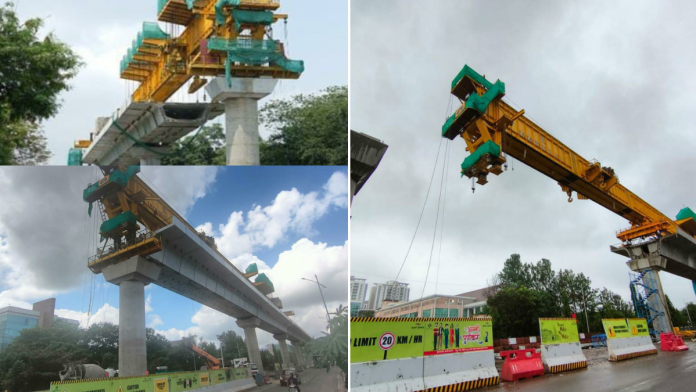
PUNE (Metro Rail News): Work on Pune Metro Line 3 connecting the IT hub of Hinjewadi to the central area of Shivajinagar is taking shape at a fast pace. After erecting a total of 112 pillars last week, Puneri Metro has now started the crucial work of Girder Launching (popularly known as "LG erection") on the pillars.

The work of Pune Metro Line 3 on the Hinjewadi to Shivajinagar route has been jointly undertaken by Tata Group and PMRDA on the basis of the Public Private Partnership (PPP) and Tata Group has established Pune IT City Metro Rail Limited as a special purpose vehicle (SPV) company for its implementation.

At present, girder launching work has been undertaken at various places on this route of a total distance of 23.3 km. The length of each of these girders is about 70.5 meters. A total of eight such girders are going to be launched for the entire project of Pune Metro Line 3. Out of these, three girders at Hinjewadi Phase Three and Balewadi Stadium have now been completed. Also, the work of connecting the fourth girder at Sindh Society on Baner Road has been started on 13th October.
After the LG erection, all the accessories will be installed and segment lifting would be the next step. Hence, girder launching is considered one of the crucial tasks in the construction process.
What is LG erection?
Launching Girder (popularly mentioned as LG) is also known as Launching Gantry. The launching gantry is used to lift and support bridge segments or girders as they are placed while being supported by the bridge piers instead of the ground. A launching girder is in general a design-and-built machine used in precast post-tensioned bridge construction. It consists of lifting devices and a supporting structure for lifting precast beams and precast bridge segments in position for assembling.
About Pune Metro line 3:
The Pune Metro line III is a ~23 Km elevated Metro rail project connecting the IT hub of Hinjawadi to the Central business district of Shivajinagar. It is a Public Private Partnership (PPP) project awarded by the Pune Metropolitan Region Development Authority (PMRDA) to a consortium consisting of Tata Group’s TRIL Urban Transport Private Limited (TUTPL) and Siemens Project Ventures GmbH. The Project would be developed & operated on Design, build, finance, operate & transfer (DBFOT) basis by a special purpose vehicle (SPV), Pune IT City Metro Rail Limited (PITCMRL) for a Concession Period
of 35 years including the construction period.

Advertisement1
InnoMetro_2026

Yeida pays DMRC Rs 1.87 crore for DPR of new Metro corridor

0
Delhi Metro
Delhi Metro/ Representational Image

NEW DELHI (Metro Rail News): The Yamuna Expressway Industrial Development Authority (Yeida) on 11th October stated that they had paid Rs 1.87 crores to the Delhi Metro Rail Corporation (DMRC) for preparing a detailed project report (DPR) to connect Greater Noida’s Knowledge Park II to New Delhi railway station.

The Yeida already has a feasibility report from the DMRC for the vital link that seeks to offer direct connectivity from Jewar airport to Delhi’s Indira Gandhi International Airport. In the upcoming six months, the DMRC will develop and submit the DPR to Yeida, according to officials.

“The DMRC will start work on the DPR immediately because it has to complete the job in six months. We need to build a Metro corridor that will connect the upcoming Noida International Airport with the Indira Gandhi International Airport directly,” said Arun Vir Singh, Yeida chief executive officer (CEO).

“We have already approved the DPR of the 35.64-km Metro corridor between Jewar and Knowledge Park II and sent the same to the Uttar Pradesh government for final approval in the month of August. Once the DPR of the 36.36-km Metro corridor between Knowledge Park II and New Delhi is complete, we will approve it and will send the same to the state government and Union government for their approval. The 72-km Metro corridor from Jewar to New Delhi roughly requires 13,000 crore in funding. The funding pattern will be finalised at a later stage,” said CEO Singh.

In order to create direct connectivity between the Indira Gandhi International Airport and the upcoming Noida International Airport at Jewar and another Metro Corridor from Greater Noida to Jewar, Yeida and DMRC signed a memorandum of understanding on September 3, 2021. The Greater Noida to Jewar Metro Corridor is expected to receive the necessary clearances by the end of this year, paving the way for construction to begin in 2023, according to the DPR.

Advertisement1
InnoMetro_2026

KMRL launches free wifi service inside Kochi Metro Rail

3
Kochi metro
Kochi metro/ Representational Image

KOCHI (Metro Rail News): The long-awaited free Wi-Fi connectivity has finally been readied in Kochi Metro Rail, and commuters will be able to download data at a speed of 5 to 10 Mbps while traveling in the Kochi metro trains. The service will be available on all 23 trains of the Kochi Metro.

Addressing the media here on 11th October, the Kochi Metro Rail Limited (KMRL) managing director Loknath Behera said commuters could utilize their travel time either for working online or for entertainment. “At present, a 4G network is being used to provide Wi-Fi connectivity. It will be upgraded to a 5G network once the service is widely available. Aimed at ensuring user data privacy, care has been taken not to share user credentials with any outside agency as per statutory guidelines. Provision for seamless Wi-Fi inside trains will enhance the overall travel experience of commuters,” he added.

The project was being implemented by KMRL to promote the Digital India Campaign, in association with a Thiruvananthapuram-based company, a registered operator under the Department of Telecommunications, to offer Wi-Fi services to the public, he said.

Instructions on how to use the free Wi-Fi are displayed on all the trains. Commuters can turn on Wi-Fi and choose “KMRL Free Wi-Fi” from the list of available networks on their mobile devices. With the OTP, they can register and use the free Wi-Fi. There are no content restrictions and the system includes all security safeguards.

The 12-km Aluva-Palarivattom metro corridor was opened in 2017, and that same year the proposal to introduce Wi-Fi was first floated. Its goal was to attract young people and tech-savvy commuters to the public transit system. The initial strategy was to increase
The original idea was to prolong the service free of charge for a period of time before charging a minimal fee for the remaining journey. Delhi metro was the first metro in the nation to offer free Wi-Fi to commuters.

Loknath Behera said the first batch of five water metro ferries will be commissioned after conducting trial runs on the High Court-Vypeen corridor. “Since it is for the first time that we are using the fleet of battery-powered ferries, an extensive trial will be conducted before launching the water metro service,” said Behera.


.

Advertisement1
InnoMetro_2026

Indian Railways to install EV charging points at major stations in next 3 years

0
EV charging points
EV charging points

NEW DELHI (Metro Rail News): The Indian Railways will install electric vehicle (EV) charging points at all major stations throughout the nation over the course of the next three years, according to a new policy to promote e-mobility.

Railway stations in megacities with a population of more than four million each will be used for the first phase of the installation of charging points for electric vehicles.

According to a document, the Indian Railways envisages the installation of EV charging stations in Mumbai, Delhi, Bengaluru, Hyderabad, Ahmedabad, Chennai, Kolkata, Pune, and Surat by December 2024, the report stated.

As the Indian Railways aims to become a net zero carbon emitter by 2030, the move aims to reduce the use of internal combustion engine (ICE) vehicles for internal use by 2025.

The railways have reportedly put forth a two-pronged strategy, one of which focuses on EV adoption and the other on the expansion of accessible and affordable charging infrastructure at Railway stations.

All major cities with a population of more than a million people and the remaining megacities will be included in the second phase of the plan, which will come to an end in December 2025.

The Indian Railways will install the EV charging stations on the remaining stations by December 2026, based on feasibility studies by the zonal railways on a case-by-case basis.

According to the report, the EV charging points will either be set up through a budgetary grant with the zonal railway owning the stations, or, under the developer mode. Under the developer mode, EV charging points will be installed by the investments of charge point operators, with a license rent payment to the railways.

Advertisement1
InnoMetro_2026

Shivaji Nagar metro station to be the first underground metro station

0
Shivaji Nagar metro station to be the first underground metro station.

PUNE (Metro Rail News): The Shivaji Nagar metro station is the first underground metro station to be completed, overall 85% work has been completed. The station is planned with Multi-Modal Integration. The station’s entry/exit is integrated with Shivaji Nagar Railway station, PMPML & MSRTC bus depots, and with Hinjewadi metro line.

Shivaji Nagar underground station is 200 meters away and located under the road connecting Sakhar Sankul to Akashwani Bhavan (AIR). Station-related buildings are coming up at the road level in 200X20 meters area. The road dug up for UG station, will be restored. Maha Metro proposed to give this entire area along with 200X20 meters area the new look and feel of the period of the Chhatrapati Shivaji Maharaj area.
The Facade of the station will depict the prestigious heritage of Shri. Chhatrapati Shivaji Maharaj era- fort, which will align with the name of the station, Shivaji Nagar Metro Station.
The Pedestrian subway network connects the old Mumbai-Pune Highway at Akashwani (AIR) Pune & Shivaji Nagar railway station. The two subways are proposed to increase the reach of the metro station. One of the subways leads towards Shivaji Nagar Railway station and another to interchange entry/egress at Dr.Kapote Junction.
The Shivaji Nagar metro station will have 5 lifts of which 3 lifts have been installed and 12
escalators of which 6 have been installed. The Tunnel Ventilation (TV) & Environmental Control System (ECS) are in the final stage of commissioning.
The road and traffic junctions will be redesigned at Shivaji Nagar with a modern look.

Maha Metro is constructing two metro corridors with a total length of about 30 Km in Pune.
Corridor-1 (North-South Corridor) starts from PCMC to Swargate and corridor-2 (East-West
Corridor) starts from Vanaz to Ramwadi with 24 Elevated and 5 Underground stations. Two
depots are planned for the project, one of them is located near Range Hill and the second is
located at Vanaz station. The underground stretch is part of Corridor-1 and starts from Range Hill Depot towards Swargate. There is a total of Five Underground Stations planned, namely Shivaji Nagar, Civil Court, Budhwar Peth, Mandai, and Swargate.

Advertisement1
InnoMetro_2026