Home Blog Page 186

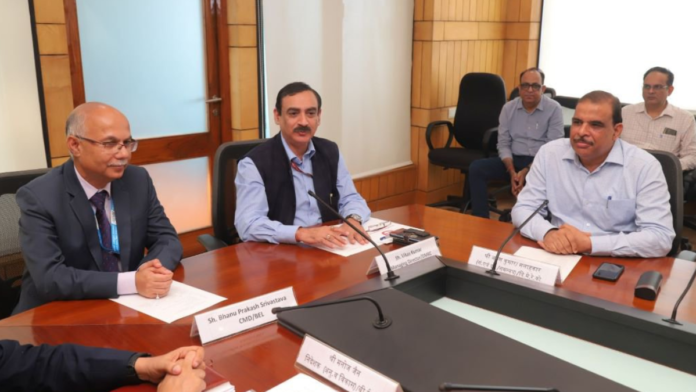
RITES Wins Safety Innovation Award, 2023

0
RITES wins Safety Innovation Award
RITES has been awarded with the Safety Innovation Award, 2023, under the construction Category in an event held at Le Meridian.

DELHI (Metro Rail News): RITES Limited has been honoured with the Safety Innovation Award, 2023, for implementing “Innovative Safety Management Systems” in its operations. The event was organised by The Institution of Engineers (India), the largest multi-disciplinary professional body of engineers. The event was held at Hotel Le Meridian, New Delhi.

RITES Limited, earlier known as Rail India Technical & Economic Service Limited, is a Miniratna Schedule ‘A’ Public Sector Enterprise sharing expertise in Transportation Consulting and engineering Services in India. It has accumulated a wealth of experience by working in about 55 countries over 49 years. 

RITES remains committed to providing the best safety practices at worksites and places otherwise. It upholds stringent safety protocols at work & otherwise, not considering geographical or logistical challenges

Advertisement1
InnoMetro_2026

Hindalco Collaborates with Metra SpA to Provide Best-In-Class Coaches for Vande Bharat Express Trains

0
Vande Bharat Train Running on Track
Vande Bharat Train/Representational image only

DELHI (Metro Rail News): Hindalco, the metals flagship company of Aditya Birla Group, signed a contract with Metra SpA, Italian Italian-based firm, a leading company in aluminum extrusion technology.  This comes at a time when Indian Railways is not only expanding its network across the nation but also planning to launch new trains for efficient and effective communication across the nation. 

With a heavy focus on modernisation and equipping the railways with next-level technology and infrastructure, the Indian Railways has undertaken several measures. It includes the upgradation of Railway Platforms, the Introduction of Vande Barat Traims etc. 

Hindalco, in collaboration with the Metra SpA, plans to invest Rs. 2,000 crore to develop coaches for the Vande Bharat Trains to ensure a wave of modern and convenient solutions to regular commutation and travelling needs. This Collaboration aims to make the makeover challenge undertaken by the Indian Railways more exciting and productive for the passengers of the Indian railways. 

This will get India into the group of nations that currently use Aluminum extrusion technology, which is limited to  Europe, China, Japan and a few other countries. 

“We are pleased to join forces with Metra to introduce a new era of aluminium extrusions for passenger trains in India,” said Mr Satish Pai, Managing Director of Hindalco Industries.

“Collaborating with Hindalco Industries presents an exciting opportunity to showcase the capabilities of our aluminium extrusion technology on a global stage,” Mr Enrico Zampedri, CEO of Metra SpA, stated enthusiastically. “Together, we are poised to redefine aluminium extrusions for high-speed train manufacturing in India, creating a fusion of strong Italian expertise in this field and Indian market knowledge.”

Aluminium coaches will prove to be the most beneficial for the Indian Railways, as Aluminium ensures reduced aerodynamic resistance, transmission loss and lower wear and tear to rolling stock along with efficiency that would make possible the speed of 200km/hr for vande Bharat. Currently, such technology is being used in the Metros. 

Additionally, Aluminium is the new Green metal as its acceptance is gradually increasing across the Globe because of its efficient operation due to its aerodynamic resistance. One rake of Aluminium can prevent over 14,500 tonnes of CO2 from entering the environment during its lifetime.

Initially, the Railways plans to use these coaches in the Vande Bharat Sleeper Version Trains only, but later on, expand it to other trains such as Rajdhani & Shatabdi Express.

Advertisement1
InnoMetro_2026

Chennai Metro Phase II Update: CMRL Signs ₹ 4,058 Crores Contract with RVNL for Underground Stations

0
Chennai metro/Representational image

DELHI (Metro Rail News): Chennai Metro Rail Limited has signed a contract with the Rail Vikas Nigam Limited (RVNL) under its 116.1 Km Phase II program for the construction of 12 Underground Metro Stations & 4 Underground Metro Works other than the diaphragm wall from Kilpauk Metro to Taramani.   

The Phase II of the Chennai metro spans 116.1 km and includes 3 corridors: 

  1. Corridor 3,  45.8 km long, from Madhavaram to SIPCOT
  2. Corridor 4, 26.1 km long , from Lighthouse to Poonamallee Bypass
  3. Corridor 5, 47 km long, from Madhavaram to Sholinganallur

The anticipated opening of the Phase II metro is between 2026 & 2028 at a total estimated cost of Rs 61,843 Crores. 

As stated in the press note, a Letter of Acceptance (LOA) has been issued, which delegates Rs 1730.60 crore for Corridor 3, Rs 1461.97 for Corridor 4 and Rs 865.63 crore for Corridor 5. The total sum of all three works has been estimated at Rs 4058.20 crore. The project is completely funded by the Japan International Cooperation Agency (JICA). 

Advertisement1
InnoMetro_2026

DMRC Signs MoU with BEL to Develop Indigenous Communication-Based Train Control System

0
DMRC signs MoU with BEL to develop i-CBTC System.

DELHI (Metro Rail News): Delhi Metro Rail Corporation has signed a Memorandum Of Understanding (MoU) with Bharat Electronics Limited (BEL) to develop an indigenous Communication-based Train Control System. It will foster the era of ushering self-reliance & innovation in the field of train control signalling systems. 

This system basically employs telecommunication between the trains & track equipment in order to manage the traffic & infrastructure. It allows for more accurate information as compared to the traditional signalling systems. 

These days, it is being used in the majority of the metro rail projects & other rail projects too.  The DMRC has already deployed the indigenous Automatic Train Supervision System (i-ATS) on the Red Line, with modifications & adjustments to suit Indian conditions. 

By embracing this cutting-edge Communication-Based Train Control System, which is widely adopted by leading metros worldwide, the DMRC aims to optimise train operations, increase frequency, and enhance passenger services while efficiently utilising rail infrastructure,” the statement released by DMRC said.

The project is being operated by 50 engineers combined from DMRC & BEL, well-informed & well-prepared in the Signalling Technology, Software Development, Hardware Development, Safety Processes, RAMS, Testing, and more. The team currently sits at the i-CBTC lab of the DMRC. 

“The i-CBTC project signifies a significant leap forward for the Delhi Metro. By embracing this cutting-edge Communication-Based Train Control System (CBTC), which is widely adopted by leading metros worldwide, DMRC aims to optimise train operations, increase frequency, and enhance passenger services while efficiently utilising rail infrastructure,” said Anuj Dayal, the DMRC spokesperson.

Along with offering Improved Safety, Increased Punctuality and ease of Maintenance, an Indigenous Communication-Based Train Control (i-CBTC) System will be a major boost for Make in India as well as Aatmanirbhar Bharat. This comes at a time when India is aspiring to achieve self-sufficiency in its majority aspects as a nation and economy. 

Advertisement1
InnoMetro_2026

Good News for Chandigarh Residents as Chandigarh Metro Receives the Green Nod.

3
Chandigarh metro (Representational image)

DELHI (Metro Rail News): There has been quite a buzz about the Chandigarh Metro, for which the discussions have been going from as early as 14 years. It is again creating a buzz because of the submission of the inception report by the RITES (Rail India Technical and Economic Service) to the Chandigarh administration. 

An inception report aims to acknowledge the mutual agreement of both parties on the timeline & plan of action suggested in order to conduct the evaluation. 

After 14 years of deliberations & discussions, the Chandigarh metro is about to get on its feet, with the first phase to cover 77 kms of distance spanning across 3 cities, namely Mohali, Chandigarh & Panchkula. That’s where it gets its name from, the Tricity Metro. In the first phase, the metro will be developed on three routes, namely: 

  1. Paroul, Sarangpur, ISBT Panchkula to Panchkula Extension (30 km)
  2. Rock Garden to ISBT Zirakpur via Industrial Area and Chandigarh Airport (34 km)
  3. Grain Market Chowk, Sector 39 to Transport Chowk, Sector 26 (13 km)

The 1st phase of the ambitious project will be developed from 2027-2037. 

Pradhuman Singh, Director, UT Transport, said, “We have received the inception report, and now RITES will give us a detailed presentation in a couple of days as to how they will go ahead with the alternative analysis report (AAR). Once the AAR is prepared, the DPR will follow.”

Chandigarh is in high need of a metro rail system because of several reasons that include 

  1. High Number of Vehicles on the Road. 
  2. Increasing Population around Chandigarh. 
  3. Growing Affluence & Investment in Chandigarh. 

With the hope of a Good Public Transport system, Chandigarh residents will be looking forward to the deployment of the metro service in the city.

Advertisement1
InnoMetro_2026

9 New Vande Bharat Express Trains To Hit The Tracks Soon

4
Orange Vande Bharat

DELHI (Metro Rail News): The Indian Railways plans to launch 9 new semi-high-speed trains of which the majority will be deployed in the poll-bound states of Rajasthan & Madhya Pradesh. The Integral Coach Factory, Chennai, will be developing the coaches for the same. 

Developed by the Integral Coach Factory, Chennai, Vande Bharat is India’s first semi-high-speed train developed indigenously to facilitate easy & efficient commutations. The Indian Railways now plans to hit the tracks with 9 more Vande Bharat trains, of which 5 have been finalised while 3 have been given to the Southern Railways, for which the routes are yet to be decided, and the details of the 4th train are not known yet. These are: 

  1. Indore – Jaipur Vande Bharat Express
  2. Jaipur-Udaipur Vande Bharat Express
  3. Puri – Rourkela Vande Bharat Express
  4. Patna-Howrah Vande Bharat Express
  5. Jaipur-Chandigarh Vande Bharat Express

There are plans underway to launch these trains after a careful and well-thought-out event to be held by the Indian Railways. 

Shri Ashwini Vaishnaw, Railways Minister, while addressing a gathering in Madhya Pradesh’s Neemuch said,” It is time for Vande Bharat to run on this route. Your Member of Parliament (MP) Sudhir Gupta has already requested for the same. Vande Bharat Express will run on your route soon”. Some media reports also suggest that the Puri -Rourkela route Vande Bharat is likely to be flagged off by PM Modi on 30th September. 

Among the 25 active Vande Bharat trains, the Nagpur-Bilaspur Express reported the highest occupancy of 106.40%. As per the railways, the total number of passengers who travelled in Vande Bharat trains in the Central Railway region from 15 August-8 September is 1.22 lakh, while the revenue generated in this period is 10.72 crores. 

Vande Bharat offers its travellers high-class amenities with easy & efficient commute. It has been built using state-of-the-art technology that offers the best possible experience in commutation. On average, it reduces travel time by about 15%. Challenges to the project include operational costs, demand-supply compliance and sanctions. 

While it is imperative for the railways to continuously explore new technologies and make them available to the commuters to make the flow easier and more efficient, Vande Bharat has been proven to be the most successful of the available technologies so far. 

Advertisement1
InnoMetro_2026

Northeast Frontier Railway Developing Drowsiness Detection Device for Train Drivers

0
Indian Railways
Indian Railways/Representational Image

NEW DELHI (Metro Rail News): The Northeast Frontier Railway (NFR) is in the process of developing an artificial intelligence-based device designed to monitor the alertness of train drivers by analyzing their eye movements. This innovation aims to detect signs of drowsiness in drivers and respond by issuing alerts or even applying emergency brakes if necessary.

The Railway Board had instructed NFR in June to create a device that could assess the alertness of train drivers based on their eye blinking patterns. The resulting device, known as the Railway Driver Assistance System (RDAS), will not only raise alarms but also trigger emergency brakes if a driver shows signs of losing alertness over a certain period.

Currently, RDAS is in the developmental phase and trial stage to ensure its functionality. The NFR’s technical team is actively working on refining the system, and it is anticipated that it will be ready for deployment in a few weeks.

On August 2, the Railway Board formally requested the NFR to accelerate the in-house development of RDAS. The plan is to incorporate this system into 20 goods train engines (WAG9) and passenger train engines (WAP7) as part of a pilot project. Furthermore, all railway zones have been asked to provide feedback on the system’s performance once implemented to facilitate any necessary improvements.
However, the Indian Railway Loco Runningmen Organisation (IRLRO) has expressed skepticism about RDAS, deeming it unnecessary. They argue that existing high speed train already feature mechanisms to keep drivers alert.

Mr. Sanjay Pandhi, the working president of IRLRO, explains that existing high-speed train engines are equipped with a foot-operated lever (pedal) requirement. Drivers are required to hit this lever approximately every 60 seconds. If a driver fails to do so, the system automatically triggers emergency brakes, bringing the train to a stop. According to Pandhi, this current system effectively ensures driver alertness.

Mr. Pandhi suggests that the railway should instead focus on addressing other aspects of driver safety, such as fatigue, working hours, and rest breaks. Many train drivers, including women, often work for over 11 hours without breaks for meals or restroom visits. Addressing these issues, Pandhi argues, would obviate the need for RDAS in train engines.

Advertisement1
InnoMetro_2026

NCRTC Invites Tenders for Reliable Mobile Network on Delhi-Meerut RRTS Corridor

0
Rapidx train/Representational image only

DELHI (Metro Rail News): The National Capital Region Transport Corporation (NCRTC) has initiated a tender process to enhance mobile network connectivity for train commuters traveling on the Delhi-Ghaziabad-Meerut RRTS Corridor. This encompasses the allocation of licensing space for in-building solutions (IBS) to facilitate shared mobile coverage within the corridor’s underground section.

The corridor has a 12-kilometer underground segment, which includes a 5-kilometer tunnel section with one underground station at Anand Vihar, Delhi, and a 7-kilometer tunnel section with three underground stations, Meerut Central, Bhaisali, and Begumpul in Meerut.

The motivation behind this initiative is to address the common issue faced by commuters in existing urban transportation systems, namely, disrupted or nonexistent mobile network coverage in underground sections. Unlike elevated sections, where coverage is ensured by established telecom infrastructure, underground areas often suffer from connectivity problems. The aim is to ensure that passengers using the Rapidx train services do not encounter similar challenges.

According to the tender invitation, a single neutral host provider will be delivering IBS through common infrastructure for all existing and future mobile operators. This approach is intended to streamline mobile operators’ ability to serve their customers effectively.

The chosen provider will offer shared solutions that cater to various types of telecom operators and their respective technologies, including GSM, UMTS, LTE, and 5G. This initiative by NCRTC is geared towards ensuring uninterrupted mobile services for commuters within the tunnels connecting underground stations and at the stations themselves.

Furthermore, this initiative serves as a means to increase the non-fare box revenue of NCRTC. The commercial potential of the Delhi-Ghaziabad-Meerut RRTS Corridor will be harnessed to generate funds, which will be directed towards covering operational expenses, as outlined by officials.

In summary, the National Capital Region Transport Corporation is taking steps to enhance mobile network connectivity for commuters traveling on the Delhi-Ghaziabad-Meerut RRTS Corridor, with a particular focus on addressing connectivity issues in underground sections. This initiative aims to ensure seamless mobile services and generate additional revenue to support operational costs.

Advertisement1
InnoMetro_2026

RAPIDX: Shri Vinay Kumar Singh Inspectes Construction Works of Duhai to Meerut South Section

0
Shri Vinay Kumar Singh, MD, NCRTC inspects construction works of Duhai to Meerut South section/ Image from NCRTC

GHAZIABAD (Metro Rail News): Shri Vinay Kumar Singh, the Managing Director of NCRTC, conducted an inspection of the construction progress in the section extending from Duhai to Meerut South Station, which is ahead of the Priority Section on the Delhi-Ghaziabad-Meerut Corridor. During this visit, Mr. Singh assessed the ongoing construction activities, including track laying, overhead electrical (OHE) installation, and electrical infrastructure, at all the stations and the viaduct within the section.

image 13

The distance between Duhai and Meerut South Station spans approximately 25 kilometers, and construction of the viaduct for this segment has been successfully completed. Within this section, there is a total of 50 kilometers of both up and down lines, with over half of the tracks already laid, as stated by the National Capital Region Transport Corporation (NCRTC).

image 14

The NCRTC has announced that the priority section of the Delhi-Ghaziabad-Meerut RRTS Corridor under the RAPIDX project is now prepared for operations, and train services on this section are expected to commence in the near future.

image 15

The NCRTC aims to open the entire 82-kilometer-long Delhi-Ghaziabad-Meerut corridor to the general public by the year 2025. However, before achieving this milestone, the corporation intends to inaugurate a 17-kilometer-long “priority section” that stretches from Sahibabad to Duhai Depot. Once this corridor is fully operational, it is anticipated to significantly reduce the travel time between the national capital and Meerut to less than one hour.

Advertisement1
InnoMetro_2026

Kanpur Metro Phase 1: TBM S93 Achieved a Remarkable Breakthrough at Bada Chauraha Station

0
Tunnel Boring Machine (TBM) S93 achieves a breakthrough at the Bada Chauraha Station
Tunnel Boring Machine (TBM) S93 achieves a breakthrough at the Bada Chauraha Station/ Image by UPMRC

KANPUR (Metro Rail News): On Sunday, Tunnel Boring Machine (TBM) S93 achieved a breakthrough at the Bada Chauraha Station, marking its third successful tunnel breakthrough in the ambitious Kanpur Metro Phase 1 project. The TBM completed the construction of the up-line tunnel from Naveen Market to Bada Chauraha, spanning approximately 510 meters. This accomplishment is part of the larger plan that involves a total of 8 breakthroughs in the 3.619 km Package KNPCC-05 section, which connects the Permat Ramp to Nayaganj Station.

image 12
TBM “Nana” Achieved Breakthrough at Bada Chauraha Station/ Image by UPMRC

The TBM responsible for this feat is the Terratec TBM, known as “Nana” after Nana Saheb Peshwa, with a diameter of 6.52 meters and a length of 120 meters.

The Nana TBM was launched at the New Market Metro Station on July 15, 2023. In just 57 days, the Nana TBM completed the task of installing 362 rings and reached the 510-meter long ‘up-line tunnel’ at Bada Chauraha. Now, this TBM will be removed from the Bada Chauraha Metro Station and lowered at the launching shaft at MacRobertganj.

Additionally, another TBM, ‘Tatya’ is also deployed in the construction of the ‘down-line’ tunnel between New Market and Bada Chauraha. So far, this TBM has completed the construction of approximately 300 meters of tunnel, involving the installation of 210 rings. The tunnel construction work will be completed soon. On the other hand, preparations are underway to launch the fourth TBM to create an underground track from Kanpur Central Station to Nayaganj.

Advertisement1
InnoMetro_2026