

Home Blog Page 184

Safeguarding Traction Systems: A Comprehensive Guide to Surge Arrester Selection: Ensuring reliable Railway Electrification

0
Safeguarding Traction Systems: A Comprehensive Guide to Surge Arrester Selection: Ensuring reliable Railway Electrification
Safeguarding Traction Systems

Introduction:

In the realm of modern transportation, electrified railway systems have become a backbone of efficient and sustainable commuting. To ensure the smooth operation of electric trains, robust and reliable traction systems are imperative. However, these systems are susceptible to transient overvoltages that can arise from lightning strikes, switching operations, and faults in the power supply. Surge arresters stand as the guardians of these systems, deflecting and dissipating transient energy to prevent catastrophic failures. This article delves into the multifaceted process of selecting surge arresters for traction systems, encompassing energy and rated voltage calculations, line length dependency, considerations for ungrounded systems, dealing with Temporary Overvoltage (TOV) conditions continuously, as well as handling, and installation guidelines.

With the introduction of ever-accelerating speeds, increasing power of locomotives, phasing out of diesel locos, increase in lightning activities, and newer traction power systems like 2x25kV with new-age projects like NCRTC, NHSRCL, DFCCIL, and many others – protecting the system has become even more crucial and correct selection of arresters is a crucial step towards ensuring reliability.

Energy Calculations:

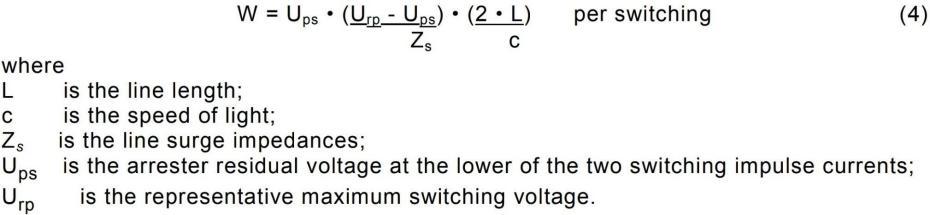
Surge arresters, often referred to as surge protectors or lightning arresters, function by absorbing and redirecting transient energy away from sensitive equipment. To ensure their effectiveness, the energy-handling capacity of the surge arrester must exceed the potential transient energy that could be introduced during surge events. As per IEC 60099-5, the energy (W) absorbed by the surge arrester during switching surges can be calculated using the formula:
ezSXFhDFitv5giqbmTonb

Generally, the total energy W’ is 2xW and is represented in kJ (kilo Joules) as 2 strokes of switching surges are considered. However, in case of traction, the factor may even be 4 in case the locomotive movement within the section is very frequent. Moreover, a safety factor of 25% is generally added.

It must be noted that the Energy capacity required is directly proportional to the line length (L) and inversely proportional to the surge impedances (Zs), and any change in these parameters would result in a change in the energy capacity required.

In recent developments, the Indian Railways have already switched to 42kV Class-4 arresters for locomotives due to the same reasons.

Considerations for TOV and Ungrounded Systems:

In certain cases, traction systems may utilize ungrounded systems to minimize service disruptions caused by ground faults. While ungrounded systems (ungrounded systems with respect to the power transformer) can reduce immediate interruptions, they pose challenges during transient events. Temporary Overvoltage (TOV) conditions can emerge during system faults, causing voltages to rise above anticipated normal levels. Surge arresters for ungrounded systems should be selected carefully, considering the increased likelihood of single-phase-to-ground faults that can escalate into severe system-wide issues. Surge arrester selection must account for the unique characteristics of ungrounded systems to provide effective protection.

For example: In traditional railway systems of 25/27.5kV, the maximum permissible voltage is 29kV. By applying the factor of 1.4 for solidly grounded systems, we arrive at a rated voltage of 29 x 1.4 = 40.6, rounded off to the nearest multiple of 3 as 42kV.

However, in the case of ungrounded systems of the same voltage levels, the factor becomes 1.73, and the appropriate rated voltage becomes 29 x 1.73 = 50.6, rounded off to 51kV.

As per IEC 60099-5, “Because the overvoltage levels on distribution systems are not well monitored and in many cases not well known, they are assumed as the worst case during a system ground fault. Since ground faults are the most common cause of temporary overvoltages on a distribution system and the magnitude of the voltage rise on the unfaulted phase is seldom known, it is assumed for arrester sizing purposes to be the worst case. The worst case voltage rise depends on the system neutral configuration.”

To counter these situations, the NHSRCL has installed an EVT (Earthing Voltage Transformer) to monitor the voltage spikes on the health line in case of a phase-ground fault.

Zero-crossing operation and co-relation to voltage spikes:

New-age circuit breakers have the ability to operate in zero-crossing conditions – which limits the rise of the voltage / avoids the voltage-doubling effect. However, in case of no zero-crossing ability, care must be taken when conducting the insulation-coordination study. The spike in voltages has been found to be multi-fold higher in the case of non-zero crossing breakers vs. zero-crossing breakers.

Handling and Installation Considerations:

Proper handling and installation of surge arresters are pivotal for their effective operation. Surge arresters should be stored and transported according to manufacturer guidelines to prevent physical damage or contamination. It is very common to see arresters being kept on the ground in a puddle of water, which then goes through all kinds of weather conditions while staying there for days in a row. Such situations must be avoided to ensure the longer life of the arresters.

Lastly, Earthing resistances are a make-or-break characteristic for the proper functioning of the arrester. As per RDSO’s TI/MI/0030 related to the installation and commissioning of the arresters – the maximum permissible earthing resistances are 10 Ohms at AT, 0.5 Ohms at TSS, and 2 Ohms at SP/SSP. Any increase in these resistances causes a large voltage drop when lightning discharge current passes through thereby stressing the insulation voltage withstand capabilities of the surge arrester.

Conclusion:

The above just skims the surface of the vast field of arrester selection which takes into account more than 25 factors (as per IEC 60099-5) for electrical and mechanical selection – like Ferranti effect, lightning intensity, number of locomotives present in the section at a given time, frequency of trains, load rejection conditions, among many others parameters.

In conclusion – Selecting surge arresters for traction systems is a multifaceted process that demands careful consideration of energy and rated voltage calculations, line length dependencies, system grounding, TOV conditions, and installation practices. By adhering to these considerations, railway operators can establish a robust defence against transient overvoltages, ensuring the reliability, safety, and efficiency of electrified railway systems. Surge arresters, as silent guardians of modern transportation, play an indispensable role in maintaining the seamless operation of electric trains in an ever-evolving world.

Advertisement1
InnoMetro_2026

Pune Metro Set Record by Completing 1000 Segments in Record 69 Days

1
Pune Metro Set Record by Completing 1000 Segments in Record 69 Days

PUNE (Metro Rail News): Pune, September 20, 2023: The relentless progress of the Pune Metro Line 3 project, connecting the thriving IT enclave of Hinjewadi to the bustling central business hub of Shivajinagar, has reached an extraordinary milestone. The various phases of this monumental endeavour are advancing with remarkable momentum. Today (Wednesday), in a momentous achievement, the casting of an impressive 4000th segment for the Hinjewadi-Shivajinagar metro line has been successfully accomplished. What sets this accomplishment apart is the staggering pace at which it was achieved: an additional 1000 segments were constructed in a mere 69 days after completing the 3000th milestone. To put this feat into perspective, the first segment of this project was cast in Hinjewadi on 23 rd July 2022, and within the subsequent 14 months, an astonishing 4000 segments have been meticulously crafted by the developers of Pune Metro Line 3, popularly known as ‘Puneri Metro’.

The work of Pune Metro Line 3 on the Hinjewadi to Shivajinagar route has been undertaken by Pune Metropolitan Region Development Authority (PMRDA) on Public Private Partnership (PPP) basis, and Tata Group has established Pune IT City Metro Rail Limited as a special purpose company (SPC) for its implementation. “The developers are tirelessly working at full capacity to ensure that the project is completed within the scheduled timeframe, a remarkable achievement given the completion of 4000 segments in just 400 days (14 months). Notably, segments constituting 80% of the total piers have been erected within the first year of commencing work, showcasing the remarkable progress achieved in this endeavour,” informed Alok Kapoor, Chief Executive Officer of Pune IT City Metro Rail Limited.

A quick overview of the segment casting at PML 3

Number of SegmentsDuration of casting the segments
0 to 1000285 Days
1001 to 200090 Days
2001 to 300079 Days
3001 to 400069 Days

The Pune Metro Line III is a ~23 Km elevated Metro rail project connecting the IT hub of Hinjawadi to the Central business district of Shivajinagar. It is a Public Private Partnership (PPP) project awarded by the Pune Metropolitan Region Development Authority (PMRDA) to a consortium consisting of Tata Group’s TRIL Urban Transport Private Limited (TUTPL) and Siemens Project Ventures GmbH. The Project would be developed & operated on a Design, build, finance, operate & transfer (DBFOT) basis by a special purpose vehicle (SPV), Pune IT City Metro Rail Limited or PITCMRL for a Concession Period of 35 years, including the construction period.

Advertisement1
InnoMetro_2026

Bengaluru Metro Update: 100th U-Girder launched on Airport Line P2

0
100th U-Girder on Bengaluru Airport Line
100th U-Girder on Bengaluru Airport Line PC: K Vinay Kumar

BANGALORE (Metro Rail News): A major development unfolded in the project timeline of Bengaluru’s Airport Line P2, with the 100th U-Girder getting installed by the construction firm NCC Limited. The line P2, also referred to as Blue Line, will be linking Bengaluru’s Kempegowda International Airport to KR Puram. 

This particular line, under the Bangalore Metro Phase 2B project, is made up of 3 Civil Packages ranging from 11-15 Kms. The very first U-girder for the project was launched in May 2023 between Piers AP700-AP701 near Bagalur Cross Station. 

This unfolding stands as a major achievement as the milestone of the 100th U-Girder has been achieved in roughly 4 months. 


Intrigued by the future of Metro and its impact on our city? Join us at our upcoming event Inno Metro to delve deeper into this vital issue. Stay informed, get involved, and let’s ride the Metro towards a brighter, more sustainable future together.

Advertisement1
InnoMetro_2026

Kolkata Metro Update: Construction of Victoria Metro Station Begins in Full Throttle

0
RVNL begins the construction of the Victoria metro station in Kolkata’s Ambitious Purple Line expansion.

KOLKATA (Metro Rail News): A major development unfolding in the Kolkata Metro Purple Line expansion project is the commencement of the Victoria metro station, which would basically be an underground metro station. It will be constructed using the cut-and-cover method, and M/s Larsen & Turbo Ltd. will be involved in its development. 

“The contract for the entire underground section has been given. The barricades on the Maidan are meant to block unauthorised access to the construction site. More such portions of the Maidan will be barricaded in the coming days,” said an official of the RVNL. 

The proposed corridor has a combination of both underground & elevated routes. The Joka-Momnipore section of the project is elevated, and the rest after Momnipore is underground. The four underground stations will be Kidderpore, Victoria, Park Street & Esplanade. The length of the underground section is about 5 Km. 

Operational since January, the Joka-Taratala section doesn’t see much footfall. It functions on a system where one train completes one leg of the journey and then comes back. Five clubs & one riding school in the periphery of the ground have been asked to vacate in order to channelize the construction work. 


“Intrigued by the future of Metro and its impact on our city? Join us at our upcoming event Inno Metro to delve deeper into this vital issue. Stay informed, get involved, and let’s ride the Metro towards a brighter, more sustainable future together.”

Advertisement1
InnoMetro_2026

Good News! Vande Bharat Sleeper Coaches And Vande Metro to Be Launched By Next Year

0
Orange Vande Bharat

DELHI (Metro Rail News): According to BG Mallya, General Manager of Integrated Coach Factory (ICF), Indian Railways is about to roll out the sleeper coaches of the Vande Bharat train very soon. “Sleeper coach of Vande Bharat will be rolled out in the current financial year where the first train is under production and will be rolled out in March 2024”, Mallya said. 

It will be a significant addition to the fleet of Indian Railways as these sleeper coaches would allow the passengers to cover long distances overnight. It would allow the Indian railways to make the Vande Bharat Trains more widely recognised.  

At the same time, Indian Railways is also planning to roll out the Vande metro in the coming times, which will be a 12-coach train that will be used for short-distance travel. It is expected to be rolled out by January 2024. 

“We’ll be launching the sleeper version of the Vande within this financial year. We’ll also be launching the Vande Metro this financial year. And we’ll be launching this train for non-air conditioned passengers, which is called a non-AC push-pull train, which will have 22 coaches and a locomotive. And that launch is going to happen before 31st October…,” Mallya said.

A total of 200 trains will be manufactured, out of which 120 Sleeper trains will be manufactured by a consortium of India’s RVNL & Russia’s TMH Group & a consortium of Titagarh Wagons & BHEL will manufacture 80. 

Vande Bharat is India’s semi-high-speed train. The first Vande Bharat train was flagged off on February 15, 2019, by the PM of India. The trains are manufactured at the Integrated Coach Factory (ICF), Chennai. The train achieved a maximum 1280 Km/hr speed on the Kota-Sawai Madhopur Section. 


“Intrigued by the future of Metro and its impact on our city? Join us at our upcoming event Inno Metro to delve deeper into this vital issue. Stay informed, get involved, and let’s ride the Metro towards a brighter, more sustainable future together.”

Advertisement1
InnoMetro_2026

Mumbai Metro Update: Line 2B to be Extended Till Cheetah Camp

0
Alstom to equip Mumbai Metro lines 2A, 2B and 7, and Pune Metro lines 1 and 2, with Urbalis 400, CBTC) technology

MUMBAI (Metro Rail News): Mumbai Metropolitan Region Development Authority (MMRDA) issued an order stating the extension of metro line 2B from Mandale to Cheetah Camp. The line starting from DN Nagar in Andheri West will be extended by a Kilometer to Cheetah Camp. 

The order states that the project connecting DN Nagar to Mandale was approved on October 25, 2016, at an estimated cost of Rs 10,896 Crore. It will pass through areas like SV Raod, BKC, Chembur etc. 

The extension of the metro line will be completed at an estimated cost of INR 205 Crores, which includes the extension as well as a metro station in that area. It amounts to about 1.88% of the estimated project cost. 

The extension will facilitate better commutation for the people in the city by ensuring smooth metro connectivity and accessibility along with a reduction in travel time. 


Intrigued by the future of Metro and its impact on our city? Join us at our upcoming event Inno Metro to delve deeper into this vital issue. Stay informed, get involved, and let’s ride the Metro towards a brighter, more sustainable future together.

Advertisement1
InnoMetro_2026

PM Modi Inaugurates Yashobhoomi Metro Station as Airport Express Line Gets Extension

0
Inauguration of Dwarka Sector-25 Yashobhoomi Metro Station

Delhi (Metro Rail News): PM Modi inaugurated the Yashobhoomi Dwarka Sector-25 Metro Station on Sunday, 18th September, which falls on the newly developed 2.5 Km patch of the Airport Express Line in New Delhi. It became operational for the public from 3:00 PM onwards. 

Yashobhoomi Dwarka Sector-25 metro station is an underground station & has three subways, including a 735-m long subway that connects the metro station to the convention centre. The Airport Express Line now has a total number of 7 stations. The Metro Station has 8 lifts, each having a capacity of 20 people at a time. 

“In addition to serving the convention centre, this new station will also provide connectivity to the residents around Sector 25, Dwarka, and the new sectors along the Dwarka Expressway in neighbouring Gurugram. As a result, residents of these areas will be able to reach central Delhi in about half an hour,” Shri Anuj Dayal, principal executive director, of corporate communications at Delhi Metro Rail Corporation (DMRC), said.

The speed of the lines has also been increased from the existing 110Km/hr to 120 Km/hr, which will bring down the travel time between New Delhi & IGI Airports to 15 & a half minutes. This is the third time that the operational speed of the Airport Express Line has been increased this year- DMRC increased its speed from 90 Km/hr to 100 Km/hr on March 22 & further increased to 110Km/hr on June 22. 


Intrigued by the future of Metro and its impact on our city? Join us at our upcoming event Inno Metro to delve deeper into this vital issue. Stay informed, get involved, and let’s ride the Metro towards a brighter, more sustainable future together.

Advertisement1
InnoMetro_2026

Chennai Metro Celebrates TBM S99 Breakthrough at Venugopal Nagar 

0
TBM Breakthrough at Venugopal Nagar shaft

CHENNAI (Metro Rail News): A major development unfolded in the 116.1 Km Chennai Metro Phase-02 project, with the TBM S99 recording a breakthrough at Venugopal Nagar Shaft. It was the very first tunnel breakthrough and the 3rd of 24 breakthroughs planned on 45.4 Km Line 3’s Civil Package TU 01 going from Venugopal Nagar to Kellys. 

TBM Chennai 02

The contract for the TU-01 Civil Package was awarded to Tata Projects by Chennai Metro Rail Limited (CMRL) in May 2021 with a 42-month deadline. Phase-02 comprises 3 corridors: Madhavaram to SIPCOT (corridor-3), Light House to Poonamallee (corridor-4), and Madhavaram to Sholinganallur (corridor-5). 

The 6.61-diameter TBM was commissioned at Madhavaram Milk Colony station’s North Shaft in May 2023. The machine travelled 415m to build the down-line tunnel towards Venugopal Nagar Shaft in approximately 4 months.

TBM Chennai 01
TBM comes out at Venugopal Nagar

Intrigued by the future of Metro and its impact on our city? Join us at our upcoming event Inno Metro to delve deeper into this vital issue. Stay informed, get involved, and let’s ride the Metro towards a brighter, more sustainable future together.

Advertisement1
InnoMetro_2026

RRTS Viaduct Crossing Over Alignment of Delhi Metro Blue Line Successfully Constructed in Delhi

0
RRTS Viaduct Crossing Over Alignment of Delhi Metro Blue Line
RRTS Viaduct Crossing Over Alignment of Delhi Metro Blue Line at Ashok Nagar Metro Station

Being constructed as a part of a long-term strategic solution to the pollution and congestion conundrum of Delhi, the Delhi-Ghaziabad-Meerut RRTS corridor has achieved an important milestone in Delhi. The construction of the viaduct of the RRTS corridor crossing over the viaduct of the Blue Line of the Delhi Metro corridor has been completed successfully.

This viaduct of the RRTS corridor crosses the Delhi Metro corridor at a height of about 20 meters at this point near the New Ashok Nagar Metro Station. Carrying out construction work at such a height over the existing and already operational metro track successfully is a big achievement from the engineering point of view.

Moving from Sarai Kale Khan RRTS station towards New Ashok RRTS station, the elevated alignment of the RRTS corridor crosses the viaduct of the Blue Line of Delhi Metro which provides services to a large number of people every day. To ensure the convenience and safety of commuters travelling from this station, construction of this part of the viaduct has been done during the night time only with the help of Tarini (Launching Gantry). In this process, segments of the girder were lifted and joined together to construct the full span of the viaduct. NCRTC received unwavering support from DMRC during this whole construction. The construction was completed safely by NCRTC while ensuring uninterrupted services of the metro.

Multi-modal integration is the guiding principle of the RRTS project being implemented by NCRTC. To facilitate this, RRTS stations have been strategically planned in such a way that they can be built as close as possible to the existing modes of public transport. Provisions have been made to provide seamless connectivity for a smooth and uninterrupted travel experience for commuters. NCRTC, while ensuring this, has also had to face many complexities related to construction and civil engineering but with innovative techniques and strategic planning, it was made possible.

New Ashok Nagar Metro Station receives a large number of commuters from Noida. Once the RRTS corridor is operational, commuters will have the option to travel towards Meerut or other RRTS corridors from this station.

To provide connectivity between the RRTS station and metro station at this point, NCRTC is constructing about 90-meter-long and 6-meter-wide Foot-Over Bridge (FOB) which will be connected from the concourse level to the concourse level of both stations. The height of this FOB will be 8 meters above the ground. This will facilitate seamless movement of commuters between both modes of transport without exiting the station premises. This will also ensure stress-free travel for commuters and play a major role in controlling traffic jams and congestion outside the station. It will especially ensure a convenient and comfortable travel experience for women, the elderly, children, and commuters travelling with luggage. Moreover, to provide better connectivity and accessibility to the station from the nearby areas, NCRTC is also constructing two more FOBs at this station to connect residential areas.

So far, construction of a more than 5-kilometer-long viaduct has been completed in Delhi out of a total 9 km elevated section. 90 per cent of the pillar construction work has also been completed. Delhi has around 14 km long section, the rest is the underground section for which construction of tunnels has already been completed.

NCRTC aims to operationalize the entire Delhi-Ghaziabad-Meerut corridor by the year 2025. Before that, the 17-km long Priority Section will be commissioned for the public soon this year.

Advertisement1
InnoMetro_2026

Patna Metro Launches First U-Girder on Corridor-I

0
U-Girder
Installation of U-Girder on Patna Metro Corridor-I

PATNA (Metro Rail News): A significant development unfolded yesterday, with YFC Projects – Montecarlo JV launching their first 170-ton Precast Viaduct U-Girder of Patna Metro’s 17.93 Km Corridor-I on the East-West Line. 

It was launched on Friday, 16th September 2023. The length of the U-Girder is 28 meters, and the launching was done on National Engineers Day at Pier/pillar number 133-134 at the viaduct between RPS More Station & Patliputra Station.

Corridor I has a total of 14 stations, underground & elevated included. Elevated stations include Danapur Cantonment, Saguna More, RPS More, Patliputra, Mithapur, Ramkrishna Nagar & Jaganpura while the underground stations include: Rukanpura, Raja Bazar, Patna Zoo, Vikas Bhawan, Vidyut Bhawan, Patna Station. It also facilitates an interchange at Patna Station and Khemni Chak stations. 

The U-girders are casted at the casting yard and transported to the sites with the help of a crane. It is launched between two Pier Caps on which the metro track will be finally laid.

Advertisement1
InnoMetro_2026