Home Blog Page 173

NCRTC Completes Installation of 6 Steel Spans on the Delhi Section of RRTS Corridor

0
NCRTC Completes Installation of 6 Steel Spans on the Delhi Section of RRTS Corridor

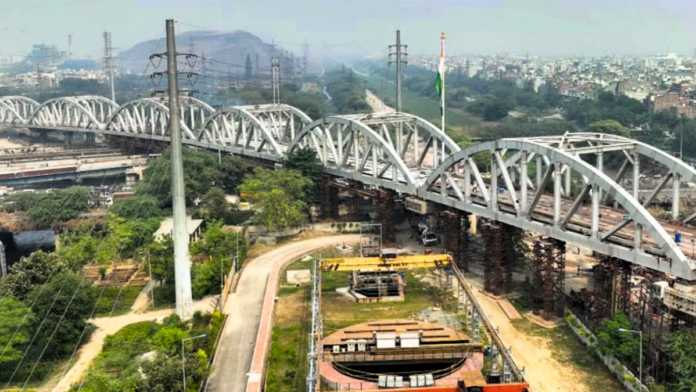
NEW DELHI (Metro Rail News): National Capital Region Transport Corporation (NCRCTC)  has successfully installed all six steel spans on the Delhi section of the RRTS Corridor. These special steel spans have been installed to make the RRTS route cross the Ghazipur drain & Kondli roundabout on its way to Anand Vihar from Ashok Nagar. 

Milestone 

It is the first of a kind to be installed for the Regional Rapid Transit System (RRTS) corridor. The spans have been installed one after the other, for it is the longest viaduct to be made for the RRTS so far with special steel spans. This engineering marvel debuts as an important landmark for RRTS as it strides towards manifesting the vision and aspiration of connected and robust transportation. 

RRTS Steel Span 03
Under construction ( a few months back)

Specifications

The total number of steel spans adds up to 360 meters, with three spans of 70 m in length each & the remaining three of 50 m in length each. These spans are nearly 14 m wide with a weight of 540 tonnes each. These are massive structures containing heavy beams made of structural steel. 

Installation 

The spans were first manufactured in a factory and then loaded onto the trailers for transporting them to the installation site. These are then assembled at the site by properly joining them using some special techniques. These are designed to suffice the requirements of construction, installation & usage. 

Challenges 

The Gazipur drain is about 40-50 meters wide, and the RRTS corridor crosses it diagonally. The deep foundations to be made for the pillars posed a tremendous challenge. The installation site also had hurdles like roads, large pipelines, high-tension lines, etc. 

RRTS Steel Span 02
The Bridge crossing the Gazipur Drain

Peculiar Case

Generally, NCRTC constructs pillars at a distance of 34 meters to facilitate the installation of viaducts, but in exceptional cases of corridor crossing rivers,  rail crossings, expressways, metro corridors, etc, maintaining the metric is quite a challenging task. In such cases, spans are used to connect the pillars. 

This particular development has taken up the total number of steel spans on the RRTS corridor to 12, with the remaining six being installed at different locations, namely Meerut (1), Vasundhra (1), Ghaziabad (1), Duhai Depot (2) & Eastern Peripheral Expressway (1). 

Delhi-Meerut RRTS 

RRTS is an 82.15 Km long mass rapid transit system being built from Delhi’s Sarai Kale Khan to connect Delhi, Ghaziabad & Meerut. The Delhi-Ghaziabad-Meerut corridor is being built at a cost of Rs 30,000 crore. The priority corridor inaugurated by PM Modi spans 17 Km with five stations: Sahibabad, Ghaziabad,  Guildhar, Duhai, and Duhai Depot. 

PM Narendra Modi inaugurated India’s first RAPIDX train, named Namo Bharat, from Sahibababd Station on 20th October. The Namo Bharat trains will run at a maximum speed of 180 kmph, costing around Rs 20- Rs 50 for standard coaches & Rs 50- Rs 100 for premium Coaches.


Discover the endless possibilities of our city’s Metro at InnoMetro, our flagship Expo and Conference. Be an active participant in shaping its future towards a more sustainable tomorrow. Stay informed and join us to take a step towards a brighter future.

Advertisement1
InnoMetro_2026

PM Modi dedicates the 77km stretch of Western Dedicated Freight Corridor to the Nation 

1
Dedicated Freight Corridor
Dedicated Freight Corridor Representational Image

AHMEDABAD (Metro Rail News): The Prime Minister dedicated the all-new 77 km New Bhandu- New Sanand section of the Western Dedicated Freight Corridor (WDFC) to the nation on 30th October. 

The PM underlined that it will further strengthen the connectivity of North Gujarat with major ports like Pipavav, Porbandar and Jamnagar. It will also strengthen the logistics and storage-related sector in North Gujarat, he said.

In the last nine years, the Prime Minister informed, approximately 2,500 km of Eastern and Western Dedicated Freight Corridors have been completed, leading to a reduced travel time for both passenger trains and goods trains. Owing to the completion of DFCs, nearly 60 goods trains have been shifted to this route to facilitate easy freight movement. 

On the other hand, this has also increased the productivity of the passenger trains as the routes are no longer decked up.

Infrastructural Specifications

There are 19 major bridges, 105 minor bridges, five rail flyovers, 81 road under bridges and six road over-bridges. The Road under bridges have been constructed in order to eliminate Level Crossings. The stretch has DoUble line electrified tracks for enhanced performance and speed in freight carriage. 

The DFC has also achieved impressive average speeds, with the highest recorded at 99.82 Kmph. “The work of doubling of Katosan Road-Becharaji railway line and Viramgam-Samakhayali track, which has been done here, will also strengthen connectivity”, the PM added.

It has enabled operations of heavy & long haul trains of 25 tonnes axle load on bridges designed for 32.5 tonne axle load for the first time in India. 

Western Dedicated Freight Corridor (WDFC): 

The Western Dedicated Freight Corridor covers a distance of 1506 Kms divided into seven sections. 

01. Dadri – Rewari (127 km) 

02. Rewari – Madar (306 km) 

03. Madar – Palanpur (353 Km) 

04. Palanpur – Makarpura (290 Km) 

05. Makarpura – Sachin (135 Km) 

06. Sachin – Vaitarna (186 Km) 

07. Vaitarna – JNPT (109 Km) 

The First three sections have already been commissioned, and 87% of financial progress has already been achieved for the entire project. The Western Dedicated Freight Corridor (WDFC) links the states of Gujarat and Rajasthan, and it is specifically engineered to accommodate heavy axle-load freight trains.

“The travel time of Ahmedabad-Delhi Rajdhani Express has been reduced by nearly one hour,” a senior official of DFCCIL said. It is going to increase the accessibility of easy means of transportation for business in the regions, thereby driving high profits and business opportunities. 


Discover the endless possibilities of our city’s Metro at InnoMetro, our flagship Expo and Conference. Be an active participant in shaping its future towards a more sustainable tomorrow. Stay informed and join us to take a step towards a brighter future.

Advertisement1
InnoMetro_2026

Chennai Metro to Lay Ballast Test Track on Poonamallee Depot in Phase 02 

0
Chennai metro
Chennai metro

CHENNAI (Metro Rail News): Chennai metro has already begun the track laying work at the Poonamallee Depot for Phase 02 of the project. Phase -02 of the project is being constructed at an estimated cost of INR 63246 Crore. 

This is a major unfolding as it’s the first time that ballast test tracks are being deployed for the Chennai Metro. Even the entire Phase 2 project will have ballastless tracks except for this depot at Poonamallee. 

Chennai Metro has taken this step in order to meet its priority of completing the 820m long test track along with a Stabling line and Inspection line to facilitate the driverless metros for Phase 02, arriving by August next year. 

The Depot will have a total of 24 tracks, out of which 13 lines will have ballasted tracks inside the depot while 11 will have ballastless tracks outside the depot. The decision to lay the Ballast Test track has been made in order to achieve timely completion of the project under the estimated budget. 

Ballast test tracks are a type of track system that consists of a layer of crushed stones, called ballast, on which the railroad ties and tracks are laid. It has got some inherent advantages like: 

  1. Cost-Effective: Ballasted tracks are generally more cost-effective to install and maintain compared to ballastless tracks.
  2. Ease of Repair: Repairs and maintenance of ballasted tracks can be simpler and quicker since it’s easier to replace damaged or worn ballast and track components.

While ballasted tracks have some inherent benefits, these also offer a plethora of challenges relating to alignment, speed limitations and extensive maintenance. Owing to constant movement and weight, ballast tracks get settled with time, demanding maintenance-intensive measures. The constant movement also necessitates regular checks of alignment to ensure continuous services. 

These tracks are also subject to environmental patterns like flood, erosion and freeze-thaw cycles that can lead to degradation of the ballast and track components. Since CMRL has decided to go with ballast test Tracks inside the depot, it seems to be a carefully calculated move to ensure timely completion while also keeping in mind the long-term sustainability of the project. 

Phase 2 of the Chennai Metro Project pitches for a 118.9 km Network consisting of 3 corridors, namely: 

  1. Corridor 3: Madhavaram to SIPCOT (45.8 Km)
  2. Corridor 4: Lighthouse to Poonamalle Bypass (26.1 Km)
  3. Corridor 5: Madhavaram to Sholinganallur (47 Km)

Currently, 36 out of the 61 packages, encompassing Civil, Track, and System components for Corridor 3, Corridor 4, and Corridor 5, have been granted, and construction is underway. The project is scheduled for completion by the conclusion of 2026.


Discover the endless possibilities of our city’s Metro at InnoMetro, our flagship Expo and Conference. Be an active participant in shaping its future towards a more sustainable tomorrow. Stay informed and join us to take a step towards a brighter future.

Advertisement1
InnoMetro_2026

Automatic Train Operation For Metro & Railways – A Global Perspective And Analysis

0
Automatic Train Control
Automatic Train Control System

Automatic Train Operation

Automatic train operation (ATO) is a mechanism usually supported by a device used to improve operational safety by automating train operations. The degree of automation is denoted by the Grade of Automation (GoA), which ranges from 1 to 4 (where the train is managed automatically without any human intervention). ATO is most commonly utilised on automated guideway transit and rapid transit systems, where it is easier to assure passenger safety. A driver is present on most systems to limit risks associated with failures or emergencies.

Many current systems are linked with automatic train control (ATC) and, in many situations, automatic train protection (ATP), where the system performs typical signaller activities such as route setting and train regulation. The ATO and ATC/ATP systems collaborate to keep a train inside a scheduling tolerance. To conform to a timetable, the combined system marginally changes operating characteristics such as the power-to-coast ratio when moving and station dwell time.

There are five Grades of Automation (GoA) of trains, according to the International Association of Public Transport (UITP) and the international standard IEC 622901. These levels relate to the SAE J3016 automotive classification:

Grade of AutomationTrain OperationDescription and ExamplesSAE Levels
GoA 0On-sightNo automation0
GoA 1ManualA train driver is in charge of starting and stopping the train, as well as operating the doors and dealing with emergencies or unexpected diversions.1
GoA 2Semi-automatic (STO)Although the train starts and stops automatically, a driver operates the doors, drives the train if necessary, and handles emergencies. Many ATO systems are GoA 2 compliant. Trains in this system move automatically from station to station, but there is a driver in the cab who is responsible for closing doors, detecting obstacles on the track in front of the train, and resolving emergency situations. The GoA2 train, like the GoA3 system, cannot function properly without a staff member on board. The London Underground Victoria line is one example.2
GoA 3Driverless (DTO)Starting and stopping are automatic; however, in the event of an emergency, a train attendant operates the doors and drives the train. Trains in this system move automatically from station to station, but there is always a staff member on board who is responsible for resolving emergency circumstances. The train cannot operate safely in a GoA3 system without a personnel member on board. The Docklands Light Railway is one example.3 and 4
GoA 4Unattended (UTO)Starting and stopping, as well as door operation, are all totally automated, with no staff on-board. For the system to be successful under this grade, it is suggested that stations install platform screen doors. Trains in this system can operate automatically at all times, including door closure, obstacle detection, and emergency scenarios. On-board staff may be provided for other reasons, such as customer service, although they are not essential for safe operation. In the case of a computer breakdown, controls are frequently given to manually drive the train. Paris Metro Line 14, Barcelona Metro Line 9, Sydney Metro, and Copenhagen Metro are a few examples.5

Additional Types

Grade of AutomationDescription and examples
GoA1+In addition to GoA1, there is connected on-board train energy optimisation (C-DAS) through ETCS.
GoA2+In the case of the Amsterdam Metro, a GoA2 can reverse into a GoA4 at the final stations. This is signified by the symbol ‘+’.
GoA2.5Except for detecting obstacles and evacuating passengers, the train driver does nothing. On December 24, 2020, Kyushu Railway Company began commercial operation of automatic train operation utilising the ATS-DK on the Kashii Line (between Nishi-Tozaki and Kashii Stations) on a trial basis. The primary objective is to attain GoA2.5, which is a type of “driverless operation with an attendant.”
GoA3+An umbrella phrase for GoA3 and GoA4 that means and refers to the replacement of human train drivers. The terms GoA3/4, GoA3,4, and autonomous trains are used interchangeably and synonymously.

Operation of ATO

On the other hand, ATP is the safety mechanism that assures safe train spacing and delivers sufficient warning and notification when it is time to stop. ATO is the ‘non-safety’ element of train operation that deals with station stops and starts, and it indicates the train’s stopping position once the ATP confirms that the line is clear.

The train approaches the station with clear signals, allowing it to do a routine run-in. The train receives a station brake command when it reaches the first beacon, which was initially a looping cable but is now usually a fixed transponder. The onboard computer calculates the braking curve to guarantee that the train stops at the correct spot. As the train approaches the platform, the curve is revised a number of times (which varies by system) to assure accuracy.

When the train comes to a complete stop, it checks that its brakes are engaged and that it is still within the door-enabling loops. These loops confirm the train’s position relative to the platform and which side the doors should open on. When all of this is completed, the ATO opens the doors. The ATO closes the doors and automatically restarts the train if the door closes proving the circuit is complete after a predefined or variable time established by the control centre. Platform screen doors are also available on some systems. ATO also provides a signal for these to open once the on-board verification operation is done. Although mentioned as an ATO function here, door enabling at stations is frequently implemented as part of the ATP equipment since it is viewed as a ‘critical’ system that requires the same safety validation processes as ATP.

If the ATP system does not intervene, the ATO system accelerates the train to cruising speed, allowing it to coast to the next station brake command beacon and then brake into the next station.

Advantages of GoA3+

The Florida Department of Transportation funded a study in 2021 by experts from Florida State University, the University of Talca, and Hong Kong Polytechnic University that outlined the following advantages of autonomous trains:

  • Removing potential sources of human error
  • Rise in capacity through better utilisation of existing rail tracks
  • Reduced operational costs. In the case of GoA 4, Paris Métro lowered its running costs by nearly thirty per cent.
  • Increased overall service dependability
  • Improved fleet management and service adaptability
  • Energy efficiency and conservation

Accidents & Incidents Involving ATO

While ATO has been shown to significantly reduce the possibility of human mistakes in railway operations, there have been a few major mishaps employing ATO systems:

  • Two trains on Shanghai Metro Line 10 crashed between Yuyuan Garden and Laoximen stations on September 27, 2011, injuring 284-300 persons. Initial investigations revealed that train operators breached and ignored regulations while manually driving trains after a power outage on the line caused its ATO and signalling systems to malfunction. There were no recorded deaths.
  • On May 4, 2015, two trains collided at Oceana station on Mexico City Metro Line 5 during heavy rain with hail, when both were travelling towards Politécnico station, injuring twelve persons.
  • Joo Koon Rail Accident – On 15 November 2017, an SMRT East-West Line C151A train rear-ended and collided with another C151A train at Singapore’s Joo Koon MRT Station, injuring 38 people. 
  • On 18 March 2019, two MTR M-Train EMUs collided in the crossover track section between Admiralty and Central while MTR was testing a new version of the SelTrac train control system intended to replace the line’s existing SACEM signalling system on the MTR Tsuen Wan Line in Hong Kong. There were no passengers on either train; however, operators on both trains were hurt.
  • In 2021, a collision occurred in the Kelana Jaya LRT line in Malaysia. It may be noted that the LRT Kelana Jaya Line is a medium-capacity light rapid transit line and the first fully automated and driverless rail system in the Klang Valley, Malaysia.

Urban Passenger Railways

  • The (former) line II (now L5) of the Barcelona Metro was the first in the world to install a GoA 2 photoelectric cell-based ATO system on an existing metro line and on its FMB 600 series (ca) rolling stock. This system was put in place in 1960-1961 and was discontinued in 1970. L9 (Europe’s longest driverless line) and L10 are currently using GoA4 ATO. L11 is running with GoA3.
  • The Teito Rapid Transit Authority (TRTA, now Tokyo Metro) began testing GoA 2 ATO in 1962 on the Hibiya Line between Minami-Senju and Iriya, later expanding to the entire line in 1970. TRTA 3000 series set 3015 was the first train refitted with ATO operating, while new trains ordered after 1963 were built with ATO. 
  • Many underground and conventional railway lines in Japan use GoA 2 ATO, with some implementations distinguishing the ATO systems’ auto-acceleration function from the indigenously developed TASC auto-braking system, which can theoretically function without driver input if the former fails. The Tokyo Disney Resort Line monorail, which opened in 2001, employs GoA 3(+), whereas people mover systems like the Yurikamome line in Tokyo, which opened in 1995, and the Linimo low-speed maglev line in Aichi Prefecture, which opened in 2005, use GoA 4. 
  • A pilot for GoA 2 ATO on the London Underground saw 1960 Stock trains equipped with ATO operated along the Woodford to Hainault portion of the Central Line from 1964 until 1986, when the trains were returned to manual control.
  • The Victoria Line was the world’s first newly and recently built full-scale automatic railway and metro line when it debuted in 1968, and it has since been the first to have an ATO system reconfigured and replaced. The whole Central, Northern, and Jubilee lines have been upgraded to use and run with an ATO. A revolutionary new automatic train control system is currently being installed on the Circle, District, Hammersmith & City, and Metropolitan lines.
  • As the first ATO line in the United States, the PATCO Speedline between Philadelphia, Pennsylvania and Lindenwold, New Jersey, opened and launched its first stretch in 1969. (The Expo Express, which ran during the World’s Fair Expo in Montreal, was the first in Canada and North America).
  • BART, which debuted in 1972, was the first new rapid transit system with numerous lines built with ATO. ATO has been used on the Montreal Metro’s Green, Orange, and Blue lines since 1977. Since 1979, all lines operated by MTR Corporation on the Hong Kong MTR Network have been using ATO. ATO has been implemented on the old KCR East Rail line network since 2002. Since 1980, the Glasgow Subway has employed the ATO.
  • The French Véhicule Automatique Léger system is a fully automated GoA 4 system that was first used on the Lille Metro in 1983. Its ATO technology is also used on the Paris Métro Line 14, Line 1, and Lausanne Métro Line 2 with conventional heavy rolling stock.
  • When the Busan Metro Line 1 opened in 1985, it was the first line on the Korean Peninsula to utilise a GoA 2 ATO system. This was followed by Seoul Subway Lines 5, 7, and 8 in 1996, Daegu Metro Line 1 in 1997, Incheon Subway Line 1 in 1999, and Seoul Subway Line 6 in 2000. Gwangju Metro Line 1 in 2004 and Daejeon Metro Line 1 in 2006. In 2011, Seoul Subway Line 2 began operating GoA 2 with an ATO system. 
  • Currently, GoA 2 ATO is utilised for operating Seoul Subway lines, Busan Metro lines, and all Daegu, Daejeon, and Gwangju Metro lines, as well as the AREX and Seohae Line, while GoA 4 ATO is used to operate Busan Metro Line 4, Gimpo Goldline, Incheon Airport Maglev, Incheon Subway Line 2, Shinbundang Line, and U Line.
  • The Vancouver SkyTrain, which opened in 1985 in Vancouver, British Columbia, is an automated and driverless system. Since 1987, all lines on Singapore’s Mass Rapid Transit (MRT) have used ATO. Since its inception in 1987, all lines on London’s Docklands Light Railway have employed ATO (GoA 3).
  • The Tren Urbano, which opened in 2004 and serves the San Juan metropolitan area of Puerto Rico, includes an ATC system that allows for totally automatic operation. Existing U2 and new U3 lines of the Nuremberg U-Bahn were converted to ATO in 2008, with a one-year mixed service.
  • ATO is utilised on the M1 Red Line and the M3 Yellow Line of the Milan Metro. Following a crash in 2009, the Washington Metro may be the world’s first system to revert to (largely) manual operation from ATO. However, GoA2 remain installed on all lines and is scheduled to be employed again in the future.
  • Historically, the Prague Metro used the GoA 1 system ARS on all lines. GoA 2 is available on line C (Siemens PA 135 and AD Praha LZA). Line B has been converted from ARS to LZA beginning in 2020. The proposed line D remains running unattended.
  • Line 4 of the Sao Paulo Metro debuted in 2010 as the first GoA 4 system in South America. In June 2012, the BMT Canarsie Line (L train) of the New York City Subway began full ATO operation with CBTC. Similarly, the IRT Flushing Line (7 and 7> trains) received track and signal upgrades, with full ATO operation beginning in November 2018.
  • The trains on Dubai Metro, as well as those on AnsaldoBreda Driverless Metro and Line C of the Rome Metro, do not have a driver. Doha Metro trains began service in 2019, running autonomously in ATO without a driver.
  • A GoA 4 ATO system is used by Aerotrain (KLIA) in Kuala Lumpur, Malaysia. The B, D, and C lines of the Los Angeles Metro use the GoA 2 ATO system. Jakarta, Indonesia’s capital city, introduced public transit (Jakarta MRT) in 2019 that uses ATO with GoA 2 Level.
  • Sydney, Australia’s capital city, has the Sydney Metro, which opened in 2019 and operates at GoA Level 4. Sydney is also improving existing lines of the Sydney Trains commuter rail network in order to enable GoA 2 and higher service in the future.
  • Line 14 was the first newly built Paris Métro to operate in GoA 4, opening in 1998, and Line 1 later had its GoA 2 ATO system from 1972 replaced with a newer GoA 4 CBTC system.
  • In December 2020, Delhi Metro in India began autonomous train operations on the Botanical Garden-Kalkaji corridor, using the GoA 4 ATO system.

Freight Railways
Rio Tinto Group’s ‘AutoHaul’ system on its Pilbara iron ore railways and train services. This system is GoA 4 competent, allowing trains to run without a single person aboard for the whole trip to the mines and back. The first completely autonomous test was conducted in October 2017 across a 100-kilometer segment. The group was granted accreditation by Australia’s Office of the National Rail Safety Regulator, allowing for the autonomous operation of iron ore trains in Western Australia’s Pilbara region.

Four remote-controlled GE E60 electric locomotives are used by the Navajo Mine Railroad. This railway is GoA2 competent, meaning it can run a train without any passengers for the full trip out to the Four Corners Generating Station and back.

Mainline Operation
Since 1991, the Czech railways have employed GoA2 operating. Approximately 400 vehicles currently have on-board units. 1500 km of lines (out of a total network of 9000 km) are fitted with lineside ATO, while the remaining 1500 km are covered by data for GPS localisation.

In the United Kingdom, the Thameslink core segment between St Pancras and Blackfriars in Central London became the first ATO route on the National Rail network in 2018. 

The Elizabeth line, which opened in 2022 as the central component of Crossrail, has been fitted with ATO-supported Trainguard MT CBTC on its core central section between London Paddington station and Abbey Wood railway station, while the branch to Heathrow Airport is equipped with ETCS Level 2 superimposed with ATO, as is the section of the Great Western Main Line from Paddington to Heathrow Airport Junction overlaid on top of the existing TPWS and AWS safeties.

High-Speed Rails

  • German ICE high-speed lines equipped with the LZB signalling system support a type of GoA 2 ATO operation known as AFB, which allows the driver to let the onboard train computer drive the train on autopilot, automatically driving at the maximum speed currently allowed by LZB signalling. 
  • In this mode, the driver is merely responsible for monitoring the train and keeping an eye out for unexpected hazards on the tracks. On lines with only PZB/Indusi, AFB acts and functions totally as a speed cruise control, driving at the speed specified by the driver and application of the brakes manually if required and necessary.
  • The CR400BF-C ‘Fuxing Hao,’ a version of the CR400 Fuxing series operating on the Beijing-Zhangjiakou intercity railway, is reported to be the world’s first commercial high-speed rail service capable of driverless automation. The Grade of Automation (GoA) has not been specified.
  • JR East demonstrated autonomously operated bullet train E7 in Niigata prefecture in November 2021; 5 kilometres between Niigata Station and Niigata Shikansen Stock Yard.
  • JR West also announced in April 2022 that they will test ATO on a 12-car W7 class Shinkansen train deployed on the Hokuriku Shinkansen at the Hakusan General Rolling Stock Yard.

Automatic Train Operations in Indian Railways

The National ATP System for Indian Railways is Kavach, which has been developed in collaboration with three Indian vendors by the Research Designs and Standards Organisation (RDSO). Kavach was developed to assist locomotive pilots in avoiding Signal Passing At Danger (SPAD) and overspeeding in difficult weather conditions such as dense fog. The device also improves train speed management and prevents accidents by automatically deploying brakes as needed.

The main features of the Kavach system are an automated brake application in the event of the locomotive pilot’s inaction, the inclusion of an SOS feature to control trains in emergency situations, the provision of a line-side signal display in the cabin for improved visibility in foggy conditions and at higher speeds, continuous updating of movement authority, automatic whistling at level crossings, and collision avoidance via direct loco-to-loco communication.

India is making technological advances in order to usher in digital railways. One of the outcomes of this rapid digitalisation is the development of driverless trains, often known as unattended train operations. However, the Indian Railways move to driverless trains is expected to be a gradual process. This is the experience that millions of passengers are going to experience with the help of Driverless Trains, the railway future that is set to become a reality in India very soon.

Conclusion – The Driverless Operations

The ‘world’s first autonomous, driverless train’ trial experiment was inaugurated in Hamburg, Germany, in October 2021. According to sources, traditional, standard-track, non-metro train technology could theoretically be deployed for rail transit worldwide and is also significantly more energy efficient. Since 2022, ATO has been introduced on the London Underground’s Circle, District, Hammersmith & City, and Metropolitan lines. Once Crossrail is operational, ATO has been planned to be deployed on portions of the line. The central London segment of Thameslink trains was the first on the UK mainline railway network to have an ATO with ETCS Level 2. 

The Vienna U-Bahn has been planned to be equipped with ATO by the end of 2023 on the new U5 line. All lines being constructed for the new Sydney Metro will be driverless, with no staff on board. The Toronto subway has been undergoing signal changes since 2012 in preparation for the introduction of ATO and ATC during the coming decade. Sections of the Yonge-University line have been completed. Since 2022, the underground segment of Line 5 Eglinton has been outfitted with ATC and ATO. The underground portion has been planned to be powered by a GoA2 system, while the Eglinton Maintenance and Storage Facility will be powered by a GoA4 system and will run about the yard driverless. The Ontario Line is expected to open in 2030, with a GoA4 autonomous system. ATO has been in daily use on Czech Railways lines with AVV since 1991 and has been in test operation with ETCS since 2008. SNCF and the Hauts-de-France area have been experimenting with a French Regio 2N Class equipped with sensors and software since March 2021.

Indian Railways has developed its own Automatic Train Protection (ATP) System named Kavach to improve train safety. RDSO developed Kavach in collaboration with three Indian vendors, and it has been adopted as the nation’s National Automatic Train Protection (ATP) System. Kavach will not only assist Loco Pilot in avoiding Signal Passing At Danger (SPAD) and overspeeding but will also assist in train operation during adverse weather such as dense fog. Thus, in the coming years, Kavach is expected to considerably improve the safety and efficiency of railway operations in India.

Advertisement1
InnoMetro_2026

A Modern Transport System for the Ancient & Pilgrimage City Varanasi

0
METROLITE
METROLITE (Representational Image)

Overview

The Uttar Pradesh government had planned to develop and construct a metro rail system in Varanasi, Meerut, and Agra. The state government hired and contracted RITES, an infrastructure development company, to carry out a traffic analysis. The government planned to reach out to RITES for a comprehensive proposal for the project that would include feasibility and financial viability. The overall completion cost for the Varanasi Metro development has been expected to be around Rs. 17,227 crores, including taxes, costs and duties. The project has been planned to be executed as a 50:50 joint venture (JV) project by the Government of India (GoI) and the Government of Uttar Pradesh (GoUP). To ensure the project’s financial viability, both the central and state governments have offered extra grants in addition to their equity investment.

The Government of Uttar Pradesh (GoUP) had delegated to the Uttar Pradesh Metro Rail Corporation (UPMRC) the role of ‘Coordinator’ for the development of the Detailed Project Report (DPR) for the Varanasi Metro. The nodal agency for the development of this DPR for the Varanasi Metro is the Varanasi Development Authority (VDA). M/s RITES, a Government of India undertaking, has been hired to prepare the DPR for this purpose. Work on preparing the DPR for the Varanasi Metro began in May 2015, with a series of site visits by an LMRC team led by LMRC and RITES, as well as VDA officials. Metro lines for Varanasi city have been finalised, and a DPR was developed following site visits, engineering surveys, and review meetings/discussions with the Commissioner, Varanasi, and VDA officials.

M/s RITES developed the DPR with the assistance of the Uttar Pradesh Metro Rail Corporation (UPMRC). The DPR envisions two lines totalling 29.235 kilometres in length for the Varanasi Metro Rail project. The first corridor, which runs from BHEL to BHU, is 19.35 kilometres long, comprising an elevated stretch of 3.845 kilometres and an underground distance of 15.505 km. The second corridor, which spans 9.885 kilometres from Benia Bagh to Sarnath, has an elevated stretch of 1.923 kilometres and an underground section of 7.962 kilometres.

According to the DPR, a maintenance depot for both corridors spanning over and covering an area of 13.2 hectares of land has been planned in Ganeshpur. The Metro in Varanasi will be a three-car unit train operating on a standard gauge track using Communication Train Control (CBTC) signalling technology with a 90-second operational headway.

Varanasi, India’s most popular spiritual and religious destination, draws hundreds of thousands of visitors from all over the world. This historic city, known for its cultural wealth and spiritual treasures, has long been plagued by traffic congestion. However, it is expected that the introduction of the Varanasi Metro project would provide significant respite from traffic congestion and bottlenecks. 

The proposed Varanasi Metro project will provide a dependable and efficient means of transportation, minimising the pressure on existing roadways and improving overall city connectivity. This modern and comfortable corridor will make it easier for residents and tourists to travel between important and key locations on a regular basis.

Project Details

Varanasi Metro, as envisaged, is a well-planned light rail transit system with two lines and 26 stations. The Uttar Pradesh Metro Rail Corporation Limited (UPMRCL) will build the metro line, which would connect important areas of the city. This project’s operational date has not been determined yet. The first corridor shall stretch around 19.35 kilometres from BHEL (Tarna, Shivpur) to Banaras Hindu University. The second corridor, on the other hand, shall span approximately 9.885 kilometres from Benia Bagh to Sarnath. The project is expected to be carried out as a 50:50 joint venture (JV) between the Government of India (GoI) and the Government of Uttar Pradesh (GoUP). In addition to their equity investment, the two governments have proposed additional funds to ensure the project’s financial viability.

RITES prepared the project’s first Detailed Project Report (DPR) in 2015, proposing a heavy-rail-based system. It has been projected that around 80% of the Phase 1 lines shall be underground. The state cabinet of Uttar Pradesh approved this DPR on April 18, 2016, and the central government approved it on May 23, 2016. The project was put on hold in 2017 due to its high costs and low predicted traffic, both of which were in contradiction to the Government of India’s new Metro Rail Policy. Since then, the project has been redesigned and repositioned as Metrolite or Light Metro Rail. After completing the route between BHEL and BHU, RITES submitted its report to the Uttar Pradesh government in December 2019.

Key Information & System Specifications

  • Line Length: 29.235 Km
  • Transit Type: Light Rail
  • Owner: Uttar Pradesh Metro Rail Corporation
  • No. of Lines: Two (Proposed)
  • No. of Stations: Twenty-Six (Proposed)
  • Estimated Cost: Approximately Rs. 17000 crores
  • Track Gauge: Standard Gauge (1,435 mm)
  • Average Speed: 35 Km/Hr 
  • Top Speed: 90 Km/Hr
  • Operational: 0 km
  • Under Construction: 0 km
  • Proposed: 29.235 km

Route Map

The ambitious Varanasi Metro project entails the construction and development of a comprehensive 29.23km metro line in India’s sacred city of Varanasi. This proposed light rail transportation system will consist of two corridors and 26 stations, twenty of which will be underground and the remaining six elevated.

Metro Stations

The BHEL to BHU route of the Varanasi Metro project is expected to include 17 proposed stations, with four above ground (reaching a maximum of around 3.845 km) and 13 underground (covering roughly 15.505 km). The second corridor of the Varanasi Metro, from Benia Bagh to Sarnath, is expected to comprise nine proposed stations, two above ground (to a maximum of about 1.923 km) and seven underground (to a maximum of about 7.962 km).

Varanasi Metro Phase 1 Routes (Proposed)

Line 1: BHEL – BHU (Banaras Hindu University)

Length: 19.35 km

Number of Stations: Seventeen (17)

Stations: BHEL, Tarna, Shivpur, Sangam Colony, Gilat Bazar, Bhojubeer, Collectorate, Nadesar, Varanasi Junction, Kashi Vidyapeeth, Rathyatra, Benia Bagh, Kashi Vishvanath, Bangali Tola, Ratnakar Park, Tulsi Manas Mandir and Banaras Hindu University

Line 2: Benia Bagh – Sarnath

Length: 9.885 km

Number of Stations: Nine (09)

Stations: Benia Bagh, Kotwali, Machoori Park, Kashi Bus Depot, Jalalipura, Punchikrshi, Abapur, Havelia and Sarnath\

Project Timeline & Important Dates

  • May 2016: Approval of the DPR (Detailed Project Report).
  • September 2017: DPR dropped due new metro rail policy. New Detailed Project Report to be developed by RITES.
  • December 2017: New Commissioning of the DPR under ‘New Metro Rail Policy’.
  • June 2018: Rejection and denial of the Varanasi Metro Rail Project due to lack of funds.
  • February 2019:  CM Yogi Adityanath allocated Rs. 150 crores in the state budget in 2019.
  • August 2020: Metro rail was found and considered infeasible; instead, light metro rail was proposed.
  • September 2020: Detailed Project Report (DPR) for the metro rail to be reviewed and assessed.
  • February 2021: The state government allocates Rs. 100 crores for the metro project.

Conclusion

Varanasi Metrolite is an urban Light Rail Transit (LRT) system with two lines and 26 stations proposed by the Uttar Pradesh Metro Rail Corporation Limited (UPMRCL) for Varanasi, Uttar Pradesh. RITES prepared the project’s initial Detailed Project Report (DPR) in 2015, which envisioned a heavy-rail-based system. It planned for around 80% of Phase 1’s lines to be completed underground. The Uttar Pradesh state cabinet approved this DPR on April 18, 2016, and the Central Government approved the project on May 23, 2016. The project was put on hold in 2017 due to higher costs and low traffic forecasts that did not align with the Government of India’s new Metro Rail Policy. The project has since been recast/rebranded as a Light Metro Rail or Metrolite project.

RITES completed the study and finalized the route connecting BHEL and BHU in December 2019 and presented its report to the Uttar Pradesh government. The Varanasi Metro Project is a significant step forward in the development of the city. By providing efficient transport infrastructure, this modern transport system aims to revolutionise the way people commute within the city. Due to better and improved connectivity, reduced travel time, and enhanced accessibility, the metro will not only relieve traffic congestion but will also contribute to economic growth and cultural interchange within the holy city of Varanasi. The project is also expected to improve the city’s economic and social characteristics, increase commercial development, and improve the general quality of life for Varanasi residents. Additionally, the proposed Varanasi Metro Project has the potential to transform the city into a more connected, lively, and sustainable city for future generations.

Latest Update

The Uttar Pradesh Metro Rail Corporation (UPMRC) has plans to launch metro services in the tourist destinations of Ayodhya, Varanasi, and Mathura. Pursuant to the plan and concept, the services would be offered as ‘Metro lite,’ which will be a small rendition and miniature version of the metro serving only a portion of the city. The Mass Rapid Transit System (MRTS) system in these locations will not only alleviate traffic congestion but will also serve as a stimulus for tourism promotion.

Plan Details

Metro services would connect Vrindavan and Govardhan Parikrama Kshetra in Mathura. Similarly, the proposed service in Varanasi will connect all of the ghats as well as key institutions and destinations such as Banaras Hindu University (BHU). The Uttar Pradesh government also has plans to build a water metro system in Varanasi similar to the one in Kochi. 

With the monumental Shri Ram Janmabhoomi temple in Ayodhya slated to open in early 2024, the temple town is expected to receive an outpouring of pilgrims. The UPMRC is striving to improve access to the temple and other key urban attractions in the city. Additionally, the proposed metro light service has been planned to include and cover areas inside Panch Kosi and Chaudah Kosi Parikrama Kshetras. Followers of the Panch Kosi Parikrama take a sacred bath in the holy Saryu River and then travel to five destinations, each one kosh (3 km) apart from Ayodhya. Kardmeshwar, Shivpur, Rameshwar, Bhimchandi, and Kapildhara are among them. Similarly, Chaudah Kosi Parikrama entails walking 42 kilometres around the city. Uttar Pradesh already has metro networks operating in Lucknow, Ghaziabad, Noida, Greater Noida, and Kanpur. The state government is seeking to expand services to include Agra, Gorakhpur, Meerut, Bareilly, Jhansi, and Prayagraj.

Metro Lite

Cities with a well-distributed geographical structure, even if they have a large population, may not have a sufficient number of corridors with sufficient density to justify metro investments. As a result, state governments have been encouraged to consider making Metro Lite the primary mode of mass transit in smaller cities. This system, which can be built and developed for roughly 40% of the cost of a high-capacity metro system, is more viable and sustainable due to lower capital, operation, and maintenance costs. Three Metro Lite Projects are currently at different stages of implementation. These include Gorakhpur in Uttar Pradesh and Jammu and Sri Nagar in Jammu and Kashmir.


Discover the endless possibilities of our city’s Metro at InnoMetro, our flagship Expo and Conference. Be an active participant in shaping its future towards a more sustainable tomorrow. Stay informed and join us to take a step towards a brighter future.

Advertisement1
InnoMetro_2026

Multi-Tracking to Boost Productivity on Hyderabad-Delhi Route of Indian Railways

0
Indian Railway
Indian Railways (Representational Image)

NEW DELHI (Metro Rail News): Indian Railways has announced to multitrack the Golden Quadrilateral network. Seven Busy routes, including the Delhi-Chennai Route, will be multi-tracked. It is gonna greatly benefit the people travelling to the Northern States like Madhya Pradesh, Uttar Pradesh & Delhi. 

The plan includes the upgradation of these routes with a third line as well as Electrification, rail bridges & station improvements. The speed of the train on these routes will also be enhanced. The multitracking covers areas like Warangal, Karimnagar, Khammam, and Adilabad. 

Currently, trains operate at a speed of 110 Kmph on these routes & 130 Kmph in some sections. Since routes passing through Telangana have only a double line, it witnesses very heavy traffic. As a result, railways couldn’t operate new trains. 


Discover the endless possibilities of our city’s Metro at InnoMetro, our flagship Expo and Conference. Be an active participant in shaping its future towards a more sustainable tomorrow. Stay informed and join us to take a step towards a brighter future.

Advertisement1
InnoMetro_2026

Foundation Stone of Odisha’s First Metro to be Laid on 1st January 

0
CM Naveen Patnaik
CM Naveen Patnaik

BHUBANESHWAR (Metro Rail News): Chief Minister Naveen Patnaik will be laying the foundation stone for Odisha’s First Metro Project connecting Bhubaneswar & Cuttack. 

V.K Pandian, Chairman, 5T, and Nabin Odisha reviewed the work of the proposed Metro Rail project. He expressed his satisfaction and ensured the project was completed on time without any delays. 

He instructed the people working on the ground to ensure that the project was completed in a time-bound manner under a deadline of 4 years. 

Phase 01 of the Metro Rail Project will run along Bhubaneswar Airport, Trisulia Square, Chandrashekharpur, Jaydev Vihar, & Rajmahal Square. The central Depot of the Metro Rail Project will be located near Trisulia Square, where the command and Control centre, as well as the stabilising facilities for the metro trains, will be constructed. 


Discover the endless possibilities of our city’s Metro at InnoMetro, our flagship Expo and Conference. Be an active participant in shaping its future towards a more sustainable tomorrow. Stay informed and join us to take a step towards a brighter future.

Advertisement1
InnoMetro_2026

MoHUA Felicitates Delhi Metro and UP Metro at UMI Conference, 2023

0
DMRC & UPMRC awarded at UMI Conference

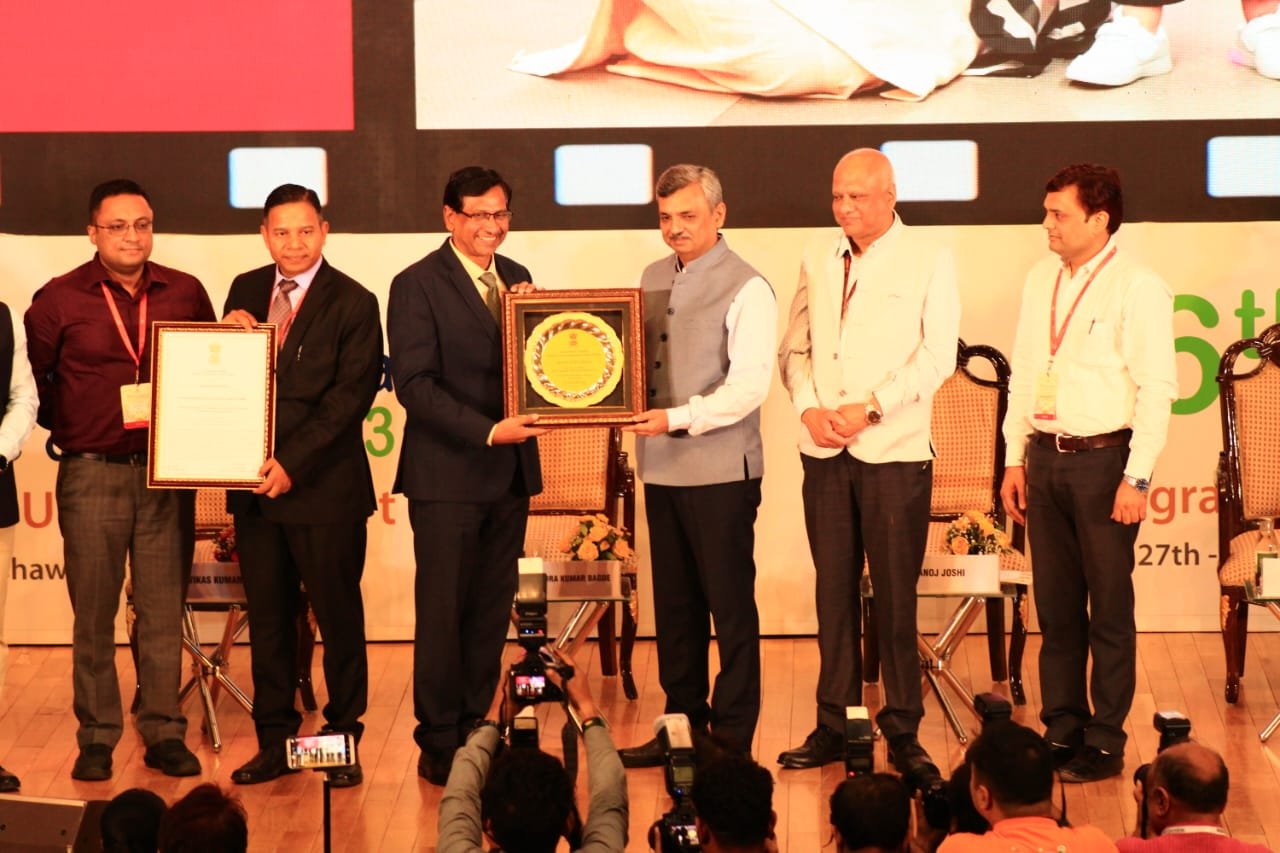
NEW DELHI (Metro Rail News): The Urban Mobility India Conference being conducted in Delhi culminated on Sunday with an award ceremony to felicitate the Metros running in India for their continuous and committed service. 

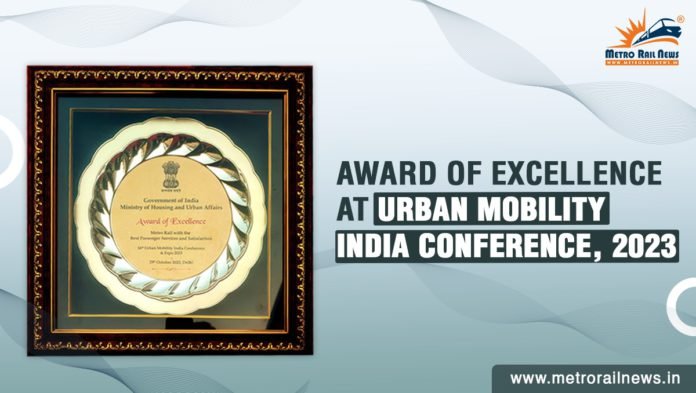
With the same endeavour, the Delhi metro & Lucknow metro was awarded an Excellence Award in Public Transport in the category of “ Metro Rail with Best Passenger Services & Satisfaction”. 

DMRC, in a tweet, said, ” Delhi Metro today received the ‘Award of Excellence in Public Transport’ in the ‘Metro Rail with Best Passenger Services and Satisfaction’ category at the 16th Urban Mobility India Conference and Expo, 2023 organised by the Ministry of Housing and Urban Affairs, Govt of India”. 

DMRC awarded at UMI 2023
DMRC awarded at UMI Conference, 2023.

UPMRC, in a tweet, said, “ Lucknow Metro won the National award from the Government of India for its excellent Passenger service and satisfaction and Best Performance which means going the extra mile for passenger comfort, punctuality, reliability, convenience, benefit, engagement and safety”. 

Lucknow metro awarded at UMI 2023
UPMRC awarded at UMI Conference, 2023.

The three-day Urban Mobility India Conference was organised by MoHUA in Manekshaw Centre and culminated on Sunday. 


Discover the endless possibilities of our city’s Metro at InnoMetro, our flagship Expo and Conference. Be an active participant in shaping its future towards a more sustainable tomorrow. Stay informed and join us to take a step towards a brighter future.

Advertisement1
InnoMetro_2026

INDIAN RAILWAYS AS A GREEN TRANSPORTER

0
Indian Railway
Indian Railways (Representational Image)

NEW DELHI (Metro Rail News): Indian Railways (IR), the world’s fourth largest railway network, endeavours to become a green transporter by mitigating its carbon footprint. In 2020, the energy consumption of IR was estimated to be 18,410 million units for traction and 2,338 million units for non-traction load. IR has taken great measures to minimise its carbon footprints and fuel expenses, and India is committed to being a ‘net-zero’ carbon-emitting country by 2030. Some of its key and principal decarbonisation measures include complete electrification of the railway’s broad gauge network, reductions in energy use, and meeting energy demand with renewable energy.

IR currently has 220 MW of renewable energy capacity, with over 3,450 MW of renewable energy capacity in the development pipeline. It is also expected that the use and consumption of renewable energy in the transportation industry will reduce greenhouse gas (GHG) emissions by nearly forty per cent. With 115,000 track kilometres, 8,500 stations, and operations of around 12,000 trains per day, IR is known to be one of India’s biggest consumers of fossil fuels, consuming approximately 2.7 billion litres of diesel yearly.

One of the world’s largest railway networks, Indian Railways, has set an ambitious goal of being a net-zero carbon emitter by 2030. The project is part of the country’s overall goal of limiting and reducing carbon emissions and mitigating the effects of climate change. The Indian Railways, which operates over 13,000 passenger and goods trains, contributes for 4% of GHG emissions from India’s transportation industry, which accounts for nearly fourteen per cent of the country’s greenhouse gas emissions. 

The railway network has made several steps to lessen its carbon footprint. Shri Ashwini Vaishnaw, Minister of Railways, Communications, and Electronics and Information Technology, revealed in a written reply to a question in Lok Sabha that the use of energy-efficient technologies, such as switching entirely to the production of three-phase electric locomotives with regenerative features, the use of head-on generation (HOG) technology, the use of LED lights in buildings and coaches, star-rated appliances, and afforestation, are some of the initiatives. Additionally, switching from diesel to electric traction, boosting energy efficiency, and afforestation have been mentioned as essential approaches for attaining the Net Zero Carbon emission targets.

Indian Railways is projected to have an energy demand of roughly 8,200 Mega Watt (MW) by 2029-2030. It is estimated that around 30,000 MW of renewable energy capacity will be required by 2029-2030 to achieve net zero carbon emissions. As of February 2023, around 147 MW of solar power plants (both on rooftops and on land) and approximately 103 MW of wind power plants have been operational. In addition, approximately 2150 MW of renewable energy capacity have been planned and committed to be developed.

Further, IR has also planned to gradually meet its future energy requirements by acquiring renewable energy through various power procurement policies and strategies. The railways have set and established the target of generating 20 GW of solar energy by 2030. As of today, Indian Railways have solarised around 960 stations. Indian Railways’ objective is to totally migrate to a ‘Green mode of transportation’ by using solar energy to meet its traction power requirements. This is consistent with the Prime Minister’s 2020 directive to solarise train stations and utilise unused railway land for renewable energy (RE) projects. According to reports, around 142 megawatts of solar plants and 103 megawatts of wind power plants have been commissioned till October 31, 2022.

In addition, the Indian Railways is taking steps to enhance the usage of green fuels. It uses a 5% biofuel blend in traction diesel fuel. The railways are also taking steps to minimise carbon emissions from goods and freight trains, which have been for long among the leading contributors to pollution. Finally, the Indian Railways’ initiative to become a net-zero carbon emitter by 2030 marks and constitutes a significant step towards lowering India’s carbon emissions and minimising the effects of climate change. The railways have taken several steps towards lowering their carbon footprint, including electrifying the railway network, using renewable energy sources, and reducing energy use. 

The Government of India has set a target of 33% reduction in emissions intensity as part of its Nationally Determined Contributions (NDCs), with transport being one of the principal sectors with significant mitigation potential. One of the most important transport emissions mitigation plans agreed to by the Government of India has been to raise Indian Railways’ share of freight movement from 35-36% to 45% by 2030. Indian Railways plays a significant role in contributing to India’s NDC to address climate change through a number of different approaches, including:

  • To increase the railways’ share of total land-based freight transit from the current thirty-six per cent to forty-five per cent by 2030. Dedicated Freight Corridors (DFCs) are being built across India by Indian Railways. Over a 30-year period of time, the first phase of the project is expected to cut emissions by 457 million tonnes of CO2.
  • Increase the proportion of renewable energy in the country’s energy mix. Railways to boost and enhance energy efficiency for both diesel and electric propulsion, allowing the country to reduce GHG emissions. The PAT Scheme is to be introduced and implemented in the railway sector. Use of a five per cent biofuel blend in traction diesel fuel.
  • Improve and enhance water usage efficiency by up to twenty per cent by 2030. Planting trees to boost carbon sink. Pollution control and waste management. Adopting best practices for green buildings, industrial units, and other establishments for resource and infrastructure management in order to promote environmental sustainability in the growth of IR. 
  • Contribution to the ‘Swachh Bharat Mission’. IR has set and established the target of becoming a ‘Net Zero’ organisation by 2030 through the electrification of its rail network. Additionally, the railways have also introduced bio-toilets in all its trains with OBHS (Board housekeeping service) facilities.

Indian Railways has taken advances to streamline its environmental management operations, with noticeable programmes and initiatives, including Energy Efficiency Management, Renewable and Alternative Energy Sources, Water Conservation, Afforestation, Water Management, and Green Certifications. The reforms carried out by Indian Railways in recent years can be broadly classified as follows:

(i) Carbon Emission: 

IR plans to make every possible effort to reduce its carbon consequences, primarily through obtaining its energy needs from renewable sources. The projected requirement for renewable capacity installation by 2029-30 is expected around 30 GW. IR has installed 142 MW of rooftop solar capacity and 103.4 MW of wind energy capacity till August 2022. Other measures for becoming a Net Zero emitter include electrification of its lines, switching from diesel to electric traction, promotion of energy efficiency, developing Dedicated Freight Corridors, Green certification of Railway Establishments, and so on.

IR has electrified 52,508 RKM out of a total BG network of 65,141 RKM (80.61%). With hundred per cent electrification, power demand is expected to rise to almost 72 BUs by 2029-30, up from 21 BUs in 2019-20. Carbon emissions are anticipated to be 60 million tonnes by 2029-30 as per business and in the usual mode, which has been planned to be mitigated by different IR initiatives.

(ii) Issuance of water policy for effective water management: 

Water Policy 2017 has been disseminated to all Zonal Railways and Production Units for implementation in Railway Stations, Trains, and Railway Colonies, among other places. This is part of the Government of India’s broader aim to reduce water consumption as part of its Nationally Determined Contribution. 

The main goal of this strategy is to promote water use efficiency through better demand and supply management, the installation of water-efficient devices, and the establishment of Water Recycling Plants on railway land.

(iii) Creation of Additional Carbon sink by Afforestation

Railway departmentally carries out afforestation on vacant railway land and in between sections. As part of the railways’ commitment to environmental betterment and sustainable development, state forest departments are involved in tree planting, maintenance, and disposal.

Since 2017, IR has been planting approximately 1 crore trees every year. During the years 2021-22, 72 lakh seedlings had been planted.

(iv) Waste Management:

More than 250 waste management stations have waste-to-energy/compost/biogas plants/material recovery facilities. Separate containers for dry and moist trash have been installed for waste categorisation at the source.

(v) Green certification/Consent to operate from the State Pollution Control Board

Around 700 railway stations have been accredited for ISO:14001 environmental management system implementation. Over 545 stations have received permission to operate (CTO) from their respective State Pollution Control Boards. Green accreditation has been granted to 31 railway buildings (including offices, training institutes, hospitals, and schools), 32 stations, and 55 workshops/PUs.

(vi) Policy for allocating one per cent cost in all sanctioned works for executing environment-related works:

To reduce the environmental impact of activities and to protect the environment, a policy was announced in May 2016 that provided for a 1% cost allocation in all sanctioned Works for executing environment-related activity.

(vii) Cleanliness of Trains & Railway Stations:

Cleanliness of trains and railway stations has gained prominence in the last few years, as the number of mechanised cleaning contracts at stations and coaches in trains, rag picking and garbage disposal contracts at stations, and On Board Housekeeping Service (OBHS) contracts have increased.

(viii) Environment-friendly Bio–Toilets for Passenger Coaches:
Indian Railways (IR) and the Defence Research and Development Organisation (DRDO) have collaborated to develop environmentally friendly bio-toilets for passenger waggons. 

Up till March 2014, 9,587 bio-toilets were installed in 3,647 coaches. The task of installing bio-toilets in all passenger-carrying coaches on Indian Railways has been completed with the installation of 2,58,990 bio-toilets in about 73,110 coaches up to March 2021.  

In accordance with the ‘Swachh Bharat Mission,’ direct discharge of human waste from trains has thus been prohibited.

(ix) Third-party Audit/Survey, including Passenger feedback on Cleanliness:

Third-party audit cum survey on cleanliness of major stations began in 2016 and has been carried out every year since then. In 2018, the first-ever third-party audit cum survey on the hygiene of major trains was conducted. Such surveys enable independent evaluation while also instilling a healthy feeling of competition in improving cleanliness in passenger interaction areas.

(x) Standard Bid Document for Housekeeping of Stations & Trains & General Conditions of Contract for Services:

To increase the effectiveness of housekeeping/cleaning contracts, the Standard Bid Document (SBD) (Aug 2017) and General Conditions of Contract for Services (GCCS) (Feb 2018) have been developed and issued, with a special focus on passenger contact areas. 

The Other Recent Developments

Indian Railways, the country’s largest electricity consumer, has set the lofty aim of being a net-zero carbon emitter by 2030. The programme was announced with a focus on the importance of industry participation and collaboration in reaching this common goal. With plans and aspirations to extend its presence and influence in the solar sector and capture clean power, Indian Railways strives to become the world’s newest, finest, and safest rail system. Indian Railways, being aware of its considerable contribution to the nation’s energy usage (about 2% of the total), is actively seeking a clean energy transition. Recognising the environmental risks posed by its energy usage, the corporation has taken great steps to reduce its carbon footprint by implementing renewable energy sources.

Solar Projects on the Rise

Indian Railways has made significant strides in incorporating solar energy into its infrastructure. As part of its commitment to renewable energy, the organisation launched a 5 MW solar power project across multiple stations in New Delhi. These photovoltaic systems and solar power plants on the rooftops of the railway stations in Hazrat Nizamuddin, New Delhi, Anand Vihar, and Delhi are like shining representations of Indian Railways’ commitment to renewable energy. By embracing solar energy, the corporation not only reduced its reliance on fossil fuels, but it has also demonstrated the potential and benefits of renewable energy adoption in the transportation sector.

Additionally, as part of its ambitious goal of obtaining 5 GW of solar capacity, Indian Railways has set its sights on developing large-scale solar power projects, both on rooftops and ground-mount systems. Indian Railways can tap into the enormous potential of solar energy and contribute considerably to the country’s renewable energy goals by capitalising on available infrastructure and space. These solar projects will not only assist in cutting carbon emissions but shall also provide a long-term and sustainable source of power for the rail network.

As part of its commitment to sustainability, the Kolkata Metro, in recent times, has made considerable efforts towards incorporating solar electricity into its network. The installation of solar power plants on rooftops throughout the metro railway’s network has become a cornerstone of the organisation’s sustainable energy strategy. The Kolkata Metro currently generates an astounding 2189.50 Kwp of solar power. This comprises the installation of 657 Kwp solar power plants along the North-South Corridor, 1519 Kwp solar power plants along the East-West Corridor, and 13.5 Kwp solar plants at the Metro Railway’s Tapan Sinha Memorial Hospital.

The solar power plants have been extremely advantageous to the Kolkata Metro. These projects have been carried out in a Public-Private Partnership (PPP) mode, having the metro rail authorities providing the rooftop areas and the solar power developer in control of the entire design, procurement, installation, testing, and commissioning work. The solar power developers are in charge of the operation and maintenance of these installations. The Metro Railway’s solar power generation system is monitored using a cloud-based monitoring system to maintain optimal performance and efficiency. External computers and smart devices use built-in metres and data loggers to analyse plant performance, providing vital information for ongoing maintenance and enhancements.

In the future, the Kolkata Metro has significant plans for solar power generation. The metro has set a target of increasing solar power capacity by 2792 Kwp in fiscal year 2023-24. This development comprises the erection of a 500 Kwp capacity plant at Central Park Depot’s Stabling Bay Line Workshop, a 92 Kwp capacity plant at Belgachia, a significant 1400 Kwp capacity plant at Joka Depot, and an 800 Kwp capacity plant at Kavi Subhash Carshed. A proposal has also been submitted for the development of a 654 Kwp solar power generating plant at Jessore Road station.

Setting up a 1 GW Solar Power Park

The Indian Railways has also announced its plans to build a gigantic 1 GW solar power facility in the state of Madhya Pradesh. This ambitious project demonstrates the company’s dedication to renewable energy and sustainability. The Rewa Solar Park, known for its low tariffs and favourable solar conditions, has piqued the interest of Indian Railways as an ideal location for this ground-breaking initiative.

A solar power park of this size will not only supply clean energy to run the railway system but will also demonstrate India’s commitment to renewable energy on a global scale. Indian Railways would be able to generate a huge amount of electricity and significantly lower its carbon footprint by utilising the plentiful solar resources available in Madhya Pradesh. The development of this solar power park will be an outstanding instance of India’s commitment to clean energy, as well as a catalyst for future solar power advancements in the country.

Indian Railways is seeking to attain energy self-sufficiency and lessen its dependency on conventional energy sources through extensive deployment of solar power. By incorporating solar energy into its operations, the railway system will not only help to green the environment but will also save money in the long run. Once established, solar power provides a consistent and predictable source of energy, lowering energy price volatility and the company’s vulnerability and responsiveness to price variations in the fossil fuel market.

Additionally, excess energy generated through the railway system can be fed back into the grid, improving the nation’s overall energy security. This excess power might be used during high-demand hours or in areas with low solar power generation capabilities. Indian Railways shall play an important part in grid stabilisation and promoting the optimal use of renewable energy resources by functioning as a net energy exporter.

Solar power integration into Indian Railways operations extends beyond lowering carbon emissions and achieving energy self-sufficiency. It displays the organisation’s dedication to sustainable practices, developing an environmental stewardship culture. Indian Railways is setting a pattern and standard for other companies and organisations to follow by embracing solar energy on a large scale, demonstrating that a clean energy transition is not only feasible but also economically sustainable.

Collaboration with Industry Stakeholders

Railways Minister Ashwini Vaishnaw has stressed the necessity of industry cooperation in meeting Indian Railways’ ambitious targets. Recognizing that great things in business are never completed by a single person, Shri Ashwini Vaishnaw has emphasized the importance of collaboration between the railways and a number of industry stakeholders. This collaboration includes solar developers, technology providers, legislators, and other stakeholders. These stakeholders can accelerate the transition to renewable energy by pooling their experience, resources, and innovative ideas. The combined efforts of industry participants will be critical in overcoming problems, recognising opportunities, and implementing long-term solutions that are consistent with Indian Railways’ vision and goals.

Partnerships, collaborative ventures, and knowledge-sharing platforms are all examples of collaboration. Indian Railways can exploit the different perspectives and strengths of its industry partners by establishing a collaborative atmosphere, paving the road for a sustainable future. Indian Railways can build a synergy between sustainability and passenger comfort by utilising technology improvements and embracing innovation. Integration of renewable energy systems, for example, can power charging stations for electric trains, increasing the adoption of cleaner transportation and lowering dependency on fossil fuels.

The commitment of Indian Railways to becoming a net-zero carbon emitter by 2030 represents a significant step towards a more sustainable and green future. The railway system may substantially reduce its carbon footprint and contribute to the nation’s environmental goals by capturing solar power and embracing sustainable energy options. With industry involvement and an emphasis on innovation, Indian Railways is on course to become one of the world’s newest, finest, and greenest railway networks.


Discover the endless possibilities of our city’s Metro at InnoMetro, our flagship Expo and Conference. Be an active participant in shaping its future towards a more sustainable tomorrow. Stay informed and join us to take a step towards a brighter future

Advertisement1
InnoMetro_2026

Jewar To New Delhi High-Speed Metro Line For Enhanced And Advanced Commuting

1
Chandigarh metro (Representational image)

NEW DELHI (Metro Rail News):

Overview

On December 13, 2022, the Yamuna Expressway Industrial Development Authority (Yeida) signed an agreement with the Delhi Metro Rail Corporation (DMRC) under which the latter had been assigned with the responsibility of preparing a detailed project report for Phase-2 of the proposed metro corridor between the Jewar Airport in Noida and the IGI Airport in Delhi. The Yamuna Expressway Authority paid Rs 2 crore to DMRC in October last year to prepare the DPR. The projected Metro corridor project, estimated to cost approximately Rs 13,000 crore, is anticipated to be financed and funded by the Noida authority, Greater Noida authority, Yeida, the Uttar Pradesh government, and the Central government.

A seventy-two-kilometre metro route has been planned and proposed to be constructed to connect the forthcoming Jewar airport to the New Delhi Metro Station. In the designed corridor, passengers shall have the option to change trains at the NDLS metro station and take the airport express metro to the IGI Airport. The intended metro rail corridor shall feature two metro rail stretches, one between Noida Airport and Knowledge Park in Greater Noida, and the other from Knowledge Park to New Delhi Railway Station. There is already a connection from New Delhi Railway Station to the Airport Express for Delhi Airport.

Jewar Airport Metro stations

Although the Jewar airport-New Delhi Metro Station Metro route was originally planned to have 12 stations, officials now claim that it may only have six in order to cut travel time. According to DMRC, once this new line is operational, the distance between Jewar Airport and IGI Airport could be traversed in one hour. The first phase of the projected Jewar airport is expected to be completed in September 2024, shortly after the NCR’s second airport opens to the public.

Jewar Airport to be linked with Bulandshahr

The Yeida has also agreed to construct two new expressways and a rail link to connect the Chola Railway Station in Bulandshahr to Jewar, which is the proposed site where the Noida International Greenfield Airport is currently being developed.

Stations between Jewar airport and Greater Noida

The Airport Express Line would connect Jewar to the Indira Gandhi International Airport in Delhi via the link between the future Noida International Airport and Greater Noida. Seven stations are planned for the proposed metro rail corridor between the upcoming Noida International Airport at Jewar & Knowledge Park-2 in Greater Noida. According to sources close to the project, it has been slated that six of the seven metro stations shall be elevated while the remaining one is expected to be underground.

The Delhi Metro Rail Corporation (DMRC) prepared a detailed project report (DPR) for the metro link between Jewar Airport and Knowledge Park-2, which was submitted to the Yamuna Expressway Industrial Development Authority (YEIDA) last year and has now been forwarded to the Uttar Pradesh government for approval.

As per the sources, ‘there are likely to be seven stations between Jewar Airport and Greater Noida. Four of these seven are likely to be Noida International Airport in Jewar, International Film City, Techzone and Knowledge Park-2. The remaining three stations are expected to come up in YEIDA residential sectors 18, 19 and 20 and industrial sectors 28 and 29,” including that the station at Noida International Airport will be underground.

Building Jewar – India’s Transport Hub

The Knowledge Park-2 metro station will serve as an interchange station for travellers switching to the Noida-Greater Noida Aqua line metro. The 35.64-kilometre-long metro link between Jewar Airport and Greater Noida is part of the 72-kilometre-long Airport Express Line, which will connect the planned Noida International Airport with the Indira Gandhi International Airport in Delhi. The project would be completed in two stages: 35.64 kilometres from Jewar Airport to Knowledge Park-2 and 36.36 kilometres from Knowledge Park-2 to Delhi, where commuters can use the current Airport Express Line.

According to sources, given the distance between the two airports, the entire metro connecting link will be a high-speed rail service, with a one-hour journey time between the two airports. According to YEIDA officials, DMRC is also preparing the DPR for the Knowledge Park-2 to New Delhi metro line, which is scheduled to be filed soon. The total project cost, including both stages, is anticipated to be Rs 13,000 crore. The DPR for Knowledge Park-2 to Delhi Metro had been scheduled to be submitted by March 31 of this year; however, it had been postponed and delayed by a few months owing to the requirement to have more time to carry out surveys.

The YEIDA shall be submitting the DPR for the Greater Noida-Delhi metro line to the state government for approval after reviewing and examining it. Work on both metro corridors can begin only after approval and acceptance from the state government. According to the officials, YEIDA signed an agreement with DMRC to perform a feasibility study for a metro link between IGI Airport and Noida International Airport in September 2021. They stated that phase one of the new airport is planned to begin in September 2024, so connecting the two airports and developing multimodal connectivity from Jewar to other sections of Greater Noida, Noida, and Delhi is vital and important.

Metro to link two NCR Airports: DPR for New Delhi-Greater Noida Metro Corridor

The Delhi Metro Rail Corporation (DMRC) has submitted the comprehensive project report for the proposed metro route between New Delhi railway station and Greater Noida Knowledge Park-2 to the Yamuna Expressway Industrial Development Authority (YEIDA). According to project officials, the detailed project report (DPR) has recommended roughly seven stations along this section of the metro network. This proposed corridor is part of a larger metro network intended to connect the National Capital Region’s (NCR) two international airports, the future Noida International Airport (NIA) in Jewar and the Indira Gandhi International Airport (IGI) in Delhi. The DPR had also been submitted to the government of Uttar Pradesh for assessment and final clearance.

According to the CEO of Yeida, the DPR for the Knowledge Park-2 to New Delhi segment has been prepared and has been sent to the state government for clearance. The DPR has proposed seven metro stations connecting Knowledge Park-2 to New Delhi. The government’s approval and orders for further project advancement are awaited. Officials said that the government shall take the final decision on the number of stations and the funding scheme. In February 2023, the DMRC began work on preparing the DPR for the development of this metro link. However, Yeida officials indicated in April that the process is being delayed because DMRC has requested more time to finish the survey work.

Linking The Two Airports

In December 2022, the DMRC and YEIDA signed a memorandum of understanding (MoU) for the compilation of the full project report for the development of the metro rail link. The 72-kilometre planned metro connectivity would be divided into two phases: a 36.36-kilometre link between New Delhi Station and Greater Noida’s Knowledge Park-2, and a 35.64-kilometre link between Knowledge Park-2 and Jewar. According to officials, the Knowledge Park-2-Jewar link has already received approval from the Yamuna authority for its DPR in August 2022 and is now awaiting approval from the Uttar Pradesh government. After the two stages are completed, this metro line will feature a total of 13 stations between Jewar Airport and New Delhi Railway Station. There is already a connection from New Delhi railway station to the Airport Express for IGI airport in Delhi. This proposed rail link is part of the Uttar Pradesh government’s intention to provide last-mile metro connectivity to Noida International Airport.

Summary

The high-speed Metro project connecting Noida International Airport with Delhi’s Indira Gandhi International Airport is slated to include only six stations on the 72km route in order to improve connectivity and assure smooth and quick journeys. The Uttar Pradesh government hopes to reduce travel time between Jewar and New Delhi stations to half an hour.

Reduced Number of Stations

The Delhi Metro Rail Corporation (DMRC) previously envisioned 12 stations along the route, beginning at the New Delhi Metro interchange and extending to the Noida airport in Jewar. However, in order to maintain high speeds, Uttar Pradesh government officials who chose anonymity insist on restricting the number of stations to six. This decision intends to make travel between the two airports more convenient and efficient. A high-level meeting had been organised, and attended by the Uttar Pradesh Chief Secretary, DMRC, Yamuna Expressway Industrial Development Authority (Yeida), Noida International Airport Limited (NIAL), Yamuna International Airport Private Limited, and the Ministry of Civil Aviation. The main purpose of the meeting has been to finalise the stations for the Metro line project and to debate the funding arrangement.

Project Implications

The construction of a high-speed Metro link between Noida International Airport and Indira Gandhi International Airport is required to meet the requirements of the agreement signed by Zurich International AG, Yamuna International Airport Private Limited, and NIAL. According to the agreement, the multimodal connection between Jewar and IGI airports must be constructed before operations at Noida airport begin in September 2024.

Upcoming Phases

Other than the 72-kilometer Metro link between Jewar and the New Delhi Metro station, two further stages are being considered. The first phase, which has already been approved, consists of a 35.64km Metro project from Jewar to Greater Noida’s Knowledge Park-2. The second phase, which is pending Yeida’s finalisation of the DPR, includes a 36.36km Metro link connecting Knowledge Park-2 and New Delhi. These future phases shall ultimately conclude the seventy-two-kilometre Metro project, providing passengers with seamless connectivity.

Conclusion

The projected high-speed Metro project connecting Noida International Airport and Delhi’s Indira Gandhi International Airport demonstrates the Uttar Pradesh government’s commitment towards strengthening and enhancing the infrastructure and connectivity in the region. With fewer stoppages and an emphasis on shorter journey times, this project intends to provide effective transportation alternatives for passengers while also contributing to the broader development of the area.


Discover the endless possibilities of our city’s Metro at InnoMetro, our flagship Expo and Conference. Be an active participant in shaping its future towards a more sustainable tomorrow. Stay informed and join us to take a step towards a brighter future

Advertisement1
InnoMetro_2026