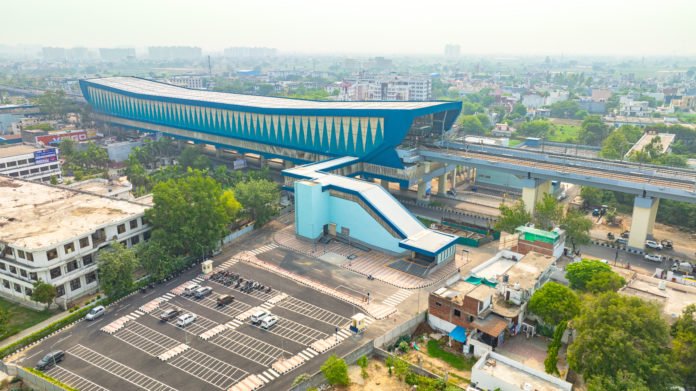
New Delhi: Prime Minister Narendra Modi has flagged-off the Delhi-Faridabad Metro Line that would allow hassle free travel for around two lakh daily commuters between the national capital and the industrial hub in Haryana.
The extension of the Delhi Metro connects Badarpur to Escorts Mujesar in Faridabad.
The total cost of the project from Badarpur to Escorts Mujesar is nearly Rs. 2,500 crore. Out of this, Rs. 1,557 crore was borne by the Haryana Government, the Centre contributed Rs. 537 crore, while the Delhi Metro provided Rs. 400 crore.
All these are elevated and located on either side of the Delhi-Mathura Road (NH-2).
“The nine-station metro corridor which was 95 per cent indigenously built will provide people a safe, affordable, quick, comfortable, reliable, environment-friendly and sustainable transport facility,” a Haryana government spokesperson said.
Haryana Chief Minister ML Khattar, addressing a press conference on Saturday, had thanked the Prime Minister for “gifting” the Metro service which would take the city to “another level of progress” with better connectivity with other NCR towns.
He had also said that the Prime Minister would be announcing the go-ahead for connecting Gurgaon with Faridabad by Metro.
Representation Purpose Only | AFC gates on Singapore’s Downtown Line
Table of Contents
Mumbai (Metro Rail News): After opening technical bids on Tuesday, Maharashtra Metro Rail Corporation Limited (MMRCL) identified three bidders for the upgrade work of Navi Mumbai Metro’s Automatic Fare Collection (AFC) system. The upgrade will enable the AFC system to accept QR codes, smart cards, and the National Common Mobility Card (NCMC) across all Navi Mumbai Metro stations.
Navi Mumbai Metro’s Line 1
Navi Mumbai Metro’s Corridor 1 runs 11.1 km from CBD Belapur Terminal to Pendhar, passing through 11 stations. This line became operational in November 2023. Currently, Navi Mumbai employs RFID tokens to provide access to the AFC system.
RFID Token (Image Credit: Jaideep)
To streamline the commuter experience and enhance convenience, MMRCL launched a new plan in January 2024. This plan aims to upgrade the Automatic Fare Collection (AFC) system, allowing commuters to use various methods for fare payment. These methods include the NCMC card, paper QR tickets, mobile QR tickets, message-based ticketing, NFC media, and web ticketing. To implement this plan, a tender was floated with a 6-month deadline to upgrade the AFC system.
Firms
Following are the three firms who submitted bids for the upgrade work of the AFC system for Navi Mumbai Metro.
Aurionpro Solutions Ltd
Satyam Software Solutions Pvt. Ltd.
Paycraft Solution Pvt. Ltd.
Scope of work
The MMRCL’s scope of work encompasses the design, supply, installation, testing, and commissioning of the AFC system by re-engineering/upgrading existing Stations AFC Automatic Gates (AG), Ticket Office Machines (TOMs), Excess Fare Offices (EFOs), Station Computers (SC), and Central Computers (CC). The upgrade will include hardware and software to support various payment methods, including Contactless Smart Cards (Type A) for a certain period, all NCMC cards, paper QR tickets, mobile QR tickets, message-based ticketing, web ticketing, and NFC media.
The scope of work also includes the design, supply, installation, testing, and commissioning of the Central Computer System (CCS) and Acquirer Bank/Financial Institution (FI) for NMML-1. The proposed solution shall work seamlessly to facilitate passenger movement and manage day-to-day data and reports.
The bids will now undergo technical evaluation, a process that can take a few months to complete. Following the technical evaluation, MMRCL will reveal the financial bids of the technically qualified bidders to identify the lowest bidder for the contract.
Imagine walking through the bustling streets of a random city, surrounded by beautiful monuments and towering skyscrapers. And you feel something big is going on. The cityscape is evolving, and you realise that 5G technology is the hidden force behind this transformation. This new technology is like a powerful thread that’s weaving together different parts of the city to make it more efficient and connected. Think of how you use your smartphone to navigate through the city. With 5G, you’ll have even faster and more reliable internet, making it easier to find your way around. The way people move around metro cities is also changing. The railways and metro systems, which are the lifeblood of the city’s transportation, are getting a major upgrade.
The scene has shifted from the old, worn platforms and bustling crowds to modern, high-tech systems that streamline travel with improved speed, safety, and convenience. Imagine tracking your train’s location in real time or receiving alerts for delays. This transformation is empowered by 5G technology. As you rush through crowded train stations, you might not notice the invisible network of 5G frequencies surrounding you. But it’s there, working behind the scenes to make the city’s infrastructure more efficient and connected. This means that different systems, like traffic management and public safety, can work together seamlessly to make the city a better place to live. Synchronising traffic lights to reduce congestion and enabling quicker responses from emergency services to accidents are now achievable with the introduction of 5G connectivity.
What is 5G?
Imagine a vast network of connections that transmit and receive data at incredible speeds. This is 5G, a fifth-generation wireless network that’s changing the way we communicate. It acts like a powerful heartbeat that connects cities, vehicles, and devices, enabling them to operate together seamlessly. Using your smartphone to navigate through the city becomes even smoother with 5G as it offers faster and more reliable internet, ultimately making it easier to find your way around. What makes 5G exceptional is its ability to take ordinary things and make them extraordinary. It’s akin to a magic trick that transforms slow traffic into smooth flow, and inefficient systems into productive ones. Daily life becomes more dynamic with the limitless possibilities of the 5G network. Imagine traffic lights that adjust their timing to align with traffic flow, effectively reducing congestion and speeding up your commute. This is the transformative potential of 5G. Imagine a world where data flows like a river, making every aspect of city life better. Buildings adapt to your needs, traffic flows smoothly, and healthcare becomes more efficient. This is the world of 5G, where what once seemed impossible becomes reality. How remote healthcare consultations can save lives, or how smart buildings can adjust their temperature and lighting to make you more comfortable, thanks to the 5G network system, which can integrate complex applications with ease.
As we explore railway corridors and underground tunnels, we’ll see how the 5G technology is transforming the city’s transportation. We’ll discover how this innovative network is making the city more efficient, safe, and connected. So, let’s start this exciting journey into the world of 5G, where the boundaries of reality are being rewritten, one connection at a time. 5G can improve public safety, and make transportation more efficient. We’ll explore these possibilities and more as we delve into the world of 5G. A train moving smoothly through the countryside, its wheels humming along the tracks. Now, imagine this train connected to a digital system that monitors every detail of its operation, from its speed to its engine health. With 5G, train control systems can communicate seamlessly, ensuring safety, precision, and optimal performance. Delays due to bad weather can be frustrating. However, with 5G, delays can be minimised, even during bad weather. The data-driven efficiency of 5G keeps schedules on track, making your commute more reliable.
How 5G Works on Trains?
We can use 5G to interconnect various sensors and devices onboard trains and along the tracks to form a comprehensive digital system for trains. These sensors can monitor diverse aspects of the train’s performance, including its speed, location, operations of electronic devices, engine health, and track conditions such as mechanical stress, load impacts, locomotive rail speed, temperature, wear and tear, etc. This data can be collected in real-time and transmitted to a central control system, where it can be analyzed and used to optimise train performance and ensure the safety of passengers and rail personnel. This scenario simplifies the operational concept, as in reality, functionality can be far more intricate. However, it illustrates how the capabilities of 5G networks are put in for systemic use. Railway and metro networks are vast and continually require technological advancements. As new and improved technologies emerge, the demand for faster connectivity systems grows. At present, this requirement for high-speed connectivity is fulfilled by 5G networks.
5G is Changing the Way We Commute
With 5G technology, stepping into a modern metro car, where your daily commute is no longer just about getting to work or school. It is transformed into a seamless blend of work and leisure. No longer just a passenger, you become an active participant in a connected world.
With 5G, you can:
Check your emails or scroll through social media while on the move, without worrying about slow internet speeds.
Use your phone to plan your route, check schedules, and even order food or coffee to be ready for pickup at your destination.
Stay entertained with streaming services, online games, or video calls with friends and family.
Receive personalized updates and offers based on your location and preferences.
The integration of 5G technology into metro systems means that you can make the most of your commute time. Whether you want to be productive, relax, or stay connected with loved ones, 5G ensures a smooth and enjoyable experience.
With 5G, the daily commute is no longer just about getting from point A to point B. It’s about experiencing a new level of convenience, connectivity, and enjoyment. As 5G technology continues to evolve, we can expect even more innovative features and services that will transform the way we travel. In the context of metro systems, 5G technology provides uninterrupted Wi-Fi connectivity, empowering passengers to remain productive and entertained throughout their commute. This feature is made possible by the low latency and high-speed data transmission capabilities of 5G networks.
5G Connection Enables Uninterrupted Connectivity
To understand how 5G achieves uninterrupted connectivity, let’s explore the technical aspects. 5G networks operate on a much faster frequency band than their 4G predecessors, with peak download speeds reaching up to 20 Gbps. This means that data transmission occurs at a much faster rate, reducing latency and ensuring seamless connectivity across various applications. Additionally, 5G networks employ advanced antenna technologies and frequency bands, which enhance the speed and reliability of data transmission. This results in a more stable and consistent internet connection, even in crowded metro cars.
The implications of uninterrupted connectivity on passenger experience are significant. With 5G, passengers can:
Stream videos and music without buffering or lag
Check and respond to emails in real-time
Plan their day, access maps, and navigate through unfamiliar areas without interruptions
Stay connected with friends and family through social media and messaging apps
This seamless connectivity transforms the daily commute into a productive and enjoyable experience, allowing passengers to make the most of their travel time.
5G Enables Real-Time Travel Information
5G’s low latency and high-speed data transmission capabilities facilitate the seamless exchange of data between transportation systems, passengers, and their devices. This enables the provision of real-time travel information, including:
Train Schedules: Up-to-the-minute train schedules, including arrival and departure times, delays, and cancellations.
Platform Changes: Real-time updates on platform changes, ensuring passengers are always aware of the correct platform for their train.
Service Alerts: Notifications about service disruptions, engineering works, or other events that may affect their journey.
Station Information: Details about station facilities, amenities, and accessibility features.
The provision of real-time travel information has a significant impact on the passenger experience, offering numerous benefits, including:
Reduced Anxiety and Stress: Passengers can plan their journey with confidence, reducing anxiety and stress associated with travel.
Improved Passenger Experience: Real-time information enables passengers to make informed decisions, optimizing their journey and reducing wait times.
Increased Efficiency: By providing accurate and timely information, passengers can better manage their time, reducing congestion and improving overall efficiency.
Enhanced Customer Satisfaction: Real-time travel information demonstrates a commitment to customer satisfaction, fostering a positive perception of the transportation provider.
Contactless Payments with 5G
The integration of 5G technology with contactless payment systems has transformed the metro experience, offering a truly convenient and cashless journey. With 5G, passengers can:
Purchase Tickets: Buy tickets or top up their travel cards using their smartphones, eliminating the need for physical tickets or cash.
Make Payments: Pay for goods and services at the station, such as food, drinks, or retail items, with a simple tap of their phone.
Streamline Travel: Enjoy a seamless travel experience, without the hassle of queuing or searching for change.
The benefits of contactless payments with 5G are numerous:
Improved Convenience: Passengers can quickly and easily make payments, reducing wait times and increasing overall efficiency.
Enhanced Safety: The reduction of cash handling minimizes the risk of theft and loss, creating a safer environment for passengers.
Increased Hygiene: By reducing the need for physical contact, contactless payments promote a cleaner and more hygienic travel experience.
For passengers seeking a moment of tranquility amidst the bustling city, virtual reality (VR) windows powered by 5G’s high-speed and low-latency connectivity offer a digital escape. These windows can display:
Scenic Vistas: Breathtaking landscapes, calming oceans, or serene forests, providing a visual respite from the urban environment.
Immersive Art: Interactive and engaging art installations, allowing passengers to explore and interact with digital masterpieces.
Live Events: Real-time broadcasts of concerts, sports, or cultural events, bringing the excitement of live experiences to the metro.
The benefits of VR windows with 5G are:
Mental Well-being: Providing a calming and relaxing environment, reducing stress and anxiety associated with urban travel.
Enhanced Passenger Experience: Offering a unique and engaging experience, making the metro journey more enjoyable and memorable.
Increased Productivity: Allowing passengers to unwind and recharge, making them more productive and focused upon arrival.
The Dawn of a New Era
A world where trains run like clockwork, arriving and departing on schedule, every time. A world where passengers can access real-time information, stream their favorite shows, and stay connected with loved ones during their commute. Welcome to the era of 5G-powered railway networks, where technology is transforming the way we travel.
Gone are the days of delayed trains and frustrated passengers. With 5G-powered railway networks, trains operate on schedule consistently. Advanced signaling systems and real-time monitoring empower railway operators to optimize train schedules, reducing congestion and increasing efficiency. Passengers can confidently plan their journeys, assured that their train will arrive and depart on time.
No more guessing when the next train will arrive or worrying about service disruptions. With 5G-powered railway networks, passengers have access to real-time information at their fingertips. Through mobile apps and digital displays, passengers can:
Track train schedules and arrival times in real-time
Receive notifications about service disruptions and delays
Plan their journey with ease, using interactive maps and route planners
Access information about station facilities, amenities, and accessibility features
Long commutes become a thing of the past with 5G-powered railway networks. Passengers can stream their favorite shows, movies, and music, or catch up on work, thanks to high-speed internet connectivity. With 5G, passengers can enjoy:
Fast and reliable internet connectivity, even in tunnels and rural areas
Seamless streaming of content, without buffering or lag
Access to a wide range of entertainment and productivity apps
With 5G-powered railway networks, passengers can stay connected with loved ones, colleagues, and friends during their commute. Whether it’s a video call, a messaging app, or a social media update, passengers can always stay connected, always. 5G technology enables:
High-quality video calls, even in low-light conditions
Fast and reliable messaging, with minimal latency
Seamless social media updates, without interruptions
5G-powered railway networks prioritize safety and security, ensuring that passengers feel protected and secure during their journey. Advanced surveillance systems, real-time monitoring, and emergency response systems work together to:
Prevent accidents and incidents, using predictive analytics and real-time monitoring
Respond quickly and effectively to emergencies, using advanced communication systems
Provide a safe and secure environment, using advanced surveillance and access control systems
Future of Railway Travel
As 5G technology continues to evolve, we anticipate an array of innovative features and services that will transform the way we travel. From augmented reality windows to personalized travel assistants, the potential for transformation is limitless. With 5G-powered railway networks, the future of railway travel is bright, convenient, and connected. The advent of 5G technology is revolutionizing the railway industry, transforming the way trains operate, and enhancing the passenger experience. With its high-speed, low-latency connectivity, 5G is enabling railway networks to become more efficient, safe, and passenger-centric.
Real-Time Information: The Key to a Seamless Commute
One of the most significant benefits of 5G technology in railway networks is its capability to deliver real-time information to passengers. With 5G, passengers can access up-to-the-minute updates about train schedules, delays, and service disruptions, ensuring that they are always well-informed and able to manage their journey effectively.
Real-time Scheduling: 5G enables railway operators to provide real-time scheduling information, allowing passengers to plan their journeys with precision.
Delay Notifications: In the event of a delay, 5G technology enables railway operators to notify passengers in real-time, reducing frustration and anxiety.
Service Disruption Alerts: 5G technology enables railway operators to alert passengers to service disruptions, such as engineering works or station closures, allowing them to plan alternative routes.
5G technology is also enabling passengers to stay connected during their commute, with high-speed, low-latency connectivity that allows them to stream content, access online services, and stay in touch with friends and family.
Streaming on the Go: With 5G, passengers can stream their favorite shows, movies, and music, making their commute more enjoyable and productive.
Online Access: 5G technology enables passengers to access online services, such as email, social media, and online banking, during their commute.
Video Calling: With 5G, passengers can make high-quality video calls, staying connected with loved ones and colleagues during their journey.
5G technology is also enabling railway operators to optimize train operations, reducing congestion, and improving overall efficiency.
Predictive Maintenance: 5G technology enables railway operators to monitor train performance in real-time, predicting maintenance needs and reducing downtime.
Optimized Scheduling: 5G technology enables railway operators to optimize train schedules, reducing congestion, and improving overall efficiency.
Increased Capacity: With 5G technology, railway operators can increase passenger capacity, reducing overcrowding, and improving the overall passenger experience.
5G technology is also enhancing safety in railway networks, enabling real-time monitoring of train operations, and ensuring that safety protocols are in place.
Safety Protocols: 5G technology enables railway operators to implement safety protocols, such as automatic braking systems, and collision avoidance systems.
Real-time Monitoring: 5G technology enables railway operators to monitor train operations in real-time, identifying potential safety risks, and taking prompt action.
Emergency Response: In the event of an emergency, 5G technology enables railway operators to respond quickly and effectively, ensuring the safety of passengers and staff.
Global Examples of 5G-Powered Railway Networks
Several cities around the world are already leveraging 5G technology to transform their railway networks.
Tokyo’s Yamanote Line: The iconic Yamanote Line in Tokyo has successfully leveraged 5G technology to improve punctuality, reduce congestion, and enhance passenger experience.
London’s Crossrail: The Crossrail project in London is using 5G technology to revolutionize its operations, providing real-time information, improving safety, and increasing efficiency.
Mumbai’s Metro: The Mumbai Metro is leveraging 5G technology to improve passenger experience, increase efficiency, and enhance safety, making it one of the most modern and efficient metro systems in India.
A World with Endless Possibilities
As 5G technology continues to evolve, the future of railway networks holds immense promise. With its high-speed, low-latency connectivity, 5G is poised to unlock a new era of innovation, transforming the way we travel and making railway networks more efficient, safe, and convenient. Gazing out of a virtual reality window, watching the countryside roll by in stunning high definition. With 5G, virtual reality technology will become an integral part of the railway experience, providing passengers with an immersive and engaging way to pass the time.
Immersive Entertainment: Virtual reality windows will offer passengers a range of immersive experiences, from movies and games to educational content and virtual tours.
Interactive Travel Guides: Virtual reality technology will provide passengers with interactive travel guides, offering insights into the history, culture, and attractions of the regions they are passing through.
Gone are the days of fumbling for cash or queuing for tickets. With 5G, contactless payments will become the norm, allowing passengers to pay for their fares with ease and convenience.
Tap-and-Go: Contactless payment systems will enable passengers to simply tap their card or device on a reader to pay for their fare.
Mobile Payments: Passengers will be able to pay for their fares using their mobile devices, eliminating the need for physical tickets or cash.
5G technology will also transform railway stations, making them smarter, more efficient, and more convenient.
Smart Lighting: 5G-enabled smart lighting systems will adjust to the time of day, weather, and passenger traffic, providing a safer and more welcoming environment.
Intelligent Signage: Digital signage will provide passengers with real-time information, directions, and alerts, making it easier to navigate the station.
Automated Security: 5G-enabled security systems will use AI-powered cameras and sensors to detect and respond to security threats, ensuring a safer and more secure environment.
5G technology will also enable railway operators to predict and prevent maintenance issues, reducing downtime and increasing efficiency. 5G-enabled sensors will monitor train performance in real-time, detecting potential issues before they occur. Advanced algorithms will analyze data from sensors and other sources to predict maintenance needs, allowing railway operators to schedule maintenance during off-peak hours.
5G technology will enable railway operators to optimize train schedules, reduce congestion, and increase passenger capacity.
Enhanced Safety: 5G technology will enable real-time monitoring of train operations, ensuring that safety protocols are in place and that passengers are protected in the event of an emergency.
Improved Convenience: 5G technology will provide passengers with a range of convenient services, from contactless payments to virtual reality windows, making travel a more enjoyable and productive experience.
The future of railway networks is bright, and with 5G technology, the possibilities are endless. As we look to the future, one thing is clear: 5G will play a critical role in shaping the future of railway travel, making it faster, safer, and more convenient for all.
Case Studies and Success Stories: 5G in Metro Systems
The integration of 5G technology in metro systems has yielded impressive results, as demonstrated by the following case studies:
Tokyo’s Yamanote Line: A Model of Efficiency
The Yamanote Line, one of the busiest metro lines in the world, has successfully leveraged 5G technology to enhance its train control and passenger services. The results are astounding:
1. 20% Improvement in Punctuality:
With 5G, the Yamanote Line has been able to optimize its train schedules, reducing delays and ensuring that trains run on time. This has been achieved through the use of advanced signaling systems and real-time monitoring of train movements. The 5G network enables the rapid transmission of data between trains, stations, and the control center, allowing for swift adjustments to be made to the schedule in case of any disruptions.
2. Lightning-Fast Connectivity:
Commuters on the Yamanote Line now enjoy seamless and high-speed connectivity, enabling them to stay productive and entertained during their daily commutes. The 5G network provides a reliable and fast internet connection, allowing passengers to access a range of services, including real-time information, entertainment, and communication.
The implementation of 5G technology on the Yamanote Line has not only improved the overall passenger experience but has also increased the efficiency of the metro system. With the ability to monitor and control train movements in real-time, the Yamanote Line has been able to reduce delays and increase the frequency of trains, resulting in a more reliable and efficient service.
London’s Crossrail: A Blueprint for Smart Cities
The Crossrail project, Europe’s largest urban rail construction, has adopted 5G technology to revolutionize its operations. The impact is far-reaching:
1. Tunnel Monitoring and Safety:
5G Enables real-time monitoring of tunnel conditions, ensuring the safety of passengers and staff. The 5G network allows for the transmission of critical data, such as temperature, humidity, and air quality, from sensors installed in the tunnels to the control center. This enables swift action to be taken in case of any anomalies or potential hazards.
2. Real-Time Updates:
Commuters on the Crossrail network receive real-time updates on train schedules, delays, and service disruptions, making their journeys more convenient and stress-free. The 5G network enables the rapid transmission of information to passengers, ensuring that they are always informed and up-to-date.
The implementation of 5G technology on the Crossrail project has set a new standard for urban rail construction. The use of 5G has enabled the creation of a smart, efficient, and safe transportation system that is capable of meeting the demands of a growing and increasingly connected city.
Mumbai Metro: A Case Study in Urban Mobility
The Mumbai Metro, one of the busiest metro systems in India, has also leveraged 5G technology to enhance its operations and passenger services. The results are impressive:
1. Improved Signaling and Automation: The Mumbai Metro has implemented 5G-based signaling and automation systems, enabling the efficient management of train movements and reducing the risk of human error. The 5G network allows for the rapid transmission of data between trains, stations, and the control center, ensuring that trains run on schedule and reducing the likelihood of delays.
2. Enhanced Passenger Experience: The Mumbai Metro has introduced 5G- enabled services, such as real-time information and entertainment, to enhance the passenger experience. The 5G network provides a reliable and fast internet connection, allowing passengers to access a range of services, including live updates, news, and entertainment.
The implementation of 5G technology on the Mumbai Metro has had a significant impact on the city’s urban mobility. The use of 5G has enabled the creation of a more efficient, reliable, and safe transportation system that is capable of meeting the demands of a rapidly growing city. With the ability to monitor and control train movements in real-time, the Mumbai Metro has been able to reduce delays and increase the frequency of trains, resulting in a more reliable and efficient service.
These case studies demonstrate the transformative potency of 5G technology in metro systems, improving:
Efficiency: Optimizing train schedules and reducing delays.
Safety: Ensuring the safety of passengers and staff through real-time monitoring.
Passenger Experience: Providing seamless connectivity and real-time updates, making journeys more convenient and stress-free.
The success of these case studies highlights the importance of:
Collaboration: Between transportation authorities, technology providers, and stakeholders to ensure seamless integration of 5G technology.
Infrastructure Investment: Upgrading infrastructure to support 5G technology and ensure reliable connectivity.
Passenger-Centric Approach: Designing services and solutions that prioritize the passenger experience and convenience.
By learning from these success stories, cities and transportation authorities can utilize 5G technology to transform their metro systems, improving the overall passenger experience and driving economic growth.
5G Network Challenges
While the integration of 5G technology in metro systems offers numerous benefits, it also presents several challenges that must be addressed to ensure a seamless and efficient passenger experience. These challenges include:
Infrastructure Overhaul
Laying Fiber-Optic Cables: Installing fiber-optic cables along thousands of kilometers of tracks demands substantial investment and resources.
Upgrading Existing Infrastructure: Upgrading metro systems to support 5G technology involves a complex and time-consuming process of enhancing existing infrastructure.
Security Concerns
Cybersecurity Threats: The integration of 5G technology in metro systems raises cybersecurity concerns, as digital systems become more susceptible to cyber threats.
Protecting Against Breaches: Metro systems must implement robust security measures to protect against cyber breaches, which could disrupt entire networks and cause chaos.
Spectrum Allocation
Balancing Spectrum Needs: Balancing spectrum allocation for 5G with existing services is a complex task that requires careful planning and coordination.
Ensuring Smooth Operation: Spectrum allocation must be done in a way that ensures the smooth operation of the metro system while also accommodating the needs of other services.
To overcome these challenges, metro systems must:
Invest in Infrastructure: Invest in upgrading existing infrastructure to support 5G technology.
Implement Robust Security Measures: Implement robust security measures to protect against cyber threats and breaches.
Coordinate Spectrum Allocation: Coordinate spectrum allocation with other services to ensure smooth operation of the metro system.
Collaborate with Stakeholders: Collaborate with stakeholders, including technology providers and government agencies, to address challenges and ensure the successful integration of 5G technology.
By addressing these challenges, metro systems can harness the full potential of 5G technology, transforming the passenger experience and improving the efficiency of urban transportation systems.
The Way Forward: Collaborating to Shape the Future of Metro Systems
As the sun sets over the urban skyline, a group of visionaries gather to chart the course for the future of metro systems. They envision a world where technology and innovation converge to create a seamless, efficient, and passenger-centric transportation experience.
To realize this vision, collaboration is essential. Governments, tech giants, and the railway industry must work together to overcome the challenges and harness the full potential of 5G technology. This collaboration will require:
Investment in Infrastructure: Governments and private sector partners must invest in the infrastructure needed to support 5G technology, including fiber-optic cables, base stations, and data centers.
Development of Standards: Industry stakeholders must work together to develop standards for 5G technology in metro systems, ensuring interoperability and security.
Research and Innovation: Continued research and innovation will be essential to unlock the full potential of 5G technology in metro systems, requiring collaboration between academia, industry, and government.
The way forward is a journey fueled by innovation, guided by pragmatism, and destined to redefine how we traverse our world. With collaboration and determination, we can transform metro systems into:
Smart Transportation Networks: Leveraging 5G technology to create intelligent, connected, and efficient transportation systems that meet the needs of passengers and cities alike.
Passenger-Centric Experiences: Providing seamless, personalized, and convenient travel experiences that prioritize passenger comfort, safety, and satisfaction.
Sustainable Urban Development: Supporting sustainable urban development by reducing congestion, emissions, and environmental impact, while promoting economic growth and social equity.
A Bright Future Ahead
As we look to the future, it’s clear that 5G will continue to play a critical role in shaping the future of railway networks. With its high-speed, low-latency connectivity, 5G will enable even more innovative features and services, such as virtual reality windows, contactless payments, and smart stations.
The integration of 5G technology in railway networks is not just about improving efficiency and safety; it’s about transforming the travel experience itself. By providing passengers with a more comfortable, convenient, and enjoyable journey, 5G is redefining the way we travel.
In conclusion, the integration of 5G technology in railway networks is setting a new standard for transportation. With its transformative power, 5G is revolutionizing the way we travel, making it faster, safer, and more convenient for all. As the transportation industry continues to evolve, one thing is clear: 5G will be at the forefront of innovation, shaping the future of railway networks and beyond. As we embark on this journey, we’re not just building a better transportation system – we’re building a better world. A world where technology and tradition converge, where innovation and progress drive human advancement, and where the future is brighter, more connected, and full of promise. So, the next time you board a train or take the metro, remember that you’re not just commuting – you’re part of a larger story, one that’s being written in the language of innovation and progress. And as the wheels turn, so does the future, promising a brighter, more connected tomorrow for all.
Conclusion: 5G Revolutionizes Railway Networks
As you step onto a train or descend into a metro station, you may not realize the intricate dance of technology and tradition that underlies the modern transportation system. But beneath the steel and concrete, a digital symphony plays, harmoniously converging the old with the new. It’s a promise etched in bits and bytes, a testament to human ingenuity and innovation.
The integration of 5G technology in metro systems is revolutionizing the way we travel and interact with our urban environments. As we look to the future, it’s clear that this convergence will continue to:
Transform the Passenger Experience: Providing seamless, personalized, and convenient travel experiences that prioritize passenger comfort, safety, and satisfaction.
Increase Efficiency: Optimizing metro operations, reducing congestion, and improving the overall efficiency of urban transportation systems.
Drive Economic Growth: Supporting sustainable urban development, promoting economic growth, and enhancing the quality of life for citizens.
The integration of 5G technology in railway networks is a groundbreaking development that is transforming the transportation industry. By harnessing the capabilities of 5G, railway networks are becoming more efficient, safe, and convenient, revolutionizing the way we travel. With 5G, railway networks are entering a new era of transportation, where real-time information, seamless connectivity, and increased efficiency are the norm. Passengers can now access up-to-the-minute information, stay connected on the go, and enjoy a more comfortable and convenient travel experience. 5G technology is also enhancing safety and efficiency in railway networks. Real-time monitoring and predictive maintenance enable railway operators to identify and address potential issues before they occur, reducing downtime and increasing overall efficiency. Additionally, 5G-enabled safety protocols ensure that passengers are protected in the event of an emergency.
New Delhi (Metro Rail News): NCRTC is going to provide extensive parking facilities to the commuters of Namo Bharat trains along the entire Delhi-Ghaziabad-Meerut RRTS corridor. More than 8,000 vehicles will be accommodated in the parking spaces being developed at the RRTS stations.
Parking Facility at Sahibabad RRTS Station
Significance of NCRTC’s Initiative
The Namo Bharat train services are connecting regional nodes across NCR with high speed. RRTS stations are strategically located at an average distance of 5 to 10 km. With an intent to promote the use of public transport, NCRTC is taking various initiatives to provide best-in-class first/last mile connectivity. In this direction, it has provided ample space for commuters to park their personal vehicles at the station parking area and enjoy the comfortable, safe and reliable ride of Namo Bharat. This will not only significantly reduce the load of private vehicles on the Delhi-Meerut route, but also save road accidents and help in reducing air pollution.
It is estimated that with the implementation of the entire Delhi – Meerut corridor the share of public transport will increase from the current 37% to 63%. NCRTC is also working on providing various options of last mile connectivity to the commuters and an expression of interest for providing various types of feeder services on all 25 stations has recently been invited.
The entire corridor’s parking facilities will likely accommodate more than 1,600 cars and over 6,500 two-wheelers. At present, there are no Parking fees for the commuters coming for pick and drop only as they can park their vehicles free of cost for first 10 minutes. Beyond that, a fee structure will be applicable, which is, for up to 6 hours, Rs 5 for bicycles, Rs 10 for two-wheelers, and Rs 25 for cars; for 6 to 12 hours, Rs 5 for bicycles, Rs 25 for two-wheelers, and Rs 50 for cars; and after 12 hours until the end of RRTS operation hours, Rs 10 for bicycles, Rs 30 for two-wheelers, and Rs 100 for cars. Night parking during non-operational hours will cost Rs 20 for bicycles, Rs 60 for two-wheelers, and Rs 200 for cars.
There are 25 stations on the entire RRTS corridor from Delhi to Meerut. The parking spaces are being developed considering the expected footfall at these stations. The biggest parking space is at Meerut South Station where around 300 cars and 900 two-wheelers can be parked. The second big parking space is being developed at Sarai Kale Khan station in Delhi where around 275 cars and 900 two-wheelers can be parked. In these parking spaces, electric charging stations are also being installed to boost convenience, clean energy adoption, and efficient last-mile connectivity.
A 34 km section of this corridor is already operational for the public with 8 RRTS stations where parking facilities have been provided to the commuters. The facility to park auto-rickshaws is also available in these parking lots. Special provisions have been made at the stations for pickup and drop-off facilities. The stations have been designed in such a way that vehicles coming from the main road can easily pick up and drop off passengers.
Along with this, keeping in mind the movement of specially-abled passengers, separate place has been earmarked for parking their vehicles and ramps have also been made for easy entry into the station, so that they can avail the facility to travel in Namo Bharat train seamlessly.
NCRTC is also planning to install battery-swapping stations in its parking areas for both commuters and last-mile service providers. This initiative will promote sustainable modes of transport at a pocket-friendly cost for commuters. The battery-swapping stations will not only encourage the use of electric vehicles but also enhance last-mile connectivity for people.
From the very beginning, NCRTC has been instrumental in providing parking facilities and last-mile connectivity to as many people as possible. This ensures that those living far from the stations can easily reach the RRTS stations without any hassle. These facilities will create a more convenient and friendly transport system, which will not only reduce pollution but also help improve the lives of people.
AI is a term that’s been all over the Internet and is hardly unheard of. It shouldn’t come as a surprise if your company or organization talks about using AI for functional operations. The fear of AI taking away jobs is one of the favourite topics that’s been looming over the internet. But do you think, it’s that easy for a machine language to take up such responsibilities? Frankly speaking, they can be very well trained to do human tasks, with utmost precision and accuracy, devoid of human errors, and providing exceptional solutions. The very essence of living beings is the ability to make mistakes, and it’s not a bad thing. But sometimes we do have to set the extent to which we should accept this error. As they can lead to hazardous consequences, that will eventually cost lives.
AI for Smarter Future
This is where AI and Machine Language models are being kept at the frontline with confidence for guidance and solutions. We are going to cover the importance of adopting AI for safety and reliability in Rail Operations. Railways are one of the most widely distributed networks around the globe. It’s natural for management operations of such vast entities to rely on smarter technologies as more and more rail networks are being adopted. Even though the railways have been keeping up with efficient operations up until now, opting for better and smarter technologies will only lead to faster growth, with fewer failures. With time, we have only seen growth in terms of technology, and AI, being in its infancy, has already won over the world, with its exceptional intelligence.
DATA and Models
Well, there’s no place where AI can’t work. It is literally designed to take up human tasks and make them better. We are relying on machine learning models, AI, and neuro-linguistic programming because they are designed to work like a human mind and produce multiple solutions based on data. One of the most important aspects of any computational model is its understanding of data. Be it old or real-time data, AI models are encoded to perform analytical functions and predict plausible solutions. In the Railway sector, every part of its operation works on data. Data like the number of passengers traveling on a day-to-day basis, on which train, from which station, the peak travel timings, seasonal variations, etc. This data concerns just about the passengers. Now imagine relating all these data, and every component would lead to humongous files of data collection. The more we progress, the more data is being collected, and due to human errors and our limitations, we can possibly miss out on some of the important pain points. But with AI and other neuro models, this error can be reduced without the worry of data being neglected. In fact, AI models are so well logically structured, that very few outliers may be neglected. These models and techniques represent themselves as powerful tools for making predictions, analyzing data, and identifying outliers across railway sectors. They leverage advanced statistical and machine learning methods to provide strong and reliable insights from complex datasets.
How is AI Going to Blend in Rail Operations?
When it comes to safety in rail operations, it is very important for us to consider it as the top priority.
As we have already seen the extensive collection of data, now we need to figure out what to do with this data. AI models can help to efficiently analyze and predict solutions that are safer and reliable to adopt. Railway infrastructure like tracks, stations, maintenance depots, signaling systems – traffic control, interlocking systems, etc, communications, power supply chains, bridges, and more, needs a regular civil inspection to check for their optimum functions. Similarly, the railway’s heart, its rolling stocks, which includes locomotives (engines), passenger trains, and freight wagons, needs to be in ideal working condition to operate. All these structural and technical operations are going on simultaneously, and minor breakdowns can happen anytime.
Predictive Maintainance
With AI, predictive models are built. These models or programs are responsible for analyzing the regular pain points in the railway operations, and predicting any anomalies that might occur due to failures or damages in the rail assets or the management depots. Implementing AI-powered predictive maintenance systems analyzes data from sensors installed on trains and tracks. Thus reducing unplanned downtimes, and preventing any accidents that might occur due to equipment failures. Since there’s timely awareness about the damages to rail assets by the AI models, maintenance teams can effectively resolve potential issues with brakes, tracks, tunnels, bogies, wheels, etc, thus helping extend the lifespan of rail assets.
Automated Train Operations
As we automate rail operations like acceleration control, braking systems, track interlocks, etc, with AI models, we are heading in the direction of precision and safety. Another benefit of automation is the reduction in human errors and adherence to consistent scheduling, which leads to enhanced operational efficiency.
Real-time Monitoring and Passenger Safety
AI-based surveillance system deployment receives data from various rail sources, helping to monitor tracks. They also detect any foreign objects or trespassers, thus ensuring timely interventions. Since AI models are working on real-time data, we can get early warnings to signal failures, unusual vibrations, and track or communication failures. AI has also been deployed for video analytics and facial recognition in real-time CCTV footage, to detect suspicious behavior, unattended items of baggage, and overcrowding, assisting in crowd management. With AI, officials can enhance their security measures and safely rely on them for accurate prompts.
Schedules and Traffic Loads
AI-driven traffic management models can be implemented to dynamically regulate train schedules and traffic flow based on real-time data. This will help to address delays and optimize track usage, hence minimizing traffic congestions we face, and improving the overall efficiency of train schedules.
The uses of AI models for operational functions are not limited but have far more applications, the more we think about it. We can use AI to build further models for solutions and predictions, that will help analyze the best energy-efficient ways for railways, which will help minimize environmental impact and improve sustainability. AI is also praised for quicker decision-making and coordination during incidents or accidents. They provide highly effective results concerning evacuation procedures, and dispatching emergency services for medical aid. The connection of AI with the Internet is commendable, especially for real-time data, which the management can use to upgrade the travel experience of passengers. The wide use of AI in the current scenarios can be observed in mobile apps and chatbots, which keep the passenger updated with train schedules, stations, routes, etc. All these developments are implemented to provide passengers with better travel journeys, all the while keeping in mind their safety. Hence relying on AI for safety measures is a way forward to walk along the present times, and adopt newer and smarter technologies for our growing demands.
Case Studies – GajRaj System and Eastern Railways Wheel Prediction System
The rail tracks are laid passing many forest areas and elephant fatalities due to train collisions were occurring frequently. To curb this, IR came up with an AI-based ‘Intrusion Detection System (IDS)’ solution. This 700 km system is laid in Assam, West Bengal, Orissa, parts of Chhattisgarh, and related regions with frequent movements of elephants. The OFC (Optical Fiber Cable) laid in association with the telecom tracks of IR, is capable of detecting the vibration of elephants within 5 meters of cable. As soon as the system detects a movement, it immediately alerts the loco pilot and other associated officials. On average 41 alerts have been received on a daily basis since the commencement of the system. And no fatalities have been reported since its installation.
Another visible upgrade in rail operations can be observed in the Eastern Railways initiative in opting for AI-based Wheel Prediction System for Locomotives for enhanced passenger Safety. CPRO Kaushik Mitra said, ‘This Software carefully monitors wheel dimensions and revolutionizes maintenance practices with reduced human error.’ The cloud-based AI system is made with Google Sheets, making it easy to input data from any rail personnel. The software can then make an analysis and predict the probable timeframe of wheel maintenance. The system is designed to streamline monitoring rail operations for enhanced efficiency, which will help in reducing manual errors and unnecessary expenditure.
AI Regulations
Like every product or service needs to keep up with safety-reliant measures, AI and other technologies are a bit difficult. Since AI is relatively new, we still have a long way to go in creating an environment for its safer use. The Internet is vast and information is immense, so do the dark lurkers, who can use this technology for the wrong purpose. And we have seen the dark usage of AI and deep fake models. So the government and higher regulating bodies should keep a stringent eye and measures on the safe usability of technologies like AI to not misuse the data against humanity.
Conclusion
In rail operations, we should definitely opt for AI models for safety, because human errors are inevitable. So, AI presents a valid and logical solution to our problem, which is not only cost-reliant but also a smarter technology. But we should take very careful steps about their usage. It being an infant technology, we are still unsure of the capabilities it holds, so moving carefully with AI and the Internet of Things would be a smart move.
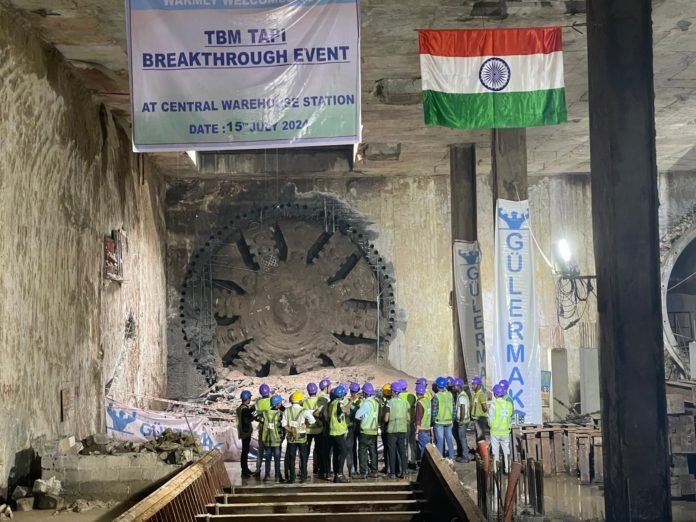
Surat (Metro Rail News): On July 15, the Surat Metro project achieved a notable milestone when the Tunnel Boring Machine (TBM) Tapi made a breakthrough at the Central Warehouse Station on Line 1. This line connects Sarthana and Dream City.
Image credit: Deniz BUYUKGOKMEN
TBM Tapi’s Journey
TBM Tapi achieved its second tunnel breakthrough under Package CS2/UG1, which covers a total distance of 3.46 km from Kapodra to Surat Railway Station. For this second assignment, TBM S78, nicknamed Tapi, began its journey from Labheshwar Chowk Station’s box. After completing its 600-meter drive, TBM reached Central Warehouse Station in 5.5 months.
Image credit: Deniz BUYUKGOKMEN
For its first assignment, TBM Tapi built a 1.5 km tunnel on the up-line from Kapodra to Labheshwar Chowk. TBM Tapi’s first breakthrough was achieved in January, and it was a hidden breakthrough. This is the first time TBM S78 has shown its face since it started its journey in January 2023.
Package CS2 / UG1
In March 2021, Gulermak – Sam India JV bagged the package CS2 / UG1 from Gujarat Metro Rail Corporation (GMRC).
Contract value: Rs. 1073.31 crore
Deadline: 40 Months
Apart from constructing three twin tunnels, Gulermak – Sam India JV is also carrying out the construction work of 3 underground stations at Kapodra, Labheshwar Chowk and Central Warehouse.
In March 2024, TBM Narmada completed the tunnelling on the downline from Labheshwar Chowk to Central Warehouse. To date, the Gulermak – Sam India JV has successfully constructed about 4.6 km of tunnels, covering both the Upline and Downline (2 x 2.3 km each).
Image credit: Mohsin Shaikh
Surat Metro Project
In March 2019, the Central Government approved the Surat Metro Phase 1 project. Phase 1 covers a total distance of 40.35 km through 2 corridors and 37 stations.
The first section of Phase 1 is likely to be opened by August 2024 and the entire Phase 1 is expected to be operational by 2027.
Bangalore (Metro Rail News): As per the latest release by BEML, on July 15, the Honourable Raksha Rajya Mantri, Shri Sanjay Seth, launched the 55th driverless MRS-1 Metro trainset for the Mumbai Metro project. This launching ceremony took place at BEML’s Bangalore plant. The Mumbai Metropolitan Region Development Authority (MMRDA) will deploy this trainset to facilitate operations on Line 2 and Line 7 of the Mumbai Metro.
BEML stated that securing the order amidst stiff global competition was an uphill task. The order entails the design, manufacture, supply, testing, commissioning, and training of 96 trainsets (6-car trainsets) of standard gauge Metro cars, valued at approximately INR 4319 crores.
Further, BEML said that initially, the order encompassed 378 cars, but then DMRC placed two more orders for rolling stock. One order includes 126 cars, and the other 72 cars. Together, this order for 576 Metro cars amounts to INR 4319 crores and is the single largest Metro rolling stock order received by any Metro manufacturer to date in India.
While recognising the efforts and continuous support of the Ministry and reiterating BEML’s commitment to delivering quality products, Shri Shantanu Roy, CMD of BEML, said, “Our team at BEML is proud to contribute to the nation’s infrastructure development. We are committed to excellence and innovation in all our endeavours.”
Shri Sanjay Seth highlighted BEML’s crucial role in promoting urban mobility through the indigenous manufacturing of rolling stock. He said, “BEML’s contribution to the ‘Make in India’ initiative is commendable. The driverless metro trainset symbolizes our nation’s growing capabilities in producing advanced transportation solutions.”
BEML stands as the first Indian rolling stock manufacturer to design, develop, manufacture, and supply driverless trains. During the design stage of the trainsets, BEML ensured that the metro trains are optimised for maximum passenger comfort, safety, and energy efficiency, meeting stringent global standards. The 6-car trainset can carry approximately 2,306 passengers, with seating for 298 passengers.
Features of BEML’s Driverless Trains
As per BEML’s release, these modernised trains will have the following features:
6-Car Formation: Streamlined design for efficient passenger transport.
Stainless Steel Car Body: Enhanced durability with colored graphic film and aesthetically appealing interiors.
Roof-Mounted Saloon Air Conditioner: Ensures a comfortable climate within the train.
IP-Based Systems: Advanced Passenger Announcement (PA), Passenger Information System (PIS), and Passenger Saloon Surveillance (PSSS).
Dynamic Route Maps: LCD-based displays for real-time route information.
Automatic Doors: Electrically driven and synchronized with platform screen doors for increased safety.
Modern Interiors: FRP panels, stainless steel grab poles, grab rails with strap hangers, and stainless steel seats.
Comfortable Seating: Seats with lumbar support for better passenger comfort. Noise Reduction: Floating floors with rubber coverings.
Bicycle Parking: Facilities in each car for end-to-end connectivity. Energy-Efficient Lighting: LED-based and auto-dimming for passenger areas. Convenience Features: USB mobile charging systems and Wi-Fi in all cars.
Accessibility: Dedicated space for wheelchair passengers.
Seamless Interconnection: Gangways with flexible interior panels for easy movement between cars.
Fire Safety: Detection systems with automatic warnings, meeting the latest international standards.
Emergency Evacuation: Front emergency door for passenger safety. Safety Devices: Obstruction deflection and derailment detection systems.
Passenger Communication: Passenger Alarm Device (PAD) for communication with train operators and OCC.
Indigenous Manufacturing: Bolsterless bogies for the MRS1 project, made by BEML.
About BEML
With a legacy of six decades in innovation, BEML Limited stands as a multi-technology ‘Schedule A’ company under the Ministry of Defence. It serves India’s major sectors, including Defence, Rail, Power, Mining, and Construction. BEML demonstrates its prowess in manufacturing earthmoving, transportation, and construction equipment. This event underscores a notable step towards achieving sustainable urban transportation solutions and aligns with the Government of India’s vision of promoting indigenous manufacturing capabilities.
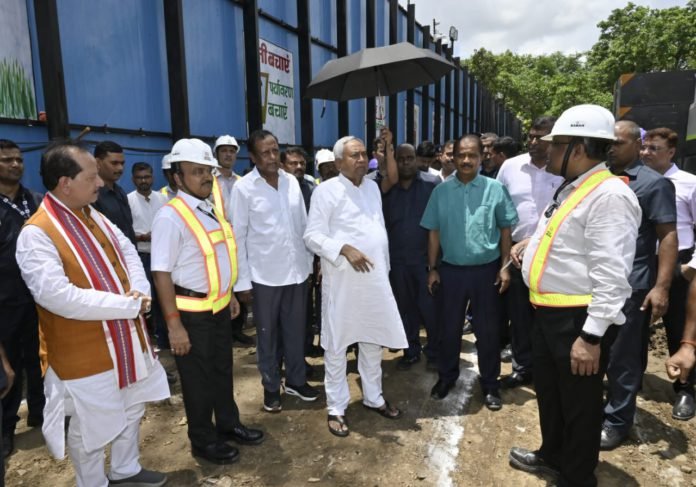
Patna (Metro Rail News): Shri Nitish Kumar, Chief Minister of Bihar conducted a comprehensive inspection of the 1.5 km pedestrian tunnel connecting the Bihar Museum and Patna Museum.
Image credit: Patna Metro
The Chief Minister reviewed the progress of the tunnel construction near Bihar Museum. The Director General of Bihar Museum, Mr Anjani Kumar Singh, provided detailed information to the Chief Minister regarding the tunnel’s entry system to Bihar Museum, parking, and other facilities for tourists.
During the inspection, the Chief Minister directed the officials to complete the tunnel construction work soon so that visitors to the Bihar Museum and Patna Museum could easily move between the two and view the exhibits.
Bihar – Patna Museums’ Tunnel
The Tunnel connecting Bihar and Patna Museum will be about 1.5km long and 8 meters wide. It will be constructed 15 meters below the ground. DMRC awarded the tunnel construction contract to Larsen & Toubro at Rs. 374.12 crore.
Bihar Museum has been developed to international standards. A large number of tourists visit both the Patna Museum and Bihar Museum. The expansion and upgradation of Patna Museum are being carried out effectively. Once the tunnel construction between Patna Museum and Bihar Museum is completed, the number of tourists will increase further.
After this, the Chief Minister also inspected the Patna Museum and its expansion work. During this time, the Chief Minister inspected the newly constructed kitchen, storage, temporary gallery auditorium, collection store, conservation lab, and the entire premises.
Image Credit: Patna Metro
During the inspection, a short film based on the upgrade and expansion work of the Patna Museum was presented before the Chief Minister in the auditorium. The Chief Minister directed the officials to carry out the upgradation and expansion work of Patna Museum efficiently and swiftly. This is an old museum housing several important archaeological and historical exhibits, and their maintenance should be enhanced through the building’s expansion. The Chief Minister also inspected the area of Patna Museum where excavation work is being done and gave necessary instructions.
Review of Patna Metro Project
Subsequently, the Chief Minister reviewed the progress of the construction work of the Patna Metro Rail project. During this period, the Chief Minister obtained information on the progress of construction work at Rajendra Nagar, Moinul Haq Stadium, Malahi Pakri, Khemnichak, Pahadi, Zero Mile Metro Station, and ISBT Metro Station. During the inspection, the Chief Minister instructed the officials to complete the construction work of the Patna Metro Rail project as per the work plan swiftly so that people could benefit from it as soon as possible. Once the metro construction work is completed, the people of Patna will have significant convenience in commuting.
Nestled in the heart of the Saurashtra peninsula, Gujarat, lies Rajkot, a city that resonates with the echoes of a rich past and thrums with the energy of a burgeoning future. Steeped in history, Rajkot boasts a legacy that stretches back centuries, while simultaneously transforming itself into a dynamic centre for trade, education, and industry.
Rajkot, the fourth largest city in Gujarat, pulsates with a vibrant blend of history, commerce, and culture. Renowned for its traditional bandhani textile industry, it is also a flourishing centre for education, healthcare, and manufacturing. However, as Rajkot’s population booms – projected to reach over 2 million by 2030 – its urban mobility landscape is facing increasing strain. This is where the much-awaited Rajkot Metro system steps in, promising to revolutionize the way residents travel within the city.
Rajkot’s Urban Mobility Landscape: A Growing Challenge
Rajkot’s current transportation system primarily relies on buses and auto-rickshaws. While these modes serve a purpose, they struggle to keep pace with the city’s rapid growth. Here’s a glimpse into the challenges:
Traffic congestion: The number of vehicles on Rajkot’s roads has surged in recent years, leading to frequent gridlocks, especially during peak hours. A 2021 survey by CEPT University found that average travel speeds during peak hours can drop as low as 5-10 km/h, significantly impacting productivity and quality of life.
Unreliable travel times: Traffic congestion translates to unpredictable travel times. Relying on buses becomes a gamble, causing frustration and impacting commutes.
Environmental concerns: Increased dependence on personal vehicles contributes to air and noise pollution. In 2023, Rajkot was ranked among the 100 most polluted cities in India. A cleaner and more efficient public transport system is crucial to address this issue.
The Need for a Metro System
The Rajkot Metro system has the potential to be a game-changer. Here’s why it’s necessary:
Reduced congestion: Metro systems offer a high passenger capacity, substantially reducing the number of vehicles on the road. This translates to smoother traffic flow and faster commutes.
Improved connectivity: A well-planned metro network can connect key areas of the city, including residential neighbourhoods, commercial hubs, and educational institutions. This enhances accessibility and promotes balanced urban development.
Environmental benefits: Metro systems are electric or use cleaner fuels, leading to reduced air and noise pollution. This will contribute to a healthier and more sustainable Rajkot.
Economic benefits: Efficient public transport fosters economic activity. Reduced travel times and improved connectivity can attract businesses and investments, creating a more dynamic urban environment.
The Rajkot Metro project is currently in its initial stages, with a Detailed Project Report (DPR) under development. While the exact route and specifications are yet to be finalized, the potential benefits are undeniable. As Rajkot gears up for its metro revolution, residents can look forward to a more efficient, sustainable, and connected future.
The Proposal
The Rajkot Metro is envisioned as a multi-line network connecting key areas of the city, including residential neighbourhoods, commercial hubs, educational institutions, and railway stations.
Potential Ridership: A ridership study conducted by the Rajkot Municipal Corporation (RMC) in 2020 estimated a daily ridership of over 500,000 passengers by 2030. This major shift towards mass rapid transit can significantly decongest roads.
Economic Benefits: The metro project is expected to generate significant economic benefits. A 2023 report by the Indian Institute of Management Ahmedabad (IIMA) predicts the metro will create over 10,000 jobs during construction and attract further investments due to improved connectivity.
Environmental Impact: Studies by the Gujarat Pollution Control Board (GPCB) show a metro system can lead to a 20-30% reduction in air pollution levels in the city.
The Rajkot Metro project is currently undergoing the Detailed Project Report (DPR) stage. While the final route and specifications are being finalized, the data and projections paint a clear picture: a metro system is not just a luxury for Rajkot, it’s a necessity for a sustainable and efficient future.
Latest Development While the Rajkot Metro project is yet to receive final approval, there have been some recent developments that signal progress: Budgetary Allocation: The Gujarat government allocated ₹100 crore ($1.2 million) in the 2024 budget for developing metro rail systems in Vadodara and Rajkot. This signifies continued government support for the project’s feasibility studies and initial planning stages. Focus on Feasibility: The Detailed Project Report (DPR) by SYSTRA MVA Consulting India, which began in September 2021, is likely still ongoing. This report will determine the project’s feasibility, including factors like route options (Metro-Lite or Metro-Neo) and ridership projections.
Possible Impacts of the Rajkot Metro
The Rajkot Metro, while still in its planning stages, promises to be a game-changer for the city’s urban landscape. Beyond the overall benefits of reduced congestion and improved connectivity, specific areas of Rajkot stand to be significantly impacted:
Emerging Business Districts: Areas like Aji Dam Road and Gondal Road, witnessing a surge in commercial activity, can benefit immensely. The Metro can provide easy access for employees and customers, fostering business growth and attracting further investments. Imagine a thriving business hub where professionals can commute efficiently, eliminating reliance on personal vehicles.
Educational Hubs: Renowned institutions like Saurashtra University and Rajkumar College will see improved accessibility for students residing in different parts of the city. This can attract students from a wider region and contribute to the vibrancy of these educational centers. Imagine students from far-flung areas reaching their universities conveniently, enhancing their educational experience.
Congested Residential Areas: Densely populated areas like Kalavad Road and Raiya Road, currently plagued by traffic congestion, can see a significant reduction in car dependence. Residents can utilize the Metro for daily commutes, leading to a quieter and more breathable environment. Imagine a neighbourhood where residents can walk or cycle for short trips, enjoying a healthier and less stressful environment.
Underdeveloped Areas: The Metro’s reach can extend to currently underdeveloped areas on the outskirts of the city. This can spur real estate development and create new job opportunities, leading to a more balanced and inclusive urban fabric. Imagine transforming peripheral areas into vibrant neighborhoods with easy access to the city center, fostering growth and opportunity.
Rajkot Railway Station: Seamless integration between the Metro and the Rajkot Railway Station can significantly improve intercity connectivity. Imagine travelers arriving at the station effortlessly connecting to the Metro for onward journeys within Rajkot. This will enhance the overall travel experience and boost tourism.
It’s important to remember that these are just a few examples. The specific impact of the Rajkot Metro will depend on the final route alignment. However, one thing is certain: the project has the potential to transform the way residents experience different areas of the city, fostering economic growth, social inclusion, and a more sustainable urban environment.
Challenges Ahead
The Rajkot Metro project, while promising significant benefits, faces several challenges and concerns that need to be addressed. Here’s a closer look at some key issues:
Land Acquisition: Building a metro network requires acquiring land for stations, depots, and corridors. This can be a complex and time-consuming process in densely populated urban areas. In Rajkot, negotiations with landowners and the potential displacement of residents could pose hurdles.
Construction Disruptions: The construction phase of a metro project can lead to disruptions in daily life. Traffic congestion might worsen around construction zones, noise pollution could be an issue, and there could be temporary disruptions to utilities like water and electricity. Mitigating these disruptions through effective planning and communication with residents is crucial.
Project Funding: The Rajkot Metro project is estimated to cost billions of rupees. Securing long-term funding from the government, private investors, or a combination of both will be essential. Delays in funding allocation could significantly impact project timelines.
Public Concerns: A 2022 survey by the Rajkot chapter of the Confederation of Indian Industry (CII) revealed that while a majority of respondents supported the Metro project, some expressed concerns about the affordability of fares. The RMC needs to address these concerns by ensuring a fare structure that is accessible to a broad range of users.
While challenges exist, proactive planning and addressing public concerns can pave the way for a successful Rajkot Metro project. Transparency throughout the process, from land acquisition to construction, is key to garnering public support. By learning from other cities’ experiences and implementing best practices, Rajkot can ensure its Metro system becomes a catalyst for sustainable urban development.
Conclusion
The Rajkot Metro project stands at a critical juncture. It presents a golden opportunity to transform the city’s mobility landscape, fostering economic growth, environmental sustainability, and improved quality of life for residents. While challenges like land acquisition and funding need to be addressed effectively, the potential benefits are undeniable. As Rajkot embraces its future, the decisions made today regarding the Metro project will have a lasting impact. With careful planning, transparency, and a commitment to public engagement, Rajkot can usher in a new era of efficient, sustainable, and connected urban mobility.
Straddling the Coromandel Coast of the Bay of Bengal, Chennai, the capital of Tamil Nadu is a city steeped in history and brimming with opportunity. Often referred to as the “Gateway to South India,” Chennai serves as a vital link for trade and commerce, not just regionally, but on a global scale. Its bustling port facilitates international trade, while its well-developed infrastructure attracts major corporations, particularly in the automobile industry, earning it the moniker “Detroit of India.” Chennai is also a hub for healthcare and education, boasting world-class medical facilities and prestigious universities.
This dynamic metropolis is home to over 8.7 million people, making it the sixth-largest city in India. Chennai’s significant population fuels a thriving economy, placing it among the top ten in the country. With its large talent pool, robust infrastructure, and strategic location, Chennai is a major contributor to India’s economic growth. However, managing the movement of such a vast population within the city limits presents a significant challenge.
To ensure the smooth flow of people and goods, Chennai boasts a multi-modal transportation network. Buses form the backbone of public transport, offering extensive coverage throughout the city. The relatively new Chennai Metro, with its growing network of underground and elevated lines, provides a fast and comfortable travel option. Suburban railways, meanwhile, efficiently connect Chennai with its neighboring areas.
However, managing increasing traffic congestion and ensuring efficient intra-city travel necessitates a robust and reliable rapid transit system. This is where the Chennai Mass Rapid Transit System, or MRTS, steps in. In the next section, we’ll delve into the MRTS, its history, functionalities, and its significance in keeping Chennai, and its economy, on the move.
Need of MRTS
Chennai’s economic boom, coupled with its ever-expanding population, placed immense strain on the city’s existing transportation infrastructure. Chennai’s burgeoning population and economic prosperity in the latter half of the 20th century presented a significant challenge: a transportation system on the verge of collapse. Here’s a breakdown of the specific needs that necessitated the creation of the Chennai MRTS:
Soaring Population: Between 1971 and 1991, Chennai’s population witnessed a staggering increase of over 60%, ballooning from 4.2 million to nearly 6.7 million. This rapid growth resulted in a surge in travel demand, putting immense pressure on existing infrastructure.
Traffic Congestion and Gridlock: As the number of vehicles on the road multiplied, so did traffic congestion. A 1979 study by Rail India Technical and Economic Services (RITES) revealed a nightmarish reality: the average traffic speed in Chennai had plummeted to a measly 10 kilometers per hour. This gridlock translated into longer commutes, reduced productivity, and frustration for residents.
Economic Impact: The crippling traffic congestion started to impede Chennai’s economic potential. Businesses faced logistical hurdles due to unreliable travel times, and the city’s attractiveness as an investment destination began to wane.
Environmental Concerns: Traffic congestion also led to a rise in air pollution. With vehicles stuck in traffic for extended periods, exhaust fumes accumulated, posing a serious health risk to residents.
Inadequacy of Existing Transport System: While Chennai had a well-established bus network, it was struggling to cope with the ever-increasing demand. Buses often became overcrowded and unreliable, leading to long wait times and frustration for commuters.
The need for the Chennai MRTS arose from the urgent requirement for a high-capacity, rapid transit system that could alleviate traffic congestion, improve travel times, and promote sustainable urban mobility for Chennai’s burgeoning population and thriving economy. Recognising the urgent need for a rapid transit solution, planners in Chennai looked towards successful metro systems in other major cities around the world. Cities like London, Tokyo, and Paris served as models, demonstrating the efficiency and capacity of rapid rail networks in managing large-scale urban mobility.
Proposal
In 1983, the Madras Metropolitan Development Authority (MMDA), then known as the Madras Metropolitan Development Board (MMDB), submitted a proposal to the Government of India for the construction of a Mass Rapid Transit System (MRTS) in Chennai. The proposed system envisioned a network of elevated railway lines, designed to decongest city roads and provide a faster, more reliable mode of public transportation.
To streamline the transportation system in Chennai, several studies were conducted, including the Madras Area Transportation Study in 1968, the Integrated Transport Plan in 1977, and the Madras Route Rationalisation Study in 1986. These studies identified key transportation routes, one of which is the rail line from Kasturba Nagar to Manali Road. They recommended building a rail-based Mass Rapid Transit System (MRTS) along the Buckingham Canal, connecting to the existing suburban rail network. The proposed MRTS would be a 59.38 km (36.90 mi) loop line linking Chennai Beach and Tiruvottiyur.
The MRTS proposal underwent a thorough evaluation process by the central government. Financial feasibility, route alignment, and environmental impact were all meticulously assessed. After several years of deliberation, the project finally received approval in 1990. Following the approval from the government, construction of the Chennai MRTS commenced in 1995. The project was a mammoth undertaking, involving the creation of elevated railway corridors, stations, and the acquisition of rolling stock. The first phase of the MRTS, connecting Beach and Washermanpet, was inaugurated in 2002, marking a significant milestone in Chennai’s transportation history.
Lines
The Chennai Mass Rapid Transit System (MRTS) serves as a critical artery for intra-city travel, offering a fast and convenient alternative to congested roads. Currently, a single 19.34-kilometer elevated line stretches from Chennai Beach Station in the north to Velachery in the south.
Key Coverage Areas:
The MRTS connects major hubs like Chennai Fort, Park Town (opposite Chennai Central Station), and Guindy (near IIT Madras).
It serves popular destinations like Marina Beach (Chepauk), Egmore (Light House), and the Chennai Trade Centre (Samayapuram).
Stations like Perambur and Pallavaram provide access to nearby industrial areas.
The line caters to residential areas like Triplicane, Thiruvallikeni,Taramani, and Velachery.
The Chennai MRTS, with its strategically placed stations, offers efficient and sustainable urban mobility for a significant portion of Chennai’s population.
Key Extension Plans The Chennai MRTS, while crucial for the city’s transportation network, currently faces limitations due to its single operational line. However, there are promising plans for extension in motion:
Velachery to St. Thomas Mount: This extension, under construction as of June 2024, is a much-anticipated project. It will extend the MRTS line by 5 kilometers southward, connecting it with the Chennai Suburban Railway network and the Chennai Metro at St. Thomas Mount station. This critical link is expected to:
Improve connectivity between the MRTS and other major transportation systems in the city.
Facilitate easier access to workplaces and educational institutions located near St. Thomas Mount.
Potentially boost ridership on the MRTS by catering to a wider catchment area.
Further Extensions
Discussions and proposals for further extensions beyond St. Thomas Mount exist. Here are two possibilities:
Velachery to Tambaram: The Chennai Metro Rail Limited (CMRL) is exploring the feasibility of extending the MRTS from Velachery towards Tambaram. This extension, with potential endpoints at either Guindy or Little Mount stations, could add another 8-10 kilometers to the network. It would cater to the densely populated areas and commercial hubs along the corridor.
In a move to bolster Chennai’s public transport network, Chennai Metro Rail Limited (CMRL) has joined forces with SYSTRA MVA Consulting (India) Pvt. Ltd. This collaboration focuses on reassessing the feasibility of a Mass Rapid Transit System (MRTS) connecting Tambaram and Velachery, a 26-kilometer stretch. The project also explores the possibility of extending the line further, with Guindy and Little Mount stations identified as potential endpoints.
Beach Station to Thiruvottiyur: This northward extension, while not in concrete stages of planning, has been floated as a potential future project. It could significantly expand the MRTS’s reach, serving the northern parts of the city with limited rapid transit options.
Ridership of the Chennai MRTS
The ridership of the Chennai MRTS has fluctuated over the years, reflecting factors like infrastructure development, competition from other modes of transport, and economic conditions. Here’s a breakdown of the ridership picture:
Early Days (2002-2010): Following its inauguration in 2002, the MRTS witnessed a steady rise in ridership, reaching approximately 1 lakh (100,000) commuters daily by 2010. This initial growth indicated the public’s demand for a rapid transit solution.
Impact of Metro (2010 onwards): The arrival of the Chennai Metro in 2010 presented some challenges for the MRTS. The Metro’s modern infrastructure, wider network coverage, and competitive fares attracted a portion of the ridership.
Pre-Pandemic Levels (2019): Despite the competition, the MRTS ridership continued to grow, reaching an estimated pre-pandemic daily average of around 1.16 lakh (116,000) commuters. This indicated the system’s continued relevance for specific travel corridors.
COVID-19 Impact (2020-Present): The global pandemic significantly impacted public transportation use. The MRTS ridership saw a sharp decline, dropping to an average of around 14,798 daily commuters in September 2020.
Recovery and Integration Efforts (2023-Present): As of 2023, ridership figures suggest a gradual recovery, with estimates reaching around 0.25 million (250,000) daily commuters. Additionally, there are ongoing talks about the potential integration of the MRTS with the Chennai Metro, which could further streamline ticketing and improve connectivity for passengers.
While the ridership of the Chennai MRTS has faced challenges, it remains a vital transportation link for many residents. The system’s future looks promising, with potential integration with the metro and ongoing efforts to modernize its infrastructure.
The Chennai MRTS Takeover by CMRL
The Chennai MRTS, currently operated by Southern Railway, faces limitations as a standalone system. However, a potential takeover by the Chennai Metro Rail Limited (CMRL) has emerged as a promising development for the city’s public transport network. Let’s delve into the current conditions, the rationale behind the takeover, its progress, and the potential benefits.
Current Conditions:
Limited Network: The Chennai MRTS boasts a single operational line spanning 19.34 kilometers. While crucial, it fails to provide comprehensive coverage across the city.
Ridership Fluctuations: The ridership on the MRTS has fluctuated over the years, impacted by factors like the emergence of the Chennai Metro and the COVID-19 pandemic. As of 2023, estimates suggest a daily ridership of around 0.25 million (250,000) commuters.
Integration Challenges: The lack of seamless integration between the MRTS and the Chennai Metro can pose an inconvenience for commuters relying on inter-system transfers.
Why a Takeover?
Network Expansion: A CMRL takeover could pave the way for the much-needed expansion of the MRTS network. Plans for extensions like Velachery to St. Thomas Mount and beyond are already underway under CMRL’s purview.
Improved Integration: A unified system under CMRL could lead to better integration between the MRTS and the Chennai Metro. This would translate to smoother inter-system transfers and a more convenient experience for passengers.
Standardization and Efficiency: A single operator could potentially streamline operations, maintenance procedures, and ticketing systems, leading to improved overall efficiency.
Increased Ridership: A more extensive and better-integrated network, coupled with potentially standardized fares, could attract more riders, boosting ridership figures for both the MRTS and the Metro.
How is the Takeover Being Processed?
In-Principle Approval (2022): In a significant development, Southern Railway granted in-principle approval for CMRL to take over the MRTS in May 2022.
Detailed Discussions: Following the initial approval, detailed discussions between Southern Railway, CMRL, and the Government of Tamil Nadu are underway to iron out the complexities of the handover process, including aspects like staffing, infrastructure transfer, and financial agreements.
Objectives of the Takeover:
Creating a Unified Rapid Transit Network: The primary objective is to establish a unified rapid transit network in Chennai, offering seamless connectivity across the city.
Boosting Public Transport Ridership: The takeover aims to incentivise public transport usage by providing a more efficient and user-friendly network.
Enhancing Urban Mobility: A unified system could significantly improve intra-city travel, potentially reducing traffic congestion and air pollution.
Latest Update Chennai Metro Rail Limited (CMRL) has taken a proactive step towards improving the Chennai MRTS system. Officials have begun a comprehensive inspection of MRTS stations to identify areas for upgrade and potential new amenities. This initiative signifies CMRL’s commitment to enhancing the passenger experience on the entire rapid transit network of the city. The proposal has been sent to the Railway Board for its in-principle approval on which a decision is expected by July 2024.
Challenges Ahead
The Chennai MRTS, despite its role as a crucial artery for intra-city travel, faces several challenges that need to be addressed to ensure its continued success and integration into a broader public transport network. Here’s a closer look at some of the key hurdles:
Limited Network and Coverage:
Single Line: Currently, the MRTS operates on a single 19.34-kilometer elevated line. This restricts its reach and leaves significant portions of the city without access to rapid transit.
Population Growth: Chennai’s population is projected to continue growing, placing a strain on the existing MRTS capacity and highlighting the need for expansion.
Integration Challenges:
Ticketing Discrepancies: Separate ticketing systems between the MRTS and the Chennai Metro can be inconvenient for commuters who rely on inter-system transfers.
Limited Connectivity: The lack of physical connections between some MRTS and Metro stations necessitates longer walking distances or additional modes of transport for transfers, creating a less seamless experience.
Ridership Fluctuations:
Pre-Pandemic Decline: Even before the COVID-19 pandemic, ridership on the MRTS witnessed a decline following the introduction of the Chennai Metro in 2010.
Post-Pandemic Recovery: The pandemic significantly impacted public transport use, and the MRTS is still in the midst of recovering its ridership numbers. Factors like competition from other modes of transport and potential fare structures need to be addressed to incentivize ridership growth.
Infrastructure Upgradation:
Ageing Infrastructure: The initial phase of the MRTS was constructed in the late 1990s. Regular maintenance and potential upgrades might be necessary to ensure the system’s long-term safety and reliability.
Station Amenities: Some MRTS stations might benefit from improved passenger amenities like better lighting, enhanced signage, and accessibility features for differently-abled commuters.
Funding and Project Completion:
Securing Funds: The expansion of the MRTS network, including the ongoing Velachery-St. Thomas Mount extension and proposed further extensions require significant funding. Public-private partnerships or central government support might be crucial.
Project Delays: Land acquisition and bureaucratic hurdles can lead to delays in project completion, impacting the timeline for expanding the network and improving connectivity.
Benchmarking the Chennai MRTS: A Roadmap for Continued Success
As a policymaker, fostering a robust and efficient public transport network is paramount. The Chennai Mass Rapid Transit System (MRTS) stands as a significant player in this arena. Let’s delve into a comparative analysis of the Chennai MRTS with its counterparts in other Indian cities, highlighting its strengths and charting a course for its continued success.
Strengths of the Chennai MRTS:
Pioneering Spirit: The Chennai MRTS holds the distinction of being the first elevated railway line in India, opening its doors in 1995. This pioneering spirit translates into a valuable experience for future expansion projects. The lessons learned from construction, operational challenges, and ridership patterns can inform the development of new corridors and stations, ensuring optimal efficiency from the get-go.
Focus on Intra-City Travel: Unlike some MRTS systems in other cities that handle both intercity and intracity commutes, the Chennai MRTS is dedicated to serving intra-city needs. This targeted approach allows for a laser focus on the specific requirements of Chennai’s urban landscape. Station placement can be optimized to cater to high-density residential areas, commercial hubs, and educational institutions, maximizing ridership potential within the city limits.
Planned Integration with Suburban Railways: The strategic extension of the MRTS to St. Thomas Mount, currently under construction, will provide a crucial link to the Chennai Suburban Railway network. This seamless transfer will benefit a wider range of commuters. Passengers travelling from suburban areas will have a convenient option to connect with the MRTS for faster intra-city travel, reducing reliance on congested roads.
Learning from Other Systems:
Network Reach: While the Chennai MRTS serves a vital role, its network pales in comparison to the expansive MRTS systems in cities like Delhi and Hyderabad. Studying their route planning and ridership patterns can offer valuable insights for future expansion plans in Chennai. Analyzing data on high-demand corridors, population density projections, and potential ridership hotspots can inform the prioritization of future extensions, ensuring the network caters to areas with the greatest need.
Multi-modal Integration: Cities like Bangalore showcase the power of successful integration between their MRTS and other modes of public transport like buses and auto-rickshaws. Implementing similar strategies in Chennai can create a more user-friendly network. A well-coordinated system with efficient first and last-mile connectivity options, like feeder buses and designated pick-up/drop-off zones for auto-rickshaws, will encourage ridership by offering a seamless travel experience.
Public-Private Partnerships (PPPs): Several Indian MRTS projects leverage PPPs to accelerate development. Chennai can explore similar models to attract private investment for network expansion and modernization initiatives. Partnering with private entities can inject much-needed capital into the system, enabling faster completion of expansion projects and potentially leading to the adoption of innovative technologies for improved passenger experience.
Capitalising on Strengths and Charting a Course for the Future:
Strategic Expansion: The Chennai MRTS can adopt a phased expansion approach, prioritizing high-demand corridors based on ridership projections and population density data. The proposed Velachery-Tambaram extension serves as a prime example of this strategy. By focusing on areas with the greatest need for rapid transit, the expansion can maximize ridership potential and contribute to decongesting Chennai’s busy roads.
Benchmarking for Efficiency: Regularly benchmarking operations against other successful MRTS systems can help identify areas for improvement in the Chennai MRTS. This could involve aspects like ticketing systems, train frequency optimization based on peak hours, and station maintenance protocols. Streamlining operations will enhance passenger experience by reducing wait times, improving reliability, and ensuring a clean and well-maintained environment within stations.
Integration with Upcoming Projects: Chennai’s upcoming Metro expansion plans present a golden opportunity for strategic integration. By creating a comprehensive rapid transit network with seamless transfers and wider connectivity, both the MRTS and the Metro can witness a significant boost in ridership. Collaborative planning that ensures efficient interchange stations and integrates ticketing systems will incentivize passengers to utilize both systems for their travel needs.
Technology Adoption: Embracing advancements in technology can position the Chennai MRTS at the forefront of Indian rapid transit systems. Implementing smart ticketing systems with contactless payment options will enhance convenience for passengers. Real-time information displays at stations and within trains will improve passenger experience by providing accurate arrival and departure times. Long-term, exploring the potential of autonomous train operations, while ensuring safety protocols are rigorously met, could further optimize efficiency and reduce operational costs.
Conclusion
The Chennai MRTS, despite its current limitations, serves as a vital artery for intra-city travel in the bustling metropolis. By building on its strengths, embracing strategic expansion plans, and fostering integration with the Chennai Metro, the MRTS can evolve into a more robust, user-friendly, and sustainable rapid transit system.
The recent developments, like CMRL’s inspection of MRTS stations and the proposed takeover, signal a commitment to revitalizing the system. By prioritizing strategic expansion based on ridership data, benchmarking operations for efficiency, and embracing technological advancements like smart ticketing and real-time information displays, the Chennai MRTS can cater to the growing needs of Chennai’s population. Furthermore, seamless integration with the Chennai Metro will create a comprehensive rapid transit network, encouraging public transport use and fostering a more sustainable urban environment. The future of the Chennai MRTS is bright, with the potential to become a model for efficient and user-friendly rapid transit in India.
Bhubaneswar Metro (The image is for representation only.)
Bhubaneswar (Metro Rail News): Delhi Metro Rail Corporation (DMRC) declared SYSTRA MVA Consulting (India) as the preferred bidder for the Detailed Designed Consultant contract of the Bhubaneswar Metro Phase 1 project, Package BCDD-01.
Under package BCDD-01, the appointed contractor will be responsible for drafting a design standard for two precast elements, which include U-girders and pier caps, and bearing for Bhubaneswar Metro’s Line 1. This line runs 26.04 km from Biju Patnaik Airport to Trishulla Square via an elevated section comprising 20 stations.
Route Map
Bidding Process
In May 2024, DMRC floated the tender for the DDC contract at an estimated cost of 97.02 lakh, with a 36-month deadline. When DMRC opened the technical bids on June 4, SYSTRA was identified as the sole bidder of this consultant contract.
However, SYSTRA’s bid, Rs.1.042 crore, exceeded DMRC’s budget by 7.40%. After negotiating with DMRC, SYSTRA placed a revised bid of Rs 1.012 crore, which was later accepted by DMRC’s tender committee. This indicates that the contract will likely be awarded to SYSTRA in the coming days.
The viaduct construction for Bhubaneswar Metro’s Line 1 will be carried out through three packages: BBC-03, BBC-04, and BBC-05.
Bhubaneswar Metro Project
Bhubaneswar Metro Phase 1 features Line 1, which spans 26.024km and has 20 elevated stations. The Odisha government approved Line 1 on November 14, 2023, at Rs. 5926.38 crore. Additionally, DMRC is serving as the turn-key consultant for Bhubaneswar Metro. This ambitious project has a four-year deadline and aims to provide an efficient and viable mode of transport to the city’s residents.