New Delhi: Prime Minister Narendra Modi has flagged-off the Delhi-Faridabad Metro Line that would allow hassle free travel for around two lakh daily commuters between the national capital and the industrial hub in Haryana.
The extension of the Delhi Metro connects Badarpur to Escorts Mujesar in Faridabad.
The total cost of the project from Badarpur to Escorts Mujesar is nearly Rs. 2,500 crore. Out of this, Rs. 1,557 crore was borne by the Haryana Government, the Centre contributed Rs. 537 crore, while the Delhi Metro provided Rs. 400 crore.
All these are elevated and located on either side of the Delhi-Mathura Road (NH-2).
“The nine-station metro corridor which was 95 per cent indigenously built will provide people a safe, affordable, quick, comfortable, reliable, environment-friendly and sustainable transport facility,” a Haryana government spokesperson said.
Haryana Chief Minister ML Khattar, addressing a press conference on Saturday, had thanked the Prime Minister for “gifting” the Metro service which would take the city to “another level of progress” with better connectivity with other NCR towns.
He had also said that the Prime Minister would be announcing the go-ahead for connecting Gurgaon with Faridabad by Metro.
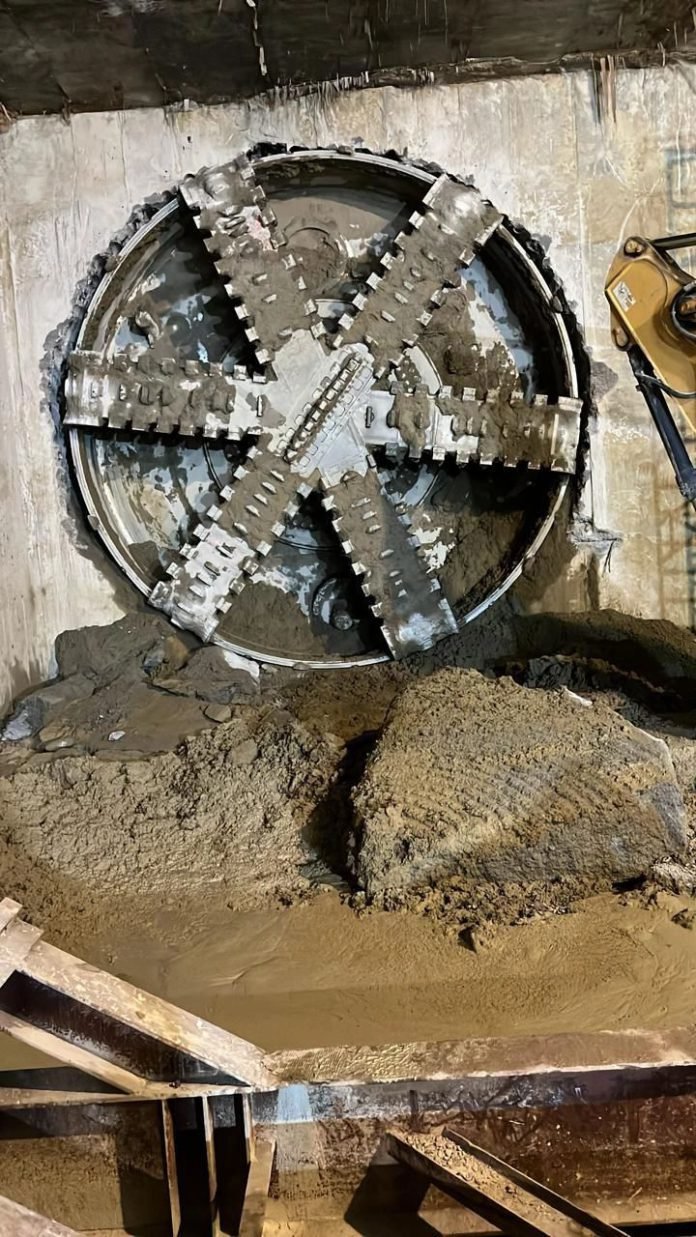
Agra (Metro Rail News): On 4th August 2024, the Agra Metro project reached another milestone as the Tunnel boring machine S115 achieved a breakthrough at Raja Ki Mandi Station for the Agra Metro Phase 1 project’s 14.25 km Line-1 which connects Sikandra and Taj East Gate.
For its second assignment, TBM S115 constructed a 684m tunnel from RBS college station to Raja ki mandi station in just 68 days.
Table of Contents
TBM S115’s Journey
This is TBM S115’s second breakthrough following the one which was recorded at RBS College Station. This is also the fourth breakthrough for the remaining part of Agra Metro Line-1’s underground Section, between RBS Ramp and Mankameshwar Mandir Station.
In total, this is the 12th breakthrough for Package AGCC-02 which spans 7.93 km and connects the RBS Ramp with the Taj Mahal Ramp.
First Assignment
TBM S115 was first deployed in December 2023 to carry out the construction of a 2.2 km tunnel for the up-line from RBS College Ramp towards Agra College Interchange Station.
For its first assignment, TBM S115 incredibly constructed a tunnel of approximately 720-metre length for the up-line from RBS Ramp to RBS College Station.
Package AGCC-02
Afcons – Sam India Consortium secured underground Package AGCC-02 from Uttar Pradesh Metro Rail Corporation (UPMRC) at Rs. 1819.79 crore in March 2022 with a 48-month deadline.
Upcoming Developments
For its final assignment, TBM S115 will construct about 535 meter 535-meter-long tunnel towards Agra College Station.
Bhubaneswar Metro (The image is for representation only.)
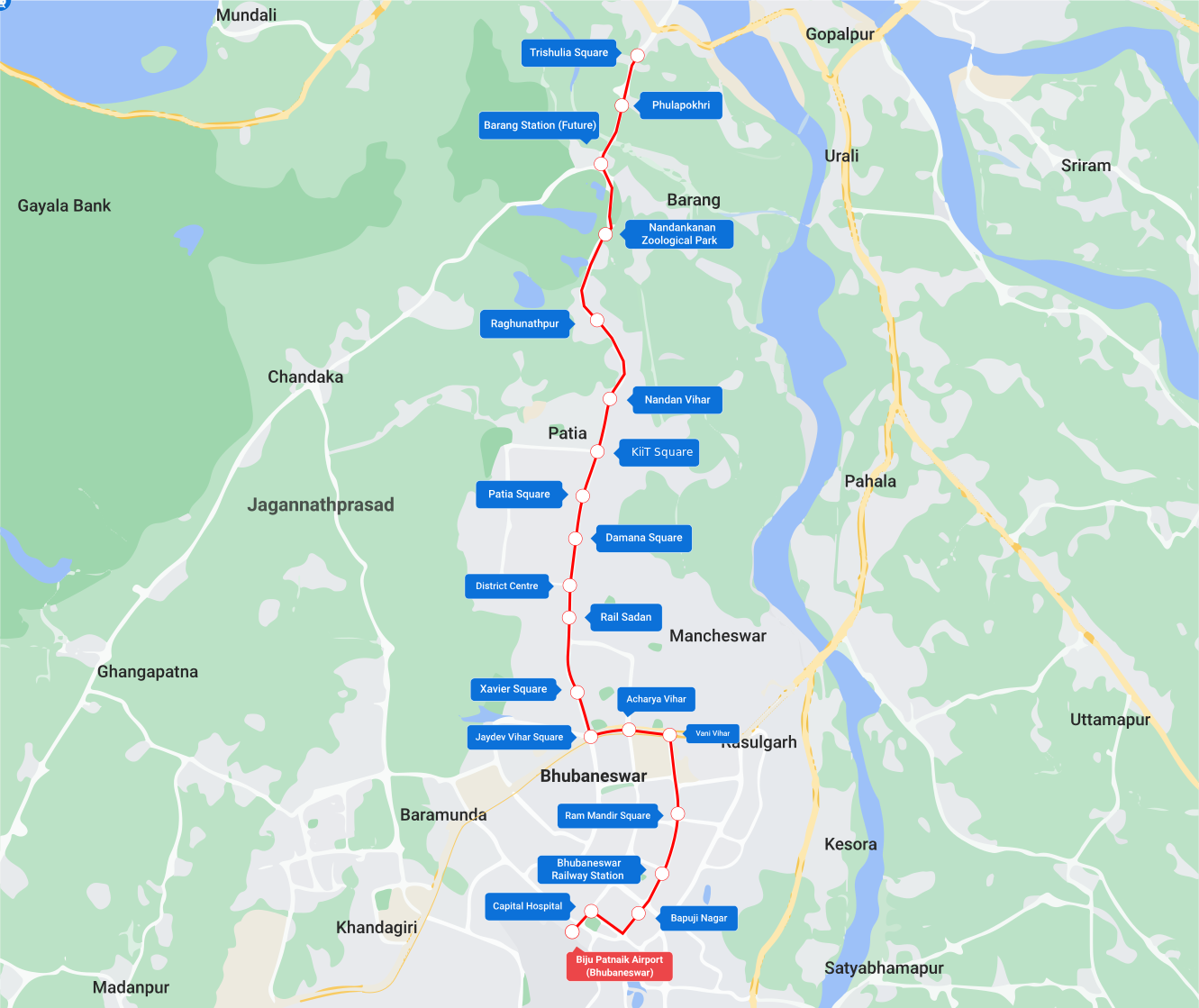
Bhubaneswar (Metro Rail News): Ranjit Buildcon Ltd (RBL) has emerged as the lowest bidder to construct Package BBC-04 of Bhubaneswar Metro’s Phase 1 project which will connect Trisulia Square – Biju Patnaik Airport via 20 elevated stations.
Table of Contents
Package BBC -04
Package BBC-04 is 7.27km long and it is located in the middle of Bhubaneswar Metro’s 26km Line -1. The package includes 7 elevated stations linking Jaydev Vihar Square to KIIT Square.
Bidding Process
In March 2024, the Delhi Metro Rail Corporation (DMRC) invited bids for the construction of the project (package BBC-04), estimated at Rs. 664.06 crore with a 36-month completion deadline. On June 19, the technical bids were opened, and all 11 bidders passed the technical evaluation.
Following are the financial bids for the package BBC-04:
Ranjit Buildcon’s bid of Rs. 625.62 crore was quite lower than DMRC’s estimate of Rs. 664.06 crore, indicating that the contract should be awarded soon without an extended financial bid evaluation period.
Scope of work:
Under Package BBC-04, the appointed contractor will be responsible for designing and constructing the elevated viaduct and seven elevated stations at the following locations except the architectural structures. The stations are as follows:
Jaydev Vihar square
Xavier Square
Rail Sadan
District Centre
Damana Square
Patai square
KIIT square
Following are the Bhubaneswar Metro’s 3 Civil Packages & their Lowest Bidders:
Bhubaneswar Metro (The image is for representation only.)
Bhubaneswar (Metro Rail News): On 5 August, Ceigall India Ltd. emerged as the lowest bidder to carry out the construction of Package BBC-05 of the Bhubaneswar Metro Phase 1 project.
Among the 3 civil packages of Bhubaneswar Metro, BBC-05 stands as the longest package. Falling on the northern end of Line, this package spans 10.97 km linking KIIT Square and Trisulia Square via 6 elevated stations.
Bidding Process
Delhi Metro Rail Corporation issued the tender for package BBC-05 in March 2024 at an estimated cost of Rs. 869.71 crore with a 3-year deadline. On 19 June technical bids were opened in which 10 bidders were identified.
The appointed contractor for this package will be responsible for the design and construction of the Elevated Viaduct and six Elevated Stations as part of the Bhubaneswar Metro Phase-I MRTS project. The stations, excluding architectural finishing, are strategically located at:
Nandan Vihar
Raghunathpur
Nandankanan Zoological Park
Barang Station
Phulapokhari
Trisulia Square
The scope of work also includes the construction of a ramp for the depot entry.
Other Civil Contracts
Recently, Ranjit Buildcon became the lowest bidder for package BBC-03. Now only Package BBC-04’s bids are yet to be opened.
Bhubaneswar Metro Phase 1
Phase 1 of the Bhubaneswar Metro features 1 corridor that will connect Trisulia Square and Biju Patnaik Airport through 20 elevated stations.
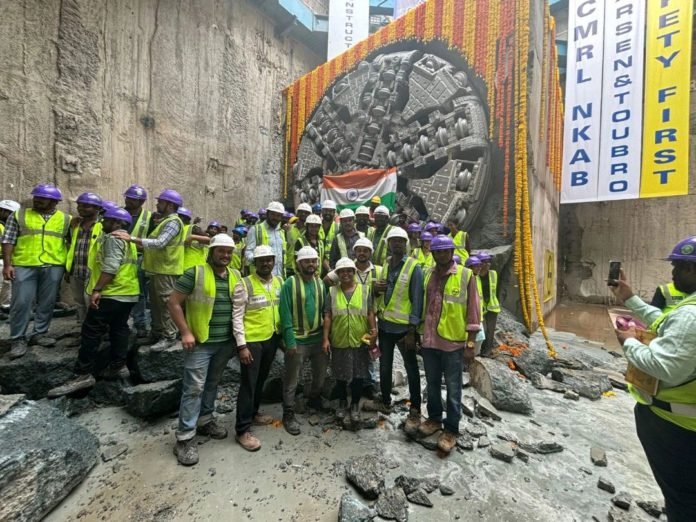
Chennai (Metro Rail News): On 5 August, the Chennai Metro Phase 2 project achieved a milestone as the Tunnel Boring Machine (TBM) Siruvani reached its first breakthrough at Sterling Road Station. This achievement occurred in Corridor 3, which extends 45.4 kilometres from Madhavaram Milk Colony to Siruseri Sipcot.
TBM DZ1040, nicknamed Siruvani, achieved this milestone under package TU-02. This package encompasses a 12-km stretch linking Kellys and Taramani Road Junction.
Image Credit: Satish
Larsen & Toubro deployed the TBM Siruvani at Chetpet Station in September 2023 for its initial assignment. Over the course of its operation, the TBM excavated approximately 703 meters of tunnel, reaching Sterling Station on August 5. This drive also successfully included the crossing of 51 meters beneath the Cooum River, overcoming an overburden of 8.0 meters.
Image credit: Tunnel India
TBM Siruvani was the third of seven TBMs to be deployed to construct approximately 12 km of twin tunnels, totalling 24 km, between Kellys and Taramani Road Junction stations.
Package TU-02
In May 2021, Larsen & Toubro was awarded Package TU-02 by Chennai Metro Rail Ltd. (CMRL) for ₹2,385 crore, with a completion deadline of 42 months. This package involves constructing twin tunnels between Kellys and Taramani Road Junction, as well as diaphragm walls and entry/exit structures for Chetpet Station, Royapettah Government Hospital Station, Thiruvanmiyur Station, and a portion of the diaphragm wall for Greenways Road Station. It also includes the construction of launching and retrieval shafts at these stations.
Chennai Metro’s Line 3
Corridor 3 (Purple Line) of the Chennai Metro Rail Limited (CMRL) extends from Madhavaram Milk Colony to Siruseri Sipcot, covering a distance of 45.4 kilometres. This corridor features 28 underground stations and 19 elevated stations.
The project is part of CMRL’s extensive infrastructure development plan, supported by funding from multinational agencies, including JICA, ADB, AIIB, and NDB.
Mumbai (Metro Rail News): Mumbai Metro Rail Corporation Ltd. has issued a tender for the geotechnical soil investigation along the 18 km Mumbai Metro Line 11 (Green Line), which will connect Anik Bus Depot to SPM Chowk through 15 underground stations.
Additionally, MMRC has recently invited bids for an underground utility survey for the new alignment of Line 11. This line will be the third line after Line 3 (Aqua Line) and Line 7 (Red Line).
Table of Contents
Core Objective Behind The Geotechnical Investigation;
This geotechnical study aims to gather essential data on the sub-soil conditions of the site. This information will assist contractors in developing an appropriate detailed design for the structures and selecting suitable machinery, methods, and technologies for construction.
Additionally, the study will help mitigate potential damage to existing structures during the construction process.
As per the terms and conditions of the tender, boreholes with a diameter of 150 mm will be drilled at regular intervals of 500 meters along the twin tunnel alignment. Additionally, 3 boreholes will be drilled at each station site. According to the basic consultant plan, the depth of these boreholes will range from 10 meters to over 20 meters.
Tender’s Description;
Contract Duration: 90 days (3 months)
Submission Deadline: August 21, 2024
Technical Bid Opening: August 22, 2024
In the new alignment map of Green Line, MMRC has referred to the Coal Bunder Station as Darukhana Station.
Stations on Mumbai Metro’s LINE 11
Anik Bus Depot
Wadala Depot
CGS Colony
Ganesh Nagar
BPT Hospital
Sewri, Hay Bunder
Coal Bunder (Darukhana)
Reay Road
Byculla
Nagpada Junction
Bhendi Bazaar
Crawford Market
CSMT Metro (interchange with Aqua Line)
Horniman Circle
SPM Circle.
The report of the geotechnical survey will incorporate the following elements:
Borehole details and locations with georeferenced coordinates
Geological characteristics of the area
Water table levels
Results of conducted tests
Foundation recommendations based on borehole data
Cut off values
Bearing capacities of Soil
Seismicity of the soil
The Green Line includes Line 4, Line 4A, Line 10, and Line 11. It connects Shivaji Chowk (Mira Road) to Gaimukh, Kasarvadavali, Wadala, and CST, covering 48 stations along the route.
The Green Line is being developed in four sections:
Line 4: Bhakti Park (Wadala) to Kasarvadavali
Length: 32.32 km
Line 4A: Kasarvadavali to Gaimukh
Length: 2.88 km
Line 10: Gaimukh to Shivaji Chowk
Length: 9.209 km
Line 11: Anik Bus Depot to SPM Chowk
Length: 18 km
The Mumbai Metropolitan Region Development Authority (MMRDA) is overseeing the development of the Green Line. The first section of the Green Line opened in 2023 and connects with other metro lines, bus services, and suburban rail services through multiple interchanges along its route.
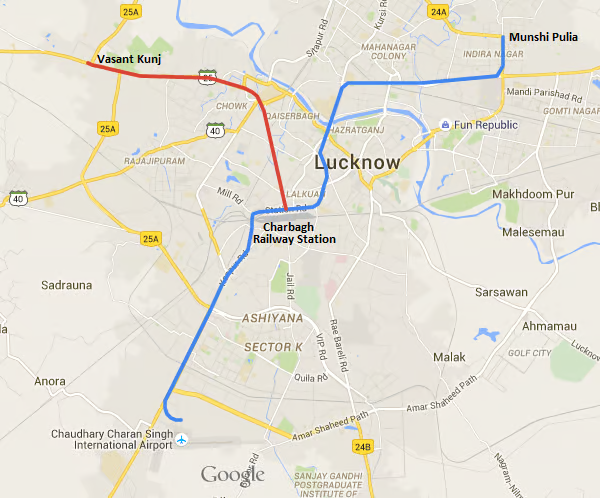
Lucknow (Metro Rail News): Uttar Pradesh Metro Rail Corporation (UPMRC) has invited bids to conduct a comprehensive topographical survey for the 11.165 km long Lucknow Metro Phase 1B project (Line 2). This Line will connect Charbagh Railway Station and Vasant Kunj with 12 stations.
Table of Contents
Package LKTS-01
Package LKTS-01 is the initial contract proposed for the development of Lucknow Metro’s East-West Corridor (Line-2). It will traverse through Old Lucknow.
Lucknow Metro’s Phase 1B
In 2024, the UP government approved the construction of Lucknow Metro’s Phase 1B at an estimated cost of Rs. 5801.05 crore. However, Lucknow Metro’s Phase 1B has not been approved by the Central Government’s Public Investment Board (PIB) within the Finance Ministry.
East-West corridor
According to the updated Detailed Project Report (DPR) for Phase 1B, the new line (East-West Corridor) will have a total length of 11.165 km. Of this, 4.286 km will be elevated and include 5 stations, while the remaining 6.879 km will be developed underground, with 7 stations.
Details of the tender
The Estimated Cost for the contract is Rs 24.32 lakhs.
The Contract Duration is 3 months. The Pre-bid Meeting will take place on August 6, 2024.
The deadline for the Bid Submission is August 27, 2024.
The Technical Bid Opening will take place on August 28, 2024.
Scope of Work
The work under this contract includes a Detailed Topographical Survey of the Lucknow Metro’s East-West Corridor (from Charbagh to Vasantkunj), encompassing the depot at Hardoi Road. It also involves the Alignment Design for the Main Line and Depot entry-exit line for the Lucknow Metro Rail Project Phase 1B.
Future Prospects
As the next step in the development of Line 2, UPMRC will commence the bidding process for geotechnical work along the East-West Corridor. The purpose of these studies is to obtain essential data needed to develop a detailed design for the structures and to select the appropriate machinery, methods, and technologies for construction.
Mumbai (Metro Rail News): In July, the Mumbai Metropolitan Region Development Authority (MMRDA) awarded Colossus Infra Projects Pvt. Ltd. a Rs. 33 crore contract for executing the electrical and mechanical work at 5 stations of the Yellow Line (Line 2B) of the Mumbai Metro project. The contract was awarded under the package CA-249.
Table of Contents
The work will be executed at the following stations:
Diamond Nagar
Shivaji-Chowk
BSNL
Mankhurd
Mandale
The construction of these stations is being carried out under (Package CA-07) by NCC Ltd.
Bidding process
In February, the Mumbai Metropolitan Region Development Authority (MMRDA) issued a tender inviting bids for the Electrical and Mechanical (E&M) work of Line 2B, with an estimated cost of ₹30.04 crore and a deadline of 2.7 years.
After opening the technical bids on 31 May, MMRDA identified 2 bidders. Subsequently, on 18 June, financial bids were opened, and Colossus emerged as the lowest bidder for this contract.
The financial bids of bidders are the following:
Firm
Bid price
Colossus
35.60 crore
Jakson
37.99 crore
Scope of work
Under this contract, Colossus will be responsible for the design, manufacture, supply, testing, commissioning, and training of personnel, along with a 2-year Defect Liability Period (DLP) for the Electrical and Mechanical (E&M) works on Line 2B of the Mumbai Metro Rail Project, which runs from Mandale to Diamond Garden.
The bid placed by Colossus was approximately 18.50% higher than the anticipated budget of ₹30.04 crores set by MMRDA. After negotiations, MMRDA issued a Letter of Acceptance for a final contract value of ₹33.95 crore.
Mumbai Metro Line 2B
Line 2B covers a total distance of 23.649 km with 22 elevated stations. It connects D.N. Nagar to Mandale via BKC. The Mandale–Diamond Garden section, which includes 5 stations, will be the first segment to become operational on this line.
Bhubaneswar Metro (The image is for representation only.)
Bhubaneswar (Metro Rail News): On 1 August, DMRC declared Ranjit Buildcon as the lowest bidder for Package BBC-03 of Bhubaneswar Metro Phase 1, which spans 26 km through 1 corridor covering 20 elevated stations.
Table of Contents
Falling within the southern section of Line 1, Package BBC-03 spans a distance of 7.122 km from Capital Hospital to Acharya Vihar Square and includes 6 elevated stations:
Capital Hospital
Bapuji Nagar
Bhubaneswar Railway Station
Ram Mandir Square
Vani Vihar
Acharya Vihar Square
Bidding Process:
In March 2024, Delhi Metro Rail Corporation (DMRC) initiated the bidding process for Package BBC-03 at an estimated cost of Rs. 630.65 crore and 3 year deadline. On June 19, technical bids were opened and 12 bidders were identified.
The financial bids of 12 bidders are the following:
Ranjit Buildcon’s bid of Rs. 561.21 crore was 11.01% below DMRC’s projected estimate of Rs. 630.65 crore, making it likely that the contract will be awarded to Ranjit Buildcon in the coming weeks.
Scope of Work
The work under Package BBC-03 involves the partial design and construction of an elevated viaduct and six elevated stations for Bhubaneswar Metro Phase-I MRTS. The stations included are Capital Hospital, Bapuji Nagar, Bhubaneswar Railway Station, Ram Mandir Square, Vani Vihar, and Acharya Vihar Square. This section covers a distance from Chainage 625.00 m to 7747.00 m, excluding architectural finishing.
Funding
The Odisha government will provide funds for the construction of Package BBC-03.
Recent updates on Bhubaneswar Metro Phase 1 project
SYSTRA MVA Consulting (India) and Intercontinental Consultants and Technocrats Pvt. Ltd. (ICT) will serve as Detailed Design Consultants (DDC) for Phase 1, under packages BCDD-01 and BCDD-02, respectively.
DMRC recently floated a tender for procuring 39 coaches for Bhubaneswar Metro’s Phase under the package BRS1.
The work on Phase 1 is advancing smoothly and rapidly. The project will connect Biju Patnaik Airport and Trisulia Square, enhancing connectivity and accessibility for the city’s residents.
Located on India’s western coast, Mumbai, originally known as Bombay, is a vibrant and busy city. Known as the ‘Financial Capital’ of India, Mumbai is famous for its fast pace of life, tall skyscrapers, lively street markets, and street food. It is home to more than 20 million people with a variety of cultures, traditions, and languages.
The city offers a fusion of modernity, culture, and history, as evidenced by its famous Marine Drive and other iconic sites such as the Gateway of India. Mumbai is the centre of India’s entertainment industry and home to Bollywood, the well-known Hindi film industry. It is a city that never sleeps and is renowned for its resilience.
Mumbai, a city with 20 million population, is continuously experiencing a rising urban population. Due to this, Mumbai faces substantial challenges. The city’s transport infrastructure is under immense pressure from the increasing number of residents and vehicles. The surge in urban population and vehicular traffic has led to congestion and strain on the existing transportation systems.
Condition of Mumbai’s Public Transport
Given the poor condition of the roads and heavy congestion, public transport is considered the best way to navigate Mumbai. However, the city’s public transport system has struggled to keep up with its rapidly growing population. The overpopulation and rising need for public transport in Mumbai result in overcrowding and road congestion.
Mumbai operates over 3,000 trains daily and has a fleet of 12,800 buses. Despite having a good amount of public transport, Mumbai faced difficulties in accommodating its people in public transport. The heavy congestion on roads did not allow buses to reach the suburban areas of the city.
To address the rising need for public transport in suburban regions, the Mumbai Metropolitan Region Development Authority (MMRDA) initiated the construction of a monorail line. This project aims to expand and enhance Mumbai’s public transport network, providing a much-needed solution to the city’s transportation woes.
Know About Monorail
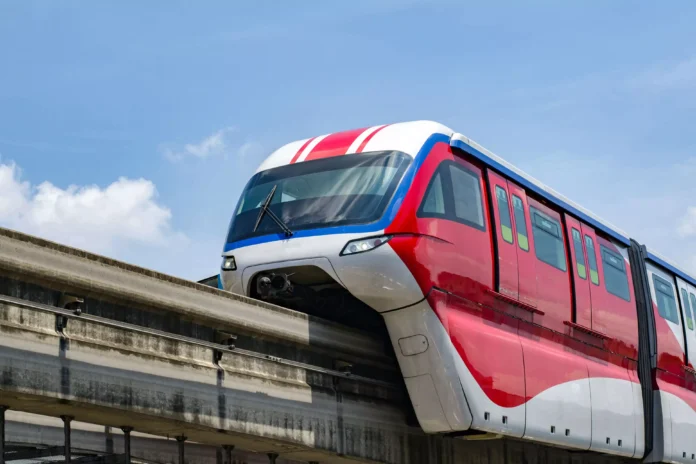
The monorail operates on a narrow, single track that can be positioned either above or beneath the railway cars. In systems where the rail is above the cars, wheeled axles run on the overhead rail. In systems where the rail is beneath the cars, guide wheels provide stabilisation. The lightweight structure of the monorail allows it to make sharp turns in congested areas of the city, making it highly suitable for densely populated areas like Mumbai. Monorails are highly preferred in urban cities because their tracks take up less space, making them a feasible solution for addressing the transportation needs of densely populated areas like Mumbai.
The Beginning of Mumbai Monorail
The Mumbai Metropolitan Region Development Authority (MMRDA) proposed a plan for the Mumbai monorail in 2005 to improve urban mobility. In September 2008, the Mumbai monorail was announced as a feeder service to connect Chembur, Wadala, and Sant Ghadge Maharaj Chowk. This initiative was undertaken for several reasons:
Reduce Congestion
The Mumbai Monorail project was initiated for the areas where the roads are narrow and congested. To reduce congestion on roads and avoid property loss for the people, the project was announced.
Improve Connectivity
Due to limited connectivity in the suburban areas of Mumbai, the project aimed to link the eastern suburban areas to South Mumbai. It also connects with the harbour line, central line, and western line, enhancing the overall transport network.
Eco-friendly Transportation
Compared to metro rail systems, monorails cause less noise pollution and are environmentally friendly.
Timely Travel
The Mumbai Monorail reduces the travel time, especially during the peak hours, and reduces the travel time between central and eastern suburban areas of Mumbai.
Key Facts about the Mumbai Monorail
Modern Urban Transport
With its remarkable features, the Mumbai Monorail is an expansion of public transport to make it accessible to sub-urban areas of the city. Travel is quick and easy with the metro, which has a speed of 80 km/h and an average speed of 32 km/h.
Safety and Capacity
The Mumbai Monorail is designed with safety and capacity in mind. Each train consists of four coaches, with a total length of 44.8 meters, and can accommodate up to 568 passengers. This capacity helps to alleviate some of the overcrowding issues faced by other modes of public transport in the city.
Cost and Investment
The development of the Mumbai Monorail is a crucial financial undertaking, with an estimated total cost of Rs. 24.6 billion. This investment reflects the city’s commitment to improving urban mobility and providing efficient, reliable transportation options for its residents.
Rolling Stock
The rolling stock for the Mumbai Monorail was initially provided by Scomi, a Malaysian engineering company. To meet the growing demand and ensure the continued development of the monorail system, new rolling stock is being produced by Medha-SMH Rail Pvt. Ltd. in collaboration with Malaysia-based SMH Rail.
Lines of Mumbai Monorail
Phase 1
Status: Operational
Line: Chembur – Wadala – Jacob Circle
Total Distance: 19.54 km
Stations: Chembur, VNP and RC Marg, Fertilizer Colony, Bharat Petroleum, Mysore Colony, Bhakti Park, Wadala, GTB Nagar, Antop Hills, Acharya Atre Nagar, Wadala Bridge, Dadar East, Naigaon, Ambedkar Nagar, Mint Colory, Lower Parel, Chinchpokli, Jacob Circle
Daily Ridership: Around 16,000 on weekdays and 10,000 on weekends
It was built and operated by a consortium of Larsen & Toubro and Malaysian firm Scomi Engineering. The estimated cost for this project was Rs. 27.16 billion.
Challenges Faced During Construction
Land Issues
The Mumbai Monorail project required a significant amount of space for infrastructure development, which included tracks and stations. Acquiring the necessary land for the project proved to be a complex and time-consuming process. The Mumbai Metropolitan Region Development Authority (MMRDA) faced bureaucratic procedures and had to address various concerns, which resulted in delays in the project timelines.
Removal of Encroachments
Along the monorail route, there were various settlements and structures that needed to be cleared, all without causing displacement or disruption to residents and businesses. This task of relocating affected parties added to the complexity of the project and required careful planning and execution to ensure smooth progress.
Approvals
The involvement of multiple stakeholders necessitated approvals at various stages of the project. Coordinating and obtaining these approvals added much time to the project schedule, which contributed to delays in construction.
Technical and Safety Concerns
In addition to bureaucratic hurdles and land acquisition challenges, technical glitches, quality control issues, and safety concerns also arose during the construction phase. Addressing these issues required meticulous attention, resulting in additional delays as corrective measures were implemented to ensure the safety and reliability of the monorail systems.
Proposed Lines of Mumbai Monorail
Phase 1
Line 2
Line: Mulund–Goregaon–Borivali
Distance: 30 km
Estimated Cost: Rs. 41.7 billion
Line 4
Line: Lokhandwala–SEEPZ–Kanjurmarg
Distance: 13.14 km
Estimated Cost: Rs. 18,265 million
Line 5
Line: Thane – Mira-Bhayandar – Dahisar
Distance: 24.25 km
Estimated Cost: Rs. 33,708 million
Phase 2
Line 6
Line: Kalyan–Ulhasnagar–Dombivli
Distance: 26.40 km
Estimated Cost: Rs. 36,696 million
Line 7
Line: Chembur–Ghatkopar–Kopar Khairane
Distance: 16.72 km
Estimated Cost: Rs. 36,863 million
Line 8
Line: Mahape–Shil Phata–Kalyan
Distance: 21.10 km
Estimated Cost: Rs. 29,329 million
Major Contractors
L&T – Scomi Engineering Bhd JV: Design, Build, and Operate Monorail.
Consort Digital: Supply, Installation, Integration and Commissioning of the entire project.
Benefits of Mumbai Monorail
Reduced Road Congestion
Monorail helped to reduce the traffic on the roads by offering an alternative mode of transportation to the people of the city. It serves as a convenient option for people to travel between Chambur to Jacob Circle, making their travel time less than usual.
Urban Development
Monorail has enhanced the overall connectivity of the city with the sub-urban areas of Mumbai. It is strategically located near commercial hubs, residential areas, and tourist attractions, enhancing connectivity and reducing the traffic on the roads. The project has encouraged the development around stations and attracted new businesses.
Environmental Impact
Operating on electricity, the Mumbai Monorail helped in reducing air pollution and promoting a cleaner, greener environment. Its lightweight design consumes less energy compared to fossil-fuel-powered vehicles, further minimising its environmental footprint. Additionally, the monorail’s operations contribute to reducing noise pollution, benefiting residents along its route.
Existing Monorail Projects around the World
Tokyo MonoRail
The Tokyo Monorail is a prominent monorail system in Japan. It connects Tokyo International Airport (Haneda) with several wards of Tokyo, including Ōta, Shinagawa, and Minato. Spanning 17.8 km along the north-south route, it runs parallel to the western coast of Tokyo Bay and serves 11 stations.
It offers passengers a combination of safe and fast travel, scenic views along its route, and, on clear days, glimpses of Mount Fuji.
Established in 1964, the Tokyo Monorail was the world’s first operational monorail. The JR pass holders have a facility to make seat reservations online and also get discounts at JR-operated hotels. For the travelers’ convenience, they have a facility for multi-language assistance.
Las Vegas MonoRail
The Las Vegas Monorail is a self-operating mass transit system located in Clark County, Nevada, United States. It runs adjacent to the Las Vegas Strip and serves 7 stations. It spans 6.3 km and connects several large casinos in the unincorporated communities of Paradise and Winchester. The monorail’s purpose is to provide safe, timely, and environmentally friendly travel.
Despite facing challenges such as financial issues, maintenance concerns, and ownership transitions over the years, the Las Vegas Monorail was able to provide a convenient travel option to the people in the city.
Conclusion
Mumbai’s efforts to update its transport system and solve the problems due to dense population and fast urbanization are tried to be solved by the Mumbai Monorail. It is a major step towards building a more sustainable and effective urban environment. It is designed to reduce traffic on roads, enhance connectivity, and offer environment-friendly transit options.
Despite encountering various obstacles during its construction phase, including challenges with land acquisition, encroachments, and bureaucratic delays, the Mumbai Monorail project has successfully launched. Today, it serves thousands of commuters daily.
The Mumbai monorail system has the ability to develop and improve the quality of urban living when compared to other global systems, such as those in Tokyo and Las Vegas.
Gurgaon (Metro Rail News): On July 29, SYSTRA MVA Consulting (India) emerged as the lowest bidder for the Detailed Design Consultant (DDC) contract for the Millennium City Centre – Cyber City Line of the Gurgaon Metro.
This new elevated Line, managed by Haryana Mass Rapid Transport Corporation Ltd. (HMRTC), will provide a vital connection between Gurugram and Old Gurugram. This corridor, featuring 27 stations, will form a circular route. It will enhance the overall connectivity and accessibility of the region and support the city’s growing transportation needs.
When technical bids were opened in June, SYSTRA was identified as the only bidder for this DDC contract under package GGNCCDD-15(R3), further positioning SYSTRA as the lowest bidder.
Scope of Work
The work under this contract involves appointing a Detailed Design Consultant (DDC) for civil, architectural, and electrical and mechanical (E&M) works for the elevated section of the project, which spans 28.5 kilometres and comprises 27 stations. The main corridor extends from Millennium City Centre to Cyber City Gurugram, covering 26.65 kilometres, with an additional spur from Basai Village to Dwarka Expressway.
SYSTRA’s Financial Bid: Rs. 22.49 crore
Deadline: 48 months
If SYSTRA secures the contract, it will develop various designs for all civil, architectural, building services, and electrical and mechanical works for the Millennium City Centre – Cyber City Line of Gurgaon Metro.
Progress on this Line:
Currently, geotechnical work is underway for this line, which commenced in March of this year.
Significance of Gurugram Metro’s Millennium City – Cyber City Line
Integration with other metro lines & RRTS
This new line will have an interchange with the yellow line at Millenium City Centre and with Gurgaon’s Rapid Metro at Cyber City.
Apart from the metro, this line is expected to be integrated with the 72 km Delhi – Dharuhera (RRTS) line at Cyber City and Hero Honda Chowk.