


Page 17 - Demo
P. 17
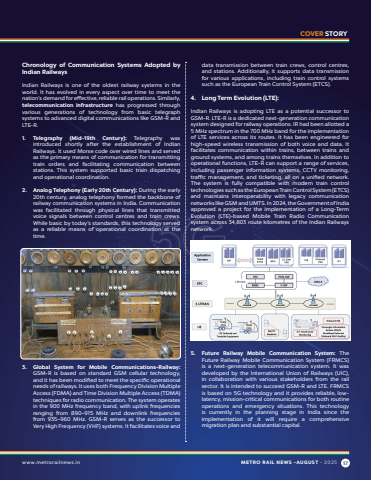
www.metrorailnews.in METRO RAIL NEWS -AUGUST - 2025 17Chronology of Communication Systems Adopted by Indian RailwaysIndian Railways is one of the oldest railway systems in the world. It has evolved in every aspect over time to meet the nation%u2019s demand for effective, reliable rail operations. Similarly, telecommunication infrastructure has progressed through various generations of technology from basic telegraph systems to advanced digital communications like GSM-R and LTE-R.1.Telegraphy (Mid-19th Century): Telegraphy was introduced shortly after the establishment of Indian Railways. It used Morse code over wired lines and served as the primary means of communication for transmitting train orders and facilitating communication between stations. This system supported basic train dispatching and operational coordination.2.Analog Telephony (Early 20th Century): During the early 20th century, analog telephony formed the backbone of railway communication systems in India. Communication was facilitated through physical lines that transmitted voice signals between control centres and train crews. While basic by today%u2019s standards, this technology served as a reliable means of operational coordination at the time.3.Global System for Mobile Communications-Railway:GSM-R is based on standard GSM cellular technology, and it has been modified to meet the specific operational needs of railways. It uses both Frequency Division Multiple Access (FDMA) and Time Division Multiple Access (TDMA) techniques for radio communication. The system operates in the 900 MHz frequency band, with uplink frequencies ranging from 890%u2013915 MHz and downlink frequencies from 935%u2013960 MHz. GSM-R serves as the successor to Very High Frequency (VHF) systems. It facilitates voice and data transmission between train crews, control centres, and stations. Additionally, it supports data transmission for various applications, including train control systems such as the European Train Control System (ETCS).4.Long Term Evolution (LTE):Indian Railways is adopting LTE as a potential successor to GSM-R. LTE-R is a dedicated next-generation communication system designed for railway operations. IR had been allotted a 5 MHz spectrum in the 700 MHz band for the implementation of LTE services across its routes. It has been engineered for high-speed wireless transmission of both voice and data. It facilitates communication within trains, between trains and ground systems, and among trains themselves. In addition to operational functions, LTE-R can support a range of services, including passenger information systems, CCTV monitoring, traffic management, and ticketing, all on a unified network. The system is fully compatible with modern train control technologies such as the European Train Control System (ETCS) and maintains interoperability with legacy communication networks like GSM and UMTS. In 2024, the Government of India approved a project for the implementation of a Long-Term Evolution (LTE)-based Mobile Train Radio Communication system across 34,803 route kilometres of the Indian Railways network.5.Future Railway Mobile Communication System: The Future Railway Mobile Communication System (FRMCS) is a next-generation telecommunication system. It was developed by the International Union of Railways (UIC), in collaboration with various stakeholders from the rail sector. It is intended to succeed GSM-R and LTE. FRMCS is based on 5G technology and it provides reliable, lowlatency, mission-critical communications for both routine operations and emergency situations. This technology is currently in the planning stage in India since the implementation of it will require a comprehensive migration plan and substantial capital.www.metrorailnews.in METRO RAIL NEWS -AUGUST- 202517COVER STORY


