


Page 19 - Demo
P. 19
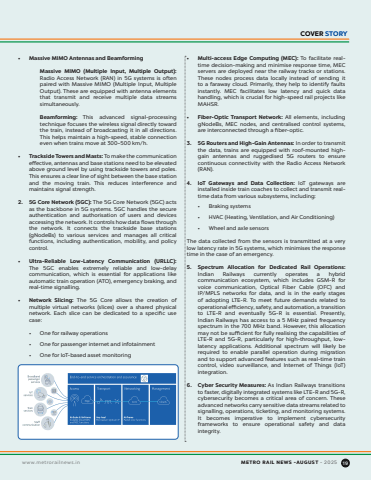
www.metrorailnews.in METRO RAIL NEWS -AUGUST - 2025 19%u2022Massive MIMO Antennas and BeamformingMassive MIMO (Multiple Input, Multiple Output): Radio Access Network (RAN) in 5G systems is often paired with Massive MIMO (Multiple Input, Multiple Output). These are equipped with antenna elements that transmit and receive multiple data streams simultaneously.Beamforming: This advanced signal-processing technique focuses the wireless signal directly toward the train, instead of broadcasting it in all directions. This helps maintain a high-speed, stable connection even when trains move at 300%u2013500 km/h.%u2022Trackside Towers and Masts: To make the communication effective, antennas and base stations need to be elevated above ground level by using trackside towers and poles. This ensures a clear line of sight between the base station and the moving train. This reduces interference and maintains signal strength.2.5G Core Network (5GC): The 5G Core Network (5GC) acts as the backbone in 5G systems. 5GC handles the secure authentication and authorisation of users and devices accessing the network. It controls how data flows through the network. It connects the trackside base stations (gNodeBs) to various services and manages all critical functions, including authentication, mobility, and policy control.%u2022Ultra-Reliable Low-Latency Communication (URLLC): The 5GC enables extremely reliable and low-delay communication, which is essential for applications like automatic train operation (ATO), emergency braking, and real-time signalling.%u2022Network Slicing: The 5G Core allows the creation of multiple virtual networks (slices) over a shared physical network. Each slice can be dedicated to a specific use case:%u2022One for railway operations%u2022One for passenger internet and infotainment%u2022One for IoT-based asset monitoring%u2022Multi-access Edge Computing (MEC): To facilitate realtime decision-making and minimise response time, MEC servers are deployed near the railway tracks or stations. These nodes process data locally instead of sending it to a faraway cloud. Primarily, they help to identify faults instantly. MEC facilitates low latency and quick data handling, which is crucial for high-speed rail projects like MAHSR.%u2022Fiber-Optic Transport Network: All elements, including gNodeBs, MEC nodes, and centralised control systems, are interconnected through a fiber-optic. 3.5G Routers and High-Gain Antennas: In order to transmit the data, trains are equipped with roof-mounted highgain antennas and ruggedised 5G routers to ensure continuous connectivity with the Radio Access Network (RAN). 4.IoT Gateways and Data Collection: IoT gateways are installed inside train coaches to collect and transmit realtime data from various subsystems, including:%u2022Braking systems%u2022HVAC (Heating, Ventilation, and Air Conditioning)%u2022Wheel and axle sensorsThe data collected from the sensors is transmitted at a very low latency rate in 5G systems, which minimises the response time in the case of an emergency. 5.Spectrum Allocation for Dedicated Rail Operations:Indian Railways currently operates a hybrid communication ecosystem, which includes GSM-R for voice communication, Optical Fiber Cable (OFC) and IP/MPLS networks for data, and is in the early stages of adopting LTE-R. To meet future demands related to operational efficiency, safety, and automation, a transition to LTE-R and eventually 5G-R is essential. Presently, Indian Railways has access to a 5 MHz paired frequency spectrum in the 700 MHz band. However, this allocation may not be sufficient for fully realising the capabilities of LTE-R and 5G-R, particularly for high-throughput, lowlatency applications. Additional spectrum will likely be required to enable parallel operation during migration and to support advanced features such as real-time train control, video surveillance, and Internet of Things (IoT) integration.6.Cyber Security Measures: As Indian Railways transitions to faster, digitally integrated systems like LTE-R and 5G-R, cybersecurity becomes a critical area of concern. These advanced networks carry sensitive data streams related to signalling, operations, ticketing, and monitoring systems. It becomes imperative to implement cybersecurity frameworks to ensure operational safety and data integrity.COVER STORY


