




Introduction
Kolkata, the capital of West Bengal, is located on the eastern bank of the Hooghly River. Kolkata is known for its cultural and historical significance; the city has long been regarded as the cultural centre of India. Kolkata is the third most populous metropolitan area in India, with an estimated 2025 population of around 15.5 to 15.8 million people, which places it behind Delhi and Mumbai. This city serves as the primary financial and commercial hub for eastern India.

During the colonial period, Kolkata served as the capital of British India from 1772 to 1911 and played a central role in the country’s administrative and economic activities. After independence, the city underwent major demographic and infrastructural changes, particularly following the partition of Bengal in 1947, which brought a large influx of refugees from East Bengal.
By the late 1960s, Kolkata faced increasing challenges related to traffic congestion and inadequate road capacity. The existing transport infrastructure could not keep pace with the city’s growing population and economic activities. To address these issues, the Government of India and the Government of West Bengal proposed the development of a metro rail system to provide a reliable, fast, and sustainable mode of urban transport.
This initiative led to the establishment of the metro system in Kolkata. Kolkata Metro holds the distinction of being India’s first metro railway. It was designed to ease traffic pressure, improve urban mobility, and modernise the city’s transport network. Since the opening of its first 3.4 km section between Esplanade and Bhowanipore (now Netaji Bhavan) in 1984, the Kolkata Metro has gradually expanded and now forms a crucial part of the city’s transport infrastructure. It continues to evolve through new corridors and technological upgrades to meet the demands of a growing urban population.
Kolkata Metro: Journey from Concept to Operation
Early Proposals
The concept of a metro system in Kolkata dates back to the early 20th century. In the September 1919 session of the Imperial Legislative Council at Shimla, a committee led by Sir William Erskine Crum recommended the construction of a metro line beneath the Hooghly River. The proposed route was to connect Bagmari in the east to Benaras Road in Howrah, which spanned approximately 10.4 km. However, due to financial constraints and the complexities of implementing such a project during colonial times, the proposal was shelved.
Establishment of the Metropolitan Transport Project (MTP)
In 1969, recognising the escalating traffic issues, the Government of India and the Government of West Bengal established the Metropolitan Transport Project (MTP). The MTP aspired to develop a comprehensive urban transport plan for Kolkata. A master plan was developed in 1971, outlining the construction of five metro lines totaling 97.5 km. Based on traffic studies, three corridors were prioritised for construction:
- Line 1 (North–South Corridor): This line was designed to connect Dum Dum to Tollygunge. This line was identified as the highest priority due to its high traffic volume.
- Line 2 (East–West Corridor): This corridor connects Bidhannagar to Ramrajatala. This line was planned to serve the eastern parts of the city.
- Line 3: This line was designed to connect Dakshineswar to Thakurpukur. This line was later divided into two sections: Line 1 (Noapara to Dakshineswar) and Line 3 (Joka to Esplanade).
Foundation Stone and Construction Challenges
On 29 December 1972, Prime Minister Indira Gandhi laid the foundation stone for the metro project in Kolkata. The construction commenced in 1973–74, with the Soviet Union providing technical assistance. The project faced several challenges, including land acquisition issues, shifting of underground utilities, and coordination among various agencies. Despite these hurdles, the project made steady progress.
Inauguration of the First Line
After years of construction, the first section of the Kolkata Metro, covering a 3.4 km stretch between Esplanade and Bhowanipore (now Netaji Bhavan), was inaugurated on 24 October 1984 by Prime Minister Indira Gandhi. This was the beginning of India’s first metro railway service. The metro system in Kolkata had set a precedent for urban transit systems across the country.
Key Specifications of Kolkata Metro
| Speed and Track | Top Speed: 80 kmphAverage Speed: 34 kmphTrack Gauge: Broad Gauge – 1676 mm (Line-1) & Standard Gauge – 1435 mm (Line-2) |
| Safety and Electrification | Electrification: 750 V DC Third Rail |
Kolkata Metro: A Comprehensive Overview of Operational Network, Ongoing Expansions, and Upcoming Corridors
Overview
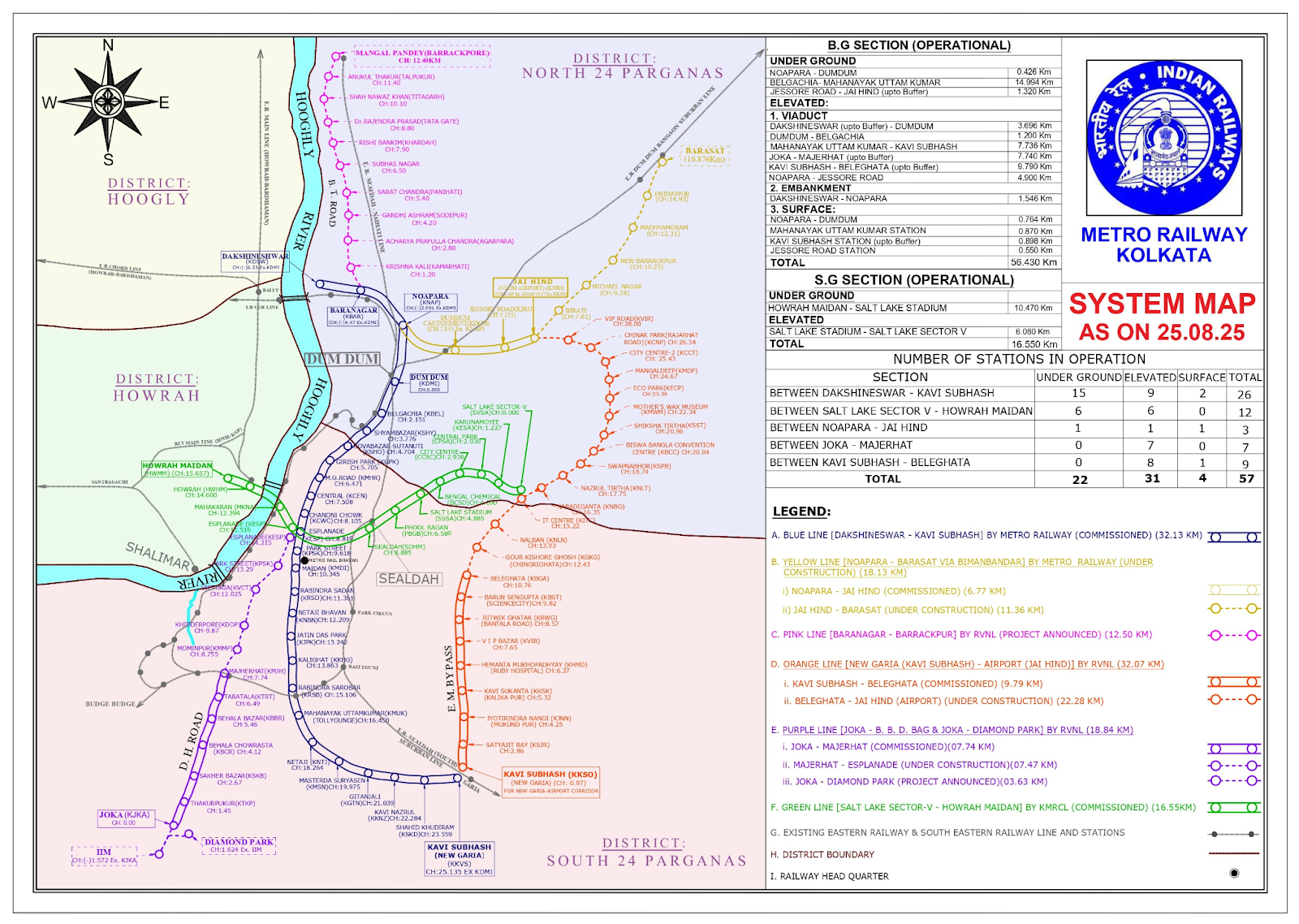
The Kolkata Metro network spans approximately 74 kilometers with 57 stations, which positions it as the third-largest metro system in India by route length.
Operational Network of Kolkata Metro
Blue Line: Dakshineswar – Kavi Subhash (New Garia)
- Length: 32.25 km
- Depot: Noapara and New Garia
- Number of Stations: 26
- Station Names: Dakshineswar, Baranagar, Noapara, Dum Dum, Belgachhia, Shyambazar, Shobabazar, Shobhabazar Sutanuti, Girish Park, MG Road, Central, Chandni Chowk, Esplanade, Park Street, Maidan, Rabindra Sadan, Netaji Bhavan, Jatin Das Park, Kalighat, Rabindra Sarobar, Mahanayak Uttam Kumar, Netaji, Masteda Surya Sen, Gitanjali, Kavi Nazrul, Shahid Khudiram, Kavi Subhash (New Garia)
Yellow Line: Nopara-Jai Hind Bimanbandar
- Length: 6.77 km
- Type: At-grade, elevated & underground
- Number of Stations: 4
- Station Names: Noapara, Dum Dum Cantt., Jessore Road, Jai Hind Bimanbandar
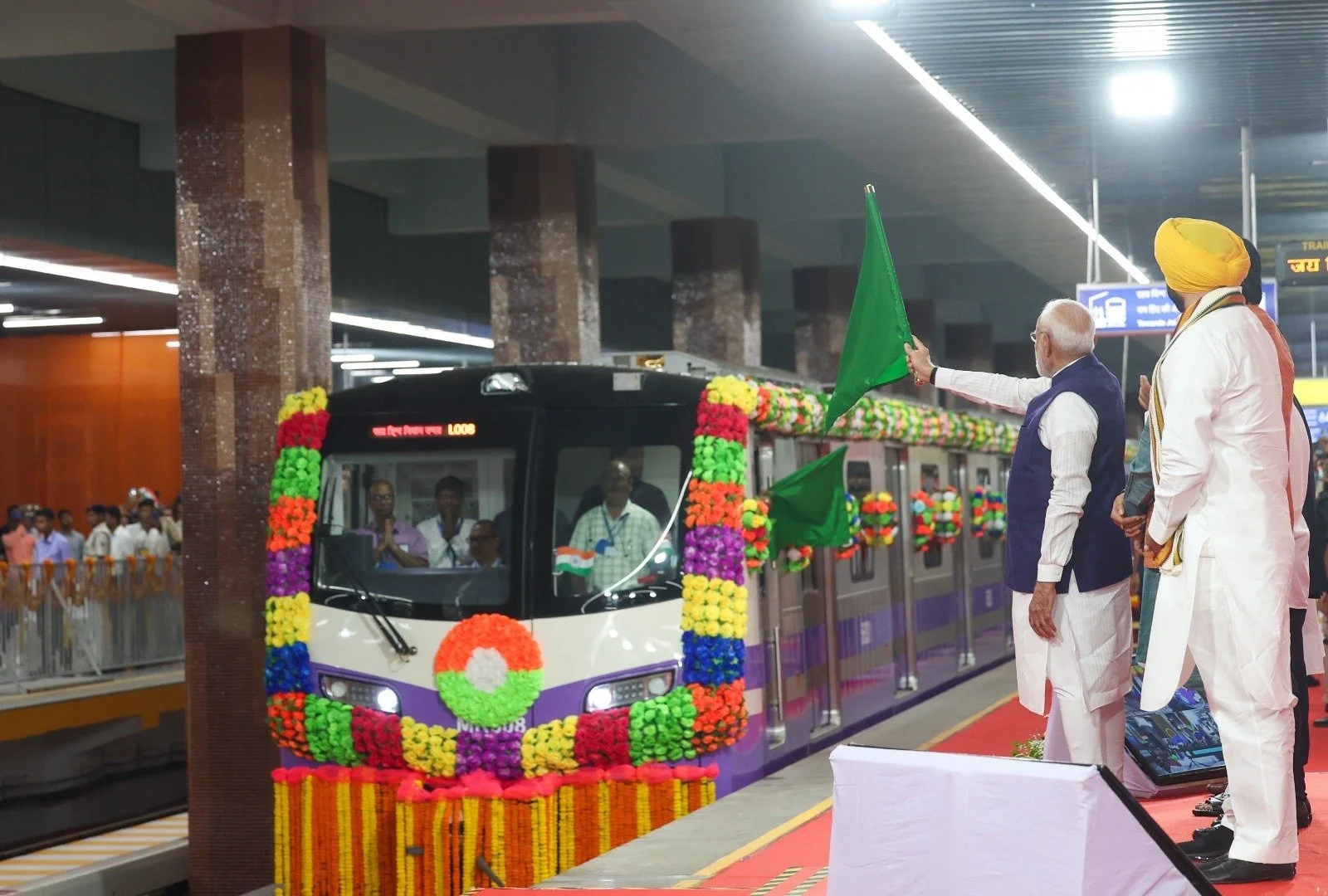
Note: PM Shri Narendra Modi commissioned the Nopara-Jai Hind Bimanbandar stretch of the Yellow Line on 22 August 2025 from Jessore Road Metro Station.
Orange Line: Kavi Subhash (New Garia) – Beleghata
- Length: 9.79 km
- Type: Elevated
- Depot: New Garia
- Number of Stations: 9
- Station Names: Kavi Subhash, Satyajit Ray, Jyotirindra Nath Nandy, Kavi Sukanta, and Hemanta Mukherjee, VIP Bazar, Ritwik Ghatak, Barun Sengupta, Beleghata.
Timeline of the Orange Line
| Operational date | Section | Length |
| 6 March 2024 | Kavi Subhash – Hemanta Mukhopadhyay | 5.68 km |
| 22 August 2025 | Hemanta Mukhopadhyay- Beleghata | 4km |
Purple Line: Joka – Majerhat
- Length: 7.74 km
- Type: Elevated
- Depot: Joka
- Number of Stations: 7
- Station Names: Joka, Thakurpukur, Sakherbazar, Behala Chowrasta, Behala Bazar, Taratala, and Majerhat
Timeline of Purple Line
| Operational Date | Section | length |
| 30 December 2022 | Joka – Taratala | 6.5 km |
| 6 March 2024 | Taratala – Majerhat | 1.25 km |
Green Line: Salt Lake Sector V – Howrah Maidan (East-West Corridor)
- Length: 13 km
- Type: Elevated (5.3 km) & Underground (7.7 km)
- Depot: Central Park in Bidhannagar (Salt Lake)
- Number of Stations: 12
- Station Names: Howrah Maidan, Howrah, Mahakaran, Esplanade, Sealdah, Phoolbagan, Salt Lake Stadium, Bengal Chemical, City Centre, Central Park, Karunamoyee, Salt Lake Sector V
Timeline of Green Line
| Operational date | Section | Length |
| 13 Feb 2020 | Sector V – Salt Lake Stadium | 5.3 km |
| 05 Oct 2020 | Salt Lake Stadium – Phoolbagan | 1.7 km |
| 14 July 2022 | Phoolbagan – Sealdah | 2.1 km |
| 6 March 2024 | Howrah Maidan – Esplanade | 3.9 km |
| 22 August 2025 | Esplanade – Sealdah | 2.6 km |
| Total | 16. 55km |
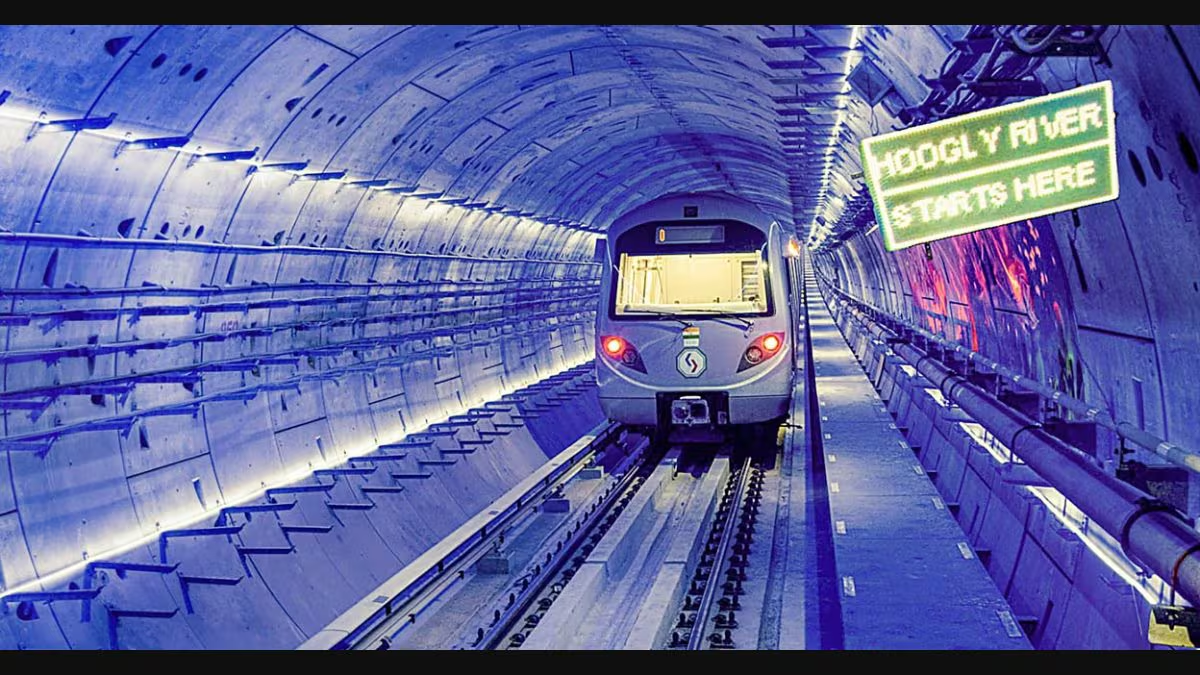
Note: The Green Line of the Kolkata Metro network became completely operational on 22 August. The corridor features India’s first underwater metro stretch spanning 520m from Howrah Maidan to Esplanade.
Under Construction Routes of Kolkata Metro
Yellow Line: Jai Hind Bimanbandar – Barasat
- Length: 11.36 km
- Type: Underground and Elevated
- Number of Stations: 6
- Station Names: Birati, Michael Nagar, New Barrackpore, Madhyamgram, Hridaypur, and Barasat
Note: The Yellow Line (Line 4) of the Kolkata Metro is slated for a 2.5-kilometre extension from the current airport terminal to Michael Nagar. This development, expected to be completed within the next three years, will further strengthen the metro’s connectivity to the northern suburbs.
Orange Line: Beleghata – Jai Hind Bimanbandar
- Length: 22.28 km
- Type: At-grade, elevated & underground
- Depot: New Town, New Garia
- Number of Stations: 15
- Station Names: Beliaghata, Gour Kishore Ghosh, NICCO Park, Saltlake Sector V, Technopolis, Nazrul Tirtha (formerly Bidhan Nagar), Swapno Bhor (formerly Sub CBD-1), Biswa Bangla Convention Centre (formerly CBD-1), Kala Kshetra, Mother’s Wax Museum (formerly New Town), Eco Park (formerly Convention Center), Siksha Tirtha (formerly Sub CBD-2), City Centre II (formerly Titumir), Chinar Park (formerly Rabindra Tirtha), VIP Road/Teghoria (Haldiram), Biman Bandar (Airport).
Purple Line: Majerhat to Esplanade
- Length: 7.55 km
- Type: Elevated (2.5 km) & Underground (5.05 km)
- Number of Stations: 5
- Station Names: Mominpur, Kidderpore, Victoria Memorial, Park Street, and Esplanade.
Planned Routes of Kolkata Metro
Pink Line: Baranagar – Barrackpore
- Length: 12.50 km
- Type: At-grade & elevated
- Number of Stations: 11
- Station Names: Baranagar, Kamarhati, Agarpara, Panihati, Sodepur, Subhash Nagar, Khardaha, Tata Gate, Titagarh, Talpukur, Barrackpore
Purple Line: Joka – Diamond Park
- Length: 3.63 km
- Type: Elevated
- Number of Stations: 3
- Station Names: Joka, Diamond Park, IIM
Note: In September 2025, Rail Vikas Nigam Limited (RVNL) issued a tender valued at over ₹377 crore for the construction of a viaduct and an elevated metro station on this section of the Kolkata Metro’s Purple Line. The project, estimated at ₹377,82,01,812.74, covers the 3.63-kilometre stretch from Joka to Diamond Park. This development is part of the ongoing efforts to enhance connectivity in southwestern Kolkata and expand the operational reach of the Purple Line.
The Gaps in Growth of India’s Oldest Metro System
- Infrastructure failures: Managing old infrastructure remains a challenge for Kolkata Metro. Critical failures continue to affect operations. For example, in July 2025, Kavi Subhas station, the terminal station of the North–South Blue Line and one of the city’s busiest hubs, was found to have irreparable cracks in its supporting columns. Due to the severity of the damage, Metro Railway has decided to demolish and completely rebuild the station. Commuters may have to wait up to a year before the station becomes operational again.
- Outdated systems: Older parts of the network suffer from outdated technology. The system is still in the process of upgrading from an older third-rail power system to a more modern and efficient one that will allow for closer train intervals.
- Financial Performance: Though Kolkata metro has witnessed a surge in ridership yet financial increasing financial losses remain a major concern. According to a statement by Metro Railway, Kolkata Metro recorded a loss of ₹224.7 crore up to January 2025, compared to a loss of ₹207.9 crore during the same period in the previous financial year. The increase in losses reflects the ongoing financial challenges faced by the metro, including operational costs, infrastructure maintenance, and limited revenue recovery from ridership and fares
- Expansion delays and cost overruns: The construction of new lines has been plagued by delays, which have led to budget revisions. For example, the Barasat extension project saw its costs grow from ₹2,397.72 crore to ₹4,829.57 crore.
Signs of improvement
Positive Ridership Trends Across Kolkata Metro Network
Kolkata Metro ridership trends show a recent surge, with daily passenger counts exceeding 8.69 lakh in late September 2025. This increase follows the recent launch of new lines and extensions, which boosted ridership by over 1 lakh in a single day.
- Traffic on Blue Line: Among the stations on the Blue Line, Dum Dum recorded the highest footfall, with over 66,000 passengers. Esplanade and Rabindra Sadan followed with around 57,000 and 41,000 passengers, respectively. These numbers indicate that the Blue Line remains the busiest corridor in the Kolkata Metro network, handling the majority of the city’s daily metro travel.
- Traffic on Green Line: On the Green Line, more than 2.04 lakh passengers traveled between Salt Lake Sector V and Howrah Maidan. The Sealdah Metro station recorded the highest usage on this corridor with over 49,000 passengers, followed closely by Howrah Metro station with around 48,700, and Howrah Maidan with about 25,500 passengers.
- Orange Line: With extensions, this line has begun to show growth, recording around 4,800 daily commuters in September 2025.
- Yellow Line: The newest addition is still in its early phase of operation, but is serving approximately 7,600 daily riders.
Growing non-fare revenue: The metro has successfully increased its earnings from sources other than tickets, with one report from 2023–24 noting an 80.5% increase in non-fare revenue.
Conclusion
Kolkata Metro, India’s oldest and third-largest metro network, continues to play an important role in meeting the growing demand for sustainable urban transport in the city. Over the past four decades, the system has expanded and evolved to serve a wider population. The ongoing expansion of the Kolkata Metro is expected to improve traffic conditions and reduce congestion across the city.
According to the former General Manager of Metro Railway, Kolkata, Shri P. Uday Kumar Reddy, the network is expected to reach over 130 km by 2027. However, to fully realise the potential of the system, it is essential to address several key challenges. Persistent delays in project execution have led to cost overruns, while financial losses remain a concern for long-term sustainability.
Despite these challenges, the Kolkata Metro has set a strong precedent for other metro systems in India by demonstrating the importance of early urban rail development and consistent public investment in sustainable transport.
Join the 6th edition of InnoMetro to explore how the progressions in AI are improving the railway systems, including ticketing, rolling stock, and signalling. Witness the innovation from 200+ exhibitors at India’s leading show for metro & railways which is going to be held on 21-22 May 2026 at Bharat Mandapam, New Delhi
Register now: https://innometro.com/visitor-registration/


