
Introduction
Ahmedabad, the largest city in Gujarat and the seventh-largest urban agglomeration in India, has a population of around 7.4 million. Situated on the banks of the Sabarmati River, it serves as the administrative headquarters of the Ahmedabad district.
The city was the capital of Gujarat from 1960 until 1970, after which the capital was shifted to Gandhinagar. Historically, Ahmedabad played a leading role in India’s struggle for independence during the early 20th century. It became the epicenter of several movements advocating civil disobedience, workers’ rights, and political freedom.
Founded in 1411 by Sultan Ahmed Shah as the capital of the Sultanate of Gujarat, the city holds a rich architectural and cultural legacy. Over time, Ahmedabad emerged as a major centre of the textile industry, earning the title “The Manchester of India.”
Reasons Behind the Development of the Ahmedabad Metro
1. Rapid Urbanisation: Ahmedabad experienced rapid urbanisation over the past few decades, which led to a sharp rise in population and expansion of city boundaries. As shown in the graph, the city’s population had grown steadily since the 1950s. This fast-paced growth placed immense pressure on existing road infrastructure and public transport, creating the need for a modern, efficient, and sustainable metro system to support urban mobility.

Ahmedabad’s Total Population By Year
2. Traffic Congestion: Ahmedabad began facing severe traffic congestion, especially during peak hours due to the rising number of private vehicles. The city’s major roads and junctions became overcrowded, resulting in longer travel times and higher pollution levels. The Ahmedabad Metro system was therefore introduced as a reliable mass transit solution to ease road traffic and reduce dependency on private vehicles.
Historical Background of Ahmedabad Metro
- 2003 – Initial Study
The Gujarat Infrastructure Development Board initiated an urban transport study exploring a potential metro link between Ahmedabad and Gandhinagar.
- June 2005 – DPR Preparation and Approval
A Detailed Project Report (DPR) was jointly prepared by Delhi Metro Rail Corporation (DMRC) and RITES Limited. The DPR was approved by the Central Government the same year.
- 2005 – Project Temporarily Suspended
Due to high estimated costs of around ₹4,295 crore and concerns over project feasibility, the metro proposal was deferred. The state government prioritised the Ahmedabad Bus Rapid Transit System (BRTS) and suburban railway improvements instead.
- 2008 – Project Revival
The metro proposal was revived with revised alignments and corridor plans to improve its practicality and financial sustainability.
- 4 February 2010 – Formation of SPV (MEGA)
The Government of Gujarat established a special purpose vehicle (SPV) named Metro Link Express for Gandhinagar and Ahmedabad Company Limited (MEGA) with an initial capital allocation of ₹202 crore to execute the project.
- 2014 – Central Government Partnership
The Central Government joined as an equal partner by taking a 50 percent equity share in the SPV, making it a joint venture project.
- 2018 – Renaming to GMRC
To consolidate operations and expand metro projects across Gujarat, the SPV was renamed Gujarat Metro Rail Corporation Limited (GMRC).
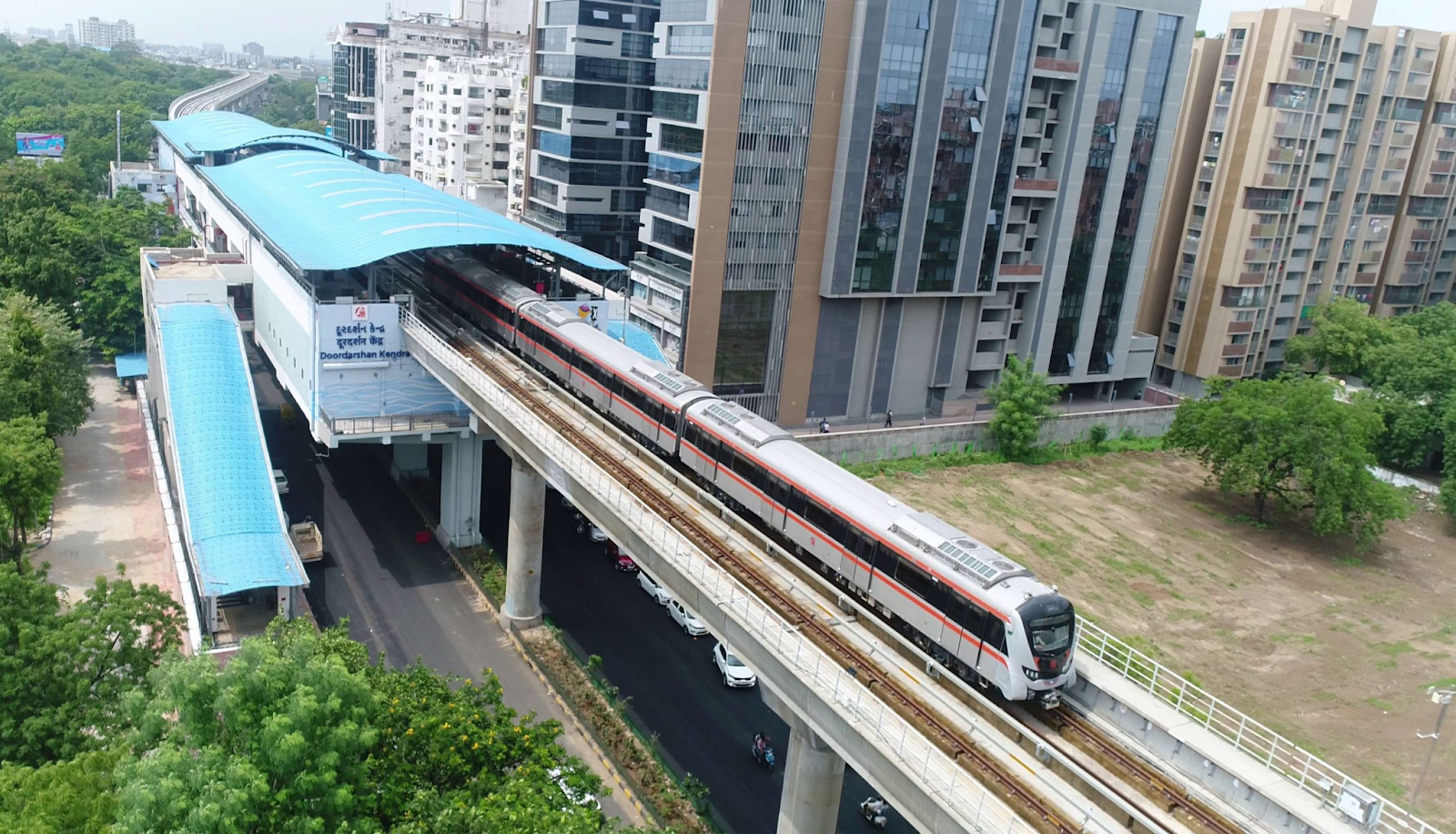
Ahmedabad Metro: Driving Modern Urban Transit
Overview
Ahmedabad Metro is an Urban Mass Rapid Transit System (MRTS) developed to enhance public transportation in the Ahmedabad-Gandhinagar region. Initially known as the Metro-Link Express for Gandhinagar and Ahmedabad (MEGA), the project is implemented and operated by the Gujarat Metro Rail Corporation (GMRC) Limited. The Ahmedabad Metro Rail Project consists of 2 Phases. Currently the Phase 1 of Ahmedabad Metro which spans 39.26 km covering two metro corridors is completely operational. The Phase 2 of Ahmedabad Metro which spans 28.254 km is partly operational and partly under construction.
Key Specification
| Authorized Authority | Gujarat Metro Rail Corporation (GMRC) Limited. |
| Speed and Track | Top Speed: 80 kmphAverage Speed: 33 kmphTrack Gauge: Standard Gauge – 1435 mm |
| Electrification | 750 V DC Third Rail |
| Signalling | Communication-based Train Control (CBTC) |
| Daily Ridership | 90,000/day (March 2023) |
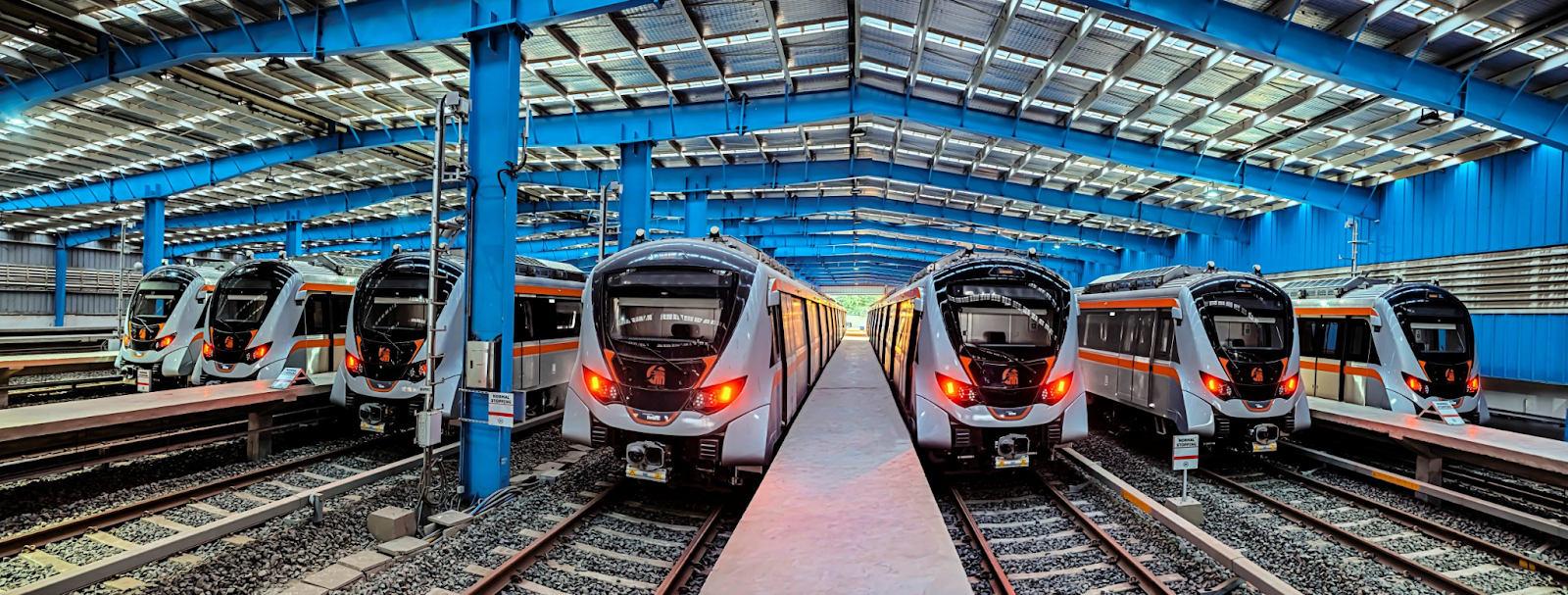
| Rolling Stock | Phase 1: 96 coaches (32 train sets x 3) supplied by Hyundai RotemPhase 2: 30 Coaches ( 10 train sets x 3) will be supplied by Titagarh |
Ahmedabad Metro Phase 1
Overview
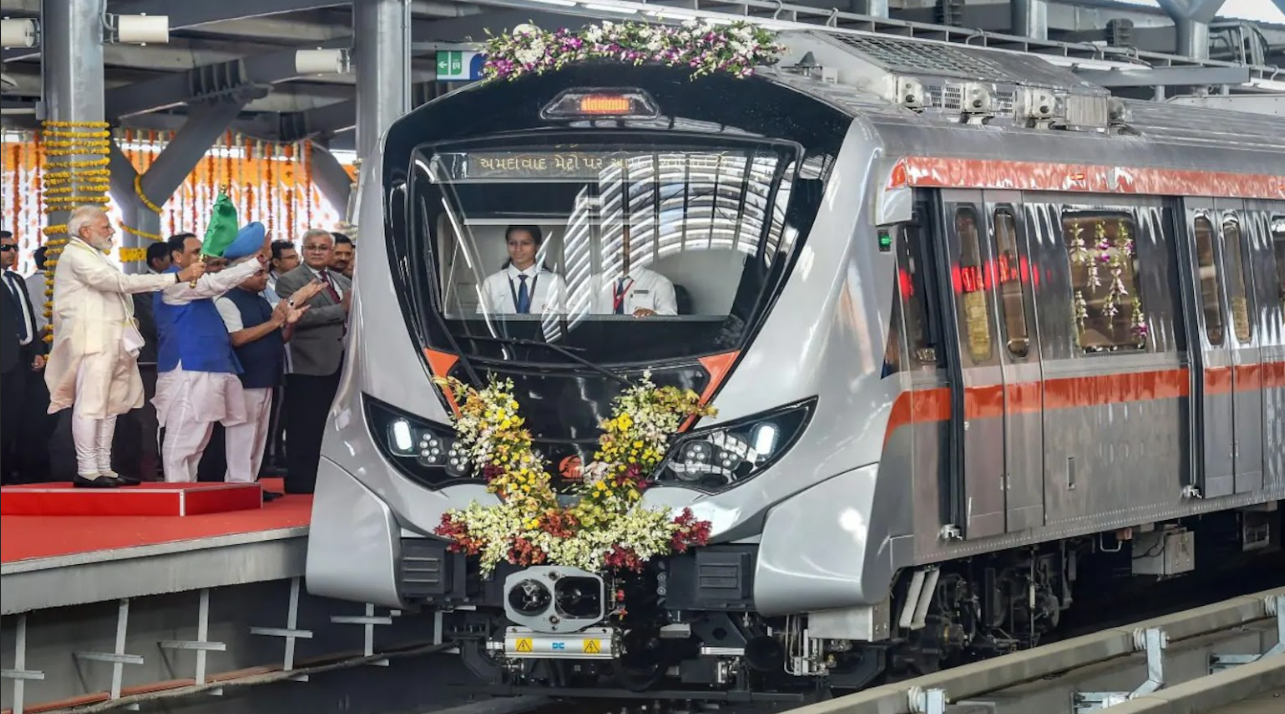
Phase 1 of the Ahmedabad Metro consists of two operational corridors spanning a total length of 39.26 km. The Detailed Project Report (DPR) for Phase 1 was prepared by the Delhi Metro Rail Corporation (DMRC) in February 2014, and the project received central government approval on October 18, 2014. with an estimated cost of Rs. 10,773 crore.
| Corridor | Route | Route Length (km) | Total no. of Stations |
| Line-1 (East-West / Blue Line): | Vastral Gam – Thaltej Gam | 21.16 | 18 |
| Line-2 (North-South / Red Line): | Motera – APMC | 18.87 | 15 |
Route Details
Line-1 (East-West Corridor /Blue Line): Vastral Gam – Thaltej Gam
- Length: 20.737 km
- Type: Elevated & Underground (6.83 km between Apparel Park and Sabarmati River)
- Depot: Apparel Park
- Number of Stations: 18
- Status: Operational
- Station Names: Thaltej Gam, Thaltej, Doordarshan Kendra, Gurukul Road, Gujarat University, Commerce Six Roads, Stadium, Old High Court Interchange, Shahpur, Gheekanta, Kalupur Railway Station, Kankaria East, Apparel Park (Depot), Amraiwadi, Rabari Colony, Vastral, Nirant Cross Roads, Vastral Gam
Line-2 (North-South Corridor /Red Line): Motera – APMC
- Length: 18.522 km
- Type: Elevated
- Depot: Gyaspur
- Number of Stations: 15
- Status: Operational
- Station Names: Motera Stadium, Sabarmati, AEC, Sabarmati Railway Station, Ranip, Vadaj, Vijay Nagar, Usmanpura, Old High Court Interchange, Gandhigram, Paldi, Shreyas, Rajiv Nagar, Jivraj Park, APMC

Phase 1 Timeline
| Line | Route | Length | Operational Date |
| Line 1 (Blue Line) | Vastral – Apparel Park | 6 km | 6 March 2019 |
| Line 1 (Blue Line) | Apparel Park – Thaltej | 13.34 km | 30 September 2022 |
| Line 2 (Red Line) | APMC – Motera | 18.52 km | 30 September 2022 |
| Line 1 (Blue Line) | Thaltej – Thaltej Gam | 1.4 km | 08 December 2024 |
Major Contractors Involved in Phase 1
| Contract | Contractor |
| General Consultant (GC) Service for Ahmedabad Metro Phase 1 | SYSTRA – RITES – Oriental – AECOM JV |
| Supply and manufacture of 96 Coach Rolling Stock for Phase 1 | Hyundai Rotem |
| design, supply, install, test and commission ballastless tracks for Ahmedabad Metro’s Phase 1 project. | Larsen & Toubro |
| Signalling and Train Control Systems | Nippon Signal |
| Telecommunication System for Phase 1 of Ahmedabad Metro | Larsen & Toubro |
| Power Supply Receiving & Distribution System, 750 V DC Third Rail Traction Electrification and SCADA System | Siemens Ltd. (India) – Siemens AG (Germany) JV |
| Construction of 6 km viaduct between Vastral Gam and apparel Park | J Kumar Infraprojects |
| Construction of 6 stations from Vastral Gam to Apparel Park | DRA – CICO JV |
| Construction of a 4.62 km viaduct and 4 stations between Gyaspur Depot and Shreyas | IL&FS Engineering |
| Construction of a 4.85 km viaduct from Motera to Ranip | Ranjit Buildcon |
| Construction of 5 stations between Motera and Ranip | Pratibha – Ranjit JV |
| Construction of an 8.94 km viaduct and 6 stations between Shreyas and Ranip | Simplex Infrastructure |
| Construction of a 2.45 km tunnel and 2 stations between East Ramp and Kalupur | Afcons Infrastructure |
| Construction of 4.38 km tunnels and 2 stations between Kalupur and West Ramp | Larsen & Toubro |
| Thaltej Gam to West Ramp(Viaduct, Sabarmati Bridge &7 stations – 8.21 km) | Tata – CCECC JV |
Ahmedabad Metro Phase 2
Overview
The 28.254 km Phase 2 of Ahmedabad Metro consists of the north extension of Line 2 (Red Line) from Motera Station to Mahatma Mandir, which spans 22.8 km covering 20 stations. Currently, the 17.3km route from Motera to Sachivalay covering 15 stations is operational. The Ahmedabad Metro Phase 2 also consists of the operational eastern spur of this line, which spans 5.4 km from GNLU to Gift City, covering 2 stations. On 19 February 2019, the Central Government of India approved the Phase 2 expansion of the Ahmedabad Metro project.
Funding Mechanism of Phase 2
| S.No. | Source | Amount (Rs. in Crores) | % Contribution |
| 1 | Equity by GoI | 757.11 | 15.28% |
| 2 | Equity by GoG | 757.11 | 15.28% |
| 3 | SD for Overall Taxes (Post GST) by GoG (2/3) | 468.06 | 9.44% |
| 4 | SD for Overall Taxes (Post GST) by GoI (1/3) | 234.03 | 4.72% |
| 5 | Loan from bilateral/ multilateral agencies | 2739.38 | 55.28% |
| 6 | Total cost excluding Land, R&R and PPP component | 4955.69 | 100.00% |
| 7 | Subordinate Debt for Land, including R&R cost by GoG | 262.48 | |
| 8 | Sub Total | 5218.17 | |
| 9 | PPP component (AFC for Stations) | 92.00 | |
| 10 | Sub Total | 5310.17 | |
| 11 | IDC for the Loan to be borne by the GoG | 74.00 | |
| 12 | Total completion cost | 5384.17 |
Ahmedabad Metro Phase 2 Routes (Operational)
Line-2 (North-South / Red Line): Motera Stadium – Sachivalay
- Length: 17.3 km
- Type: Elevated
- Number of Stations: 15
Line-3 (Eastern Spur): Gujarat National Law University – Gujarat International Finance Tec-City (GNLU – GIFT City)
- Length: 5.416 km
- Type: Elevated
- Number of Stations: 2
- Stations Names: Gujarat National Law University (GNLU), Pandit Deendayal Petroleum University (PDPU) and Gujarat International Finance Tec-City (GIFT City)
Ahmedabad Metro Phase 2 Routes (Under Construction)
Line-2 (North-South / Red Line): – Sachivalay – Mahatma Mandir
- Length:5 km
- Type: Elevated
- Depot: Indroda
- Number of Stations: 5
- Stations: Akshardham, Old Secretariat, Sector-16, Sector-24 and Mahatma Mandir.
| Recent Update: In October 2025, Gujarat Metro Rail Corporation (GMRC) conducted a successful trial run between Sachivalay and Mahatma Mandir covering 5 stations. Following the successful trial, a proposal will be submitted to the Commissioner of Metro Rail Safety (CMRS) for the required approvals. Upon receiving clearance, metro services up to Mahatma Mandir are expected to commence for the public by the beginning of 2026. |
Expansion of Ahmedabad Metro Phase 2
In November 2025, The Gujarat Metro Rail Corporation floated a tender for appointing a detailed design consultant for Ahmedabad Metro Phase 2 expansion project. The appointed Detailed Design Consultant (DDC) will be responsible for providing comprehensive design and engineering services for 2 metro extensions under the Ahmedabad Metro Rail Project Phase 2A and Phase 2B.
Ahmedabad Metro Phase 2A
- Route: Koteshwar Road- Sardar Vallabhbhai Patel Airport
- Length: 6 km
- Estimated Cost: ₹1,800 Crore
- Stations: 4
Ahmedabad Metro Phase 2B
- Route: Internal Connectivity within GIFT City
- Length: 10 km
- Stations: 3
- Note:Out of the proposed 10-kilometre alignment, construction will initially focus on the first 3.3-kilometre stretch, with an estimated cost of ₹900 crore.
Construction activities for both Phase 2A and Phase 2B are scheduled to begin in the 2026–27 financial year. The overall completion is targeted for the end of 2028, marking another milestone in Ahmedabad’s urban transit development.
Ridership Trend in Ahmedabad Metro

The graph mentioned above shows a consistent and positive ridership growth in the Ahmedabad Metro over three years.
Improvement in Travel Time
The Ahmedabad Metro has brought a measurable improvement in travel time along major routes such as Vastral-Thaltej and Motera-GIFT City. Since the system runs on an elevated and underground alignment, trains do not face delays that are common on city roads. This grade-separated operation provides consistent and predictable travel times, which is especially beneficial for daily commuters. The reliability of metro services has encouraged many users to switch from slower and uncertain road-based modes.
Shift in Commuter Patterns
The Ahmedabad-Gandhinagar route has registered a steady rise in daily ridership, increasing from an average of nearly 35,000 passengers in 2019 to about 1.5 lakh commuters per day in 2025. With an impressive on-time performance of 99.84%, the system has maintained high operational reliability. To date, more than 10.38 crore passengers have travelled on the metro. It shows a gradual shift in commuter behaviour is visible as more people prefer the metro for routine point-to-point travel. Two-wheeler and auto-rickshaw users are increasingly opting for the metro on routes where stations are easily accessible. Ahmedabad Metro recorded its highest-ever monthly ridership in July 2025, with 44.04 lakh commuters travelling on the Ahmedabad–Gandhinagar corridor. This shift is still developing but is already noticeable during peak hours, where metro ridership patterns reflect growing trust in its punctuality and operational stability.
Better Connectivity Across Key Urban Corridors
The metro has strengthened connectivity between major residential, commercial, and employment zones. Areas such as Apparel Park, Stadium, Vastral, Vastrapur, Thaltej, Motera, and GIFT City now have predictable transit access, which streamlines overall urban mobility. By linking eastern and western parts of the city and connecting emerging employment hubs, the metro supports more balanced urban movement and reduces dependence on long, circuitous road routes.
Influence on Land Use and Local Development
The development patterns around several metro stations have become more structured. The increase in footfall and improved accessibility have led to the growth of commercial activities within walking distance of stations. While Ahmedabad already had strong real estate growth, the presence of metro infrastructure has encouraged more organised development around key corridors. This includes small businesses, offices, and residential projects that are benefiting from proximity to reliable mass transit.
Multimodal Integration
Another major impact is the improvement in multimodal coordination. The metro’s integration with BRTS, feeder auto-routes, and pedestrian pathways has made transfers easier. This has reduced the need for private vehicles for certain trip lengths. The city is now moving towards a more connected transport network where different modes complement each other instead of operating in isolation.
Road Traffic and Emissions
Even with moderate ridership levels, the metro has contributed to fewer vehicles on the road along key corridors. This has resulted in lower fuel consumption and a reduction in local emissions. The metro’s energy-efficient systems and solar installations on stations further support sustainable operations. Over time, as ridership grows, the cumulative environmental benefit is expected to increase.
Safety and Travel Experience
The metro has set a higher benchmark for safety and service quality. Stations and trains are equipped with CCTV monitoring, emergency communication systems, and trained staff, which cumulatively form a more controlled environment compared to road-based travel. The consistent service frequency, cleanliness, and organised station layout have raised expectations for quality across Ahmedabad’s transport systems.
Long-Term Benefits for Urban Mobility
In the long term, the metro supports a more sustainable mobility framework for Ahmedabad by minimising the city’s reliance on road-based transport. The infrastructure is designed to support future expansions and higher ridership levels. As the network matures, the metro is expected to play a central role in the way people move across the city.
Conclusion
The Ahmedabad Metro has emerged as a practical and dependable mobility solution for a rapidly growing urban region. Its development spread across two phases, which reflects a systematic approach to easing congestion, improving city-wide connectivity, and supporting long-term urban planning goals for Ahmedabad and Gandhinagar. The steady rise in ridership and a high on-time performance record indicate that the system is functioning as designed and meeting core operational objectives.
The project’s impact is visible across several dimensions. The multimodal integration has strengthened last-mile connectivity, and transit-oriented development around stations is beginning to take shape. These improvements demonstrate how a structured mass transit system can support economic activity while providing a reliable alternative to road-based modes of transport. The system’s progress also highlights the importance of continuous investment, coordinated planning, and timely execution, especially as Phase 2 extensions and future corridors move forward.
However, to fully utilise the existing infrastructure and further increase ridership, it is necessary to strengthen last-mile connectivity through reliable feeder services and integrated transport options. In addition, long-term financial sustainability will require systematic monetisation of metro assets, including station areas, commercial spaces, and transit-oriented development zones. As the network extends toward Mahatma Mandir, the airport, and GIFT City, Ahmedabad is expected to achieve more balanced and efficient urban mobility. In this manner, the metro will continue to support daily travel needs while contributing to the region’s broader economic and developmental objectives.
Explore how AI-integrated systems are improving comfort, connectivity, and accessibility for passengers across metro and rail networks at the 6th edition of InnoMetro, India’s leading expo for the Metro & Railway industry which is going to held on 21-22 May 2026 at Bharat Mandapam, New Delhi
Register now: https://innometro.com/visitor-registration