



Introduction
Railways are the circulatory system of modern economies. In India, where Indian Railways operates one of the world’s largest rail networks running approximately 25,000 trains daily across 69,439 route kilometres and serving over eight billion passengers annually, the stakes of operational efficiency are not merely commercial. They are national. Yet for decades, the gap between the scale of India’s rail network and the sophistication of its operational infrastructure has been wide and consequential. Delayed trains, manual signalling systems, fragmented passenger information, and reactive maintenance have been persistent features of a network that was largely built in the 19th century and expanded through the 20th.

That calculus is now changing. India has achieved one of the world’s fastest electrification drives as of January 2026; 99.4 per cent of its broad-gauge network stands electrified, covering 69,744 route kilometres, making it the operator of the world’s largest electrified rail system. Metro systems now operate across 26 cities, with a total operational network of approximately 1,095 kilometres, the third-largest in the world. But electrification and network expansion, for all their significance, are enablers, not a transformation. The next frontier is digitalisation. If electrification is about where the energy comes from, digitalisation is about how smartly it is used.
The global digital railway market is estimated at USD 82.76 billion in 2025 and is projected to reach USD 127.54 billion by 2030, growing at a CAGR of 9 per cent. India, with its massive network and growing urban metro ecosystem, stands at the intersection of this global shift with meaningful progress already made, significant gaps still to be bridged, and a policy framework that is, for the first time, beginning to treat digital infrastructure with the same urgency as physical infrastructure.
The Case for Digital Infrastructure in Railways
The business case for digitising railway and metro operations is not theoretical it is grounded in measurable outcomes across three dimensions: operational efficiency, passenger experience, and financial sustainability.
On the operations side, digital systems enable real-time monitoring of train locations, predictive maintenance of assets, automated signalling, and data-driven scheduling all of which reduce delays, lower maintenance costs, and improve network reliability. On the passenger side, digital infrastructure enables accurate real-time information, seamless ticketing across modes, and personalised journey planning, reducing friction and improving the perceived quality of service. On the financial side, digital systems reduce waste, enable non-fare box revenue through data monetisation and targeted commercial offerings, and extend the operational life of assets through condition-based rather than time-based maintenance.
The Internet of Things in Railways market is expected to grow at a CAGR of 9.1 per cent, reaching USD 50.58 billion by the end of 2030, driven by the rising adoption of IoT in railways and advancements in communication technology. The shift is no longer a question of whether to invest in digital infrastructure; it is a question of how fast, and whether the institutional capacity exists to absorb and leverage it effectively.
What India Has Built: The Government’s Digital Push
The Indian government’s investment in digital railway infrastructure has accelerated significantly in the 2025-26 period, spanning safety systems, communication backbone, passenger information, and ticketing platforms.
Communication Backbone
A key development has been the enhancement of the Unified Telecom Backbone Infrastructure through Internet Protocol Multi-Protocol Label Switching (IP MPLS) technology. This high-capacity network is being developed to meet present and future bandwidth requirements of mission-critical railway applications, enabling centralised accessibility of video surveillance and supporting core systems such as Mobile Train Radio Communication, the Passenger Reservation System, the Unreserved Ticketing System, and the Freight Operations Information System. The IP MPLS backbone has been commissioned at 1,396 stations, providing a resilient digital foundation across the network.
This is not incidental infrastructure; it is the nervous system upon which every other digital application depends. Without a high-bandwidth, low-latency communication backbone, real-time train control, AI surveillance, and passenger information systems cannot function reliably at scale.
AI-Enabled Safety and Surveillance
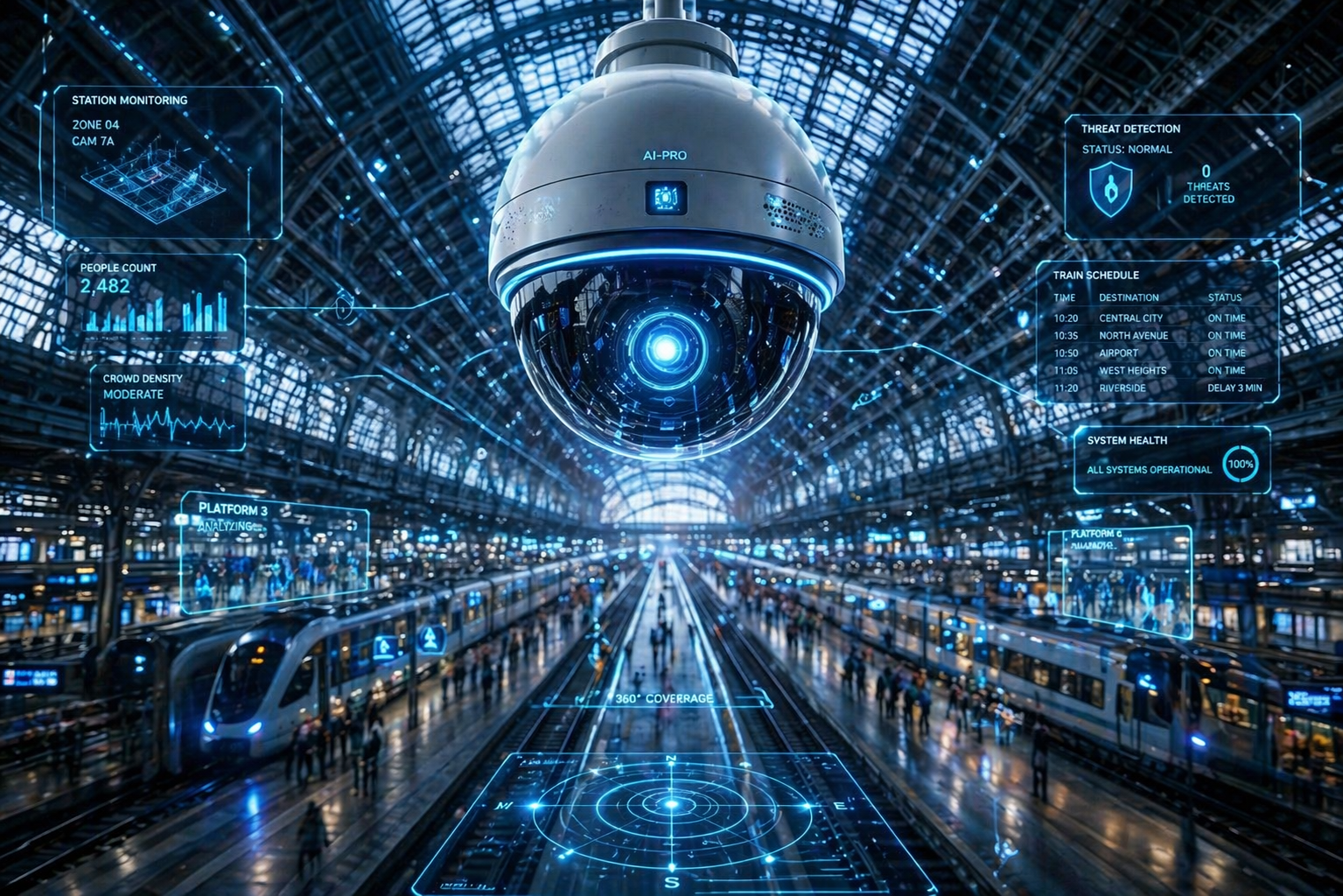
AI-enabled video surveillance systems have been deployed across 1,874 stations. Equipped with advanced analytics, these systems can automatically detect suspicious activities such as intrusion and loitering, while facial recognition technology enables real-time monitoring and identification. The scale of deployment nearly 1,900 stations, makes this one of the largest AI surveillance rollouts on any railway network globally.
Real-Time Passenger Information
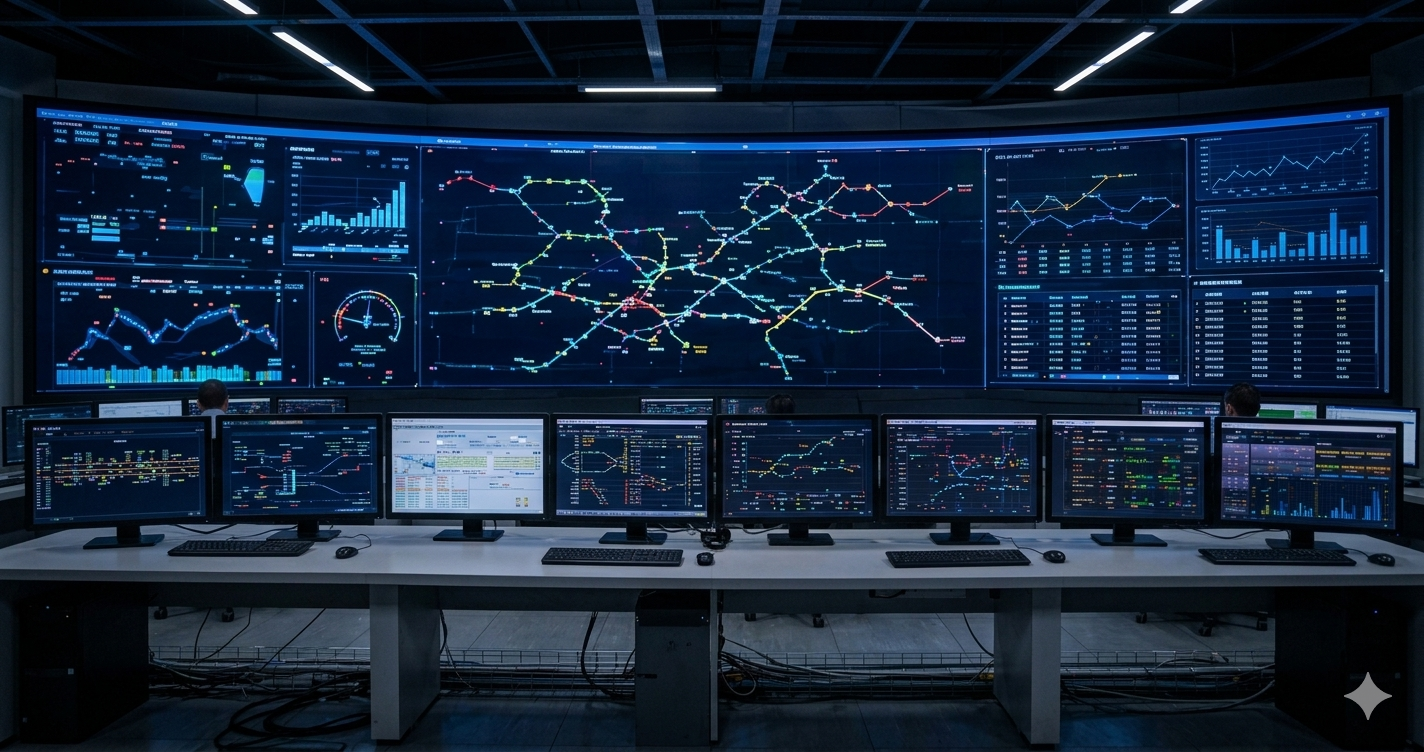
Automatic train announcements are now operational at 1,405 railway stations, integrated with the National Train Enquiry System, ensuring timely and accurate updates for passengers through electronic display boards, coach guidance systems, and public address networks. For a network that has historically been criticised for poor passenger communication, particularly during delays, this represents a structural improvement in the passenger information ecosystem.
Kavach 4.0: Digital Safety at the Train Level
Perhaps the most strategically significant digital infrastructure investment is Kavach, India’s indigenously developed Automatic Train Protection system. As of early 2026, Kavach 4.0 the latest version, has been formally commissioned on 1,452 route kilometres, covering the high-density Delhi-Mumbai and Delhi-Howrah corridors. In March 2026, it was further commissioned on the Prayagraj-Kanpur section of the Delhi-Howrah corridor, covering an additional 190 route kilometres.
The broader rollout picture is more extensive. Trackside Kavach implementation work has been taken up on 24,427 route kilometres covering the Golden Quadrilateral, Golden Diagonal, and other high-density segments. Supporting infrastructure already in place includes 8,570 kilometres of optical fibre cable, 1,100 telecom towers, 767 station data centres, and onboard Kavach devices fitted on 4,154 locomotives. Bids have been issued to equip a further 9,069 locomotives. The safety impact is already visible: consequential train accidents declined from 135 in 2014-15 to just 14 in 2025-26 a reduction of nearly 90 per cent.
Kavach uses a combination of Radio Frequency Identification, GPS, and ultra-high frequency radio communication to automatically apply brakes if a driver fails to respond to a signal. It is the digital layer at the train-track interface, translating sensor data into real-time safety actions without human intervention. The challenge now is scale: with the broad-gauge network exceeding 70,000 km, the gap between what is commissioned and what remains to be covered is still substantial.
The RailOne App and Digital Ticketing
In July 2025, Indian Railways launched the RailOne App, which consolidated ticketing, enquiries, and grievance redressal into a single platform, while over 30.4 million suspicious user accounts were removed to promote fair access. The consolidation of previously fragmented digital touchpoints, the IRCTC app, UTS app, and various enquiry platforms into a unified interface is a significant step toward a seamless passenger digital experience.
Rail Tech Policy 2026
At the policy level, the Rail Tech Policy 2026 is a comprehensive framework designed to bring cutting-edge technology into Indian Railways’ operations at scale. Under this policy, the railways will actively engage with startups, innovators, industry experts, and academic institutions to adopt advanced technologies, including Artificial Intelligence and drone-based monitoring systems. A major highlight is the dedicated Rail Tech Portal, a 24×7 digital platform that allows innovators and startups to submit proposals online, interact with railway departments, and pilot innovative solutions directly with the railways. This institutionalisation of technology adoption, moving from ad hoc procurement to a structured innovation pipeline, is arguably the most important structural development in India’s railway digital transformation agenda.
Operational Impact: Punctuality as a Metric
The operational impact of digital investment is beginning to show in punctuality data. In financial year 2025-26, the railway network recorded an overall punctuality of more than 77 per cent, with several divisions crossing 90 per cent. Systems such as the Integrated Coaching Management System, the Control Office Application, and the National Train Enquiry System enable a continuous flow of information on train movements, allowing controllers to monitor delays and quickly adjust timetables. Real-Time Train Information System devices, based on GPS technology, enable a train’s location to be transmitted to the central control system automatically, a fundamental shift from the manual train charting that long defined Indian railway operations.
Global Example
Deutsche Bahn and Europe’s Shift2Rail Programme
DB Netz, a major subsidiary of Deutsche Bahn, has been digitalising its train control systems through a research programme on digital control command and signalling technology. The broader European Shift2Rail public-private partnership has examined the potential of digital applications across multiple railway subsystems: X2Rail for control, command and signalling, Pivot for rolling stock, In2Track for infrastructure, and In2Stempo for energy, with Research and Innovation activities contributing to more efficient ways to predict and control the performance of rail assets.
The Shift2Rail model is significant not just for its technological output, but for its governance structure: a formal public-private partnership that pools funding from both European Union Horizon 2020 grants and industry members, creating a shared incentive structure for innovation. India’s Rail Tech Policy 2026 draws conceptual parallels with this model, but lacks the structured co-funding mechanism that gives Shift2Rail its durability.
The Gaps: What Still Needs to Be Addressed
For all the progress made, India’s digital railway transformation has significant structural gaps that must be acknowledged.
Fragmented Implementation Across Zones
Indian Railways operates across 18 zonal railways and numerous metro corporations, each at different stages of digital maturity. The IP MPLS backbone reaching 1,396 stations is meaningful, but India has over 7,000 stations. AI surveillance deployed at 1,874 stations leaves thousands of smaller stations unmonitored. The risk is that digital investment concentrates on high-visibility urban and trunk routes while leaving the vast secondary network which serves the majority of the population underserved.
Kavach Rollout Speed vs. Network Scale
Kavach 4.0 has been commissioned on 1,452 route kilometres, with trackside work taken up on 24,427 kilometres but India’s broad-gauge network spans over 70,000 kilometres. The December 2025 deadline for completing the Delhi-Mumbai and Delhi-Howrah corridors was missed. While the rollout is accelerating with bids issued for 9,069 additional locomotives and the number of approved installation vendors growing beyond five the constraint remains supply chain capacity and the speed at which the OFC backbone can be laid to support Kavach’s communication requirements. Every kilometre without Kavach is a kilometre operating on the assumption of human infallibility.
Data Integration and Interoperability
India’s railway digital systems have grown organically the Passenger Reservation System, the Freight Operations Information System, the National Train Enquiry System, and metro AFC systems across 26 cities each operate on different technology stacks with limited interoperability. A passenger travelling from a suburban metro station to an intercity train cannot yet access a unified journey planner, book an end-to-end ticket, or receive integrated real-time updates across modes. This is not a technology problem it is an integration and governance problem that requires deliberate cross-institutional architecture.
Cybersecurity

As railway systems become more digitally integrated, their attack surface expands. The use of passenger data to improve service and comfort must be balanced with strict protocols and laws. Anonymisation techniques and increased data usage controls are needed to protect passenger privacy, and robust safeguards are essential to address data handling concerns. Indian Railways has not yet articulated a comprehensive public cybersecurity framework for its growing digital infrastructure, a gap that becomes more consequential with every new system commissioned.
Human Capital and Digital Literacy
Technology cannot transform railways on its own. Engineers, drivers, and operators must be trained to use automation tools effectively. Indian Railways has trained over 40,000 personnel, including 30,000 loco pilots and assistant loco pilots, on Kavach systems in collaboration with IRISET. However, this is a narrow slice of a workforce that numbers in the millions. The International Transport Forum emphasises that digital literacy is essential for resilient rail systems in fast-growing economies, and India must invest as much in people as in platforms.
Conclusion
India’s railway and metro digital transformation is real, accelerating, and consequential. The investments made in 2025-26 in communication backbone, AI surveillance, real-time passenger information, Kavach 4.0 deployment across 1,452 route kilometres, and the unified RailOne platform represent the most substantive digital infrastructure push in the network’s history. With 99.4 per cent electrification achieved, a 69,439-kilometre network, and metro systems operational across 26 cities, India has built a foundation that digital systems can now leverage.
But the gap between what has been built and what a fully digitised, interoperable, data-driven railway network looks like remains large. India’s urban population is set to grow by 270 million by 2040. Building new tracks and trains alone cannot meet this demand in a sustainable way. What the railways need is a digital nervous system, one that helps existing infrastructure deliver more, faster, and better.
The global railway digital market is growing at 9 per cent annually. The technology exists, the policy intent is declared, and the business case is unambiguous. The constraint now is execution the speed at which India can close the gap between its most digitally advanced corridors and its vast secondary network, and the discipline with which it integrates fragmented systems into a coherent, interoperable whole. That is the work of the next decade, and it will determine whether Indian Railways becomes a global model for digital transformation in large, complex public infrastructure.
Also Read: Jaipur Metro: Struggling to Match Its Intended Potential