


Page 25 - Demo
P. 25
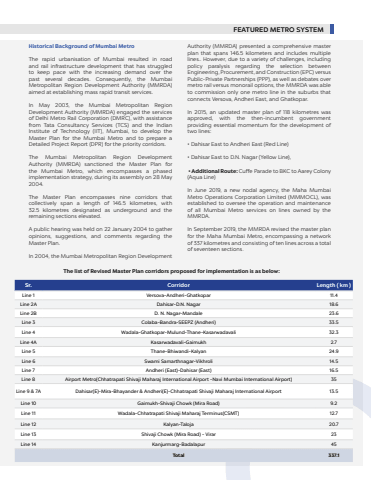
Historical Background of Mumbai Metro The rapid urbanisation of Mumbai resulted in road and rail infrastructure development that has struggled to keep pace with the increasing demand over the past several decades. Consequently, the Mumbai Metropolitan Region Development Authority (MMRDA) aimed at establishing mass rapid transit services. In May 2003, the Mumbai Metropolitan Region Development Authority (MMRDA) engaged the services of Delhi Metro Rail Corporation (DMRC), with assistance from Tata Consultancy Services (TCS) and the Indian Institute of Technology (IIT), Mumbai, to develop the Master Plan for the Mumbai Metro and to prepare a Detailed Project Report (DPR) for the priority corridors. The Mumbai Metropolitan Region Development Authority (MMRDA) sanctioned the Master Plan for the Mumbai Metro, which encompasses a phased implementation strategy, during its assembly on 28 May 2004.The Master Plan encompasses nine corridors that collectively span a length of 146.5 kilometres, with 32.5 kilometres designated as underground and the remaining sections elevated. A public hearing was held on 22 January 2004 to gather opinions, suggestions, and comments regarding the Master Plan.In 2004, the Mumbai Metropolitan Region Development Authority (MMRDA) presented a comprehensive master plan that spans 146.5 kilometers and includes multiple lines.. However, due to a variety of challenges, including policy paralysis regarding the selection between Engineering, Procurement, and Construction (EPC) versus Public-Private Partnerships (PPP), as well as debates over metro rail versus monorail options, the MMRDA was able to commission only one metro line in the suburbs that connects Versova, Andheri East, and Ghatkopar.In 2015, an updated master plan of 118 kilometres was approved, with the then-incumbent government providing essential momentum for the development of two lines: %u2022 Dahisar East to Andheri East (Red Line)%u2022 Dahisar East to D.N. Nagar (Yellow Line),%u2022 Additional Route: Cuffe Parade to BKC to Aarey Colony (Aqua Line) In June 2019, a new nodal agency, the Maha Mumbai Metro Operations Corporation Limited (MMMOCL), was established to oversee the operation and maintenance of all Mumbai Metro services on lines owned by the MMRDA.In September 2019, the MMRDA revised the master plan for the Maha Mumbai Metro, encompassing a network of 337 kilometres and consisting of ten lines across a total of seventeen sections. Sr.CorridorLength ( km )Line 1Versova-Andheri-Ghatkopar11.4Line 2ADahisar-D.N. Nagar18.6Line 2BD. N. Nagar-Mandale23.6Line 3Colaba-Bandra-SEEPZ (Andheri)33.5Line 4Wadala-Ghatkopar-Mulund-Thane-Kasarwadavali32.3Line 4AKasarwadavali-Gaimukh2.7Line 5Thane-Bhiwandi-Kalyan24.9Line 6Swami Samarthnagar-Vikhroli14.5Line 7Andheri (East)-Dahisar (East)16.5Line 8Airport Metro(Chhatrapati Shivaji Maharaj International Airport -Navi Mumbai International Airport)35Line 9 & 7ADahisar(E)-Mira-Bhayander & Andheri(E)-Chhatrapati Shivaji Maharaj International Airport13.5Line 10Gaimukh-Shivaji Chowk (Mira Road)9.2Line 11Wadala-Chhatrapati Shivaji Maharaj Terminus(CSMT)12.7Line 12Kalyan-Taloja20.7Line 13Shivaji Chowk (Mira Road) - Virar23Line 14Kanjurmarg-Badalapur45Total337.1The list of Revised Master Plan corridors proposed for implementation is as belo FEATURED METRO SYSTEM


