


Page 37 - Demo
P. 37
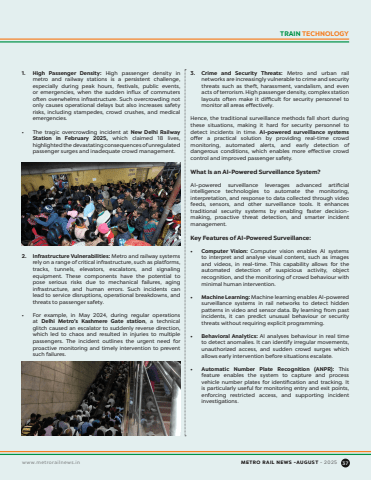
www.metrorailnews.in METRO RAIL NEWS -AUGUST - 2025 371.High Passenger Density: High passenger density in metro and railway stations is a persistent challenge, especially during peak hours, festivals, public events, or emergencies, when the sudden influx of commuters often overwhelms infrastructure. Such overcrowding not only causes operational delays but also increases safety risks, including stampedes, crowd crushes, and medical emergencies.%u2022The tragic overcrowding incident at New Delhi Railway Station in February 2025, which claimed 18 lives, highlighted the devastating consequences of unregulated passenger surges and inadequate crowd management. 2.Infrastructure Vulnerabilities: Metro and railway systems rely on a range of critical infrastructure, such as platforms, tracks, tunnels, elevators, escalators, and signaling equipment. These components have the potential to pose serious risks due to mechanical failures, aging infrastructure, and human errors. Such incidents can lead to service disruptions, operational breakdowns, and threats to passenger safety. %u2022For example, in May 2024, during regular operations at Delhi Metro%u2019s Kashmere Gate station, a technical glitch caused an escalator to suddenly reverse direction, which led to chaos and resulted in injuries to multiple passengers. The incident outlines the urgent need for proactive monitoring and timely intervention to prevent such failures.3.Crime and Security Threats: Metro and urban rail networks are increasingly vulnerable to crime and security threats such as theft, harassment, vandalism, and even acts of terrorism. High passenger density, complex station layouts often make it difficult for security personnel to monitor all areas effectively.Hence, the traditional surveillance methods fall short during these situations, making it hard for security personnel to detect incidents in time. AI-powered surveillance systems offer a practical solution by providing real-time crowd monitoring, automated alerts, and early detection of dangerous conditions, which enables more effective crowd control and improved passenger safety.What Is an AI-Powered Surveillance System?AI-powered surveillance leverages advanced artificial intelligence technologies to automate the monitoring, interpretation, and response to data collected through video feeds, sensors, and other surveillance tools. It enhances traditional security systems by enabling faster decisionmaking, proactive threat detection, and smarter incident management.Key Features of AI-Powered Surveillance:%u2022Computer Vision: Computer vision enables AI systems to interpret and analyse visual content, such as images and videos, in real-time. This capability allows for the automated detection of suspicious activity, object recognition, and the monitoring of crowd behaviour with minimal human intervention.%u2022Machine Learning: Machine learning enables AI-powered surveillance systems in rail networks to detect hidden patterns in video and sensor data. By learning from past incidents, it can predict unusual behaviour or security threats without requiring explicit programming.%u2022Behavioral Analytics: AI analyses behaviour in real time to detect anomalies. It can identify irregular movements, unauthorized access, and sudden crowd surges which allows early intervention before situations escalate.%u2022Automatic Number Plate Recognition (ANPR): This feature enables the system to capture and process vehicle number plates for identification and tracking. It is particularly useful for monitoring entry and exit points, enforcing restricted access, and supporting incident investigations.TRAIN TECHNOLOGY


