


Page 41 - Demo
P. 41
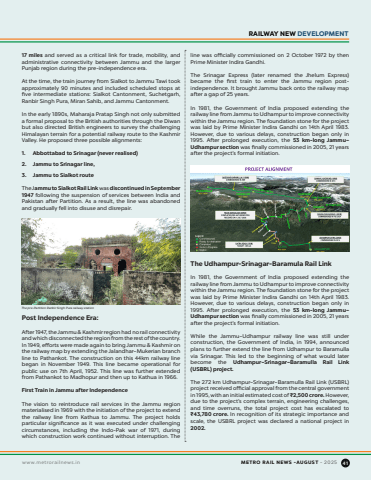
www.metrorailnews.in METRO RAIL NEWS -AUGUST - 2025 4117 miles and served as a critical link for trade, mobility, and administrative connectivity between Jammu and the larger Punjab region during the pre-independence era.At the time, the train journey from Sialkot to Jammu Tawi took approximately 90 minutes and included scheduled stops at five intermediate stations: Sialkot Cantonment, Suchetgarh, Ranbir Singh Pura, Miran Sahib, and Jammu Cantonment.In the early 1890s, Maharaja Pratap Singh not only submitted a formal proposal to the British authorities through the Diwan but also directed British engineers to survey the challenging Himalayan terrain for a potential railway route to the Kashmir Valley. He proposed three possible alignments:1.Abbottabad to Srinagar (never realised)2.Jammu to Srinagar line, 3.Jammu to Sialkot routeThe Jammu to Sialkot Rail Link was discontinued in September 1947 following the suspension of services between India and Pakistan after Partition. As a result, the line was abandoned and gradually fell into disuse and disrepair.The pre-Partition Ranbir Singh Pura railway stationPost Independence Era: After 1947, the Jammu & Kashmir region had no rail connectivity and which disconnected the region from the rest of the country. In 1949, efforts were made again to bring Jammu & Kashmir on the railway map by extending the Jalandhar%u2013Mukerian branch line to Pathankot. The construction on this 44km railway line began in November 1949. This line became operational for public use on 7th April, 1952. This line was further extended from Pathankot to Madhopur and then up to Kathua in 1966.First Train in Jammu after IndependenceThe vision to reintroduce rail services in the Jammu region materialised in 1969 with the initiation of the project to extend the railway line from Kathua to Jammu. The project holds particular significance as it was executed under challenging circumstances, including the Indo-Pak war of 1971, during which construction work continued without interruption. The line was officially commissioned on 2 October 1972 by then Prime Minister Indira Gandhi.The Srinagar Express (later renamed the Jhelum Express) became the first train to enter the Jammu region postindependence. It brought Jammu back onto the railway map after a gap of 25 years.In 1981, the Government of India proposed extending the railway line from Jammu to Udhampur to improve connectivity within the Jammu region. The foundation stone for the project was laid by Prime Minister Indira Gandhi on 14th April 1983. However, due to various delays, construction began only in 1995. After prolonged execution, the 53 km-long Jammu%u2013Udhampur section was finally commissioned in 2005, 21 years after the project%u2019s formal initiation.The Udhampur-Srinagar-Baramula Rail LinkIn 1981, the Government of India proposed extending the railway line from Jammu to Udhampur to improve connectivity within the Jammu region. The foundation stone for the project was laid by Prime Minister Indira Gandhi on 14th April 1983. However, due to various delays, construction began only in 1995. After prolonged execution, the 53 km-long Jammu%u2013Udhampur section was finally commissioned in 2005, 21 years after the project%u2019s formal initiation. While the Jammu%u2013Udhampur railway line was still under construction, the Government of India, in 1994, announced plans to further extend the line from Udhampur to Baramulla via Srinagar. This led to the beginning of what would later become the Udhampur%u2013Srinagar%u2013Baramulla Rail Link (USBRL) project. The 272 km Udhampur%u2013Srinagar%u2013Baramulla Rail Link (USBRL) project received official approval from the central government in 1995, with an initial estimated cost of %u20b92,500 crore. However, due to the project%u2019s complex terrain, engineering challenges, and time overruns, the total project cost has escalated to %u20b943,780 crore. In recognition of its strategic importance and scale, the USBRL project was declared a national project in 2002.RAILWAY NEW DEVELOPMENT


