


Page 32 - Demo
P. 32
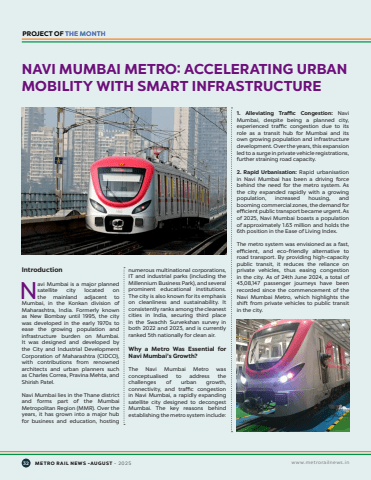
32METRO RAIL NEWS -AUGUST 2025 www.metrorailnews.in NAVI MUMBAI METRO: ACCELERATING URBAN MOBILITY WITH SMART INFRASTRUCTUREIntroductionNavi Mumbai is a major planned satellite city located on the mainland adjacent to Mumbai, in the Konkan division of Maharashtra, India. Formerly known as New Bombay until 1995, the city was developed in the early 1970s to ease the growing population and infrastructure burden on Mumbai. It was designed and developed by the City and Industrial Development Corporation of Maharashtra (CIDCO), with contributions from renowned architects and urban planners such as Charles Correa, Pravina Mehta, and Shirish Patel. Navi Mumbai lies in the Thane district and forms part of the Mumbai Metropolitan Region (MMR). Over the years, it has grown into a major hub for business and education, hosting numerous multinational corporations, IT and industrial parks (including the Millennium Business Park), and several prominent educational institutions. The city is also known for its emphasis on cleanliness and sustainability. It consistently ranks among the cleanest cities in India, securing third place in the Swachh Survekshan survey in both 2022 and 2023, and is currently ranked 5th nationally for clean air.Why a Metro Was Essential for Navi Mumbai%u2019s Growth? The Navi Mumbai Metro was conceptualised to address the challenges of urban growth, connectivity, and traffic congestion in Navi Mumbai, a rapidly expanding satellite city designed to decongest Mumbai. The key reasons behind establishing the metro system include:1. Alleviating Traffic Congestion: Navi Mumbai, despite being a planned city, experienced traffic congestion due to its role as a transit hub for Mumbai and its own growing population and infrastructure development. Over the years, this expansion led to a surge in private vehicle registrations, further straining road capacity.2. Rapid Urbanisation: Rapid urbanisation in Navi Mumbai has been a driving force behind the need for the metro system. As the city expanded rapidly with a growing population, increased housing, and booming commercial zones, the demand for efficient public transport became urgent. As of 2025, Navi Mumbai boasts a population of approximately 1.63 million and holds the 6th position in the Ease of Living Index. The metro system was envisioned as a fast, efficient, and eco-friendly alternative to road transport. By providing high-capacity public transit, it reduces the reliance on private vehicles, thus easing congestion in the city. As of 24th June 2024, a total of 43,08,147 passenger journeys have been recorded since the commencement of the Navi Mumbai Metro, which highlights the shift from private vehicles to public transit in the city.PROJECT OF THE MONTH


