


Page 33 - Demo
P. 33
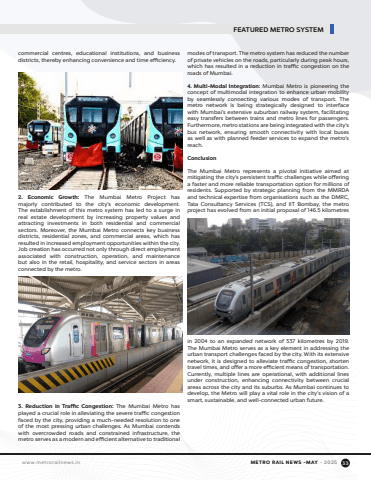
www.metrorailnews.in METRO RAIL NEWS -MAY - 2025 33commercial centres, educational institutions, and business districts, thereby enhancing convenience and time efficiency. 2. Economic Growth: The Mumbai Metro Project has majorly contributed to the city's economic development. The establishment of this metro system has led to a surge in real estate development by increasing property values and attracting investments in both residential and commercial sectors. Moreover, the Mumbai Metro connects key business districts, residential zones, and commercial areas, which has resulted in increased employment opportunities within the city. Job creation has occurred not only through direct employment associated with construction, operation, and maintenance but also in the retail, hospitality, and service sectors in areas connected by the metro. 3. Reduction in Traffic Congestion: The Mumbai Metro has played a crucial role in alleviating the severe traffic congestion faced by the city, providing a much-needed resolution to one of the most pressing urban challenges. As Mumbai contends with overcrowded roads and constrained infrastructure, the metro serves as a modern and efficient alternative to traditional modes of transport. The metro system has reduced the number of private vehicles on the roads, particularly during peak hours, which has resulted in a reduction in traffic congestion on the roads of Mumbai. 4. Multi-Modal Integration: Mumbai Metro is pioneering the concept of multimodal integration to enhance urban mobility by seamlessly connecting various modes of transport. The metro network is being strategically designed to interface with Mumbai%u2019s extensive suburban railway system, facilitating easy transfers between trains and metro lines for passengers. Furthermore, metro stations are being integrated with the city's bus network, ensuring smooth connectivity with local buses as well as with planned feeder services to expand the metro's reach.ConclusionThe Mumbai Metro represents a pivotal initiative aimed at mitigating the city%u2019s persistent traffic challenges while offering a faster and more reliable transportation option for millions of residents. Supported by strategic planning from the MMRDA and technical expertise from organisations such as the DMRC, Tata Consultancy Services (TCS), and IIT Bombay, the metro project has evolved from an initial proposal of 146.5 kilometres in 2004 to an expanded network of 337 kilometres by 2019. The Mumbai Metro serves as a key element in addressing the urban transport challenges faced by the city. With its extensive network, it is designed to alleviate traffic congestion, shorten travel times, and offer a more efficient means of transportation. Currently, multiple lines are operational, with additional lines under construction, enhancing connectivity between crucial areas across the city and its suburbs. As Mumbai continues to develop, the Metro will play a vital role in the city%u2019s vision of a smart, sustainable, and well-connected urban future.FEATURED METRO SYSTEM


